Low Volume CNC Machining: Small Batch Production Strategies and Manufacturing Guide
19 min
- What Is Low Volume CNC Machining?
- Low Volume CNC Machining vs Other Low Volume Manufacturing Processes
- When Is Low Volume CNC Machining the Right Choice?
- Manufacturing Challenges in Small Batch CNC Production
- Materials Used for Low Volume CNC Machined Parts
- CNC Machining Processes for Low Volume Production
- Designing Parts for Cost-Effective Low Volume Manufacturing
- Cost Factors in Low Volume CNC Machining
- Quality Control and Tolerance Management in Low Volume Production
- How to Choose a Low Volume CNC Machining Supplier
- Conclusion About Low Volume CNC Machining
- FAQ About Low Volume CNC Machining
Key Takeaways About Low Volume CNC Machining
- Low volume CNC machining is typically used for production runs ranging from a single part to roughly 1,000 units, without the tooling investment required by molding or casting processes.
- Small batch CNC machining is often the most practical choice when designs are still evolving, demand is uncertain, or production quantities are too low to justify dedicated tooling.
- CNC machining can produce production-grade parts from aluminum, stainless steel, titanium, and engineering plastics using the same manufacturing methods applied in larger-scale production.
- Unit cost is generally higher than mass production because programming and setup expenses are distributed across fewer parts, although total project cost may still be lower when tooling is considered.
- Typical applications include bridge production, replacement components, custom OEM parts, functional testing, and products with ongoing low-volume demand.
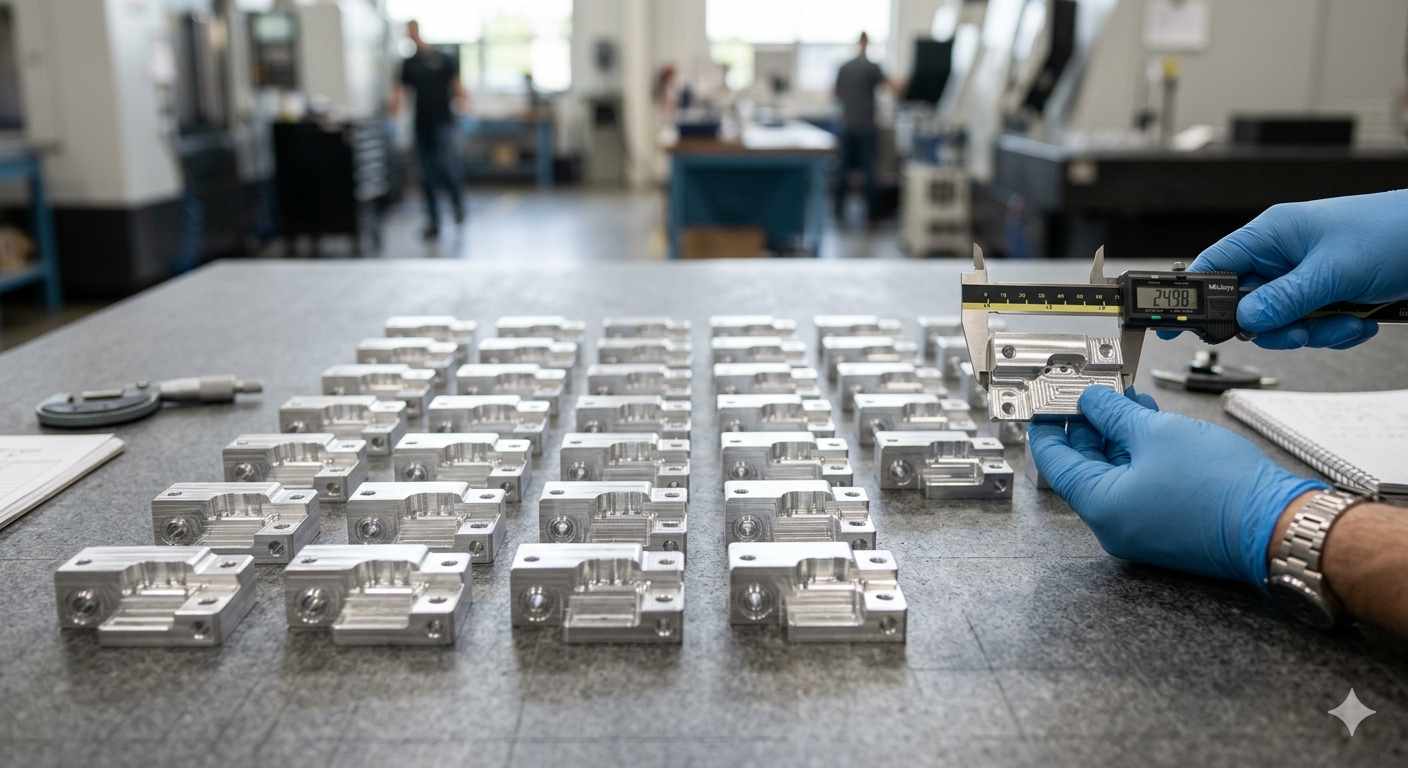
(AI generated) Small batch of precision CNC machined aluminum parts
There's a production gap that trips up a lot of engineers. The prototype works. The design is validated.
But when you need 50 parts, you need 50 parts. Not 5 and not 5,000. Injection molding tooling costs $30,000 before you've made a single production part. Manual machining is too slow and inconsistent. That gap, between prototype and full production, is exactly where low volume CNC machining lives.
It's not a compromise. For the right applications, it's the correct manufacturing strategy, full stop. This guide covers when that's true, what it costs, and how to get it right.
What Is Low Volume CNC Machining?
Low volume CNC machining is the production of precision parts in small quantities, typically one to one thousand units, using CNC milling, turning, or multi-axis machining without dedicated production tooling, serving applications between prototype manufacturing and full-scale production.
Low Volume CNC Machining vs Other Low Volume Manufacturing Processes
| Process | Tooling Cost | Lead Time | Typical Volume | Best For |
|---|---|---|---|---|
| CNC machining | None | 3 to 10 days | 1 to 1,000 units | Precision metal and plastic parts |
| 3D printing (FDM/SLS) | None | 1 to 5 days | 1 to 500 units | Complex geometry, polymer parts |
| Sheet metal fabrication | Low (bending tools) | 5 to 14 days | 10 to 5,000 units | Enclosures, brackets, formed parts |
| Vacuum casting | Low (silicone mold) | 7 to 14 days | 10 to 100 units | Polymer prototypes, soft materials |
| Injection molding | Very high | 4 to 12 weeks | 1,000+ units | High volume identical plastic parts |
| Die casting | Very high | 6 to 14 weeks | 5,000+ units | High volume metal parts |
CNC machining wins in the low volume range specifically because there's no tooling cost, and the material and tolerance capabilities match production requirements. Processes that look cheaper per part, like injection molding, require upfront investment that only makes sense at high volume.
When Is Low Volume CNC Machining the Right Choice?
Functional Prototypes and Design Validation
Not every prototype needs to be production-representative. A cosmetic enclosure may be validated with additive manufacturing, but parts that carry load, transfer motion, or interface with precision hardware usually require the actual production material.
Consider a gearbox housing that will ultimately be machined from 6061-T6 aluminum. Testing a nylon prototype may verify basic fit, but it reveals little about thread strength, bearing seat stability, or thermal expansion under operating conditions.
Low volume CNC machining is often selected when engineers need functional data from parts that closely match the final production design, especially in functional prototyping programs where material behavior and assembly performance need to be verified before release.
Bridge Production Before Tooling Is Ready
Production tooling rarely arrives as quickly as product schedules demand. Injection molds often require four to twelve weeks. Die-casting and stamping tools may take even longer when design revisions occur during development.
During this period, manufacturers frequently use low volume CNC machining to supply early production units. The geometry remains unchanged, assembly procedures can be validated, and field feedback becomes available before permanent tooling is locked.
Finding a design issue after 50 machined units usually means updating a CAD model. Finding the same issue after mold qualification can require expensive tooling modifications.
Products With Uncertain or Variable Demand
Some products never reach the production volume needed to justify dedicated tooling.
Research equipment, industrial automation devices, specialty instrumentation, and custom OEM assemblies often ship in quantities of tens or hundreds rather than tens of thousands. Demand may also fluctuate significantly from year to year.
In these situations, low volume CNC machining reduces inventory exposure because production can follow actual order volume instead of forecast volume. Material is purchased when required. Parts are manufactured when needed.
Replacement and End-of-Life Components
Many industrial systems remain in service long after original production has ended. The machine may still be operating, but replacement parts are no longer available through the OEM supply chain.
Low volume CNC machining allows components to be reproduced from existing drawings, scanned geometry, or reverse-engineered models without recreating production tooling.
Manufacturing Challenges in Small Batch CNC Production
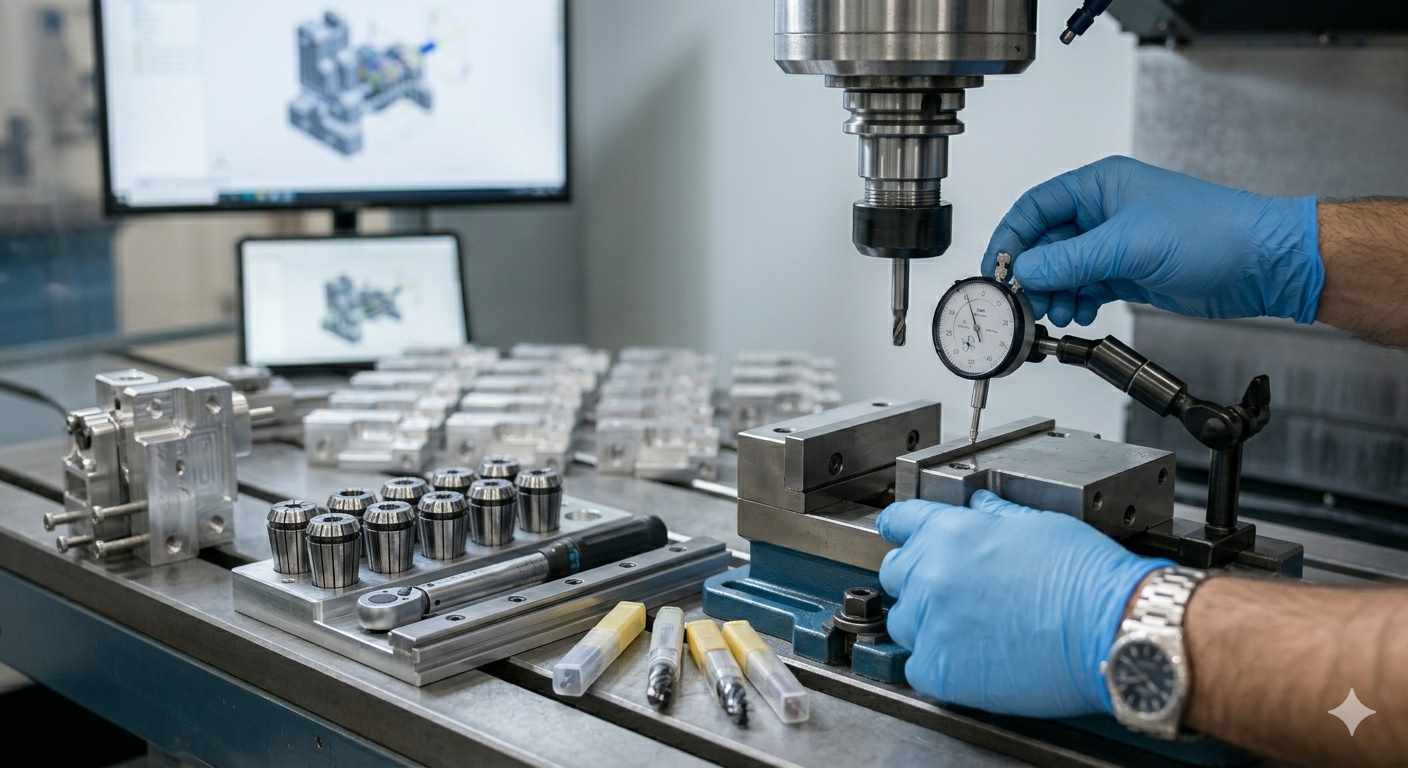
(AI generated) CNC machine setup process
Maintaining Consistency Across Separate Production Runs
Low volume CNC machined parts are often reordered months after the original batch was completed. The drawing may stay the same, but production conditions rarely do. Material can come from a different heat lot. A cutter used in the first run may no longer be available. Even fixture setups are usually recreated rather than preserved.
This becomes noticeable on tight-fit components. A bearing housing produced today may measure within tolerance, yet slight differences in tool wear, offset adjustment, or stock condition can shift dimensions toward the opposite end of the tolerance range during a later production run.
For repeat orders, shops typically rely on documented cutting parameters, setup records, tooling data, and inspection reports to reproduce the original process as closely as possible.
Managing Complex Geometry Efficiently
Part complexity affects small-batch production differently than large-scale manufacturing.
A deep pocket, an undercut, or a feature located on multiple faces may require additional setups before machining can even begin. On a production run of several thousand parts, the programming effort is spread across a large quantity. In a batch of twenty parts, the same programming and setup time becomes a much larger portion of the total manufacturing cost.
Features that provide little functional benefit are often reviewed during DFM analysis. Removing a non-critical undercut or increasing an internal corner radius may eliminate an entire setup and shorten production time without changing part performance.
Materials Used for Low Volume CNC Machined Parts
Materials Overview
| Material | Machinability | Relative Cost | Typical Applications | Key Advantage |
|---|---|---|---|---|
| 6061-T6 Aluminum | Excellent | Low | Structural parts, enclosures, brackets | Fast machining, low cost, good strength |
| 7075-T6 Aluminum | Good | Medium | High-strength aerospace, structural | Best strength-to-weight of aluminum alloys |
| 304 Stainless Steel | Moderate | Medium | General corrosion-resistant parts | Widely available, good all-round properties |
| 316L Stainless Steel | Moderate | Medium-High | Medical, marine, chemical | Superior corrosion resistance |
| 4140 Alloy Steel | Good | Low-Medium | Shafts, gears, structural components | High strength after heat treatment |
| Titanium Grade 5 | Difficult | High | Aerospace, medical implants | Strength, lightweight, biocompatible |
| POM (Delrin) | Excellent | Low | Sliding parts, bushings, precision components | Low friction, dimensionally stable |
| PEEK | Moderate | High | High-temp, chemical resistance | Performance at elevated temperature |
| Nylon (PA6/PA12) | Good | Low | Light structural, wear parts | Tough, lightweight, low cost |
| Polycarbonate | Good | Low | Transparent housings, light-duty structural | Optical clarity, impact resistance |
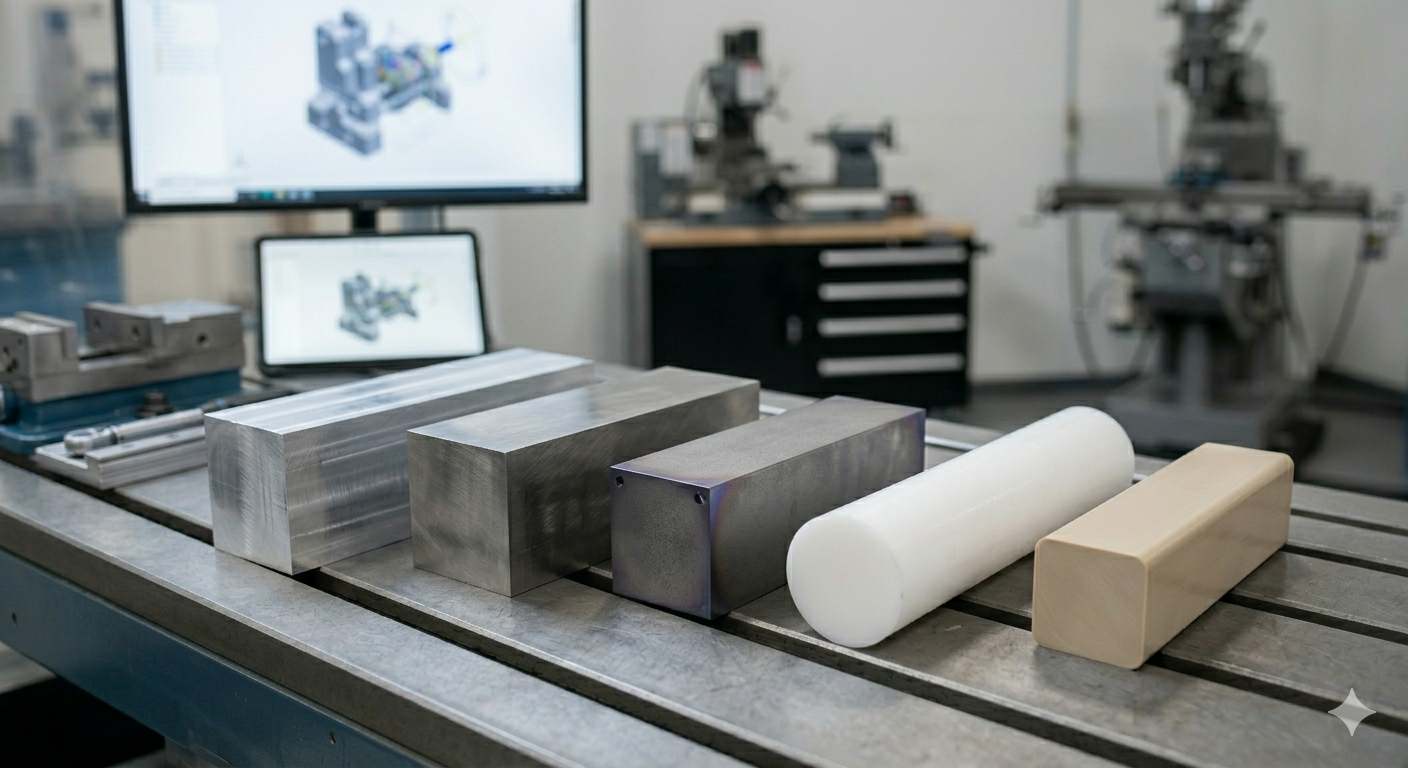
(AI generated) Common CNC machining materials
Low volume CNC machining is usually chosen because it has to cover a mixed set of constraints—mechanical load, corrosion, sometimes temperature, sometimes just cost pressure. The material choice follows that rather than a fixed “list of options”.
6061-T6 aluminum tends to show up first in most jobs. It runs fast on the machine, chips cleanly, and doesn’t punish tooling too much, so cycle time stays reasonable for brackets, housings, fixture-type parts. Once you move into stainless, everything slows down. Feed has to be pulled back, tools don’t last as long, and you end up watching heat more carefully than you would with aluminum, especially on parts that see moisture or chemical exposure in service.
With plastics like POM or PEEK, the machining behavior is different again. Parts stay stable dimensionally if the stock is decent, and for sliding features or insulating fixtures they behave more predictably than printed alternatives. Nothing special in setup, but you notice quickly if the material batch quality varies.
Titanium Grade 5 sits in a different category. It’s not about convenience. Cutting is slower, tool wear is real, and coolant strategy matters more than people expect on first pass. Still, for small batches—ten parts, maybe a few hundred—it stays workable because the setup effort doesn’t change much, only the cutting time does.
CNC Machining Processes for Low Volume Production
CNC Milling for Multi-Feature Components
3-axis CNC milling handles the majority of low volume machined parts, flat features, pockets, slots, holes, and profiled edges on prismatic geometry. For most enclosures, brackets, housings, and structural components, 3-axis milling in one or two setups produces the complete part geometry.
The cost efficiency of 3-axis milling in low volume production comes from setup simplicity. Standard vise workholding, minimal tooling beyond a basic end mill selection, and straightforward CAM programming keep non-cutting time low relative to actual machining time.
CNC Turning for Rotational Parts
Shafts, pins, bushings, spacers, and threaded components are more efficiently produced by turning than by milling. A CNC lathe produces concentric cylindrical geometry in a single continuous operation that would require multiple milling setups to approximate. For low volume CNC machined parts with rotational symmetry, turning is almost always the correct process selection.
Mill-turn machines combine milling and turning in one setup, a rotating shaft that needs a milled flat or a cross-drilled hole can be completed without a second setup on a machine with live tooling. For small batch production this eliminates the setup and handling time between turning and milling operations.
Multi-Axis Machining for Complex Designs
5-axis machining accesses complex geometry in fewer setups than 3-axis work on the same part. A part that would need four 3-axis setups with repositioning and re-indicating between each might run in one 5-axis setup. For low volume production where setup cost per part is significant, the setup reduction from 5-axis machining partially offsets the higher machine rate.
The break-even depends on part complexity. Simple parts don't benefit enough from 5-axis efficiency to justify the rate premium. Parts with compound angles, undercuts, and features on multiple non-parallel faces often produce better economics on 5-axis than on 3-axis despite the higher hourly cost.
Secondary Operations and Surface Finishing Processes
Low volume CNC machined parts regularly need secondary operations beyond machining, anodizing, bead blasting, powder coating, heat treatment, thread inserts, passivation. Each adds cost, lead time, and coordination overhead. Minimizing required secondary operations through smart design reduces both cost and lead time. Where secondary operations are necessary, a supplier who handles them in-house rather than outsourcing to sub-suppliers simplifies coordination and reduces total lead time.
Designing Parts for Cost-Effective Low Volume Manufacturing
Simplifying Features
Every feature adds machining time. In low volume production, unnecessary features disproportionately increase cost. Cosmetic chamfers, non-critical engravings, or tight tolerances on non-mating faces should be questioned. If a feature does not serve assembly, load, or functional purpose, it likely can be removed.
Designing for Tool Access
Features requiring unusual angles, deep pockets, or blocked geometry increase setup complexity. Internal radii smaller than standard end mills or narrow slots beyond tool reach require custom tooling or EDM, multiplying cycle time. Aligning hole sizes, pocket depths, and internal radii with available tooling reduces machining effort without compromising function.
Standardizing Threads and Holes
Non-standard threads or hole diameters add tooling and programming overhead. Matching threads and holes to stock taps, thread mills, and end mill sizes reduces cost and lead time while maintaining functional integrity. Internal radii should correspond to common end mill sizes where possible.
JLCCNC includes DFM review with every low volume CNC machining quote. Upload your files to identify features that impact cost before production begins.

Precision CNC Machining Service
Professional manufacturing, fast turnaround, and quality assurance.
Cost Factors in Low Volume CNC Machining
Material Consumption and Scrap Rates
CNC machining is subtractive, the part starts as a block or bar of material and the machining removes everything that isn't the part. For low volume CNC machined parts with complex geometry, the ratio of finished part weight to starting material weight (buy-to-fly ratio in aerospace terminology) can be 5:1 or worse. That wasted material cost is real and affects the economics of low volume production more than it does high-volume production where material efficiency improvements can be engineered over time.
Choosing near-net-shape starting material, starting closer to the finished geometry, reduces material waste. Bar stock for turned parts, appropriate plate thickness for flat components, and minimal-excess billets for complex machined parts all reduce the material cost per finished piece.
Machine Time and Programming Requirements
Machine time in low volume CNC machining is calculated per part, regardless of batch size. A 25-minute cycle time costs the same whether you're running one part or fifty. The machine rate and the cycle time determine the machining cost per part directly.
Programming cost is amortized over the batch. A two-hour CAM programming session for a ten-part run adds 12 minutes of programming labor per part. For a fifty-part run it adds 2.4 minutes per part. This is why per-part cost drops noticeably as quantity increases from single digits to tens to hundreds within the low volume range. The programming and setup overhead dilutes as the run length grows.
Fixture and Setup Considerations
Simple parts that hold in a standard vise have near-zero fixture cost. Complex parts that need custom workholding have fixture design and fabrication costs that, in a low volume run, add significantly to per-part cost. Designing parts with flat, parallel clamping surfaces that work with standard workholding reduces this cost.
Where custom fixturing is unavoidable, fixture cost should be factored into the total project cost rather than evaluated as a per-part cost, a $500 fixture amortized over a 50-part run is $10 per part, which may be acceptable. The same fixture on a 5-part run is $100 per part, which changes the project economics significantly.
How Production Quantity Influences Unit Cost
The unit cost curve in low volume CNC machining drops steeply between one and twenty parts, then more gradually to one hundred, then more gradually still to one thousand. The steepest part of the curve, the biggest per-part savings, comes from moving from one-offs to small batches rather than from moving within the batch to higher quantities.
A single machined part might cost $200. Five of the same part might cost $120 each. Twenty might cost $85 each. One hundred might cost $65 each. The economics of ordering slightly more than the immediate requirement to save on per-part cost are often compelling in low volume machining, if the design is stable and parts won't become obsolete.
Quality Control and Tolerance Management in Low Volume Production
Typical Tolerances
Most low-volume CNC parts meet ±0.05 mm without special measures. Tighter tolerances increase machining time and demand careful control of tool wear, thermal effects, and measurement frequency. Features such as bearing seats or sealing surfaces may require ±0.01mm, sometimes necessitating additional finishing operations like grinding.
Inspection Methods
First-article inspection is performed immediately after the initial part. Any fixture misalignment or tool offset errors can be corrected before batch production begins. Standard components are measured with calipers or micrometers, while critical surfaces use CMMs. Some high-risk parts, such as medical components, may undergo full-batch inspection, but for most industrial applications, first-article plus sampling is sufficient.
Maintaining Consistency Across Batches
Low-volume production rarely completes all units in one run. Repeat orders may occur weeks or months later, with material from different lots and worn tools. Machine setups are rebuilt rather than preserved. Keeping records of first-article measurements, offsets, and cutting parameters ensures that later batches remain consistent with earlier production.
Surface Finish Verification
Milled surfaces usually achieve Ra 1.6–3.2 μm. General components can rely on these values. Surfaces involved in sliding or sealing often require additional passes to reach Ra 0.8–1.6 μm. Profilometers measure critical areas, while visual comparison suffices for less demanding surfaces. Specifying Ra values on drawings provides unambiguous criteria for acceptance.
How to Choose a Low Volume CNC Machining Supplier
Manufacturing Capabilities and Production Capacity
The supplier needs to have the processes your parts require, not just milling and turning in general, but the specific machine types, axis counts, and work envelopes your geometry needs. A supplier with 3-axis machines only can't efficiently produce parts with compound angles and undercuts. A supplier whose largest machine handles 400mm x 400mm workpieces can't produce a 600mm structural plate.
Asking for specific equipment information rather than general capability claims separates suppliers with genuine capability from those who subcontract work they can't do in-house.
Material and Process Expertise
Low volume machining of titanium, PEEK, or other difficult materials requires process knowledge, correct tooling grades, cutting parameters, coolant strategy, and workholding approaches, that not every CNC shop has. Asking about previous work on your specific material and geometry type, and requesting references or example parts, provides more useful information than asking whether the supplier can machine titanium in principle.
Quality Systems and Inspection Resources
A supplier without CMM capability can't verify tight tolerances to drawing requirements. A supplier without documented processes can't maintain consistency across batches. ISO 9001 certification provides some assurance that quality management systems exist, but it doesn't guarantee specific inspection capabilities.
Asking directly about CMM capability, first article inspection process, material certification traceability, and non-conformance handling gives a more accurate picture of quality capability than certifications alone.
Lead Time Performance and Engineering Support
Quoted lead time and actual lead time are different things at some suppliers. References from existing customers on lead time reliability are more useful than marketing claims. For engineering support, DFM feedback, tolerance review, material recommendations, asking a technical question during the quoting process reveals whether engineering support is real or nominal.
JLCCNC provides engineering review with every low volume CNC machining quote, documented inspection on tight-tolerance features, and consistent process records that carry forward to repeat orders. Fast quoting, short lead times, and material and finishing options that cover most low volume production requirements
Conclusion About Low Volume CNC Machining
Low volume CNC machining fills a production need that neither prototyping nor mass production addresses well. It produces real parts in real materials to production tolerances at quantities that justify neither the cost of prototyping compromises nor the tooling investment of mass production.
The economics work because CNC machining has no tooling cost, design changes cost nothing beyond a revised file, and quality is inherent to the process rather than dependent on production volume. Per-part cost is higher than tooled production at scale, that's unavoidable, but the total project cost, including the risk of tooling a design that needs changes, often favors low volume CNC machining through the development and early production phases of any product.
For bridge production, replacement parts, custom components, and products with genuinely low annual demand, low volume CNC machining isn't a temporary solution waiting to be replaced by higher-volume production. It's the right manufacturing strategy for the application. Get a Quote for Your Low Volume CNC Machining Project at JLCCNC.
Precision CNC Machining Service
Professional manufacturing, fast turnaround, and quality assurance.
FAQ About Low Volume CNC Machining
Q: What is considered low volume CNC machining?
Low volume CNC machining generally refers to production runs from one to one thousand parts, though the practical range where it makes the most economic sense compared to tooled processes is one to five hundred units, depending on part complexity and material.
Q: What is the typical quantity range for small batch production?
Small batch CNC production typically runs from two to two hundred parts per order, with single-unit prototypes at one end and bridge production or replacement parts runs at the other. The economics improve noticeably between one and fifty units as setup cost amortizes across more parts.
Q: Can low volume CNC parts achieve tight tolerances?
Yes. CNC machining capability doesn't change with production volume. CNC machining typically holds ±0.05 mm tolerances under standard ISO 2768 machining practice. The same tolerances achievable in mass production are achievable in a five-part run.
Q: Which materials are commonly used for low volume machining?
6061-T6 aluminum covers most general applications. 304 and 316L stainless steel for corrosion resistance. 4140 alloy steel for high-strength mechanical components. Titanium Grade 5 for aerospace and medical. POM and PEEK for engineering plastic applications. Material availability isn't limited by volume, CNC machining works from standard stock material in any quantity.
Q: How does low volume CNC machining compare with injection molding?
Injection molding has a lower per-part cost at high volume but requires $10,000 to $100,000+ in tooling before the first part is produced. Low volume CNC machining has zero tooling cost, works from the day the order is placed, and allows design changes without tooling modification cost. Below several hundred to a few thousand units, depending on tooling investment and part complexit, the total project cost of low volume CNC machining is lower than injection molding when tooling cost is included.
Q: How can production costs be reduced for small CNC orders?
Order slightly more than the immediate requirement to amortize the setup cost across more parts. Design for minimal setups, features accessible from as few orientations as possible. Standardize threads, hole sizes, and internal radii to stock tooling. Remove features that add machining time without adding function. Consolidate material selection to high-machinability grades where performance permits. Review DFM feedback from the supplier before finalizing the design.
Popular Articles
• Rapid Prototyping Guide: Processes Compared and How to Choose the Right Method for Manufacturing
• CNC Rapid Prototyping: Cost, Lead Time, Design Tips & Machining Service
• How is the Cost of CNC Machining Determined
• CNC machining solutions for DIY project designers
• The true cost of CNC machining services what are the main factors affecting price
Keep Learning
Rapid Prototyping Guide: Processes Compared and How to Choose the Right Method for Manufacturing
What Is Rapid Prototyping (AI generated) Various rapid prototyping parts including 3D printed, CNC machined, and sheet metal components on a workshop table. Rapid prototyping is a manufacturing approach that produces physical parts directly from CAD data within hours or days, enabling engineers to quickly validate design, fit, and function before full-scale production. Modern shops use several methods under this umbrella. 3D printing, CNC machining, and sheet processes all fall into the rapid prototyp......
What Is CNC Precision Machining? Process, Tolerances & Applications
Key Takeaways CNC precision machining focuses on controlling part variation within strict dimensional requirements rather than simply producing smaller features. Many precision machining applications can achieve tolerances around ±0.025 mm when the part design and manufacturing conditions are suitable. The final accuracy of a machined part depends on how well the process is planned, controlled, and verified from design to inspection. CNC precision machining is widely used for parts that require consis......
Additive vs Subtractive Manufacturing: Differences, Advantages, and How to Choose the Right Process
Quick Comparison: Additive vs Subtractive Manufacturing Feature Additive Manufacturing Subtractive Manufacturing How it works Builds parts layer by layer Removes material from solid stock Best for Complex geometry, prototypes, low-volume production Precision parts, tight tolerances, production runs Design freedom Excellent, including internal channels and lattices Limited by cutting tool access Typical accuracy Lower as-built accuracy; post-processing is often required High dimensional accuracy direct......
OEM vs ODM: Key Differences, Benefits, and How to Choose
Key Differences at a Glance Between OEM and ODM Factor OEM Manufacturing ODM Manufacturing Design Origin Buyer provides the product design Supplier provides an existing design Product Control Higher control over specifications and development Less control over the core product design Engineering Input Requires more engineering and product development work Requires less technical involvement Customization Extensive customization options Limited to predefined modification options Intellectual Property I......
Large Part CNC Machining: Processes, Challenges, and Manufacturing Considerations
Key Takeaways About Large Part CNC Machining Large part CNC machining handles components where size itself introduces manufacturing challenges that standard machining doesn't face, thermal effects, deflection, workholding complexity, and dimensional control over long spans. Machine travel is one constraint but not the only one, part weight, spindle access, and workholding capability define what a machine can actually do with large components as much as the stated work envelope. Accuracy on large parts......
Low Volume CNC Machining: Small Batch Production Strategies and Manufacturing Guide
Key Takeaways About Low Volume CNC Machining Low volume CNC machining is typically used for production runs ranging from a single part to roughly 1,000 units, without the tooling investment required by molding or casting processes. Small batch CNC machining is often the most practical choice when designs are still evolving, demand is uncertain, or production quantities are too low to justify dedicated tooling. CNC machining can produce production-grade parts from aluminum, stainless steel, titanium, a......