Online CNC Machining Services for Startups: Benefits & Uses
18 min
- What Are Online CNC Machining Services?
- How Does Online CNC Machining Work?
- Why Startups Use Online CNC Machining Services
- Online CNC Machining for Prototyping
- From CNC Prototypes to Small-Batch Production
- What Types of CNC Parts Can Startups Order Online?
- How Much Do Online CNC Machining Services Cost?
- What Should Startups Look for in an Online CNC Service?
- Online CNC Machining for Startups: Key Benefits at a Glance
- Why Choose JLCCNC for Startup CNC Machining?
- Conclusion: Using Online CNC Machining to Move from Idea to Production
- FAQs About Online CNC Machining for Startups
Key Takeaways
- Online CNC machining lets startups upload CAD files, get quotes, order custom parts, and manage production through a digital workflow.
- Prototyping: Startups can order single or small quantities to test fit, function, materials, and designs before scaling production.
- Production flexibility: The same CNC service can support prototypes, small batches, and higher quantities as product demand develops.
- Cost factors: Material, part size, geometry, tolerances, quantity, machining requirements, and surface finishes all affect the final cost.
- Supplier selection: Compare machining capabilities, materials, quality control, lead times, quoting workflow, and production flexibility before ordering.
- Prototype-to-production: CNC machining can bridge the gap between early prototypes and low-volume production before a product reaches the volume needed for tooling-based manufacturing.
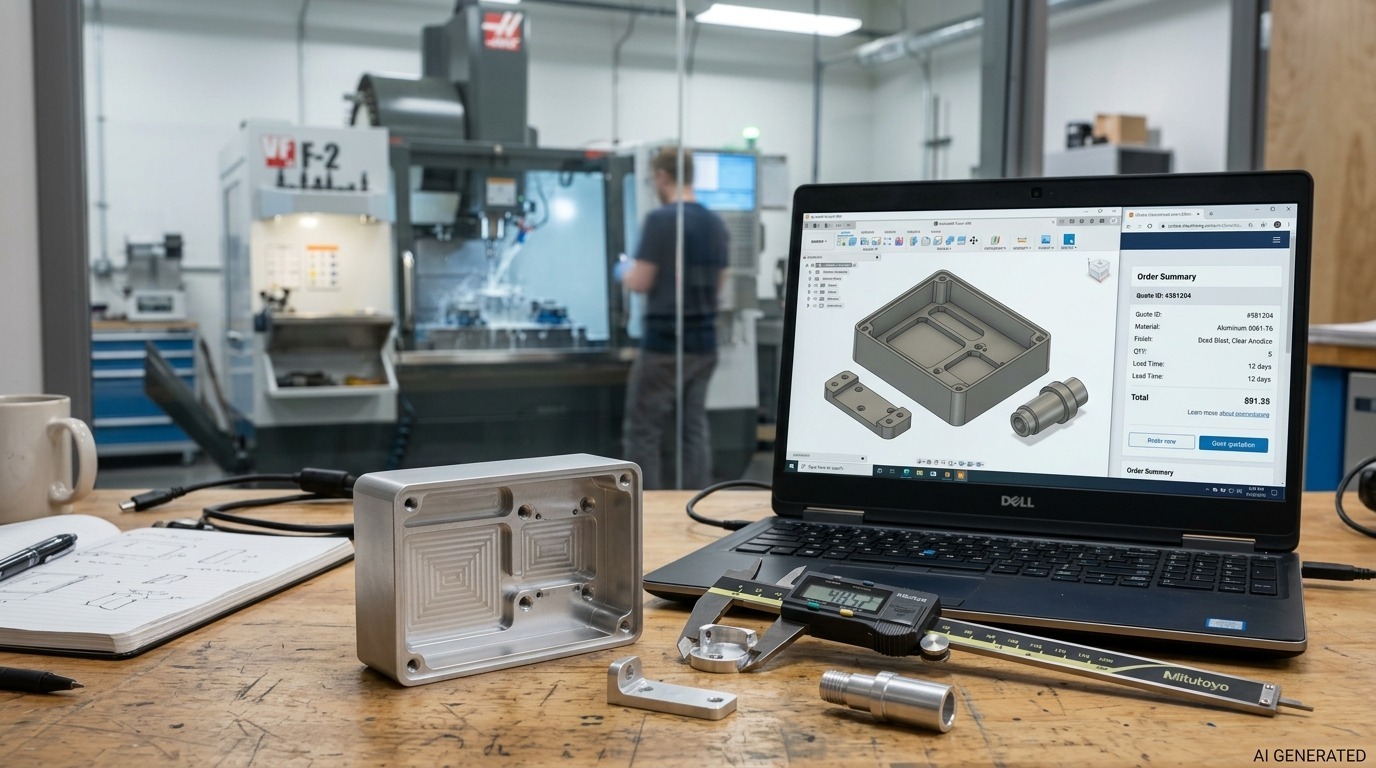
several small precision components
Starting a hardware company is expensive enough before you factor in manufacturing. Most early-stage teams don't have a machine shop. They don't have a manufacturing engineer on staff. And they definitely don't have six months to find and qualify a supplier while the product is still changing every two weeks.
Online CNC machining services let customers submit CAD files, select materials and manufacturing requirements, receive an online quote, and order custom-machined parts through a digital platform. The manufacturing itself still uses conventional CNC milling, turning, and related processes; the main difference is how quoting, ordering, and production communication are handled.
This guide covers how online CNC machining actually works, what it costs, what kinds of parts startups typically need, and how to evaluate a service before committing to it.
What Are Online CNC Machining Services?
Online CNC machining services let customers upload CAD files, specify requirements, request quotations, and order custom parts through a digital platform. Straightforward orders may require little direct communication, while unclear specifications or complex features can require engineering review.
The manufacturing still uses conventional processes such as CNC milling and turning. Additional capabilities, including multi-axis machining, EDM, grinding, and finishing, vary by supplier. Depending on the platform, quotations and manufacturability checks may be automated, reviewed by engineers, or handled through a combination of both. Some suppliers accept single-piece orders, subject to their production requirements.
For startups that need CNC prototypes without investing in in-house equipment, JLCCNC supports online CNC machining from single prototypes to small-batch production. Upload your CAD files to check manufacturing options and get an online quote.

Precision CNC Machining Service
Professional manufacturing, fast turnaround, and quality assurance.
How Does Online CNC Machining Work?
Upload Your CAD File
Most online CNC services accept STEP files as the primary format. STEP is the standard neutral format that works across CAD platforms, SolidWorks, Fusion 360, Onshape, CATIA, whatever you're using, it exports STEP. Some services also accept IGES, Parasolid, or native formats from specific software packages.
The file should represent the final geometry of the part you want. If there are tight tolerances, specific surface finish requirements, or GD&T callouts, those need to be on a 2D drawing (PDF) that gets submitted alongside the model. The 3D model carries the geometry; the drawing carries the specification. If a part has critical tolerances, threads, or special finishing requirements, provide a technical drawing when supported by the service. A 3D model defines the geometry, while the drawing can communicate requirements that are not fully defined by the model alone.
Before uploading a part for online CNC machining, see our guide on how to prepare CAD files for CNC machining, including file formats, units, drawings, and CNC-ready geometry.
Select Materials and Manufacturing Options
After uploading, you choose material, surface finish, and sometimes specific machining requirements. Material options vary by service but a reasonable platform covers aluminum alloys (6061, 7075), stainless steel (304, 316L), mild steel, brass, copper, titanium, and engineering plastics like Delrin, nylon, and PEEK.
Surface finish options typically run from as-machined (visible tool marks, functional surface) through bead blasting, anodizing, powder coating, and electropolishing. Anodizing aluminum is a commonly requested finish for startup hardware products. It can improve appearance, provide surface protection, and add color options.
Get an Online CNC Quote
Automated quoting systems evaluate factors such as material, geometry, quantity, machining requirements, and finishing options. For a closer look at what actually drives a CNC machining quote, see our guide to the true cost of CNC machining services.
For simple to moderately complex parts, this happens in seconds or minutes. More complex geometry, parts with tight tolerances, or requests that need human review may take longer.
The quote should show pricing at different quantities so you can compare the per-unit cost. A single part generally costs more per unit than a batch of ten, while a batch of ten may cost more per unit than fifty.
Confirm the Order
Once the price looks right and any DFM feedback has been addressed, you confirm and pay. Many platforms do DFM (design for manufacturability) analysis as part of the quoting process and flag potential problems, features that are too thin, holes that need tolerances specified, radii that are tighter than standard tooling can achieve. Addressing these before order confirmation avoids delays and scrapped parts.
Production and Quality Inspection
Parts go through production, CNC milling, turning, or both depending on geometry, followed by quality inspection before shipping. What inspection looks like varies by service and part requirements. For standard-tolerance parts, sampling inspection with calibrated measurement tools is typical. For tight-tolerance critical parts, 100% inspection with CMM measurement and a dimensional report is what's appropriate.
Delivery of Finished Parts
Shipping times range from overnight to a week or more depending on where the facility is, what shipping speed you select, and whether the parts needed special finishing that adds lead time. For startups with tight iteration schedules, knowing the lead time before ordering is important. Lead time is part of development-cycle planning, not an afterthought.
Why Startups Use Online CNC Machining Services
Reduce Upfront Manufacturing Investment
A production-capable CNC machine can require a substantial upfront investment beyond the machine itself, including tooling, workholding, software, maintenance, and operator time. Most startups shouldn't buy one. The capital is better spent on the product itself, and the floor space and operational complexity of in-house machining is a distraction from product development at early stages.
Online CNC machining converts manufacturing from a capital expenditure into a variable cost. You pay per part, when you need parts. That's a more sensible structure for early-stage companies where demand is uncertain and designs are changing.
Accelerate Product Development
The speed advantage is real and it compounds. If your iteration cycle goes from three weeks to five days because you're not waiting on traditional shop lead times, you can run more design cycles in the same calendar time. More design iterations can help teams identify functional and manufacturing issues before launch, potentially reducing late-stage changes and production risks.
For hardware startups specifically, the number of design iterations you can complete before funding runs out is a meaningful constraint on the quality of the final product. Anything that speeds up individual cycles matters.
Access Professional CNC Capabilities
Online CNC services provide access to machining capabilities without requiring a startup to purchase or operate its own equipment. Available processes may include milling, turning, multi-axis machining, and additional operations, depending on the supplier. Confirm that the service can produce the required geometry, tolerances, materials, and finishes before placing an order.
Order Only the Parts You Need
Many traditional machine shops may have practical minimum order quantities, even if they do not state them explicitly. Each job requires setup time, so very small orders may be less economical for the shop. Online platforms with automated quoting can accept single-unit orders because the economics work differently.
For early prototype stages, ordering one or two of each part is the right quantity. You'll change the design. Ordering 50 pieces of a design that gets revised in two weeks wastes money and time.
Online CNC Machining for Prototyping
From CAD Design to Functional Prototype
Functional prototypes, parts that work mechanically, not just visual models, are where online CNC machining delivers the most obvious value for hardware startups. Both 3D printing and CNC machining can produce functional prototypes. The more representative process depends on the intended production material, manufacturing method, geometry, and test objectives. When the production part will be CNC machined, a prototype made from the specified stock and material condition can provide useful evidence about fit and mechanical performance. It can help verify mechanisms, threaded features, component fit, and surface finish.
The jump from a CAD model to a physical part you can hand to someone and say "does this feel right?" is harder than it sounds. CNC machining makes it much more accessible than it used to be.
Test and Refine Product Designs
The value of fast prototyping is iteration. You make a part, you test it, you find the problem, you change the design, you order again. Online CNC services make this loop faster and cheaper than it's ever been for small teams without manufacturing facilities.
For a startup, the goal of early prototyping is to find the problems while changing the design is still cheap. Problems found in prototype are fixed with a CAD revision. The same problem found after production tooling is cut is a much more expensive and slower fix.
Prototype With Production-Grade Materials
One genuine advantage of CNC prototyping over most alternative rapid prototyping methods is material fidelity. A part machined from 6061-T6 aluminum has the mechanical properties of 6061-T6 aluminum. You can test it in the same conditions the production part will see, which gives you data you can actually act on.
3D printed parts in various materials are useful for early concept validation, but they have different mechanical properties, different surface finishes, and different failure modes than machined metal. When a product includes load-bearing mechanical components, prototyping in the intended production material and process can provide more representative test data.
From CNC Prototypes to Small-Batch Production
Low-Volume CNC Manufacturing
After prototypes are validated, the next step for most startups is small-batch production, enough parts to send to beta users, fulfill initial presale orders, or run internal testing at scale. This is somewhere between 10 and a few hundred units, depending on the product.
Online CNC services handle this range well. If you're moving from a few prototypes toward initial production, see our guide to low-volume CNC machining for startups.
Continuing with the same supplier may simplify the transition from prototypes to production. Before placing a batch order, confirm the approved CAD and drawing revisions, material and finish requirements, critical dimensions, inspection coverage, documentation, quantity, and delivery schedule. Production orders may also require additional quality agreements or first-article approval, depending on the application.
Validate Products Before Scaling
Small-batch production through CNC has a role in market validation that's separate from prototyping. Making 50 units and putting them in customers' hands tells you things that testing 5 internal prototypes doesn't. Real use cases, real environmental conditions, real user behavior. CNC machining at small quantities lets you do this before committing to the tooling investment that higher-volume production methods require.
Injection molding requires upfront tooling investment, which can range from a few thousand dollars for simple prototype tooling to much higher amounts for complex production molds. CNC at small volumes bridges the gap between prototype and the volume that justifies that tooling commitment.
Scale Production as Demand Grows
At some volume, CNC machining becomes less cost-competitive than tooled production methods for suitable geometries. But that crossover point is higher than most startups expect, and the transition can happen gradually. Some products stay in CNC production permanently, either because volumes never reach tooling breakeven, or because the geometry complexity makes CNC the right process regardless of volume.
What Types of CNC Parts Can Startups Order Online?
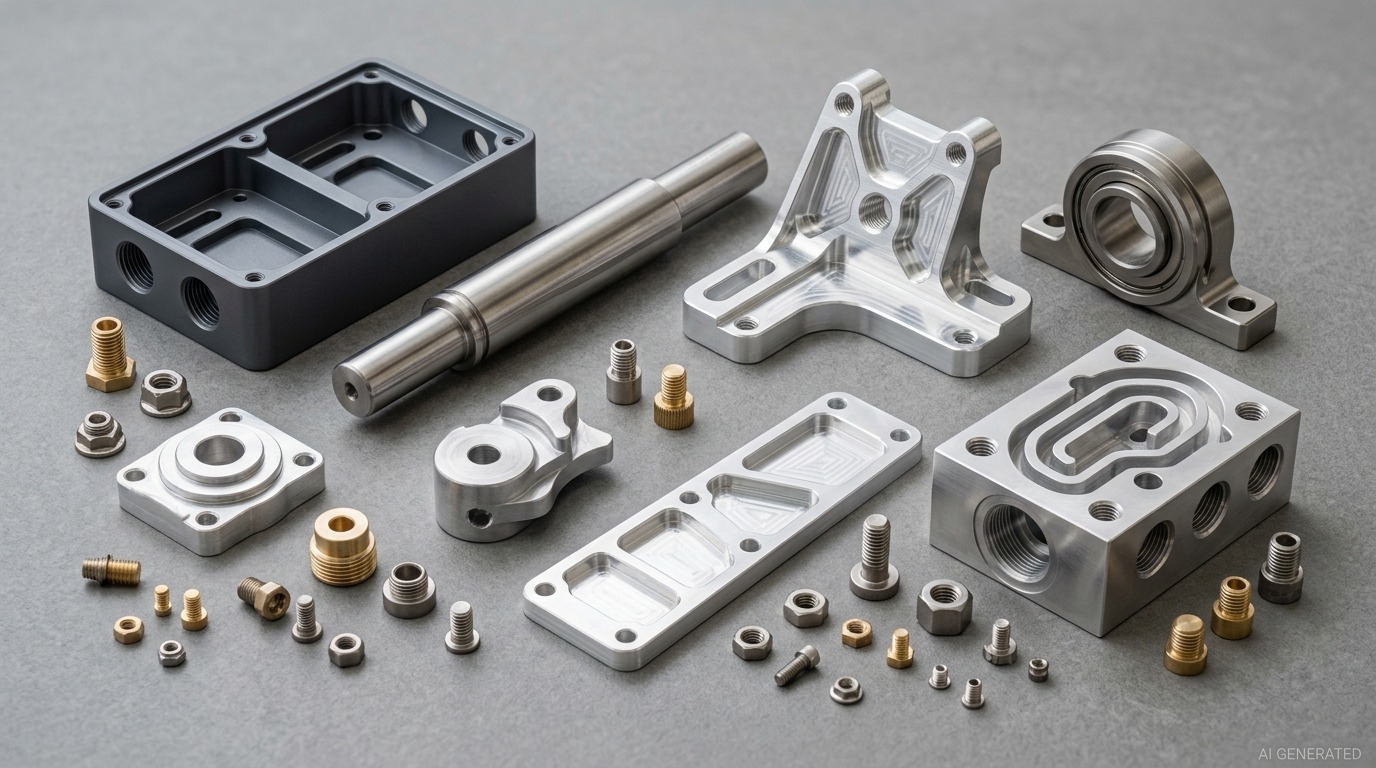
collection of finished CNC-machined components
Functional Prototypes
Mechanical mechanisms, test fixtures, housings for electronics, structural components meant for load testing, anything where material properties and dimensional accuracy matter for the test to be valid.
Mechanical Components
Shafts, gears, cams, linkages, threaded components, bearing housings, precision brackets. Parts that need to fit other parts precisely, transmit force, or maintain dimensional relationships during operation. These are applications where CNC machining is often practical for small quantities, particularly when the parts require precise features or frequent design changes.
Enclosures and Housings
Product enclosures, the outer shells of hardware products, are commonly CNC machined for prototyping and low-volume production. Aluminum enclosures with anodized finish look professional and can be used for customer-facing demos or beta units. Features like connector cutouts, mounting boss patterns, and lid interfaces can be machined to precise dimensions.
Brackets, Fixtures, and Custom Parts
Mounting brackets for sensors, structural frames, tooling fixtures for assembly processes, custom adapters between standard components, the parts that don't get catalogued because they're specific to a particular product architecture. CNC machining is often suitable for parts with pockets, precision bores, or substantial three-dimensional features. For thin, uniform-wall brackets and panels, sheet metal cutting and bending may be economical even for prototypes or small batches. Compare processes by geometry, material, tolerances, tooling requirements, and quantity.
How Much Do Online CNC Machining Services Cost?
Material and Part Size
Material cost is usually the starting point in any CNC quote. Aluminum 6061 is the most commonly ordered material and generally the most affordable metal option. Stainless steel costs more. Titanium costs significantly more. Engineering plastics vary widely, Delrin is cheap, PEEK is expensive.
Part size directly affects material consumption and machining time. Larger parts cost more. There's no fixed per-kilogram rate because machining time varies with geometry.
Geometry and Machining Complexity
A simple rectangular block with a few holes is fast to program and machine. A complex organic shape requiring 5-axis paths, multiple setups, and careful workholding takes much longer and costs proportionally more. Deep pockets, thin walls, undercuts, and features requiring tool changes or repositioning all add to machining time and therefore cost.
Surface quality requirements also matter. Taking a surface to mirror finish requires additional operations beyond standard milling. If as-machined surface finish is acceptable, it's the cheapest option.
Quantity and Production Volume
Setup cost, programming, fixturing, the first part, gets amortized across the order quantity. A part that costs $120 for one unit might cost $60 per unit for 10, and $30 per unit for 50. The curve flattens out at some quantity beyond which the per-unit reduction is less dramatic.
For startups, this creates a real decision point at each order: what quantity to commit to. Ordering more than you need wastes money if the design changes. Ordering one at a time maximizes flexibility but pays the highest per-unit cost.
Tolerances and Surface Finishes
A tolerance around ±0.1 mm is commonly achievable for many general CNC features, but actual capability depends on part geometry, material, machining process, and inspection requirements. Tighter tolerances require more careful machining, in-process measurement, and sometimes additional operations, all of which add cost. Specify tolerances tighter than necessary and you pay for precision that doesn't benefit the part.
Finishing operations, anodizing, powder coating, bead blasting, each add cost and time. Some finishes affect dimensions (hard anodize adds material thickness), which needs to be accounted for in the part design.
What Should Startups Look for in an Online CNC Service?
Manufacturing Capabilities
Multi-axis milling, turning, threading, surface finishing, confirm the service has the processes your parts actually require. Some online platforms are primarily 3-axis milling with limited turning capability. If your parts need turned features or 5-axis operations, verify before you spend time uploading files and getting quotes.
Materials and Surface Finishes
Material range matters more as the product design matures. Early prototypes might all be in 6061 aluminum. Production parts might need 7075 for strength, or 316L stainless for corrosion resistance, or PEEK for high-temperature applications. A service with broad material availability means fewer supplier transitions as the design evolves.
Quality and Tolerances
What inspection does the service perform, and what documentation comes with the parts? For early prototypes, standard inspection is usually fine. For production parts going into a product that customers will use, you want to know whether critical dimensions were measured and whether there's documentation you can keep for QC records.
Lead Times
Lead time is part of the product development cycle planning. A service that quotes 5 business days should be reliably delivering in 5 business days, not 9. Ask about typical lead times for the type and complexity of parts you order, and ask about expedited options when you need them.
Online Quoting and Ordering
Look for a quoting workflow that makes pricing, assumptions, and outstanding questions clear. Straightforward parts may receive an automated quote, while complex geometry or special requirements may need manual review. Confirm whether DFM feedback is automated, engineer-reviewed, or both, and resolve manufacturing questions before production.
Production Flexibility
The ability to order one part, ten parts, or a hundred parts from the same platform without hitting minimum order walls is genuinely valuable at startup scale. Confirm that the service actually accepts small orders without restrictions that make single-unit ordering impractical in practice.
Online CNC Machining for Startups: Key Benefits at a Glance
| Benefit | Why It Matters |
|---|---|
| Lower upfront equipment investment | Teams can outsource machining instead of purchasing and operating CNC equipment. |
| Prototype quantities | Suppliers that accept small orders let teams test designs before committing to larger batches. |
| Access to machining capabilities | Startups can obtain the processes their parts need, subject to supplier capability. |
| Representative prototype materials | Specified materials and manufacturing processes can make functional testing more relevant to production. |
| Online quoting and order management | Digital workflows can simplify quote requests, requirement submission, and order tracking. |
| DFM feedback | Manufacturing review can help identify issues before production. |
| Prototype-to-batch continuity | A suitable supplier may support both stages once production requirements are confirmed. |
Why Choose JLCCNC for Startup CNC Machining?
JLCCNC's online CNC machining service handles the full range of startup manufacturing needs, from single-piece prototypes through production batch orders, with online quoting from uploaded CAD files and production support for prototype and small-batch orders.
Material options cover aluminum alloys, stainless steel, carbon and alloy steels, brass, copper, titanium, and engineering plastics. Surface finish options include anodizing, bead blasting, powder coating, and electropolishing. Tolerances down to ±0.02 mm are available for suitable precision features.
The workflow is built for the startup iteration cycle: upload a file, get pricing and DFM feedback, order, and receive parts with quality inspection documentation. No account setup, no minimum order, no mandatory supplier agreements before the first order.
Precision CNC Machining Service
Professional manufacturing, fast turnaround, and quality assurance.
Conclusion: Using Online CNC Machining to Move from Idea to Production
Hardware product development has always been capital-intensive and slow. Online CNC machining doesn't change the fundamental challenge of building a physical product, but it does meaningfully reduce two of the biggest friction points for startups: time to get parts and capital required to get started.
The ability to go from a CAD file to a machined metal part in a few days, at quantities that match where the product actually is in development, is genuinely different from how custom manufacturing worked fifteen years ago.
The practical approach: Use online CNC for agile prototyping and low-volume validation, transitioning to tooled manufacturing only when production volumes justify the economics.
FAQs About Online CNC Machining for Startups
Can startups order CNC prototypes online?
Yes. Many online CNC services accept single-piece prototype orders, subject to their minimum-order and production requirements.
Can I order a single CNC machined part?/h3>
Yes. Some online CNC services support single-piece orders, although the per-unit cost is usually higher than for larger quantities.
What CAD files are needed for an online CNC quote?
STEP is widely used for CNC quoting. If the part has critical tolerances, GD&T, threads, or specific finishing requirements, include a technical drawing when the service supports it.
How quickly can startups get CNC prototypes?
Lead times vary by geometry, material, finishing, production queue, and shipping. Straightforward parts may be produced within a few business days, while complex finishing can add time.
Can online CNC services support small-batch production?
Yes. Many services support both prototype and small-batch orders. The practical quantity range depends on the supplier, part geometry, and production requirements.
Popular Articles
• Micro CNC Machining Explained: Process, Precision & How Small It Can Really Get
• CNC Machining in the Medical Industry
• CNC for Luxury Watchmaking: Achieving Sub-Micron Tolerances
• Micro CNC Machining: Techniques for Manufacturing Miniature Components
• CNC Machining vs Sheet Metal: Which is Better for Enclosures?
Keep Learning
CNC Motorcycle Parts: Types and How They Are Made
Key Takeaways CNC motorcycle parts are custom or production components machined from CAD models to achieve specified mounting interfaces, dimensions, and surface features. CNC is well suited to brackets, covers, spacers, bushings, and low-volume replacements, but parts affecting braking, steering, suspension, wheel retention, or rider safety require engineering validation beyond machinability. CNC milling suits brackets, covers, and parts with complex profiles, while CNC turning is used for shafts, bu......
Micro CNC Machining Explained: Process, Precision & How Small It Can Really Get
Explaining Micro CNC Machining Any machinist can machine a block of aluminum into a bracket. But what happens when your part is the size of a grain of rice, and still needs tolerances tighter than a human hair? That's when “standard CNC” suddenly feels clumsy, and every micron starts to matter. This is the world of micro CNC machining. It's not about big, impressive cuts, it's about making the kind of components you'll never notice… until they fail. Like the gears in a luxury watch, the nozzles in med......
Custom Bicycle Parts: CNC Machining Guide
Key Takeaways CNC machining is often a practical choice for custom bicycle parts when production quantities are low, the geometry is complex, or critical interfaces require tighter dimensional control than near-net-shape forming can provide. The parts that benefit most are the ones where fit accuracy genuinely matters, such as bearing seats, bottom bracket interfaces, derailleur mounting features, and suspension pivots, where dimensional variation can affect assembly and performance. For CNC-machined ......
Online CNC Machining Services for Startups: Benefits & Uses
Key Takeaways Online CNC machining lets startups upload CAD files, get quotes, order custom parts, and manage production through a digital workflow. Prototyping: Startups can order single or small quantities to test fit, function, materials, and designs before scaling production. Production flexibility: The same CNC service can support prototypes, small batches, and higher quantities as product demand develops. Cost factors: Material, part size, geometry, tolerances, quantity, machining requirements, ......
CNC Machining for the Automotive Industry
Key Takeaways Automotive CNC machining is used both to produce certain low-volume components directly and to finish cast or forged parts at critical interfaces, including engine blocks, transmission housings, suspension uprights, brake components, and EV motor housings. CNC machining isn't how most automotive parts get manufactured in volume; casting, forging, and stamping handle the majority of mass production. What CNC does well is prototyping, low-volume production, precision finishing of cast or f......
CNC Machining for the Optics Industry: Optical Components & Housings
Key Takeaways CNC machining for optical systems primarily produces optomechanical components that hold, locate, align, and protect optical elements, including housings, lens barrels, mounts, spacers, retaining rings, and alignment fixtures. Conventional CNC machining is primarily used for the mechanical components around optical elements, while lenses and mirrors are generally produced through specialized grinding, polishing, coating, or ultra-precision machining processes. CNC machining provides the ......