5-Axis CNC Machining: Why Is It Needed for Complex Parts?
15 min
- 3-Axis vs 5-Axis CNC: Key Differences
- 3-Axis CNC Machining: When Is It the Better Choice?
- 5-Axis CNC Machining: When Does It Make More Sense?
- 3-Axis vs 5-Axis CNC Cost: Which Is More Affordable?
- 3+2 vs Simultaneous 5-Axis CNC Machining
- How to Choose Between 3-Axis, 3+2, and 5-Axis CNC
- Conclusion: Choosing the Right CNC Axis Strategy
- 3-Axis vs 5-Axis CNC FAQs
Key Takeaways
- 3-axis CNC machining is often a practical and cost-effective choice when all critical features can be reached using a small number of straightforward setups, with the tool orientation fixed relative to the workpiece during each setup.
- A 5-axis machine can improve access to angled or multi-sided features and reduce re-clamping. These benefits can often be achieved with 3+2 positioning, without simultaneous 5-axis cutting.
- 3+2 machining uses two rotary axes to position the workpiece or cutting head, then holds that orientation during 3-axis cutting. It is often suitable for angled holes, inclined pockets, and multi-face parts.
- Simultaneous 5-axis machining coordinates linear and rotary motion so tool orientation can change during cutting. It is useful when continuous orientation changes are needed for access, collision avoidance, or suitable cutting contact.
- Compare total part cost, not just machine hourly rates. Programming, setup, fixturing, cycle time, inspection, and production quantity all affect the result. The same 5-axis machine may perform both 3+2 and simultaneous operations.
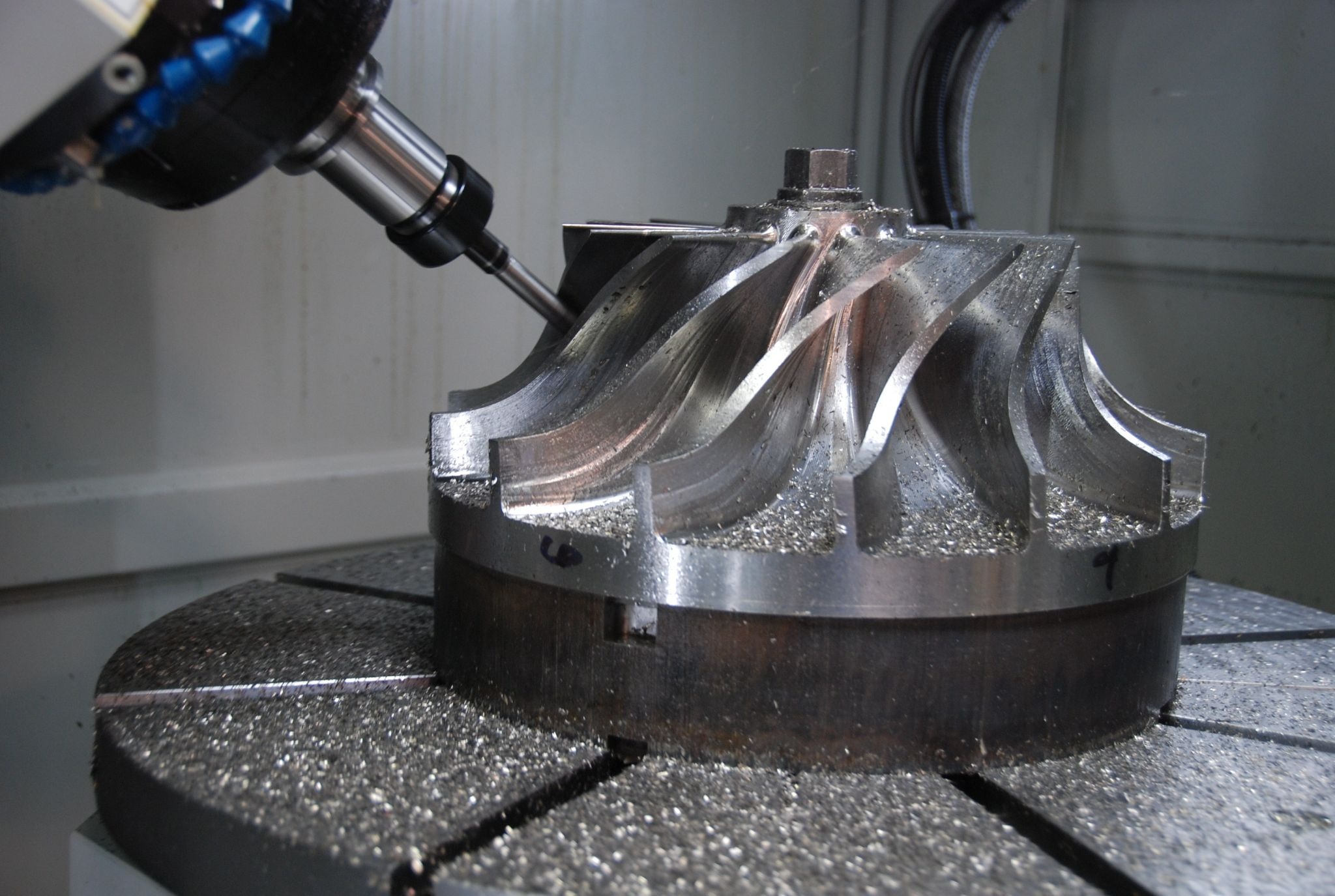
(Reddit) 5-axis CNC machine
The number of axes a CNC machine has tells you something meaningful about what it can do, but it doesn't tell you which machine is right for a given part. 5-axis machining gets treated as inherently superior in a lot of marketing material. It's not. It's more capable for certain types of geometry. For many common parts, 3-axis machining is sufficient and may be more economical. However, a 5-axis machine can still offer savings through fewer setups, less handling, or automation, even when simultaneous 5-axis cutting is not required.
What this guide actually covers: the real differences between 3-axis, 3+2, and simultaneous 5-axis machining, when each approach makes the most practical and economic sense, and how to think about the decision for a specific part rather than defaulting to assumptions.
JLCCNC can manufacture parts using 3-axis, 3+2, or simultaneous 5-axis machining based on the required geometry, access, tolerances, and production requirements. Uploaded files can be checked against manufacturing standards before production to help determine a suitable machining approach.

Precision CNC Machining Service
Professional manufacturing, fast turnaround, and quality assurance.
3-Axis vs 5-Axis CNC: Key Differences
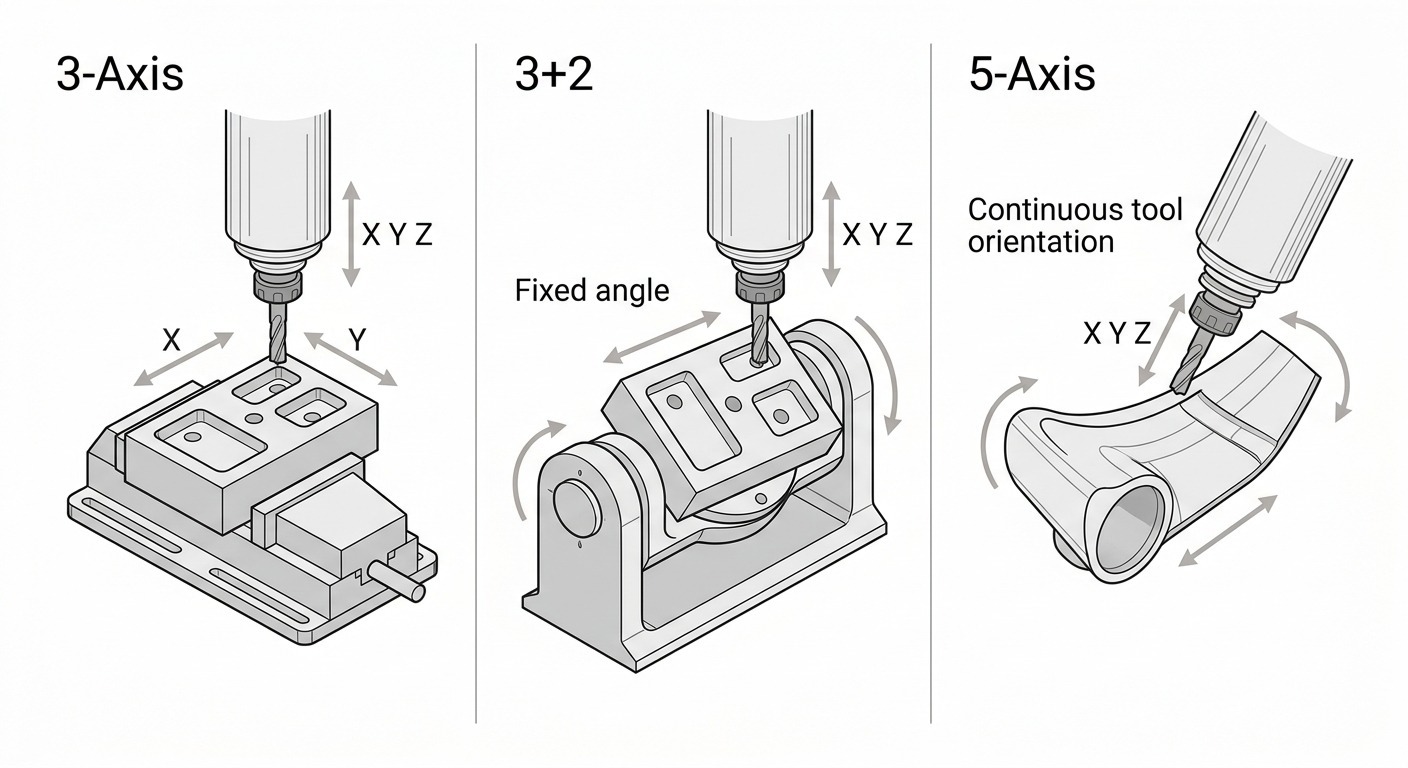
3-axis CNC machining, 3+2 machining, and simultaneous 5-axis CNC machining
| Factor | 3-Axis CNC | 3+2 (Positional 5-Axis) | Simultaneous 5-Axis |
|---|---|---|---|
| Axis motion | X, Y, and Z linear motion; tool orientation remains fixed relative to the workpiece within each setup | Two rotary axes position the workpiece or head, then remain stationary during 3-axis cutting | Coordinated linear and rotary motion allows tool orientation to change during cutting |
| Tool access | A fixed tool orientation within each setup; other orientations require repositioning the workpiece | Multiple fixed tool orientations, subject to machine travel and clearance | Changing tool orientation along the cutting path, subject to machine travel and clearance |
| Part geometry | Features accessible with fixed tool orientations and practical workholding | Angled holes, inclined pockets, and features on multiple faces | Features that require or benefit from changing tool orientation during cutting |
| Number of setups | Depends on feature access and workholding; multiple setups may be needed | Can reduce re-clamping by reaching several faces in one setup | Can reduce re-clamping, but does not necessarily require fewer setups than 3+2 |
| Programming complexity | Usually lower for straightforward parts | Often simpler than simultaneous 5-axis for fixed-angle features | Often higher when continuous orientation control is required |
| Best for | Plates, brackets, housings, and other parts suited to straightforward setups | Multi-face parts and fixed-angle features that would otherwise require additional setups or angled fixtures | Selected blade, impeller, and sculptured-surface operations requiring continuous orientation control |
For both 3+2 and simultaneous 5-axis machining, additional setups may still be needed to machine gripping surfaces or features that remain inaccessible.
On the 3+2 point specifically: Okuma and other manufacturers distinguish 3+2 positioning from true simultaneous 5-axis, and it's a meaningful distinction in practice. 3+2 machining uses the rotary axes to position the workpiece or cutting head at fixed angles, then performs conventional 3-axis cutting from each orientation. It often simplifies programming for angled or multi-face features that can be machined from fixed orientations. For a planar feature at a 30-degree angle, 3+2 machining is often sufficient if tool access and clearance allow. It typically simplifies programming compared with simultaneous 5-axis machining, but does not necessarily reduce cycle time.
For a closer look at how 3-axis CNC machining works, its capabilities, and where its limitations begin, see our guide to 3-axis CNC milling.
3-Axis CNC Machining: When Is It the Better Choice?
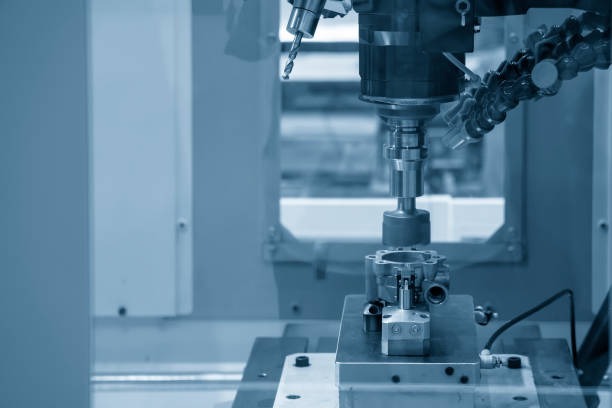
(Istock) 3-axis CNC machine
The narrative that 5-axis is the obviously better technology leads engineers to occasionally spec 5-axis time on parts that simply don't need it. That's a waste of budget. 3-axis machining is the right choice more often than the marketing around 5-axis suggests.
Simple Part Geometries
A bracket with pockets, holes, and flat mating surfaces. An enclosure with a rectangular cavity. A plate with counterbores and slots. These parts are often suitable for 3-axis machining when their features can be reached through straightforward setups. Repositioning the part in a vise or fixture can provide access to additional faces, provided locating and clamping are practical and the required tolerances can be maintained. A 5-axis machine operating in 3+2 mode may still offer an advantage by reducing re-clamping and manual handling.
Many production parts with prismatic geometry fall into this category. Brackets, housings, spacers, plates, manifolds with straight bores, the work that fills shop floors. 3-axis covers it.
Lower Machine and Setup Costs
A conventional 3-axis VMC often has a lower hourly rate than a comparably sized 5-axis machining center. However, shop rates also reflect machine specification, utilization, automation, and local operating costs. The lower hourly rate translates into a lower part price only when the remaining production costs are comparable.
Setup on a 3-axis machine for a part that needs two or three orientations is also simpler than it sounds. A well-thought-out fixture and an experienced machinist can work through multiple setups efficiently. Three simple 3-axis setups can still be more economical than a complex 5-axis operation, depending on setup time, programming effort, and production volume.
For a closer look at how setup time, workholding, tool offsets, and verification affect CNC machining costs and accuracy, see our CNC setup guide.
Simpler Programming and Production
3-axis CAM programming is faster, more widely understood, and easier to verify than 5-axis programs. The post-processors are more straightforward. 3-axis programs avoid the additional rotary-axis motion and clearance considerations of simultaneous 5-axis machining. They still require verification of toolpaths, offsets, workholding, and collision clearance.
For high-volume prismatic parts, efficient 3-axis fixtures can provide low unit costs. However, programming costs are spread across the production quantity, while cycle time, loading, automation, and scrap continue to affect each part. Compare the complete production process before choosing either approach.
5-Axis CNC Machining: When Does It Make More Sense?
Complex Multi-Sided Geometries
Parts where important features exist on multiple faces, at compound angles, or where a curved surface needs to be machined with consistent tool engagement, these are the legitimate cases for 5-axis. An impeller with twisted blade surfaces that can't be reached from any fixed angle. A turbine blade with a complex profile that changes along its length. An aerospace structural component with pockets at multiple compound angles off the primary face.
For these parts, 3-axis machining with multiple setups either isn't feasible geometrically or produces worse results because maintaining precise feature relationships between setups is difficult.
For a deeper look at 5-axis CNC machining, including how the additional axes work and which parts benefit from them, see our guide to 5-axis CNC milling.
Difficult Tool Access and Angled Features
When a feature is at an angle that a vertical spindle simply can't reach, an inclined bore through a curved surface, a pocket on an angled face that needs a short tool to avoid deflection, 5-axis (or at minimum 3+2) is the solution. In 3-axis, the alternative is angled fixturing, which introduces its own complications for locating and measuring the workpiece.
5-axis allows the machine to tilt the part or the head so the feature of interest is presented perpendicular to the spindle axis, enabling machining with shorter, more rigid tools. Shorter tools mean less deflection, which means better surface finish and more consistent dimensions on those angled features.
Fewer Setups for Complex Parts
Re-clamping can introduce locating errors and variation in the relationships between features. Machining several faces without re-clamping can reduce this source of variation, and both 3+2 and simultaneous 5-axis strategies may offer that advantage.
However, fewer setups do not guarantee higher accuracy. Rotary-axis calibration, machine geometry, thermal behavior, workholding, and tool deflection still affect the result. Tight positional or perpendicularity requirements should be evaluated against the complete machining and inspection process.
Improved Tool Orientation
With a ball-end mill, cutting speed approaches zero at the tool center. A suitable tool tilt can move the contact region away from that center and improve cutting conditions. A fixed tilt may be sufficient with 3+2 machining; simultaneous 5-axis is useful when the required orientation changes along the surface.
Surface finish also depends on tool geometry, stepover, local surface curvature, cutting parameters, runout, and vibration. Five-axis machining does not automatically remove scallops or guarantee fewer finishing passes.
3-Axis vs 5-Axis CNC Cost: Which Is More Affordable?
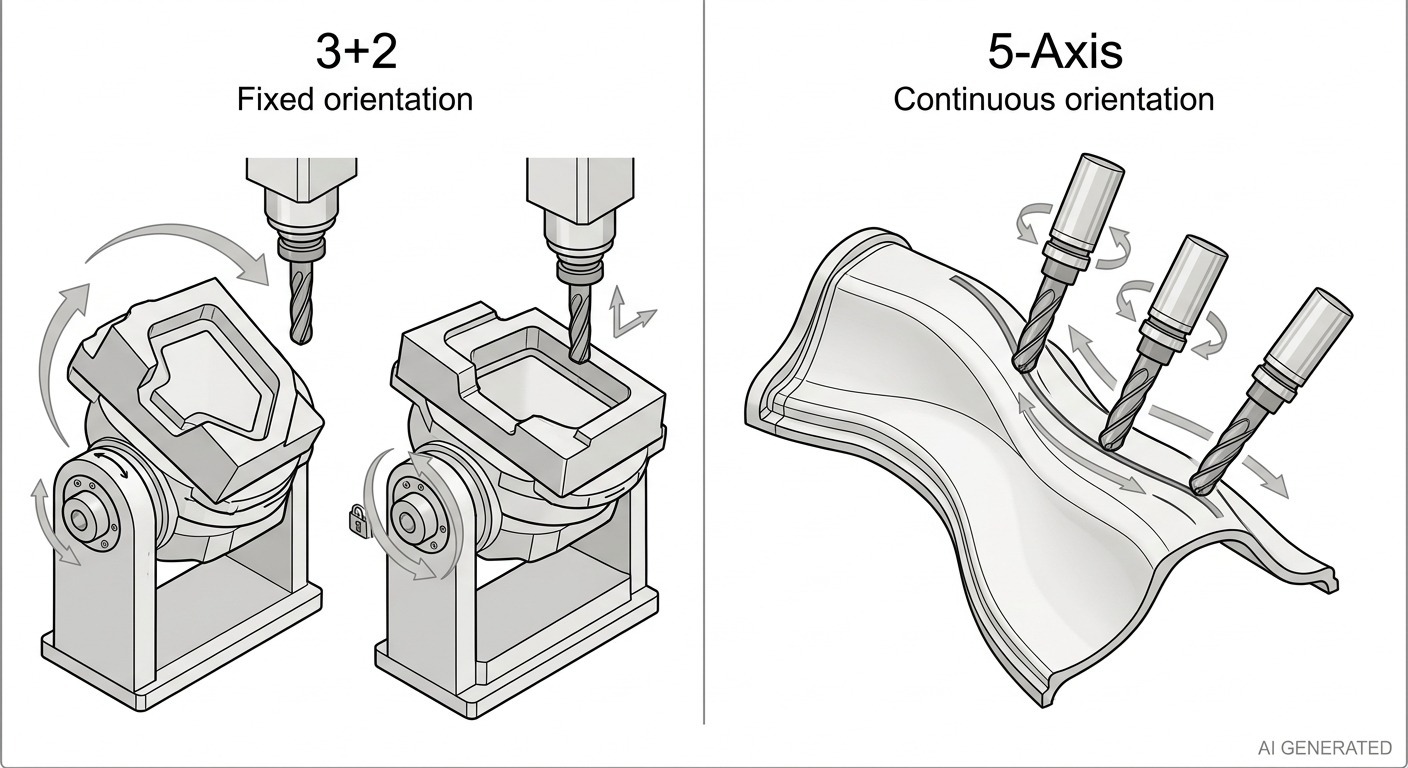
3+2 positional machining and simultaneous 5-axis machining
When 3-Axis CNC Costs Less
The machine hourly rate comparison is the starting point, but it's not the whole picture. 5-axis machining typically has a higher machine-hour cost than conventional 3-axis machining because of the machine configuration, programming requirements, and associated equipment. However, the higher hourly rate does not necessarily mean a higher total part cost when 5-axis machining reduces setups, fixturing, or cycle time. If machining time, setup effort, tooling, inspection, and expected yield are comparable, the lower machine rate generally favors 3-axis machining.
Setup count also matters. If a 3-axis approach needs three setups but each is simple and quick, and a 5-axis approach does it in one setup but with more complex programming, probing, and verification time, the 3-axis total might still be cheaper. Programming hours are a real cost. A complex 5-axis program can take longer to write, simulate, and prove out than an equivalent 3-axis program.
For high-volume production of suitable prismatic parts, 3-axis machining is often more economical because programming, setup, and machine-hour costs can be lower.
When 5-Axis CNC Can Reduce Total Machining Cost
A 5-axis machine can reduce total part cost when savings in fixture preparation, manual handling, machining time, or rework outweigh the additional programming and machine charges.
The crossover point depends heavily on part complexity and production volume. One-off or low-volume complex parts often justify 5-axis not because the machine rate is lower, but because the total cost including fixturing, setup time, and rework risk is lower. Even for relatively simple parts, reduced handling and automation can make a 5-axis process competitive at production volumes. The decision should be based on estimated unit cost and throughput.
3+2 vs Simultaneous 5-Axis CNC Machining
This distinction matters more than most introductory guides acknowledge. A lot of parts that get described as "requiring 5-axis machining" actually require 3+2, which is considerably simpler and often cheaper.
In 3+2 machining, the machine uses its two rotary axes to tilt the workpiece (or the head, depending on machine configuration) to a defined angular position, locks the rotary axes, and then runs a conventional 3-axis tool path in that orientation. For a part with a pocket at 45 degrees, the machine tilts 45 degrees, the pocket gets cut as if it were a horizontal pocket in 3-axis, and then the machine moves to the next orientation if needed.
This is how Okuma and other machine builders describe 3+2 capability. The machine indexes to fixed positions and then machines in 3-axis mode from each orientation. It's available on many machines that also offer simultaneous 5-axis, and it can cover many multi-angle machining requirements without requiring continuous 5-axis motion.
Simultaneous 5-axis machining coordinates linear and rotary motion so tool orientation can change during cutting. It is useful when a fixed orientation cannot maintain access, clearance, or the required cutting contact along a toolpath. Selected blade and impeller operations are common examples.
It requires appropriate CAM programming, post-processing, and machine simulation. A straight angled bore normally uses a fixed tool orientation and does not, by itself, require simultaneous 5-axis machining.
How to Choose Between 3-Axis, 3+2, and 5-Axis CNC
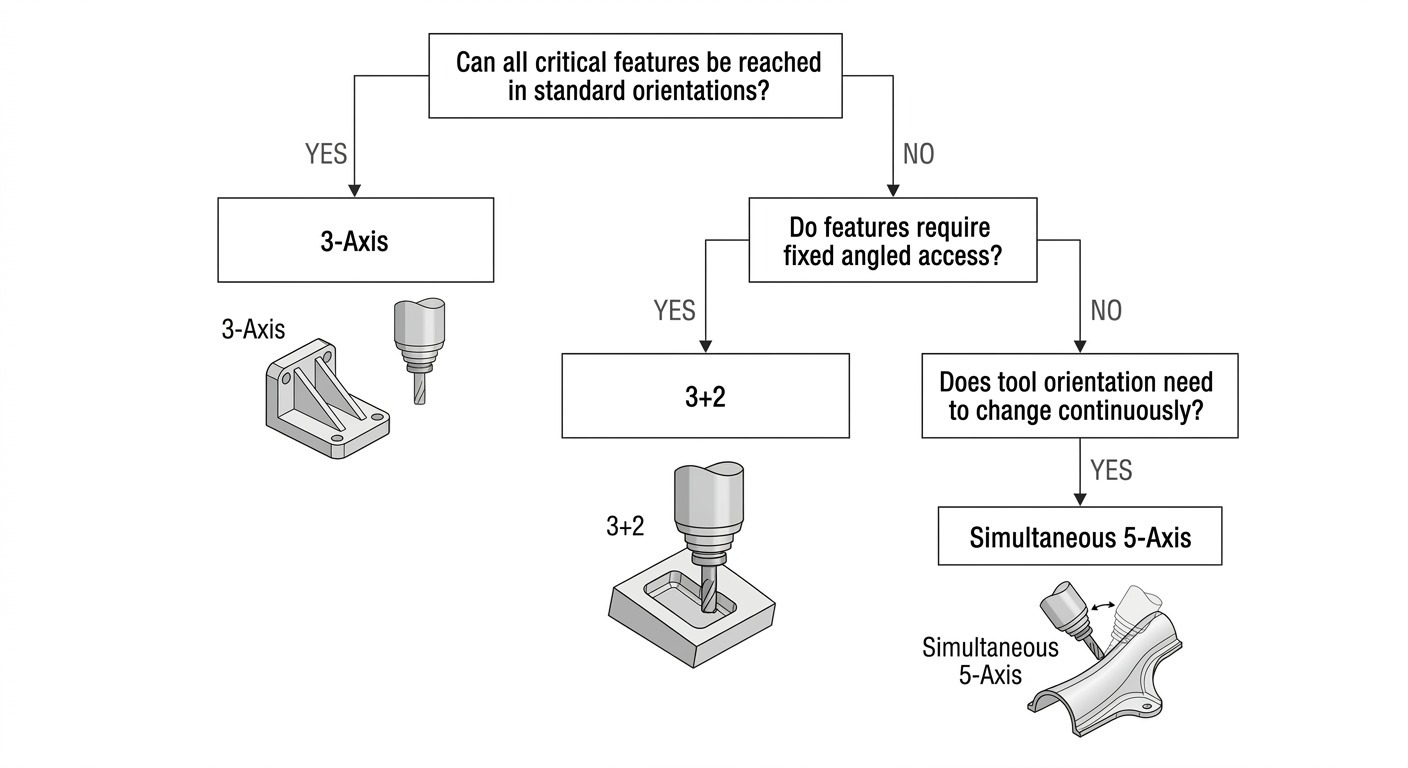
decision-flow infographic
Choose 3-Axis CNC When Features Are Accessible from One or Two Orientations
Choose 3-axis machining when all critical features can be reached with a small number of conventional setups and do not require continuous tool-axis adjustment. Prismatic parts, plates, brackets, housings, and similar components often fit this category.
Choose 3+2 Machining When Features Require Fixed Angled Access
A part with bores at specific angles, pockets on inclined faces, or features that would require complex angled fixtures in 3-axis machining, but where those features are themselves geometrically simple, is a good 3+2 candidate. The machine orients to each angle and cuts in conventional 3-axis mode. 3+2 offers simpler programs than simultaneous 5-axis machining and can provide good geometric control. On a machine that supports both strategies, the additional machining cost may also be limited, depending on the part and setup.
Many aerospace and medical components with fixed-angle features can be good candidates for 3+2 machining, although the appropriate strategy depends on the geometry, tolerances, and access requirements. Angled bores, features on multiple faces, compound pockets, these usually need 3+2 positioning, not continuously interpolating simultaneous 5-axis motion.
Choose Simultaneous 5-Axis When Tool Orientation Must Change Continuously
Choose simultaneous 5-axis when continuous changes in tool orientation are needed to maintain cutter access, avoid tool or holder interference, or achieve the required cutting contact. It may also be selected when a validated toolpath provides a meaningful productivity benefit over fixed-orientation machining.
Many curved surfaces can still be machined accurately with 3-axis or 3+2 strategies. Undercuts must be assessed individually: some are accessible with special cutters or indexed orientations, while others remain inaccessible even on a 5-axis machine.
Conclusion: Choosing the Right CNC Axis Strategy
The right CNC machining strategy depends on feature accessibility, part geometry, tolerance requirements, setup complexity, and total production cost. 3-axis machining remains a practical choice for many prismatic parts, while 3+2 provides fixed-angle access without requiring continuous five-axis motion. Simultaneous 5-axis machining becomes more valuable when tool orientation must change continuously or when multiple complex features are difficult to reach with conventional setups.
The goal is not to choose the machine with the most axes. It is to use the simplest machining strategy that can meet the part's manufacturing requirements reliably and economically.
3-Axis vs 5-Axis CNC FAQs
Is 5-axis CNC better than 3-axis CNC?
Not universally. Three-axis machining is often suitable for accessible features and straightforward setups. Five-axis machines can improve access and reduce re-clamping, using either 3+2 positioning or simultaneous motion. The better choice is the process that meets the part requirements at an acceptable total cost.
Is 5-axis CNC more expensive than 3-axis?
Five-axis machining often has a higher hourly rate, but it may still produce a lower total part cost by reducing setups, fixtures, handling, or machining time. Fewer re-clamping operations can reduce some error sources, but they do not eliminate rework risk. Compare quotations for the same part requirements and production quantity.
What parts require 5-axis machining?
Parts with features at several fixed angles may benefit from 3+2 machining. Simultaneous 5-axis is needed when a required operation cannot be completed with fixed tool orientations and continuous orientation changes are necessary for access or cutting contact. Some impeller passages and twisted blade surfaces fit this description, depending on the tool and fixture arrangement.
What parts require 5-axis machining?
Yes, with appropriate fixturing and multiple setups. Many geometrically complex parts are routinely machined on 3-axis equipment by breaking the work into sequential setups, each accessible from a standard orientation. The question is whether the geometry can be fully reached, whether inter-setup tolerance accumulation is acceptable for the requirements, and whether the fixturing investment is worthwhile relative to 5-axis alternatives.
Does 5-axis CNC reduce machining time?
Sometimes. Five-axis machining can reduce overall production time by cutting down on re-clamping, fixture changes, and handling. It may also shorten cutting time through better tool access or more efficient toolpaths. However, programming, simulation, indexing, and machine-motion limits can offset those savings. Compare cutting time and total production time separately.
Popular Articles
• What is Swiss Machining: Swiss CNC Machines and Their Precision
• Desktop 5-Axis CNC Machine: Own One or Outsource to Industrial Services?
• How a Laser Cutter Operates
• The Superiority of CNC Routers Over Laser Cutters in Modern Manufacturing
• Best CNC Machines for Metal: A Guide for Choosing Between Mills, Routers, and Press Brakes
Keep Learning
What is Swiss Machining: Swiss CNC Machines and Their Precision
What is Swiss Machining? (Freepik) When you hear people talk about the “gold standard” in precision manufacturing, they're usually talking about Swiss machining. Swiss machining traces its roots back to 19th-century Switzerland, where it was originally developed for the watchmaking industry. When you're dealing with gears and components smaller than a fingernail, you need more than just accuracy, you need repeatable precision at a microscopic level. That's where the Swiss lathe came in. At its core, S......
5 Signs You Need a CNC Machine for Your Metal Project
You’ve got a metal project on your hands, maybe a few prototypes, maybe a production run, and you're wondering if it’s time to upgrade your toolkit. CNC machines aren’t just fancy toys for industrial giants anymore. Today, shops of all sizes rely on them to cut, mill, drill, and shape metal with unshakable accuracy. But when is the right time to make that leap? This isn’t just about having cool equipment. It’s about knowing when manual methods, traditional tools, or even outsourcing just aren't cuttin......
How to Make a CNC Machine at Home: DIY CNC Router & Lathe Guide
How to Make a CNC Machine? (Reddit) Why would anyone want to build their own CNC machine at home? Isn't that super complicated? Honestly, that's the fun of it. Figuring out how to make a CNC machine can be both exciting and surprisingly cost-effective. Think of it like combining engineering curiosity with the satisfaction of saying, “Yep, I built that myself.” For hobbyists, small workshops, or even engineers tinkering at home, DIY CNC machines open the door to custom fabrication without dropping thou......
Lathe vs Mill: Differences, Applications, and Machine Selection
Key Takeaways Lathe-vs-mill selection starts with the part, not the machine: a lathe is the more direct route for rotational features, while a mill suits prismatic geometry and features distributed across multiple faces. On a lathe the workpiece spins and the tool feeds; on a mill the cutting tool spins while the workpiece is held. That motion difference determines the geometry each machine produces efficiently. Workholding, feature access, setup count, and cross-feature tolerance relationships decide......
5-Axis CNC Machining: Why Is It Needed for Complex Parts?
Key Takeaways 3-axis CNC machining is often a practical and cost-effective choice when all critical features can be reached using a small number of straightforward setups, with the tool orientation fixed relative to the workpiece during each setup. A 5-axis machine can improve access to angled or multi-sided features and reduce re-clamping. These benefits can often be achieved with 3+2 positioning, without simultaneous 5-axis cutting. 3+2 machining uses two rotary axes to position the workpiece or cut......
Desktop CNC Machines: Cost, Capabilities, and Limitations
Key Takeaways Desktop CNC machines commonly range from under $1,000 for basic routers to several thousand dollars for better-equipped mills and routers, while specialized 5-axis systems can reach well into the five-figure range. Tooling, workholding, software, fixturing, and other setup costs can add another $1,000$5,000 or more depending on the machine and application. Desktop CNC machines are well suited to prototyping, smaller parts, softer materials, and learning CNC fundamentals. Desktop CNC mach......