From CAD to CNC The Importance of Accurate 3D Modeling in Manufacturing
5 min
In modern manufacturing, the process from CAD design to CNC machining is an indispensable part of producing high-quality parts and products, and 3D modelling, as a core part of this process, has a direct impact on the accuracy, functionality and appearance of the final product. In this article, we will discuss the CAD to CNC process, analyse the importance of accurate 3D modelling, and share how to optimise the modelling process to improve manufacturing efficiency and product quality.
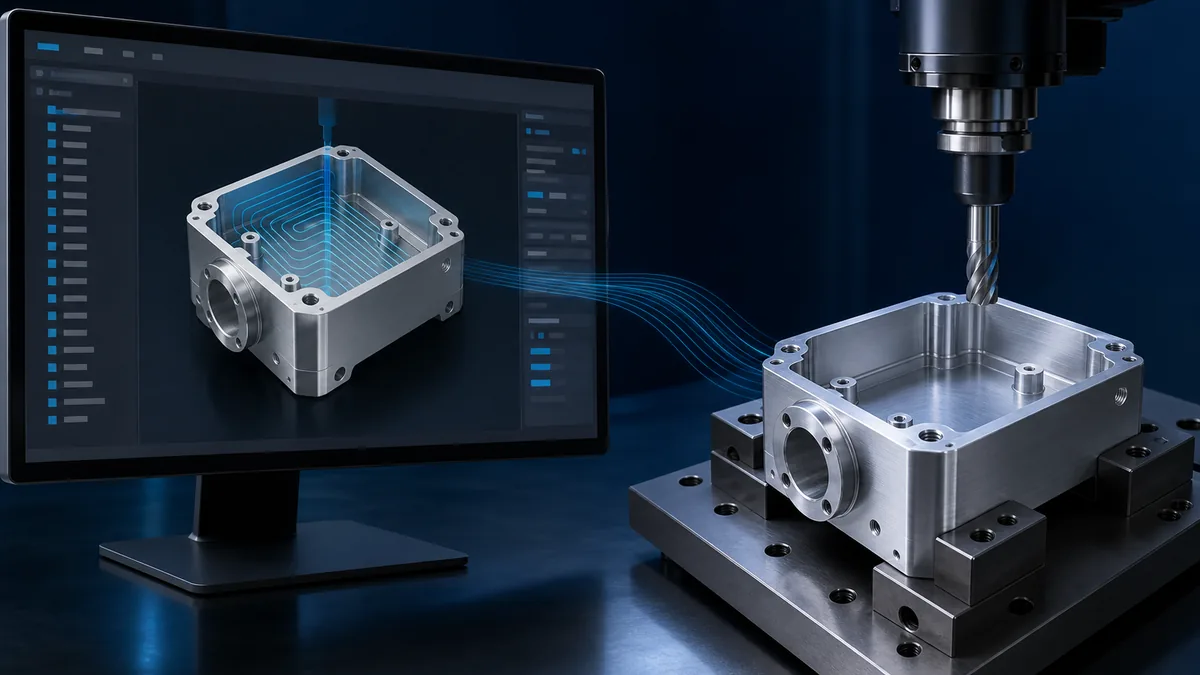
I. CAD design: laying the foundation for accurate manufacturing
CAD (Computer Aided Design) is the cornerstone of modern manufacturing, which helps designers create accurate 3D models through digital tools. A high-quality CAD model not only accurately reflects the design intent, but also provides a reliable data base for subsequent CNC machining.
1. Key elements of CAD design
Accuracy: Ensure that all dimensions, angles and tolerances are within design specifications.
Detailing: Attention to every detail of the part, such as chamfers, threads and hole positions.
Manufacturability: Consider machining feasibility at the design stage to avoid machining problems caused by complex structures.
2. Commonly used CAD software
SolidWorks: suitable for mechanical design and complex parts modelling.
AutoCAD: Commonly used for 2D and 3D design.
Fusion 360: supports cloud collaboration and real-time rendering.
II. From CAD to CNC: Data Conversion and Machining Preparation
Translating CAD models into CNC machining code is a critical step in the manufacturing process. This process requires ensuring data integrity and accuracy to avoid machining errors.
1. Data conversion tools
CAM software: e.g. Mastercam, NX CAM, etc. for CNC machining code generation.
G-code generation: CAM software converts CAD models into G-codes that can be executed by the machine tool.
2. Machining preparation
Tool path planning: Ensure that the tool path is reasonable to avoid collision and overcutting.
Fixture design: Choose suitable fixture to fix the parts to ensure the stability of machining.
Optimisation of machining parameters: Adjust the rotational speed, feed rate and depth of cut according to the material properties.
III. Importance of 3D modelling in CNC machining
Accurate 3D modelling is not only the core task of the design phase, but also the key to the success of CNC machining. The following are the important roles of 3D modelling in manufacturing:
1. Improved machining accuracy
Dimensional control: Every dimension in the 3D model can be precisely executed in machining.
Surface quality: By optimising the model surface, surface defects during machining are reduced.
2. Optimise machining efficiency
Reduce the cost of trial and error: Verify the design in the virtual environment and reduce the number of trial and error of physical sample parts.
Reduce machining time: Improve machining efficiency through reasonable tool path planning.
3. Support complex structure machining
Multi-axis machining: The 3D model can support 5-axis CNC machining to achieve high-precision machining of complex surfaces.
Lightweight design: Optimize the part structure through modelling to reduce weight and ensure strength at the same time.
IV. Practical Tips to Improve 3D Modelling Accuracy
Choosing the right modelling method
Solid modelling: suitable for the design of mechanical parts.
Surface modelling: suitable for the modelling of complex surfaces.
Parametric design
Quickly adjust the model to adapt to design changes through parametric tools.
Data checking and validation
Check the integrity and consistency of your model using the validation tools of your CAD software.
Import into CNC simulation software to preview the machining process and ensure that it is correct.
Team Collaboration and Data Management
Use cloud-based collaboration platforms, such as Fusion 360, to enable design and machining teams to work together seamlessly.
Establish a standardised data management process to ensure data security and consistency.
V. JLCCNC: One-stop solution from CAD to CNC
In the CAD to CNC manufacturing process, it is crucial to choose a professional machining service provider. jlccnc provides high-quality CNC machining services to global customers with its advanced equipment and rich experience in the industry.
Technical Advantage:
5-axis CNC machining: supports the machining of complex surfaces and high-precision parts.
3D Printing and Modelling: Provide rapid prototyping services to accelerate product development cycle.
Strict Quality Control: From design to delivery, every step is strictly inspected to ensure zero defects.
Service Highlights:
24/7 customer support: answer technical questions and provide professional advice at any time.
Global Delivery Network: Production bases covering multiple regions to ensure fast delivery.
Customised solutions: provide personalised processing solutions according to customer needs.
Summary
Accurate 3D modelling is key to ensuring product quality and process efficiency in the manufacturing process from CAD to CNC. By mastering CAD design techniques, optimising data conversion processes and improving modelling accuracy, companies can significantly increase their manufacturing competitiveness. If you are looking for professional CNC machining services, JLCCNC is your reliable partner. We are committed to providing you with low-cost, efficient and precision manufacturing solutions to help you success!
Popular Articles
• Are There Any Design Limitations or Restrictions for CNC Machining
• From CAD to CNC The Importance of Accurate 3D Modeling in Manufacturing
• Understanding CNC Machine Tolerances and Their Impact on Part Accuracy
• How to Learn CNC Programming: A Step-by-Step Guide for Beginners
• G and M code: a beginner's guide to CNC programming language
Keep Learning
Are There Any Design Limitations or Restrictions for CNC Machining
Quick Answer: CNC design is limited mainly by tool access, cutter radius, part rigidity, workholding, machine travel, material behavior, and tolerance requirements. Review those constraints before finalizing CAD, especially for deep pockets, thin walls, internal corners, undercuts, small threads, and critical fits. A design that looks completely reasonable in CAD can turn out to be genuinely difficult — or impossible — to machine as drawn. Not because the geometry is wrong in any absolute sense, but b......
GD&T in CNC Machining: Everything You Need to Know.
Why Does GD&T Matter in CNC Manufacturing? (autodesk) What is GD and T? Ask five machinists to interpret a drawing without it and you might end up with five completely different parts. That's because traditional linear dimensions and notes can only go so far, leaving plenty of room for misinterpretation. This is where GD&T (Geometric Dimensioning and Tolerancing), the universal language of engineers, is used to define how a part should truly function and fit. At its core, GD&T is a symbolic system tha......
What Is CNC Programming? A Complete Guide
What Is CNC Programming? A Complete Guide A finished CAD model doesn't cut anything by itself. Between a 3D design sitting on a screen and an actual part coming off a machine, there's a translation step that turns geometry into motion — where the tool goes, how fast it moves, when it changes, when coolant kicks on. That translation is CNC programming, and it's easy to take for granted until something in it goes wrong: a program that runs a toolpath through a clamp, a feed rate that's fine on paper but......
From CAD to CNC The Importance of Accurate 3D Modeling in Manufacturing
In modern manufacturing, the process from CAD design to CNC machining is an indispensable part of producing high-quality parts and products, and 3D modelling, as a core part of this process, has a direct impact on the accuracy, functionality and appearance of the final product. In this article, we will discuss the CAD to CNC process, analyse the importance of accurate 3D modelling, and share how to optimise the modelling process to improve manufacturing efficiency and product quality. I. CAD design: l......
What Is Stepover in CNC Machining? Meaning, Surface Finish, and Toolpath Strategy
Stepover in CNC machining refers to the lateral distance a cutting tool moves between successive passes. It is a key parameter in CNC toolpaths that directly affects surface finish, machining time, and tool wear. Understanding what stepover in CNC means is essential for optimizing both roughing and finishing operations in milling processes. What Stepover Means in CNC Toolpaths? CAM toolpath illustrating stepover in CNC machining. (Source: chrisandjimcim.com) Efficient milling requires long-term precis......
From STP File to Finished Part How Online CNC Machining Brings Your CAD Model to Life
Driven by intelligent manufacturing and industrial internet, CNC machining is innovating from traditional mode to digitalization and visualization. As the “international language” for product data exchange, STP file (STEP/STP format) has become the core bridge connecting design and manufacturing due to its high compatibility and integrity. In this article, we will explain how to realize the whole process management from STP files to finished parts through online visualization technology, covering key ......