What Is Sheet Metal Ductwork? A Guide to HVAC and Industrial Duct Fabrication
22 min
- What Is Sheet Metal Ductwork?
- Sheet Metal Ductwork Types (Quick Comparison)
- How to Choose Sheet Metal Ductwork Types
- Sheet Metal Duct Fabrication Process: Step-by-Step
- HVAC Ductwork Fabrication: Key Design Requirements
- Ductwork Design Mistakes That Increase Cost or Reduce Performance
- Industrial Ductwork Fabrication and Heavy-Duty Applications
- Advantages of Sheet Metal Ductwork in HVAC System
- Challenges and Limitations of Metal Ductwork
- Applications of Sheet Metal Ductwork
- How to Choose the Right Sheet Metal Duct Fabrication Method
- FAQs about the Sheet Metal Ductwork
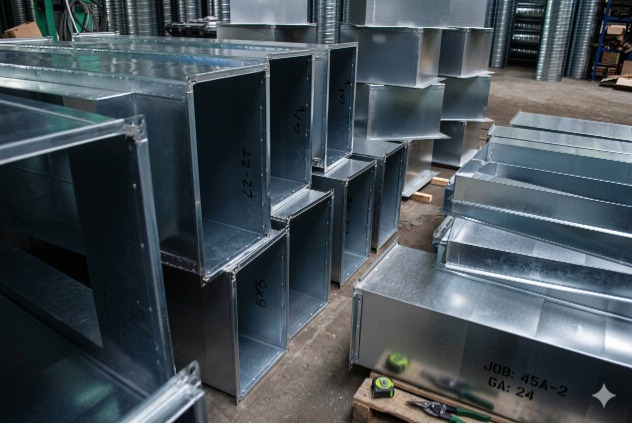
(AI generated) Sheet metal ducts stacked in a factory
Sheet metal ductwork is a system of rigid metal air channels used to distribute airflow in HVAC and industrial ventilation systems. It is commonly fabricated from galvanized steel and designed to minimize air leakage, pressure loss, and energy consumption. Go into any factory, hospital, or data center and look up. Behind the ceiling panels sits a metal network moving thousands of cubic meters of air every hour.
Most people will never notice it or think about it. But engineers do.
That network is sheet metal ductwork, and it quietly determines whether an HVAC system runs efficiently or keeps wasting energy for decades. Poorly fabricated ducts leak air, create pressure losses, and force fans to work harder. Good ductwork does the opposite.
Air moves smoothly.
The system balances faster.
Energy use drops.
The scale is massive. According to the International Energy Agency, buildings account for roughly 30% of global energy consumption, and HVAC systems represent one of the largest contributors. Even small airflow inefficiencies multiply across large facilities.
That’s why engineers pay attention to sheet metal duct fabrication quality. The geometry, seams, and material selection directly affect airflow performance.
At JLCCNC, we see the tolerance issues, tooling wear, and forming constraints that determine whether a duct system installs smoothly or turns into a field headache.
In this article, we’ll break down what sheet metal ductwork actually is and how we fabricate it.
What Is Sheet Metal Ductwork?
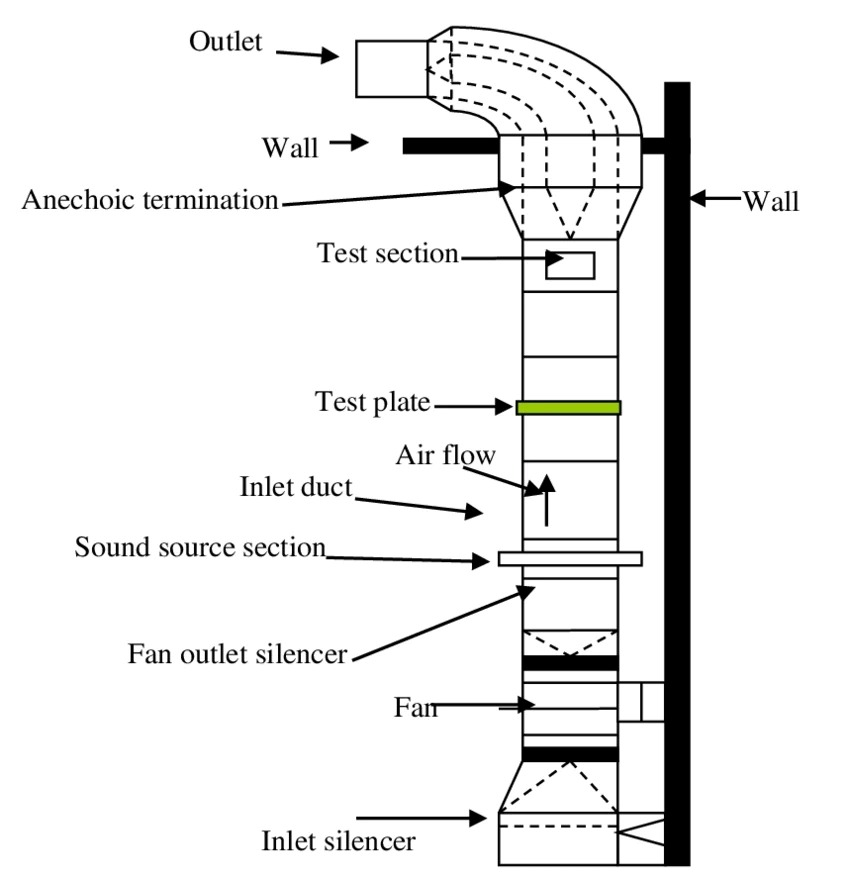
(ResearchGate) Diagram of a flow duct
Definition of Sheet Metal Ductwork
Sheet metal ductwork is the building's rigid circulatory system. These are just "pipes" to other people but to us, they are a specifically engineered network of thin-gauge metal channels designed to move massive volumes of conditioned air without collapsing or leaking under pressure.
While you'll occasionally see aluminum or stainless steel in high-spec labs or "wash-down" industrial zones where corrosion is a constant threat, galvanized steel is the undisputed industry standard. It’s the sweet spot for most mechanical contractors because it offers the structural "backbone" needed for long spans while the zinc coating keeps rust at bay for decades.
The actual fabrication process is where the engineering happens. It’s the transition from flat, inert sheets into functional air-distribution sections through a series of...
● Sheet metal cutting or shearing
● Press-brake bending or roll forming
● Seam locking or welding
● Flange attachment and reinforcement
Each fabricated section becomes part of a larger airflow system. Installers connect the sections using flanges, slip joints, or mechanical locks.
Rigid construction matters here. Sheet metal maintains its shape under airflow pressure, which keeps the internal cross-section consistent and predictable.
That stability is one reason engineers prefer sheet metal ducting in commercial HVAC installations.
Difference Between Metal Ductwork and Flexible Duct Systems
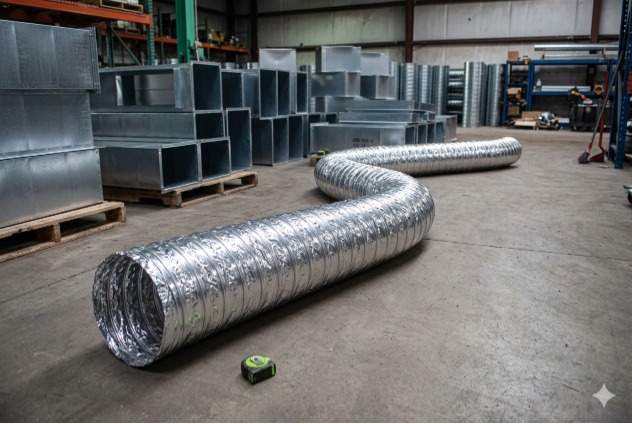
(AI generated) Flexible Duct
Not every HVAC system has to use rigid ducts.
Flexible ducts appear in residential installations and short branch runs too. They consist of a spiral wire core surrounded by plastic and insulation.
Flexible ducts solve routing problems. They bend around obstacles and install quickly.
Rigid metal ductwork maintains a consistent internal diameter. Air travels with less turbulence and lower friction losses.
Flexible ducts behave differently, hence the name “flexible”. When installers compress or stretch them during installation, the internal diameter changes. The duct sags between supports. Airflow resistance increases.
Field measurements often confirm the difference. Engineers conducting airflow balancing frequently find that they can reduce airflow by 10–30%, depending on installation quality, length, and support spacing in long flexible duct runs compared with rigid duct sections.
That’s why large buildings and industrial systems rely heavily on sheet metal ducting for main airflow trunks.
Role in HVAC Airflow and Ventilation Systems
Air distribution systems depend on pressure differences created by fans or air handlers.
The duct network channels that air to occupied spaces.
If the ducts leak, airflow drops before it reaches the room. If the internal surface is rough or poorly formed, friction increases and fans must work harder.
The U.S. Department of Energy estimates that duct leakage can waste up to 20–30% of HVAC airflow in poorly sealed or uncommissioned systems.
That’s a massive loss.
Proper industrial ductwork fabrication minimizes these issues through:
● Tight seam construction
● Reinforced duct walls
● Smooth internal surfaces
● Accurate flange alignment
Engineers also design duct layouts to maintain proper airflow velocity. Too slow and air stagnates. Too fast and noise increases.
Good duct fabrication keeps those design calculations valid once the system reaches the field.
Sheet Metal Ductwork Types (Quick Comparison)
(AI generated) Sheet metal ducts of various shapes stacked in a factory
| Duct Type | Typical Shape & Construction | Where Engineers Use It | Advantages | Limitations |
|---|---|---|---|---|
| Rectangular Ducts | Fabricated from flat sheet metal panels bent on press brakes and joined with Pittsburgh or lock seams. Reinforced with stiffeners on large sections. | Commercial buildings, offices, hospitals, and ceiling plenums where space is tight. | Fits easily between beams and ceilings. Simple to fabricate with standard sheet metal duct fabricatio equipment. Good for large trunk lines. | Higher friction losses than round ducts. Needs reinforcement on larger sizes to prevent wall vibration. |
| Spiral Ducts | Formed by wrapping sheet metal into a continuous spiral seam using spiral duct forming machines. Usually galvanized steel. | Modern commercial buildings, exposed HVAC systems, warehouses, retail stores. | Strong structure with fewer joints. Fewer joints typically result in lower leakage potential. Cleaner airflow path and visually appealing when exposed. | Requires specialized forming machines. Fittings can cost more than standard rectangular components. |
| Round / Circular Ducts | Straight cylindrical ducts fabricated by roll forming sheet metal and joining longitudinal seams. | High-efficiency HVAC systems, industrial ventilation, long airflow runs. | Best aerodynamic performance. Lower pressure drop compared with most metal ductwork geometries. Less surface area for air friction. | Harder to route through tight ceiling spaces. Installation may require additional clearance. |
| Flexible Ducts | Plastic inner liner supported by spiral wire coil and covered with insulation jacket. Not true sheet metal ducting, but often connected to rigid duct systems. | Short branch runs between rigid ducts and diffusers in residential or light commercial systems. | Very easy to install. Bends around obstacles. Low material cost. | Airflow losses increase when ducts sag or compress. Limited durability compared with rigid sheet metal ductwork. |
| Custom or Specialty Ducts | Includes oval ducts, double-wall insulated ducts, stainless steel ducts, and corrosion-resistant systems produced through custom industrial ductwork fabrication. | Laboratories, food processing plants, chemical facilities, or architectural HVAC installations. | Tailored to airflow constraints, corrosion environments, or strict hygiene requirements. |
In practice, most HVAC systems combine multiple duct types to balance space constraints, airflow efficiency, and cost.
How to Choose Sheet Metal Ductwork Types
When picking the right sheet metal ductwork type, you should understand airflow, installation constraints, and how the system will behave ten years from now. Engineers usually start with two questions: First, how much air needs to move? Second. How much space does the building give you to move it?
Below are the decisions that matter most when selecting metal ductwork.
Rectangular vs Round vs Spiral Ductwork
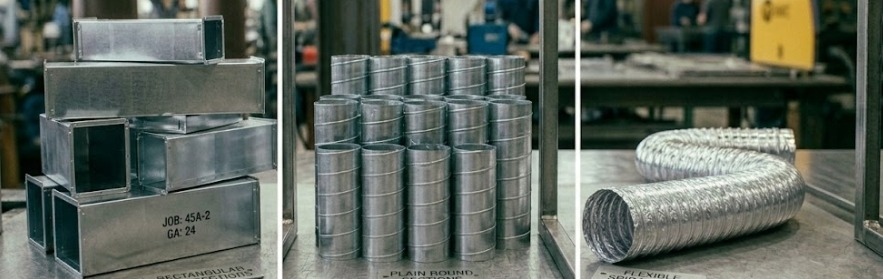
(AI generated) comparison of rectangular vs round as spiral
Each geometry solves a different engineering problem.
Rectangular ducts dominate commercial buildings because they fit where space is tight. If you’ve worked above a drop ceiling, you already know why. Structural beams, electrical trays, and plumbing leave narrow gaps. Rectangular sheet metal ducting slides through those gaps more easily than round pipes.
But airflow isn’t perfect in rectangles. The corners create turbulence and slightly higher pressure loss.
Round ducts move air more efficiently. The circular cross-section keeps airflow smooth and reduces friction. Engineers often use round ducts for long trunk lines in industrial buildings or warehouses where ceiling space isn’t as restrictive.
Spiral ducts are essentially round ducts with a spiral seam. They combine structural strength with efficient airflow. You’ll see them in exposed HVAC systems in factories or modern offices.
One manufacturer we worked with installed round spiral ducts in a warehouse distribution center. The system moved air across long distances with fewer booster fans. That design cut energy consumption compared with the original rectangular layout.
Rigid vs Flexible Duct Systems
Rigid ducts handle the heavy lifting in most HVAC systems.
Rigid sheet metal ductwork keeps its shape even under high airflow velocity. That stability keeps pressure losses predictable, which makes airflow balancing easier during commissioning.
Flexible ducts solve a different problem. They simplify installation in tight spaces.
Installers often connect flexible ducts between rigid branches and ceiling diffusers. The flexibility allows quick alignment with vents without cutting additional metal sections.
But flexibility comes with a tradeoff.
If flexible ducts sag or compress, airflow resistance increases quickly. That’s why engineers typically limit flexible runs to short sections rather than full duct routes.
In most hvac ductwork fabrication projects, the backbone of the system remains rigid metal ducts.
Galvanized Steel, Stainless Steel, and Aluminum Ducts
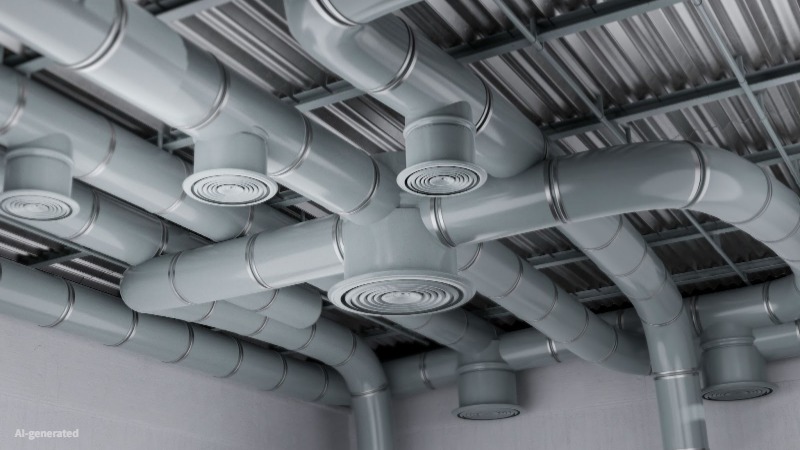
(Freepik) Metal Ductwork
Material specs dictate a system's lifespan, corrosion overhead, and total cost. Most commercial HVAC projects rely on galvanized steel. The zinc coating provides a reliable barrier against oxidation, while the base metal offers the structural rigidity needed for high-velocity airflow.
On the other hand, stainless steel is the standard for aggressive environments. You will typically find stainless ductwork in food processing, pharmaceutical labs, or chemical plants where contamination or flash-rusting isn't an option. While more expensive, the material's inert properties are a requirement for these clean-room standards. Learn how stainless steel compares to cold rolled steel in sheet metal.
Aluminum serves a specific niche: weight reduction and coastal resilience. We specify aluminum when structural load limits are tight or when salt-air corrosion would strip a galvanized coating in months.
Our manufacturer building high-spec ventilation units recently hit a bottleneck with stainless steel forming accuracy. Stainless is notorious for "spring-back" during bending. By switching to precision-machined tooling, we maintained tighter seam alignment across the duct sections. This improved fit-up directly reduced air leakage and cut down on the sealant required during final assembly.
Choosing the right duct type for HVAC systems
Rarely does a system use a single duct type.
The main trunk lines usually require rectangular sheet metal to fit within the constraints of tight ceiling plenums. Once the run moves into an open mechanical room, switching to round ducts is the better move for airflow efficiency. Finally, use flexible ducts only for short terminal connections; they simplify the final drop to the diffuser but shouldn't be used for long runs where static pressure loss becomes an issue.
Sheet Metal Duct Fabrication Process: Step-by-Step
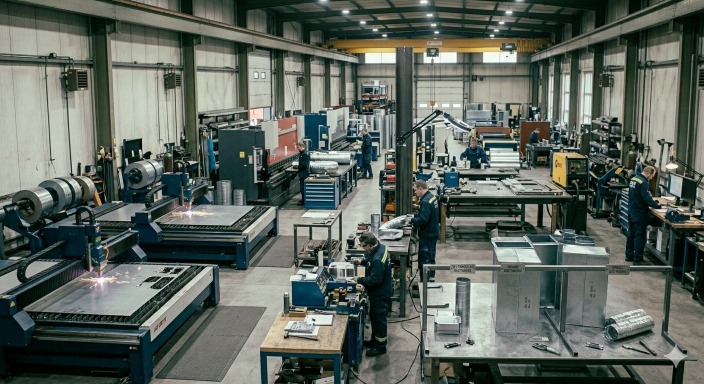
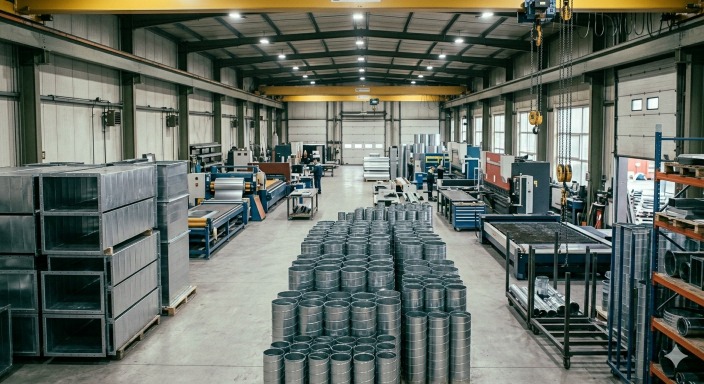
(AI generated) Factory floor showing sheet metal duct fabrication
When people picture sheet metal duct fabrication, they usually imagine someone just easily bending metal in a factory. That’s not how real production works.
A duct system passes through several steps before it ever reaches the job site. Miss one detail early and the installer pays for it later. Parts don’t line up. Seams leak.. And airflow drops.
So, what actually happens inside a typical hvac ductwork fabrication shop?
Design and CAD/BIM Planning
Everything starts in the design model.
Engineers lay out the duct network in CAD or BIM software so the system fits around beams, electrical trays, sprinkler lines, and everything else hiding above the ceiling. If you’ve ever opened a mechanical room drawing, you know space disappears fast.
The model defines:
● duct dimensions
● airflow capacity
● connection points
● fittings and transitions
In larger commercial projects, that digital layout feeds directly into fabrication software. The shop receives flat patterns ready for cutting. No guessing.
When the planning stage works well, installers spend less time trimming or forcing sections to fit on-site.
Cutting Methods: Laser, Plasma, and Shearing
Before forming begins, flat sheets must be cut into patterns that will become duct sections.
| Cutting Method | How It Works | When Shops Use It |
|---|---|---|
| Laser Cutting | Focused laser beam melts and cuts sheet metal with high precision. | Complex duct fittings, tight tolerances, automated sheet metal duct fabrication lines. |
| Plasma Cutting | High-temperature plasma arc slices through metal quickly. | Thicker materials and high-volume industrial duct parts. |
| Mechanical Shearing | Straight blades cut sheet metal along linear edges. | Simple rectangular sections in standard sheet metal ducting production. |
Most shops combine these methods. Simple duct panels often go through shearing machines. Complex fittings move to laser cutters.
See our detailed guide on laser cutting vs plasma cutting
Forming and Bending Processes
Once the flat patterns are ready, they move to forming.
Press brakes bend panels into rectangular duct sections. Roll forming machines create round ducts. Spiral machines produce continuous spiral seams used in exposed metal ductwork systems.
Forming accuracy matters here. A bend angle off by a few degrees may not look serious, but multiply that error across dozens of sections and installers start fighting the joints.
In high-volume industrial ductwork fabrication, automated forming lines keep those angles consistent.
Assembly: Welding, Fastening, and Sealing
After forming, the duct sections start to look like real ducts.
Technicians join seams using methods such as:
● Pittsburgh lock seams
● spot welding
● mechanical fasteners
● flange systems
Sealing comes next. Sealants or gaskets close small gaps to prevent air leaks.
Poor seam sealing is one of the biggest reasons HVAC systems lose airflow. In some buildings, leaks can quietly waste a large percentage of conditioned air before it reaches the room.
Good hvac ductwork fabrication avoids that problem at the shop level.
Quality Control and Inspection
Before ducts leave the shop, technicians check the basics:
● seam integrity
● dimensional accuracy
● flange alignment
● surface defects
If a flange twists or a seam opens slightly, installers will notice immediately when they try to connect sections.
Good fabrication shops catch those problems early. Fixing them in the factory takes minutes. Fixing them on a ladder during installation takes much longer.
Cost Drivers: Material, Labor, and Complexity
Three things usually determine the cost of sheet metal ductwork.
Material. Galvanized steel is the standard. Stainless steel or aluminum increases cost quickly.
Labor. Complex fittings and transitions require more forming and assembly time.
Complexity. Custom shapes, tight tolerances, or specialized industrial ductwork fabrication processes add additional steps.
When putting it into practice, simple rectangular ducts remain the most economical option. Once designs involve curved sections, stainless materials, or architectural spiral ducts, fabrication costs rise fast.
That’s why early design decisions matter. Ready to get your custom sheet metal ductwork fabricated exactly to spec? Upload your files now and let our engineers turn your designs into precision-built reality, fast, accurate, and stress-free.
HVAC Ductwork Fabrication: Key Design Requirements
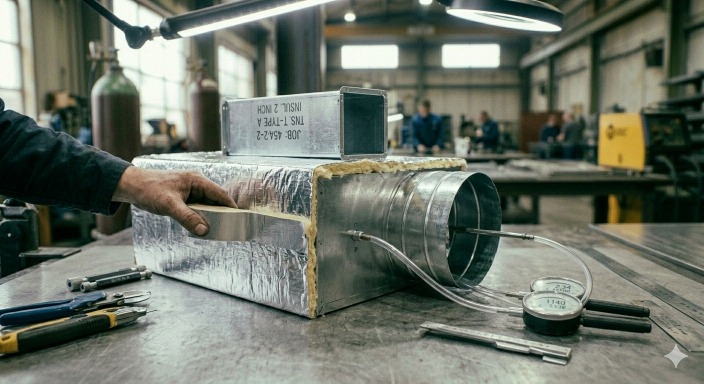
(AI generated) Sheet metal duct with insulation and airflow testing
Small issues stack up. By the time the system runs, the fan works harder and the airflow never quite matches the design.
Good hvac ductwork fabrication prevents those problems before installation.
Here are the four requirements engineers care about most when designing sheet metal ductwork.
Airtightness and Leakage Control
Air leaks are the silent performance killer in HVAC systems.
Every joint in sheet metal duct fabrication is a potential escape path for air. When seams aren’t sealed properly, conditioned air leaks into ceilings or mechanical rooms instead of reaching occupied spaces.
Field studies in commercial buildings often show 10–30% airflow loss due to duct leakage.
You’ll notice it during system balancing. The airflow calculations look correct, but the vents still feel weak.
Fabricators reduce leakage by:
● using proper seam locks
● applying duct sealant at joints
● keeping flange connections tight and square
If the fabrication shop does its job well, installers spend far less time chasing airflow problems later.
Structural Strength and Rigidity
Large ducts carry a surprising amount of pressure.
When air moves quickly through wide rectangular sections, the duct walls can flex inward. That deformation changes the internal cross-section and increases resistance.
In extreme cases, poorly reinforced metal ductwork can vibrate or create noise when the system runs at full capacity.
Fabrication shops prevent that by adding:
● reinforcement ribs
● stiffening bars
● thicker sheet gauges on large ducts
This is especially important in industrial ductwork fabrication, where airflow volumes are much higher than in typical office HVAC systems.
Thermal Performance and Insulation
Temperature control doesn’t stop at the air handler.
If ducts run through unconditioned spaces like attics or mechanical shafts, heat transfer can reduce HVAC efficiency. Cold supply air warms up before it reaches the room.
That’s why many systems use insulated sheet metal ducting.
Insulation serves two purposes:
1. It prevents heat loss or gain.
2. It reduces condensation on duct surfaces.
Without insulation, moisture can form on ducts carrying cold air, which eventually leads to corrosion or water damage.
Airflow Efficiency and Pressure Management
Air behaves like a fluid when it moves through these pipes. Every bend, seam, and rough surface will affect how easily it flows.
Well-designed sheet metal ductwork keeps airflow smooth by:
● limiting sharp turns
● maintaining consistent duct diameters
● using gradual transitions between sections
Round and spiral ducts often perform better here because they reduce friction compared with rectangular designs.
In long runs, those efficiency gains matter. Lower resistance means the fan doesn’t need to work as hard, which reduces energy consumption over the system’s lifetime.
Ductwork Design Mistakes That Increase Cost or Reduce Performance
Most duct problems start in the design.
Incorrect Duct Sizing
Undersized ducts choke airflow. The fan works harder, noise increases, and rooms never receive the air volume they need.
Oversized ducts create a different issue. Air slows down too much, which makes balancing the HVAC system harder and wastes material.
Engineers usually size sheet metal ductwork based on airflow demand and velocity targets. Skip those calculations and the whole system struggles.
Excessive Bends and Turns
Every turn adds resistance, just like driving a car.
Too many sharp elbows in sheet metal ducting increase pressure loss and reduce airflow efficiency. Long duct runs with multiple turns often require larger fans just to maintain the same airflow rate.
Good duct layouts keep the path simple with less turns.
Poor Material Selection
Standard galvanized metal ductwork is not the answer to every environment.
High humidity, corrosive air, or industrial fumes can destroy the wrong material quickly. Stainless steel or coated metals often perform better in those conditions. All this should be kept in mind that material decisions can affect long-term results.
Insufficient Sealing or Leakage
Leaky ducts waste air obviously.
Loose seams, poorly sealed joints, or misaligned flanges during hvac ductwork fabrication allow conditioned air to escape into ceilings and mechanical spaces, which is a total waste of good air.
Ignoring Airflow and Static Pressure
Airflow design should never be left to guesswork. It depends on static pressure calculations across the entire duct network.
If designers ignore pressure losses from bends, fittings, and duct length, the system won’t perform as expected.
Fans may struggle to push air through the system, even when the duct size appears correct.
Industrial Ductwork Fabrication and Heavy-Duty Applications
Industrial Duct Systems vs Commercial HVAC
| Feature | Industrial Duct Systems | Commercial HVAC Duct Systems |
|---|---|---|
| Purpose | Transport dust, fumes, exhaust gases, or process air | Distribute conditioned air for heating and cooling |
| Airflow Volume | Often extremely high for production equipment | Moderate airflow for building ventilation |
| System Complexity | Integrated with manufacturing equipment and filtration systems | Integrated with air handlers and building ventilation |
| Fabrication Approach | Heavy-duty industrial ductwork fabrication with thicker materials and reinforcements | Standard sheet metal duct fabrication using lighter gauges |
High-Temperature and High-Pressure Environments
| Requirement | Industrial Systems | Standard HVAC Systems |
|---|---|---|
| Temperature Range | Can exceed several hundred degrees in exhaust systems | Typically near room temperature airflow |
| Pressure Loads | Higher internal pressures from extraction systems | Lower pressure from building air handlers |
| Reinforcement | Additional stiffeners and thicker metal | Minimal reinforcement in most ducts |
| Safety Considerations | Heat resistance and structural durability critical | Focus mainly on airflow efficiency |
Dust, Fumes, and Exhaust Handling Systems
| Application | Industrial Duct Use | Key Design Considerations |
|---|---|---|
| Dust Collection | Moves particles from machinery to filtration units | Smooth interior surfaces reduce buildup |
| Fume Extraction | Removes welding or chemical fumes from work areas | Corrosion-resistant sheet metal ducting often required |
| Process Exhaust | Removes heat or gases from production lines | Larger diameters and reinforced sections |
| Ventilation Systems | Maintains safe air quality in factories | Integrated filtration and fan systems |
Materials Used for Industrial Ductwork
| Material | Why It’s Used | Typical Applications |
|---|---|---|
| Galvanized Steel | Durable and cost-effective | General factory ventilation systems |
| Stainless Steel | Corrosion and heat resistance | Chemical plants and food processing |
| Aluminum | Lightweight and corrosion resistant | Coastal facilities or lightweight installations |
| Carbon Steel | High strength for heavy-duty systems | Large-scale industrial ductwork fabrication in manufacturing plants |
Advantages of Sheet Metal Ductwork in HVAC System
Engineers don't specify rigid sheet metal because it’s the easiest option, they do it because it’s the only one that doesn't collapse or leak profile after five years of thermal cycling. Unlike flex duct, which turns into a high-resistance mess if the installer misses a single support bracket, rigid metal stays true to the original CAD flow-sim.
The Performance Reality
Durability is the obvious win, but the real value is in the static pressure consistency. A well-fabricated system keeps the fan curve where it belongs. When you reduce leakage through precision-sealed seams, the BHP (Brake Horsepower) requirement for the blower drops. That’s an immediate energy win for the building owner that flex-duct simply can't match.
Safety is also a non-negotiable factor. In commercial plenums, fire codes are brutal. Metal doesn't melt, off-gas, or contribute to flame spread like plastic-based alternatives.
Challenges and Limitations of Metal Ductwork
The high performance comes with a literal price tag. You’re looking at significantly higher material costs and a labor-heavy install. Between the weight of the sections and the precision needed for hangers, it’s a slower "boots-on-the-ground" process.
Noise is the other major hurdle. Rigid steel is a great conductor for vibration. If the design skips acoustic liners or canvas duct connectors at the unit discharge, the ductwork basically acts as a giant stethoscope for the AHU (Air Handling Unit).
Applications of Sheet Metal Ductwork
The application usually dictates the gauge and the seal class:
Residential: Generally uses lighter 26-28 gauge for supply trunks.
Data Centers & Hospitals: High-pressure Class A seals are mandatory here. We use precision CNC fabrication to ensure the static pressure remains rock-steady for HEPA filtration.
Industrial/Manufacturing: These systems are often reinforced to handle particulate loading or dust extraction where abrasive wear is a factor.
How to Choose the Right Sheet Metal Duct Fabrication Method
Choosing a type is only half the battle. The real friction starts when you have to pick a fabrication workflow that doesn't blow the budget or create a nightmare for the install crew. If the method doesn't match the design intent, you’re just paying for scrap metal and field fixes.
Environment vs. Tooling
The shop floor approach changes the moment you move away from standard galvanized steel. While a basic pittsburgh machine handles light-gauge galvanized all day, stainless steel is a different animal. It’s less forgiving, has high spring-back, and usually demands higher-tonnage press brakes and precision laser cutting to keep the seams from drifting. If you're in a coastal or high-moisture zone specifying aluminum, your welding and fastening techniques have to pivot to avoid tearing the softer material during the roll-forming stage.
Geometry: When to Go Custom
Most trunk lines are straightforward, but building layouts rarely play fair.
Straight Runs: Stick to automated coil lines and shearing for rectangular sections to keep the cost per foot down.
Complex Transitions: When you’re jumping from a massive AHU discharge into a tight ceiling plenum, CNC-cut fittings are mandatory. Trying to "field-fit" complex offsets without precision-cut transitions is a guaranteed way to spike your labor hours.
Spiral vs. Rectangular: We favor spiral or round ducts for long, open runs because the airflow physics (and lower pressure drop) are superior. Rectangular stays in the "low-headroom" category where every inch of height matters.
The JLCCNC Advantage: Beyond Off-the-Shelf
Off-the-shelf components work for a generic house, but industrial-grade systems need a tighter feedback loop. At JLCCNC, we bridge the gap between a CAD model and a production-ready quote. Upload your files and get started your quete today!
FAQs about the Sheet Metal Ductwork
Q: What is sheet metal duct fabrication?
Sheet metal duct fabrication is the process of cutting, forming, and assembling flat metal sheets into duct components used to transport air in HVAC and industrial ventilation systems. It typically involves operations like shearing, bending, seam locking, and sealing to ensure airtight performance.
Q: What is sheet metal ductwork used for?
It distributes conditioned air through HVAC systems in homes, commercial buildings, and industrial facilities.
Q: What material is most common for metal ductwork?
Galvanized steel is the most widely used material for sheet metal ductwork because it balances durability, corrosion resistance, and cost.
Q: Are round ducts better than rectangular ducts?
Round ducts typically allow smoother airflow and lower pressure loss, while rectangular ducts fit better in tight ceiling spaces.
Q: How long does sheet metal ductwork last?
Properly fabricated and installed metal ductwork can last several decades with minimal maintenance.
Q: Is sheet metal ducting better than flexible ducting?
Rigid sheet metal ducting generally provides better airflow efficiency and durability, while flexible ducts are mainly used for short connections.
Q: What affects the cost of sheet metal duct fabrication?
Material type, duct size, fabrication complexity, and installation requirements all influence the final cost of sheet metal duct fabrication
Popular Articles
• CNC Machining in the Medical Industry
• CNC for Luxury Watchmaking: Achieving Sub-Micron Tolerances
• Micro CNC Machining: Techniques for Manufacturing Miniature Components
• CNC Machining vs Sheet Metal: Which is Better for Enclosures?
• Micro CNC Machining Explained: Process, Precision & How Small It Can Really Get
Keep Learning
What Is Sheet Metal Ductwork? A Guide to HVAC and Industrial Duct Fabrication
(AI generated) Sheet metal ducts stacked in a factory Sheet metal ductwork is a system of rigid metal air channels used to distribute airflow in HVAC and industrial ventilation systems. It is commonly fabricated from galvanized steel and designed to minimize air leakage, pressure loss, and energy consumption. Go into any factory, hospital, or data center and look up. Behind the ceiling panels sits a metal network moving thousands of cubic meters of air every hour. Most people will never notice it or t......
CNC Enclosure Design for Machining: Cost, Materials, and Production Considerations
What Is a CNC Machined Enclosure (AI generated) CNC-machined aluminum enclosure with internal cavities A CNC machined enclosure is a housing manufactured by removing material from a solid block using milling or turning operations. The process creates accurate internal cavities, threaded features, and sealing surfaces. Engineers use CNC machining when the enclosure must hold electronics, sensors, or mechanical assemblies with tight alignment requirements. Typical examples include control modules, instr......
Aerospace CNC Machining: Processes, Materials, Challenges, and Applications
(AI-generated) Aerospace machining plays a critical role in the manufacturing of aircraft, spacecraft, and defense systems, where safety, performance, and reliability are non-negotiable. From structural airframe components to complex engine parts, machining for aerospace requires extreme precision, strict quality control, and deep expertise in materials With the advancement of aerospace CNC machining, manufacturers can now produce highly complex geometries with tight tolerances while meeting demanding......
CNC Machining vs Sheet Metal: Which is Better for Enclosures?
Introduction Designing enclosures for electronic devices and industrial equipment can be challenging. Factors like precision, material selection, production cost, and manufacturing lead time all play critical roles in the success of a product. For engineers, designers, and startups, choosing the right manufacturing method for enclosures is crucial. JLCCNC provides both CNC machining and sheet metal fabrication services, helping clients transform their CAD designs into high-quality enclosures quickly a......
Micro CNC Machining Explained: Process, Precision & How Small It Can Really Get
Explaining Micro CNC Machining Any machinist can machine a block of aluminum into a bracket. But what happens when your part is the size of a grain of rice, and still needs tolerances tighter than a human hair? That's when “standard CNC” suddenly feels clumsy, and every micron starts to matter. This is the world of micro CNC machining. It's not about big, impressive cuts, it's about making the kind of components you'll never notice… until they fail. Like the gears in a luxury watch, the nozzles in med......
How Jewelry Manufacturing Is Being Revolutionized by CNC Machines
Efficiency, inventiveness, and precision are essential in the jewelry-making industry. The way jewelers create and produce their items has changed dramatically over time thanks to CNC (Computer Numerical Control) devices. Compared to more conventional techniques, these machines are allowing jewelers to produce intricate designs more quickly, consistently, and with less waste. This article examines how CNC technology is transforming the jewelry sector by giving producers the means to experiment and sat......