What Is Bakelite? Properties, Manufacturing Process, and CNC Machining Guide
18 min
- What Is Bakelite
- Key Properties of Bakelite
- How Bakelite Is Made and Why It Affects Machining Results
- Types and Grades of Bakelite Materials
- CNC Machining Behavior and Challenges of Bakelite
- Machining Guidelines for Bakelite Parts
- Design Guidelines for Machined Bakelite Parts
- When Bakelite Should NOT Be Used
- Cost Factors in Machining Bakelite Parts
- Typical Applications of Bakelite Components
- CNC Machining Bakelite at JLCCNC
- FAQ About Bakelite Machining
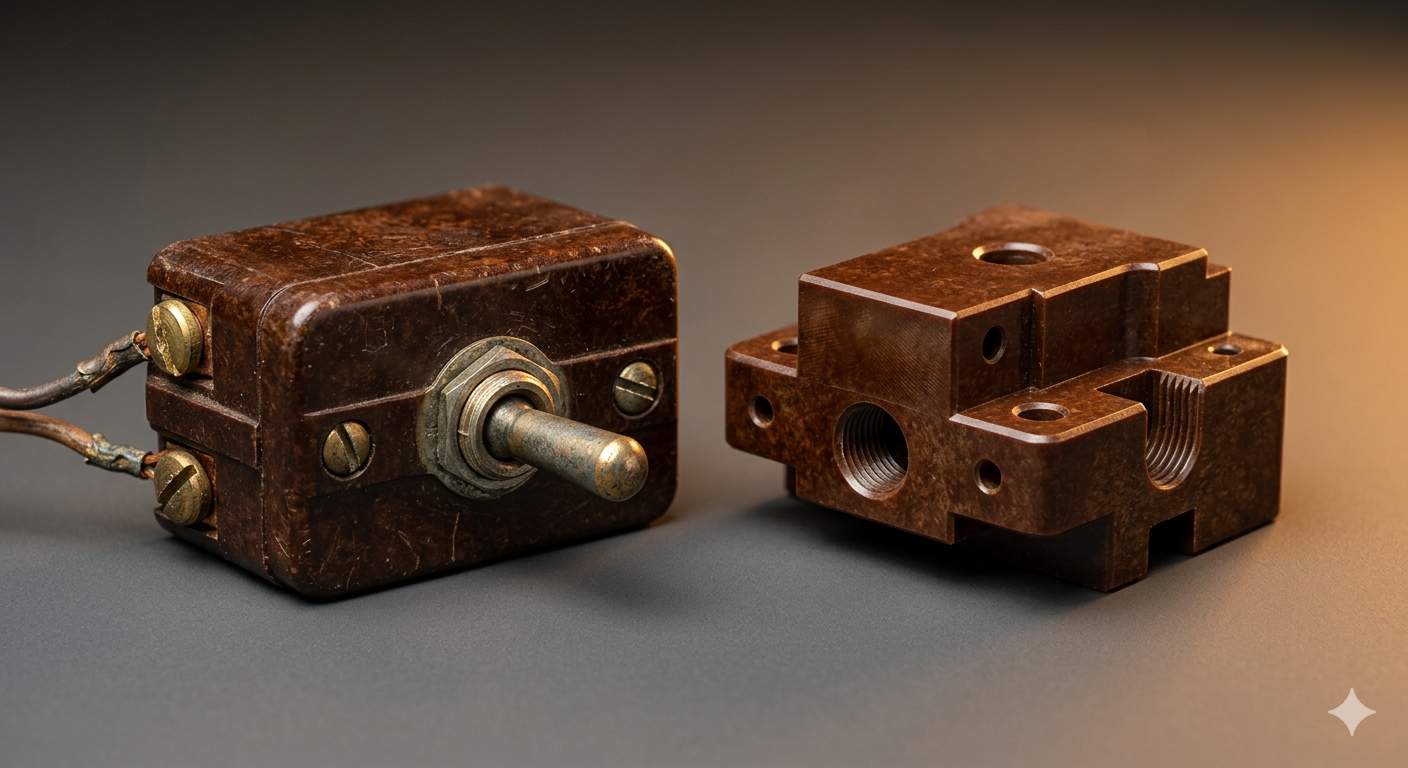
(AI generated) Vintage bakelite switch and modern machined bakelite
Bakelite still appears in electrical systems, legacy equipment, and industrial fixtures where thermal stability and insulation matter more than mechanical toughness. In these environments, materials are not selected for flexibility or impact resistance, but for their ability to remain stable under heat, voltage, and long-term load.
Unlike modern thermoplastics, Bakelite does not soften or deform once formed. That behavior affects not only how it performs in service, but also how it must be machined. Edge integrity, tool wear, and dust control all become process constraints rather than secondary considerations.
Understanding how Bakelite is made and how it behaves under cutting conditions is necessary before applying it to CNC machining or part design.
What Is Bakelite
Bakelite is a thermoset plastic made from phenol and formaldehyde that permanently hardens during heat and pressure curing. Once formed, it cannot be melted or reshaped. Its cross-linked structure provides high electrical insulation, heat resistance, and dimensional stability, which is why it is commonly used in electrical components, industrial fixtures, and legacy molded parts.
Key Properties of Bakelite
Bakelite is defined by its thermoset structure, which determines how it behaves under thermal, electrical, and mechanical conditions. Unlike thermoplastics, its properties remain stable after curing and do not change with reheating.
Thermal stability is one of the defining characteristics. Bakelite maintains structural integrity at elevated temperatures where many plastics would soften or deform. Instead of melting, it gradually degrades at higher temperatures, which allows it to be used in heat-exposed electrical components and housings.
Electrical insulation performance is another key property. The material exhibits high dielectric strength and low electrical conductivity, making it suitable for switchgear, circuit components, and insulation panels where consistent performance under voltage is required.
Mechanically, Bakelite offers high compressive strength but limited toughness. It resists deformation under load but shows low elongation at break, typically around 0.5–2% depending on grade. This means it does not absorb impact energy well and tends to fracture rather than deform.
Dimensional stability is generally good over time, especially in static environments. The cross-linked structure prevents creep, which is common in thermoplastics. However, internal stresses introduced during curing can remain in the material and may release under certain conditions.
Material composition also plays a role. Fillers such as paper, fabric, or glass fibers affect density, strength, and thermal behavior. These variations mean that properties can differ between grades, even when the base resin is the same.
How Bakelite Is Made and Why It Affects Machining Results
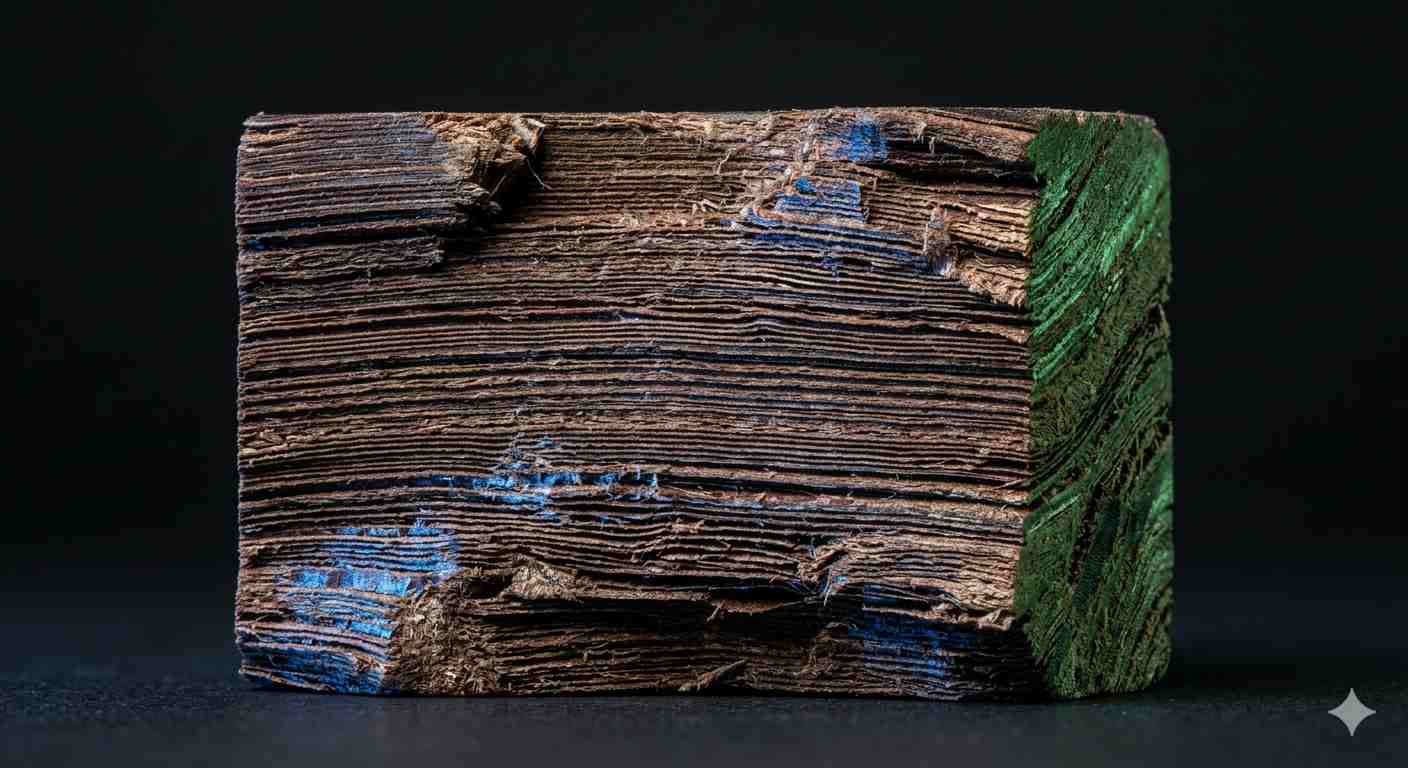
(AI generated) Cross-section of bakelite material
The bakelite manufacturing process uses compression, heat, and irreversible curing to lock the material into a rigid, cross-linked structure. That structure is exactly why it performs well under heat and electrical load. It’s also why it can chip, crack, or behave unpredictably if you treat it like a uniform material.
Understanding the bakelite manufacturing process directly explains why machining results vary from part to part.
Compression Molding and Curing Process
Bakelite starts as a phenolic resin mixed with fillers like wood flour, paper pulp, or fabric. This mixture is placed into a heated mold and compressed under high pressure.
During curing, a chemical reaction takes place. The resin cross-links permanently, forming a rigid, three-dimensional network.
That curing process creates two important machining realities.
First, the material is hard but brittle. It doesn’t deform before failure like metals or ductile plastics. It fractures. That means cutting forces need to stay controlled, especially at edges and thin features.
Second, density isn’t always perfectly uniform. Small variations in pressure or filler distribution during molding can create localized differences in hardness. When machining Bakelite, you’ll feel that as inconsistent cutting resistance across the same part.
This is why conservative feeds and sharp tools matter more than aggressive removal rates.
Layered Structure and Anisotropy
Sheet-based forms, especially those made with paper or fabric reinforcement, develop a layered structure during manufacturing. Think of it less like a solid block and more like a compressed stack of bonded layers.
That introduces anisotropy, meaning the material behaves differently depending on the cutting direction.
Machine along the layers, and the cut can feel stable and controlled. Cut across them, and you increase the risk of chipping or delamination, especially near edges or drilled holes.
This is one of the biggest differences in machining bakelite compared to relatively isotropic materials like aluminum alloys. Toolpath direction and entry strategy start to matter more than most people expect.
Ignoring layer orientation is one of the fastest ways to ruin surface finish or edge integrity.
Internal Stress and Batch Variability
Because Bakelite cures under heat and pressure, internal stresses are often locked into the material during manufacturing.
Once you start machining, those stresses can release.
That’s when you see parts shift slightly after cutting, or small dimensional changes that weren’t present in the raw stock. It’s not the machine. It’s the material relaxing.
Batch variability adds another layer.
Different batches of bakelite plastic can vary based on:
- filler type and ratio
- curing conditions
- age and storage environment
Two sheets from different suppliers, or even different production runs, may behave differently during machining. One cuts clean. Another chips at the edges under identical parameters.
That’s why process stability with Bakelite comes from testing, not assumptions.
Types and Grades of Bakelite Materials
| Category | Type / Grade | Structure & Composition | Key Properties | Machining Behavior | Typical Applications |
|---|---|---|---|---|---|
| Phenolic Resin Variants | General Phenolic (Paper-filled) | Phenolic resin with paper pulp layers | Good electrical insulation, moderate strength, lightweight | Machines relatively clean but can delaminate if cut across layers | Electrical panels, insulation sheets |
| Fabric-filled Phenolic | Reinforced with cotton or fabric layers | Higher mechanical strength, better wear resistance | More stable than paper-based, but tougher on tools | Gears, bushings, structural components | |
| Glass-filled Phenolic | Resin with glass fiber reinforcement | High strength, heat resistance, improved dimensional stability | Abrasive to tools, requires controlled cutting | High-performance electrical and thermal components | |
| Manufacturing Type | Laminated Bakelite | Layered sheets compressed and cured | Anisotropic behavior, strength varies by direction | Sensitive to cutting direction, risk of edge chipping | Sheets, panels, machined flat components |
| Molded Bakelite | Compression molded into final shape | More uniform structure, less directional weakness | More predictable machining, less delamination risk | Housings, knobs, legacy molded parts | |
| Application Grade | Electrical Grade | Optimized for insulation and heat resistance | High dielectric strength, stable under voltage and heat | Machines well but brittle at edges | Switchgear, insulators, circuit components |
| Industrial Grade | Designed for mechanical performance | Higher toughness, better wear resistance | Slightly tougher to machine but more durable | Bearings, fixtures, mechanical supports |
These variations directly affect machining stability and tool wear in CNC processing. Here’s how different CNC materials compare in terms of machinability, strength, and cost across real applications.
CNC Machining Behavior and Challenges of Bakelite
Bakelite creates machining problems for reasons that are built into the material itself. Once cured, it does not soften, stretch, or recover the way most plastics do. Instead, it reacts to cutting forces through brittle fracture, abrasive tool contact, localized heat damage, and, in some cases, small dimensional shifts after machining. These behaviors do not always cause obvious failure during the cut, but they often show up later as chipped edges, worn tools, burn marks, or tolerance drift.
Thermoset vs Thermoplastic Behavior
Most plastics become softer as the temperature rises. During machining, this gives the cutting edge a small margin of tolerance because the material can deform slightly before it fails. Bakelite behaves differently. As one of the defining distinctions between thermosets and thermoplastics, a cured thermoset remains permanently rigid rather than softening again under heat.
That rigidity changes how the tool engages the material. There is no softening window and very little plastic response at the cutting edge. Instead of flowing away from the tool, the material resists until the stress exceeds its limit. This is why machining Bakelite feels less forgiving than machining plastics such as nylon, ABS, or acetal. Small parameter errors that might only leave a rough surface on a thermoplastic are more likely to cause edge damage or cracking in Bakelite.
Brittle Fracture and Edge Chipping
The most common failure mode in Bakelite machining is not deformation but fracture. The material does not absorb cutting shock well, especially at unsupported edges, hole exits, thin walls, or sharp corners. Once a crack starts, it can extend quickly through the surrounding material instead of stopping at the immediate cutting zone.
This is why edge chipping is such a persistent issue. A cut may appear stable through most of the toolpath, then break out at the exit or around a narrow feature. Drilling can create similar problems if the tool pushes through too aggressively or if the remaining section is too thin to support the load. In practice, Bakelite requires cutting conditions that reduce sudden force changes rather than simply maximizing material removal rate.
Abrasive Fillers and Tool Wear
Bakelite is not just cured resin. Many grades include fillers such as paper, fabric, or glass fiber, and those fillers have a direct effect on tool life. Instead of cutting a fully uniform material, the tool repeatedly moves through areas with different resistance and abrasive behavior.
This becomes more noticeable over longer runs. Tool wear may not appear dramatic at first, but once the edge begins to dull, cutting forces rise and edge quality starts to fall. Surface finish becomes less consistent, heat increases at the tool contact zone, and the risk of chipping goes up with it. In filled grades, tool condition has to be treated as part of process control, not just a maintenance issue.
Heat Buildup and Burning Risk
Bakelite is often selected for heat resistance, but that does not mean it is insensitive to heat during machining. It does not melt the way thermoplastics do, yet localized heat can still cause scorching, discoloration, or a burnt odor if the cut starts rubbing instead of cutting cleanly.
This usually happens when the feed is too low, the tool is dull, or the cutter dwells too long in one area. The problem is not bulk temperature across the part but concentrated heat at the cutting edge. Once that heat builds, the surface can darken, and edge quality may decline even if the part remains dimensionally intact. For this reason, stable engagement and clean chip removal matter more than simply slowing the process down.
Dimensional Drift from Internal Stress
Bakelite is generally valued for dimensional stability in service, but machining can expose internal stresses left behind during curing and molding. When material is removed, those stresses may release in small but important ways, especially in larger parts, thin sections, or features cut close to one another.
The result is usually not severe distortion. More often, it appears as slight dimensional drift after roughing or after the part has been fully machined. A part may measure correctly at one stage, then shift enough to affect a tighter tolerance band later. This is one reason Bakelite machining often benefits from a conservative stock removal strategy, light finishing passes, and dimensional verification after critical operations.
Machining Guidelines for Bakelite Parts
If you look at the challenges above, the machining strategy becomes obvious. You’re not trying to push performance. You’re trying to remove variability.
Tool Selection and Edge Sharpness
Start with sharp tools. Not “good enough” sharp. Actually sharp.
A dull edge doesn’t just reduce surface quality. It increases cutting force, which is exactly what causes chipping and cracking in Bakelite. Carbide works well, but geometry matters more than material. Clean cutting edges with minimal edge radius perform better than heavy-duty geometries meant for metals.
Once tool edge wear begins, results drop quickly. Tool condition needs to be monitored more closely than usual.
Feed, Speed, and Heat Control Strategy
This is where most people get it wrong.
Running too slow feels safe, but it isn’t. Low feed rates increase friction, and friction builds localized heat. That’s when you start seeing the burning or edge damage.
The goal is a steady cut. Enough feed to keep the tool engaged, but not so aggressive that it shocks the material. In machining bakelite, consistency matters more than exact numbers.
Depth of Cut and Step-Over Control
Heavy cuts don’t work well here.
Large depths of cut increase stress on the material and raise the risk of fracture, especially near edges or thin sections. It’s better to remove material in controlled passes than try to reduce cycle time with aggressive cuts.
Step-over matters too. Sudden engagement changes can introduce vibration, which translates directly into edge damage.
Clamping and Vibration Reduction
Bakelite doesn’t absorb vibration. It reflects it instead.
If the setup isn’t stable, the material will chip before you even realize there’s a problem. Proper clamping, full support under the part, and minimizing tool overhang all help keep the cut stable.
This ties directly back to tolerance control. Even small vibrations can affect edge quality and final dimensions.
Tooling plays a major role here. This guide on CNC cutting tools explains how tool geometry and material affect performance across difficult materials.
Design Guidelines for Machined Bakelite Parts
Designing for Bakelite is less about pushing geometry and more about respecting how the material fails. Earlier, the machining challenges came down to fracture, edge damage, and instability. Good design reduces those risks before the part ever reaches the machine.
Minimum Wall Thickness and Edge Distance
Thin sections are where Bakelite starts to work against you. During machining, cutting forces don’t just remove material. They load the remaining structure. If walls are too thin, they flex slightly, then chip or crack instead of holding shape. Keeping a reasonable wall thickness isn’t just about strength in use, it’s about surviving the machining process itself. The same applies to edge distance. Features placed too close to an edge leave no support during cutting, which is when chipping usually happens.
Avoiding Sharp Corners and Stress Concentration
Sharp internal corners force the tool to slow down and concentrate force in a very small area. In ductile materials, this creates minor deformation. In Bakelite, it creates cracks. Adding even a small radius changes how the load flows through the part and how the tool engages the material. It also allows the use of larger, more stable tools, which directly improves edge quality and consistency.
Hole Placement and Structural Integrity
Holes introduce weak points, especially in a brittle material. When they’re placed too close together or too close to edges, the remaining material between them can’t distribute stress properly. During machining, this often shows up as breakout or edge damage around the hole. Keeping adequate spacing and aligning holes with the strongest direction of the material, especially in laminated grades, helps maintain integrity both during cutting and in service.
When to Redesign Instead of Forcing the Material
Some geometries simply don’t suit Bakelite. Deep, narrow slots, ultra-thin ribs, or aggressive corner transitions push the material beyond what it can handle reliably. At that point, the issue isn’t machining strategy, it’s the design itself. Small adjustments, slightly thicker sections, smoother transitions, and better feature spacing often solve problems that no toolpath or parameter change can fix.
With Bakelite, the most efficient solution is usually decided at the design stage. Once the geometry aligns with how the material behaves, the machining process becomes far more predictable.
Consider these 10 design optimization tips.
When Bakelite Should NOT Be Used
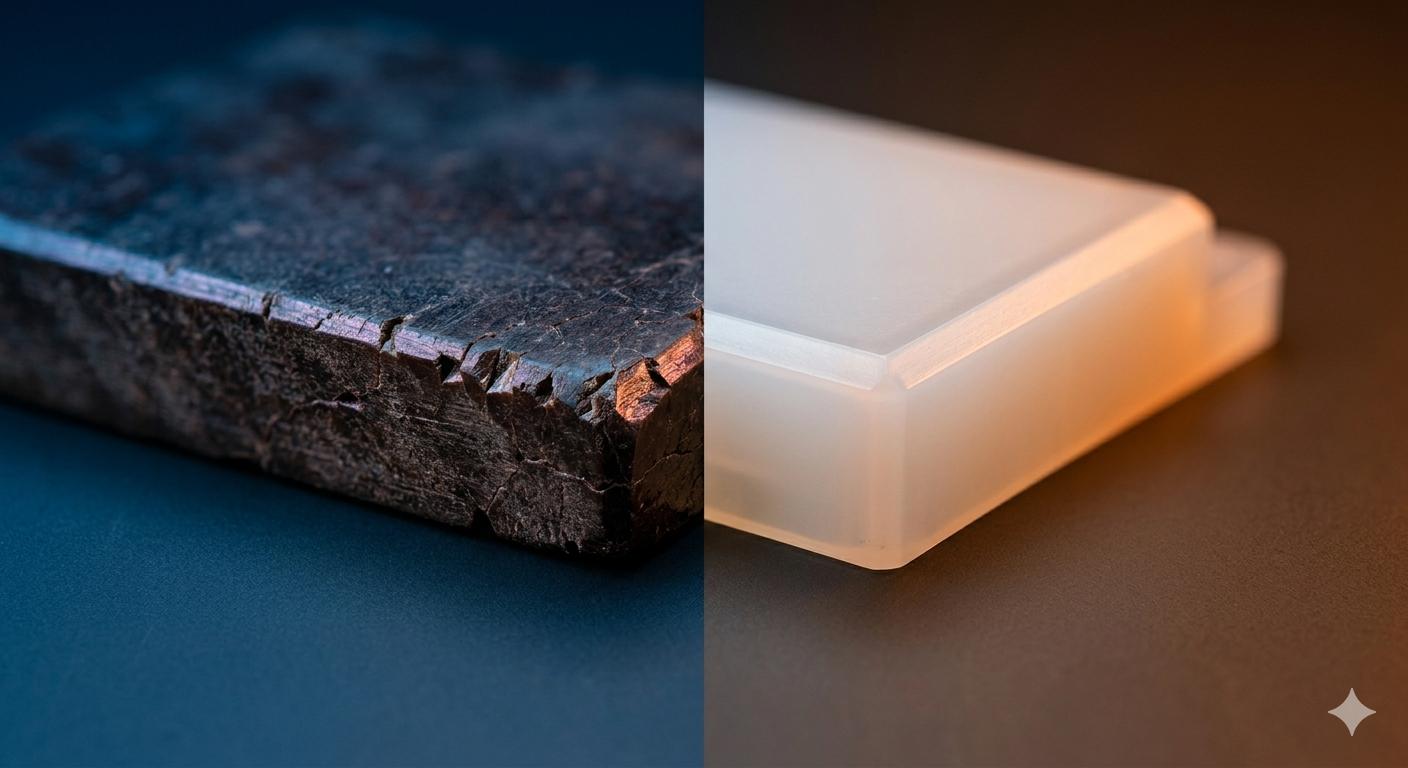
(AI generated) Cracked bakelite part compared with durable modern plastic
Bakelite works well within limits, then breaks once those limits are crossed.
When Impact Resistance Is Required
Bakelite can handle compression, but it can’t handle shock.
Impact strength for bakelite plastic typically ranges from ~2.7 to 10 kJ/m², depending on grade and reinforcement. That’s significantly lower than polycarbonate or ABS, which are designed for impact-heavy use.
A minor drop or sudden load can cause visible cracks or a complete fracture. That’s why it stays in static housings and electrical panels. Once impact enters the equation, it becomes a weak choice.
When Toughness or Flexibility Is Needed
There’s no flex window here.
Bakelite shows an elongation at break of roughly 0.5 to 2 percent, meaning it barely stretches before failure. In practical terms, it doesn’t bend. It snaps.
Materials like nylon or polypropylene operate at much higher elongation ranges, which is why they replace bakelite in parts exposed to vibration or repeated load cycles.
When Modern Laminates or Plastics Perform Better
The bakelite manufacturing process was designed around thermal stability and insulation, not mechanical performance.
Tensile strength for bakelite typically sits between 50 to 110 MPa, with compressive strength exceeding 200 MPa in some grades. That sounds strong on paper, but fracture toughness remains low, which limits real-world durability.
Modern laminates like FR4 maintain similar electrical properties while improving structural reliability in many electrical insulation applications. At the same time, machining bakelite still comes with tradeoffs like chipping and higher tool wear.
That’s why bakelite manufacturing now sits in narrow use cases. For most modern designs, newer materials deliver better durability, easier processing, and fewer failure points.
Cost Factors in Machining Bakelite Parts
Raw material isn’t where the cost builds. Bakelite itself is relatively affordable compared to metals. The real cost shows up during machining, where material behavior starts dictating tool life, scrap rates, and setup stability.
Tool Wear and Replacement Frequency
Bakelite cuts, but not cleanly, because it is a fiber-reinforced thermoset, so the structure itself is abrasive on contact. Paper or fabric fillers drag against the tool edge, and because it doesn’t conduct heat well, that heat stays concentrated around the cutting zone instead of spreading out.
Typical cutting speeds sit around 50 to 100 m/min for milling and 20 to 50 m/min for drilling, already lower than many plastics.
Heat buildup and abrasive fibers accelerate edge wear. Shops compensate by reducing speeds or switching tools more often. Either way, the cost per part increases.
Scrap Risk and Yield Variability
Bakelite fractures without warning. The part can be machined cleanly through most steps, then chip or crack right at the end, even when everything looked fine earlier.
Impact strength typically ranges between 2 to 10 kJ/m², which is low compared to modern engineering plastics.
That narrow failure window creates variability. A batch can run clean, then lose parts due to edge breakage or drilling cracks. Yield becomes inconsistent, and scrap cost rises with geometry complexity.
Setup Sensitivity and Process Stability
This is where machining bakelite becomes process-dependent.
The material has significantly lower stiffness than steel.
That affects clamping and cutting. Too much force introduces deformation or cracking. Too little allows vibration, which damages edges and reduces accuracy.
Stable machining requires controlled feeds, proper fixturing, and dust management.
The bakelite manufacturing process includes conservative setups and test runs. It slows initial throughput, but it prevents higher losses during production.
Typical Applications of Bakelite Components
| Area | Use Case | Key Reason | Limitation |
|---|---|---|---|
| Electrical insulation | Switchgear, sockets | Dielectric strength | Brittle |
| Legacy components | Knobs, housings | Compatibility | Obsolete in new designs |
| Fixtures | Jigs, spacers | Dimensional stability | Low mechanical strength |
CNC Machining Bakelite at JLCCNC
At the service level, CNC providers typically start by checking three things: fiber content, thickness, and the required tolerance band. Paper or glass-filled grades directly affect tool life and edge chipping risk, which is a known issue in phenolic machining.
| Factor | CNC Evaluation Focus | Impact on Cost |
|---|---|---|
| Tool wear | Abrasive phenolic fillers reduce tool life | Higher tool replacement frequency |
| Cutting stability | Heat buildup + brittle fracture risk | Slower feeds, more conservative machining |
| Scrap risk | Crack propagation during drilling/exit | Lower yield on complex parts |
| Setup control | Fixturing sensitivity and vibration control | Longer setup and validation time |
JLCCNC approaches bakelite machining with controlled feeds, sharp tooling, and stable fixturing to keep yield consistent across batches, especially where edge integrity and tolerance stability are critical.
For parts with defined geometry and material grade, cost and lead time can be estimated early in the process. Upload your CAD file to receive a quote starting from $1, with lead times as short as 3 days, depending on part complexity and machining requirements.
FAQ About Bakelite Machining
Q: Is Bakelite still used today?
Yes, but mainly in electrical insulation parts, legacy equipment, and low-load fixtures where stability matters more than strength.
Q: Is Bakelite safe to machine?
Yes, if controlled feeds and proper dust extraction are used, since phenolic dust and heat buildup need proper handling.
Q: Why does Bakelite crack during machining?
It cracks because it is brittle and does not deform under stress, so internal tension releases suddenly during cutting or drilling.
Q: Can Bakelite be replaced with modern plastics?
In most cases, yes, engineering plastics like nylon, FR4, or polycarbonate offer better toughness and easier machining performance.
Keep Learning
Acetal (POM) Plastic: Properties, Uses & Material Selection
Key Takeaways Acetal (POM) is a semi-crystalline engineering thermoplastic with high stiffness, low friction, excellent dimensional stability, and outstanding machinability. POM material comes in two main types, homopolymer (POM-H, Delrin) and copolymer (POM-C), with slightly different property profiles suited to different applications. Acetal plastic properties include tensile strength of 60-75 MPa, very low moisture absorption (0.2%), and a coefficient of friction of 0.1-0.3 against steel without lu......
What Is a Composite Material? Types, Properties, Examples, and Applications
Key Takeaway A composite material is an engineered material made from two or more constituent materials with different properties that, combined, produce a material with superior or unique characteristics neither component has alone. The main types of composite materials are classified by matrix (polymer, metal, ceramic) and by reinforcement form (fiber, particle, sandwich). Composite material properties are directional, they vary depending on fiber orientation, which is both an advantage for optimiza......
HDPE: Material Properties, Machining, and Applications
Key Takeaways HDPE stands for high-density polyethylene, a thermoplastic polymer with high strength-to-density ratio, excellent chemical resistance, and very low moisture absorption. HDPE material machines well on standard CNC equipment without coolant in most operations. HDPE plastic is FDA-compliant in food-grade grades, making it common in food processing equipment and cutting board applications. HDPE sheet is the most common stock form for machined flat components, available in thicknesses from 1.......
Polycarbonate CNC Machining: Properties, Design Guidelines, and Manufacturing Considerations
Key Takeaways About Polycarbonate CNC Machining Polycarbonate is used for clear guards, covers, housings, and inspection parts where visibility and protection matter in use, not just on drawings. Different machining materials or grades behave differently during cutting and show up mainly in surface clarity and edge condition. Heat from cutting affects surface marks more than the strength of the material itself. Thin walls and wide flat areas are where most surface issues start during machining. Tool s......
Polycarbonate vs Acrylic for CNC Parts: Strength, Machining & Material Selection
Quick Comparison: Polycarbonate vs Acrylic Property Polycarbonate Acrylic Tensile strength 55–75 MPa 70–80 MPa Impact resistance 600–900 J/m (notched Izod) 15–30 J/m Flexural modulus 2.1–2.5 GPa 3.0–3.3 GPa Light transmission 88–90% 92–93% Heat deflection temp approximately 110–130°C depending on grade and test condition 75–100°C Chemical resistance Moderate. attacked by solvents Good. resists most common chemicals Machinability Good. tends to melt at edges Excellent. clean chips, sharp edges UV resis......
What Is Bakelite? Properties, Manufacturing Process, and CNC Machining Guide
(AI generated) Vintage bakelite switch and modern machined bakelite Bakelite still appears in electrical systems, legacy equipment, and industrial fixtures where thermal stability and insulation matter more than mechanical toughness. In these environments, materials are not selected for flexibility or impact resistance, but for their ability to remain stable under heat, voltage, and long-term load. Unlike modern thermoplastics, Bakelite does not soften or deform once formed. That behavior affects not ......