What Is CBAM and How It Affects Manufacturing and CNC Supply Chains
11 min
- CBAM Explained: Key Facts at a Glance!
- What Is CBAM (Carbon Border Adjustment Mechanism)?
- When Does CBAM Come Into Effect?
- Which Industries and Products Are Covered by CBAM?
- Why CBAM Matters for Manufacturing and CNC Supply Chains?
- CBAM Reporting Requirements and Compliance
- How CBAM Changes Cost Structure in Machined Parts?
- What Does This Mean for Engineering and Sourcing Decisions?
- From CBAM Understanding to Practical Considerations
- Conclusion About CBAM Impact on Manufacturing
- FAQs About CBAM
CBAM is the first international carbon border tax. The European Union mandates that importers must buy special certificates. These certificates cover embodied greenhouse gases in certain industrial materials. The raw materials are directly affected by CBAM. The raw unwrought aluminum or steel bar stock entering the machining center is taxed by the regional authorities. Embedded carbon becomes a cost factor.
CBAM Explained: Key Facts at a Glance!
- What it is: The European Union mandates importers buy special certificates covering embodied greenhouse gases in industrial materials.
- Who it affects: European importers and international manufacturers making high-carbon industrial inputs need to overhaul data collection workflows.
- When it starts: The transitional reporting period is currently underway. Full financial liabilities come into play on January 1, 2026.
- What companies must do: Procurement teams pull verified facility-level emissions data from supply chains to calculate accurate import taxes.
For a more detailed breakdown of reporting requirements, cost structure, and supplier data workflows, see this CBAM compliance guide for manufacturers.
What Is CBAM (Carbon Border Adjustment Mechanism)?
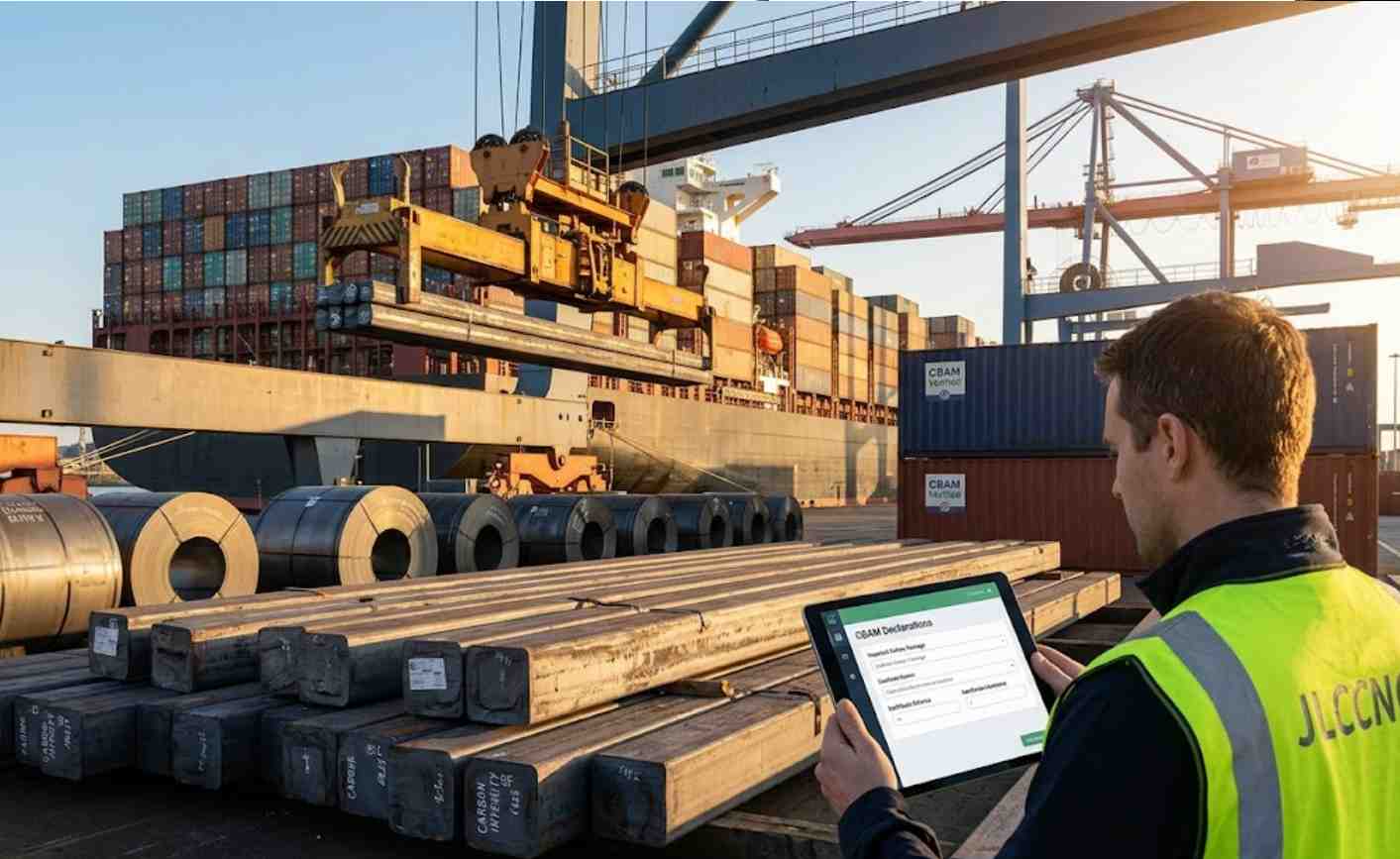
(AI-generated) CBAM declarations for imported steel at EU port
This mechanism is designed to prevent carbon leakage across borders. European producers are subject to carbon pricing under the EU ETS. Offshoring high-carbon production to unregulated countries undermines these climate objectives. The policy imposes taxes on imported goods tailored to their manufacturing carbon footprint.
What Is CBAM Regulation?
The CBAM regulation is a European Union policy designed to impose carbon costs on imported goods based on their embedded emissions. It aligns import pricing with the EU Emissions Trading System (EU ETS), ensuring that foreign manufacturers face similar carbon costs as EU producers.
The regulation primarily targets carbon-intensive sectors such as steel, aluminum, cement, fertilizers, and electricity. Over time, its scope may expand to include downstream and finished products.
What CBAM Regulates in Industrial Trade?
The law is focused on bulk commodities that carbon-intensive commodities. Heavy materials include unwrought alumina, iron, and steel. Regulators cover specific CN codes, including raw and certain semi-finished materials.
How CBAM Works in Practice?
Importers act as authorized declarants on the official government record, purchasing certificates for goods they bring into the European market and submitting annual declarations on the embedded carbon of those goods.
How CBAM Calculates Carbon?
CBAM carbon calculation is based on both direct emissions from production processes and indirect emissions (mainly from electricity consumption). In practice, the methodology is more structured than a simple measurement.
Companies are expected to use actual, verified emissions data at the facility level whenever possible. However, when such data is not available, CBAM allows the use of default values provided by the European Commission. These default values are typically conservative and often result in higher reported emissions.
Because of this, there is a clear hierarchy in data usage. Verified primary data leads to more accurate and often lower carbon reporting, while missing data forces companies into less favorable assumptions. This is why data availability across the supply chain becomes a critical factor in both compliance and cost control.
When Does CBAM Come Into Effect?
The immediate procurement strategy is conditioned by knowing exactly when CBAM comes into effect for your specific business operations. This is the first phase of the plan, and the government launched this initial reporting period on October 1.
Transition Phase
Importers use the transitional registry portal to submit embedded emissions data. The European Commission is taking data without requesting certificate payments.
Certificate Obligations Are Phased in from 2026
The final regime kicks in as of January 1, 2026. Operations transition from reporting to financial taxation. Real emissions data must be verified by independent auditors.
Which Industries and Products Are Covered by CBAM?
The CBAM regulation is applied through the heavy industrial sectors. These sectors include iron, steel, aluminum, and electricity generation.
Core Sectors Affected
Raw material inputs in custom machined parts fall directly under the CBAM scope and impact the entire industry.
Where CNC Parts Fit into CBAM Scope?
The law is focused on bulk commodities that embody energy. The raw unwrought aluminum or steel bar stock entering the machining center is taxed by the regional authorities. Input commodities such as steel bar stock and unwrought aluminum are subject to taxes, which increases the overall cost of machined parts through material pricing.
Since CBAM primarily targets raw and semi-finished materials such as aluminum and steel, understanding how these materials are selected and used in manufacturing is increasingly important. For a broader overview, refer to this CNC machining materials guide.
Why CBAM Matters for Manufacturing and CNC Supply Chains?
Under CBAM, carbon intensity effectively acts like an additional import cost that varies depending on how materials are produced. European prices can fluctuate significantly, often used as a benchmark in CBAM calculations. Purchasing heavy steel components from coal energy-producing areas provides a disastrous baseline total cost of ownership.
Embedded Carbon Becomes a Cost Factor
Suppliers face pressure to reveal their energy consumption. Buyers select their manufacturing partners based on how transparent suppliers are with their environmental data.
Shift in Supplier Evaluation Criteria
With no real energy monitoring installed in factories, European importers are left with default carbon values. Default estimates balloon part landed costs.
Early Impact on Cross-Border CNC Sourcing
Procurement officials embed the requirement of direct and indirect emissions disclosures in official quotation packages. For international machine shops, data transparency is the barrier to entry today.
CBAM Reporting Requirements and Compliance
Knowing exactly how to comply with CBAM reporting requirements saves millions in customs shipments stuck at the border. CBAM compliance relies on accurate classification of imported goods, as different material categories are subject to different reporting and carbon calculation requirements. One of the biggest challenges companies face is not the reporting itself, but the lack of upstream data. Without reliable emissions data from suppliers, companies are often forced to rely on default values, which can significantly increase costs.
Reporting and Data Requirements
Official auditors need data mapped directly to the furnace or mill producing the batch. Supply chain tracking is a mandatory practice.
Supplier Transparency and Traceability
Importers use the official registry to upload digital footprint files of international supply chains. Compliance requires tracing each aluminum billet back to its original smelting source.
In many cases, this shifts procurement decisions away from low-cost regions toward suppliers with verifiable low-carbon energy sources.
Risks of Non-Compliance
Financial fines range per tonne of unreported embedded carbon emissions. Shipments may be delayed or rejected due to non-compliance.
How CBAM Changes Cost Structure in Machined Parts?
Hydroelectric grids produce aluminum billets with dramatically less carbon signatures than a traditional coal-smelted billet. This geographical energy difference has a significant impact on final import costs when entering the European market. Have you calculated how much the default carbon values will increase your total import costs next year?
Material-Origin Driven Cost Differences
Under CBAM, most carbon cost is driven by raw material production, rather than machining itself. Material origin and production method are the primary drivers. Material inefficiency increases total embedded emissions and, therefore, overall compliance cost.
Hidden Carbon Cost in Semi-Finished Materials
Since suppliers could not submit verified metrics, importers used standard default values. This artificially inflated carbon penalty crushed the price advantage of the supplier.
Why Identical Parts Can Carry Different CBAM Costs?
Identical components created in different regions have different carbon footprint profiles attached to them. Clean energy lowers the final taxation price.
CBAM Cost Breakdown in Manufacturing
Under CBAM, the total cost impact on manufacturing is driven by several key factors:
- Raw material emissions (60–80%)
The majority of CBAM cost comes from upstream material production such as steel and aluminum smelting.
- Energy source differences (10–30%)
Materials produced using renewable energy carry significantly lower carbon costs compared to coal-based production.
- Data availability penalty (default values)
If suppliers fail to provide verified emissions data, default values are applied, often increasing carbon cost significantly.
- Material efficiency and waste
Higher buy-to-fly ratios increase embedded emissions and therefore CBAM-related costs.
Understanding this cost structure allows manufacturers to optimize sourcing strategies and reduce total landed cost under CBAM regulation.
What Does This Mean for Engineering and Sourcing Decisions?
Design engineers can easily make their way into future tax liabilities if they ignore the new rules. By specifying near net shape forgings, the importation of raw block mass is greatly minimized. Selecting recycled aluminum alloys rather than virgin ores cuts embedded indirect electricity emissions dramatically.
Material Selection Starts Earlier in Design
The engineering department must select raw materials with low carbon footprints during the initial design phase. This proactive step saves the company from paying financial penalties later.
Supplier Capability Becomes a Risk Variable
The use of regenerative drive motors and oil free coolants brings competitive advantages for modern machine shops. Strong data infrastructure equals survival in this competitive industrial market.
When Regional or Alternative Sourcing Is Considered?
Buyers increasingly value data transparency in nearshoring strategies over the simple unit price of goods. JLCCNC offers expert guidance on optimizing supply chains to avoid unnecessary carbon taxation.
For manufacturers sourcing CNC machined parts globally, CBAM introduces a new layer of complexity in supplier selection.
At JLCCNC, we help customers navigate these challenges by providing transparent material sourcing, optimized material usage, and fast-turn CNC machining services starting from $1 with lead times as fast as 3 days.
By combining precision manufacturing with efficient material utilization, companies can reduce both production cost and CBAM-related carbon exposure.
From CBAM Understanding to Practical Considerations
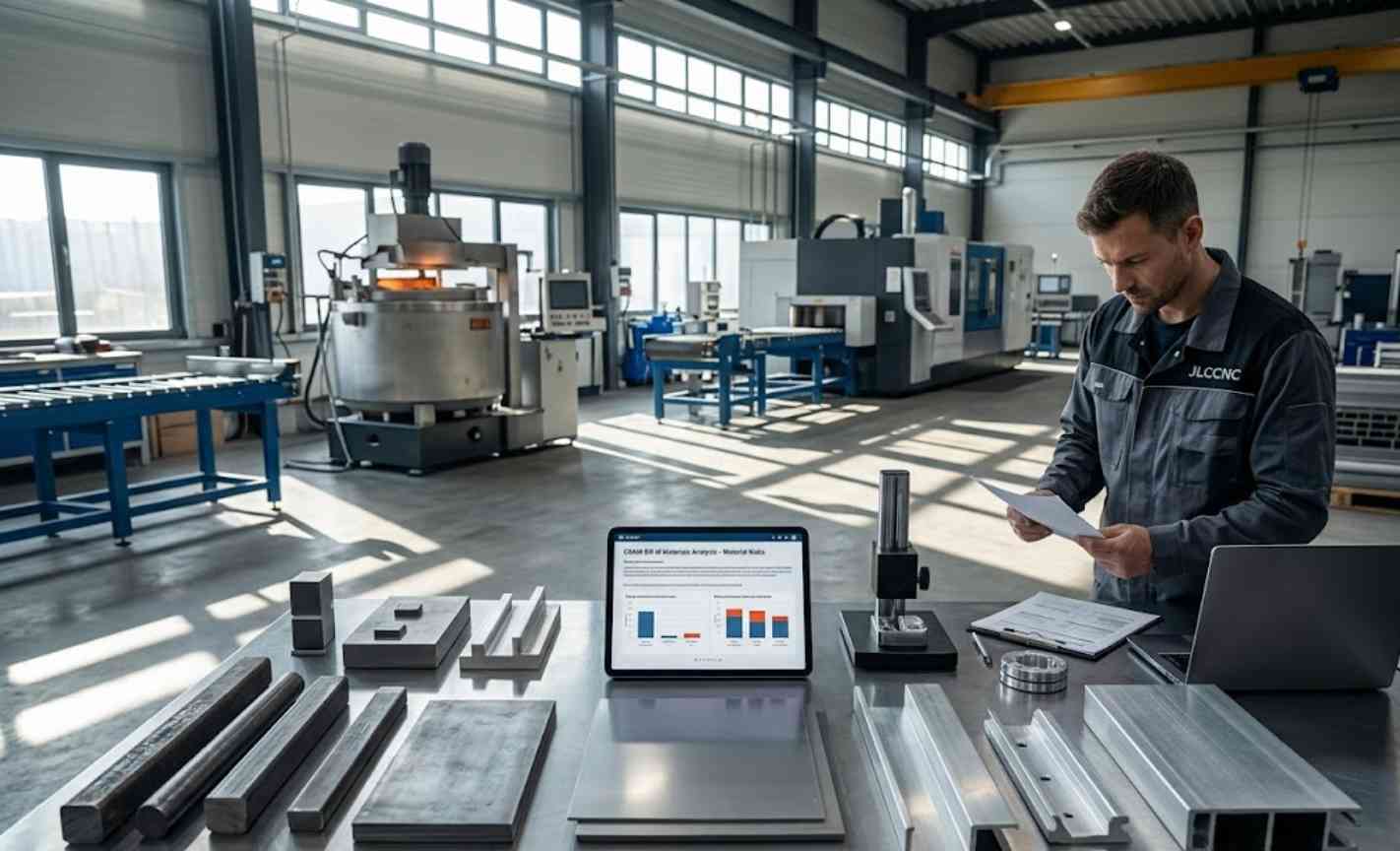
(AI-generated) CBAM reporting review for CNC metal manufacturing
Conduct a detailed analysis of your entire bill of materials to find hidden regulatory risks. Iron and steel are primarily based on direct emissions, with indirect emissions also considered depending on methodology. These direct furnace emissions and indirect grid electricity variables are required by law, and they must be included in the compliance calculations.
Supplier Evaluation Under CBAM
Audit your international partners to ensure they do installation-level carbon tracking. Insist on robust documentation that clearly proves closed-loop scrap recycling capabilities.
Reducing CBAM Cost in Manufacturing
Reduce component designs to attain low buy-to-fly material consumption ratios. Because CBAM costs are tied to material volume and embedded emissions, even small reductions in material usage can have a measurable impact on total import cost.
CBAM Reporting and Compliance
In practice, CBAM is forcing companies to restructure internal workflows, often requiring closer coordination between procurement, compliance, and sustainability teams. Facility managers must secure their authorized declarant status. Building a reliable data pipeline ensures imported goods pass through customs.
Conclusion About CBAM Impact on Manufacturing
Ensuring lasting industrial resilience requires adapted supply chain networks today. To tackle embedded carbon well, companies must move through CBAM with absolute precision. Better material verification systems will surely help you secure your competitive advantage. For advanced precision machining that meets strict global carbon compliance, please visit JLCCNC to perfectly optimize your future industrial production.
FAQs About CBAM
Q: What Is CBAM In Simple Terms?
The European Union taxes imported industrial goods according to the greenhouse gases emitted during production, and this equalizes carbon costs across borders.
Q: When Will CBAM Fully Apply?
Starting January 1, 2026, the definitive financial mechanism introduces mandatory carbon certificate purchases instead of mere data reporting.
Q: Does CBAM Affect CNC Machined Parts?
Input commodities such as steel bar stock and unwrought aluminum are subject to high taxes, and these taxes heavily burden upstream machining costs.
Q: Who Is Responsible For CBAM Reporting?
The European importers registered in accordance with the official customs code bear full legal responsibility for submitting the correct carbon certificates.
Q: What Are CBAM Reporting Requirements?
Importers provide validated information on the tracking of direct emissions, and they must include indirect electricity consumption and actual manufacturing plant data.
Q: What Products Are Covered Under CBAM?
The regulators actively target high-polluting core commodities, and these include raw cement, iron, steel, unwrought aluminum, fertilizers, hydrogen, and electricity.
Q: How Is CBAM Carbon Calculated?
Calculations combine direct onsite manufacturing emissions with indirect grid electricity usage, and this requires verified installation-level data rather than broad estimates.
Q: Does CBAM Apply To Finished Parts?
Because of complex finished assemblies, goods are currently not directly covered, but indirectly affected through material inputs. Regulators have introduced proposals that would tax products manufactured downstream.
Popular Articles
• Rapid Prototyping Guide: Processes Compared and How to Choose the Right Method for Manufacturing
• CNC Rapid Prototyping: Cost, Lead Time, Design Tips & Machining Service
• How is the Cost of CNC Machining Determined
• CNC machining solutions for DIY project designers
• The true cost of CNC machining services what are the main factors affecting price
Keep Learning
Rapid Prototyping Guide: Processes Compared and How to Choose the Right Method for Manufacturing
What Is Rapid Prototyping (AI generated) Various rapid prototyping parts including 3D printed, CNC machined, and sheet metal components on a workshop table. Rapid prototyping is a manufacturing approach that produces physical parts directly from CAD data within hours or days, enabling engineers to quickly validate design, fit, and function before full-scale production. Modern shops use several methods under this umbrella. 3D printing, CNC machining, and sheet processes all fall into the rapid prototyp......
What Is CNC Precision Machining? Process, Tolerances & Applications
Key Takeaways CNC precision machining focuses on controlling part variation within strict dimensional requirements rather than simply producing smaller features. Many precision machining applications can achieve tolerances around ±0.025 mm when the part design and manufacturing conditions are suitable. The final accuracy of a machined part depends on how well the process is planned, controlled, and verified from design to inspection. CNC precision machining is widely used for parts that require consis......
Additive vs Subtractive Manufacturing: Differences, Advantages, and How to Choose the Right Process
Quick Comparison: Additive vs Subtractive Manufacturing Feature Additive Manufacturing Subtractive Manufacturing How it works Builds parts layer by layer Removes material from solid stock Best for Complex geometry, prototypes, low-volume production Precision parts, tight tolerances, production runs Design freedom Excellent, including internal channels and lattices Limited by cutting tool access Typical accuracy Lower as-built accuracy; post-processing is often required High dimensional accuracy direct......
OEM vs ODM: Key Differences, Benefits, and How to Choose
Key Differences at a Glance Between OEM and ODM Factor OEM Manufacturing ODM Manufacturing Design Origin Buyer provides the product design Supplier provides an existing design Product Control Higher control over specifications and development Less control over the core product design Engineering Input Requires more engineering and product development work Requires less technical involvement Customization Extensive customization options Limited to predefined modification options Intellectual Property I......
Large Part CNC Machining: Processes, Challenges, and Manufacturing Considerations
Key Takeaways About Large Part CNC Machining Large part CNC machining handles components where size itself introduces manufacturing challenges that standard machining doesn't face, thermal effects, deflection, workholding complexity, and dimensional control over long spans. Machine travel is one constraint but not the only one, part weight, spindle access, and workholding capability define what a machine can actually do with large components as much as the stated work envelope. Accuracy on large parts......
Low Volume CNC Machining: Small Batch Production Strategies and Manufacturing Guide
Key Takeaways About Low Volume CNC Machining Low volume CNC machining is typically used for production runs ranging from a single part to roughly 1,000 units, without the tooling investment required by molding or casting processes. Small batch CNC machining is often the most practical choice when designs are still evolving, demand is uncertain, or production quantities are too low to justify dedicated tooling. CNC machining can produce production-grade parts from aluminum, stainless steel, titanium, a......