Magnetic Abrasive Finishing: Process, Applications, and Benefits for CNC Machined Parts
11 min
- How Magnetic Abrasive Finishing Works
- Magnetic Abrasive Finishing Equipment and Media
- What Can Magnetic Abrasive Finishing Achieve?
- Magnetic Deburring: How Burr Removal Works
- Advantages and Limitations of Magnetic Abrasive Finishing
- Magnetic Abrasive Finishing vs Other Metal Finishing Methods
- Applications of Magnetic Abrasive Finishing
- Factors and Challenges in Magnetic Abrasive Finishing
- Magnetic Abrasive Finishing for CNC Machined Parts
- When Should You Use Magnetic Abrasive Finishing?
- Conclusion About Magnetic Abrasive Finishing
- FAQ About Magnetic Abrasive Finishing
Key Takeaways and Introduction About Magnetic Abrasive Finishing
- Magnetic abrasive finishing uses a magnetic field to control abrasive particles.
- The process improves surface finish and removes fine burrs.
- It can reach internal passages and difficult-to-access features.
- Magnetic deburring is often used on precision machined components.
- Media selection and magnetic field strength strongly affect results.
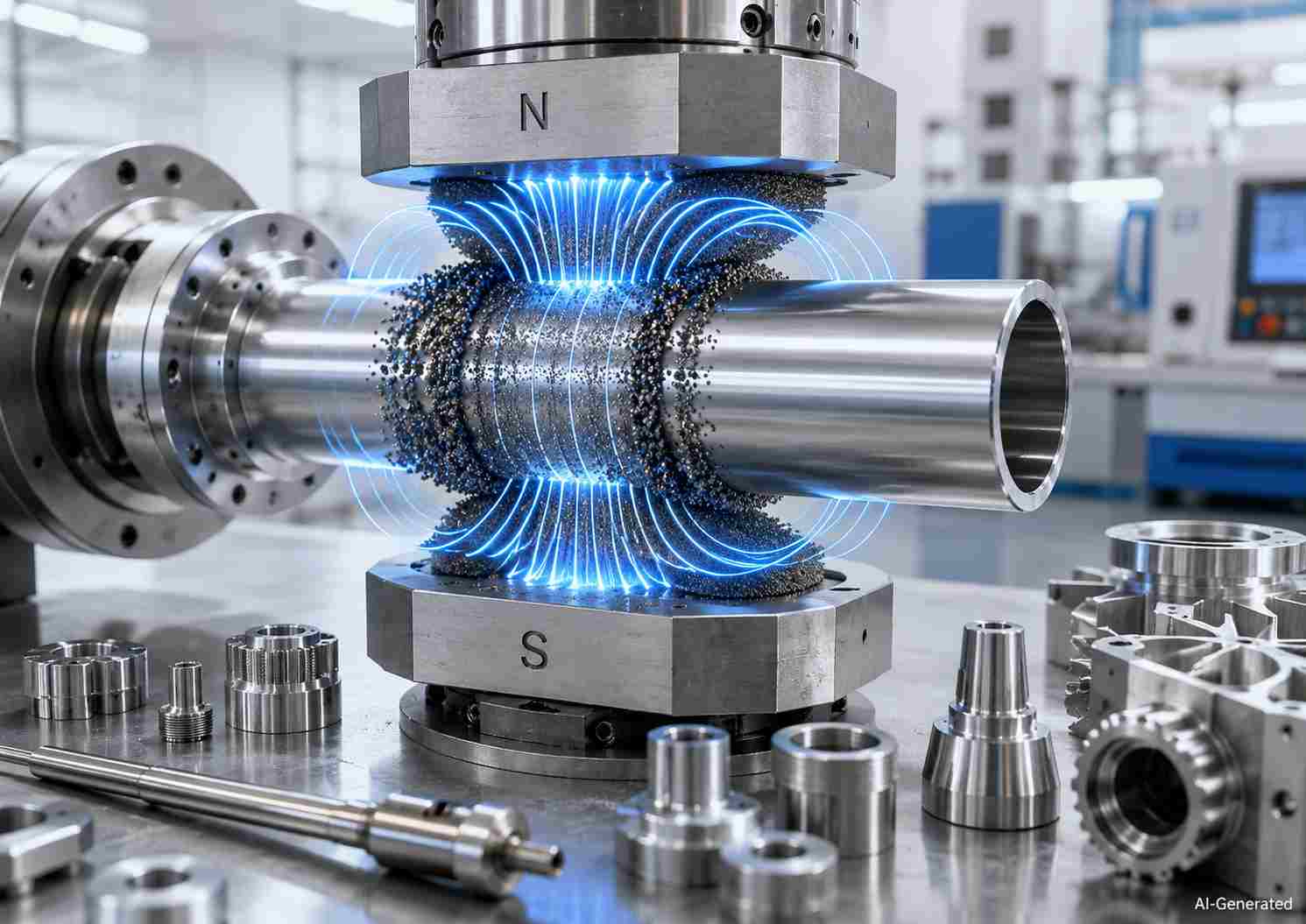
Magnetic abrasive finishing of precision metal tube
Precision metal parts might need more than accurate CNC machining. Surface condition is equally important, especially when edges, passages, and fine features must meet higher performance requirements.
What Is Magnetic Abrasive Finishing?
Magnetic abrasive finishing (MAF) uses a magnetic field to control a mixture of ferromagnetic particles and abrasive grains. The particles form a flexible magnetic brush that removes microscopic surface irregularities and fine burrs from a workpiece.
Why Magnetic Fields Are Used in Surface Finishing
A magnetic field gives the abrasive grains direction, pressure, and contact stability. This makes magnetic polishing useful when a part needs a smoother surface without harsh tool marks.
How Magnetic Abrasive Finishing Works
Magnetic Field Formation
The process begins when a magnet or electromagnet creates a concentrated magnetic field around the workpiece. It draws the abrasive mixture toward the target area.
Abrasive Brush Generation
As the particles align along the magnetic flux lines, they form a flexible abrasive brush that remains in contact with the workpiece surface.
Material Removal Mechanism
In the magnetic abrasive finishing process, relative motion makes each grain slide over high spots. Consequently, it shaves peaks and cuts loose burr roots.
Surface Smoothing Mechanism
With repeated passes, surface peaks are gradually reduced and the workpiece develops a smoother finish without excessive contact pressure.
Magnetic Abrasive Finishing Equipment and Media
Industrial MAF systems range from simple rotary machines to automated equipment used for parts with internal channels, deep bores, or difficult-to-access surfaces.
The process relies on a magnetic field and abrasive media working together. When the field is applied, the media forms a flexible magnetic brush that moves across the workpiece surface.
Magnetic Abrasive Particles
MAF media contains ferromagnetic particles mixed with abrasive grains.
The magnetic particles respond to the field and create the brush structure. Material removal comes from the abrasive grains trapped inside that brush.
Media size affects where the brush can reach. Larger particles are commonly used on open surfaces. Small passages and cross-holes often require finer media.
Media Selection
Media is selected according to the material being processed and the finishing target.
Aluminum oxide is commonly used on machined steels and stainless steels. Silicon carbide is often chosen when burr removal is the primary concern. Diamond abrasives may be used on carbide components and hardened materials.
Particle size also influences the result. Shops removing drilling burrs typically use coarser media. Surface refinement generally requires finer abrasive grades.
Magnetic Field Strength
Field strength determines how firmly the magnetic brush is held together.
A stronger field increases contact pressure between the brush and the surface. A weaker field produces a gentler finishing action.
Part geometry usually influences the setting. Thin edges and delicate features may require lower magnetic force than large external surfaces.
What Can Magnetic Abrasive Finishing Achieve?
Surface Finish Improvement
Utilizing this technique may lessen the presence of rough machining traces and provide the component with a more uniform exterior texture for improved contact performance.
Deburring and Edge Refinement
Within the context of magnetic deburring, the finishing operation can remove fine burrs while preserving the underlying geometry.
Internal Features and Complex Geometries
Many finishing methods struggle to maintain consistent contact inside small holes, curved channels, and other difficult-to-reach areas. MAF can improve access to certain internal features, although effectiveness still depends on field strength, media flow, and feature geometry.
Dimensional Control and Repeatability
With the help of regulated parameters, the method is able to help maintain consistent results while simultaneously minimising the removal of excess stock from part features.
Magnetic Deburring: How Burr Removal Works
External Burr Removal
As the abrasive brush passes over external burrs, repeated contact gradually thins the burr root until the excess material separates from the workpiece.
Internal Burr Removal
Because the abrasive media follows the magnetic field into holes, slots, and recesses, it can reach burrs that are difficult to remove with conventional deburring tools.
Edge Radiusing and Edge Conditioning
After burrs are reduced, magnetic abrasive technology for metal finishing can soften sharp borders into small controlled radii for safer handling and better mating.
Deburring Challenges in Complex Parts
Complicated components demand careful planning. The reason is that burr size, corner access, and uneven field reach might leave some areas underfinished.
Advantages and Limitations of Magnetic Abrasive Finishing
Advantages of Magnetic Abrasive Finishing
MAF applies relatively low finishing forces, which helps when working with thin walls, small features, or parts that could be damaged by aggressive mechanical polishing.
Limitations of Magnetic Abrasive Finishing
Results can vary significantly if the magnetic field does not fully reach the target area. Deep cavities, complex geometries, and poorly selected media often require additional process development before stable production is achieved.
When MAF Is Not the Best Choice
For plain flat components, heavy stock removal, or highly low-cost batches, conventional grinding, brushing, or tumbling might be the more sensible route.
Magnetic Abrasive Finishing vs Other Metal Finishing Methods
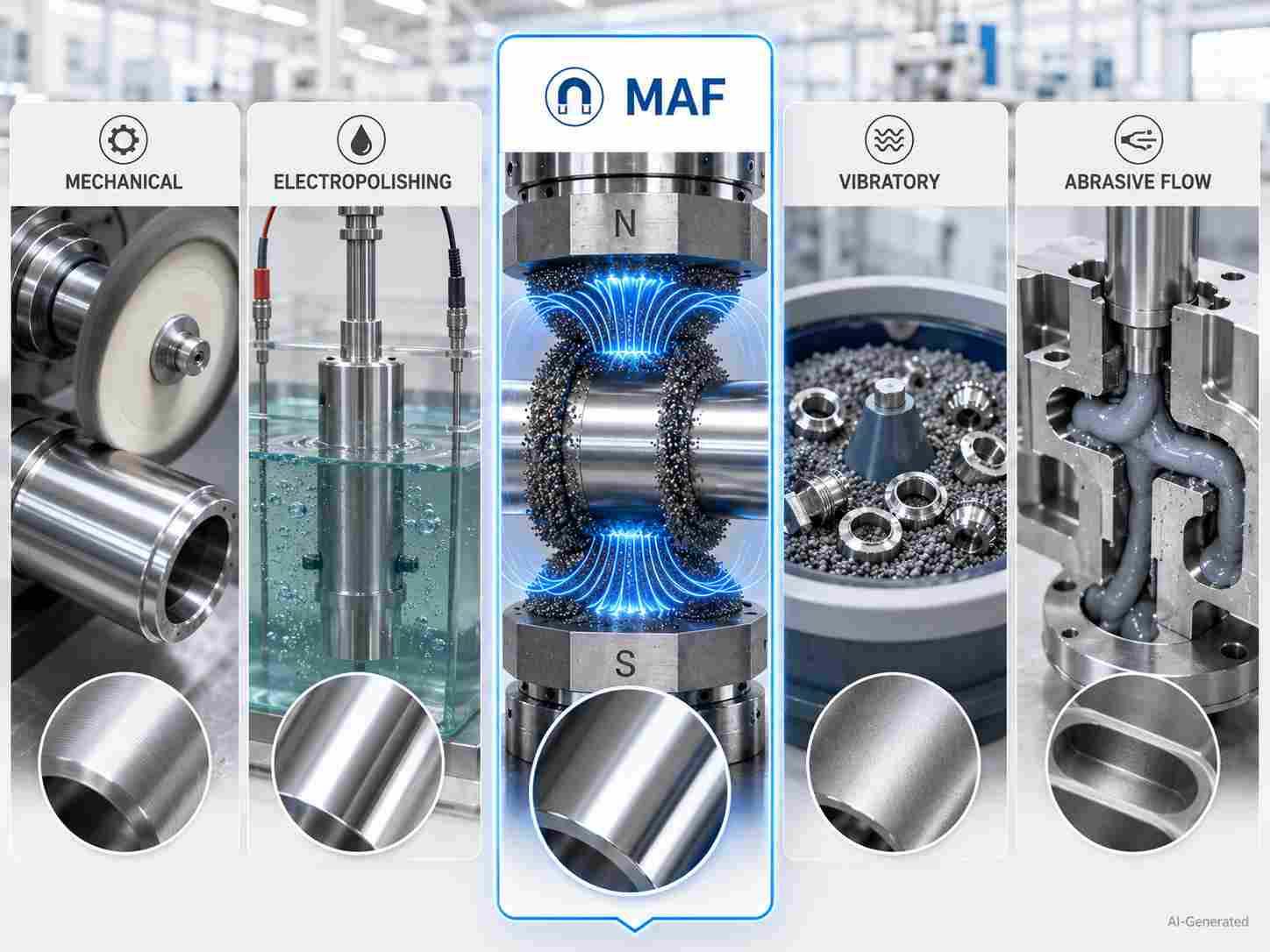
Comparison of MAF with other metal finishing methods
MAF vs Mechanical Polishing
Mechanical polishing depends on direct tool contact. Meanwhile, MAF uses magnetic polishing action to guide abrasive media with lighter contact on fine features.
MAF vs Electropolishing
Electropolishing removes metal through an electrochemical reaction. On the other hand, MAF removes raised material through abrasive contact under field control.
MAF vs Vibratory Finishing
Vibratory finishing treats many parts in a moving media mass. Nevertheless, MAF might be a better option for selected zones that need more controlled contact.
MAF vs Abrasive Flow Machining
Abrasive flow machining pushes abrasive paste through passages. However, MAF uses field-guided grains when contact force and direction need tighter control.
Applications of Magnetic Abrasive Finishing
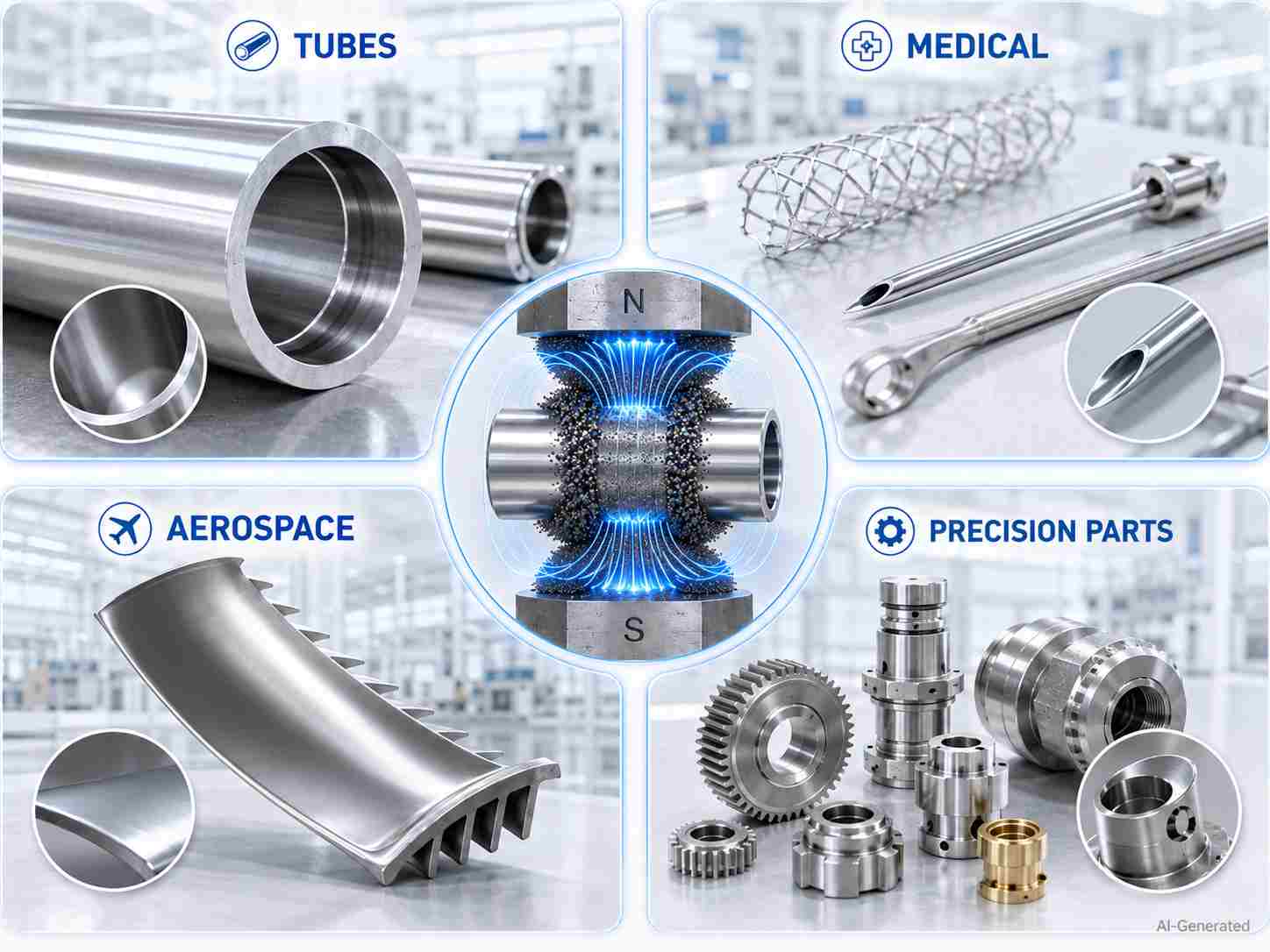
Applications of magnetic abrasive finishing in metal parts
Internal Passages and Tubular Parts
For situations in which the inner walls need a more seamless contact with fluid or gas, long bores, tubes, and curved channels are all ideal possibilities.
Medical and Surgical Components
When it comes to medical parts, surgical instruments, miniature medical components, and selected medical components where smooth surfaces can improve cleanliness, reduce surface irregularities, or support specific functional requirements.
Aerospace and High-Performance Components
Blades, aerofoils, and other high-duty metal features that have a surface condition that influences service life are examples of the types of aerospace parts that employ this approach.
Precision Components Requiring Deburring
It is advantageous to use for machined inserts, small gears, valves, and molds when it is necessary to remove fine burrs without engaging in strenuous manual work.
Many precision components require both machining and secondary finishing before they are ready for use. JLCCNC manufactures custom CNC parts from customer CAD files and can help evaluate finishing requirements during production planning.

Precision CNC Machining Service
Professional manufacturing, fast turnaround, and quality assurance.
Factors and Challenges in Magnetic Abrasive Finishing
Material Properties and Initial Surface Condition
In the context of magnetic polishing, material hardness, previous tool marks, and coating condition decide how much finishing time a component may demand.
Part Geometry and Accessibility
The presence of deep pockets, thin walls, and narrow entry might restrict media interaction, which is why holding design becomes a component of the finishing plan.
Abrasive Selection and Process Control
Grain type, iron content, field level, speed, and working distance must work together. Otherwise, results may be different from batch to batch.
Productivity and Cost Considerations
Finish objectives are evaluated by engineers throughout production, taking into consideration cycle time, media wear, inspection requirements, and operator skill.
Magnetic Abrasive Finishing for CNC Machined Parts
Improving Surface Finish After CNC Machining
After milling or drilling, a part may still show fine ridges from the cutting path. Magnetic abrasive finishing can lower these marks while keeping the intended profile.
Removing Burrs From Complex Features
CNC parts might carry raised lips around cross holes, slots, pockets, and threads. The finishing media can trim these kinds of lips without rough hand filing.
Finishing Internal Channels and Passages
It is possible for the media to operate within locations where a cutter no longer has room to polish, such as ports, manifolds, and flow paths that have been drilled.
Integrating MAF Into Secondary Finishing Operations
Shops can place MAF after machining, washing, and inspection planning. Meanwhile, cycle targets are matched to the final roughness callout and part function.
When Should You Use Magnetic Abrasive Finishing?
- Use it for fine burrs on precision parts.
- Use it for inner holes and passages.
- Use it for delicate machined edges.
- Use it when handwork may damage detail.
- Use it when finish quality affects part function.
- Use it for parts with tight inspection needs.
- Avoid it for heavy stock removal.
- Avoid it for low-cost bulk deburring.
- Avoid it when geometry blocks field reach.
- Choose another method for large flat faces.
Conclusion About Magnetic Abrasive Finishing
Magnetic abrasive finishing is typically used when a part already meets its dimensional requirements, but the surface condition still needs improvement. The process can reduce fine burrs, smooth machining marks, and reach areas that are difficult to finish with conventional tools.
Its value becomes more apparent on components with internal passages, narrow features, or delicate edges, where aggressive finishing methods may create new defects. For applications that require significant stock removal, however, grinding, machining, or other finishing processes are usually more efficient.
For parts that require machining and secondary finishing, process planning often begins before production starts. Factors such as burr location, surface-finish requirements, and feature accessibility can influence both machining strategy and finishing method selection.
JLCCNC manufactures custom CNC parts from customer CAD files and can help evaluate suitable finishing processes during quotation and production planning.
Precision CNC Machining Service
Professional manufacturing, fast turnaround, and quality assurance.
FAQ About Magnetic Abrasive Finishing
Q: What is magnetic abrasive finishing?
Magnetic abrasive finishing is a precision finishing process that uses a magnetic field to control abrasive particles near a workpiece surface. The abrasive brush removes fine burrs and smooths microscopic surface irregularities.
Q: What is magnetic deburring?
Magnetic deburring is a finishing process that uses a magnetic field to guide abrasive media across a part surface and remove small burrs. The abrasive particles act on raised edges while applying relatively low force to the surrounding material, making the process suitable for precision components, internal passages, and features that are difficult to reach with conventional deburring tools.
Q: What are magnetic abrasive particles?
Magnetic abrasive particles are the working media used in magnetic abrasive finishing. They typically consist of ferromagnetic particles combined with abrasive grains. Under a magnetic field, the ferromagnetic portion forms a flexible abrasive brush, while the abrasive grains perform the actual cutting and polishing action. Particle size and abrasive type influence material removal rate, burr removal performance, and final surface finish.
Q: How does magnetic abrasive finishing work?
The magnetic field forms a flexible abrasive brush around the workpiece. Relative motion between the brush and the surface allows abrasive grains to remove microscopic peaks, smooth machining marks, and reduce fine burrs.
Q: What is magnetic polishing?
Magnetic polishing is a surface-finishing process that uses magnetically controlled abrasive media to improve surface smoothness, reduce minor imperfections, and enhance surface appearance.
Q: Can magnetic abrasive finishing remove burrs?
When the media size and field access are compatible with the feature, it might decrease the fine burrs that are present around holes, slots, and sensitive edges.
Q: What materials can be finished using MAF?
MAF is used on a variety of metals that are difficult to finish, including but not limited to steels, stainless steels, titanium alloys, aluminum alloys, nickel alloys, and other hard to finish metals.
Q: What surface finish can magnetic abrasive finishing achieve?
In optimized applications, MAF can reduce surface roughness from approximately Ra 0.5–1.0 μm to below Ra 0.1 μm, although actual results vary with material, geometry, and process conditions.
Q: How does MAF compare with electropolishing?
MAF employs abrasive contact under magnetic control. On the other hand, electropolishing removes metal through a chemical and electrical reaction.
Q: What is the difference between magnetic abrasive finishing and abrasive flow machining?
Magnetic abrasive finishing guides loose abrasive media with a field. Yet, abrasive flow machining moves abrasive paste through or across the part.
Popular Articles
• Surface Finish in Machining, Types, Charts & Testing
• Anodizing vs. Hard Anodizing: The Differences in Surface Treatment Techniques
• Anodized Aluminum Colors: Options, Limits, and Real-World Results
• Explanation of different material surface treatment technologies in CNC machining
• How to choose between Laser marking and UV printing?
Keep Learning
Surface Finish in Machining, Types, Charts & Testing
What is Surface Finish in Machining? At its core, surface finish in machining refers to the small-scale irregularities left on the surface of a part after machining. These irregularities are typically grouped into three categories: Roughness: The fine, closely spaced deviations caused by the cutting process itself. Roughness depends heavily on feed rate, tool sharpness, and cutting speed. Waviness: Larger, more widely spaced variations caused by machine tool vibration, deflection, or thermal distortio......
CNC Machining Surface Roughness: A Practical Guide
Why Surface Roughness Matters in CNC Machining When we talk about CNC machining, precision isn't just about hitting the right dimensions, it’s also about how the surface feels and performs. Surface roughness describes the fine irregularities left on a machined surface, and it directly impacts how a part behaves in the real world. So, what is surface roughness? In simple terms, it's the measure of tiny peaks and valleys created by the cutting process. While they might look smooth to the naked eye, thes......
Optimizing Manufacturing Efficiency: A Guide to Computerized Numerical Control (CNC) Machining Surface Finishes
CNC Surface Finishes: Types, Costs, and How to Choose Quick Answer: Choose an as-machined finish when cost and dimensional stability matter most. Use bead blasting or brushing for a uniform cosmetic appearance, anodizing for aluminum corrosion resistance, hard anodizing for wear, and laser marking or UV printing for identification. Confirm material, tolerance, color, masking, and end-use environment before quoting. A CNC-machined part comes off the machine functional but rarely finished — tool marks, ......
Anodizing vs. Hard Anodizing: The Differences in Surface Treatment Techniques
Quick Answer: Choose Type II anodizing when corrosion resistance, color, and cosmetic appearance are the main requirements. Choose Type III hard anodizing when the part needs greater wear resistance and the coating thickness can be accommodated in the fit and tolerance plan. Confirm alloy, coating thickness, color, sealing, and critical dimensions before release. An aluminum bracket for an outdoor enclosure and a hydraulic cylinder rod both might get anodized — but specifying the same process for both......
How to Remove Anodizing from Aluminum Parts
Key Takeaways Chemical stripping is commonly used when anodizing needs to be removed from most or all of an aluminum part, but the process can also attack the underlying aluminum if it is not controlled. Mechanical removal works well for accessible areas but can change the surface texture and remove more base metal than intended. CNC machining gives better control when a defined anodized area needs to be removed from a precision part. Laser-based removal can be useful for controlled localized treatmen......
Anodizing Thickness: How Much Does It Add?
Anodizing Thickness and Dimensional Change at a Glance Feature Approximate dimensional effect One coated external surface +0.5 × coating thickness Outside diameter across two coated surfaces +1 × coating thickness Bore diameter with two coated walls −1 × coating thickness 60° thread pitch diameter Changes by about 4 × surface-growth amount, or about 2 × coating thickness under the 0.5× growth assumption Dimensional estimates below use the 0.5 × coating-thickness surface-growth relationship given in MI......