Metal Polishing Process for CNC Machined Parts and Surface Finishing
23 min
- What Is Metal Polishing?
- Metal Polishing Process for CNC Machined Components
- Metal Surface Polishing Methods and Techniques
- Stainless Steel Polishing Methods and Finish Grades
- How Different Metals Respond to Polishing
- How Metal Polishing Affects CNC Part Tolerances and Surface Roughness
- Polished Metal Finish Grades and Surface Appearance
- CNC Metal Polishing Applications in Manufacturing
- Advantages and Limitations of Metal Polishing
- Metal Polishing vs Other Surface Finishing Processes
- How to Choose the Right Metal Polishing Method
- FAQs About Metal Polishing
Key Takeaways
- Metal polishing is a surface finishing process that improves the smoothness, appearance, and functional properties of CNC machined metal parts through progressive abrasive material removal.
- The metal polishing process removes surface peaks, tool marks, and micro-defects to produce surfaces ranging from matte satin to mirror finish.
- CNC metal polishing removes material and can affect part dimensions, so it must be accounted for on close-tolerance features.
- Different metals respond differently to polishing. Stainless steel, aluminum, and titanium each require different abrasives, pressures, and process controls.
- A polished metal finish improves corrosion resistance, reduces bacterial adhesion, and in some applications improves fatigue life alongside the visual result.
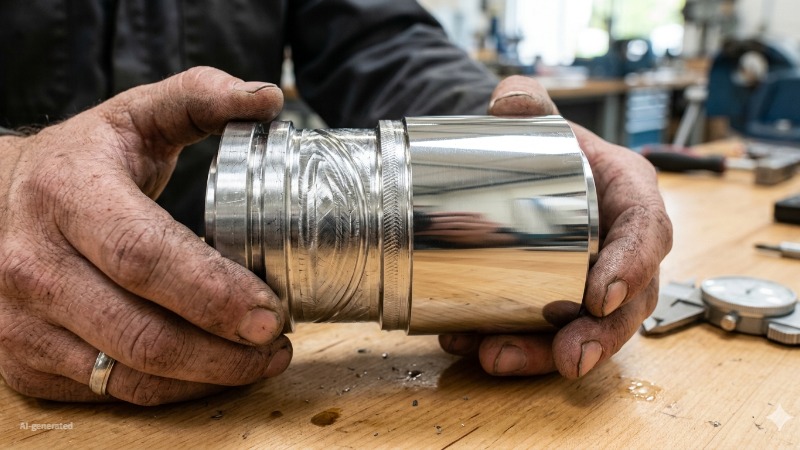
(AI generated) Raw vs polished stainless steel CNC part
A CNC machined part may be dimensionally correct and fully within tolerance, yet still look unfinished. Tool marks, light surface roughness, and sharp edges are common after machining. For many applications, that is acceptable. When appearance, cleanliness, corrosion resistance, or lower roughness matters, metal polishing helps turn a machined surface into a finished one.
Getting it right means understanding which process suits the material, the geometry, and the finish requirement. Getting it wrong means either over-processing parts that didn't need it or under-processing parts that did.
What Is Metal Polishing?
Definition of Metal Polishing
Metal polishing is a surface finishing process that uses abrasive media or polishing compounds to remove a controlled amount of material from a metal part. The goal is to reduce surface roughness, remove visible defects, and achieve a specified finish grade.
The word "progressive" matters. Metal polishing works in stages. Coarse abrasive cuts fast and removes significant surface material including deep scratches and machining marks. Each subsequent stage uses finer abrasive to remove the marks left by the previous stage. The final stage produces the target polished metal finish. Skip stages or start with the wrong grit and the final result carries defects from earlier in the process that finer abrasive can't remove.
How Metal Polishing Works
At the surface level, polishing works by replacing deeper scratches with progressively finer ones. Polishing works by replacing deeper scratches with progressively finer ones. As the abrasive sequence becomes finer, surface roughness decreases and the surface becomes smoother and more reflective.
Mirror polishing extends this process further by using very fine compounds, often sub-micron alumina, chromium oxide, or diamond paste, to minimize surface texture. In well-controlled applications, surface roughness can drop below Ra 0.05 µm, giving the surface a mirror-like appearance. At that level the surface appears mirror-like because the surface irregularities are smaller than the wavelength of light. For more detail, see our guide to achieving a mirror finish on CNC machined parts.
The mechanics differ between metal polishing methods. In mechanical polishing, an abrasive wheel or belt physically cuts the surface. In buffing, a soft wheel with polishing compound burnishes and lightly abrades simultaneously. In vibratory or mass finishing, media particles contact the surface at low force but very high frequency. Each approach suits different geometries, production volumes, and target finishes.
Why Metal Polishing Is Used for CNC Parts
Three reasons drive the decision to specify metal polishing on CNC machined components: appearance, function, and downstream process requirements.
Appearance is the most obvious reason. A polished metal finish looks better than a machined one for consumer-facing products, presentation components, and anywhere visual quality matters to the end customer.
For stainless steel parts, polishing is often followed by passivation to improve surface cleanliness and corrosion performance. On fatigue-critical parts, polishing can reduce surface stress concentrators and may improve fatigue performance in high-cycle applications, depending on the material, geometry, and starting surface condition.
Downstream process requirements drive metal polishing in regulated industries. Pharmaceutical process equipment, medical devices, and food contact surfaces all have minimum surface roughness specifications that as-machined surfaces typically don't meet without a metal polishing process step.
CNC metal polishing on JLCCNC parts includes tolerance review as part of the process planning. If your design has features where polishing-induced dimensional change creates a risk, that gets identified and resolved before the part goes into production, not discovered after the first batch comes back out of spec. If your design includes tight-tolerance features, upload your CAD file for an engineering review before quoting.

Precision CNC Machining Service
Professional manufacturing, fast turnaround, and quality assurance.
Metal Polishing Process for CNC Machined Components
(AI generated) Buffing wheel polishing a metal part
Surface Preparation Before Polishing
Polishing does not remove embedded contamination; if contamination is present, polishing can smear or trap it in the surface. Parts going into any metal polishing process need to arrive clean. Cutting oil, coolant residue, rust, oxide scale, and handling contamination all interfere with polishing results. Alkaline degreasing removes oil and coolant. Acid pickling removes scale and oxide on steel and stainless. Abrasive or chemical pre-treatment removes heavy surface contamination that would clog abrasives and produce uneven metal surface polishing results.
The starting surface condition sets the practical limit of the result. Polishing can improve a surface, but deep scratches, pits, or handling damage may require more stock removal than the part can tolerate. Deep scratches from handling damage, grinding marks from setup, and pitting from corrosion don't polish out unless you remove enough material to get below them, which on close-tolerance parts may not be feasible. If the part arrives at polishing in poor surface condition, the metal polishing process either takes longer and removes more material, or the final result carries remnant defects.
Mechanical and Abrasive Polishing Steps
For standard CNC metal polishing, the process typically runs through three to five stages depending on the starting surface and target finish grade.
Stage 1: coarse abrasive (120-180 grit). Used mainly on accessible external surfaces to remove machining marks and level the surface. Ra typically drops from 1.6-3.2 µm to 0.8-1.2 µm in this stage. Material removal at this stage can be significant, often around 20-50 µm per surface, which matters on close-tolerance features.
Second stage: medium abrasive (240-320 grit) removes the scratches from stage one and produces a more uniform surface texture. Ra drops to 0.4-0.6 µm. The surface looks obviously smoother but still has visible texture under raking light.
Third stage: fine abrasive (400-600 grit) produces a satin or pre-polish condition. Ra 0.2-0.4 µm. On stainless steel this stage produces a typical satin or brushed polished metal finish that many industrial applications specify as the final condition.
Additional stages: 800, 1200, 2000 grit and polishing compound produce progressively brighter finishes approaching semi-mirror and mirror conditions. Each stage removes less material than the previous but takes comparable time because the abrasive is working on a finer scale.
Final Cleaning and Inspection
After polishing, parts should be cleaned before inspection so residual compound does not interfere with visual or roughness evaluation. Ultrasonic cleaning is often used when blind holes or recessed features are difficult to wipe clean.
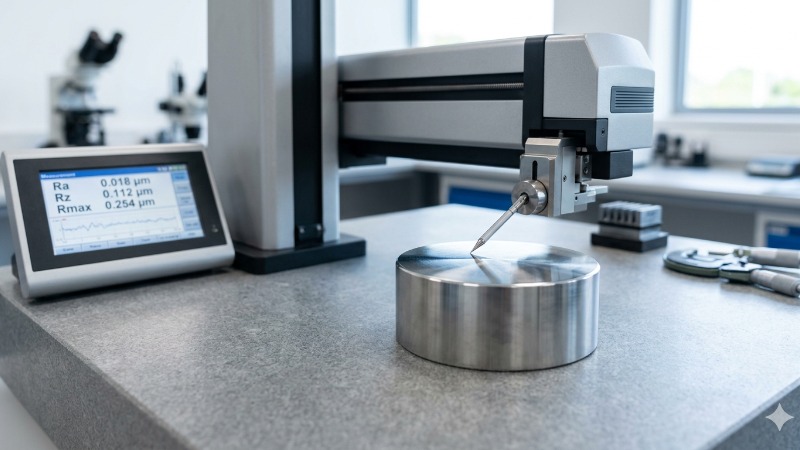
Final inspection checks Ra against the specified target using a surface profilometer, visual inspection under appropriate lighting for polishing defects, and dimensional check on any close-tolerance features that the metal polishing process may have affected. Parts going to anodize, plate, or coating after polishing should be inspected and processed promptly, freshly polished surfaces can oxidize quickly, especially on aluminum, so parts should be cleaned, protected, or moved promptly to the next finishing step.
Metal Surface Polishing Methods and Techniques
(AI generated) Polished metal finish samples
Mechanical Polishing
Mechanical polishing uses rigid or semi-rigid abrasive tools such as grinding wheels, flap wheels, belts, and mounted points to remove material in a controlled, directional pattern. The tool follows the surface, and the metal surface polishing action is controlled by grit, tool pressure, and relative speed between tool and surface.
Mechanical polishing works well on flat faces, cylindrical shafts, and external profiles accessible to the tool. It produces a directional polished metal finish, the scratch pattern follows the polishing direction, creating the characteristic lines of a brushed or grained finish. For components where directional texture is acceptable or specified, mechanical polishing is fast and cost-effective.
The limitation is geometry access. A grinding wheel or belt can't reach internal corners, deep slots, or complex recesses. Mechanical metal polishing on complex geometry parts requires multiple tool changes, manual work in hard-to-reach areas, and often produces inconsistent results between accessible and inaccessible surfaces.
Buffing and Abrasive Polishing
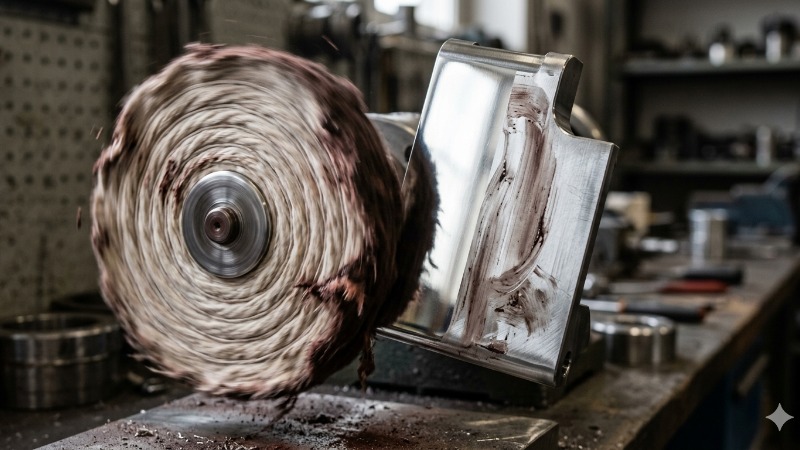
Buffing is used after abrasive polishing to increase brightness using soft wheels such as cotton, sisal, or flannel loaded with polishing compound. The wheel applies compound to the surface and the combination of mild abrasive cutting from the compound and burnishing action from the soft wheel produces reflective, bright surfaces that grinding and sanding don't achieve alone.
Compound selection drives the result. Cutting compounds contain harder abrasive and remove surface material aggressively, used for intermediate stages of the metal polishing process or for removing fine scratches from mechanical polishing stages. Finishing compounds contain finer, softer abrasive for the final buffing stage that produces the polished metal finish. Coloring compounds for the final pass produce maximum brightness with minimal material removal.
CNC metal polishing using automated buffing machines maintains consistent compound application, wheel pressure, and surface speed across a production batch. In production, automated buffing can provide better batch-to-batch consistency than manual buffing.
Mirror Finish Polishing
Mirror finish metal polishing is the most demanding and labor-intensive form of metal surface polishing. After mechanical and buffing stages bring the surface to Ra 0.1-0.2 µm, final mirror polishing uses sub-micron diamond or alumina compound on soft laps or cloths to push Ra below 0.05 µm.
At this level, the process becomes highly sensitive to contamination. A single oversized hard particle can leave a visible scratch that requires rework. Clean rooms, dedicated tools, and careful material handling are required for reliable mirror finish metal polishing in production.
Mirror finish is specified where reflectivity is a functional requirement, optical components, laser equipment, certain medical instruments, or where premium cosmetic appearance justifies the significant additional cost. For most industrial CNC metal polishing applications, satin or semi-polished finishes deliver the required functional benefits at substantially lower cost.
Stainless Steel Polishing Methods and Finish Grades
Why Stainless Steel Polishes Differently
Stainless steel behaves differently from aluminum, brass, or copper during polishing because it is harder, generates more heat, and can work harden under abrasive contact. That means the process needs controlled pressure, sharp abrasives, and a consistent grit sequence to avoid smearing the surface or leaving uneven scratch patterns.
Another difference is that stainless steel polishing is not only about appearance. In many CNC applications, the polished surface also affects cleanability, contamination control, and corrosion performance, which is why polishing parameters and post-polishing handling matter more than they do on many softer metals.
304 vs 316 Stainless Steel Polishing
Both 304 and 316 stainless steel can be polished to satin, bright, or mirror finishes, and both are widely used for CNC machined parts. In practice, the polishing process is similar for the two grades, but 316 is more often selected for corrosive or sanitary environments, while 304 is more common for general industrial and consumer applications because it is usually more cost-effective.
From a finishing standpoint, both alloys can achieve very smooth surfaces when the starting surface is well machined and the abrasive sequence is properly controlled. The choice between 304 and 316 is usually driven more by service environment and corrosion requirements than by major differences in polishability.
Common Stainless Steel Finish Grades
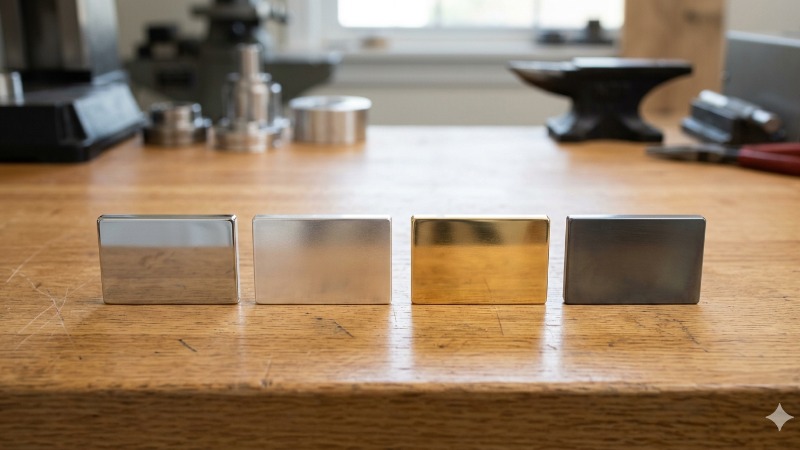
For CNC machined stainless steel parts, the most common finish grades are satin, semi-polished, and mirror. Satin finishes usually have a fine directional grain and low reflectivity, making them suitable for industrial equipment, food-contact parts, and housings where a clean but non-glossy appearance is preferred.
Semi-polished and mirror finishes use finer abrasives and buffing stages to reduce visible texture and increase reflectivity. Semi-polished surfaces are often chosen for medical devices, precision hardware, and premium consumer parts, while mirror finishes are typically reserved for decorative, inspection-critical, or high-visibility applications where appearance justifies the added cost.
Passivation and Contamination Control After Polishing
After stainless steel polishing, the surface should be thoroughly cleaned to remove polishing compounds, embedded debris, and handling contamination before final inspection or passivation. If residue remains on the part, it can affect both the visible finish and the corrosion performance of the surface.
When corrosion resistance is important, polishing is often followed by passivation to help restore the stainless steel surface condition after finishing. Good contamination control is just as important as the polishing step itself, especially for medical, food-processing, pharmaceutical, and other clean-service applications.
How Different Metals Respond to Polishing
| Metal | Polishing Behavior | Grit Sequence | Challenges | Typical Final Finish |
|---|---|---|---|---|
| 304/316 Stainless Steel | Work hardens during polishing | 120 → 240 → 400 → 600 → buff | Heat control and abrasive condition matter | Ra 0.05-0.4 µm, satin to mirror |
| 17-4 PH Stainless | Harder than austenitic grades, polishes to excellent finish | 180 → 320 → 600 → buff | Higher cutting forces required, more tool wear | Ra 0.1-0.3 µm |
| 6061 Aluminum | Soft, polishes quickly, scratches easily | 240 → 400 → 600 → buff | Soft surface picks up contamination during polishing, prone to scratching | Ra 0.1-0.4 µm, bright finish |
| 7075 Aluminum | Similar to 6061, slightly harder | 240 → 400 → 600 → buff | Alloying elements can cause slight surface mottling at mirror finish | Ra 0.1-0.4 µm |
| Brass | Very easy to polish, polishes to bright finish quickly | 240 → 400 → buff | Soft, scratches easily, tarnishes after polishing without lacquer | Ra 0.05-0.2 µm, high shine |
| Copper | Similar to brass, very reflective when polished | 240 → 400 → buff | Oxidizes quickly after polishing, requires immediate protection | Ra 0.05-0.2 µm |
| Grade 2 Titanium | Difficult, springy, work hardens | 180 → 320 → 600 → buff | Generates significant heat, galls on abrasive tools, requires frequent abrasive changes | Ra 0.2-0.6 µm |
| Ti-6Al-4V | Harder than Grade 2, more difficult to polish | 180 → 320 → 600 | More tool wear, heat management critical | Ra 0.2-0.5 µm |
| Inconel 625 | Very difficult, extreme work hardening | 120 → 240 → 400 → 600 | Short abrasive life, high heat, inconsistent results without experience | Ra 0.3-0.8 µm |
How Metal Polishing Affects CNC Part Tolerances and Surface Roughness
(AI generated) Profilometer measuring surface roughness
Surface Roughness and Ra Improvement
The Ra improvement from metal polishing follows the abrasive grit sequence. Each stage removes the marks from the previous stage and reduces Ra approximately 40-60%. A machined stainless steel surface at Ra 1.6 µm reaches Ra 0.8 µm after 240-grit mechanical polishing, Ra 0.4 µm after 400-grit, Ra 0.2 µm after 600-grit, and Ra 0.05-0.1 µm after buffing with fine compound.
These improvements are not automatic. They depend on the starting surface, the abrasive sequence, pressure control, and enough time at each stage. Rushing the metal polishing process by skipping stages produces a surface that looks good in one lighting condition and shows remnant defects under inspection lighting. The stages exist because you can't get from Ra 1.6 µm to Ra 0.05 µm in one step without removing far more material than close-tolerance parts can afford.
Edge Rounding and Dimensional Changes
Metal surface polishing removes material. On functional surfaces with tight tolerances, this matters. Mechanical polishing removes 20-100 µm per surface on coarse stages. Fine polishing stages remove 5-20 µm. A complete metal polishing process sequence from machined to satin finish removes 30-80 µm total per surface on most stainless steel parts.
For bores, external diameters, and mating faces with tolerances tighter than ±0.05mm, this material removal is significant. Parts that will be polished should be machined with an appropriate polishing allowance so the final dimension remains within specification after material removal.
Edge rounding is the other dimensional effect. The metal polishing process rounds sharp 90-degree edges progressively. On general parts this is a benefit, controlled edge break improves safety and assembly. On parts with functional sharp edges, cutting tools, precise mating features, optical components, metal polishing must be carefully controlled or those edges masked to prevent rounding.
Tolerance Considerations for Precision Parts
Parts with tolerances tighter than ±0.02mm on any feature that will be polished need explicit discussion with the polishing operation before committing to the process sequence. Either the tight-tolerance features need masking, protecting them from the abrasive, or the machining target needs adjustment to accommodate material removal.
Polished Metal Finish Grades and Surface Appearance
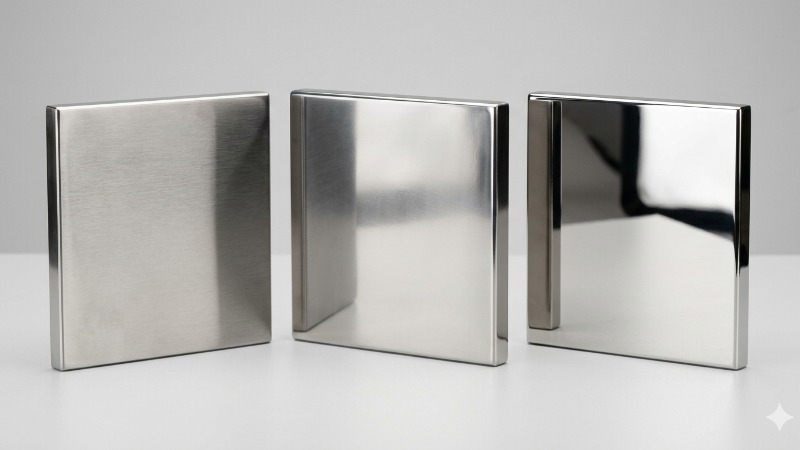
(AI generated) Stainless steel polished finish grades
Satin and Brushed Finishes
Satin and brushed finishes are directional, low-reflectivity finishes typically produced by abrasive polishing without bright buffing. They are common on industrial, sanitary, and architectural stainless steel parts.
Semi-Polished Surfaces
Semi-polished finishes have lower roughness and slight reflectivity, making them suitable for medical devices, precision hardware, and consumer products.
Mirror and High-Gloss Finishes
Mirror finishes are highly reflective and usually reserved for decorative, optical, or premium applications where appearance or reflectivity justifies the extra cost.
Surface Finish Grades and Roughness Values
| Finish Grade | Ra (µm) | Visual Appearance | Typical Process |
|---|---|---|---|
| As machined | 0.8-3.2 | Visible tool marks | CNC machining only |
| Satin/brushed | 0.4-0.8 | Uniform grain, non-reflective | Mechanical polishing 320-400 grit |
| Semi-polished | 0.2-0.4 | Low reflectivity, fine grain | 600-800 grit + light buff |
| Polished | 0.1-0.2 | Reflective, bright | 1200 grit + cut compound buff |
| Mirror | 0.025-0.1 | Highly reflective, near-mirror | Full sequence + finishing compound |
| Super mirror | Below 0.025 | True mirror reflection | Full sequence + sub-micron diamond |
CNC Metal Polishing Applications in Manufacturing
| Industry | Application | Finish Grade | Reason for Metal Polishing |
|---|---|---|---|
| Aerospace | Turbine components, structural brackets, fasteners | Polished to mirror on fatigue-critical parts | Fatigue life improvement, corrosion resistance in service environment |
| Automotive | Engine components, decorative trim, fluid system parts | Satin to polished | Appearance, corrosion resistance, fluid flow efficiency |
| Medical devices | Surgical instruments, implants, device housings | Semi-polished to mirror | Sterilization compatibility, bacterial adhesion resistance, visual inspection |
| Pharmaceutical | Process vessels, fittings, mixing components | Satin to polished per ASME BPE | Cleanability, CIP compatibility, regulatory compliance |
| Food processing | Contact surfaces, conveyors, processing equipment | Satin minimum | Hygiene, cleaning chemical resistance, regulatory compliance |
| Consumer products | Watches, jewelry, hardware, premium electronics | Semi-polished to mirror | Appearance, brand perception |
| Semiconductor | Process chambers, fluid handling components | Mirror to super mirror | Particle reduction, outgassing minimization, ultra-clean surfaces |
| Optical | Mirror substrates, precision mounts, laser components | Mirror to super mirror | Reflectivity, surface accuracy, functional optical requirements |
| Oil and gas | Valve bodies, pump components, connectors | Satin | Corrosion resistance in process fluid environments |
| General industrial | Shafts, housings, precision fixtures | Satin to semi-polished | Corrosion resistance improvement, assembly surface quality |
Advantages and Limitations of Metal Polishing
Improved Surface Finish and Appearance
Metal polishing produces the best achievable surface finish on metal parts short of specialized grinding or lapping operations. The range, from satin at Ra 0.8 µm to mirror below 0.025 µm, covers every industrial and cosmetic requirement.
Corrosion Resistance Benefits
On stainless steel, polishing can improve surface cleanliness and support better post-treatment results when followed by proper cleaning and passivation. On aluminum, polishing before anodizing produces more uniform anodize adhesion and appearance. For aluminum parts going to anodize after polishing, understanding which anodize type suits your application is worth reading, our anodizing vs hard anodizing guide covers the difference.
The corrosion benefit of polishing can be meaningful, especially when it is paired with the correct post-treatment for the material. For stainless steel, polishing followed by passivation can improve corrosion performance compared with passivation alone, because a smoother surface provides fewer initiation sites for localized attack.
Cost and Production Considerations
Metal polishing is labor-intensive. Manual metal surface polishing of complex geometry parts takes significant skilled operator time, a complex CNC machined part with internal features and multiple surface orientations might take 30-90 minutes to polish manually to a semi-polished finish. At production volumes, this labor cost per part is significant.
Automated CNC metal polishing on simple geometry, flat faces, cylindrical external surfaces, reduces this. Vibratory and mass finishing processes handle batch metal polishing of simple parts efficiently. But complex three-dimensional CNC parts with varied surface orientations still require manual polishing for complete coverage, and that's where the production cost of metal polishing becomes a real factor in the specification decision.
Metal Polishing vs Other Surface Finishing Processes
| Factor | Metal Polishing | Electropolishing | Bead Blasting | Vibratory Finishing |
|---|---|---|---|---|
| Surface finish achievable | Ra 0.025-0.8 µm | Ra 0.1-0.8 µm | Ra 0.8-2.0 µm | Ra 0.2-1.6 µm |
| Mirror finish capability | Yes | No | No | No |
| Internal feature access | Poor, manual tools limited | Excellent, electrolyte reaches all | None, line-of-sight | Good with correct media |
| Labor per part | High | Very low at volume | Low | Very low |
| Batch capability | Poor | Excellent | Moderate | Excellent |
| Dimensional change | Moderate, 20-100 µm | Low, 5-30 µm | Very low | Low |
| Corrosion resistance improvement | Good | Excellent for stainless | Minimal | Minimal |
| Best application | Complex geometry, high-finish requirements, low volume | Stainless steel high-cleanliness batch production | Uniform matte texture | Deburring and surface prep at volume |
| Worst application | High-volume production, internal features | Mirror finish requirements, aluminum | Precision parts, internal features | Large single parts, mirror finish |
| Cost per part at volume | High | Low | Low | Very low |
When Polishing Is Not the Best Option
Metal polishing isn't always the right answer. For high-volume production where part geometry is simple and a uniform matte surface is acceptable, vibratory finishing or bead blasting produces consistent results at dramatically lower cost per part. For some stainless steel components where cleanliness and corrosion resistance matter more than cosmetic appearance, electropolishing may be a more efficient option than mechanical polishing. For parts with extensive internal geometry that manual polishing can't reach, electropolishing or vibratory finishing produce more consistent all-over surface quality than metal polishing that only covers accessible external surfaces.
How to Choose the Right Metal Polishing Method
Material Compatibility
The metal polishing process needs to suit the material. Stainless steel polishing uses harder abrasives and higher pressures than aluminum polishing, using the wrong approach produces inconsistent results and unnecessary tool wear. Titanium requires special attention to heat management during metal surface polishing. Soft metals like brass and copper polish quickly but scratch easily and require careful handling between stages.
The material hardness and work hardening behavior determine grit selection, polishing pressure, and stage sequence. Getting this right depends on process knowledge, which is one reason polishing results can vary significantly between suppliers even for the same material and target finish.
Surface Finish Requirements
Match the metal polishing process to the finish requirement. Specifying mirror finish metal polishing on a part that only needs satin finish for its application wastes money. Specifying satin when the application requires semi-polished risks compliance failure in regulated industries.
Define the target finish by Ra value instead of using a general term such as "polished." For example, Ra 0.2 µm is far more precise than a purely visual description. Specify the measurement standard (ISO 4287 or ASME B46.1), the measurement length, and the direction of measurement relative to any polishing direction on the part.
Production Volume and Cost Factors
Low volume (under 50 parts): manual metal polishing is practical. Per-part labor cost is high but the fixed investment in equipment and process development isn't justified.
Medium volume (50-500 parts): semi-automated metal surface polishing with fixturing and automated buffing heads reduces per-part labor. The consistency improvement over manual polishing justifies the setup investment.
High volume (500+ parts): automated CNC metal polishing, mass finishing, or electropolishing depending on geometry and finish requirements. At this volume, the labor efficiency of automated processes makes manual metal polishing economically unviable.
Metal Polishing Services for CNC Machined Parts at JLCCNC
JLCCNC provides metal polishing as part of the complete CNC machining and finishing service, not as a separate operation that requires coordinating between suppliers.
Available polishing finishes cover satin and brushed finishes for industrial and food-grade applications, semi-polished surfaces for medical and pharmaceutical components, and polished finishes for precision and consumer-facing parts. Stainless steel polishing and aluminum surface polishing are the primary capabilities, covering the materials that account for the majority of industrial CNC metal polishing requirements.
Tolerance review is built into the process for every polishing order. Parts with close-tolerance features get reviewed for polishing-induced dimensional change before machining targets are set, so finished parts meet both the dimensional and surface finish specifications rather than trading one off against the other.
JLCCNC supports both prototype and production quantities. The same process documentation is used to help maintain finish consistency from prototype approval through production.
If you're specifying a polished metal finish on a CNC part and aren't sure which finish grade suits the application or whether the geometry is compatible with the polishing process, upload your file and our engineers will give you a recommendation before quoting.
Precision CNC Machining Service
Professional manufacturing, fast turnaround, and quality assurance.
FAQs About Metal Polishing
Q: How much material does metal polishing remove?
Metal polishing typically removes about 10-100 µm per surface, depending on the starting condition, abrasive sequence, and target finish. Coarser polishing stages remove the most material, while fine buffing removes much less.
Q: Can polishing remove CNC machining marks completely?
Yes, polishing can remove CNC machining marks if there is enough material allowance and the marks are not too deep. Deep tool marks may require extra stock removal or may remain faintly visible on tight-tolerance parts.
Q: What surface roughness can polished stainless steel achieve?
Polished stainless steel commonly reaches about Ra 0.4-0.8 µm for satin finishes, Ra 0.1-0.4 µm for semi-polished finishes, and Ra below 0.1 µm for mirror finishes. The final result depends on the stainless grade, starting surface, and polishing process.
Q: s polishing or electropolishing better for stainless steel parts?
Mechanical polishing is better when you need a specific visual finish such as brushed, satin, or mirror on external surfaces. Electropolishing is often better for improving corrosion resistance, cleanability, and internal surface coverage on stainless steel parts.
Q: Does polishing affect tight-tolerance features and edges?
Yes, polishing removes material and can round edges, so it can affect tight-tolerance features if no polishing allowance is planned. Features with very tight tolerances may need masking or process review before polishing.
Popular Articles
• Surface Finish in Machining, Types, Charts & Testing
• Anodizing vs. Hard Anodizing: The Differences in Surface Treatment Techniques
• Anodized Aluminum Colors: Options, Limits, and Real-World Results
• Explanation of different material surface treatment technologies in CNC machining
• How to choose between Laser marking and UV printing?
Keep Learning
Surface Finish in Machining, Types, Charts & Testing
What is Surface Finish in Machining? At its core, surface finish in machining refers to the small-scale irregularities left on the surface of a part after machining. These irregularities are typically grouped into three categories: Roughness: The fine, closely spaced deviations caused by the cutting process itself. Roughness depends heavily on feed rate, tool sharpness, and cutting speed. Waviness: Larger, more widely spaced variations caused by machine tool vibration, deflection, or thermal distortio......
CNC Machining Surface Roughness: A Practical Guide
Why Surface Roughness Matters in CNC Machining When we talk about CNC machining, precision isn't just about hitting the right dimensions, it’s also about how the surface feels and performs. Surface roughness describes the fine irregularities left on a machined surface, and it directly impacts how a part behaves in the real world. So, what is surface roughness? In simple terms, it's the measure of tiny peaks and valleys created by the cutting process. While they might look smooth to the naked eye, thes......
Optimizing Manufacturing Efficiency: A Guide to Computerized Numerical Control (CNC) Machining Surface Finishes
CNC Surface Finishes: Types, Costs, and How to Choose Quick Answer: Choose an as-machined finish when cost and dimensional stability matter most. Use bead blasting or brushing for a uniform cosmetic appearance, anodizing for aluminum corrosion resistance, hard anodizing for wear, and laser marking or UV printing for identification. Confirm material, tolerance, color, masking, and end-use environment before quoting. A CNC-machined part comes off the machine functional but rarely finished — tool marks, ......
Anodizing vs. Hard Anodizing: The Differences in Surface Treatment Techniques
Quick Answer: Choose Type II anodizing when corrosion resistance, color, and cosmetic appearance are the main requirements. Choose Type III hard anodizing when the part needs greater wear resistance and the coating thickness can be accommodated in the fit and tolerance plan. Confirm alloy, coating thickness, color, sealing, and critical dimensions before release. An aluminum bracket for an outdoor enclosure and a hydraulic cylinder rod both might get anodized — but specifying the same process for both......
How to Remove Anodizing from Aluminum Parts
Key Takeaways Chemical stripping is commonly used when anodizing needs to be removed from most or all of an aluminum part, but the process can also attack the underlying aluminum if it is not controlled. Mechanical removal works well for accessible areas but can change the surface texture and remove more base metal than intended. CNC machining gives better control when a defined anodized area needs to be removed from a precision part. Laser-based removal can be useful for controlled localized treatmen......
Anodizing Thickness: How Much Does It Add?
Anodizing Thickness and Dimensional Change at a Glance Feature Approximate dimensional effect One coated external surface +0.5 × coating thickness Outside diameter across two coated surfaces +1 × coating thickness Bore diameter with two coated walls −1 × coating thickness 60° thread pitch diameter Changes by about 4 × surface-growth amount, or about 2 × coating thickness under the 0.5× growth assumption Dimensional estimates below use the 0.5 × coating-thickness surface-growth relationship given in MI......