Sheet Metal Roofing: Types, Panels, Systems & Practical Guide
24 min
- What is Sheet Metal Roofing
- How Sheet Metal Roofing Systems Work
- Types of Sheet Metal Roofing
- Corrugated Roofing: Features, Benefits & Applications
- Metal Roof Panels vs Metal Sheets: What's the Difference?
- Metal Roofing Systems Explained (Fixing and Structure Types)
- What Is Metal Roofing Made Of? (Material Breakdown)
- How Sheet Metal Roofing Is Manufactured (From Sheet to Panel)
- Sheet Metal Roofing Cost Factors
- Key Features and Benefits of Sheet Metal Roofing
- How to Choose the Right Sheet Metal Roofing Solution
- FAQs About Sheet Metal Roofing
What is Sheet Metal Roofing
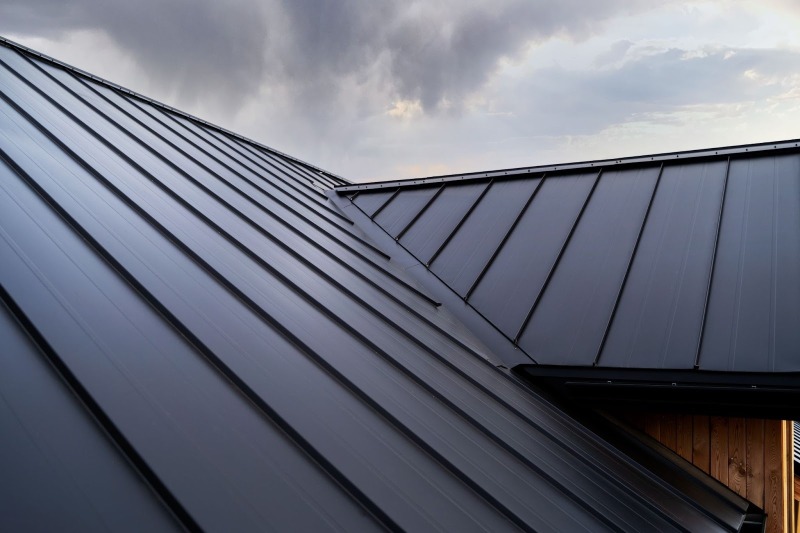
(AI generated)Metal sheet roofing
Sheet metal roofing is a roofing system made from thin, formed metal sheets—typically steel, aluminum, or copper—designed to protect buildings from weather while providing durability, corrosion resistance, and long service life.
It is widely used in residential, commercial, and industrial buildings due to its strength, lightweight properties, and low maintenance requirements.
Most roof failures don’t happen because of the metal itself; it’s the system design that fails. When you’re specifying a build, you’re really solving for thermal movement and wind uplift. If you pick the wrong fastening method or a profile that can't handle the local snow load, the alloy’s 70-year lifespan doesn't matter.
Defining Sheet Metal Roofing
Sheet metal roofing is a roofing system built from thin metal sheets or formed panels. Manufacturers typically produce these panels from steel, aluminum, zinc, or copper.
Installers place metal roof panels over a roof deck or structural frame to create a continuous protective surface. These panels overlap or interlock to control water flow and resist wind uplift.
Common sheet metal roofing types include corrugated roofing, standing seam panels, and ribbed metal sheets. These metal roofing systems appear on residential homes, warehouses, factories, and commercial buildings because they offer long service life and strong corrosion resistance.
How Do Sheet Metal Roofing Systems Work?
Sheet metal roofing systems work by using interlocking or overlapping metal panels, supported by a structural deck and sealed with fasteners and flashing, to create a durable, weather-resistant barrier that directs water away from the building.
They are designed to manage water flow, allow thermal expansion, and resist environmental loads such as wind and snow.
It is much more than just a lid for a building; it’s a managed assembly. A standard spec usually falls into these four layers:
● The Panels: These are roll-formed to increase the section modulus. By adding ribs or corrugations, we make thin-gauge sheet metal stiff enough to span wide distances without sagging.
● Underlayment: This is your last line of defense against condensation and "ice damming."
● Fasteners/Clips: This is the biggest decision. Exposed fasteners (like in corrugated roofs) are cost-effective but create thousands of potential leak points. Concealed clips (standing seam) allow the roof to "breathe" and move as it heats up.
● Flashing: This is where the skill is. If the flashing at the ridges and valleys isn't precise, the whole system fails.
Why Choose Sheet Metal Roofing?
The $23 billion shift toward metal was not just for the "curb appeal", it was for the math.
● Strength-to-Weight: We can cover a massive warehouse with aluminum or steel for a fraction of the structural load required by tile or concrete.
● Coating Tech: We’re seeing 40 to 70-year lifespans now because modern galvanized and Kynar coatings have fundamentally changed the oxidation timeline.
● Speed of Close-in: On a commercial site, time is a massive cost. Metal panels let contractors dry-in a building weeks faster than traditional methods.
"The profile and the way you pin it down matter way more than the metal you're using." — Jason Beaudry, MCA Engineer.
If you're dealing with high wind zones or corrosive salt-spray environments, the documentation is just as important as the metal. Getting a clean trail on material origin and coating specs is the only way to ensure 2026 compliance.
How Sheet Metal Roofing Systems Work
A sheet metal roofing system is not just a surface layer—it is a multi-component assembly designed to manage water, air, and thermal movement while maintaining structural integrity. Each layer and connection point plays a specific role in ensuring long-term performance.
Core Layers of a Metal Roofing System
1. Metal Roof Panels
These are the visible outer layer, typically formed into corrugated, ribbed, or standing seam profiles. The geometry increases stiffness, allowing thin sheet metal to span across structural supports without deformation.
2. Underlayment
Installed beneath the panels, the underlayment acts as a secondary moisture barrier. It protects against condensation, wind-driven rain, and potential leakage at seams or fasteners.
3. Structural Support (Deck or Purlins)
Panels are fixed onto a roof deck (in residential systems) or directly onto purlins (in industrial buildings). This structure carries the load of the roofing system, including wind uplift and snow loads.
4. Fasteners and Clips
The fixing method defines how the system performs:
● Exposed fasteners directly penetrate the panels (common in corrugated systems)
● Concealed clips sit beneath seams (used in standing seam systems), allowing panels to expand and contract without stress
5. Flashing and Seals
Flashing components are installed at joints, edges, ridges, and valleys. These areas are the most vulnerable to leaks, so precise fabrication and installation are critical.
How the System Manages Water and Weather
Metal roofing systems are engineered to control water flow rather than completely block it at a single point.
● Overlapping or interlocking panels create controlled drainage paths
● Raised seams and ribs prevent water from traveling laterally
● Flashing directs water away from critical junctions
● Sealants and gaskets provide localized protection at penetrations
In high-performance systems like standing seam roofing, concealed connections reduce the number of exposed entry points for water.
Thermal Movement and Expansion Control
One of the most critical challenges in sheet metal roofing is thermal expansion.
Metal expands when heated and contracts when cooled. If this movement is restricted, it can lead to:
● Panel distortion (oil canning)
● Fastener fatigue
● Joint failure
To manage this:
● Standing seam systems use sliding clips
● Panel lengths and fixing points are carefully calculated
● Expansion gaps are integrated into the design
Load Distribution and Structural Behavior
The panel profile directly affects how the system handles loads:
● Corrugated panels distribute stress through curved geometry
● Ribbed panels increase stiffness with linear reinforcement
● Standing seam panels combine structural strength with flexibility
These profiles allow lightweight sheet metal to perform under:
● Wind uplift forces
● Snow loads
● Maintenance foot traffic
Why System Design Matters More Than Material
Even high-quality materials like aluminum or coated steel can fail if the system is poorly designed. In practice, most issues come from:
● Incorrect fastening methods
● Poor flashing execution
● Inadequate allowance for thermal movement
A well-designed sheet metal roofing system ensures that all components—panels, fasteners, and seals—work together as a coordinated system, not just individual parts.
Wind Uplift
Wind uplift resistance measures how well a metal roofing system can withstand upward wind pressure.
Typical performance ranges:
● Corrugated roofing: 20–40 psf
● Ribbed metal panels (R-panels): 30–60 psf
● Standing seam systems: 60–120 psf (depending on clip spacing and design)
These values typically align with testing standards such as ASTM E1592 for metal roof systems.
Higher wind resistance depends on:
● Panel profile geometry
● Fastener spacing and type
● Substructure design
Engineered standing seam systems are commonly used in high-wind regions because they provide superior uplift resistance.
Types of Sheet Metal Roofing
You might have seen several sheet metal roofing types in real projects. And each profile changes how the metal roof panels look, how water drains, and how the roof behaves under wind and snow loads.
Contractors usually choose a panel shape based on installation speed, structural stiffness, and visual style. Here’s the most common metal roofing systems used today.
| Roofing Type | Panel Appearance | Typical Panel Shape | Where You’ll See It | Why Contractors Use It |
|---|---|---|---|---|
| Corrugated Roofing | Repeating wave pattern across the panel | Continuous rounded ridges and valleys | Warehouses, farms, industrial sheds | The corrugation increases stiffness in thin metal sheets for roofs, allowing large spans with lightweight panels. |
| Standing Seam Roofing | Clean vertical lines with raised seams | Tall interlocking seams between flat panels | Homes, offices, modern commercial buildings | Hidden fasteners protect the roof surface and create a sleek architectural look. These metal roof panel also handle thermal expansion well. |
| Ribbed Metal Roofing | Straight vertical ribs spaced across the sheet | Flat panel sections separated by narrow ribs | Commercial buildings, workshops, garages | Ribs increase panel strength and help guide water down the roof surface. These panels install quickly in large metal roofing systems. |
| Custom Profiled Sheets | Profile depends on project design | Custom roll-formed ridges, ribs, or trapezoidal shapes | Stadiums, airports, architectural buildings | Engineers specify custom sheet metal roofing types when standard metal roof panels do not meet structural or visual requirements. |
Corrugated Roofing
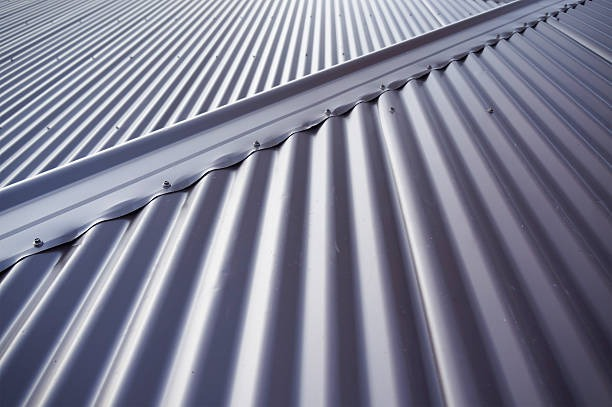
(Istock) Corrugated Metal Roofing
Standing Seam Roofing
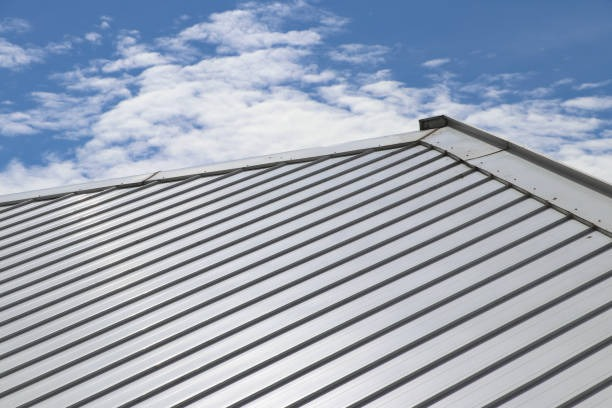
(Istock) Standing Seam Roofing
Ribbed Metal Roofing
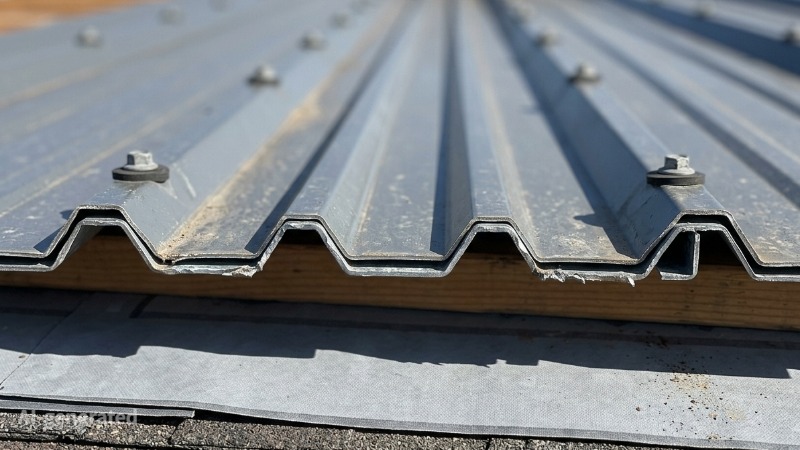
(AI generated) Ribbed Metal Roof
Sheet Metal Roofing Types Comparison
Sheet Metal Roofing Types Comparison
Sheet metal roofing systems can be categorized based on structural design, fastening method, and performance characteristics. The three most widely used types are corrugated roofing, standing seam roofing, and ribbed metal roofing.
Corrugated Roofing
Best for low-cost, high-speed installation with exposed fasteners. Common in industrial and agricultural buildings.
Standing Seam Roofing
A high-performance system with concealed fasteners and excellent thermal movement handling. Common in residential and commercial architecture.
Ribbed Metal Roofing
A balance between strength and installation efficiency, widely used in workshops and commercial structures.
Key Differences in Performance
- Water resistance: Standing seam > Ribbed > Corrugated
- Installation cost: Corrugated < Ribbed < Standing seam
- Lifespan: Standing seam ≥ Ribbed > Corrugated
Corrugated Roofing: Features, Benefits & Applications
For any factory roof, you’ll see the standard wave pattern of corrugated metal. It has a simple profile, but the geometry is doing some heavy lifting. The core problem in roofing is that thin sheet metal is flimsy when flat. By roll-forming those waves into the sheet, you’re fundamentally changing its moment of inertia. This stiffness boost is what allows us to span wide distances without the panels buckling under their own weight, all without adding a single millimeter of thickness.
Structure and Design of Corrugated Roofing
Corrugated panels aren't just about looks; they’re a lesson in structural efficiency. When flat coil stock goes through a roll-former, the ridges and valleys create a series of structural "beams" across the panel.
● Stiffness vs. Weight: Even a 0.5 mm steel sheet becomes remarkably rigid once it’s corrugated. This allows for wider purlin spacing, which cuts down on the overall structural steel needed for the building frame.
● Managing the Load: The corrugation height directly dictates how much snow or wind load the roof can take. If you’re in a high-wind zone, you don't necessarily need thicker metal; you might just need a deeper profile.
● Drainage Reality: While the ridges guide water down, the real engineering happens at the overlaps. Proper sidelaps and weather-stripping in those valleys are what actually keep the building dry during a heavy downpour.
Why It's Still the Industrial Standard
There's a reason corrugated remains one of the most specified sheet metal roofing types, even with more presentable standing seam systems available.
1. Material Efficiency: You get the most "strength per dollar" here. Since the profile provides the stiffness, you can stick with lighter gauges (0.4 mm to 1.0 mm) and still meet code.
2. Installation Logistics: It’s fast. You’re using exposed fasteners, screws with neoprene washers, driven right into the crests. It isn’t as visually appealing as a concealed clip system, but when you have 50,000 square feet to cover, speed is the priority.
3. Field Serviceability: If a forklift or a fallen branch dents a panel, you can swap out a single sheet without dismantling half the roof. That’s a massive win for long-term maintenance in agricultural or industrial settings.
Where We Actually Use It
While you’ll see it on barns and carports, the heavy-duty applications are in Industrial and Commercial facilities. Factories and warehouses rely on these systems because they can handle the vibration of heavy machinery and the thermal stress of large open spaces.
Architects have also started pulling the "industrial look" into residential workshops and modern homes, but even then, the decision usually comes down to the same thing: it’s a lightweight, high-strength barrier that doesn't overcomplicate the build.
Metal Roof Panels vs Metal Sheets: What's the Difference?
Both metal roof panels and metal sheets for roofs come from the same raw material: thin rolled metal. The difference lies in how manufacturers form the metal before installation.
Panels are shaped during manufacturing to add stiffness and structural capacity. Sheets remain flat or lightly processed and are often formed later during installation.
| Feature | Metal Roof Panels | Metal Sheets for Roofs |
|---|---|---|
| Product form | Pre-formed roofing components manufactured with structural profiles | Flat or lightly processed sheet metal supplied in large sheets or coils |
| Structural design | Roll-formed into profiles that increase stiffness and load capacity | Typically flat sheet stock that requires additional forming or support |
| Installation approach | Installed directly as part of complete metal roofing systems | Often cut, bent, or formed during installation |
| Manufacturing process | Factory roll-forming creates consistent panel shapes | Produced as flat sheet metal from coil stock |
| Structural performance | Higher stiffness due to engineered geometry | Lower stiffness unless formed or reinforced |
| Typical materials | Galvanized steel, coated aluminum, copper alloys | Steel, aluminum, stainless steel, copper |
| Typical use | Commercial roofs, residential roofing systems, industrial buildings | Smaller structures, custom fabrication, architectural sheet work |
How to Choose Between Panels and Sheets
When you plan a sheet metal roofing project, the decision between metal roof panels and metal sheets for roofs usually comes down to installation method and structural needs.
Use this checklist to guide the choice.
Choose metal roof panels when:
● The building uses a complete metal roofing system
● Large roof areas need fast installation
● Structural stiffness matters across wide spans
● The design relies on factory-formed components
Panels arrive ready for installation. That reduces on-site forming work and keeps installation consistent.
Choose metal sheets for roofs when:
● The project requires custom shaping or bending
● The roof area is small or irregular
● Fabrication happens on site
● The material serves architectural or cladding purposes
Flat sheets give fabricators more flexibility during installation. Contractors can cut, bend, and form them to match unique roof designs.
In large commercial or industrial projects, most engineers specify metal roof panels because they integrate directly into engineered metal roofing systems.
Metal Roofing Systems Explained (Fixing and Structure Types)
A metal roofing system includes more than the visible profiled metal sheets. The fixing method determines how the panels attach to the structure, how the roof handles expansion, and how well the system resists wind and water.
Different fixing systems work with different sheet metal roofing types, including corrugated roofing and other profiled metal sheets for roofs.
Exposed Fastener (Nail-Through) Systems
Exposed fastener systems attach metal roof panels directly to the roof structure using screws or nails that remain visible on the panel surface.
Contractors commonly use this system with corrugated roofing and ribbed panels. Installation moves quickly and material cost stays low. The trade-off involves more fastener penetrations across the roof surface.
Concealed Fastener Systems
Concealed fastener systems hide the attachment hardware beneath the panel edges. Installers secure clips or brackets to the structure, then lock adjacent roof cladding panels together over the clips.
This design reduces exposed penetrations and improves weather protection in many metal roofing systems.
Standing Seam Metal Roofing
Standing seam systems use vertical seams that interlock adjacent panels. Clips attach the panels to the roof deck while allowing movement from thermal expansion.
These systems appear frequently in residential and commercial sheet metal roofing because they provide strong water resistance and a clean roof surface.
Flat Lock Roofing Systems
Flat lock systems use small flat metal sheets for roofs that interlock on all sides. Installers fold the edges together to create a tight mechanical connection.
This method works well on steep or complex roof shapes where large roofing panels would be difficult to install.
System Performance Comparison
| System Type | Waterproofing | Wind Resistance | Thermal Expansion Handling |
|---|---|---|---|
| Exposed Fastener | Moderate | Moderate | Limited |
| Concealed Fastener | High | High | Good |
| Standing Seam | Very High | Very High | Excellent |
| Flat Lock | High | High | Good |
Thermal Expansion of Roofing Metals
Different metals expand at different rates when exposed to temperature changes.
Typical linear expansion coefficients:
- Steel: 12 × 10⁻⁶ /°C
- Aluminum: 23 × 10⁻⁶ /°C
- Copper: 17 × 10⁻⁶ /°C
For example, a 10-meter aluminum panel can expand over 2.5 mm with a 10°C temperature change. Over a 40°C seasonal variation, expansion can exceed 10 mm, which must be accommodated in system design.
This is why:
- Long panels require expansion gaps
- Standing seam systems use sliding clips
- Fastener systems must allow controlled movement
Ignoring thermal expansion can lead to panel deformation, fastener failure, or leakage.
What Is Metal Roofing Made Of? (Material Breakdown)
| Material Type | Common Forms in Roofing | Key Properties | Corrosion Resistance | Typical Cost Level | Common Applications in Metal Roofing Systems |
|---|---|---|---|---|---|
| Steel Roofing Sheets (Galvanized & Galvalume) | Corrugated panels, ribbed metal roof panels, structural metal sheets for roofs | High strength, good load capacity, widely available, compatible with most sheet metal roofing types | Galvanized steel uses a zinc coating. Galvalume adds aluminum for improved corrosion protection. Performs well in most climates. | Low to moderate | Industrial buildings, warehouses, commercial roofs, agricultural corrugated roofing, large metal roofing systems |
| Aluminum Roofing Sheets | Standing seam panels, architecturalmetal roof panels, lightweight metal sheets for roofs | Lightweight, easy to form, naturally corrosion resistant, suitable for coastal environments | Very high corrosion resistance due to natural oxide layer. Performs well in humid or marine conditions. | Moderate to high | Residential roofing, coastal buildings, architectural sheet metal roofing, modern commercial structures |
| Copper Roofing Sheets | Flat lock panels, custom architectural sheets, specialty metal roof panels | Highly durable, flexible for forming, develops a natural patina over time | Excellent corrosion resistance. Copper forms a protective oxide layer that increases longevity. | Very high | Historic buildings, architectural roofs, domes, decorative sheet metal roofing types |
| Other Materials (Tin / Stainless Steel) | Flat sheets, specialty metal roof panels, fabricated metal sheets for roofs | Tin historically used for corrosion protection. Stainless steel provides high strength and chemical resistance. | Stainless steel offers very high corrosion resistance. Tin-coated steel provides moderate protection. | Moderate to very high depending on alloy | Industrial facilities, specialized architectural roofs, environments requiring high corrosion resistance |
| Material Performance Comparison | Used across different metal roofing systems including standing seam and corrugated roofing | Steel provides the highest structural strength. Aluminum offers lightweight corrosion resistance. Copper provides long service life and aesthetic value. | Stainless steel and copper perform best in corrosive environments. Galvalume steel performs well for most construction. | Steel systems generally provide the lowest installed cost. Copper remains the most expensive roofing metal. | Material choice depends on structural loads, climate exposure, and the design requirements of the metal roof panels used in the project. and the performance of different metal sheets for roofs in specific environments. |
If you work with sheet metal roofing, you already know something: the real challenge starts when that design moves into fabrication.
Panel geometry, sheet thickness, bending limits, coating compatibility, and manufacturing tolerances all affect whether a part performs well once installed. Small design choices can change production cost, installation time, and long-term durability.
That‘s where JLCCNC helps.
Instead of guessing how your parts will be manufactured, you can upload your design and see how professional fabrication handles it. Engineers review the geometry, material choice, and manufacturability before production begins.
You get parts produced using industrial processes such as precision cutting, bending, and finishing, all suitable for structural sheet metal applications.
Typical Lifespan by Material
The service life of sheet metal roofing varies significantly by material and coating quality:
● Galvanized steel: 20–40 years
● Galvalume steel: 30–50 years
● Aluminum roofing: 40–60 years
● Copper roofing: 70–100+ years
● Stainless steel: 50+ years
Actual lifespan depends on:
● Environmental exposure (coastal, industrial, humidity)
● Coating system performance
● Installation quality and maintenance
High-performance coatings such as PVDF (Kynar 500) can significantly extend service life.
What Is the Best Metal Roofing Material?
The best sheet metal roofing material depends on performance requirements:
● Galvanized steel: cost-effective and strong
● Galvalume steel: better corrosion resistance than galvanized steel
● Aluminum: lightweight and highly corrosion-resistant
● Copper: premium durability and long lifespan
● Stainless steel: excellent strength and corrosion resistance
Each material is selected based on environment, budget, and expected lifespan.
How Sheet Metal Roofing Is Manufactured (From Sheet to Panel)
The production of metal roof panels is a high-precision transition from raw coil stock to a structurally rigid building component. The durability of a system depends entirely on how the material is handled during the forming and coating stages, as these processes dictate the final yield strength and corrosion resistance of the sheets.
Roll Forming Process
Roll forming is the mechanical heart of the operation. It involves feeding flat coil through a synchronized series of hardened steel rollers. Rather than stamping the shape all at once, which would stress the material and cause fractures, the rollers gradually "train" the metal into its final profile.
This incremental shaping is what allows us to produce common sheet metal roofing types like standing seam and corrugated panels in massive lengths. By maintaining tight dimensional consistency over a 40-foot span, manufacturers can minimize the number of end-laps on a project, which is the most effective way to eliminate leak points in large-scale metal roofing systems.
Sheet Thickness and Tolerances
In the shop, gauge is a functional constraint. Manufacturers must hold strict tolerances because even a 0.05 mm deviation can compromise the panel’s load-bearing capacity over a long span.
| Material | Typical Thickness Range | Common Use |
|---|---|---|
| Steel | 0.40 mm – 0.70 mm | High-traffic industrial and commercial decks. |
| Aluminum | 0.50 mm – 1.00 mm | Salt-spray environments and residential builds. |
| Copper | 0.50 mm – 0.80 mm | Century-scale architectural heritage projects. |
Panel thickness directly affects how far a panel can span without additional support.
Typical guidelines:
- 0.4–0.5 mm steel: up to 0.8–1.2 m span
- 0.6–0.7 mm steel: up to 1.5–2.0 m span
- Aluminum panels require slightly thicker gauges for similar spans
Span performance also depends on:
- Panel profile (corrugated vs ribbed vs standing seam)
- Load conditions (wind, snow)
- Support structure spacing
Engineers must balance thickness, profile geometry, and cost when specifying metal roof panels.
If the thickness isn't uniform, the panels won't nest or interlock correctly during installation, leading to structural buckling under snow loads.
Coating and Finishing (Galvanizing, Coating)
A raw steel or aluminum sheet wouldn't survive five years without surface treatment. The industry relies on metallurgical barriers to stall oxidation:
Galvanizing: A sacrificial zinc layer that protects the steel core.
Galvalume: An aluminum-zinc alloy that offers superior edge-cut protection compared to standard galvanizing.
Kynar 500 / Hylar 5000: High-performance resin coatings used on residential and architectural sheets to prevent UV degradation and chalking.
Sheet Metal Roofing Cost Factors
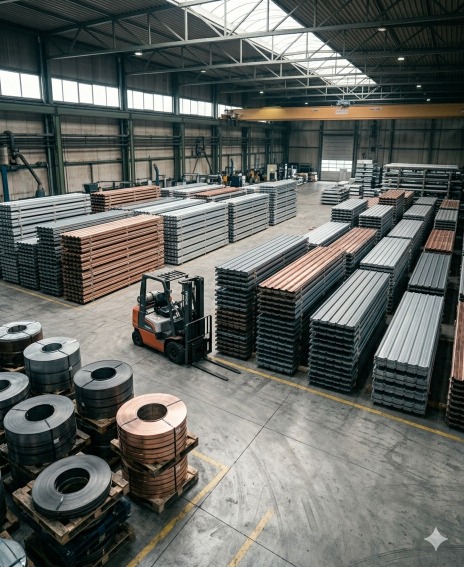
(AI generated) Warehouse storage of stacked metal roofing panels
The price of a metal roofing system isn't just about the weight of the metal. It’s a balance between material grade, the geometry of the panels, and the man-hours required for the specific fastening method.
Material Cost Differences
Steel is almost always the baseline for industrial cost-efficiency. Aluminum carries a premium because it’s lighter and inherently more corrosion-resistant, while copper is reserved for projects where the budget allows for a 100-year lifecycle. The choice usually comes down to the environment: if you’re within five miles of the coast, the extra cost of aluminum is a necessity, not an upgrade.
Panel Type Impact
Complexity in the profile drives the price up.
Corrugated Panels: Low cost, high speed. Because they use exposed fasteners, they are the fastest to install.
Standing Seam: Higher cost. The panels require more specialized forming and involve concealed clips that allow for thermal movement. You're paying for a system that can breathe without leaking.
Installation Complexity
Labor often outweighs material costs on complex rooflines. A simple warehouse shed roof is inexpensive because the panels can be craned into place and secured in hours. Conversely, a roof with multiple dormers, valleys, and penetrations requires custom-cut flashing and manual folding, which significantly inflates the project total.
Maintenance and Lifecycle Cost
When looking at the 40 to 70-year horizon, metal is often the cheapest option per year of service. While an asphalt roof might be cheaper today, the lifecycle cost of metal is lower because it avoids the "tear-off and replace" cycle. Maintenance is mostly proactive: clearing debris from gutters, checking neoprene washers on exposed fasteners, and ensuring the sealants at the penetrations haven't dried out.
For sheet metal roofing components, fabrication precision directly affects installation performance, especially in custom flashing, structural panels, and architectural roofing details.
At JLCCNC, we support precision sheet metal fabrication for engineering applications where tolerances, bending accuracy, and material selection directly impact system performance.
This includes cutting, forming, and finishing processes used in structural sheet metal components for industrial and architectural applications.
Key Features and Benefits of Sheet Metal Roofing
Sheet metal roofing remains widely used because it solves multiple structural and environmental challenges at once. The material performs well under weather exposure, structural loads, and long service periods.
Durability and Long Lifespan
High-quality metal roofing sheets often last several decades. Steel, aluminum, and copper roofing materials resist cracking, warping, and biological damage. Many metal roofing systems operate reliably for forty years or more when properly installed.
Corrosion Resistance
Modern coatings protect metal sheets for roofs from oxidation and environmental exposure. Galvanized and Galvalume coatings shield steel panels from rust. Aluminum and copper naturally form protective oxide layers.
This corrosion resistance allows sheet metal roofing types to perform well in coastal, humid, and industrial environments.
Energy Efficiency and Heat Reflection
Many metal roof panels use reflective coatings that reduce solar heat absorption. Reflective roofing surfaces help lower roof temperatures during hot weather, which can reduce cooling demand in buildings.
Large commercial metal roofing systems often use reflective coatings for energy performance.
Lightweight and Easy Installation
Compared with tile or concrete roofing, metal sheets for roofs remain relatively lightweight. This reduces structural load on the building.
Large corrugated roofing panels and other profiled sheets also cover large roof areas quickly, which speeds up installation.
Environmental Benefits (Recyclability)
Most sheet metal roofing materials are fully recyclable. Steel and aluminum panels often contain recycled material and can return to the recycling stream at the end of their service life.
Because of this circular material use, many modern metal roofing systems support sustainable construction practices.
How to Choose the Right Sheet Metal Roofing Solution
Selecting the right sheet metal roofing depends on project requirements, environmental conditions, installation constraints, and choosing the correct metal roofing systems and metal sheets for roofs
Based on Budget
Steel metal roof panels usually provide the most economical solution for large roof areas. Aluminum panels cost more but offer strong corrosion resistance. Copper systems represent a premium option used in architectural projects.
Budget decisions often balance material cost with expected lifespan.
Based on Environment
Climate plays a major role in selecting metal sheets for roofs.
Coastal regions often benefit from aluminum roofing because it resists salt corrosion. Industrial areas may require coated steel panels designed for chemical exposure. Humid environments also benefit from corrosion-resistant coatings.
Choosing the correct material ensures the metal roofing system performs well over time.
Based on Building Type
Different buildings require different sheet metal roofing types.
Warehouses and factories commonly use corrugated roofing because it installs quickly and handles wide structural spans. Residential homes frequently use standing seam panels for appearance and weather protection.
Large commercial buildings may combine multiple metal roof panels depending on structural layout.
Based on Installation Method
Fixing systems also influence roof selection.
Exposed fastener panels often reduce installation cost and installation time. Concealed fastener systems improve weather resistance and visual appearance.
Understanding the installation method helps determine which metal roofing systems best match the project.
FAQs About Sheet Metal Roofing
Q: What is the best metal for roofing?
Steel for strength, aluminum for corrosion resistance, copper for premium durability.
Q: What is the difference between corrugated and standing seam roofing?
Corrugated uses exposed fasteners; standing seam locks panels with concealed seams.
Q: How long does sheet metal roofing last?
Typically 40–70 years with proper material and maintenance.
Q: Is metal roofing more expensive than traditional roofing?
Higher upfront, but longer lifespan and lower maintenance reduce total cost.
Q: Can sheet metal roofing rust?
Steel can if coatings fail; aluminum and copper resist rust naturally.
Popular Articles
• Micro CNC Machining Explained: Process, Precision & How Small It Can Really Get
• CNC Machining in the Medical Industry
• CNC for Luxury Watchmaking: Achieving Sub-Micron Tolerances
• Micro CNC Machining: Techniques for Manufacturing Miniature Components
• CNC Machining vs Sheet Metal: Which is Better for Enclosures?
Keep Learning
Micro CNC Machining Explained: Process, Precision & How Small It Can Really Get
Explaining Micro CNC Machining Any machinist can machine a block of aluminum into a bracket. But what happens when your part is the size of a grain of rice, and still needs tolerances tighter than a human hair? That's when “standard CNC” suddenly feels clumsy, and every micron starts to matter. This is the world of micro CNC machining. It's not about big, impressive cuts, it's about making the kind of components you'll never notice… until they fail. Like the gears in a luxury watch, the nozzles in med......
Custom Bicycle Parts: CNC Machining Guide
Key Takeaways CNC machining is often a practical choice for custom bicycle parts when production quantities are low, the geometry is complex, or critical interfaces require tighter dimensional control than near-net-shape forming can provide. The parts that benefit most are the ones where fit accuracy genuinely matters, such as bearing seats, bottom bracket interfaces, derailleur mounting features, and suspension pivots, where dimensional variation can affect assembly and performance. For CNC-machined ......
Online CNC Machining Services for Startups: Benefits & Uses
Key Takeaways Online CNC machining lets startups upload CAD files, get quotes, order custom parts, and manage production through a digital workflow. Prototyping: Startups can order single or small quantities to test fit, function, materials, and designs before scaling production. Production flexibility: The same CNC service can support prototypes, small batches, and higher quantities as product demand develops. Cost factors: Material, part size, geometry, tolerances, quantity, machining requirements, ......
CNC Machining for the Automotive Industry
Key Takeaways Automotive CNC machining is used both to produce certain low-volume components directly and to finish cast or forged parts at critical interfaces, including engine blocks, transmission housings, suspension uprights, brake components, and EV motor housings. CNC machining isn't how most automotive parts get manufactured in volume; casting, forging, and stamping handle the majority of mass production. What CNC does well is prototyping, low-volume production, precision finishing of cast or f......
CNC Machining for the Optics Industry: Optical Components & Housings
Key Takeaways CNC machining for optical systems primarily produces optomechanical components that hold, locate, align, and protect optical elements, including housings, lens barrels, mounts, spacers, retaining rings, and alignment fixtures. Conventional CNC machining is primarily used for the mechanical components around optical elements, while lenses and mirrors are generally produced through specialized grinding, polishing, coating, or ultra-precision machining processes. CNC machining provides the ......
Semiconductor CNC Machining: Precision Parts for Semiconductor Equipment
Key Takeaways CNC machining produces semiconductor equipment parts such as vacuum plates, manifolds, chambers, stages, brackets, and equipment housings. The function of a feature should set its machining requirements. A sealing surface needs suitable flatness and surface condition, while locating holes depend more on diameter and position. Large pockets can make an aluminum plate move after material removal. Roughing and finishing operations may therefore need separate setups. Thin walls can deflect u......