CNC Machining Center: Types, Operations & Applications
10 min
- What Is a CNC Machining Center?
- How Does a CNC Machining Center Work?
- What Are the Main Types of CNC Machining Centers?
- What Technical Specifications Matter in a CNC Machining Center?
- What Parts Can Be Made on a CNC Machining Center?
- How to Choose the Right CNC Machining Center for Your Part?
- FAQs About CNC Machining Centers
Key Takeaways
- A CNC machining center performs multiple cutting operations through automatic tool changes, often without unclamping the workpiece.
- Vertical models are good for top-facing features and accessible surfaces.
- Horizontal configurations simplify machining across many sides.
- Gantry structures accommodate large and heavy components.
- Multi-axis systems tackle complicated angles and contours.
- Spindle performance, travel limits, and precision influence machine selection.
- Applications include brackets, housings, and mold components.
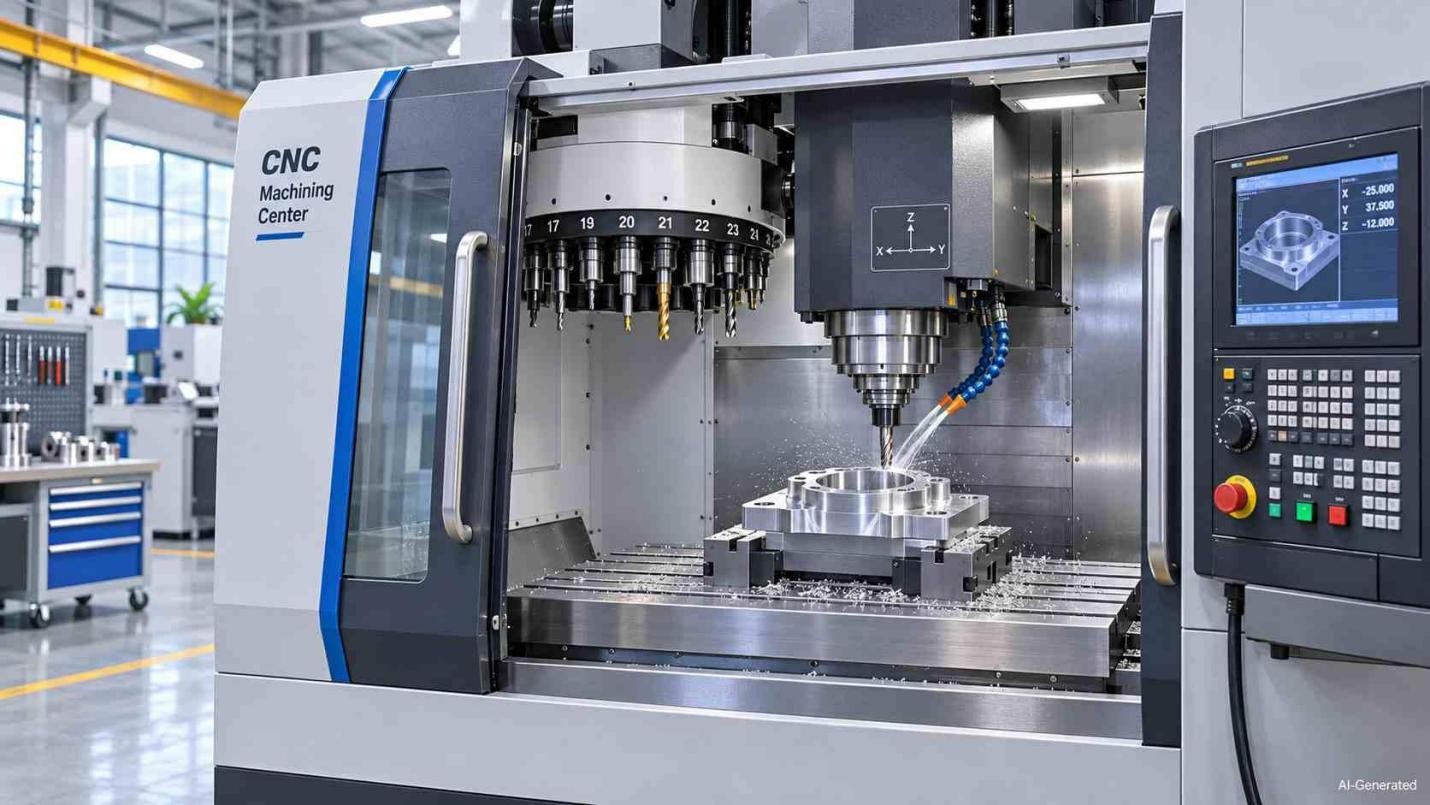
CNC machining center milling a metal part with ATC
A raw block of metal is not a precisely engineered part by chance. Every pocket, hole, and contour demands planning when a minuscule dimensional error could ruin the finished component. Here, a CNC machining center plays a role on the shop floor. But the catch is that not every configuration is good for every job. Some are good for straightforward geometries, and others deal with awkward shapes that would make conventional setups a headache. Knowing what separates these machines, how they operate, and which specs are critical can help manufacturers to avoid costly mismatches and make smarter production decisions.
What Is a CNC Machining Center?
So, what is a CNC machining center? A CNC machining center is a computer-controlled machine tool designed for milling and related cutting operations. The CNC controller executes the part program, while an automatic tool changer (ATC) transfers tools between the spindle and a tool magazine. This allows programmed operations such as milling, drilling, boring, reaming, and tapping to run in sequence without manual tool changes. Because the workpiece can remain clamped while tools are exchanged, the machine can reduce handling time and positioning errors associated with repeated fixturing.
How Does a CNC Machining Center Work?
Before a CNC machining center does its job, the operator secures the workpiece in a fixture, sets a coordinate reference point, and records tool offsets. G-codes direct the machining paths. M-codes control auxiliary machine functions. The spindle rotates the cutting tool at a programmed speed, while servo-driven axes move it relative to the workpiece. The programmed feed rate controls the tool's travel speed, and the toolpath sets the depth of cut. An M06 command typically calls the tool change, but the machine control determines the exact sequence. After the incoming tool's offsets are applied, the program continues with the next operation. The control uses position feedback to monitor axis movement. The work coordinate system keeps programmed features referenced to the same part datum, allowing operations within that setup to continue without re-establishing the workpiece origin.

Precision CNC Machining Service
Have a part ready for CNC machining? Upload your CAD file to JLCCNC to request a quote and get a DFM review based on your part's design.
What Are the Main Types of CNC Machining Centers?
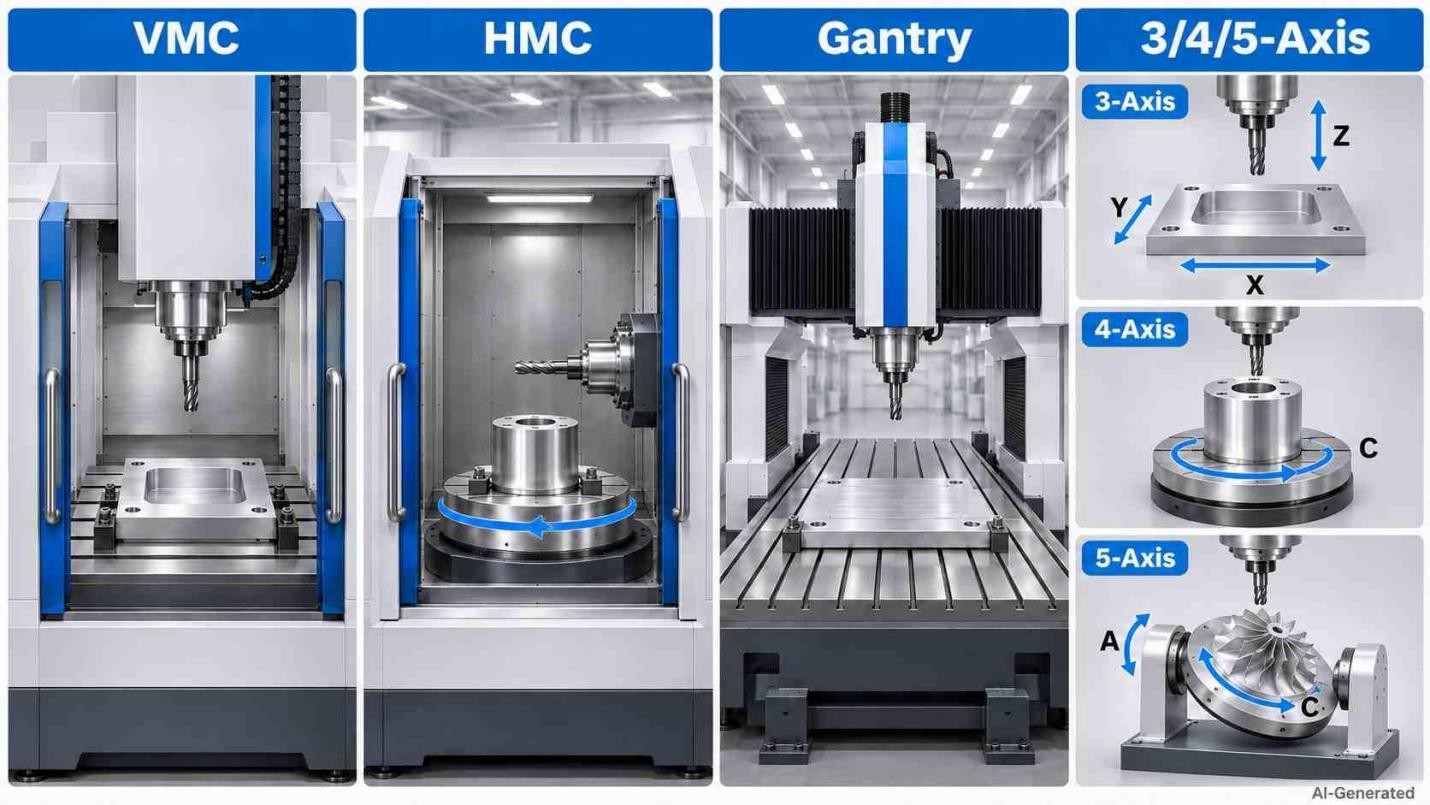
CNC machining center types: VMC, HMC, gantry, and axes
Vertical Machining Center (VMC)
In CNC vertical machining centers, the spindle is perpendicular to the worktable. This allows the cutting tool to approach the material from above. Moreover, this arrangement provides excellent visibility of the cutting zone. As a result, workholding, alignment, and inspection are comparatively straightforward. Operators can conveniently mount stock using standard vises or clamps without elaborate fixtures. These machines are good for producing slots, recessed cavities, flat surfaces, as well as threaded holes in relatively simple geometries.
Horizontal Machining Center (HMC)
Horizontal machining centers have a horizontal spindle, so the cutter approaches the workpiece from the side. This orientation helps chips fall away from the cutting area, although coolant flow and the chip-conveyor design also affect evacuation. HMCs are often configured with rotary pallets and tombstone fixtures to expose multiple faces of a workpiece. Models equipped with an automatic pallet changer can let operators load the next setup while the machine is cutting.
When comparing VMCs versus HMCs, HMCs often require more floor space and a higher initial investment. For repeat production of multi-sided parts, an HMC may improve utilization and reduce handling when its pallet, rotary-indexing, and fixture strategy reduce setup time. The benefit depends on the part mix, workholding, automation level, and production volume.
VMC vs. HMC: Key Differences
| Parameter | VMC | HMC |
|---|---|---|
| Spindle orientation | Vertical | Horizontal |
| Cutting direction | From above | From the side |
| Chip evacuation | Chips can collect on top surfaces and in pockets | Gravity helps move chips away from the cutting area |
| Machining access | Mainly top-facing surfaces | Multiple faces with rotary indexing, depending on configuration |
| Workholding | Usually vises or simple fixtures | Often tombstone fixtures or rotary pallets |
| Floor space | Typically smaller | Typically larger |
| Initial investment | Typically lower | Typically higher |
| Production volume | Often used for prototypes and low-to-medium batches | Often selected for repeat production involving multiple faces |
| Automation | ATC; rotary tables or pallet systems optional | ATC; automatic pallet changer optional |
| Applications | Plates, brackets, and molds | Gearbox housings, manifolds, and engine blocks |
Gantry Machining Center
The gantry classification refers more to the machine's supporting framework. Two columns support an overhead crossbeam carrying the cutting head. This creates a rigid and bridge-like structure that resists deflection under machining forces. Based on the design, either the gantry travels over a stationary bed or the table moves beneath a fixed bridge. The architecture is good for manufacturing aircraft wing spars, industrial machine bases, and oversized stamping dies.
3-Axis, 4-Axis, and 5-Axis Machining Centers
Axis count is a separate classification, which is independent of the machine's structural arrangement. A 3-axis configuration provides linear movement along X, Y, and Z. It accommodates features reachable from a fixed tool orientation. A fourth, rotary axis enables circumferential machining for helical grooves and radial hole patterns. A 5-axis system gives another rotational degree of freedom. It can position the cutter at compound angles through indexed machining (3+2) or continuously change tool orientation during simultaneous cutting. Consequently, it is good for sculptured geometries such as impellers and turbine blades.
What Technical Specifications Matter in a CNC Machining Center?
A look at CNC machining center technical specifications also shows the limits of the equipment. Axis travel tells the available range of movement. On the other hand, table dimensions and load capacity tell how much space and weight the machine can accommodate, including fixtures. Spindle speed, in revolutions per minute (RPM), affects attainable cutting speeds for different tool diameters and materials. Spindle power affects the material-removal rate the machine can sustain, while torque is especially important for heavy cuts at lower spindle speeds.
Magazine capacity determines how many tools are available before manual replenishment is necessary. Two specifications deserve particular attention: positioning accuracy and repeatability. Positioning accuracy describes how closely an axis reaches its commanded position; repeatability describes how consistently it reaches that position over repeated approaches. But neither ensures finished-part tolerances. Tool wear, cutter deflection, thermal expansion, clamping distortion, and material behavior can all cause dimensional deviations even if the equipment is within its published specs.
What Parts Can Be Made on a CNC Machining Center?
A CNC machining center can produce parts ranging from electronic enclosure plates to load-bearing robotics components. For example, fixture plates need consistent flatness and accurately spaced dowel-pin holes, while mounting brackets may have reinforcing ribs and perpendicular mating faces. These parts are often machined on VMCs when their critical features are accessible from the top or from reachable sides. Gearbox and pump housings present a different challenge because their bearing seats and sealing surfaces may span multiple faces. An HMC with rotary indexing can machine these features with fewer repositioning steps. Cross-drilled passages may also require tool access from more than one direction, depending on their layout.
Injection mold cores and cavity inserts may need five-axis machining to reach steep walls with shorter, more rigid cutters, reducing tool deflection and helping maintain surface finish. Precision mechanical parts, say actuator blocks, optical mounts, and surgical instrument components, demand good control over feature-to-feature alignment, complicated profiles, and assembly clearances. Depending on their geometry, these parts may need only a three-axis center or a five-axis setup, with either indexed (3+2) or simultaneous motion.
How to Choose the Right CNC Machining Center for Your Part?
Begin with the engineering drawing. Review the part's geometry and dimensions, then identify the tool approach required for each feature. Remember, a workpiece inside the machining envelope may not give enough clearance for toolholders, fixtures, or rotary movements. For jobs with accessible features and simple workholding, VMCs are often more economical for prototypes and small production runs. An HMC may be more economical for recurring jobs when the time saved by reducing repositioning offsets the higher cost of the machine and its workholding system.
A multi-axis machine may be worthwhile when certain features cannot be reached economically with standard fixtures, even for a one-off part. Before you decide finally, compare programming effort, setup duration, expected cycle time, and per-part manufacturing costs. The most capable equipment might not be the most profitable. What matters is how efficiently its capabilities satisfy the production demands.
Precision CNC Machining Service
Have a part ready for CNC machining? Upload your CAD files to get an instant CNC machining quote and DFM feedback from JLCCNC engineers.
FAQs About CNC Machining Centers
What Is the Difference Between a CNC Machine and a CNC Machining Center?
A CNC machine is an umbrella term for equipment controlled by computer numerical control, including laser cutters, grinders, routers, and electrical discharge machining (EDM) systems. A machining center is a specific type of CNC machine designed for automated cutting operations with rotating tools.
Is a CNC Machining Center the Same as a CNC Milling Machine?
Not quite. Both have the same fundamental milling principles. But the fact is that they have a different level of automation. A CNC milling machine may not have an automatic tool changer. When it is equipped with an ATC and can run programmed cutting operations with automatic tool changes, it is generally classified as a machining center.
Can a CNC Machining Center Perform Multiple Operations in One Setup?
Yes. But the necessary features should be within the cutter's reach. For instance, a component may undergo roughing, semi-finishing, precision boring, and chamfering without being unclamped. Features hidden by the workholding or located on an inaccessible face may still require the part to be repositioned or clamped in a second setup.
What Is the Difference Between a Machining Center and a Turning Center?
The difference is what spins when you cut. A turning center normally rotates the workpiece while a cutting tool removes material, making it suitable for shafts, bushings, and other rotationally symmetric parts. A machining center typically rotates the cutting tool while the workpiece remains clamped. However, the boundary is not absolute. Turning centers with live tooling can also produce noncylindrical features such as wrench flats and cross holes.
Popular Articles
• What is Swiss Machining: Swiss CNC Machines and Their Precision
• Desktop 5-Axis CNC Machine: Own One or Outsource to Industrial Services?
• The Superiority of CNC Routers Over Laser Cutters in Modern Manufacturing
• How a Laser Cutter Operates
• Best CNC Machines for Metal: A Guide for Choosing Between Mills, Routers, and Press Brakes
Keep Learning
CNC Machining Center: Types, Operations & Applications
CNC Machining Center: Types, Operations & Applications
What is Swiss Machining: Swiss CNC Machines and Their Precision
What is Swiss Machining? (Freepik) When you hear people talk about the “gold standard” in precision manufacturing, they're usually talking about Swiss machining. Swiss machining traces its roots back to 19th-century Switzerland, where it was originally developed for the watchmaking industry. When you're dealing with gears and components smaller than a fingernail, you need more than just accuracy, you need repeatable precision at a microscopic level. That's where the Swiss lathe came in. At its core, S......
5 Signs You Need a CNC Machine for Your Metal Project
You’ve got a metal project on your hands, maybe a few prototypes, maybe a production run, and you're wondering if it’s time to upgrade your toolkit. CNC machines aren’t just fancy toys for industrial giants anymore. Today, shops of all sizes rely on them to cut, mill, drill, and shape metal with unshakable accuracy. But when is the right time to make that leap? This isn’t just about having cool equipment. It’s about knowing when manual methods, traditional tools, or even outsourcing just aren't cuttin......
How to Make a CNC Machine at Home: DIY CNC Router & Lathe Guide
How to Make a CNC Machine? (Reddit) Why would anyone want to build their own CNC machine at home? Isn't that super complicated? Honestly, that's the fun of it. Figuring out how to make a CNC machine can be both exciting and surprisingly cost-effective. Think of it like combining engineering curiosity with the satisfaction of saying, “Yep, I built that myself.” For hobbyists, small workshops, or even engineers tinkering at home, DIY CNC machines open the door to custom fabrication without dropping thou......
Lathe vs Mill: Differences, Applications, and Machine Selection
Key Takeaways Lathe-vs-mill selection starts with the part, not the machine: a lathe is the more direct route for rotational features, while a mill suits prismatic geometry and features distributed across multiple faces. On a lathe the workpiece spins and the tool feeds; on a mill the cutting tool spins while the workpiece is held. That motion difference determines the geometry each machine produces efficiently. Workholding, feature access, setup count, and cross-feature tolerance relationships decide......
5-Axis CNC Machining: Why Is It Needed for Complex Parts?
Key Takeaways 3-axis CNC machining is often a practical and cost-effective choice when all critical features can be reached using a small number of straightforward setups, with the tool orientation fixed relative to the workpiece during each setup. A 5-axis machine can improve access to angled or multi-sided features and reduce re-clamping. These benefits can often be achieved with 3+2 positioning, without simultaneous 5-axis cutting. 3+2 machining uses two rotary axes to position the workpiece or cut......