CNC Probing Guide: How CNC Probe Systems Work, Applications, and Benefits
21 min
- What Is CNC Probing?
- Components of a CNC Probing System
- What Can CNC Probing Measure?
- Programming CNC Probing Cycles
- Common Applications of CNC Probing
- CNC Probing Accuracy: Factors and Limitations
- Benefits of CNC Probing in Manufacturing
- Common Types of CNC Probes
- CNC Probing vs Traditional Measurement Methods
- CNC Probing Software and Simulation
- When Should You Use CNC Probing?
- Conclusion About CNC Probing
- FAQ About CNC Probing
Key Takeaways About CNC Probing
- CNC probing is on-machine measurement that replaces or reduces manual setup and inspection steps.
- A CNC probing system combines a probe body, stylus, signal transmission, and controller integration to measure workpiece position, tool length, feature dimensions, and surface location.
- CNC probing solutions range from basic workpiece location routines on a manual machine to fully automated in-process verification in unattended manufacturing cells.
- CNC probing simulation lets programmers verify probing cycles before running them on the machine, preventing collisions and confirming measurement logic without risking the part.
- Probing improves setup accuracy, reduces scrap, cuts cycle time, and gives manufacturers real data about what's actually happening at the machine rather than what's assumed to be happening.
Most machining errors don't come from bad cutting. They come from not knowing exactly where the part is, how long the tool actually is, or whether the last operation reached the correct dimension. CNC probing systems solve these problems by bringing automated measurement directly into the machining process.
A CNC probing system is a measuring device built into the machine itself, running the same way a cutting tool does but touching the part and feeding data back to the controller instead of removing material. The machine uses that data to set work offsets, adjust tool compensation, verify dimensions mid-operation, and catch problems before they become scrap. It's one of the most widely adopted process improvements.
What Is CNC Probing?
CNC probing is the use of a precision touch or scanning probe mounted in a CNC machine to perform automated measurements of workpiece position, tool geometry, and part features during or between CNC machining operations.
How CNC Probing Works
The probe is mounted in the spindle or installed at a fixed position on the machine table, depending on its function. When the CNC probing system moves the stylus tip into contact with a surface, the probe generates a signal, either a trigger at the moment of contact, or a continuous stream of position data for scanning probes. The machine controller records the exact machine position at that moment and uses it to calculate workpiece coordinates, feature dimensions, or tool length offsets.
The measurement principle is straightforward. If the controller knows where the probe tip is supposed to be and records exactly where it was when contact happened, it knows where the workpiece surface is. From there it can set work offsets automatically, flag dimensions that are out of tolerance, or adjust tool compensation values before the next cut.
Why Modern CNC Machines Use Probing Systems
Manual setup takes time and introduces human variation. An experienced machinist's edge-finding and setting datums manually might take tens of minutes on a complex setup. A CNC probing system does the same job in under two minutes with better repeatability than any manual method. More importantly, CNC probing keeps measurement inside the machine, where the data is immediately usable to correct offsets and catch errors before they compound.
Components of a CNC Probing System
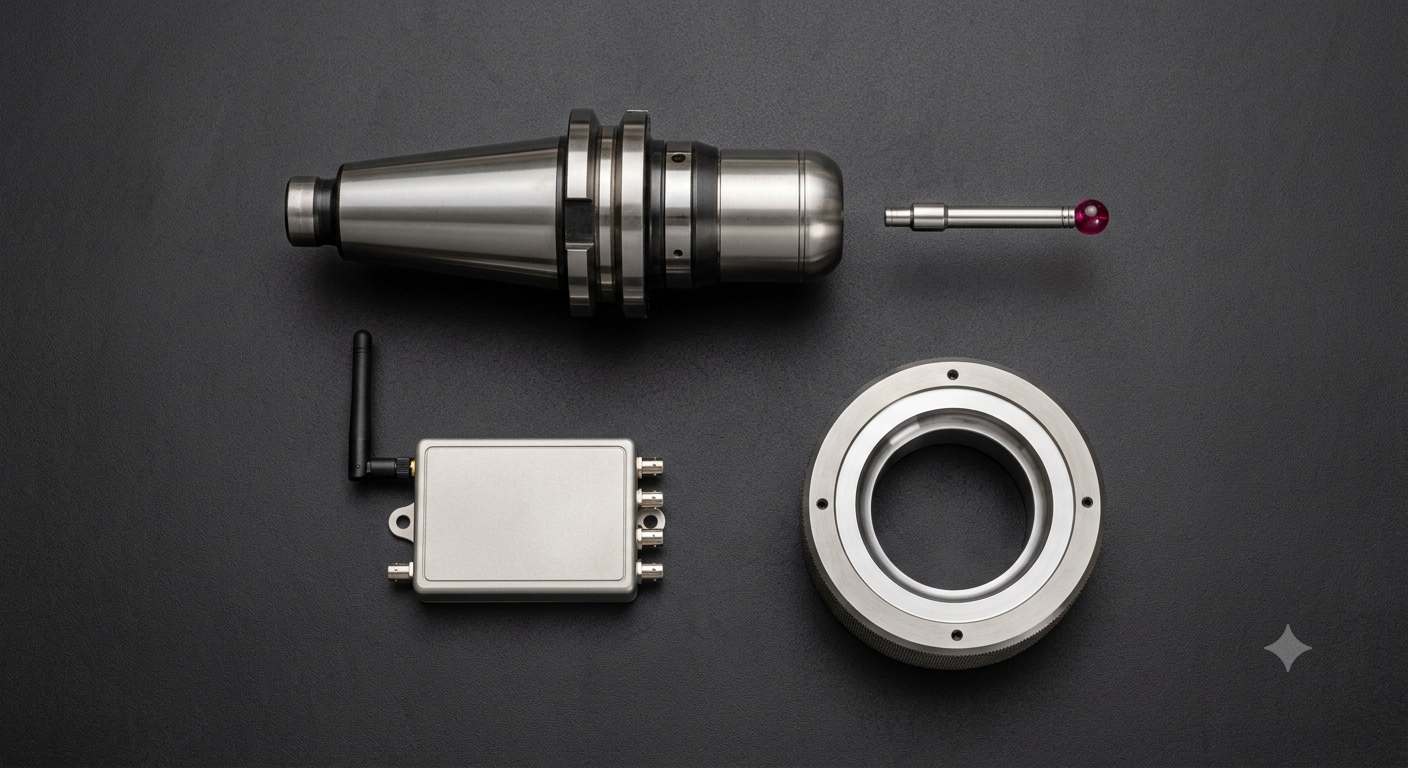
(AI generated) Disassembled CNC probing system components
A CNC probe tool is one of the key components of a CNC probing system. It allows the machine to measure workpieces, locate features, and update machining offsets automatically.
Probe Body and Stylus
The probe body houses the measurement mechanism, either a kinematic switch that triggers on contact deflection, or a strain gauge system for scanning probes. The stylus extends from the probe body and makes actual contact with the part. Stylus configuration matters: a standard straight stylus handles most CNC probing applications, while star stylus configurations allow CNC probing solutions to reach undercuts and features not accessible from a single direction.
Signal Transmission Methods
The probe signal needs to get from the probe tip to the controller. Three main approaches exist. Hard-wired transmission connects directly through the spindle and machine cable, reliable but limits spindle movement. Radio transmission sends the probe signal wirelessly, common on modern machining centers and compatible with full spindle rotation. Optical transmission uses infrared light between the probe and a fixed receiver, standard on many production CNC probing systems where radio interference is a concern.
CNC Controller Integration
Every major CNC controller, Fanuc, Siemens, Heidenhain, Mazak, has built-in probing cycles or accepts custom probing macros. The CNC probing system communicates directly with the controller, feeding measured positions into the variables that control work offsets and tool compensation. This integration is what makes CNC probing genuinely useful rather than just an expensive touch-screen: the machine acts on the measurement data automatically rather than requiring an operator to read a number and type it in.
Probing Cycles and Measurement Software
Manufacturers like Renishaw, Heidenhain, and Blum supply probing cycle libraries that run on the CNC controller, standard routines for common tasks like single-surface probing, bore centerline finding, corner location, and tool length measurement. CNC probing solutions from these suppliers include pre-written, tested cycles that most shops use directly rather than writing probing macros from scratch.
Probe Calibration and Setup
A CNC probing system is only as accurate as its calibration. Before using the probe for measurement, the stylus tip radius and exact probe trigger point get characterized against a precision reference artifact, usually a calibration sphere or ring gauge with known dimensions. This calibration tells the controller exactly where the probe tip center is relative to the machine's position feedback, which is the foundation of all subsequent CNC probing accuracy.
What Can CNC Probing Measure?
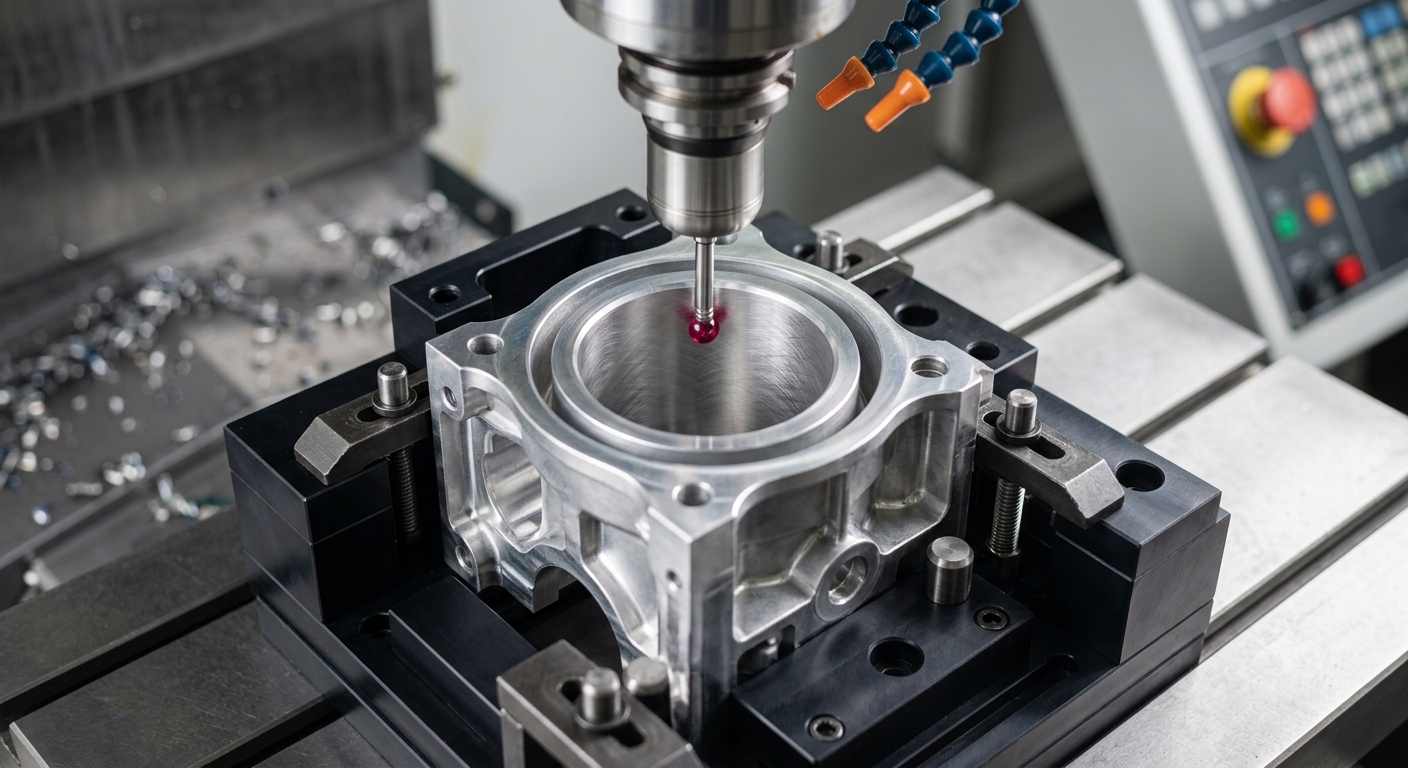
(AI generated) Touch probe stylus tip making contact with inner bore wall
Workpiece Position and Datum Location
The most common CNC probing application. Before cutting starts, the CNC probing system touches the workpiece from multiple directions to locate its exact position on the machine table. This sets the work coordinate system origin automatically, no edge finding, no manual offset entry, no guessing whether the part is square.
Tool Length and Tool Diameter
A tool setting probe at a fixed position on the machine table measures each tool's actual length and diameter as it's installed. When a tool is replaced, the CNC probing system re-measures it automatically, compensating for any difference between the new tool and the one it replaced. Over a production run where tools get changed multiple times, this keeps dimensions consistent without operator intervention.
Hole Location and Feature Position
Hole location and position are often verified according to GD&T requirements, particularly when true position tolerance controls assembly performance.
CNC probing measures bore centers, slot positions, and feature locations directly on the machine. This matters when a part has been flipped or repositioned mid-operation, probing the previously machined features gives the controller the actual position of the new work coordinate system based on real geometry, not assumed fixturing.
Surface and Dimensional Verification
After machining, CNC probing verifies that key dimensions are within tolerance before the part comes out of the fixture. Finding a problem at this stage means the part is still in position and potentially correctable with another pass. Finding it at the CMM means the setup is already broken down and correction means a full re-setup.
Some parts benefit from in-process probing, while others can be inspected efficiently after machining. The choice depends on tolerance, feature accessibility, production volume, and the overall manufacturing plan.
When you upload a CAD model to JLCCNC, the engineering review considers these factors as part of process planning.

Precision CNC Machining Service
Professional manufacturing, fast turnaround, and quality assurance.
Programming CNC Probing Cycles
Programming a probe is different from programming a cutting tool. The objective is not to generate a toolpath but to tell the machine where to measure, how fast to approach the surface, and what to do after contact is detected. In most production shops, programmers start from existing probing routines supplied with the control or the probing package instead of writing every sequence themselves.
Standard Probe Cycles
Most machining centers already contain probing cycles for routine measurements. A cycle may locate a datum face before machining, check the diameter of a finished bore, or verify that a workpiece has been loaded in the correct position. Once the probe triggers, the control records the contact point and uses the measured coordinates in the next calculation.
Cycle names differ from one control to another. The operating sequence, however, changes very little because stable triggering and machine repeatability matter more than the software interface.
Macro Programming and G65 Calls
Production environments often combine probing with macro programming so the machine can react to measured results instead of simply displaying them. A bore may be measured after rough machining. If the value is still within the expected range, finishing continues. If not, the program can pause or apply a wear compensation before the next cut.
On many Fanuc controls, probing routines are commonly called through G65. The command itself is only a way to pass parameters into a stored macro. Which macro is executed depends on how the machine has been configured, so the same G65 call does not necessarily perform the same inspection on every machine.
Inspection Software and Automation
Many industrial machines are supplied with dedicated probing software such as Renishaw Inspection Plus. These packages provide ready-to-use routines for everyday measurement tasks, allowing programmers to build inspection sequences without developing the logic from the beginning.
The software is different, but the workflow is familiar. Measure a feature. Compare the result with the expected value. Then decide whether machining should continue or whether the setup needs attention. That approach is now standard practice in many automated machining cells.
Common Applications of CNC Probing
Machine Setup Automation
CNC probing cuts setup time dramatically on complex parts with multiple datums, angled features, or cast/forged starting stock where the actual part position varies from one piece to the next. Rather than spending 30–45 minutes on manual setup, the CNC probing system locates the part automatically and sets the coordinate system in under two minutes.
Tool Management and Compensation
Production runs change tools multiple times. Without probing, tool changes require either pre-measured tooling with confirmed lengths, or manual re-measurement after each change. A tool setting CNC probe tool handles this automatically, measuring each new tool as it's loaded and updating offsets before the next cut runs.
In-Process Verification
Mid-operation CNC probing checks critical dimensions after roughing before committing to the finish pass. If a bore is at 29.85mm and the target is 30.00mm, the system knows to adjust the finish pass to remove exactly 0.15mm per side rather than running the programmed 0.10mm per side that would leave it undersize. This closed-loop approach is what separates reliable production from crossing your fingers between operations.
Quality Control Improvement
CNC probing solutions that include post-process measurement generate statistical data about actual part dimensions across a production run. Rather than inspecting sampled parts at a CMM and hoping the rest are similar, in-machine probing can verify every part's critical dimensions and log the results, providing 100% measurement coverage without a separate inspection step.
CNC Probing Accuracy: Factors and Limitations
Typical Probe Accuracy
Most touch trigger CNC probing systems achieve 1–3 µm repeatability under controlled conditions. Practical on-machine accuracy is somewhat lower, 3–8 µm is a realistic working accuracy for CNC probing in a production environment when machine thermal variation, vibration, and coolant effects are accounted for.
Repeatability vs Machine Accuracy
The probe itself might repeat to 1 µm, but the machine's own positioning accuracy limits what the CNC probing system can actually measure. If the machine has 5 µm positioning error at a particular location, the probe measurement inherits that error. CNC probing accuracy is always bounded by machine accuracy, the probe doesn't compensate for machine errors, it relies on machine accuracy to translate probe trigger position into a meaningful measurement.
Calibration Impact
An uncalibrated or poorly calibrated CNC probe tool produces systematically wrong results, consistent but wrong. Probe calibration against a reference artifact corrects for stylus tip radius and trigger direction bias, which are the main sources of systematic error. Regular re-calibration, typically at the start of each shift for precision work or at tool changes for production work, maintains CNC probing accuracy over time.
When Probing Is Not Accurate Enough
For tolerances tighter than ±0.005mm, on-machine CNC probing may not be the right verification method even on a high-quality probing system. Critical features on precision parts, bearing bores, precision journals, tight positional tolerances on complex geometry, warrant CMM verification in a temperature-controlled environment where measurement accuracy is better characterized and traceable.
Benefits of CNC Probing in Manufacturing
Reducing Setup Time
Studies from probing system suppliers consistently report substantial setup time reductions when CNC probing replaces manual setup methods. On a part that previously required manual edge finding and work offset adjustment, automated probing can establish the machining coordinate system in only a few minutes. If you're unfamiliar with how datums, work offsets, and fixture alignment are established before machining, our guide to CNC setup explains the complete setup workflow before probing routines are introduced. High-volume production benefits the most because the same fixture can be located consistently from one batch to the next.
Improving Dimensional Consistency
Manual setup introduces variation, the same machinist doing the same setup twice doesn't hit exactly the same position twice. CNC probing hits the same measurement result repeatedly, typically within 1–2 µm repeatability on a well-maintained system. That consistency carries through to the finished part dimensions.
Reducing Scrap and Rework
First-article rejection rates drop when CNC probing catches problems at the machine rather than at inspection. Industry data from Renishaw's application studies puts scrap reduction at 20-50% for operations that implement in-process CNC probing solutions, depending on the part complexity and previous rejection rate. Even at the lower end, that's a meaningful reduction in scrapped material and machining time.
Supporting Lights-Out Manufacturing
Unattended machining depends on CNC probing solutions to manage what an operator would otherwise handle. Tool wear monitoring through periodic measurement, automatic offset updates when tools are changed by a robot or ATC, workpiece verification before starting the program, all of this happens autonomously when the CNC probing system is integrated into the cell control logic. Without it, lights-out machining requires either accepting higher scrap rates or limiting it to very simple, high-confidence operations.
Common Types of CNC Probes
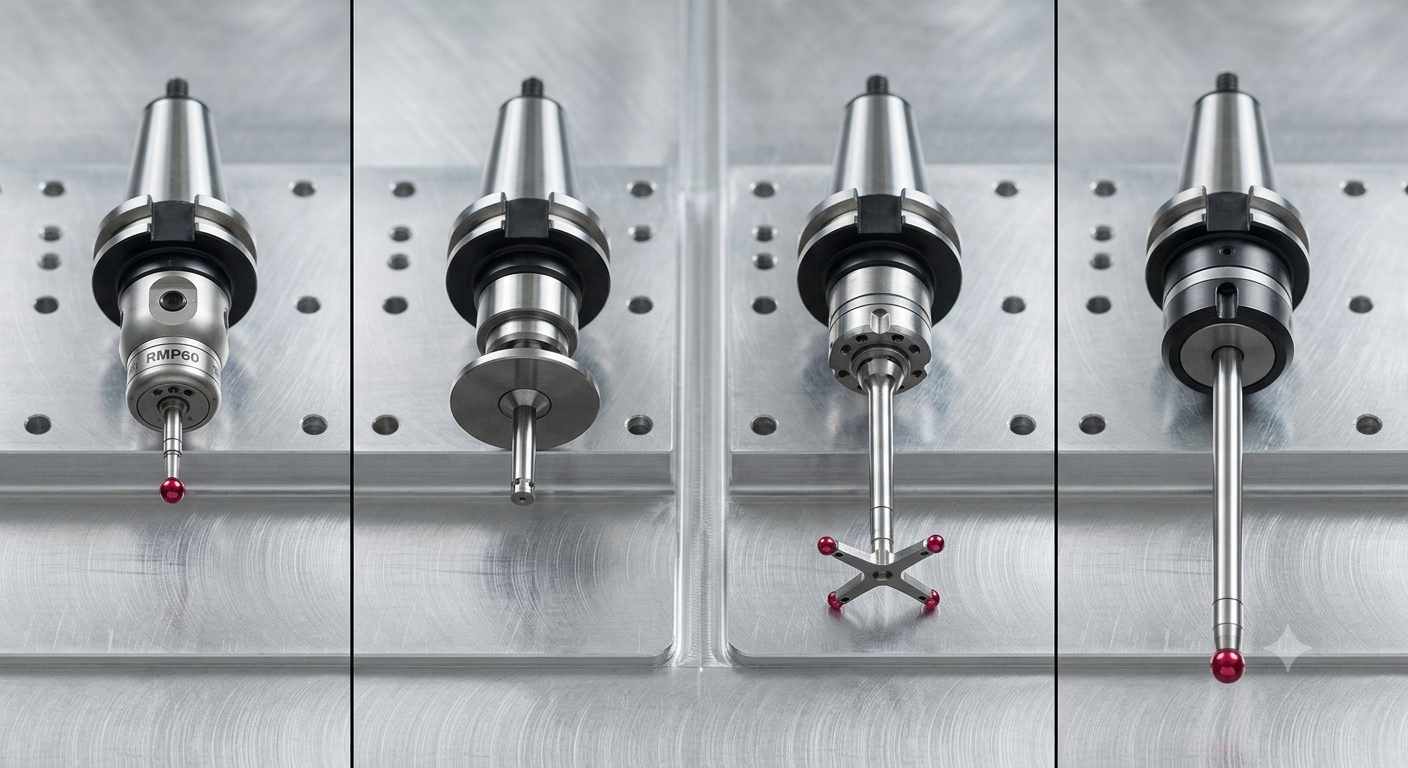
(AI generated) Four different CNC probe types arranged side by side
Workpiece Measurement Probes
These mount in the machine spindle like a cutting tool and move to contact the workpiece to establish position and measure features. Renishaw's RMP series, Heidenhain's TS series, and Blum's TC series are standard examples. Most workpiece CNC probe tools transmit via radio or infrared and are compatible with automatic tool changers.
Tool Setting Probes
These sit at a fixed position on the machine table. The machine moves each tool to contact the probe, measuring tool length and diameter automatically. Tool setting probes like the Renishaw RTS or Blum TM series update tool offset tables without operator involvement and trigger alarms when a measured tool dimension falls outside the acceptable range, indicating a broken or worn tool.
Touch Trigger Probes
The most common CNC probe tool type. They generate a discrete trigger signal at the moment of stylus contact, and the controller records the machine position at that instant. Touch trigger probes are accurate, reliable, and work well for the majority of CNC probing applications, workpiece setup, feature location, and dimensional verification.
Scanning Probes
Rather than triggering at a single contact point, scanning probes measure continuously as the stylus travels across a surface, generating a dense point cloud of surface data. Slower than touch trigger probing and more expensive, but capable of surface form measurement and profile verification that trigger-style CNC probe tools can't perform. Scanning CNC probing solutions are common in mold and die work where complex curved surfaces need to be verified.
CNC Probing vs Traditional Measurement Methods
| Comparison | Key Differences |
|---|---|
| CNC Probing vs Manual Setup | Manual setup using edge finders, dial indicators, and gauge blocks gets the job done, but it's slower, depends heavily on operator skill, and doesn't automatically record measurements in the CNC controller. CNC probing performs the same alignment and measurement tasks much faster and more consistently, automatically updating wear offsets and eliminating manual data entry that can introduce transcription errors. |
| CNC Probing vs CMM Inspection | CMM inspection offers higher accuracy, with high-end systems measuring around 0.1–0.5 µm compared to 1–5 µm for typical CNC probing systems. However, CMM inspection is performed off the machine after the part has been removed from the fixture, making any corrections require a complete re-setup. CNC probing takes place while the part remains fixtured on the machine, allowing setup errors or machining issues to be detected and corrected immediately. In most production environments, CNC probing and CMM inspection complement each other rather than compete. |
| When CNC Probing Delivers the Greatest Value | CNC probing provides the highest return on investment in high-mix production with frequent setup changes, complex parts requiring multiple datums and feature relationships, and unattended or automated machining where no operator is present to verify setup manually. In these situations, probing significantly reduces setup time, minimizes scrap, and improves process reliability. |
CNC Probing Software and Simulation
Programming Probing Cycles
Probing cycles get programmed either through the CNC controller's built-in cycle library, through CAM software that generates probing routines alongside cutting toolpaths, or through specialist probing software like Renishaw's Productivity+. The approach depends on the machine type, controller, and how deeply CNC probing is integrated into the production workflow.
Many shops do not write probing routines entirely from scratch. Instead, they call predefined macros supplied by systems such as Renishaw Inspection Plus or controller-specific probing libraries.
Probing Simulation and Verification
Before a probing routine runs on the machine, many shops verify it in a virtual environment. Simulation checks probe approach directions, clearance moves, trigger locations, and measurement logic before the program reaches the machine.
This step is especially useful for multi-axis machining, where an incorrect approach direction can damage the stylus or contact the fixture unexpectedly. Modern CAM systems and software such as Vericut, Siemens NX, and Renishaw simulation tools can identify potential collisions and logical errors before production starts.
Simulation does not improve measurement accuracy directly. Its value is preventing programming mistakes that would otherwise interrupt machining or damage expensive probing equipment.
When Should You Use CNC Probing?
High-Precision Components
When tolerances are tight enough that setup variation from manual methods contributes meaningfully to dimensional scatter, CNC probing is a straightforward fix. Parts held to ±0.02mm or tighter benefit clearly from automated CNC probing at setup, the 0.05–0.1mm variation possible in skilled manual setup is simply too large relative to the tolerance band.
Complex Multi-Setup Parts
Parts that get flipped, re-fixtured, or moved between machines multiple times accumulate positioning error at each step. CNC probing at each setup re-locates the part based on its actual position rather than assumed fixture repeatability, which is particularly important when features machined in later operations need to be precisely related to features machined earlier.
Automated and Unattended Machining
Any automated manufacturing environment essentially requires CNC probing solutions. Without an operator present to catch setup errors and dimensional drift, the CNC probing system is the mechanism that keeps the process running correctly. Tool wear compensation based on probed measurements, automatic offset updates at tool changes, and in-process verification of critical features are all functions that probing provides to make unattended machining reliable rather than a high-scrap gamble.
Situations Where Probing May Not Be Necessary
Simple, low-precision parts with loose tolerances, very short production runs where setup time is a small fraction of total part time, and operations where the fixturing is highly repeatable (precision pallets, well-maintained chuck jaws) and manual verification is fast, in these situations CNC probing adds cost and complexity without commensurate benefit. The investment in a CNC probing system pays back fastest on high-precision, high-volume, or high-mix applications. For simple low-volume work, the economics are less clear.
Conclusion About CNC Probing
CNC probing moves measurement from the inspection room to the machine itself. It is often used during setup, and it can also verify critical features before the part moves to the next operation.
Whether probing is worthwhile depends on the part itself. Tight tolerances, multiple setups, and repeat production usually benefit the most, while simpler work may not require the same level of in-process measurement.
When a project is reviewed at JLCCNC, the manufacturing plan is developed according to the drawing requirements, tolerance, and inspection needs. Where appropriate, probing, conventional measurement, or CMM inspection may all be incorporated as part of the production process.
Upload your CAD model to receive a CNC machining quote and a manufacturability review.
Precision CNC Machining Service
Professional manufacturing, fast turnaround, and quality assurance.
FAQ About CNC Probing
Q: What is a CNC probe tool?
A CNC probe tool is a precision measurement device that mounts in the machine spindle or at a fixed position on the machine table. It makes contact with the workpiece or cutting tool and sends a signal to the controller at the moment of contact, allowing the machine to record exact position data for setting offsets or measuring features.
Q: How does a CNC probing system work?
A CNC probing system moves the probe stylus to contact a surface, generates a trigger signal on contact, and records the machine's position at that instant. The controller uses that position data to set work coordinate origins, measure feature dimensions, or update tool offset values, all automatically without operator input.
Q: What can CNC probing measure?
CNC probing measures workpiece position and orientation, tool length and diameter, hole and bore locations, slot positions, surface heights, and feature dimensions. Post-process CNC probing can also verify that finished dimensions meet drawing requirements before the part leaves the fixture.
Q: What is CNC probing simulation?
CNC probing simulation is the verification of a probing program in a virtual machine environment before running it on the actual CNC machine. CNC probing simulation checks probe approach paths for collisions, verifies measurement logic, and confirms that the probing sequence will produce the intended results without risking damage to the probe or the part.
Q: Can CNC probing replace CMM inspection?
Not entirely. CNC probing works at 1–8 µm practical accuracy, which is sufficient for most production monitoring and process control applications but falls short of the 0.1–0.5 µm accuracy of a high-end CMM in a temperature-controlled inspection room. CNC probing and CMM inspection complement each other, probing for in-process control, CMM for final verification on critical tolerance features.
Q: How accurate is CNC probing?
Modern touch-trigger probes typically achieve repeatability around 1–2 μm under controlled laboratory conditions. Practical on-machine accuracy in a production environment is typically 3–8 µm, depending on machine condition, thermal stability, and calibration frequency.
Q: What are the benefits of CNC probing?
Reduced setup time (typically 50-–90% versus manual methods), improved dimensional consistency, lower scrap and rework rates, automated tool management, and the ability to run unattended manufacturing without relying on operator presence to catch problems.
Q: What is the difference between a touch trigger probe and a scanning probe?
A touch trigger CNC probe tool generates a single signal at the moment of stylus contact and records one position per measurement point. A scanning probe measures continuously as it travels across a surface, generating a dense point cloud. Touch trigger probing is faster for discrete feature measurement; scanning is better for surface form verification and complex curved geometry.
Q: When should CNC probing be used?
CNC probing delivers the most value on high-precision parts with tight tolerances, complex multi-setup operations where feature relationships between setups are critical, automated or unattended manufacturing cells, and high-mix production where frequent setup changes make manual setup a throughput bottleneck.
Q: Does CNC probing improve machining accuracy?
CNC probing improves process accuracy and setup consistency rather than the inherent positioning accuracy of the machine. The probe itself doesn't make the machine more accurate. The machine's own positioning accuracy still limits what's achievable, but CNC probing removes the sources of error that exist on top of machine accuracy.
Popular Articles
• End Milling Explained: Types, Uses & Best End Mills for Metal & Wood
• End Milling vs Face Milling: Key Differences, Tools & Applications
• CNC Tooling 101: Choosing the Right End Mills and Cutters
• How to Choose the Right Cutting Tool Material (CNC & Lathe Guide)
• A Complete Guide to Tool Wear Detection and Maintenance in CNC Machining
Keep Learning
CNC Probing Guide: How CNC Probe Systems Work, Applications, and Benefits
Key Takeaways About CNC Probing CNC probing is on-machine measurement that replaces or reduces manual setup and inspection steps. A CNC probing system combines a probe body, stylus, signal transmission, and controller integration to measure workpiece position, tool length, feature dimensions, and surface location. CNC probing solutions range from basic workpiece location routines on a manual machine to fully automated in-process verification in unattended manufacturing cells. CNC probing simulation le......
Drill Point Angle: Selection, Materials, and Drilling Performance
Key Takeaways About Drill Point Angle A 118° point is used most often in steel and aluminum jobs because it drills without special setup changes on standard machines. 135° points show up more in stainless and tool steel work since they keep the drill from pushing hard at the center during entry. In aluminum and similar ductile materials, chips often come out in long strands when the point geometry does not support breakage. Hole entry stays more consistent when the drill point matches the material ins......
Jig vs Fixture: Key Differences and Applications in Machining
(AI generated) Drilling jig with guide bushings and CNC machining fixture holding a metal workpiece on a machine shop workbench. If you ask three machinists to explain the difference between jigs and fixtures, you’ll likely get three different answers. It’s one of those things that gets mixed up constantly, especially by anyone who isn’t actually standing at the machine. But when you’re planning a setup, that distinction becomes critical. How you hold a part changes everything: alignment, repeatabilit......
Types of Taps: How to Choose the Right Thread Tap for CNC Machining
(AI generated) Close-up of a thread tap cutting internal threads inside a metal workpiece. Tap breakage during blind hole threading is one of the most common production disruptions. This guide explains the different types of thread taps used in CNC machining and provides practical selection advice based on hole type, material, and machining conditions. What Is a Thread Tap and How Tapping Works What Is a Thread Tap? A thread tap is a cutting tool used to create internal threads inside a pre-drilled ho......
CNC Tooling 101: Choosing the Right End Mills and Cutters
Introduction: The Unsung Heroes of CNC Machining In CNC machining, precision doesn’t start with the machine—it starts with the tooling. Choosing the right end mills and cutters determines not only the surface finish and dimensional accuracy but also the machining time, tool life, and overall production cost. Many machinists and engineers underestimate how much tooling affects performance. Whether you’re shaping aluminum, cutting stainless steel, or milling engineering plastics, the right CNC tool can ......
How to Choose the Right Cutting Tool Material (CNC & Lathe Guide)
If you've ever heard a cutting tool scream with chatter or watched an edge chip after just a few passes, you already know, the wrong tool material will wreck your part, your time, and your budget. Geometry matters, yes, but material is what defines whether that tool can survive under the pressures of real machining. This is especially true when comparing lathe cutting tools with modern cutting tools for CNC. Traditional lathes can get the job done, but they're limited by manual control, speed, and con......