OEM vs ODM: Key Differences, Benefits, and How to Choose
11 min
- What Is OEM Manufacturing?
- What Is ODM Manufacturing?
- OEM vs ODM vs Contract Manufacturing
- Advantages and Disadvantages of OEM and ODM
- How to Choose Between OEM and ODM
- OEM vs ODM Cost Comparison
- Common Business Scenarios for OEM and ODM Manufacturing
- Common Misconceptions About OEM and ODM
- Conclusion About OEM vs ODM Manufacturing
- FAQ About OEM and ODM Manufacturing
Key Differences at a Glance Between OEM and ODM
| Factor | OEM Manufacturing | ODM Manufacturing |
|---|---|---|
| Design Origin | Buyer provides the product design | Supplier provides an existing design |
| Product Control | Higher control over specifications and development | Less control over the core product design |
| Engineering Input | Requires more engineering and product development work | Requires less technical involvement |
| Customization | Extensive customization options | Limited to predefined modification options |
| Intellectual Property | IP typically remains with the buyer | Base design IP usually belongs to the supplier |
| Time to Market | Longer due to design and validation work | Faster due to existing product platforms |
| Initial Investment | Higher development and tooling costs | Lower upfront costs |
| Best Suited For | Unique products and long-term product ownership | Private label products and market testing |
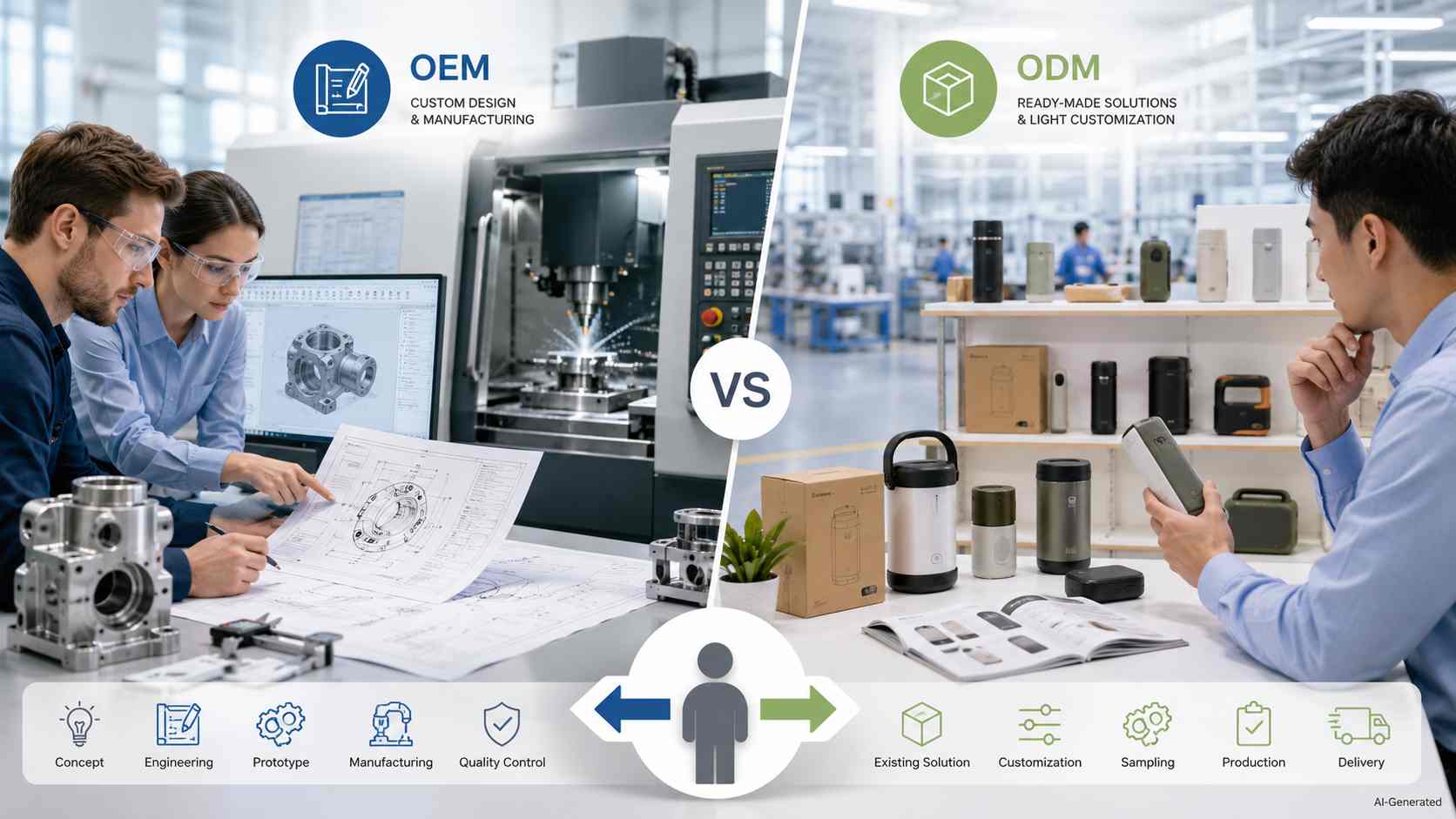
Alt Tag: OEM vs ODM manufacturing comparison in factory
Understanding ODM vs OEM manufacturing helps companies decide how much control, investment, and product ownership they need.
Before comparing OEM and ODM in detail, it helps to view ODM vs OEM manufacturing as two different starting points. In one path, the buyer arrives with the product idea already shaped. In the other, the supplier brings an existing design that the buyer can brand and adjust.
What Is OEM Manufacturing?
OEM manufacturing refers to a production model in which a manufacturer produces parts or products according to a buyer's design and specifications.
How OEM Manufacturing Works
Practically, the buyer sends files, tolerances, samples, or notes. Then, the factory reviews the job, prepares production, makes the item, checks quality, and ships it under the buyer’s brand.
What Is ODM Manufacturing?
In an ODM model, the supplier owns or controls the original product design and offers it to multiple buyers. Customers can typically customize branding, packaging, colors, or selected features without developing an entirely new product.
How ODM Manufacturing Works
In a typical ODM project, the buyer selects an existing product platform, reviews available customization options, approves samples, and then moves into production. Most engineering work has already been completed before the buyer enters the project.
OEM vs ODM vs Contract Manufacturing
What Is Contract Manufacturing?
Contract manufacturing refers to outsourcing production to an external factory. The factory may manufacture components, perform assembly, or handle complete production according to an agreed scope of work.
Unlike OEM or ODM, contract manufacturing does not define who owns the product design. A contract manufacturer may build a buyer-designed product, produce an ODM supplier's existing design, or simply provide manufacturing capacity.
How Contract Manufacturing Relates to OEM and ODM
The difference is often misunderstood.
In an OEM project, the buyer usually owns the product design and provides engineering requirements. Production may still be performed by a contract manufacturer. A CNC supplier machining parts from customer CAD files is a typical example.
In an ODM project, the supplier starts with an existing design platform. The buyer selects the product, requests approved modifications, and sells it under its own brand. Manufacturing is frequently performed under a contract manufacturing arrangement as well.
As a result, OEM and ODM describe how a product is developed and controlled, while contract manufacturing describes how production work is organized.
Advantages and Disadvantages of OEM and ODM
Benefits of OEM Manufacturing
OEM manufacturing gives a company more room to shape product identity, performance, materials, and brand value. It is appropriate for teams who choose to have a unique product and own the resources necessary to direct each manufacturing decision.
Benefits of ODM Manufacturing
By providing companies with a product foundation that has already been established, ODM manufacturing may reduce early effort. This strategy may be useful for brands who are looking to join a market that requires less engineering effort in the beginning.
Key Trade-Offs Between OEM and ODM
The choice between OEM or ODM comes down to how much freedom, cost, risk, and timing are important for the project. OEM provides greater control over product development and intellectual property. ODM reduces engineering effort and shortens the path to market.
How to Choose Between OEM and ODM
Product Differentiation Requirements
Suppose the product must stand apart in function, look, or user experience. In that case, OEM may be the better fit. On the other hand, if the product can share a proven base, ODM vs OEM becomes a question of how different the final offer must be.
Budget and Development Resources
Because much of the development work has already been completed, ODM generally requires fewer engineering resources from the buyer. OEM becomes more practical when a company has internal engineering support and plans to develop a product around its own specifications.
Speed to Market Requirements
If launch timing matters more than deep product changes, ODM can shorten the journey. If the product needs testing, revisions, and special features, OEM may require a longer path.
Long-Term Product Strategy
OEM becomes more attractive when future product revisions and patentable designs are part of the roadmap. ODM is often chosen when demand is uncertain, and the business wants to validate market interest before investing in custom development.
If your choice points toward OEM-style custom parts, JLCCNC can support the next step with CNC machining for prototypes and production-ready components. You can upload your CAD file, review material options, and request a quote for parts that match your project needs.

Precision CNC Machining Service
Professional manufacturing, fast turnaround, and quality assurance.
OEM vs ODM Cost Comparison
Initial Development Cost
OEM asks for more money at the start. The product needs research, drawings, samples, and tests. Prototype development often represents a significant portion of early OEM investment, particularly when multiple design revisions and validation cycles are required. ODM cuts this entry spend. The supplier has already done much of the product groundwork.
Tooling Investment
With OEM, new molds, fixtures, or production aids may be needed for a custom item. Tooling investment varies by process. Tooling costs can vary significantly depending on the manufacturing process, product complexity, and production volume. With ODM, existing tooling might support the project, which can lower the first spend.
Unit Production Cost
Unit price depends on materials, order volume, process steps, and quality checks, not only on OEM or ODM. In the beginning, the price of a customized item can be more per piece. Nonetheless, the price of a shared product base might be more consistent.
Long-Term Profitability
OEM can support higher margins when the product earns its place in the market. ODM can reduce upfront investment, but profit may be tighter when similar products are available from other brands.
Common Business Scenarios for OEM and ODM Manufacturing
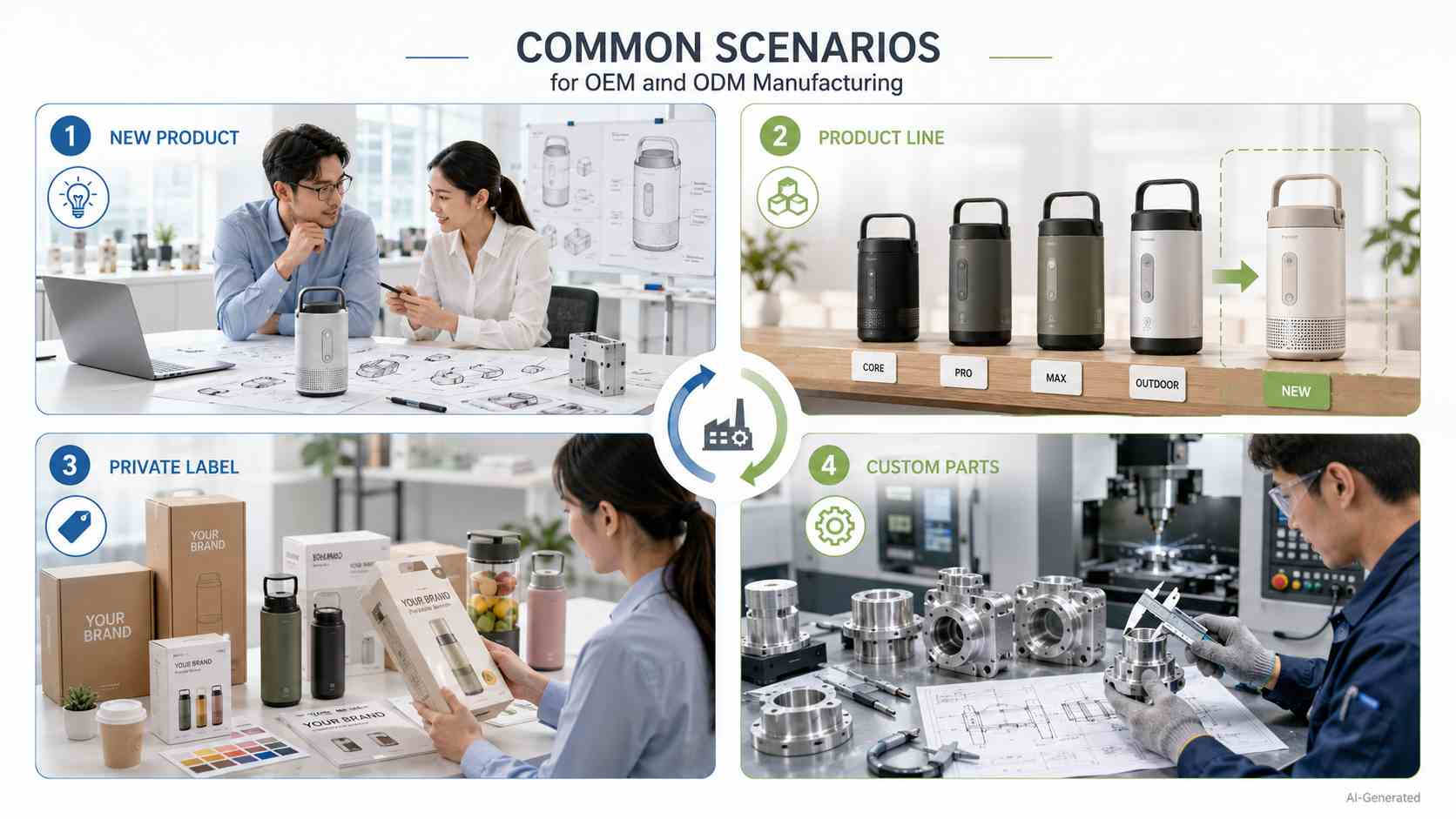
Alt Tag: Business scenarios for OEM and ODM manufacturing
Launching a New Product
When a company starts from a fresh idea, OEM can suit a product that needs its own shape, function, and test plan. ODM can suit a brand that wants to enter a category with a ready base.
Expanding an Existing Product Line
An existing line may need a related item for current buyers. ODM vs OEM manufacturing helps decide whether that item should follow a known supplier platform or a more custom route.
Building a Private Label Brand
Private label brands use ODM when they need a ready product base, branded packaging, and lower early planning. OEM may benefit them later when the brand needs a more distinct item.
Producing Custom Industrial Components
For machined, fabricated, or engineered components, OEM might be the better match. Its reason is that the part may need drawings, tolerances, materials, and inspection steps. ODM is less common unless a supplier already has an appropriate standard design.
OEM Manufacturing in CNC and Industrial ProductionCAD Models and Technical Documentation
OEM manufacturing projects typically begin with engineering data. Buyers provide CAD files, 2D drawings, tolerance requirements, material specifications, and surface finish requirements. The manufacturer reviews these documents before production planning starts.
Design for Manufacturing (DFM) Review
Before machining begins, manufacturers often evaluate wall thickness, feature accessibility, tool selection, and tolerance requirements. Small design adjustments at this stage can reduce machining time and manufacturing costs. Design for cost principles are often applied before production to eliminate features that add machining complexity without improving part performance.
Prototype Development and Validation
Prototype builds help verify dimensions, assembly fit, material performance, and manufacturability. Engineering teams may revise features after testing before moving into larger production volumes.
Inspection and Production Control
OEM production commonly includes first article inspection, in-process quality checks, and final dimensional verification. Inspection requirements depend on part complexity, tolerance requirements, and industry standards.
Transition to Production
Once the design is validated, manufacturing shifts toward process stability, repeatability, lead time management, and quality consistency across production batches.
For companies developing custom industrial parts, JLCCNC provides OEM CNC machining support from prototype development to low-volume production.
Common Misconceptions About OEM and ODM
OEM Does Not Mean the Manufacturer Owns the Product
In an OEM deal, the factory makes the item for the buyer. Usually, ownership follows the buyer's design documents, contract conditions, and intellectual property papers.
ODM Is Not Always a Fully Standard Product
ODM starts from the supplier's platform, but buyers may still request changes to branding, packaging, finish, or selected features within agreed limits.
Cost and Development Assumptions Are Not Always Correct
The ODM vs OEM choice should not depend on a blanket price rule. That is because order size, testing needs, tooling, revisions, and support terms can change the final cost.
Conclusion About OEM vs ODM Manufacturing
The right choice depends on what the company needs to control, invest in, and own during product development. They serve different buying plans. OEM is the better route when a company wants a distinct product, tighter design direction, and room to refine details with the supplier. ODM is the better route when a brand wants to enter a product category with less early work and a ready supplier base. The best choice comes from the product goal, budget, schedule, IP terms, and the level of technical input the buyer can manage.
Many OEM programs begin with a small number of parts rather than full-scale production. Engineering teams often need physical components to evaluate manufacturability, verify assembly conditions, or confirm critical dimensions before release. JLCCNC supports this stage with CNC-machined prototypes and low-volume production parts manufactured directly from customer CAD models and engineering drawings.
Precision CNC Machining Service
Professional manufacturing, fast turnaround, and quality assurance.
FAQ About OEM and ODM Manufacturing
Q: What is the difference between OEM and ODM?
OEM starts with the buyer's design and engineering requirements. ODM starts with a product platform that already exists at the supplier. In daily sourcing, the difference begins with who brings the product idea to the table.
Q: What Does OEM Mean in Manufacturing?
OEM stands for Original Equipment Manufacturer. In manufacturing, an OEM produces products or components according to another company's design, specifications, or engineering requirements. The buyer typically controls the product design, while the manufacturer focuses on production.
Q: Which is cheaper, OEM or ODM?
ODM costs less at the start since the supplier has already dealt with much of the product planning. OEM can require more early spending when the item needs custom development.
Q: Is OEM Better Than ODM?
Neither model is inherently better. OEM provides greater control over product design, customization, and intellectual property. ODM can reduce development effort and shorten time to market by using an existing product platform. The better choice depends on the product strategy, available resources, and business goals.
Q: Which model offers more customization?
OEM gives more room for special features, materials, sizes, and performance needs. ODM can still allow changes, but those changes remain within the supplier's existing product frame.
Q: Who owns the intellectual property in OEM manufacturing?
In many OEM projects, the buyer owns the drawings, specs, and product data it provides. The final answer should always come from the contract, NDA, and IP terms.
Q: Can ODM products be customized?
Yes. ODM products can be customized in areas such as branding, finish, packaging, or selected features. The range depends on the supplier's design limits and production process.
Q: How do companies choose between OEM and ODM?
Companies compare product goals, budget, schedule, technical skill, and future plans. The better option is the one that matches how much product direction the buyer wants to keep.
Q: Is Private Label the Same as ODM?
Not always. Many private label products are sourced through ODM manufacturers because the supplier already owns the product design. However, some private label brands eventually move toward OEM manufacturing when they require custom features, proprietary designs, or greater product differentiation.
Popular Articles
• Rapid Prototyping Guide: Processes Compared and How to Choose the Right Method for Manufacturing
• CNC Rapid Prototyping: Cost, Lead Time, Design Tips & Machining Service
• How is the Cost of CNC Machining Determined
• CNC machining solutions for DIY project designers
• The true cost of CNC machining services what are the main factors affecting price
Keep Learning
Rapid Prototyping Guide: Processes Compared and How to Choose the Right Method for Manufacturing
What Is Rapid Prototyping (AI generated) Various rapid prototyping parts including 3D printed, CNC machined, and sheet metal components on a workshop table. Rapid prototyping is a manufacturing approach that produces physical parts directly from CAD data within hours or days, enabling engineers to quickly validate design, fit, and function before full-scale production. Modern shops use several methods under this umbrella. 3D printing, CNC machining, and sheet processes all fall into the rapid prototyp......
What Is CNC Precision Machining? Process, Tolerances & Applications
Key Takeaways CNC precision machining focuses on controlling part variation within strict dimensional requirements rather than simply producing smaller features. Many precision machining applications can achieve tolerances around ±0.025 mm when the part design and manufacturing conditions are suitable. The final accuracy of a machined part depends on how well the process is planned, controlled, and verified from design to inspection. CNC precision machining is widely used for parts that require consis......
Additive vs Subtractive Manufacturing: Differences, Advantages, and How to Choose the Right Process
Quick Comparison: Additive vs Subtractive Manufacturing Feature Additive Manufacturing Subtractive Manufacturing How it works Builds parts layer by layer Removes material from solid stock Best for Complex geometry, prototypes, low-volume production Precision parts, tight tolerances, production runs Design freedom Excellent, including internal channels and lattices Limited by cutting tool access Typical accuracy Lower as-built accuracy; post-processing is often required High dimensional accuracy direct......
OEM vs ODM: Key Differences, Benefits, and How to Choose
Key Differences at a Glance Between OEM and ODM Factor OEM Manufacturing ODM Manufacturing Design Origin Buyer provides the product design Supplier provides an existing design Product Control Higher control over specifications and development Less control over the core product design Engineering Input Requires more engineering and product development work Requires less technical involvement Customization Extensive customization options Limited to predefined modification options Intellectual Property I......
Large Part CNC Machining: Processes, Challenges, and Manufacturing Considerations
Key Takeaways About Large Part CNC Machining Large part CNC machining handles components where size itself introduces manufacturing challenges that standard machining doesn't face, thermal effects, deflection, workholding complexity, and dimensional control over long spans. Machine travel is one constraint but not the only one, part weight, spindle access, and workholding capability define what a machine can actually do with large components as much as the stated work envelope. Accuracy on large parts......
Low Volume CNC Machining: Small Batch Production Strategies and Manufacturing Guide
Key Takeaways About Low Volume CNC Machining Low volume CNC machining is typically used for production runs ranging from a single part to roughly 1,000 units, without the tooling investment required by molding or casting processes. Small batch CNC machining is often the most practical choice when designs are still evolving, demand is uncertain, or production quantities are too low to justify dedicated tooling. CNC machining can produce production-grade parts from aluminum, stainless steel, titanium, a......