Aluminum vs Stainless Steel: Which Sheet Metal Material Is Better?
25 min
- Aluminum vs Stainless Steel: Comparison Table
- Aluminum vs Stainless Steel: Key Differences for Sheet Metal
- Aluminum vs Stainless Steel Weight Comparison
- Aluminum vs Stainless Steel Strength Comparison
- Aluminum vs Stainless Steel Corrosion Resistance
- Aluminum vs Stainless Steel Cost Comparison
- Real Fabrication Problems Engineers Run Into
- Aluminum vs Stainless Steel Applications in Sheet Metal
- How to Choose Between Aluminum and Stainless Steel for Sheet Metal
- FAQ: Aluminum vs Stainless Steel in Sheet Metal
Note
• Aluminum vs stainless steel is not a one-answer choice; the better material depends on weight, strength, corrosion exposure, fabrication method, and total cost.
• Aluminum is much lighter, easier to machine, and often less expensive, making it a strong choice for enclosures, panels, and weight-sensitive sheet metal parts.
• Stainless steel offers higher absolute strength, better stiffness, and stronger corrosion resistance in harsh environments such as marine, chemical, and food-processing applications.
• In aluminum vs stainless steel weight, aluminum is about 66% lighter and roughly one-third the density of stainless steel.
• In aluminum vs stainless steel strength, stainless steel is generally stronger and stiffer, while aluminum can still be highly competitive when strength-to-weight ratio matters.
• In aluminum vs stainless steel cost, aluminum usually has the lower upfront material and processing cost, while stainless steel can offer better long-term value in aggressive service environments.
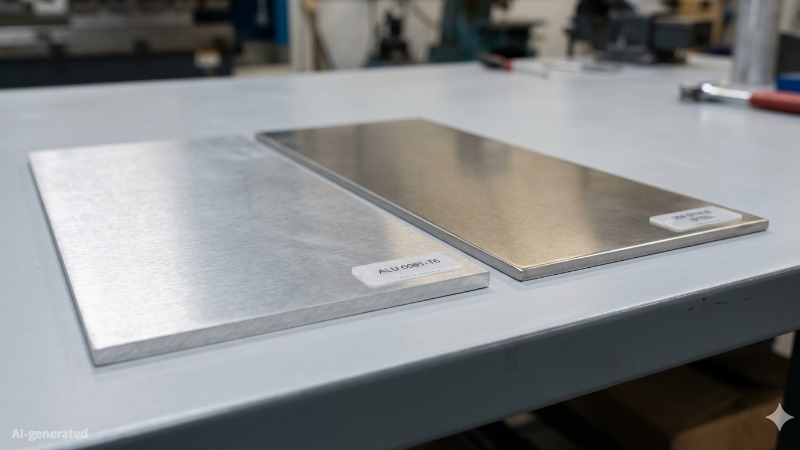
(AI generated) Brushed aluminum sheet vs stainless steel sheet placed side by side
That question has no universal answer, and any guide that gives you one answer is oversimplifying aluminum vs stainless steel. The material that's said to be "better" is actually the one that can survive your specific load, environment, weight budget, and production cost.
If you pick the wrong one, you may either overbuild an enclosure that costs three times more than necessary or end up with a structural bracket that fails six months into service.
This guide gives you the actual engineering differences between aluminum and stainless steel in sheet metal applications. Not vague generalities. So you can make the call confidently for your specific part.
What matters at JLCCNC is not just cutting metal, but understanding what happens before and after. Will the part warp during bending? Will it hold tolerance after welding? Will that “cost-saving” material choice create problems down the line?
That’s where experienced process control comes in. At JLCCNC, parts are reviewed with manufacturing in mind from the start, so material choice, geometry, and finishing all align with real-world use, not just CAD assumptions.

Precision Sheet Metal Fabrication
Professional manufacturing, fast turnaround, and quality assurance.
Aluminum vs Stainless Steel: Comparison Table
| Property | Aluminum (5052/6061) | Stainless Steel (304/316) |
|---|---|---|
| Density | 2.7 g/cm³ | 7.9–8.0 g/cm³ |
| Weight difference | ~66% lighter than stainless | ~3x heavier than aluminum |
| Tensile strength | 130–310 MPa depending on alloy | 480–620 MPa depending on grade |
| Yield strength | 90–275 MPa | 170–310 MPa |
| Corrosion resistance | Good, natural oxide layer | Excellent, passive chromium layer |
| Saltwater/marine | Moderate (5052 better than 6061) | Excellent (316 grade) |
| Thermal conductivity | 150–200 W/m·K | 15–25 W/m·K |
| Machinability | Excellent | Moderate, work hardening is a factor |
| Formability/bending | Very good | Good, springback more significant |
| Weldability | Good (TIG/MIG) | Good to excellent |
| Raw material cost | Lower | 2–4x higher than aluminum |
| Typical sheet applications | Enclosures, panels, aerospace, electronics | Structural brackets, food equipment, marine, chemical exposure |
Aluminum vs Stainless Steel: Key Differences for Sheet Metal
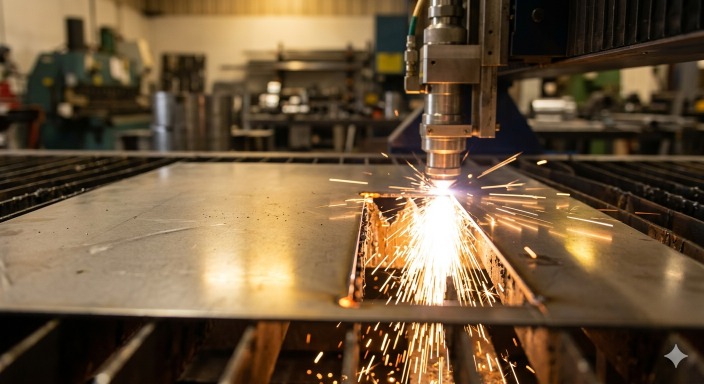
(AI generated) CNC laser cutter cutting through a stainless steel sheet
Start with density and most decisions follow from there.
Aluminum sits at 2.7 g/cm³.
Stainless is 7.9 g/cm³.
In sheet metal terms that means a 2mm aluminum panel weighs roughly the same as a 0.7mm stainless panel (about a third of the mass for the same surface area).
In aerospace, automotive, or anything that gets carried or moved, that gap decides material selection before any other property gets considered.
Most people would say that steel easily wins in strength but it’s not as straightforward.
304 runs 480–620 MPa tensile against 130–310 MPa for common aluminum alloys. But tensile strength in isolation is the wrong metric for most sheet metal decisions.
6061-T6 aluminum offers a favorable strength-to-weight ratio, but whether it can replace stainless steel depends on stiffness, deflection limits, geometry, and load conditions.
When you see 480–620 MPa, it means the material can take a lot more pulling force than something rated at 130–310 MPa.
Whether that matters depends on this: is aluminum vs stainless steel weight a real constraint or just a preference?
If weight is not a major design constraint, stainless steel often has an advantage in absolute strength and stiffness. When weight is critical, aluminum becomes much more competitive.
Corrosion is where environment becomes the deciding variable.
Both materials form passive surface layers
Aluminum, an oxide film
Stainless, a chromium oxide layer
And both hold up well in indoor and moderate outdoor conditions without much maintenance.
But if you’re looking into pushing either in an aggressive territory, they’ll diverge fast.
Saltwater, chloride exposure, high humidity, 316 stainless handles these environments reliably. Standard aluminum alloys can’t. For marine hardware, food processing, and chemical enclosures, the stainless cost premium is worth it.
Cost, at least at the raw material level, is simple.
Aluminum sheet runs $2–5/kg.
Stainless is $4–12/kg depending on grade, 316 sitting at the higher end. Here’s a detailed comparison of 304 vs 316
On a large panel run or a weight-sensitive structure, that difference adds up faster than most people expect when they're early in material selection.
Overview of Aluminum in Sheet Metal Fabrication
Aluminum works in sheet metal fabrication because several useful properties happen to land in the same material. Aluminum is light, formable, machinable, and reasonably priced. For many standard sheet metal applications, few materials match that combination.
5052 aluminum is one of the most commonly used alloys in sheet metal fabrication. Enclosures, panels, formed parts. 5052 is often preferred for formed and welded sheet metal parts because it offers better formability and more predictable post-weld corrosion performance than 6061 in many applications. Tensile strength lands at 210–260 MPa, which covers most panel and enclosure applications comfortably.
6061-T6 is where you go when strength matters more than formability. 276 MPa tensile, 241 MPa yield, structural brackets, mounting plates, load-bearing panels. The catch is that tight bend radii risk cracking without proper radius allowances, and welding knocks down strength at the heat affected zone unless you post-weld heat treat. Know that going in.
Machinability is a real fabrication advantage. Aluminum cuts faster, tools last longer, cycle times are shorter. On high-volume work, that shows up directly in cost per part.
One thing worth factoring before assuming aluminum always wins on aluminium vs stainless steel weight: Young's modulus is about 69 GPa versus 193 GPa for stainless. Aluminum panels deflect more under load. Large unsupported spans need ribbing or extra thickness to match stainless stiffness, which eats into the weight advantage, though usually doesn't eliminate it.
Overview of Stainless Steel in Sheet Metal Fabrication
Stainless earns its place in the applications where aluminum runs out of capability. High structural loads, aggressive corrosion environments, elevated operating temperatures, hygiene regulations , these are stainless territory.
304 is the standard grade for many enclosures, brackets, food equipment, and architectural applications. It offers tensile strength of roughly 480–515 MPa, good formability, and reliable corrosion resistance in most environments without coating. Springback during bending is more pronounced than aluminum and needs to be compensated in tooling and bend allowance calculations. Not a dealbreaker, just something to design for rather than discover at the brake.
316 adds molybdenum. Costs 20–30% more than 304. Worth it anywhere chloride exposure is real, marine, chemical processing, medical, coastal architecture. In chloride-rich environments, 304 is more prone to pitting, while 316 offers significantly better resistance. Specifying 304 where 316 is needed isn't a cost saving, it's a service life problem.
Welding stainless needs more care than aluminum, heat input has to stay controlled to avoid sensitization, which is carbide precipitation at grain boundaries that compromises corrosion resistance in the weld zone. 304L and 316L (low-carbon variants) reduce this risk and are worth specifying when weld quality is critical.
Work hardening catches people off guard. 304 and 316 harden rapidly during cutting and forming. It's manageable with correct tooling and parameters, but it needs to be accounted for, not discovered mid-production run.
Core Differences at a Glance
| Situation / Requirement | Go with Aluminum | Go with Stainless Steel |
|---|---|---|
| Weight matters | Much lighter, easier to move or mount | Heavier, adds stability but increases load |
| Environment | Works fine in normal indoor or mild outdoor use | Better for saltwater, chemicals, or constant humidity |
| Cost at scale | Usually cheaper to produce in volume | Costs more to machine and process |
| Strength needs | Good for moderate loads | Better for high loads at the same thickness |
| Temperature | Fine below ~150–200°C | Holds strength better at higher temperatures |
| Surface durability | Needs coating or anodizing for long-term wear | Naturally durable, no coating needed |
| Fabrication speed | Faster machining and forming | Slower, harder on tools |
| Low-volume builds | Not always worth optimizing heavily | Makes sense when performance matters more than cost |
At this point, the difference between aluminum and stainless is clear, but applying that to your actual part is where things get tricky.
Aluminum vs Stainless Steel Weight Comparison
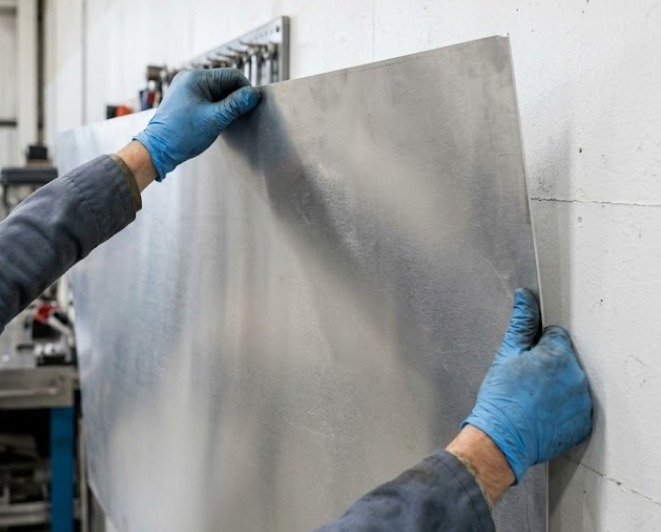
(AI generated) Technician holding a large thin aluminum sheet panel
The density numbers from the comparison table (2.7 g/cm³ for aluminum vs 7.9 g/cm³ for stainless) translate into something more tangible when you're specifying a real enclosure or structural panel. A 1m × 1m sheet of 2mm aluminum weighs roughly 5.4kg. The same sheet in 2mm stainless weighs 15.8kg. That's not an abstract material science difference. It's the difference between one person carrying a panel on a job site and two people needing a lift assist.
Density Differences and What They Mean
The three-times weight difference between aluminum and stainless steel affects more than just the part itself. It ripples through shipping cost, installation labor, supporting structure requirements, and in dynamic applications, the energy needed to move the assembly.
For shipped products, enclosures, equipment housings, panels, aluminum's weight advantage reduces freight cost directly. A 100-unit production run of aluminum enclosures vs stainless equivalents can represent a meaningful freight cost difference per shipment, compounding over a product's commercial life.
For installed structures, wall-mounted panels, ceiling-hung enclosures, equipment frames, the supporting structure has to carry the weight of the sheet metal components. A stainless steel panel array that requires a heavier subframe to support it may eliminate the apparent material cost saving from choosing stainless in the first place. The weight of the cladding drives the weight of the structure behind it.
For moving assemblies, robotic arms, actuated panels, vehicle components, every gram of unnecessary mass requires more energy to accelerate and decelerate. In high-cycle applications this adds up in power consumption and wear on drive components over time.
Impact on Fabrication and Installation
Weight affects handling at every stage of fabrication.
Large aluminum sheets are manageable by a single operator on a press brake or laser cutting table.
Large stainless sheets of equivalent thickness require mechanical assistance or two-person handling, which affects shop floor workflow and cycle time on high-volume work.
Distortion during welding is also influenced by mass.
Stainless holds heat locally during welding.
Thin sheet distorts faster than many people expect, especially on long seam welds.
That concentration drives distortion in thin stainless sheet, requiring more fixture time and post-weld correction than equivalent aluminum work.
When Lightweight Design Matters Most
Weight is a primary constraint in aerospace and aviation components, where every kilogram of structural mass reduces payload capacity.
It matters in portable equipment and handheld enclosures, where user fatigue and ergonomics drive design decisions.
It matters in electric vehicles and any battery-powered system, where mass directly affects range.
And it matters in seismic applications, where lighter cladding reduces lateral loads on the supporting structure during ground movement.
In applications where none of those factors apply, a fixed industrial enclosure bolted to a concrete floor, a food processing surface that stays in one place, the weight difference matters less and other properties like corrosion resistance and surface finish durability take precedence.
Aluminum vs Stainless Steel Strength Comparison
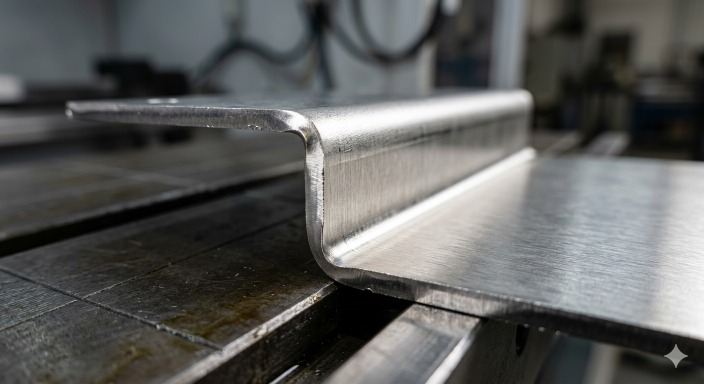
(AI generated) stainless steel structural bracket showing a sharp 90-degree bend
Weight and strength are related but not the same thing, and the relationship between them is where most aluminum versus stainless steel decisions get made poorly. As mentioned earlier, stainless steel has higher absolute tensile strength. What that means in a sheet metal application depends on what kind of strength the part actually needs.
Strength vs Stiffness Explained
Tensile strength and stiffness are two different properties that people often get confused with when specifying sheet metal.
Tensile strength is how hard you have to pull to break it.
Stainless steel's 480–620 MPa tensile strength significantly exceeds aluminum's 130–310 MPa range. Stainless wins here by a clear margin.
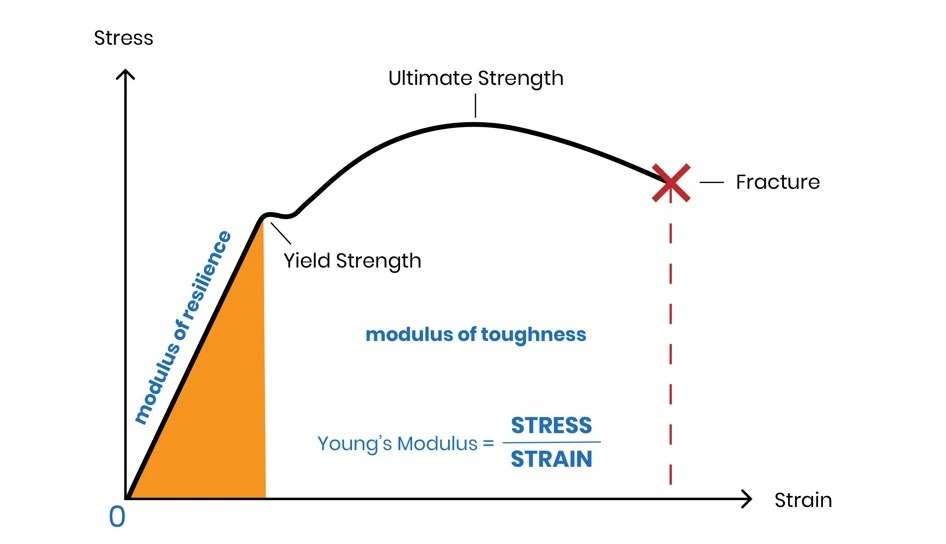
(ServiceThread) Graphical Representation of Young’s modulus
Stiffness (Young’s modulus) is how much it bends before it even gets close to breaking.
Stainless steel's modulus is approximately 193 GPa.
Aluminum's is approximately 69 GPa. Stainless is about 2.8 times stiffer than aluminum at the same thickness.
For sheet metal terms, this means an aluminum panel bends (or deflects) nearly 3x as much as an equivalent stainless panel under the same load.
For large unsupported panels, enclosure lids, access covers, equipment faces, that deflection can cause oil-canning (visible surface waviness under load) that stainless avoids at the same gauge.
The way to solve aluminum's lower stiffness is usually to increase sheet thickness or add ribs and returns at the edges.
A 3mm aluminum panel can match the stiffness of a 2mm stainless panel. Increasing aluminum thickness can partially compensate for its lower stiffness, although the required thickness depends on geometry and load conditions. But now you're comparing a 8.1kg/m² aluminum sheet against a 15.8kg/m² stainless sheet, and aluminum still has less weight despite the thickness increase.
Performance in Thin Sheet Applications
Thin sheet (typically 0.5mm to 1.5mm) is where the strength and stiffness difference becomes most important.
Thin stainless sheet holds its shape under forming and in service better than an equivalent thin aluminum.
For precision enclosures with tight dimensional tolerances, thin stainless maintains flatness and edge definition more reliably than thin aluminum.
Aluminum can distort during forming and handling at lower gauges.
Thin aluminum sheet compensates through alloy selection. 5052-H32 at 1.0mm handles light-duty enclosure applications well, the H32 temper provides enough strength for most panel applications while retaining good formability.
Going thinner than 0.8mm in aluminum starts to introduce handling and distortion risks that thinner stainless doesn't have to the same degree.
For structural sheet metal, brackets, mounting plates, load-bearing frames, the yield strength difference matters more than stiffness. Yield strength is the point at which the material permanently deforms rather than springing back. 304 stainless at 170–310 MPa yield vs 6061-T6 aluminum at 241–276 MPa yield are actually comparable at similar alloy grades.
Which is one reason 6061-T6 holds up well in structural bracket applications despite the overall tensile strength gap.
Best Use Cases for High Strength Needs
Stainless steel is the correct choice when the sheet metal part
Carries significant structural load at standard gauges
When thin-wall construction is required with no room for thickness compensation
When impact resistance matters
Stainless steel is often preferred where impact resistance and toughness are important, although actual performance depends on grade and condition. When the part operates at elevated temperatures, where aluminum alloys begin softening above 150–200°C.
Aluminum handles high-strength applications well when the alloy and temper are matched correctly to the load case.
6061-T6 in structural brackets
5052-H32 in formed enclosures
7075-T6 in aerospace and high-performance structural applications where strength-to-weight ratio is the primary design driver.
7075-T6 reaches 503 MPa tensile, competitive with lower-grade stainless, at less than a third of the density. For weight-critical structural applications, that combination is hard to beat.
The failure mode to avoid is specifying aluminum in a high-strength application based on weight preference without checking whether the alloy and temper actually meet the load requirements, or specifying stainless in a weight-sensitive application because it "feels stronger" without running the strength-to-weight numbers.
Both are common and both produce parts that either fail or cost more than they need to.
Aluminum vs Stainless Steel Corrosion Resistance
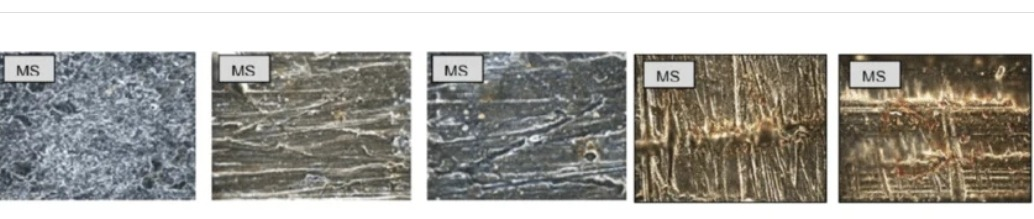
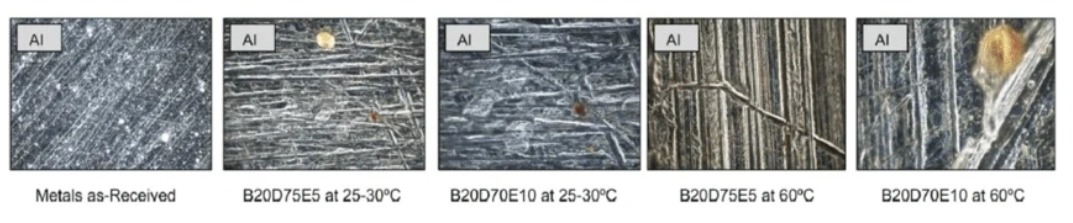
(ResearchGate) morphological corrosion of aluminium and mild steel
Corrosion resistance is one of the most misunderstood factors in the aluminum vs stainless steel decision. Both materials resist corrosion, but through completely different mechanisms, and they fail in completely different environments.
How Aluminum Resists Corrosion
Aluminum doesn't rust. Instead it oxidizes, the surface reacts with oxygen almost instantly to form a thin aluminum oxide layer that seals the metal underneath from further attack. That layer is self-healing. Scratch it and it reforms within seconds in air.
In most indoor, outdoor, and moderate humidity environments, this makes aluminum corrosion resistance genuinely excellent with zero maintenance. Anodizing thickens that oxide layer artificially, improving durability and enabling color finishing simultaneously.
The vulnerability is chlorides. In saltwater or coastal environments, chloride ions penetrate aluminum's oxide layer and cause pitting, localized corrosion that's difficult to detect visually until it's structurally significant. 5052 aluminum resists this better than 6061, which is why marine sheet metal applications favor 5052 when aluminum is specified at all.
How Stainless Steel Prevents Rust
Stainless steel's corrosion resistance comes from chromium, minimum 10.5% by composition. Chromium forms a passive oxide layer on the steel surface that prevents the iron underneath from oxidizing into rust. Unlike carbon steel, which rusts progressively once the surface is broken, stainless steel's passive layer also self-repairs in oxygen-containing environments.
304 stainless handles most indoor and outdoor environments reliably. Where aluminum vs stainless steel corrosion resistance diverges most sharply is marine and chemical exposure. 316 stainless adds molybdenum to the composition, which resists chloride attack that would pit both 304 stainless and standard aluminum alloys. For seawater immersion, chemical processing equipment, and coastal architectural applications, 316 is the correct specification.
Choosing Based on Environment
In dry indoor environments, electronics enclosures, equipment panels, interior architectural, aluminum and stainless steel both perform well and the corrosion decision is essentially neutral. Cost and weight considerations from earlier sections dominate.
In moderate outdoor exposure, general industrial, urban environments, non-coastal, both materials perform adequately. Aluminum with anodize or powder coat extends service life significantly. Uncoated stainless handles this environment without surface treatment.
In aggressive environments, marine, coastal, chemical, food processing, high humidity industrial, steel vs aluminum corrosion resistance diverges sharply. 316 stainless is the reliable choice. Aluminum requires careful alloy selection (5052 or 5083 for marine) and protective coating for long service life.
Aluminum vs Stainless Steel Cost Comparison
The cost comparison question looks simple on the material price list. It gets more complicated when fabrication, finishing, and service life enter the calculation.
Material Cost Differences
Aluminum sheet runs approximately $2–5/kg for 5052 and 6061 at standard market pricing.
Stainless steel sheet runs $4–8/kg for 304 and $6–12/kg for 316.
On raw material alone, aluminum is 40–60% cheaper than 304 stainless and significantly cheaper than 316.
For large-format sheet metal work, enclosures, panels, cladding, that material cost difference compounds quickly. A 50-piece enclosure run in aluminum versus 304 stainless can represent thousands of dollars in material cost difference before a single operation runs.
Fabrication and Processing Costs
Raw material is only part of the aluminum vs stainless steel cost picture. Fabrication behavior affects total cost significantly.
Aluminum cuts faster on laser and waterjet, machines with less tool wear, and bends with less springback compensation required. In high-volume sheet metal production, faster cycle times and lower tooling wear translate directly into lower cost per part.
Stainless steel work-hardens during cutting and forming, increases tool wear rates, and requires more careful parameter control to avoid surface damage. Press brake operators need to account for greater springback when bending stainless, which adds setup time and increases scrap risk on tight-tolerance formed parts.
Finishing costs also differ.
Aluminum typically requires anodizing or powder coating for outdoor durability, add $3–8/m² depending on process.
Stainless steel can be left uncoated in many applications, or brushed/polished for aesthetic finish without the ongoing coating maintenance cost.
Long-Term Value Considerations
In applications where coating maintenance is a recurring cost, outdoor aluminum panels that need periodic recoating, stainless steel's lower maintenance requirement can close or reverse the initial cost gap over a 10–15 year service life.
In applications where weight drives operating cost, aerospace, automotive, portable equipment, aluminum's lighter weight reduces lifetime energy or fuel cost in ways that dwarf the initial material price difference.
The steel vs aluminum cost decision is genuinely application-specific.
Aluminum wins on upfront cost in most fabrication scenarios.
Stainless wins on total cost of ownership in harsh environments where aluminum needs ongoing surface protection to survive.
Real Fabrication Problems Engineers Run Into
Common Aluminum Fabrication Problems
Aluminum is easier to cut and form than stainless steel, but it introduces its own manufacturing problems during production.
Soft aluminum surfaces dent easily during transport and handling, especially on large enclosure panels and cosmetic parts. Thin aluminum sheet may also deform during powder coating or welding because heat spreads rapidly across the material.
Thread strength is another overlooked issue. Repeated assembly and disassembly can strip tapped aluminum threads much faster than stainless steel, particularly in softer alloys like 5052.
Laser-cut aluminum may also leave edge burrs or oxide residue depending on alloy and cutting parameters, which affects cosmetic appearance before anodizing or powder coating.
Common Stainless Steel Fabrication Problems
Stainless steel creates a different set of fabrication challenges.
304 and 316 work harden quickly during machining and forming. Once the material hardens at the cut edge, tool wear increases rapidly and bending becomes less predictable.
Springback during press brake forming is another common issue. Stainless tends to recover more aggressively after bending than aluminum, which means bend compensation must be carefully controlled during setup.
Laser reflection can also become problematic on polished stainless surfaces, particularly with thin sheet and high-power cutting systems.
Compared with aluminum, deburring and surface finishing generally take longer because stainless edges remain harder after cutting.
Aluminum vs Stainless Steel Applications in Sheet Metal
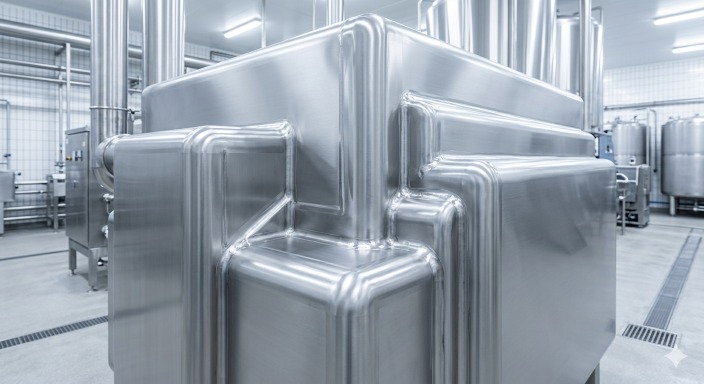
(AI generated) Polished stainless steel fabricated enclosure
Typical Applications of Aluminum Sheet Metal
Aluminum sheet dominates applications where the combination of light weight, good corrosion resistance, and fabrication efficiency outweighs the need for maximum strength or surface hardness.
Electronics enclosures and equipment housings are aluminum's strongest territory in sheet metal. The material machines cleanly, anodizes well for EMI shielding and surface durability, and keeps enclosure weight low enough for rack-mount and portable equipment. Most 1U and 2U server enclosures, instrument housings, and control panels default to 5052 or 6061 aluminum for exactly these reasons.
Lightweight structural panels, aerospace interior panels, vehicle body components, architectural cladding, use aluminum where the weight-to-stiffness ratio determines design viability. As covered earlier in the strength comparison, 7075-T6 pushes into structural territory that overlaps with stainless on strength while keeping the weight advantage intact. 7075 is used in high-strength, weight-sensitive aerospace and structural applications, but it is less common in general formed sheet metal fabrication due to its lower formability.
HVAC ducting, signage, marine interior fittings, and consumer product enclosures round out the common aluminum sheet metal application space, anywhere indoor or moderate outdoor exposure, weight sensitivity, and cost efficiency align.
Typical Applications of Stainless Steel Sheet Metal
Stainless steel sheet occupies applications where surface integrity, structural load, or environmental aggression rules aluminum out.
Food processing and pharmaceutical equipment is almost exclusively stainless, 304 or 316 depending on cleaning chemical exposure, because surface hygiene requirements, frequent washdown with aggressive detergents, and regulatory compliance all point to stainless. Aluminum's oxide layer doesn't hold up to repeated alkaline cleaning cycles the way stainless passive film does.
Industrial equipment frames, structural brackets, and load-bearing enclosures use stainless where the strength-to-thickness ratio matters and weight isn't a constraint. A 2mm stainless bracket carries more load than a 2mm aluminum equivalent without requiring thickness compensation.
Marine hardware, coastal architectural elements, chemical processing vessels, and medical device housings favor 316 stainless for the chloride resistance discussed in the corrosion section. These are environments where the cost premium for stainless is justified by service life that aluminum, even properly coated, can't reliably match.
When Each Material Performs Best
Aluminum performs best when weight drives the design, the environment is moderate, fabrication volume is high enough that cycle time savings matter, and the budget favors lower upfront material cost. Electronics, aerospace, automotive, portable equipment, and general industrial enclosures in controlled environments.
Stainless steel performs best when the environment is aggressive, structural load at standard gauges is a requirement, surface finish must survive without coating, or hygiene and regulatory standards apply. Food, medical, marine, chemical, and heavy industrial applications.
The overlap, moderate loads, indoor environment, cost sensitivity, comes down to volume, weight targets, and finishing requirements as outlined in the cost and weight sections earlier.
How to Choose Between Aluminum and Stainless Steel for Sheet Metal
Best Choice for Lightweight Applications
Aluminum. No qualification needed for weight-driven applications. The density difference covered earlier (2.7 g/cm³ versus 7.9 g/cm³) makes stainless steel sheet between 2.5–3x heavier at equivalent thickness. For aerospace panels, portable enclosures, vehicle body components, and any assembly where mass affects performance or shipping cost, aluminum is the default.
Alloy selection within aluminum matters: 5052-H32 for formed enclosures and panels, 6061-T6 for structural lightweight brackets, 7075-T6 for maximum strength-to-weight in demanding structural applications.
Best Choice for Strength and Durability
Stainless steel for absolute strength at standard gauge. 304 stainless at 480–515 MPa tensile handles structural bracket, frame, and load-bearing enclosure applications that push aluminum's limits at equivalent thickness.
That said, for weight-critical structural applications where aluminum vs stainless steel strength is the deciding factor, 6061-T6 at 276 MPa tensile competes effectively when thickness can be increased, and 7075-T6 at 503 MPa tensile matches lower-grade stainless on strength while remaining under a third of the density.
If the part needs to survive impact, repeated load cycles, or elevated operating temperature above 150°C, stainless steel's durability advantage over aluminum becomes decisive.
Best Choice for Corrosion Resistance
Environment-dependent, as detailed in the corrosion section. For aggressive environments, marine, coastal, chemical, food processing, 316 stainless is the reliable answer. For moderate outdoor and general industrial environments, aluminum with anodize or powder coat performs well at lower cost. For indoor applications, both materials are adequate and the decision reverts to weight and cost.
Material selection usually affects manufacturing cost earlier than most teams expect.
If you're unsure whether aluminum or stainless makes more sense for your design, JLCCNC engineers can review the geometry, bending requirements, welding process, and production environment before quoting.
Precision Sheet Metal Fabrication
Professional manufacturing, fast turnaround, and quality assurance.
FAQ: Aluminum vs Stainless Steel in Sheet Metal
Q: Is aluminum cheaper than stainless steel?
In most cases, yes, aluminum vs stainless steel cost favors aluminum due to faster machining and forming. However, stainless steel may be more cost-effective long-term in harsh environments due to its durability.
Q: Which material is better for outdoor use?
For outdoor conditions, aluminum vs stainless steel corrosion resistance depends on exposure. Stainless steel (especially 316) performs better in aggressive environments, while aluminum works well in general conditions with proper finishing.
Q: Does aluminum rust like stainless steel?
No, aluminum does not rust; it forms a protective oxide layer instead. In the steel vs aluminum comparison, stainless steel resists rust, but aluminum naturally prevents corrosion differently.
Q: Which is easier to machine and bend?
Aluminum is significantly easier to machine and bend due to its lower hardness and higher ductility. In aluminum vs stainless steel strength, stainless steel is stronger but harder to process.
Q: Which is better for sheet metal enclosures, aluminum or stainless steel?
It depends on requirements, aluminum is better for lightweight, cost-sensitive enclosures, while stainless steel is preferred for strength and durability. The aluminum vs stainless steel weight difference is a key factor in design.
Q: Is aluminum strong enough to replace stainless steel in structural parts?
Sometimes, but not always, aluminum vs stainless steel strength shows aluminum has lower absolute strength but higher strength-to-weight ratio. It works for lightweight structures but not for high-load or impact-critical applications.
Popular Articles
• 9 Sheet Metal Cutting Problems and Solutions
• Hole cutting in sheet metal: techniques, tolerances and applications
• Introduction to Sheet Metal Processing: Techniques and Tools for Precision
• Bending and Forming Technology in Sheet Metal Processing
• Laser cutting technology in sheet metal processing
Keep Learning
Galvanized Sheet Metal: Grades, Specs & When to Use It
Galvanized Sheet Metal: Grades, Specs & When to Use It A design engineer specs "galvanized sheet metal" on a drawing and sends it out for quotes. Three shops come back with three different prices, and one of them asks a follow-up question the others didn't: which gauge, which coating class, hot-dip or electro-galvanized? That question is the difference between a part that survives outdoors for fifteen years and one that starts showing rust spots after eighteen months — and it's the kind of detail that......
Custom Sheet Metal Fabrication: How the Process Works From Design to Delivery
Custom Sheet Metal Fabrication: How the Process Works From Design to Delivery A stock enclosure almost fits. The mounting holes are close but not quite right, the depth is half an inch too shallow, and the vendor's next size up is twice the volume you actually need. This is the point where most people start looking into custom sheet metal fabrication — not because they set out to design a part from scratch, but because nothing off the shelf actually solves the problem. Custom fabrication sounds like i......
Sheet Metal Assembly: How Fabricated Parts Come Together
Sheet Metal Assembly: How Fabricated Parts Come Together Cutting and bending gets a lot of attention because that's where a flat sheet visibly turns into a 3D part. But a single bracket by itself rarely finishes the job — most real sheet metal products are assemblies, multiple formed pieces joined into one working unit, and that assembly step is where a lot of designs quietly succeed or fail. A part that measured perfectly on its own can still not fit once it's supposed to mate with three other pieces......
Sheet Metal Bender: Types, Specs & How to Choose the Right Machine
Sheet Metal Bender: Types, Specs & How to Choose the Right Machine Every sheet metal bracket, enclosure, and panel eventually passes through a bender of some kind — that's the machine, not the process. Our guide on sheet metal bending covers how bending actually deforms metal — springback, minimum radius, bend allowance, and the core press brake and CNC press brake setups most shops run. This one goes further into the equipment side specifically: the less common bender types beyond the standard press ......
What Is Galvanized Metal? Process, Types & How It Works
What Is Galvanized Metal? Process, Types & How It Works Leave a piece of bare steel outside for a season and you'll see exactly why galvanizing exists. Rust doesn't wait for dramatic weather — a little humidity and a few weeks is enough to start eating into an unprotected surface. Galvanized metal solves that problem by giving steel a sacrificial layer of zinc that corrodes in its place, and it's done this job well enough that it's become the default choice for anything from highway guardrails to HVAC......
What Is Sheet Metal Fabrication? The Complete Guide
What Is Sheet Metal Fabrication? The Complete Guide Somewhere between a CAD file and a working enclosure sitting on your bench, a flat piece of metal gets cut, bent, joined, and finished into something that actually does a job. That's sheet metal fabrication — and if you've never ordered a part before, the term can feel bigger than it needs to be. Ask five people what "sheet metal fabrication" covers and you'll get five different answers: some think laser cutting, some think welding, some just picture......