Anchor Fasteners for Sheet Metal: Best Types for Concrete and Industrial Use
20 min
- What is an Anchor Fastener in Sheet Metal
- How Anchor Fasteners Work
- Common Anchor Fastener Types
- Anchor Fastener vs Bolt: What's Better for Sheet Metal Installation?
- Anchor Fasteners for Concrete in Sheet Metal Installation
- Industrial Anchor Fasteners in Sheet Metal Fabrication
- Stainless Steel Anchor Fasteners for Sheet Metal Projects
- How to Choose the Right Anchor Fastener for Sheet Metal
- FAQ About Anchor Fasteners in Sheet Metal
What is an Anchor Fastener in Sheet Metal
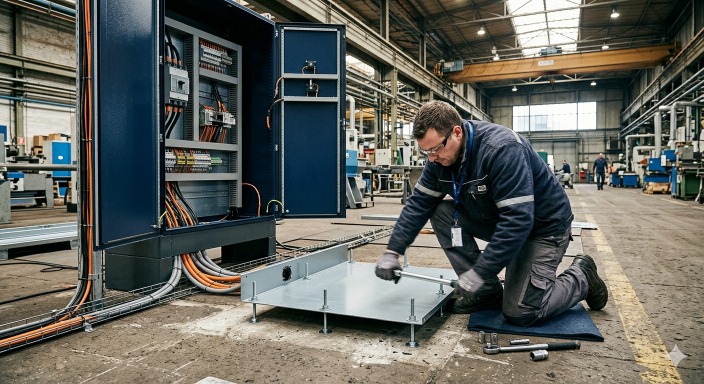
(AI generated) Technician securing a sheet metal enclosure
Even the most precisely engineered sheet metal part is useless if it isn’t secured properly. In a real-world installation, parts don't exist in a vacuum. Enclosures have to be bolted to shop floors, brackets have to carry heavy piping, and panels have to withstand constant machine vibration. The stability of the entire assembly depends on how it is connected to the base material, usually concrete or masonry.
That is the specific job of an anchor fastener.
In industrial construction, this is more than a ‘big screw’. They are mechanical systems designed to handle the load transfer between a thin, fabricated metal part and a rigid structural slab. With the surge in industrial infrastructure through 2025, anchoring has become a critical point of failure that engineers have to account for long before the part reaches the site.
In sheet metal work, the part gets all the attention. In many cases, the fastener is the component that ultimately transfers the load to the structure.
At JLCCNC, we see this all the time. A well-designed bracket or enclosure only performs as well as the way it’s mounted. That’s why we don’t just focus on fabrication. We look at how your parts are actually installed, including the right anchor fastener types for real-world conditions.
If you’re building sheet metal parts that need to hold up under load, vibration, and time, getting both the design and the anchoring right makes the difference. That’s exactly where a reliable fabrication partner helps.
Definition of Anchor Fasteners
An anchor fastener is the mechanical interface used when you need to attach a part to a material that won't accept threads, like concrete, brick, or stone. Concrete generally cannot be treated like ductile metal for conventional tapped threads, so anchoring systems are typically used instead. You need a device that can grip the internal surface of the hole through expansion or chemical bonding.
The most common types found in the field include:
● Expansion Anchors: (Wedge and sleeve anchors) These use mechanical force to bite into the concrete walls as the bolt is torqued.
● Chemical Anchors: Epoxy systems that essentially glue the threaded rod into the substrate.
● Drop-in Anchors: Internal-thread anchors used for overhead applications like hanging ductwork.
● Concrete Screws: Large-diameter fasteners that cut their own threads into the masonry, relies on thread engagement, not expansion.
The goal is not only to hold the fixture in place, but also to transfer the load without damaging the base material. In heavy industrial setups, a single stainless steel wedge anchor can be rated for several kilonewtons depending on embedment depth and concrete strength, provided the embedment depth is correct.
Why Anchor Fasteners Are Used in Sheet Metal Assembly
Sheet metal is inherently thin, usually sitting between 0.5 mm and 6 mm. This thinness makes it great for forming, but it provides almost zero surface area for traditional fastening. Anchors are used because sheet metal alone does not provide enough thickness or pull-out resistance for structural mounting.
The primary reasons for anchoring include:
● Resisting Vibration: High-speed machinery will walk a sheet metal guard right off the floor if it isn't anchored into the slab.
● Dynamic Loading: Supports for HVAC or piping experience constant movement that standard bolts can't handle in masonry.
● Alignment: Anchors ensure that a control panel stays perfectly plumb even if the floor isn't.
This highlights the main difference between an anchor fastener and a bolt: A bolt is typically used to clamp components that already have holes or threads, while an anchor fastener is used to secure a fixture to a base material such as concrete or masonry. In some systems, the anchor itself may include a bolt, stud, or threaded rod.
If your mounting holes or edge distances are off, even the best anchor fastener will fail, which is why following proper sheet metal design guidelines is critical from the start
Common Sheet Metal Structures That Require Anchoring
You will see industrial anchor fasteners specified in almost every phase of a factory build-out.
Equipment enclosures Electrical panels and server racks are essentially big sheet metal boxes. They are top-heavy and require floor-mounted wedge anchors to prevent tipping and to protect the sensitive electronics inside from building vibration.
Structural brackets and supports Custom brackets for cable trays or pneumatic lines rely on anchors to transfer the weight of the lines into the concrete ceiling or walls. If the anchor choice is wrong, the bracket will eventually pull out under the weight of the dead load.
Machine guards and safety barriers These are meant to stop impacts. A safety rail is only as strong as its connection to the floor. Engineers typically specify stainless steel anchor fasteners here to prevent rust from weakening the connection over time.
HVAC and duct systems Large-scale ductwork creates significant leverage on its mounting points. Anchoring systems ensure that these systems don't sag or vibrate loose over decades of operation.
Modular frames and racks Without it, the frame would twist under the weight of the materials it was built to hold.
How Anchor Fasteners Work
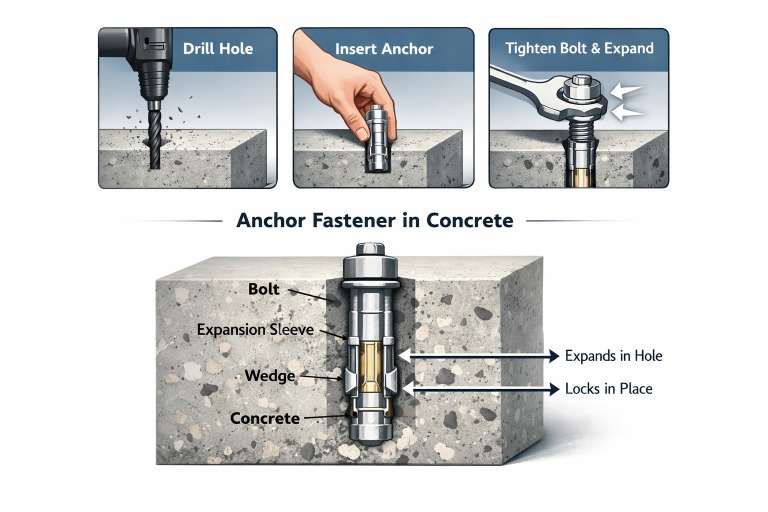
(AI generated) Diagram explaining installation and working of anchor fasteners
An anchor fastener has a singular mission: converting the weight and movement of your sheet metal part into a compression load that the concrete can actually handle.
Expansion Mechanism
Mechanical anchors are all about friction. When you apply torque, the anchor’s main end expands outward. This creates a mechanical interlock.
Why does torque matter? If you under-torque, the anchor slips under load. If you over-torque, you risk blowing out the concrete cone inside the hole. This is especially critical for thin sheet metal brackets, if the bracket deforms before the anchor seats, your alignment is toast.
Chemical Bonding Mechanism
Chemical anchors treat the concrete and the bolt as one piece. The resin fills every microscopic void in the drilled hole. Once it kicks, the load is distributed across the entire embedded surface area.
A chemical anchor is only as good as your vacuuming. If there’s dust in the hole, the epoxy bonds to the dust, not the concrete. In a professional fab environment, a failed chemical anchor is almost always an installation error (not a product failure).
Load Transfer to Base Material
Every anchor eventually has to deal with Tensile (pull-out) and Shear (sideways) forces. Sheet metal parts are deceptive.. A lightweight control panel can exert massive shear force if someone leans on it or if a machine hits it.
Engineers can’t just guess. They calculate capacity based on embedment depth and edge distance. If you place a heavy wedge anchor too close to the edge of a slab, the expansion force will simply pop the corner off the concrete. By spreading the load correctly, you ensure the fastening system is actually more robust than the sheet metal it's holding.
At this point, you’ve probably realized something. Choosing the right anchor fastener depends heavily on how your sheet metal part is designed in the first place.
Hole placement, thickness, load distribution. It all ties back to your CAD file.
Common Anchor Fastener Types
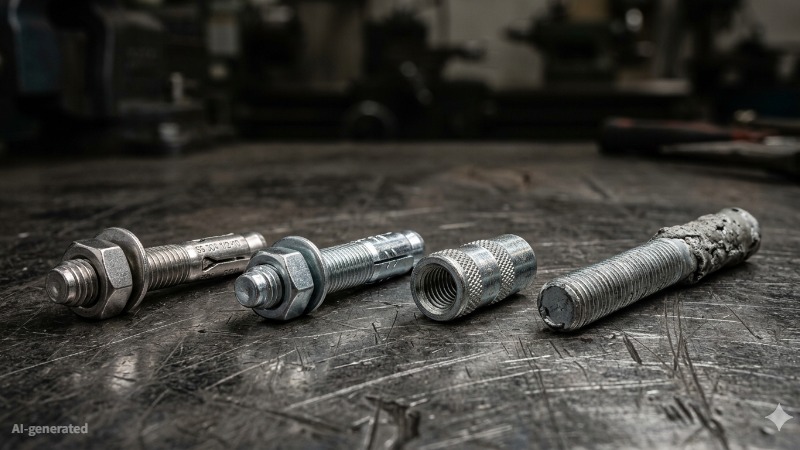
(AI generated) Different types of anchor fasteners
Anchors aren't interchangeable. Choosing the wrong one isn't just a minor oversight. The wrong choice can lead to pull-out failure, concrete cracking, or long-term loosening. In sheet metal work, where parts are often thin but subject to high-frequency vibration, the anchor is the only thing standing between a secure install and a catastrophic shear failure.
Typically, you're choosing between two worlds: mechanical and chemical.
Mechanical Anchor Fasteners (Wedge, Sleeve, Drop-in)
Mechanical anchors are immediate. They rely on physical expansion to bite into the base material. For most sheet metal enclosures or floor-mounted brackets, these are the default because you can load them the second they’re torqued.
● Wedge Anchors: These are generally considered permanent in concrete. In many cases, they are not fully removable without damaging the surrounding material, so they are often cut flush or left in place after fixture removal.
● Sleeve Anchors: The expansion happens along a larger sleeve area, making them ideal for mounting medium-duty panels into brick or block where a wedge anchor might just shatter the substrate.
● Drop-in Anchors: These sit flush. You use a setting tool to expand the internal plug. These are a staple for overhead sheet metal ducting because they keep the threaded rod connection clean and manageable.
Chemical Anchor Fasteners
Chemical anchors are the special ops of fastening. Instead of forcing the concrete apart via expansion, they use a resin or epoxy to create a unified bond between the steel and the substrate.
This is a massive advantage when you're working with cracked concrete or when you need to mount a heavy sheet metal frame near a slab edge. Expansion anchors exert constant bursting pressure; chemical anchors don't.
But, you’re trading speed for strength. Depending on the site temperature, you might be waiting hours for a full cure. But for vibration-heavy environments, like a massive sheet metal blower housing, the fatigue resistance of a chemical bond is hard to beat.
Choosing the Right Type for Sheet Metal Mounting
You can’t simply pick an anchor out of a bin. You need to match it to the load case, base material, and installation conditions. For high-vibration industrial mounts, stainless steel anchor fasteners are a non-negotiable to prevent hidden rust from eating the connection.
The logic is simple: Chemical anchors are often preferred when the substrate is cracked, edge distance is limited, or expansion forces must be minimized. For dynamic loads, the selection should be based on the load case, certification data, and manufacturer recommendations.
Anchor Fastener vs Bolt: What's Better for Sheet Metal Installation?
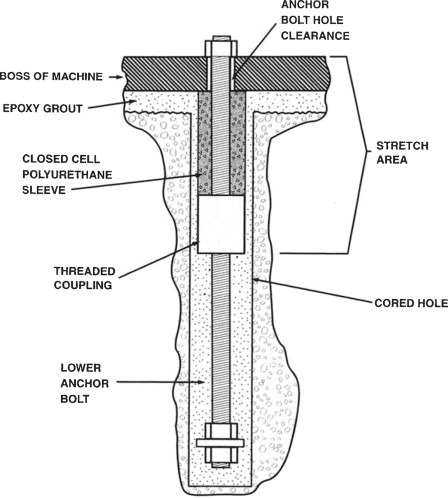
(ScienceDirect) Working of an anchor bolt
| Factor | Anchor Fastener | Bolt / Screw |
|---|---|---|
| Where it’s used | Fixes sheet metal to solid materials like concrete or brick | Connects two parts that already have holes or threads |
| How it holds | Expands or bonds inside the base material | Clamps parts together using threads and nuts |
| Installation | Requires drilling into concrete and setting the anchor | Requires pre-drilled holes or threaded inserts |
| Load handling | Designed to transfer load into concrete (handles high pull-out and shear forces) | Handles clamping force between parts, limited by thread strength |
| Typical use in sheet metal | Mounting enclosures, brackets, frames to floors or walls | Assembling sheet metal parts together (panels, covers, housings) |
| Strength reliability | Depends on embedment depth, concrete strength, and installation quality | Depends on bolt grade and tightening torque |
| Removal | Often permanent or semi-permanent | Easy to remove and reuse |
| When to use | When fixing sheet metal to a structural base like concrete | When joining sheet metal components together |
Anchor Fasteners for Concrete in Sheet Metal Installation
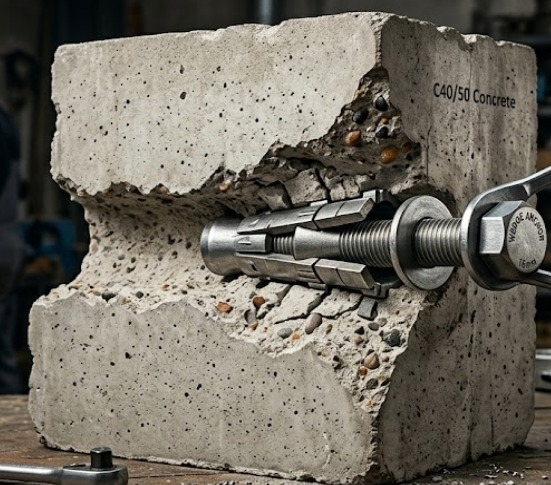
(AI generated) Cutaway view of an anchor fastener in concrete
Most sheet metal structures don’t fail because of the metal. They fail at the connection.
In real installations, you’re almost always fixing sheet metal to concrete. Floors, walls, slabs, and foundations carry the load. The anchor fastener becomes the critical link between your design and the structure.
Why Concrete Is Common in Sheet Metal Installations
You’ll see sheet metal assemblies mounted to concrete in:
• factory floors
• warehouse walls
• equipment foundations
• mechanical and HVAC systems
A typical reinforced concrete slab in industrial settings ranges from 150 mm to 300 mm thick, providing enough depth for secure anchor embedment.
Sheet metal parts themselves are thin. Most fall under 6 mm thickness. They need a rigid base to carry loads, resist vibration, and maintain alignment. Concrete provides that base.
So the system works like this:
sheet metal part, then anchor fastener, then concrete structure.
If the anchor fails, the entire assembly loses stability.
Best Anchor Fasteners for Fixing Sheet Metal to Concrete
Different anchor fastener types suit different sheet metal applications. The choice depends on load, installation conditions, and long-term performance.
Wedge anchors
These are the first line industrial anchor fasteners for heavy-duty sheet metal installations. They expand tightly inside the concrete and provide strong pull-out resistance.
Use them for:
• structural brackets
• machine-mounted sheet metal frames
• floor-mounted enclosures
Sleeve anchors
These distribute load along a sleeve and work well for medium-duty applications.
Use them for:
• wall-mounted panels
• support brackets
• general sheet metal mounting
Drop-in anchors
Installed flush into concrete and expanded internally.
Use them for:
• overhead duct supports
• suspended sheet metal systems
Chemical anchors
These rely on epoxy bonding instead of expansion.
Use them when:
• concrete is cracked or weak
• edge distance is limited
• higher load capacity is required
In outdoor or corrosive environments, stainless steel anchor fasteners provide better durability and prevent long-term degradation.
Choosing the correct anchor isn’t optional. It directly affects safety and performance.
Load Capacity and Safety Considerations
Every anchor fastener for concrete must handle real forces, not just theoretical loads.
In sheet metal installations, loads typically fall into three categories:
• tensile load (pull-out force)
• shear load (side force)
• dynamic load (vibration or movement)
A single M10 wedge anchor in standard concrete can often handle several kilonewtons of load, but the actual capacity depends on:
• embedment depth
• concrete strength (e.g., C20 vs C30)
• spacing between anchors
• distance from edges
Engineers apply safety factors to account for uncertainties. In many industrial applications, a safety factor of 2 to 4 is common.
That means if the expected load is 2 kN, the anchor system should handle at least 4–8 kN.
Poor installation reduces capacity quickly. Common failure causes include:
• incorrect hole diameter
• insufficient embedment
• improper torque
• unclean holes (critical for chemical anchors)
Even high-quality industrial anchor fasteners fail if installation is wrong.
For sheet metal structures, this matters more than it seems. A lightweight enclosure may not look critical, but once it carries equipment, cables, or vibration loads, the forces increase.
A well-designed anchoring system ensures:
• stable installation
• long-term reliability
• resistance to vibration and fatigue
When you select the right anchor fastener types and install them correctly, the connection becomes the strongest part of the system, not the weakest.
Industrial Anchor Fasteners in Sheet Metal Fabrication
On blueprints, a sheet metal structure may look light. In the field, it rarely is.
Once you add equipment weight, vibration, and daily use, those thin panels start carrying real loads. That’s where industrial anchor fasteners come in. They don’t just hold parts in place. They keep entire assemblies stable over years of use.
Applications in Industrial Sheet Metal Structures
You’ll see anchor fasteners used anywhere sheet metal connects to something permanent.
Common setups include:
• electrical enclosures fixed to concrete walls
• cable tray supports running across plant floors
• ducting systems suspended from slabs
• machine guards anchored around production lines
These aren’t static environments. Equipment runs all day. Vibrations travel through the structure. Temperature changes expand and contract metal.
In most factories, even a small bracket ends up handling more stress than expected. That’s why engineers treat anchoring as part of the structure, not just installation.
Anchor Fasteners for Heavy Equipment and Enclosures
Heavy equipment changes the equation fast.
A simple sheet metal enclosure might weigh 20–30 kg on its own. Add transformers, wiring, or control systems, and the load can easily cross 100 kg or more. Now add vibration from nearby machines.
From an engineering perspective, this is where anchor fasteners for concrete need to do real work.
Wedge anchors and chemical anchors are common choices here because they handle both static and dynamic loads.
What matters more is consistency. If one anchor loosens, the load shifts to the others. That’s how failures start.
So in practice, engineers don’t just pick a strong anchor. They design the pattern, spacing, and embedment depth to share the load evenly.
Environmental and Durability Requirements
Industrial environments aren’t clean or controlled.
You get:
• moisture and humidity
• oil and chemical exposure
• temperature swings
• constant vibration
Over time, these conditions break down weak fastening systems.
Standard carbon steel anchors work indoors for basic setups. But once you move into harsher environments, you need better materials.
Corrosion is the biggest issue. A small amount of rust at the anchor interface can reduce holding strength over time.
Durability here isn’t about surviving day one. It’s about holding the same load after five or ten years without loosening or degrading.
Stainless Steel Anchor Fasteners for Sheet Metal Projects
Some environments don’t give you a second chance. If corrosion starts, it keeps going.
That’s why stainless steel anchor fasteners show up so often in sheet metal projects that sit outdoors or deal with moisture.
Benefits of Stainless Steel in Sheet Metal Environments
Stainless steel handles conditions that would slowly damage standard fasteners.
It forms a natural oxide layer that protects the surface. That layer rebuilds itself if scratched, which is why stainless performs well over long periods.
In sheet metal installations, this matters more than people expect. The anchor sits inside concrete, but the exposed portion still faces air, moisture, and contaminants.
Using stainless steel means:
• less maintenance over time
• stable load capacity
• reduced risk of failure from corrosion
For installations that are hard to access later, that reliability saves real cost.
Corrosion Resistance and Outdoor Applications
Outdoor installations push fasteners harder than indoor ones.
Rain, humidity, and temperature cycles create the perfect conditions for corrosion. In coastal areas, salt accelerates the process even more.
That’s why anchor fasteners for concrete used outdoors often shift toward stainless steel.
Typical use cases include:
• exterior HVAC systems
• rooftop enclosures
• solar panel mounting frames
• outdoor control cabinets
In these setups, even small corrosion can weaken the connection over time. Stainless steel slows that process significantly.
When to Choose Stainless Steel vs Other Materials
You don’t need stainless steel everywhere. But when you need it, there’s no shortcut.
Use stainless steel anchor fasteners when:
• the installation is outdoors
• the environment includes moisture or chemicals
• long-term durability matters more than upfront cost
For indoor, controlled environments, zinc-coated or plated anchors often work fine and cost less.
So the decision usually comes down to exposure and lifespan.
If the anchor needs to hold for years without inspection or replacement, stainless steel is the safer choice.
How to Choose the Right Anchor Fastener for Sheet Metal
In industrial environments, this is where most people guess. And that’s usually where problems start.
As discussed earlier, you don’t have to pick the strongest anchor fastener, you have to match the anchor to how your sheet metal part actually behaves once installed.
A small bracket holding cables and a floor-mounted machine enclosure don’t need the same solution. Treat them the same, and one of them will fail.
Here’s how engineers actually make that decision.
Load Requirements and Weight Support
Start with the real load, not the part weight.
A sheet metal enclosure might weigh 25 kg. Add internal components, cables, and dynamic loads, and you’re easily looking at 80–120 kg total.
Then consider how that load is distributed. One anchor rarely carries everything evenly.
As a rough approach:
• calculate total load
• divide across anchors
• apply a safety factor
Most industrial setups use a safety factor between 2 and 4. If one anchor is expected to carry 2 kN, you design for at least 4–8 kN capacity.
This step alone filters out most wrong choices.
Base Material (Concrete, Brick, etc.)
The base material decides how the anchor behaves.
Concrete handles expansion anchors well because it’s dense and strong. Brick and block behave differently. They’re more brittle and don’t distribute stress the same way.
So:
• concrete → wedge anchors, sleeve anchors, chemical anchors
• brick or hollow block → sleeve anchors or chemical anchors (less expansion stress)
If the base material is weak or cracked, mechanical expansion can cause failure. That’s when chemical systems make more sense.
Environmental Conditions (Indoor vs Outdoor)
Environment subtly kills fasteners over time.
Indoor, dry environments are forgiving. Standard plated anchors usually hold up fine.
Outdoor or humid environments change everything.
Moisture, temperature cycles, and chemicals slowly reduce strength. That’s why stainless steel anchor fasteners show up in:
• rooftop installations
• outdoor enclosures
• coastal or humid areas
If you expect exposure, don’t compromise here. Corrosion doesn’t fail fast. It fails later, when no one is checking.
Compatibility with Sheet Metal Parts
Sheet metal itself is thin. That changes how loads transfer.
If the anchor is oversized relative to the sheet, you risk deforming the metal around the hole. If it’s undersized, you lose load capacity.
Good practice:
• match washer size to spread load
• ensure hole size aligns with anchor diameter
• avoid point loading on thin sheet edges
In real projects, the failure often starts at the sheet metal interface, not the anchor itself.
Load Type (Shear vs Tension)
Not all loads act the same.
Tension load (pull-out) tries to pull the anchor straight out of the concrete.
Shear load pushes sideways across the anchor.
Most sheet metal installations see a mix of both.
Wall-mounted panels → more shear
Ceiling-mounted systems → more tension
Floor-mounted equipment → combination + vibration
Different anchor fastener types handle these loads differently. Different anchor types have different load characteristics, and their tensile and shear capacities should always be verified using manufacturer data and applicable design standards.
You don’t guess this. You match the anchor to the dominant load.
Embedment Depth
Depth matters more than people expect.
A shallow anchor might feel tight during installation but fail under load. Deeper embedment increases holding strength because more surface area engages with the concrete.
Typical embedment depths range from 40 mm to over 100 mm, depending on anchor size and load requirements.
Manufacturers provide charts. Use them.
Ignoring embedment depth is one of the fastest ways to reduce anchor capacity without realizing it.
Safety Factor
This is your margin for error.
No installation is perfect. Concrete strength varies. Holes aren’t always drilled perfectly. Loads change over time.
That’s why engineers never design anchors at their exact load limit.
A 2× safety factor is common for light-duty setups.
Heavy industrial systems often go 3× or higher.
This buffer absorbs:
• installation variation
• material inconsistencies
• unexpected loads
Skip this, and small issues turn into failures.
Before finalizing your anchors, it helps to understand how your part is actually made, which we explain in our sheet metal fabrication process guide
FAQ About Anchor Fasteners in Sheet Metal
Q: What is the best anchor fastener for sheet metal to concrete?
Wedge anchors work best for heavy loads, while sleeve anchors suit general mounting and chemical anchors handle weak or cracked concrete.
Q: How much weight can anchor fasteners hold?
It depends on size and embedment, but a typical M8–M12 anchor can handle hundreds to several thousand newtons when installed correctly.
Q: Are stainless steel anchors necessary for outdoor sheet metal?
Yes, stainless steel anchor fasteners are recommended outdoors because they resist corrosion and maintain strength over time.
Q: What is the difference between anchor fasteners and bolts?
Anchor fasteners secure sheet metal to concrete or masonry, while bolts connect parts that already have holes or threads.
Q: Can anchor fasteners be reused?
Most mechanical anchor fasteners are not reusable once installed, especially expansion anchors, while some screw-type anchors can be removed and reused in limited cases.
Q: How deep should anchor fasteners be installed
Embedment depth typically ranges from 40 mm to 100+ mm, depending on load requirements and anchor type.
Popular Articles
• 9 Sheet Metal Cutting Problems and Solutions
• Hole cutting in sheet metal: techniques, tolerances and applications
• Introduction to Sheet Metal Processing: Techniques and Tools for Precision
• Bending and Forming Technology in Sheet Metal Processing
• Laser cutting technology in sheet metal processing
Keep Learning
Galvanized Sheet Metal: Grades, Specs & When to Use It
Galvanized Sheet Metal: Grades, Specs & When to Use It A design engineer specs "galvanized sheet metal" on a drawing and sends it out for quotes. Three shops come back with three different prices, and one of them asks a follow-up question the others didn't: which gauge, which coating class, hot-dip or electro-galvanized? That question is the difference between a part that survives outdoors for fifteen years and one that starts showing rust spots after eighteen months — and it's the kind of detail that......
Custom Sheet Metal Fabrication: How the Process Works From Design to Delivery
Custom Sheet Metal Fabrication: How the Process Works From Design to Delivery A stock enclosure almost fits. The mounting holes are close but not quite right, the depth is half an inch too shallow, and the vendor's next size up is twice the volume you actually need. This is the point where most people start looking into custom sheet metal fabrication — not because they set out to design a part from scratch, but because nothing off the shelf actually solves the problem. Custom fabrication sounds like i......
Sheet Metal Assembly: How Fabricated Parts Come Together
Sheet Metal Assembly: How Fabricated Parts Come Together Cutting and bending gets a lot of attention because that's where a flat sheet visibly turns into a 3D part. But a single bracket by itself rarely finishes the job — most real sheet metal products are assemblies, multiple formed pieces joined into one working unit, and that assembly step is where a lot of designs quietly succeed or fail. A part that measured perfectly on its own can still not fit once it's supposed to mate with three other pieces......
Sheet Metal Bender: Types, Specs & How to Choose the Right Machine
Sheet Metal Bender: Types, Specs & How to Choose the Right Machine Every sheet metal bracket, enclosure, and panel eventually passes through a bender of some kind — that's the machine, not the process. Our guide on sheet metal bending covers how bending actually deforms metal — springback, minimum radius, bend allowance, and the core press brake and CNC press brake setups most shops run. This one goes further into the equipment side specifically: the less common bender types beyond the standard press ......
What Is Galvanized Metal? Process, Types & How It Works
What Is Galvanized Metal? Process, Types & How It Works Leave a piece of bare steel outside for a season and you'll see exactly why galvanizing exists. Rust doesn't wait for dramatic weather — a little humidity and a few weeks is enough to start eating into an unprotected surface. Galvanized metal solves that problem by giving steel a sacrificial layer of zinc that corrodes in its place, and it's done this job well enough that it's become the default choice for anything from highway guardrails to HVAC......
What Is Sheet Metal Fabrication? The Complete Guide
What Is Sheet Metal Fabrication? The Complete Guide Somewhere between a CAD file and a working enclosure sitting on your bench, a flat piece of metal gets cut, bent, joined, and finished into something that actually does a job. That's sheet metal fabrication — and if you've never ordered a part before, the term can feel bigger than it needs to be. Ask five people what "sheet metal fabrication" covers and you'll get five different answers: some think laser cutting, some think welding, some just picture......