Sheet Metal Deburring: Methods, Tools & How to Deburr Metal and Aluminum
18 min
- Sheet Metal Deburring Methods (Quick Comparison)
- What Is Sheet Metal Deburring and Why It Matters
- What Causes Burrs in Sheet Metal Cutting Processes?
- Sheet Metal Deburring Methods and Their Trade-offs
- How to Deburr Metal: Practical Methods for Sheet Metal Deburring
- Deburring Aluminum and Other Materials
- Key Factors to Consider in Sheet Metal Deburring
- How to Reduce Burrs Before Deburring (DFM Tips)
- Common Applications of Deburring in Manufacturing
- Sheet Metal Fabrication and Deburring Services
- Conclusion: Choosing the Right Deburring Process
- FAQs About Deburring Metal
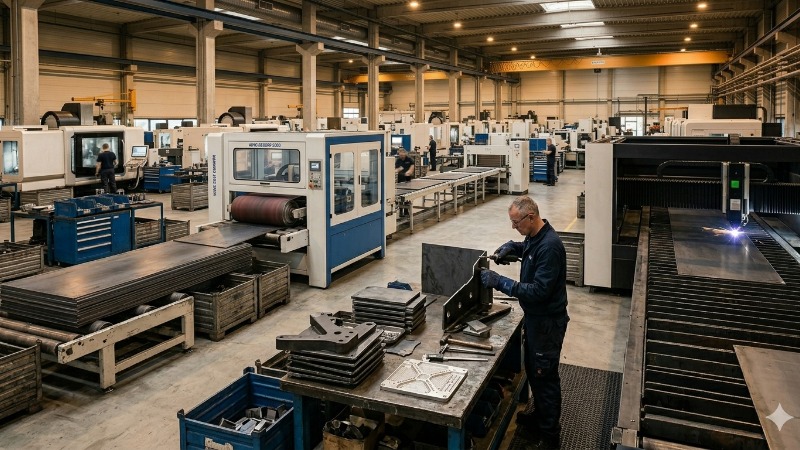
(AI generated) Sheet metal production workflow
In this guide, we’ll cover:
- What sheet metal deburring is and why it matters
- Common burr formation mechanisms
- Deburring methods and their trade-offs
- How to deburr different metals effectively
- Design tips to reduce burr formation
Sheet Metal Deburring Methods (Quick Comparison)
Method | Best For | Speed | Notes |
|---|---|---|---|
Manual | Small jobs | Slow | Precise, low cost |
Abrasive Belt | Flat sheets | Fast | Uniform finish |
Brush | Light burrs | Fast | Good for deburring aluminum |
Vibratory | Small parts | Medium | Batch processing |
Thermal | Internal burrs | Fast | High setup cost |
Electrochemical | Precision work | Medium | No tool contact |
What Is Sheet Metal Deburring and Why It Matters
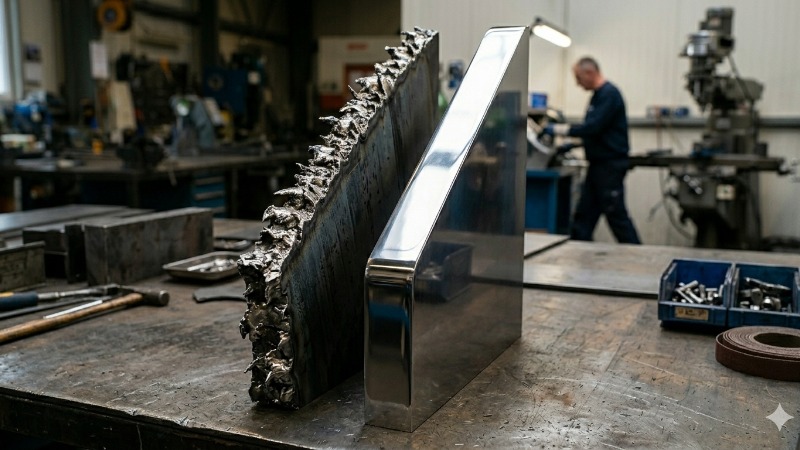
(AI generated) Rough vs smooth metal edge
Definition of Sheet Metal Deburring
Sheet metal deburring is the process of removing sharp edges or raised material (burrs) formed during cutting, punching, or machining. It improves edge safety, ensures proper fit during assembly, and enhances surface quality for finishing. They appear as sharp ridges or raised edges. The goal is practical: remove the burr while keeping the edge true, without changing dimensions or damaging the surface finish.
For a detailed guide on burrs read our article on machining burrs explained!
In practice, the deburring process uses abrasive belts, brushes, tumbling media, or manual tools. Each method targets a specific burr size and material type.
For example, sheet metal deburring aluminum requires lower pressure and finer abrasives to avoid edge roll because it is malleable. Steel can handle more aggressive passes though.
Engineers select the method based on thickness, tolerance, and batch size. High-volume lines use automated systems. Low-volume jobs often rely on hand tools.
Impact on Safety, Assembly, and Product Quality
Burrs cause assembly issues. They block proper fit and increase tolerance stack-up. A clean edge fixes that. It also reduces friction points during installation.
Edges left untreated can cause cuts to operators and damage sensitive components. Deburring metal early reduces these risks.
Surface quality improves as well. Paint and coatings adhere better on smooth edges. This reduces rework and improves corrosion resistance. In aerospace and medical parts, edge condition directly affects compliance.
Skipping sheet metal deburring process leads to downstream failures. Rework, scrap, and delays follow. A controlled deburring process avoids these losses.
Industries Where Deburring Is Critical
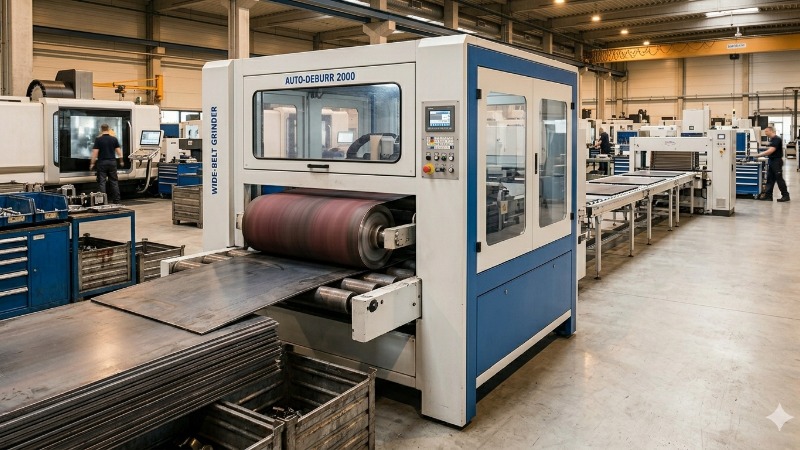
(AI generated) Deburring machine in operation
A controlled sheet metal deburring process isn't just about making parts look pretty, it’s about preventing the catastrophic failure of a $50,000 assembly because of a single stray metal flake.
In the sectors we work with, a burr isn't a nuisance; it's a liability.
Aerospace: You aren't just meeting a tolerance; you're ensuring a localized stress fracture doesn't start at a sharp edge mid-flight.
Medical & Tech: There is zero room for error here. A burr on a surgical tool is a hygiene failure. A microscopic shard in an enclosure? That’s a short circuit waiting to happen.
Automotive & Consumer Goods: If parts don't seat perfectly on the first try, your assembly line grinds to a halt. Worse, if a consumer cuts themselves on a sharp edge, that’s a brand-killing PR nightmare.
We’ve seen plenty of shops treat deburring process as an afterthought, something a junior tech does with a hand tool at the end of the shift. That’s where the inconsistency starts.
At JLCCNC, we don't just "sand it down." We match the deburring method to the specific alloy and geometry of the part. The goal is a part that’s "assembly-ready" the second it leaves the crate. Over the years, we’ve found that spending those extra minutes on the bench saves our clients days of rework and keeps their operators' hands safe.
What Causes Burrs in Sheet Metal Cutting Processes?
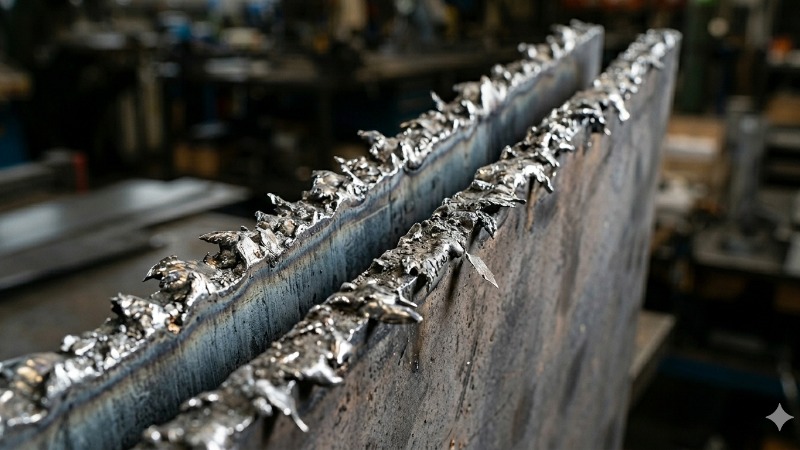
(AI generated) Rough metal edge with burrs
How Burrs and Dross Form During Cutting and Machining Processes
In a perfect world, a cutting tool would pass through an alloy like a scalpel. In reality, metal is resistant to clean separation. Instead of breaking cleanly, the material often stretches, tears, or gets displaced, leaving behind burrs along the edges.
Burrs are typically formed through mechanical displacement, where cutting tools push material beyond the intended geometry. In contrast, dross forms when molten or oxidized material re-solidifies on the surface, which is more common in thermal cutting processes such as laser cutting.
These imperfections are not just cosmetic. They are the structural result of how material behaves under stress, heat, and friction during cutting operations. The type of metal, thickness, and tool condition all directly influence the size and type of burr formed. Understanding these differences is essential for selecting the right deburring process without affecting part tolerances.
Laser Cutting Effects
Laser cutting is often marketed as a "finish-free" process, but that's a bit of a myth on the shop floor. Even with a perfectly tuned fiber laser, you’re dealing with a localized heat-affected zone. Nonetheless, we’ve written a detailed guide on how to avoid HAZ in laser cutting.
As the beam melts the border, a tiny amount of molten metal can "re-cast" at the exit point of the cut, hardening into a razor-thin ridge. It’s easy to miss under standard shop lighting, but the second you try to seat that part into a precision housing or apply a powder coat, that ridge becomes a massive headache.
The Fix is that you don't need aggressive grinding here. The goal for laser-cut edges is a light, consistent "edge-break." We use specialized deburring media or hand-held ceramic blades that take off the re-cast material without digging into the base metal or changing the part's footprint.
Waterjet Cutting Effects
Waterjet cutting is famous for its lack of a Heat-Affected Zone (HAZ), but that doesn't mean the edges are perfect. Because it's a high-pressure mechanical process, soft metals like aluminum often experience "edge-roll." Instead of the garnet abrasive cutting through cleanly at the exit point, the last few microns of the metal can actually fold or smear downward.
The Fix is that you aren't dealing with hardened slag here, so you don't need heavy grinding. A quick pass with a medium-grit deburring wheel or a vibratory tumble is usually enough to "snap" those folded edges off without affecting the part's dimensions.
See our detailed guide on laser cutting vs waterjet cutting.
Mechanical Cutting and Deformation
In a punch press or a mill, you’re literally pushing the metal until it fails.
Harder Alloys (Steel/Stainless): These tend to "fracture" at the edge. You get sharp, brittle burrs that can act like a saw blade if they aren't handled.
Softer Alloys (Copper/Aluminum): These "smear." If your milling inserts are even slightly dull, the heat from the friction causes the metal to become gummy. Instead of chips flying off, the metal rolls over the edge, creating a "flange" burr that is much harder to remove than a brittle one.
Heat, Friction, and Material Behavior
Even in high-precision CNC machining, tool wear and vibration (chatter) create micro-burrs along edges. Heat generated during cutting can soften material, especially in aluminum, causing burrs to smear instead of breaking off cleanly.
Proper tool maintenance, optimized cutting parameters, and cooling methods all help reduce burr formation at the source.
Differences between burrs and dross
Feature | Burrs | Dross |
|---|---|---|
Formation | Mechanical displacement | Molten or oxidized material |
Location | Edges of cut or punched part | Surface of cut or molten layer |
Size | Small, sharp ridges | Flaky or irregular deposits |
Removal | Deburring metal, filing, brushing | Chipping or grinding |
Sheet Metal Deburring Methods and Their Trade-offs
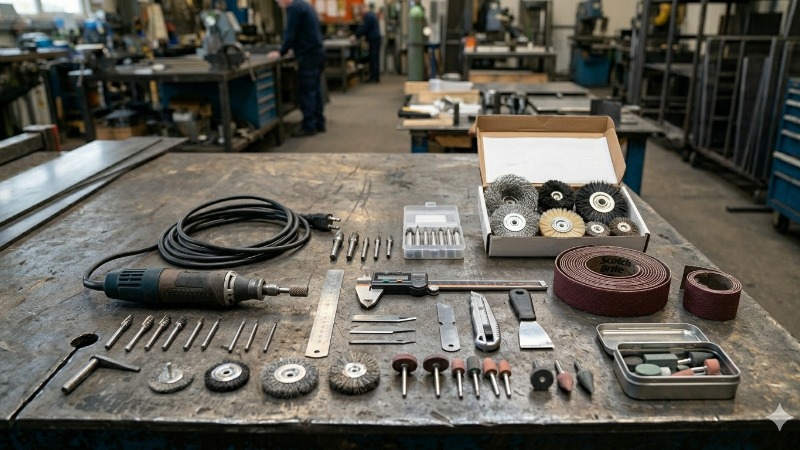
(AI generated) Various deburring tools setup
Cost vs Efficiency Trade-offs in Deburring
In sheet metal deburring, cost and efficiency often move in opposite directions. Faster methods reduce processing time but may require higher upfront investment or sacrifice edge precision. Slower methods offer better control but increase labor cost.
Manual deburring has the lowest setup cost and works well for small batches or complex geometries. However, it is time-consuming and depends heavily on operator skill. This makes it less suitable for scalable production.
Mechanical methods such as abrasive belts or brush systems improve speed and consistency. They are ideal for medium to high volumes, but require machine setup and may not handle intricate features as precisely.
Batch processes like vibratory tumbling provide excellent efficiency for large quantities of small parts. The trade-off is reduced edge sharpness and less control over tight tolerances.
Advanced methods such as thermal or electrochemical deburring deliver high precision and can remove internal burrs that other methods cannot reach. However, these processes involve higher equipment cost, complex setup, and are typically only justified in high-value or high-volume applications.
Balancing these factors depends on part requirements, production volume, and tolerance limits. In most cases, the optimal deburring process is not the fastest or the cheapest, but the one that delivers consistent quality with minimal rework.
Manual Deburring
Manual sheet metal deburring uses hand tools like files or scrapers. It gives full control on edges. Trade-off: slow, depends on operator skill, not good for large batches.
Mechanical Deburring
Mechanical deburring uses machines like belts or brushes. It handles medium to large volumes fast. Trade-off: less control on fine edges, setup needed for each part type.
Tumbling
If you have a crate of 500 small brackets, you aren't paying a tech to hand-deburr each one. Parts are typically processed in a vibratory tumbler. It’s the "set it and forget it" solution for bulk finishing, using ceramic or plastic media to scrub the parts clean.
The Reality Check: You will lose the "crispness" of your edges. If your print has a tight ±0.005 tolerance on a sharp corner, tumbling will likely round it off. It’s a great bulk process, but it’s a blunt instrument.
Thermal / Electrochemical Deburring
Sometimes a burr is trapped inside a manifold or a cross-drilled hole where a brush simply won't fit.
Thermal Deburring: This is essentially a rapid thermal energy process that removes burrs through controlled combustion. A short burst of high heat vaporizes the burrs (which have high surface area) while leaving the main part (high mass) untouched.
Electrochemical (ECD): This uses a "reverse plating" logic to dissolve the burr in a salt-water electrolyte. It is especially effective for internal features and hard-to-reach areas.
Both are expensive and require significant setup. Unless you’re running a high-volume aerospace or medical contract, the specialized tooling and chemical disposal usually make these overkill for a standard job shop.
Wet Deburring VS Dry Deburring
The choice between wet and dry deburring process usually comes down to the alloy and the mess you're willing to clean up.
Wet Deburring: We run water or coolant over the part to keep the friction heat from "smearing" the metal. This is the gold standard for aluminum, if you dry-sand aluminum too fast, the heat turns the burrs gummy and they just roll over the edge instead of snapping off. Plus, the water carries the fines away, so the part stays cleaner for the next stage of assembly.
Dry Deburring: It’s faster and easier to set up for carbon steel. You don't have to worry about drying the parts afterward (which prevents flash-rusting on raw steel). The trade-off is the dust. Without a serious extraction system, a dry-deburring station will coat every surface in the shop with fine metal particulate in an hour.
Check out our detailed guide on Deburring Tools.
Deburring Methods Comparison: When to Use Each
Choosing the right sheet metal deburring method depends on part size, material, burr type, and production volume. Each method performs best under specific conditions, and selecting the wrong one can lead to unnecessary cost or inconsistent edge quality.
Below is a practical comparison of common deburring methods and when to use them:
Method | Best For | Speed | When to Use |
|---|---|---|---|
Manual Deburring | Small batches, complex features | Slow | Prototyping, tight tolerances, hard-to-reach edges |
Abrasive Belt | Flat sheets, uniform edges | Fast | Large panels, consistent edge finishing |
Brush Deburring | Light burrs, soft metals | Fast | Deburring aluminum, surface finishing before coating |
Vibratory Tumbling | Small parts, bulk processing | Medium | High-volume production, non-critical edge precision |
Thermal Deburring | Internal burrs | Fast | Complex internal geometries, cross-drilled holes |
Electrochemical Deburring | Precision components | Medium | Sensitive parts, no mechanical stress allowed |
How to Deburr Metal: Practical Methods for Sheet Metal Deburring
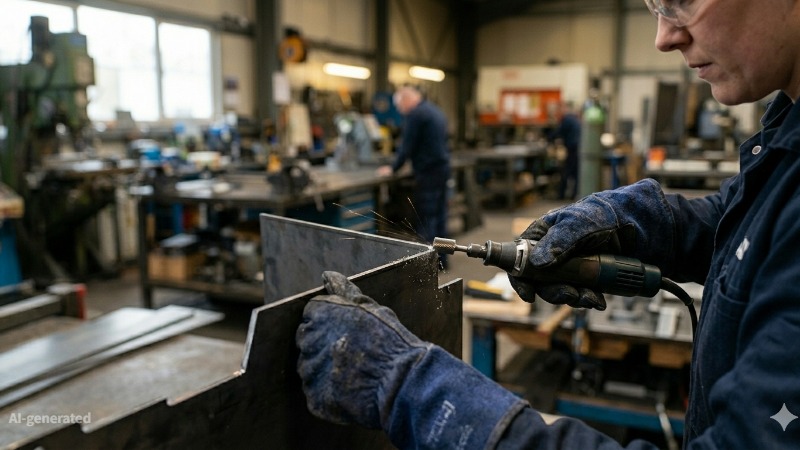
(AI generated) Manual deburring metal edge
Step-by-Step: How to Deburr Sheet Metal
Step 1: Identify burr type (rollover, fracture, or dross)
Step 2: Select deburring method based on material and geometry
Step 3: Apply controlled edge removal (manual or machine)
Step 4: Inspect edge quality and verify tolerance compliance
Hand Deburring Tools and When to Use Them
Hand tools like files, scrapers, and deburring blades suit small batches and tight features. They give direct control over the edge. Use them when access is limited or when a light touch is required. This approach helps when figuring out how to deburr new or delicate parts.
Machine-Based Deburring Techniques
Machines handle repeat work with stable output. Abrasive belts, brushes, and rotary systems clean edges across flat or uniform parts. Setup depends on material and burr size. Lighter settings work better for deburring aluminum, while harder metals can take more pressure. This keeps the deburring process consistent as volume increases.
Choosing the Right Method Based on Part Size
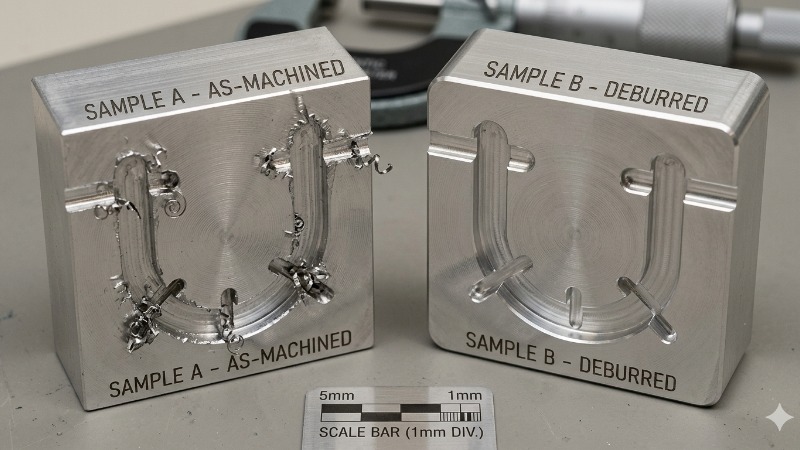
(AI generated) comparison of CNC machined aluminum blocks
Small parts are easier to manage with hand tools or batch methods. Larger sheets benefit from belt or brush systems. Thin parts need light passes to avoid edge distortion. Thicker parts can handle deeper removal. Matching method to size keeps deburring metal efficient without affecting geometry.
Tips to Avoid Damaging Edges or Tolerances
Start light and increase pressure only if needed. Use fine abrasives for tight tolerances. Keep movement steady to avoid uneven edges. Check parts during the process instead of waiting until the end. Testing on a sample piece helps confirm the right approach for sheet metal deburring.
Deburring Aluminum and Other Materials
Deburring methods change depending on the metal, and getting it right keeps edges clean, parts accurate, and surfaces smooth.
Challenges in Deburring Aluminum
Aluminum is soft, so edges can smear or fold instead of snapping off. Burrs often bend back, and heat from tools can make them roll. You have to be gentle and pay attention to how the tool contacts the part, or the shape will get altered.
Best Deburring Methods for Aluminum
Light touch works best. Use soft brushes, fine abrasive belts, or non-woven pads. Move steadily, keep pressure low, and check the edges frequently. Doing a test run on a few pieces first helps you see if the method works without damaging parts.
Stainless Steel and Other Metal Considerations
Hard metals like stainless steel make small, stiff burrs. They can handle stronger tools and more force, but the tools wear out faster. Checking tools regularly keeps the process even. The goal here is clean edges without losing strength or accuracy.
Preventing Warping and Surface Damage
Pressure control is everything. Too much force can bend thin parts or throw off tolerances. Keep tools moving smoothly, support thin sections, and go over edges evenly. This keeps surfaces smooth and edges consistent.
Key Factors to Consider in Sheet Metal Deburring
Deburring works best when design and process decisions are made early. Paying attention to material, shape, and finishing needs keeps edges clean, parts accurate, and surfaces smooth.
Material Thickness Requirements
Material thickness sets the baseline for tool selection and pressure. Very thin sheets can flex under load, so a light pass is preferred. In many applications, sheets around 0.05″ (≈1.2 mm) or thicker are easier to deburr consistently, though this depends on the process and material. Thicker parts allow more aggressive passes but still require controlled motion to maintain tolerances.
Geometry and Part Complexity
Simple shapes are easier to handle, straight edges respond well to consistent passes. Complex parts, corners, slots, or inner cuts hold burrs longer and may require hand tools or staged passes. Highly detailed or fragile features need extra care to avoid edge damage.
Part Size Limitations
Size affects handling and machine choice. Large sheets must be supported during processing, especially in linear systems. Small parts can shift if not secured, which affects edge uniformity. Proper fixturing ensures the part stays stable, producing consistent results.
Compatibility with Finishing Processes
Edges must be clean and smooth so coatings or treatments stick correctly. Burrs left behind can cause uneven coverage or weak adhesion.
A light brushing step before powder coating helps create a consistent surface, hardcoat or conductive anodizing reacts to rough edges, so careful deburring ensures the finish works as intended.
How to Reduce Burrs Before Deburring (DFM Tips)
Small changes during design and machining keep edges clean and reduce defects. Handling parts properly at this stage saves time later.
Optimize Cutting Parameters
Adjust cutting speed, feed, and tool angle to suit each material. Slower, steady cuts usually create cleaner edges and fewer defects.
Select the Right Material and Thickness
Choose metals that handle cutting well. Thin sheets can bend or twist, so keeping thickness above 0.05 inches keeps edges stable.
Use Proper Tooling and Sharp Edges
Sharp tools make clean cuts; dull ones tear edges and enlarge burrs. Regular maintenance keeps edges consistent.
Design with Adequate Edge Clearance
Allow space between holes, bends, and edges. Tight areas pinch metal, creating heavier burrs.
Control Grain Direction in Bending
Bend with the metal’s natural direction. Bending against it can cause cracks or uneven edges.
Minimize Secondary Operations
Extra cuts and punches add burrs. Combining steps reduces handling and preserves the original edge.
Specify Edge Quality Requirements Early
Set burr limits, tolerances, and edge finish in the design. Early specs reduce rework and ensure proper assembly.
Common Applications of Deburring in Manufacturing
Automotive and Fabrication:
Edges of panels, brackets, and frames are cleaned to prevent assembly problems.
Aerospace and Precision Components:
Burrs removed from precise parts to keep tolerances intact.
Electronics and Small Parts:
Tiny components get edge cleanup to fit properly and avoid damage.
General Sheet Metal Production:
Smooth metal sheets reduce handling issues and improve surface finish.
Sheet Metal Fabrication and Deburring Services
JLCCNC blends practical engineering with hands‑on finishing. Our team plans every cut, bend, and edge cleanup to match real world use, not just CAD files.
Custom Fabrication and Deburring Capabilities
We cut, form, and finish sheet metal in one flow. Burrs are removed right after cutting and bending so parts fit without surprises. This keeps assemblies tight and consistent.
Materials and Finishing Options
We work with aluminum, stainless steel, and mild steel. After deburring, parts can go through brushing, powder coating, or anodizing, depending on how you need them to perform or look.
Quality Control and Standards
Every part is measured after fabrication and deburring. Edges, dimensions, and surface conditions are checked against your drawing, so nothing leaves the shop until it’s right.
Rapid Production and Quoting
Need sheet metal parts with clean, assembly-ready edges?
JLCCNC provides integrated cutting, forming, and deburring services to ensure consistent edge quality from prototype to production.
Upload your CAD file to get a quote and review deburring requirements before manufacturing.
Conclusion: Choosing the Right Deburring Process
Key takeaways on deburring processes
Deburring removes sharp edges and leftover metal after cutting, punching, or forming. Each method performs best with specific burr sizes, materials, and part tolerances.
Matching method to material and application
The deburring approach should be chosen based on the material and part design. Soft metals like aluminum respond well to gentle pressure, while harder metals withstand more force. Part size and tolerance requirements guide the method.
Efficiency versus quality trade-offs
Faster techniques can reduce time but may need extra setup. Slower, hands-on methods give more precise edges. Balance production speed with quality to meet your goals.
Final recommendations
Deburring should be planned during the design stage. Edge finish and burr limits must be defined early. Proper tools should be applied, and parts inspected regularly. This ensures edges remain safe, consistent, and ready for assembly.
FAQs About Deburring Metal
Q: What is the best deburring process?
No single method fits every case. It usually comes down to the material, burr size, and how the part will be used.
Q: Can all metals be deburred the same way?
Not really. Aluminum needs a lighter touch, while steel can take more pressure without issues.
Q: How to deburr small or delicate parts?
Go gentle. Fine brushes or light hand work are usually enough to clean the edge without damaging it.
Q: Is deburring necessary for all sheet metal parts?
Depends on the part. If edges affect fit, safety, or finish, then it’s usually worth doing.
Q: What is the difference between deburring and polishing?
Deburring removes sharp edges and burrs from metal parts to ensure safety and proper fit, while polishing smooths and refines the overall surface finish for appearance or coating preparation.
Popular Articles
• 9 Sheet Metal Cutting Problems and Solutions
• Hole cutting in sheet metal: techniques, tolerances and applications
• Introduction to Sheet Metal Processing: Techniques and Tools for Precision
• Bending and Forming Technology in Sheet Metal Processing
• Laser cutting technology in sheet metal processing
Keep Learning
Galvanized Sheet Metal: Grades, Specs & When to Use It
Galvanized Sheet Metal: Grades, Specs & When to Use It A design engineer specs "galvanized sheet metal" on a drawing and sends it out for quotes. Three shops come back with three different prices, and one of them asks a follow-up question the others didn't: which gauge, which coating class, hot-dip or electro-galvanized? That question is the difference between a part that survives outdoors for fifteen years and one that starts showing rust spots after eighteen months — and it's the kind of detail that......
Custom Sheet Metal Fabrication: How the Process Works From Design to Delivery
Custom Sheet Metal Fabrication: How the Process Works From Design to Delivery A stock enclosure almost fits. The mounting holes are close but not quite right, the depth is half an inch too shallow, and the vendor's next size up is twice the volume you actually need. This is the point where most people start looking into custom sheet metal fabrication — not because they set out to design a part from scratch, but because nothing off the shelf actually solves the problem. Custom fabrication sounds like i......
Sheet Metal Assembly: How Fabricated Parts Come Together
Sheet Metal Assembly: How Fabricated Parts Come Together Cutting and bending gets a lot of attention because that's where a flat sheet visibly turns into a 3D part. But a single bracket by itself rarely finishes the job — most real sheet metal products are assemblies, multiple formed pieces joined into one working unit, and that assembly step is where a lot of designs quietly succeed or fail. A part that measured perfectly on its own can still not fit once it's supposed to mate with three other pieces......
Sheet Metal Bender: Types, Specs & How to Choose the Right Machine
Sheet Metal Bender: Types, Specs & How to Choose the Right Machine Every sheet metal bracket, enclosure, and panel eventually passes through a bender of some kind — that's the machine, not the process. Our guide on sheet metal bending covers how bending actually deforms metal — springback, minimum radius, bend allowance, and the core press brake and CNC press brake setups most shops run. This one goes further into the equipment side specifically: the less common bender types beyond the standard press ......
What Is Galvanized Metal? Process, Types & How It Works
What Is Galvanized Metal? Process, Types & How It Works Leave a piece of bare steel outside for a season and you'll see exactly why galvanizing exists. Rust doesn't wait for dramatic weather — a little humidity and a few weeks is enough to start eating into an unprotected surface. Galvanized metal solves that problem by giving steel a sacrificial layer of zinc that corrodes in its place, and it's done this job well enough that it's become the default choice for anything from highway guardrails to HVAC......
What Is Sheet Metal Fabrication? The Complete Guide
What Is Sheet Metal Fabrication? The Complete Guide Somewhere between a CAD file and a working enclosure sitting on your bench, a flat piece of metal gets cut, bent, joined, and finished into something that actually does a job. That's sheet metal fabrication — and if you've never ordered a part before, the term can feel bigger than it needs to be. Ask five people what "sheet metal fabrication" covers and you'll get five different answers: some think laser cutting, some think welding, some just picture......