Metal Mesh Sheets: Types, Sizes, Materials & Custom Fabrication Guide
17 min
- What Is a Metal Mesh Sheet?
- Types of Metal Mesh Sheets
- Metal Mesh Sheet Sizes, Thickness & Specifications
- Metal Mesh Sheet Materials
- Applications of Metal Mesh Sheets
- Custom Metal Mesh Sheets: Design & Fabrication
- How Metal Mesh Sheets Are Manufactured
- Engineering Design Considerations for Metal Mesh Sheets
- How to Choose the Right Metal Mesh Sheets
- Advantages of Metal Mesh Sheets
- FAQ About Metal Mesh Sheets
What Is a Metal Mesh Sheet?
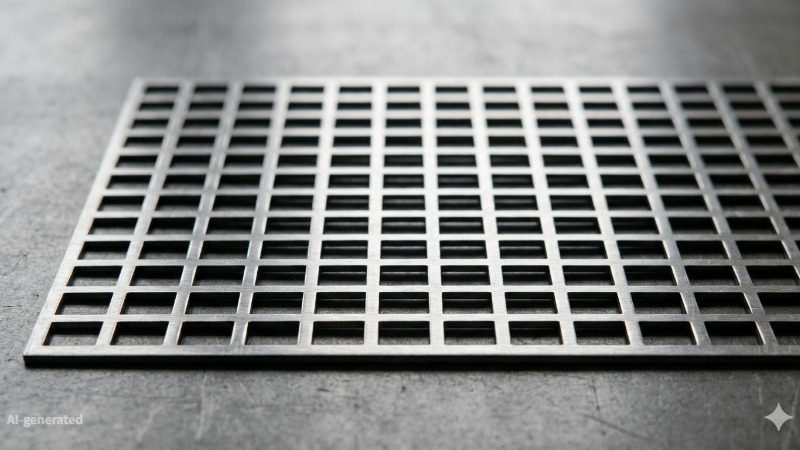
(AI generated) metal mesh sheet showing precise grid structure
A metal mesh sheet is a material formed by interlacing, welding, or expanding metal into a network of controlled openings. It is widely used where airflow, visibility, or weight reduction is required without sacrificing structural support.
A metal mesh sheet is a sheet formed by interlacing, welding, or expanding metal into a network of openings. Those openings are controlled. Size, spacing, and pattern all affect strength, airflow, visibility, and weight.
Most sheet metal mesh products use steel, stainless steel, or aluminum. Steel handles load. Stainless steel handles corrosion. Aluminum keeps weight down.
You’ll find metal mesh sheets used where solid sheet metal fails. When you need airflow, drainage, or visibility, mesh solves the problem without giving up structural support.
In 2024–2025, demand for custom metal mesh sheets continued to grow in construction and industrial equipment. This maintains the structural perimeter needed for mounting while allowing the system to breathe.
Definition and Basic Structure
A steel metal mesh sheet starts as wire or sheet stock. It then goes through one of three processes:
● weaving (like fabric, using metal wire)
● welding (intersection points fused together)● expanding (cut and stretched from a solid sheet)
The result is a sheet with a repeating open pattern.
You control how it behaves by adjusting:
● wire diameter or sheet thickness
● opening size
● pattern geometry
This is why metal mesh sheet sizes vary so much. You can go from fine filtration mesh with sub-millimeter openings to heavy structural mesh with openings over 50 mm.
In real projects, you don’t pick mesh randomly. You match the structure to the function.
Most shops treat mesh like a simple part on a screen. But in the real world, a mesh panel is a "living" material. If the wire is too thin or the hole pattern is too wide, the panel will deform, lose rigidity, or fail under load the moment it’s installed.
In practice, these issues are typically identified during design review. At JLCCNC, mesh specifications are evaluated for manufacturability, including deformation risk, weld integrity, and material behavior during forming.

- High precisous, low cost——Starting at $0.4
- Tight tolerance. Exceptional quality
Key Components (Wire, Opening, Pattern)
| Category | Parameter | What It Controls | Practical Impact | Example / Use Case |
|---|---|---|---|---|
| Core Components | Wire (strand thickness) | Strength and stiffness | Thicker wire increases load capacity but reduces open area | 3 mm welded mesh carries higher loads than 1 mm woven mesh |
| Opening (aperture size) | Airflow, visibility, filtration | Smaller openings improve filtration but restrict airflow; larger openings improve ventilation and reduce weight | Small openings for filters; large openings for guards and ventilation panels | |
| Pattern (geometry) | Load distribution and behavior | Pattern affects how stress spreads across the mesh | Diamond (expanded) spreads stress; square (welded) distributes load evenly | |
| Structure Types | Metal mesh sheets (woven / welded) | Flexibility and airflow | Wide range of opening sizes, good ventilation, adaptable designs | Guards, filters, cages, partitions |
| Perforated metal | Structural continuity | Stronger flat sheet due to continuous material, limited flexibility in airflow control | Panels, acoustic sheets, decorative facades | |
| Expanded metal | Strength-to-weight ratio | No material waste, high strength with reduced weight | Walkways, grating, structural platforms | |
| Selection Logic | Airflow & flexibility needed | Open structure | Use sheet metal mesh | Ventilation panels, machine guards |
| Flat strength & clean finish needed | Solid sheet with holes | Use perforated metal | Architectural panels, covers | |
| Strength with lower weight needed | Stretched sheet structure | Use expanded metal | Industrial flooring, catwalks |
In many industrial sourcing contexts, perforated metal is compared alongside metal mesh because both provide airflow and visibility, although perforated sheet is technically a punched sheet rather than a wire or expanded mesh.
An engineer from the fabrication side put it simply:
“Mesh gives you control over openness. Expanded metal gives you strength without adding weight.”
If you're still deciding between mesh, perforated, or expanded designs, our detailed breakdown of sheet metal fabrication processes and how material choice affects cost and strength explains this in more engineering depth.
Types of Metal Mesh Sheets
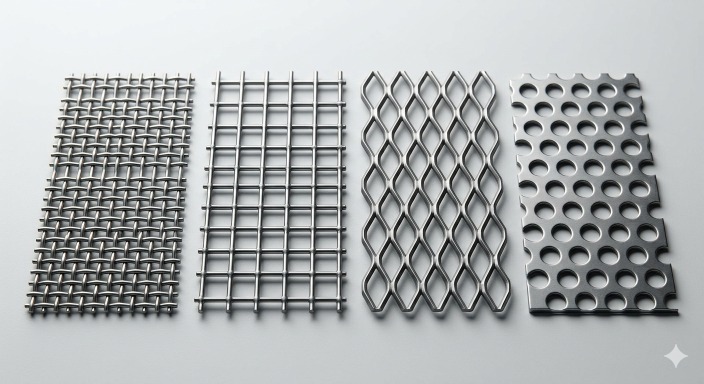
(AI generated) comparison of woven, welded, expanded, and perforated metal mesh sheets
| Type | How It’s Made | Structure & Behavior | Performance Impact | Typical Applications |
|---|---|---|---|---|
| Woven Wire Mesh | Interlaced metal wires woven together (like fabric) | Flexible structure, wires can shift slightly under load | High precision openings, good for filtration, lower rigidity compared to welded mesh | Filters, sieves, screens, fine guards |
| Welded Wire Mesh | Wires welded at each intersection point | Rigid grid structure, fixed geometry | High strength and dimensional stability, handles load well, less flexible | Machine guards, cages, partitions, structural panels |
| Expanded Metal Mesh | Solid sheet cut and stretched into a mesh pattern | Continuous strands with no joints or welds | Strong for its weight, no material waste, good load distribution, moderate airflow | Walkways, grating, platforms, protective covers |
| Perforated Metal Mesh | Holes punched into a solid sheet | Flat sheet with uniform hole pattern | High flat strength, controlled airflow, less open area than mesh types | Acoustic panels, facades, ventilation covers |
In practice, woven mesh is used for precision and filtration, welded mesh for structural rigidity, and expanded metal for strength-to-weight efficiency.
Metal Mesh Sheet Sizes, Thickness & Specifications
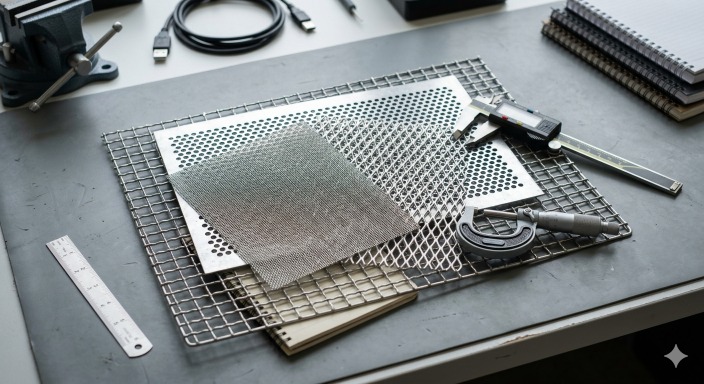
(AI generated) Different sized metal mesh sheets displayed
Specs decide performance. You can pick the right material and still fail if the mesh size, opening, or wire diameter doesn’t match the job.
In real projects, engineers don’t ask “what mesh?” They ask: what opening, what thickness, and what load?
Metal mesh sheet sizes typically follow standard sheet dimensions, but can be customized depending on application and fabrication constraints.
Standard Sheet Sizes
Most metal mesh sheets follow standard sheet formats to match fabrication and transport constraints.
Common stock sizes:
● 1000 × 2000 mm (1 × 2 m)
● 1220 × 2440 mm (4 × 8 ft)
● 1500 × 3000 mm
● 2000 × 6000 mm (industrial scale panels)
For large projects, custom metal mesh sheets can go beyond 6 meters in length, especially for architectural facades and industrial screening.
Here’s what most people don’t mention:
Sheet size affects waste and cost more than material choice in many jobs.
Example:
If your design uses 1300 mm width, a 1220 mm sheet creates immediate scrap. That alone can increase material waste by 5–15% per sheet depending on nesting.
So in practice, you design around sheet size, not the other way around.
Mesh Opening Size & Patterns
Opening size defines how the mesh behaves.
Typical opening ranges:
● Fine mesh: 0.5 mm – 2 mm (filtration, screens)
● Medium mesh: 2 mm – 10 mm (guards, covers)
● Heavy mesh: 10 mm – 50+ mm (structural, fencing, walkways)
Patterns matter just as much:
● Square grid (welded mesh) → uniform strength distribution
● Diamond pattern (expanded mesh) → better stress flow, less localized failure
● Rectangular openings → directional strength (stronger along one axis)
For machine guarding, opening size should be selected according to the applicable safety standard and the distance from the hazard zone. In many cases, smaller apertures are required to prevent finger access.
So opening size isn’t just airflow. It’s compliance.
Wire Diameter & Thickness
Wire diameter controls strength more than anything else.
Typical ranges:
● Light-duty mesh: 0.5 mm – 1.5 mm
● Medium-duty: 1.5 mm – 3 mm
● Heavy-duty: 3 mm – 6+ mm
For expanded mesh, you’ll see thickness expressed as sheet thickness instead of wire diameter.
Important relationship:
● Increasing wire diameter by 2× can substantially improve load capacity, depending on material, pattern, and support conditions
● At the same time, open area drops, which reduces airflow
Open Area & Strength Ratio
Open area is one of the most ignored specs. It shouldn’t be.
It defines how much of the sheet is actually empty space.
Typical open area ranges:
● Woven mesh: 30% – 70%
● Welded mesh: 50% – 80%
● Expanded metal: 60% – 85%
● Perforated metal: 10% – 60%
Higher open area means:
● better airflow
● lower weight
● lower material cost
But it also means lower strength.
Here’s the practical rule our engineers use:
● Below 40% open area → structure behaves closer to solid sheet
● Above 70% open area → airflow dominates, strength drops significantly
Open area directly influences the strength-to-weight ratio and airflow performance of the mesh.
For example:
An expanded metal sheet with 75% open area can weigh up to 40% less than a solid sheet of the same thickness, while still carrying moderate loads.
That’s why it’s used in walkways and platforms.
Metal Mesh Sheet Materials
| Material | Key Properties | Performance Impact | Cost Range | Typical Applications |
|---|---|---|---|---|
| Stainless Steel Mesh Sheets | High strength, corrosion resistant, heat resistant | Handles harsh environments, long lifespan, maintains strength under load and exposure | High | Food processing, chemical plants, outdoor structures, filtration systems |
| Aluminum Mesh Sheets | Lightweight, naturally corrosion resistant, easy to form | Reduces overall weight, good for airflow applications, lower strength than steel | Medium | Ventilation panels, facades, lightweight enclosures |
| Galvanized Steel Mesh Sheets | Steel coated with zinc for corrosion protection | Strong and cost-effective, moderate corrosion resistance, suitable for general use | Low to medium | Fencing, guards, construction, general industrial use |
| Copper, Brass & Specialty Metals | Excellent corrosion resistance, electrical conductivity, decorative finish | Used for specific functional or aesthetic needs, softer than steel, higher material cost | High | Architectural panels, EMI shielding, decorative mesh, specialty filtration |
Applications of Metal Mesh Sheets

(AI generated) Metal mesh facade on a modern building filtering sunlight
Metal mesh applications are primarily defined by three factors: opening size, material, and structural rigidity.
You have to match the mesh to what the application demands.
Most failures happen when people choose based on “type” instead of function. Here’s how to think about it in real use.
Filtration and Industrial Use
Start with the opening size. Everything else follows.
● 0.5–2 mm openings → fine filtration, dust, particles
● stainless steel mesh sheets → handle heat, chemicals, corrosion
● woven mesh works best when you need precision and consistency
In production lines, even a 0.2 mm variation in opening size can affect filtration efficiency. That’s why woven mesh dominates here.
Architecture and Decorative Panels
Here, structure and appearance both matter.
● expanded metal mesh → high open area (60–80%), lighter panels, better airflow
● aluminum mesh sheets → can help reduce panel weight compared with steel, depending on thickness and design
● perforated sheets used where a clean, flat finish is required
For large facades, weight drives cost. Lighter panels reduce support structure, which often saves more than the material itself.
Safety, Guards, and Enclosures
This is where specs are not optional.
● welded wire mesh → rigid, holds shape under impact
● opening size often <12 mm to meet safety standards
● wire diameter typically ≥2–3 mm for durability
In machine guarding, the mesh doesn’t just block access. It has to absorb impact and stay intact. That’s why welded mesh is preferred over woven.
Ventilation and HVAC Systems
Here, airflow comes first.
● open area typically 50–80%
● aluminum or galvanized steel mesh for corrosion resistance
● larger openings reduce pressure drop and improve efficiency
A small design change, like increasing open area from 45% to 65%, can significantly improve airflow and reduce system load.
Custom Metal Mesh Sheets: Design & Fabrication
Most projects don’t use off-the-shelf sizes. You adjust the mesh to fit the system.
That’s where custom metal mesh sheets come in.
Custom Sizes and Shapes
Standard sheets rarely match final dimensions.
● sheets cut to exact sizes to reduce installation time
● complex shapes for enclosures, panels, and brackets
● large panels (up to 3–6 meters) for architectural use
Designing around standard sheet sizes still helps reduce waste before cutting.
Cutting, Bending, Welding & Rolling
Mesh behaves differently than solid sheet during fabrication.
● laser or plasma cutting for precise edges
● bending requires larger radii to avoid distortion
● welded frames often added to maintain rigidity
● rolling used for cylindrical or curved structures
Thin mesh can deform during cutting. That’s why fixturing and support matter more than most expect.
Surface Finishing (Powder Coating, Galvanizing)
Sheet metal finishing changes both durability and appearance.
● galvanizing: improves corrosion resistance for outdoor use
● powder coating: adds protection and uniform color
● stainless steel often left untreated for natural corrosion resistance
Outdoor mesh without coating can lose performance faster than expected, especially in humid or industrial environments.
Design Considerations (Tolerance, Load, Environment)
This is where most designs fail.
● tolerances: mesh openings and wire spacing can vary slightly during manufacturing
● load: larger openings reduce strength, especially under point loads
● environment: moisture, chemicals, and temperature affect material choice
Example:
A mesh that works indoors may fail outdoors within a year due to corrosion or thermal expansion.
So when you design sheet metal mesh, you’re balancing geometry (opening, wire, pattern), material (steel, aluminum, stainless), environment (indoor, outdoor, industrial)
Get those aligned, and the mesh performs exactly how you expect.
How Metal Mesh Sheets Are Manufactured
Material Selection
The ductility-to-strength ratio of the raw stock dictates the entire manufacturing process. Choosing 316 stainless will give you the necessary chloride resistance for marine environments, while high-yield carbon steel offers the stiffness required for structural floor grates. If the grain structure is too brittle, the bonds, the solid junctions in the grid, will micro-fracture during the expansion or welding cycle, leading to a structural failure under load.
Mesh Forming (Weaving / Welding / Expanding)
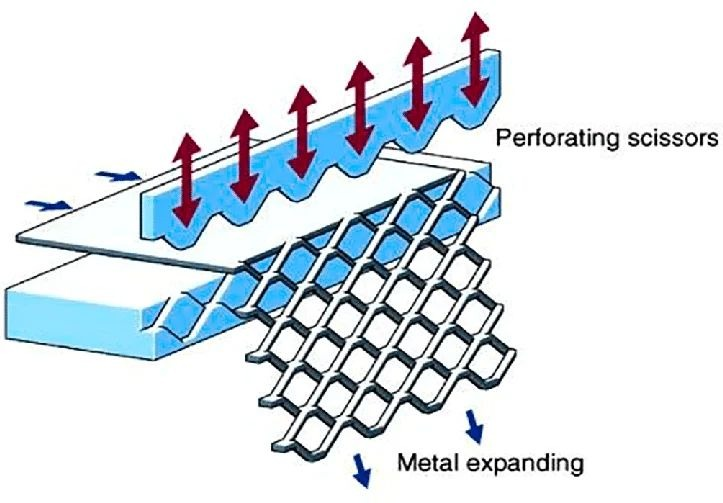
(ResearchGate) Expanding of sheet metal diagram
The structural integrity of the part depends on how the grid is mechanically joined:
Woven Mesh: This physical interlace provides micron-level precision for filtration but lacks lateral rigidity. It will shift under its own weight if not tensioned properly.
Welded Mesh: Resistance welding at every intersection creates a monolithic panel. This allows for complex perimeter cutting without the edges unravelling, making it the industry standard for high-impact safety guards.
Expanded Metal: A single solid sheet is slit and pulled into a 3D truss-like geometry. This stretching process creates a directional grip and a strength-to-weight ratio that a standard perforated sheet cannot achieve, all while producing zero material scrap.
Cutting and Shaping
Blanking a mesh to size is where most fabrication errors occur. Unlike a solid plate, mesh panels have exposed strands that snag or warp during mechanical shearing. Fiber laser cutting is the most effective method for high-precision frames; however, the programmer must account for the air-cuts between every open cell to maintain a clean edge profile.
Finishing and Quality Control
A mesh is only as durable as its surface seal. Hot-dip galvanizing is the industrial baseline for corrosion protection. For equipment where personnel will be in direct contact with the guards, powder coating is required to smooth out the sharp burrs left by the cutting tools. Inspection focus remains on mesh pitch and weld integrity to prevent a zipper effect, where the grid unzips under tension.
Engineering Design Considerations for Metal Mesh Sheets
Load Bearing and Structural Strength
Mesh relies on a load path through the strands rather than across a uniform surface. A common field failure is mounting a woven mesh without a rigid perimeter frame to maintain tension. Without this frame, the mesh will shift or sag. You must calculate support spacing based on the wire diameter and the specific point load of the application.
Open Area vs Durability
This is the fundamental trade-off in mesh engineering. An Open Area Percentage of 70% is mandatory for high-velocity HVAC plenums to prevent backpressure, but that openness directly reduces the panel's shear strength. A safety guard with a 40% open area offers high impact resistance but can choke an intake motor. The design must hit the intersection where airflow is sufficient but impact resistance stays within safety margins.
Corrosion & Environmental Factors
The environment dictates the metallurgy. Galvanized steel is the budget choice but eventually falls to intergranular corrosion in salt-air or chemical washdown zones. Aluminum mesh is lighter than steel, but under the same geometry it is generally less stiff and may deform more easily under impact.
Manufacturing Tolerances
Engineers often mistakenly expect mesh to be dimensionally perfect, but it is a mechanically flexible structure. Woven mesh shifts during shipping, and expanded metal often carries a curl from the stretching rollers. If the assembly requires sub-millimeter bolt-hole alignment, the mounting brackets must use oversized slots to accommodate the natural give of the mesh panel.
At this stage, you’ve seen how small spec changes in metal mesh sheet sizes, wire diameter, or open area can completely change performance.
That’s exactly where most designs go wrong. Not in material choice, but in the details.
How to Choose the Right Metal Mesh Sheets
Choosing the wrong mesh manufacturing process, perforated, expanded, or woven, can significantly increase material waste and processing cost. While perforated sheets offer precision, expanded metal is formed by slitting and stretching a solid sheet, which minimizes material waste during mesh forming compared with punched patterns. Understanding these manufacturing limits is the difference between a high-yield production run and an over-engineered, expensive failure
Choosing by Application
Start with what the mesh needs to do. Filtration needs fine woven mesh with tight openings. Guards and enclosures need welded mesh with rigid structure. Walkways and platforms need expanded metal for strength without excess weight.
Choosing by Size and Load Requirements
Check opening size, wire diameter, and support conditions together. Larger openings improve airflow but reduce strength. Thicker wire increases load capacity. For structural use, always design with framing or support, not standalone mesh.
Choosing by Material
Match the environment first. Stainless steel works for corrosion and outdoor exposure. Aluminum works when weight matters. Galvanized steel fits general indoor or low-cost applications.
Cost vs Performance
Material and open area drive cost. High open area reduces material use but can require thicker wire to maintain strength. Stainless steel costs more upfront but reduces maintenance over time. Pick based on lifecycle, not just purchase price.
Advantages of Metal Mesh Sheets
Lightweight but Strong
Mesh reduces weight while maintaining usable strength through its structure.
Excellent Airflow and Visibility
Open patterns allow air, light, and visibility without losing basic protection.
Corrosion Resistance
Material choice like stainless steel or aluminum helps mesh perform in harsh environments.
Cost-Effective & Durable
Lower material usage and long service life make metal mesh a practical option for many applications.
Move to Production with JLCCNC
Manufacturing mesh panels usually involves fighting edge distortion and material bow. Most shops deliver sheets that require on-site grinding or forced alignment just to fit the frame.
JLCCNC eliminates that secondary work. We maintain the structural tension of the mesh during the cutting process so every panel stays flat and every perimeter remains clean. Your components arrive ready for immediate installation, with hole alignments that actually match your CAD file.
FAQ About Metal Mesh Sheets
Q: What is a metal mesh sheet?
A metal mesh sheet is a network of wires or strands formed into a grid or pattern with controlled openings.
Q: What materials are used in metal mesh sheets?
They typically come in standard sizes like 4×8 ft or 1×2 m, with custom sizes available.
Q: What sizes do metal mesh sheets come in?
They typically come in standard sizes like 4×8 ft or 1×2 m, with custom sizes available.
Q: Can metal mesh sheets be customized?
Yes, you can customize size, opening, wire diameter, pattern, and surface finish based on application needs.
Q: What is the difference between woven, welded, and expanded metal mesh?
Woven mesh: interlaced wires, best for filtration
Welded mesh: welded joints, best for strength and rigidity
Expanded metal: slit and stretched sheet, best for lightweight strength
Q: What opening size should I choose for a metal mesh sheet?
0.5–2 mm: filtration
2–10 mm: guards and covers
10–50+ mm: fencing and structural use
Smaller openings improve protection and filtration.
Larger openings improve airflow and visibility.
Popular Articles
• 9 Sheet Metal Cutting Problems and Solutions
• Hole cutting in sheet metal: techniques, tolerances and applications
• Introduction to Sheet Metal Processing: Techniques and Tools for Precision
• Bending and Forming Technology in Sheet Metal Processing
• Laser cutting technology in sheet metal processing
Keep Learning
Galvanized Sheet Metal: Grades, Specs & When to Use It
Galvanized Sheet Metal: Grades, Specs & When to Use It A design engineer specs "galvanized sheet metal" on a drawing and sends it out for quotes. Three shops come back with three different prices, and one of them asks a follow-up question the others didn't: which gauge, which coating class, hot-dip or electro-galvanized? That question is the difference between a part that survives outdoors for fifteen years and one that starts showing rust spots after eighteen months — and it's the kind of detail that......
Custom Sheet Metal Fabrication: How the Process Works From Design to Delivery
Custom Sheet Metal Fabrication: How the Process Works From Design to Delivery A stock enclosure almost fits. The mounting holes are close but not quite right, the depth is half an inch too shallow, and the vendor's next size up is twice the volume you actually need. This is the point where most people start looking into custom sheet metal fabrication — not because they set out to design a part from scratch, but because nothing off the shelf actually solves the problem. Custom fabrication sounds like i......
Sheet Metal Assembly: How Fabricated Parts Come Together
Sheet Metal Assembly: How Fabricated Parts Come Together Cutting and bending gets a lot of attention because that's where a flat sheet visibly turns into a 3D part. But a single bracket by itself rarely finishes the job — most real sheet metal products are assemblies, multiple formed pieces joined into one working unit, and that assembly step is where a lot of designs quietly succeed or fail. A part that measured perfectly on its own can still not fit once it's supposed to mate with three other pieces......
Sheet Metal Bender: Types, Specs & How to Choose the Right Machine
Sheet Metal Bender: Types, Specs & How to Choose the Right Machine Every sheet metal bracket, enclosure, and panel eventually passes through a bender of some kind — that's the machine, not the process. Our guide on sheet metal bending covers how bending actually deforms metal — springback, minimum radius, bend allowance, and the core press brake and CNC press brake setups most shops run. This one goes further into the equipment side specifically: the less common bender types beyond the standard press ......
What Is Galvanized Metal? Process, Types & How It Works
What Is Galvanized Metal? Process, Types & How It Works Leave a piece of bare steel outside for a season and you'll see exactly why galvanizing exists. Rust doesn't wait for dramatic weather — a little humidity and a few weeks is enough to start eating into an unprotected surface. Galvanized metal solves that problem by giving steel a sacrificial layer of zinc that corrodes in its place, and it's done this job well enough that it's become the default choice for anything from highway guardrails to HVAC......
What Is Sheet Metal Fabrication? The Complete Guide
What Is Sheet Metal Fabrication? The Complete Guide Somewhere between a CAD file and a working enclosure sitting on your bench, a flat piece of metal gets cut, bent, joined, and finished into something that actually does a job. That's sheet metal fabrication — and if you've never ordered a part before, the term can feel bigger than it needs to be. Ask five people what "sheet metal fabrication" covers and you'll get five different answers: some think laser cutting, some think welding, some just picture......