CNC Milling vs. CNC Turning: Which is Better?
7 min
- CNC Milling vs. CNC Turning: Which Process Fits Your Part?
- The Fundamental Difference: Tool Rotation vs. Workpiece Rotation
- Direct Comparison
- When to Choose CNC Milling for Non-Round Parts
- When to Choose CNC Turning for Cylindrical Features
- Hybrid Solutions: When a Part Needs Both Milling and Turning
- Cost and Volume Considerations for Production Runs
- A Common Design Mistake Worth Flagging
- Quick Design for Manufacturability (DFM) Rules
- Frequently Asked Questions (FAQ)
- Not Sure Whether Your Part Needs Milling, Turning, or Both?
CNC Milling vs. CNC Turning: Which Process Fits Your Part?
Quick Answer: Choose CNC milling for prismatic, flat, pocketed, and complex 3D parts. Choose CNC turning for parts whose primary geometry is cylindrical or rotationally symmetric. Use mill-turn or secondary milling when a turned part also needs flats, keyways, cross-holes, or other non-round features.
A shaft and a bracket can come from the same material, hold similar tolerances, and still need completely different machines to make — not because one part is harder than the other, but because their basic shapes point in opposite directions. That's really what the milling-versus-turning question comes down to: it's not about which process is more capable, it's about which shape you're starting with.

Precision CNC Machining Service
Professional manufacturing, fast turnaround, and quality assurance.
The Fundamental Difference: Tool Rotation vs. Workpiece Rotation
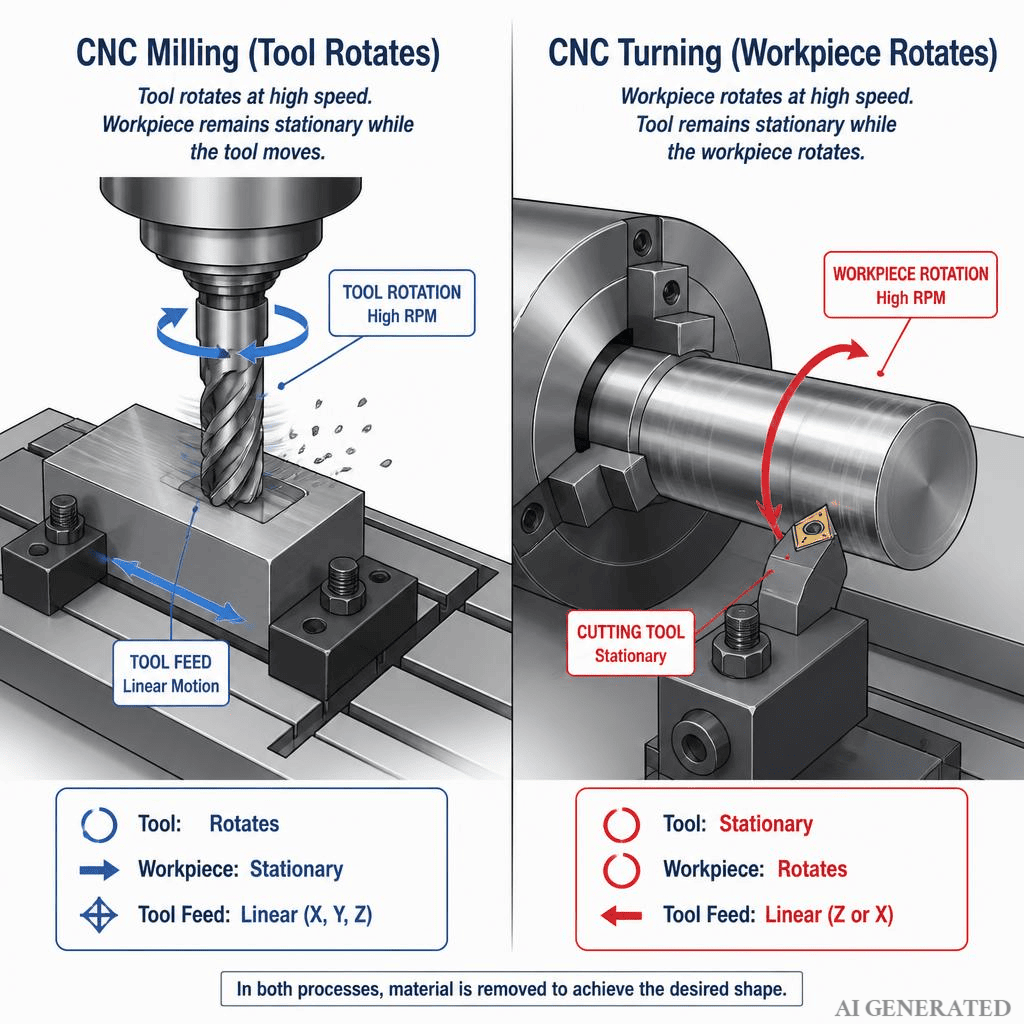
CNC milling rotates the cutting tool while the workpiece stays fixed (or is repositioned between operations); the tool moves along multiple axes to remove material and shape the part.
CNC turning does the opposite — the workpiece itself rotates in a lathe while a stationary or slowly-traversing tool cuts into it.
That single difference in what's spinning is the root of almost everything else that separates the two processes.
Direct Comparison
| Factor | CNC Milling | CNC Turning |
|---|---|---|
| What rotates | The cutting tool | The workpiece |
| Best-suited geometry | Flat faces, pockets, complex 3D contours, non-round shapes | Cylindrical, rotationally symmetric parts |
| Typical axes | 3, 4, or 5 | 2 (X and Z), sometimes with live tooling for added capability |
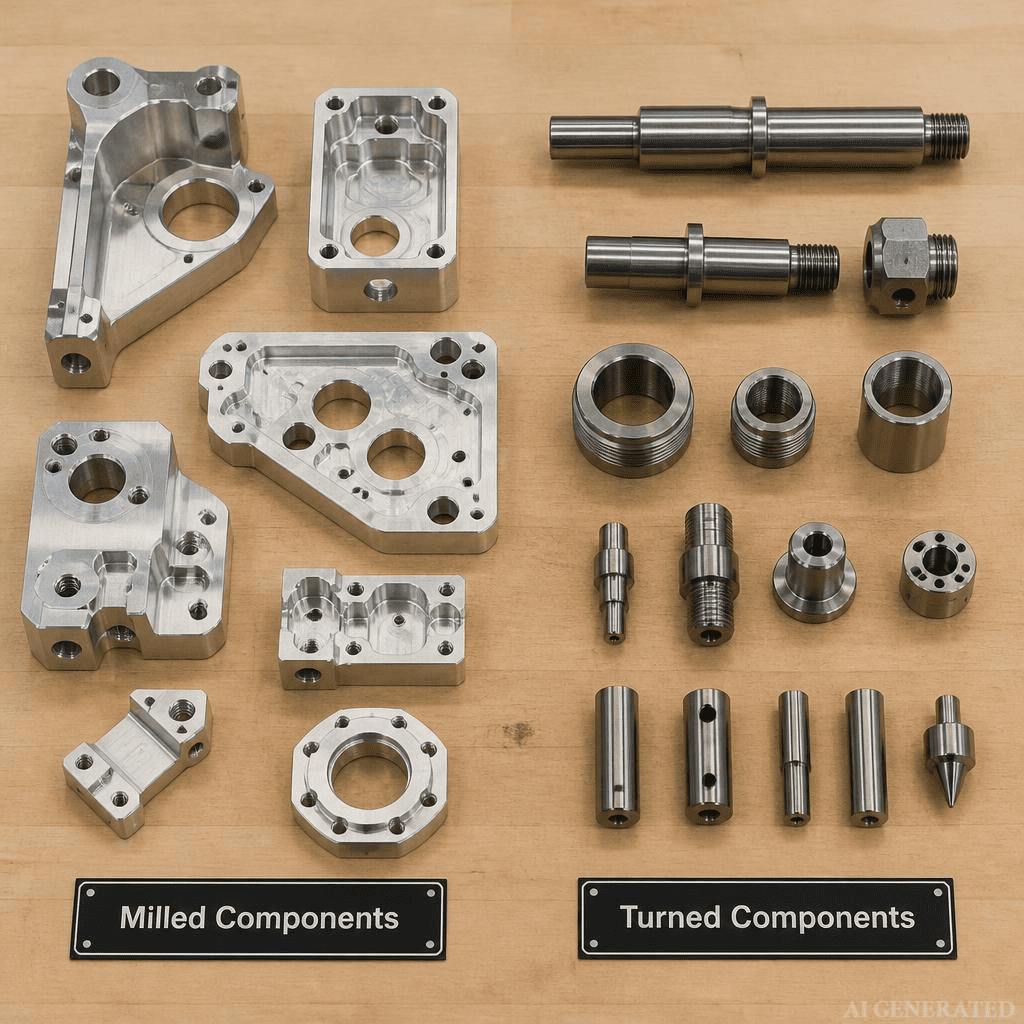
| Common parts | Brackets, housings, molds, plates | Shafts, pins, bushings, fittings, threaded components |
| Cycle time for round parts | Slower — round features are harder to hold efficiently | Faster — turning is the natural fit for round geometry |
| Cycle time for non-round parts | Faster — natural fit for flat/angular features | Complex non-round features generally need live tooling, mill-turn, or a secondary milling operation |
When to Choose CNC Milling for Non-Round Parts
Any part that isn't fundamentally round — a bracket with flat mounting faces, a housing with internal pockets, a plate with holes at multiple angles — is a milling job.
Milling's multi-axis motion lets the tool approach a part from different directions (especially on 4- and 5-axis setups), which is what makes complex 3D geometry, deep pockets, and multi-sided features practical in a way turning simply can't replicate on its own. If a part's defining shape is "not a cylinder," it's almost certainly milled.
When to Choose CNC Turning for Cylindrical Features
Anything built around a central axis — a shaft, a bushing, a threaded fastener, a fitting — turns more efficiently than it mills.
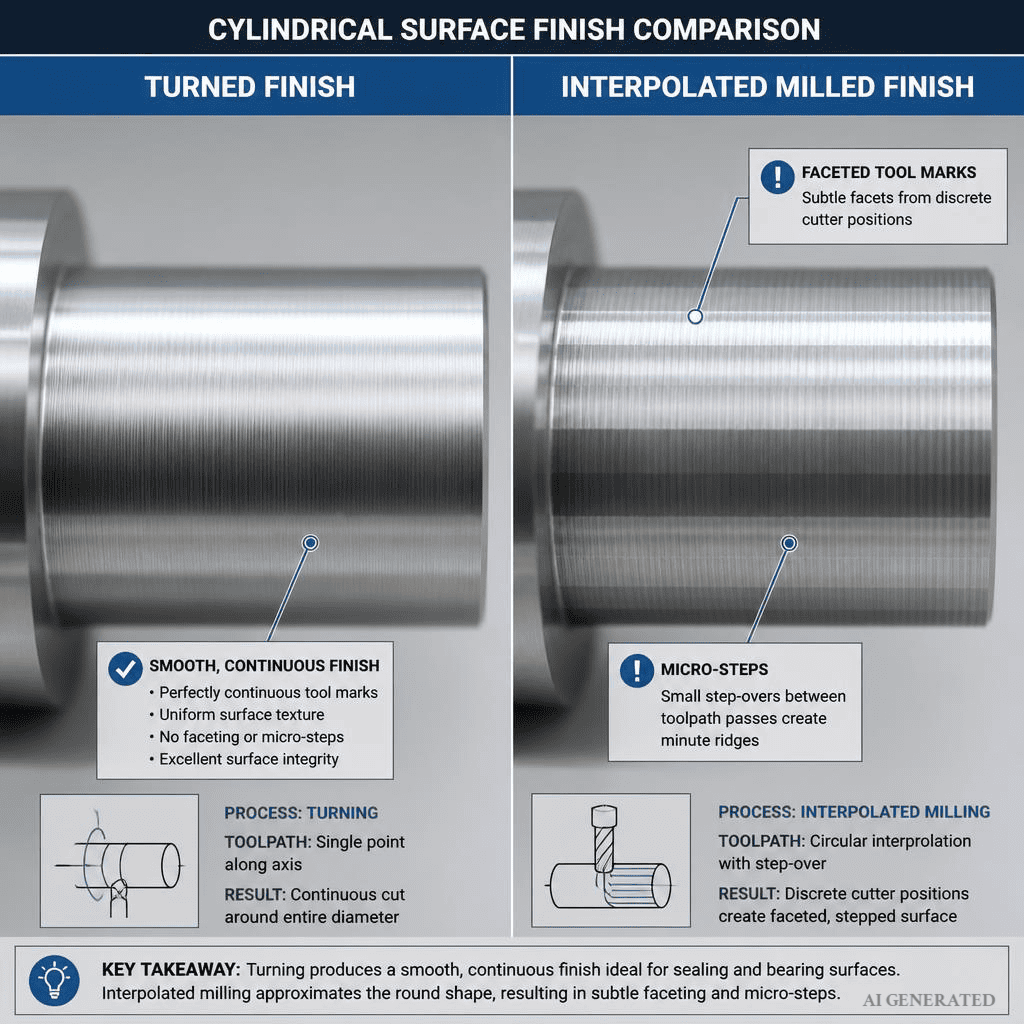
Because the workpiece itself spins, turning can remove material around the entire circumference in a single continuous cut, which is both faster and generally produces a more consistent, concentric surface than trying to mill the same round profile through a series of separate passes — though how consistent that surface actually comes out depends on workholding, tool condition, machine rigidity, and the inspection method used, not the process alone. Milling can technically produce a round feature, but it's rarely the efficient choice when the part is round to begin with.
Hybrid Solutions: When a Part Needs Both Milling and Turning
Plenty of real parts aren't purely one shape or the other. A shaft might be turned for its main cylindrical body, then moved to a mill (or a mill-turn machine that combines both capabilities in one setup) to cut a keyway or flat mounting face into that otherwise round shaft.
Recognizing this early — rather than trying to force an entirely round-and-flat part through just one process — is often what separates an efficient production plan from one that fights the part's actual geometry.
The Rise of Mill-Turn Machines
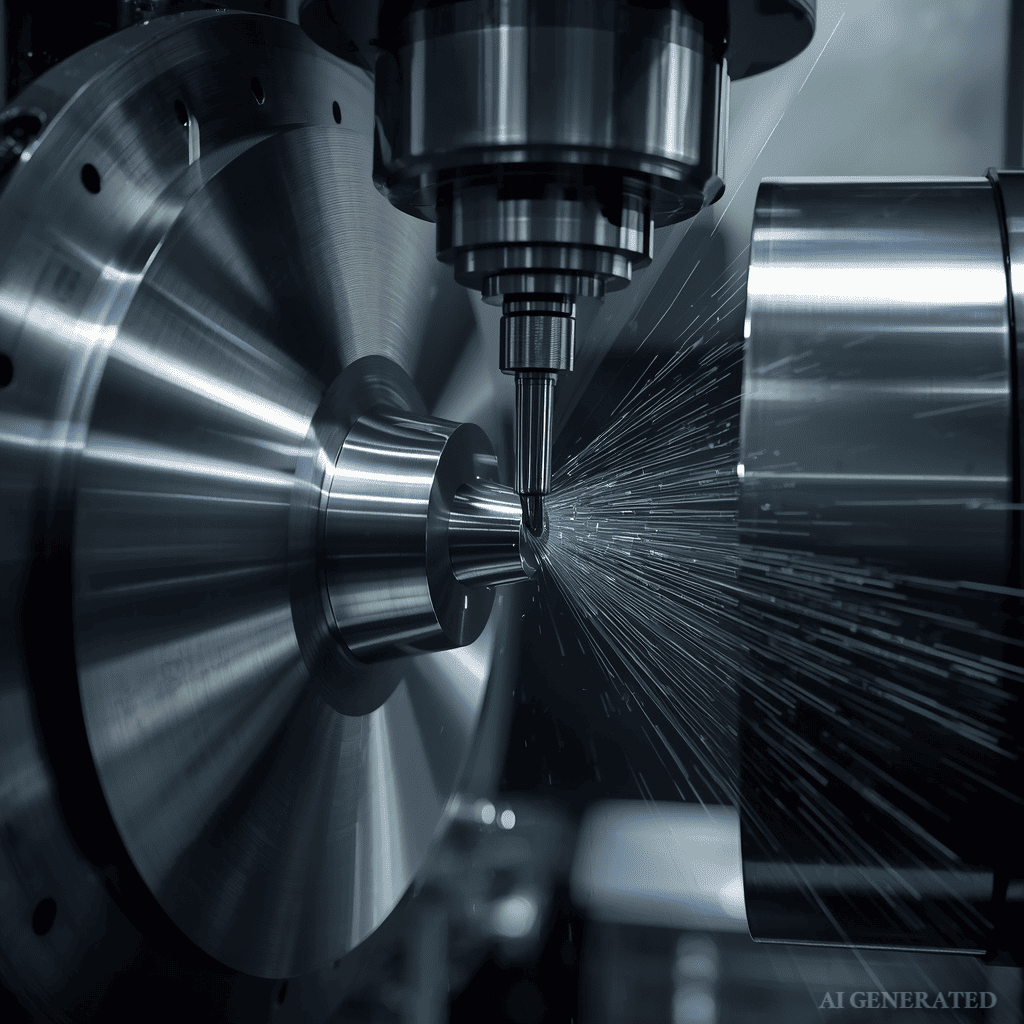
Mill-turn machines, which combine live milling tools with a turning spindle in a single setup, are increasingly common specifically for parts like this — they avoid the need to move a part between a separate lathe and mill, reducing both cycle time and the alignment risk that comes with re-fixturing a part between two different machines.
Cost and Volume Considerations for Production Runs
For a genuinely round part, turning is almost always the more economical choice per unit — it's faster, and the tooling and setup are simpler than trying to replicate a round profile on a mill.
For non-round geometry, milling isn't really competing with turning on cost; for complex non-round features, it's typically the only practical option without adding live tooling or a mill-turn setup.
Where the decision gets more nuanced is on parts with both round and non-round features — whether it's worth a mill-turn setup, or two separate operations on dedicated machines, depends on volume and part complexity enough that it's worth discussing with whoever's actually running the job rather than assuming one approach is automatically cheaper.
A Common Design Mistake Worth Flagging
Defaulting to milling for every part — including genuinely round ones — because a shop or designer is more comfortable with mill-based workflows is a real and avoidable cost driver.
A shaft milled into shape instead of turned takes meaningfully longer and typically produces a less consistent round surface than the same part turned on a lathe. If a part's core geometry is a cylinder, that's usually the strongest signal to check whether turning — or a mill-turn combination if secondary features are needed — is the more efficient path, rather than defaulting to whichever process is more familiar.
Quick Design for Manufacturability (DFM) Rules
- Match cutter radii: Specify internal pocket corner radii compatible with standard end-mill radii, and avoid specifying a corner radius smaller than the practical cutter radius the job would use — a corner tighter than any standard tool can produce forces an unnecessary secondary operation.
- Leverage bar stock: Design shafts to standard bar diameters to reduce lathe turning time and material waste.
- Reduce re-fixturing: Align non-round features on turned parts along accessible planes so they can be machined easily via live tooling or a single secondary mill operation.
Frequently Asked Questions (FAQ)
Can CNC milling produce round parts? Yes, but it's rarely the efficient choice — milling a round profile requires interpolated circular toolpaths across multiple passes, which is slower and generally less consistent than turning the same shape in a single continuous cut on a lathe.
Can CNC turning produce flat or non-round features? Only to a limited extent — live tooling on some turning centers can add drilling or light milling capability, but for genuinely complex 3D geometry or non-round shapes, a dedicated mill, mill-turn setup, or secondary milling operation is usually still needed.
What's a mill-turn machine? A machine that combines turning (a rotating workpiece) with live milling tools in one setup, letting a single part move between round and non-round features without being physically transferred between separate lathe and mill equipment — useful for parts needing both types of geometry.
Is turning always cheaper than milling for round parts? Generally yes, per part, since turning removes material around the full circumference in a continuous cut rather than requiring multiple interpolated passes — though the actual cost difference depends on part size, material, and specific feature requirements.
Not Sure Whether Your Part Needs Milling, Turning, or Both?
The right process usually comes down to your part's basic shape — round parts and non-round parts play to different strengths, and plenty of real parts need a bit of both. Our engineering team reviews your CAD model before quoting and can flag whether a mill-turn setup, or two separate operations, makes more sense for your specific geometry and volume.
- Flexible Capabilities: CNC milling, turning, and mill-turn setups under one roof
- Engineering Review: Manufacturability and process-fit feedback with every quote
- Fast Quotes: Upload your 3D CAD files (.STEP / .IGES) for a rapid review and quote
Keep Learning
Laser Engraving Aluminum: Marking Methods & Surface Effects
Key Takeaways Laser engraving usually removes base material to create a recess. Laser marking is a broader term that can describe a surface-color change or material removal, so the process name alone does not define the final result. On aluminum, alloy and surface finish affect marking contrast. A light mark on dark anodized aluminum is a common design target, but the actual appearance depends on the finish and laser process. JLCCNC laser marking produces a recessed area 0.03–0.1 mm deep. The result i......
CNC Cutting Fluid: Types, Functions, Applications, and Selection Guide
Key Takeaways Cutting fluid in machining performs four functions simultaneously: cooling the tool and workpiece, lubricating the tool-chip interface to reduce friction, carrying chips away from the cut zone, and protecting machined surfaces from corrosion between operations. Different machining operations need different fluid priorities: high-speed aluminum milling may need adhesion control and chip evacuation, threading and tapping need strong lubrication, and grinding requires both cooling and fine ......
Blind Hole Machining Guide: What Is a Blind Hole, Types of Holes, and Tapping Tips
What Is a Blind Hole? Types of Holes and CNC Hole Machining Explained In CNC machining, few operations challenge process control and tool stability as much as blind hole machining. A blind hole is a hole that terminates at a defined internal depth rather than breaking through the opposite surface. Because the cavity is enclosed at the bottom, chip evacuation, thermal behavior, tool wear, and dimensional accuracy become far more difficult to manage compared to through-hole machining. These constraints ......
Rake Angle in Machining: Machinists’ Guide to Perfect Cuts
What is Rake Angle? (minaprem) If you've ever stood in front of a CNC machine or a manual lathe, you know that the cutting tool's geometry isn't just some arbitrary design. Every angle, edge, and surface has a job to do, and one of the most important of those is the rake angle. We've been running machines long enough to know that rake angle can make or break your surface finish, tool life, and machining efficiency. In this guide, we're going to walk you through what rake angle is, how it works, and ho......
Sheet Metal vs CNC Machining: A Guide to Choosing the Right Method for Your Metal Parts
Quick Answer: Choose sheet metal for uniform-thickness enclosures, panels, and formed brackets when bends and production volume support lower unit cost. Choose CNC machining for variable wall thickness, precision bores, tight feature relationships, and complex 3D geometry. Use a hybrid design when a formed structure needs precision-machined interfaces. A quote comes back for a bracket, and it's priced as a CNC part — machined from solid aluminum, a few hours of spindle time, a per-part cost that makes......
What Steps Are Taken To Minimize Waste In CNC Machining Processes?
How to Reduce Waste in CNC Machining: 5 Practical Strategies Quick Answer: CNC machining waste is reduced mainly through DFM, near-net stock, efficient toolpaths, preventive tool maintenance, and alloy-segregated recycling. The biggest gains usually come before cutting: reduce unnecessary material removal and prevent scrap or rework. Every CNC-machined part starts as more material than it ends up being. A pocket gets milled out, a profile gets cut away, a boss gets faced down to size — and all of that......