CNC Router vs CNC Mill: Key Differences, Applications & How to Choose
12 min
- What Is a CNC Router?
- What Is a CNC Mill?
- CNC Router vs CNC Mill: What's the Difference?
- Typical Applications
- How to Choose Between a CNC Router and a CNC Mill
- CNC Router vs CNC Mill: Advantages and Limitations
- When Should You Outsource CNC Milling?
- FAQs About CNC Routers and CNC Mills
Quick Comparison Between CNC Router and Mill
Choose a CNC router for large sheets, softer materials, rapid profiling, and a spacious cutting area. And choose a CNC mill for rigid workholding, heavier metal removal, deeper features, hard materials, and parts needing tougher dimensional control. These are general tendencies and not fixed rules. Industrial routers and high-speed mills can overlap considerably.
| Comparison Point | CNC Router | CNC Mill |
|---|---|---|
| Primary strength | Processes large and relatively flat workpieces at high feed rates | Produces detailed and dimensionally controlled metal components |
| Machine structure | A moving gantry structure supported by linear guides and a large work bed | A rigid column, base, and machine frame designed to reduce cutting deflection |
| Typical materials | Wood, MDF, foam, plastics, composites, and some aluminum applications | Aluminum, brass, steel, stainless steel, titanium, and machinable alloys |
| Cutting approach | Good for rapid profiling, engraving, pocketing, and sheet cutting | Good for heavier cuts, deep pockets, drilling, tapping, and complicated machining |
| Spindle characteristics | Emphasizes higher rotational speed and rapid axis movement | Provides greater low-speed torque and cutting force |
| Work envelope | Offers a large X-Y area with relatively limited Z travel | Has a smaller X-Y area but more Z travel and capacity for thick fixtures |
| Rigidity under load | Lower on many light and mid-range models, limiting aggressive metal removal | Higher, allowing larger tools, deeper cuts, and tougher materials |
| Typical Accuracy Range | Around ±0.05–0.15 mm for many industrial applications | Around ±0.005–0.05 mm for precision machining applications |
| Workholding | Spoilboards, clamps, screws, T-slots, or vacuum hold-down systems | Machine vises, T-slot clamps, pallets, chucks, and dedicated fixtures |
| Typical cost position | Modular and entry-level models provide a lower-cost route to a large work area | Demands greater investment in the machine, enclosure, coolant system, tooling, and installation |
| Common applications | Furniture, cabinetry, signs, molds, patterns, plastic components, and aluminum panels | Brackets, housings, dies, molds, engine parts, aerospace parts, and precision prototypes |
| Best choice when | Part size and cutting speed are more important than heavy material removal | Rigidity, material hardness, depth, and dimensional accuracy are priorities |
CNC router vs CNC mill depends less on their similar three-axis motion and more on the material, part size, cutting forces, geometry, and tolerance that is needed. When manufacturers know how the structures influence actual machining performance, they may select a machine that can produce the part efficiently without having to pay for unnecessary capacity.
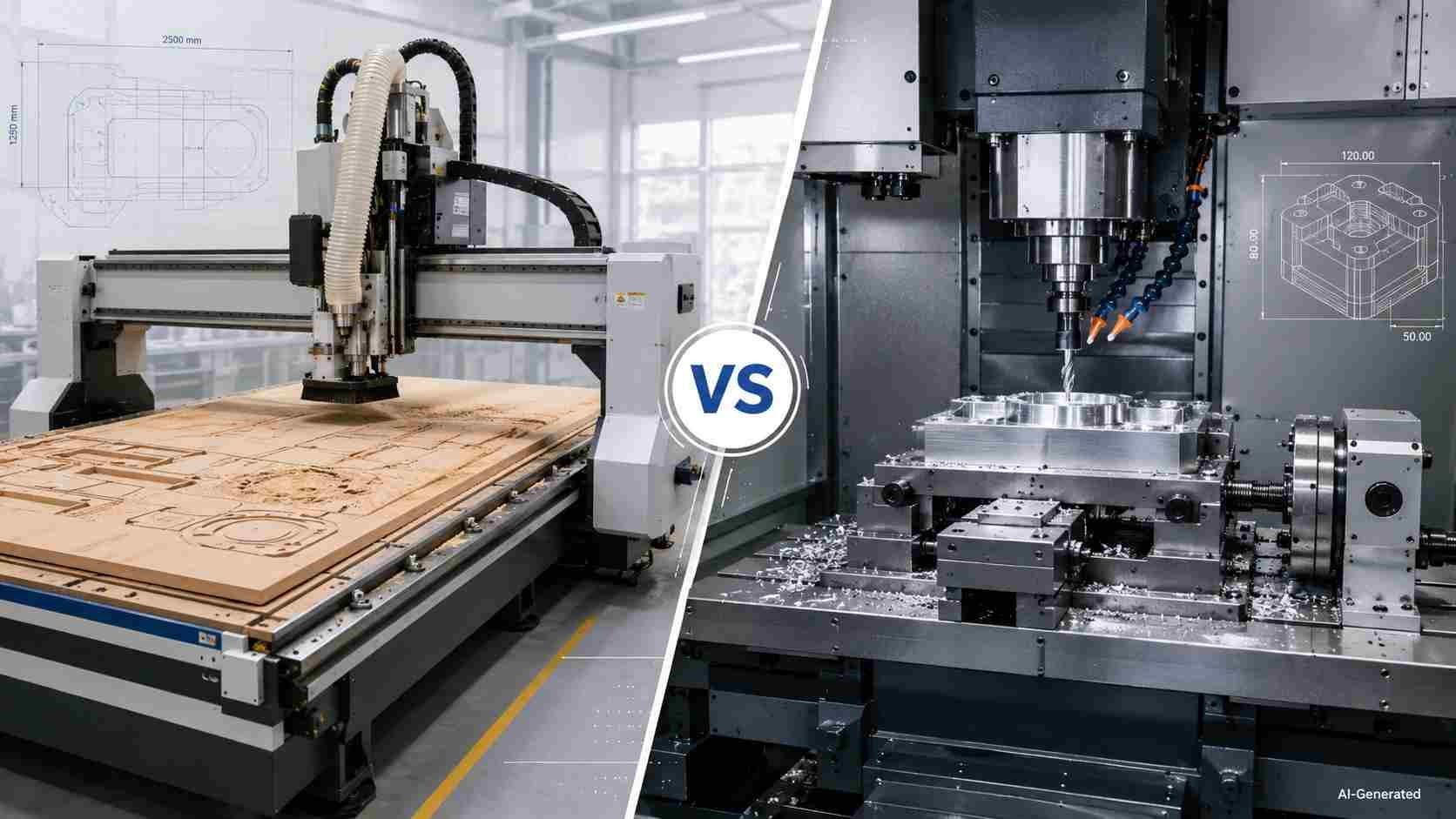
CNC router and CNC mill side-by-side comparison
What Is a CNC Router?
A CNC router is a computer-controlled cutting machine that uses a rotating cutting tool to remove material from a workpiece, commonly through a moving gantry system.
The workflow starts with a CAD drawing or 3D model. CAM software makes toolpaths and G-codes. The controller sends those instructions to the spindle and axis motors in order to carve, profile, pocket, drill, or engrave the part with repeatable movement. The workpiece is usually placed on a large open bed, while the spindle moves along the gantry. The spindle assembly moves across the bed, which may be supported by a spoilboard, a vacuum hold-down system, and dust extraction, depending on the application.
In a CNC router vs mill discussion, this moving-gantry format explains the router's ability to cover wide and shallow geometry. Yet, the CNC mill vs router comparison highlights its emphasis on spindle speed, reach, and uninterrupted tool travel, not heavy cutting loads.
What Is a CNC Mill?
A CNC mill, also called a CNC milling machine, is a machine tool designed for precision material removal. Programmed axis movement guides the cutter, worktable, or both around a clamped part.
Its spindle can carry end mills, drills, and face mills. One setup can create holes, slots, pockets, threads, angled faces, and contoured surfaces. Enclosed models may add coolant delivery, chip removal, probing, and automatic tool changes. Unlike the wide gantry layout common on routers, a mill places its cutting zone within a compact base-and-column frame. Rigid guideways and secure workholding support deeper cuts, thicker stock, and difficult-to-machine materials.
This mechanical difference gives the CNC router vs mill comparison its core meaning. A CNC mill vs router review shows why milling is the choice whenever three-dimensional features, difficult alloys, or close dimensional control are more important than table coverage.
For parts that require CNC milling, JLCCNC provides precision machining services for custom metal and plastic components. Upload your CAD file to receive a manufacturing review and CNC milling quotation.

Precision CNC Machining Service
Professional manufacturing, fast turnaround, and quality assurance.
CNC Router vs CNC Mill: What's the Difference?
Machine Structure and Rigidity
In CNC router vs CNC mill, the key structural issue is the cutting-force path. A router's gantry carries loads across a wide span. A mill transfers cutting forces through a rigid spindle and machine frame. That shorter and heavier path limits vibration and deflection when tool pressure rises.
Cutting Capability
The routing vs milling difference appears in tool engagement. Routers pair high spindle rpm with modest cut depth for sheet goods, polymers, foam, composites, and aluminum. Mills can apply greater torque at lower rpm. They let larger tools remove more material from resistant alloys.
Accuracy and Surface Finish
Accuracy depends on the entire cutting loop. Guideway condition, workholding, tool length, backlash, thermal changes, and chatter all influence the final result. A rigid mill structure generally reduces deflection under higher cutting loads, which aids close tolerances and repeatable finishes on pockets, bores, and mating faces. On the other hand, a router is a better match for nesting, trimming, carving, and broad-area contours.
Working Size and Cost
Routers devote more travel to the X and Y axes as well as allow full sheets and long panels to remain on one bed. Mills might add Z capacity, coolant, enclosures, chip management, precision workholding, and heavier tooling. These requirements can raise purchase and operating expenses. However, machine size, accuracy, power, and automation also affect the final cost.
Typical Applications
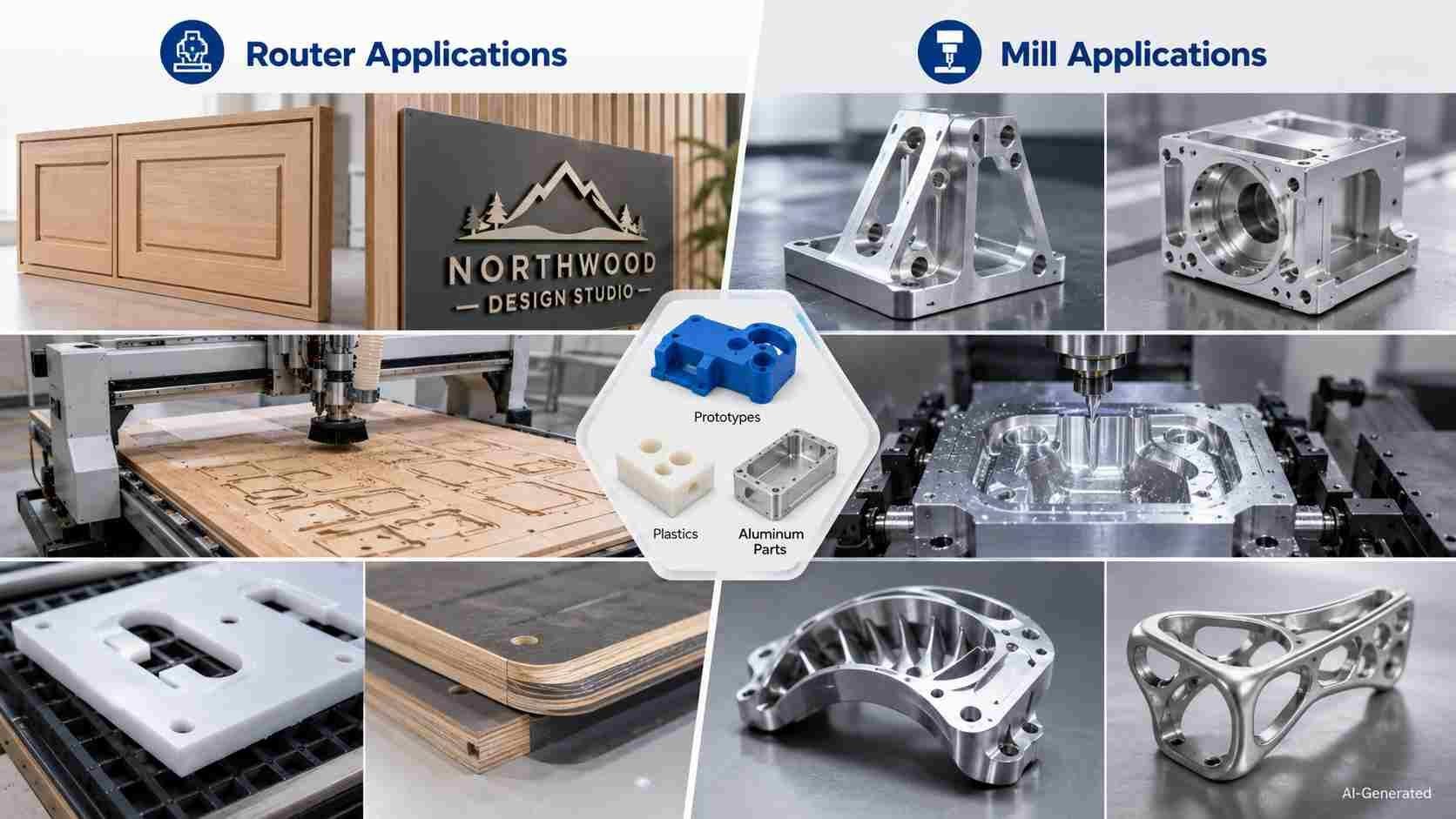
CNC router and mill applications comparison
CNC Router Applications
CNC routers are common in cabinet production, furniture, signs, display fixtures, architectural millwork, composite trimming, patterns, and large molds. Their broad tables also support nested sheet cutting. Many components are arranged within one panel to reduce scrap and handling.
CNC Mill Applications
CNC mills are in service for precision brackets, housings, dies, mold inserts, engine components, medical devices, and aerospace hardware. The overlap in CNC milling vs routing appears with aluminum, plastics, composites, prototypes, and tooling. Nevertheless, mills take over when a part demands complicated multi-face features or closely controlled dimensions.
How to Choose Between a CNC Router and a CNC Mill
1Start with the material
Is the workpiece wood, MDF, foam, plastic, composite board, or other sheet stock?
→ Yes: Choose a CNC router.
→ No: Continue.
Will you regularly machine steel, stainless steel, titanium, or another resistant alloy?
→ Yes: Choose a CNC mill.
→ No, mainly aluminum or engineering plastic: Continue.
2Consider the part geometry
Is the part wide, flat, or cut from a full sheet, with profiles, engraving, shallow pockets, or large contours?
→ Yes: Choose a CNC router.
→ No: Continue.
Does it require deep pockets, accurate bores, threads, thick stock, or intricate three-dimensional features?
→ Yes: Choose a CNC mill.
→ No: Continue.
3Check the accuracy requirement
Does the part contain close-tolerance mating faces, bearing seats, precision holes, or dimensions critical to assembly?
→ Yes: Choose a CNC mill.
→ No: Continue.
4Review production volume
Will production depend on nesting many flat components across each sheet?
→ Yes: Choose a CNC router.
→ No, the job involves repeated precision components or varied machining operations: Choose a CNC mill.
5Compare the budget
Is the priority obtaining a large cutting area while limiting the initial investment?
→ Yes: A CNC router is better.
→ No, the budget covers heavier equipment, precision workholding, coolant, tooling, and chip control: Select a CNC mill.
Still undecided?
→ Choose according to the part's hardest requirement. Use a router when sheet capacity governs the job. Use a mill when material resistance, feature depth, or dimensional control governs it.
CNC Router vs CNC Mill: Advantages and Limitations
A CNC router is usually chosen when the part requires a large cutting area. Sheet materials can remain in their original size during machining, which is useful for panels, templates, and nested production. A 4 × 8 ft sheet can often be processed in one setup instead of being divided into smaller sections before machining.
The same gantry structure that gives a router a large working area also affects how it handles cutting loads. During light machining, the machine can produce clean edges on plastics and aluminum sheets. When the cutter engages deeper into solid metal, the increased force can cause vibration or reduce surface quality, especially on lighter machines.
A CNC mill uses a more rigid structure to control the cutting process. The spindle, column, and workpiece are supported through a shorter load path, which helps maintain tool position during heavier operations. This is why mills are commonly used for parts with precision holes, machined faces, or features that must align with other components.
The limitation of a mill is usually related to part size and preparation time. A large plate or oversized component may not fit within the available travel. The setup may also require dedicated fixtures before machining can begin.
The suitable machine depends on the part requirements rather than the machine category alone. A router fits jobs where the material size drives the process. A mill is usually the better option when the machining operation itself places higher demands on the machine structure.
When Should You Outsource CNC Milling?
Low-Volume Production
If your project requires milling capability but only involves prototypes, pilot batches, or occasional replacement components, outsourcing avoids tying capital to equipment that may remain idle. Outsourcing avoids tying capital to equipment that might remain idle. An established machining provider carries programming, workholding, maintenance, tooling, and inspection overhead.
High-Precision Parts
For components with close-fitting tolerances, coordinated five-axis motion, or detailed inspection records, outsourcing provides access to calibrated equipment, process gauging, CMM inspection, and trained personnel. This option might cost less than purchasing comparable capability as well as developing a stable production process for limited orders.
Hard-to-Machine Materials
Titanium and nickel superalloys create demanding temperatures, cutting forces, and tool wear during machining. A specialist supplier can apply suitable cutters, coolant methods, parameters, and process monitoring. This reduces process trials and helps avoid unnecessary tooling wear or part rejection.
FAQs About CNC Routers and CNC Mills
Q: What Is the Difference Between a CNC Router and a CNC Mill?
A router spreads axis movement across a gantry and broad bed. In comparison to this, a mill directs cutting loads through a compact column and worktable. The former favors expansive stock. The latter deals with demanding features and resistant metals.
Q: Can a CNC Router Cut Aluminum?
Yes. A CNC router can machine aluminum when its frame, spindle, cutter, workholding, feed rate, and chip evacuation are in accordance with the task. Capability differs widely. Meanwhile, lighter models may struggle with vibration, heat, or poor edge quality.
Q: Can a CNC Router Perform Milling?
A router can carry out milling operations, including profiling, pocketing, drilling, and three-dimensional contouring. However, you should keep in mind that performing the same operation does not give it the load capacity or process stability of a dedicated mill.
Q: Which Machine Is More Accurate?
A CNC mill maintains higher accuracy when cutting forces increase. Nonetheless, thermal growth, tool wear, calibration, fixturing, and machine condition influence the final outcome. Some industrial routers can still meet demanding tolerances on suitable parts.
Q: Which Machine Is Better for Woodworking?
When it comes to woodworking, including but not limited to plywood panels, cabinetry, joinery, signs, furniture components, and carved designs, a CNC router seems to be better. Its bed arrangement also supports large wooden workpieces and repeated sheet layouts.
Q: Which Machine Is Better for Metal Machining?
A CNC mill might be preferable for steel, stainless steel, titanium, thick aluminum, and components that have demanding internal geometry. An adequate router maintains its viability for aluminum sheet, brass, and non-ferrous work under moderate cutting loads.
Q: Are CNC Routers Cheaper Than CNC Mills?
Often, and that is particularly when comparing machines with similar X-Y coverage. But industrial routers can cost more than compact mills. Ownership costs also depend on tooling, extraction equipment, coolant equipment, maintenance, inspection, and floor-space needs.
Q: Can a CNC Router Replace a CNC Mill?
Only within their shared capability range. A capable router may replace a mill for flat aluminum, plastic, or composite parts with moderate tolerance needs. A CNC router cannot generally replace a rigid CNC mill for applications involving high cutting forces, deep cavities, or tight-tolerance interfaces.
Precision CNC Machining Service
Professional manufacturing, fast turnaround, and quality assurance.
Conclusion About CNC Router vs CNC Mill
A CNC router and a CNC mill serve different machining needs. The right option is determined by the part design, the material being cut, and the level of machining control required during production.
For large-format parts or sheet materials, a router can provide an efficient machining approach. For components that require more rigid cutting conditions, a CNC mill provides better support for precision machining operations.
JLCCNC provides CNC milling services for custom metal and plastic components. Upload your CAD file to receive a manufacturing review and project quotation based on your part requirements.
Keep Learning
CNC Cutting Fluid: Types, Functions, Applications, and Selection Guide
Key Takeaways Cutting fluid in machining performs four functions simultaneously: cooling the tool and workpiece, lubricating the tool-chip interface to reduce friction, carrying chips away from the cut zone, and protecting machined surfaces from corrosion between operations. Different machining operations need different fluid priorities: high-speed aluminum milling may need adhesion control and chip evacuation, threading and tapping need strong lubrication, and grinding requires both cooling and fine ......
Sheet Metal vs CNC Machining: A Guide to Choosing the Right Method for Your Metal Parts
Sheet Metal vs CNC Machining: How to Choose the Right Method for Your Metal Parts Quick Answer: Choose sheet metal for uniform-thickness enclosures, panels, and formed brackets when bends and production volume support lower unit cost. Choose CNC machining for variable wall thickness, precision bores, tight feature relationships, and complex 3D geometry. Use a hybrid design when a formed structure needs precision-machined interfaces. A quote comes back for a bracket, and it's priced as a CNC part — mac......
Tapped Hole vs Threaded Hole: Differences, Machining Methods & Design Guide
Key Takeaways A tapped hole is a threaded hole produced with a tap; “threaded hole” is the broader term covering internal threads made by tapping, thread milling, or thread forming. Internal threads are produced by tapping, thread milling, or thread forming, chosen based on material, thread size, hole geometry, and production requirements. A threaded-hole callout should specify thread size, pitch, standard, tolerance class, and usable depth. Thread size, depth, wall thickness, and tool accessibility s......
Titanium CNC Machining: Properties, Challenges & Best Practices
Titanium CNC Machining: Properties, Challenges & Best Practices A shop that's comfortable machining aluminum all day can still get caught off guard the first time a titanium job comes through. The part looks the same on the CAD screen, the toolpath strategy looks reasonable, and then the tool overheats, work-hardens the surface it just cut, and the finish comes out nothing like what aluminum would have produced at the same settings. Titanium isn't just "harder aluminum" — it behaves differently enough......
What Are Secondary Operations in Manufacturing?
Key Takeaways Secondary operations refine a part after its main production stage. Their classification depends on the production route. Typical tasks include machining, heat treatment, finishing, joining, and marking. Final drawing requirements help determine which added steps are needed. Extra stages can influence cost, lead time, handling, and inspection. Secondary operations are additional manufacturing steps performed after an earlier production stage to bring a part to its required final conditio......
What Is EDM? How Electrical Discharge Machining Works
What Is EDM (Electrical Discharge Machining)? How It Works & Applications A mold shop needs to cut a cavity into hardened tool steel — the kind of material that would dull a carbide end mill before the cut is even halfway done. A medical device maker needs a slot 0.05mm wide in a titanium component, thinner than most drill bits can even produce. Neither job is solvable with a spinning cutting tool, because the material is either too hard, the geometry too fine, or both. That's the gap EDM was built to......