Laser Engraving Aluminum: Marking Methods & Surface Effects
11 min
- What Is Laser Engraving Aluminum and How Does It Work?
- Laser Engraving vs. Laser Marking vs. Laser Etching on Aluminum
- Bare Aluminum vs. Anodized Aluminum: How Do Laser Marks Differ?
- Benefits and Limitations of Laser Engraving Aluminum
- Common Applications for Engraved and Laser-Marked Aluminum Parts
- What Should You Specify for Laser Engraving Aluminum?
- Laser Engraving Aluminum FAQs
Key Takeaways
- Laser engraving usually removes base material to create a recess. Laser marking is a broader term that can describe a surface-color change or material removal, so the process name alone does not define the final result.
- On aluminum, alloy and surface finish affect marking contrast. A light mark on dark anodized aluminum is a common design target, but the actual appearance depends on the finish and laser process.
- JLCCNC laser marking produces a recessed area 0.03–0.1 mm deep. The result is single-tone, with its appearance determined by the material and surface treatment.
- Provide 1:1 DWG or DXF artwork and a 2D drawing showing the marking face, graphic dimensions, and locating dimensions.
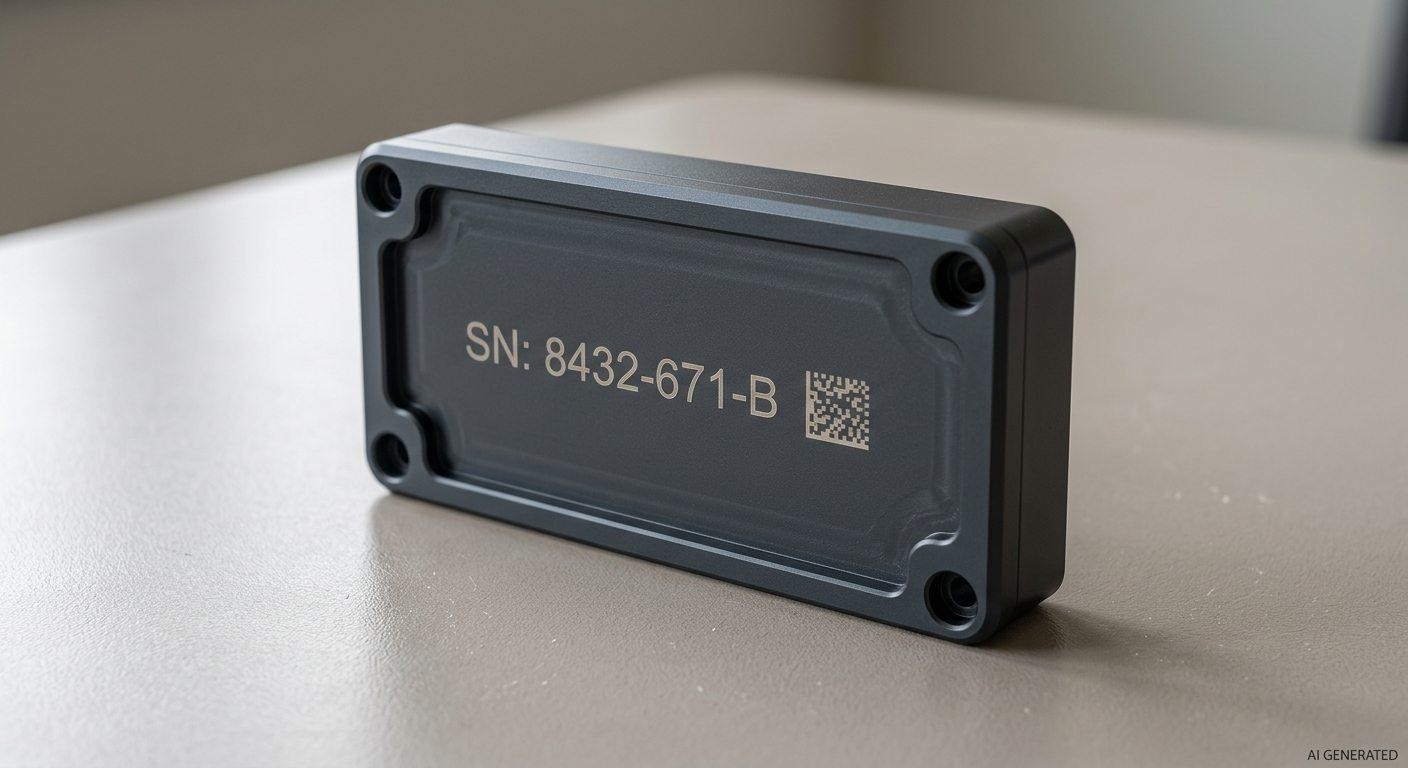
Black anodized aluminum enclosure with a light laser-marked serial number
Aluminum is widely used for CNC-machined enclosures, brackets, heat sinks and panels. These parts often need serial numbers, revision codes, Data Matrix codes or operating legends, and the marking has to remain legible on the finished surface. The term laser engraving aluminum can describe different results in practice. One supplier may interpret it as cutting a measurable recess into the base metal, while another may use it loosely for a laser mark on a coated surface. If the finished part needs a specific recess or visual contrast, state that requirement on the drawing rather than relying on the process name alone.
For aluminum components, JLCCNC offers laser marking as a surface-finish option. The marked area is recessed by 0.03–0.1 mm, and the result is single-tone, with the appearance determined by the material and surface treatment. In this article, engraving and etching are used to compare broader industry terminology with the marking result specified for JLCCNC parts.
What Is Laser Engraving Aluminum and How Does It Work?
Laser engraving removes base material through localized heating and material ejection. The resulting cavity depends on the laser source, focal position, pulse settings, scan speed, and number of passes. For parts with a defined depth requirement, the cavity must be assessed against the drawing rather than estimated from a generic material-removal rate.
Aluminum presents a different laser-marking challenge from steel because surface reflectivity and thermal conductivity affect how energy couples into the workpiece and how heat spreads. For example, 6061-T6 aluminum has a much higher thermal conductivity than 304 stainless steel, but this property alone does not determine marking speed or achievable depth. Process settings must be matched to the alloy, surface finish, and required mark.
Laser marking can produce a visible result through material removal or a change in surface color, depending on the material and process. On anodized aluminum, do not assume that a light mark is produced solely by bleaching the dye or that the anodic layer remains intact. On bare aluminum, contrast is influenced by the alloy and surface finish, so the actual appearance should be assessed on the specified material rather than predicted from color alone.
Laser Engraving vs. Laser Marking vs. Laser Etching on Aluminum
| Process | Material removal | Depth interpretation | Typical result |
|---|---|---|---|
| Laser engraving | Removes base material | Defined by the required recess and process settings; often used for deeper cavities | Recessed feature, sometimes with a tactile edge |
| Laser etching | Usually involves limited material removal or shallow surface modification | Depends on the process; no universal depth cutoff | Shallow surface change or contrast effect |
| Laser marking | Broad term covering surface changes and material removal | Depends on the marking method | Visible mark shaped by material, finish and laser settings |
| JLCCNC laser marking | Produces a recessed marking area | 0.03–0.1 mm | Single-tone result determined by material and surface treatment |
Suppliers do not always use engraving, etching and marking in exactly the same way. When comparing processes, look at how much material is removed and what the finished surface needs to look like. For JLCCNC parts, the relevant marking depth is 0.03–0.1 mm. See our laser etching guide for a closer comparison of the related processes.
Precision CNC Machining Service
If your aluminum part needs a logo, serial number, or panel legend, you can include laser marking in your JLCCNC quote rather than sourcing it separately. Upload your CAD files to get an instant quote and DFM feedback from our engineers.
Bare Aluminum vs. Anodized Aluminum: How Do Laser Marks Differ?
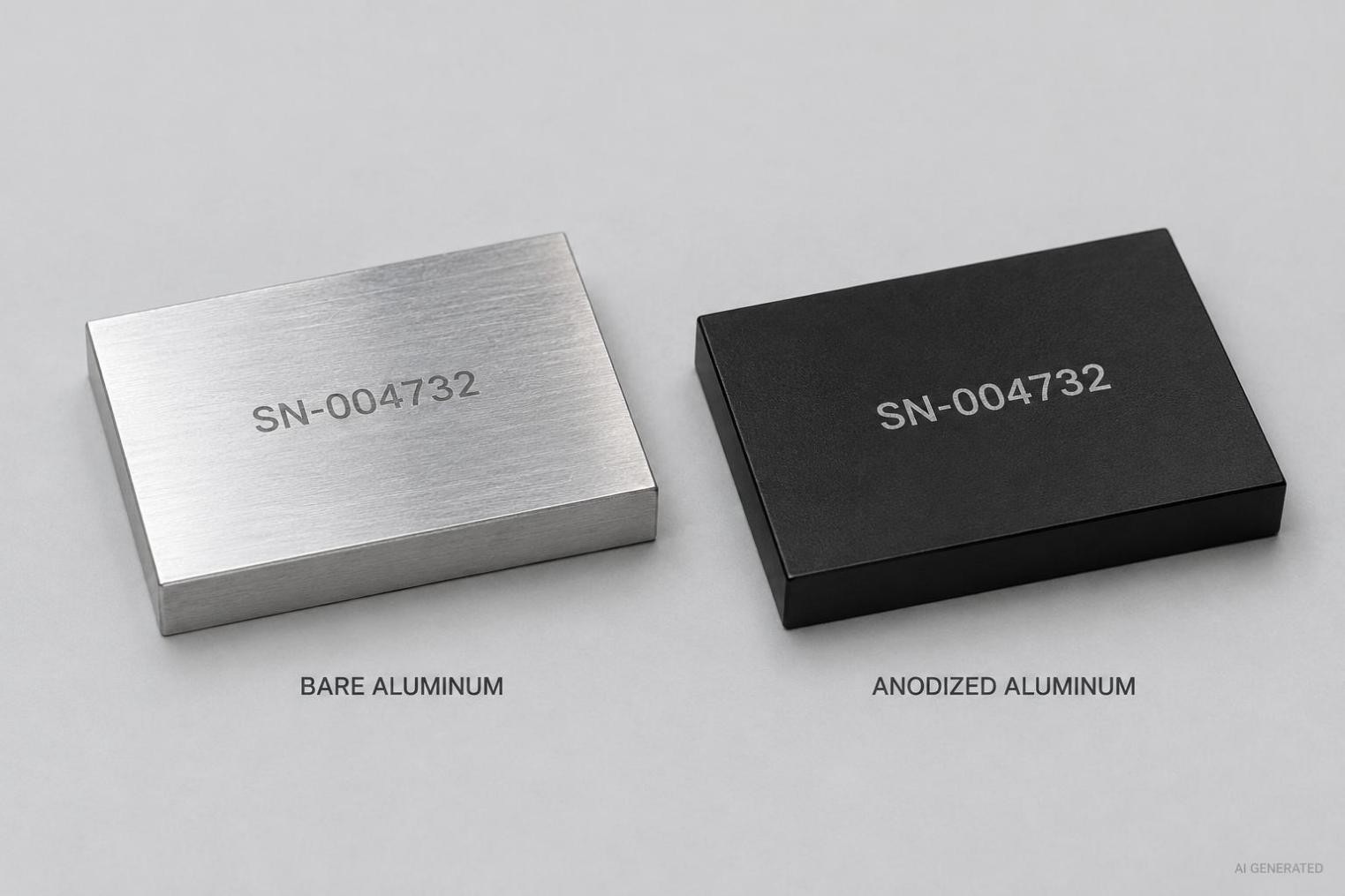
comparison of bare aluminum and black anodized aluminum.
The two surfaces respond through different mechanisms, and within each, alloy and finish details change the outcome. The same result can't be predicted on both surfaces.
Laser Marking on Bare Aluminum
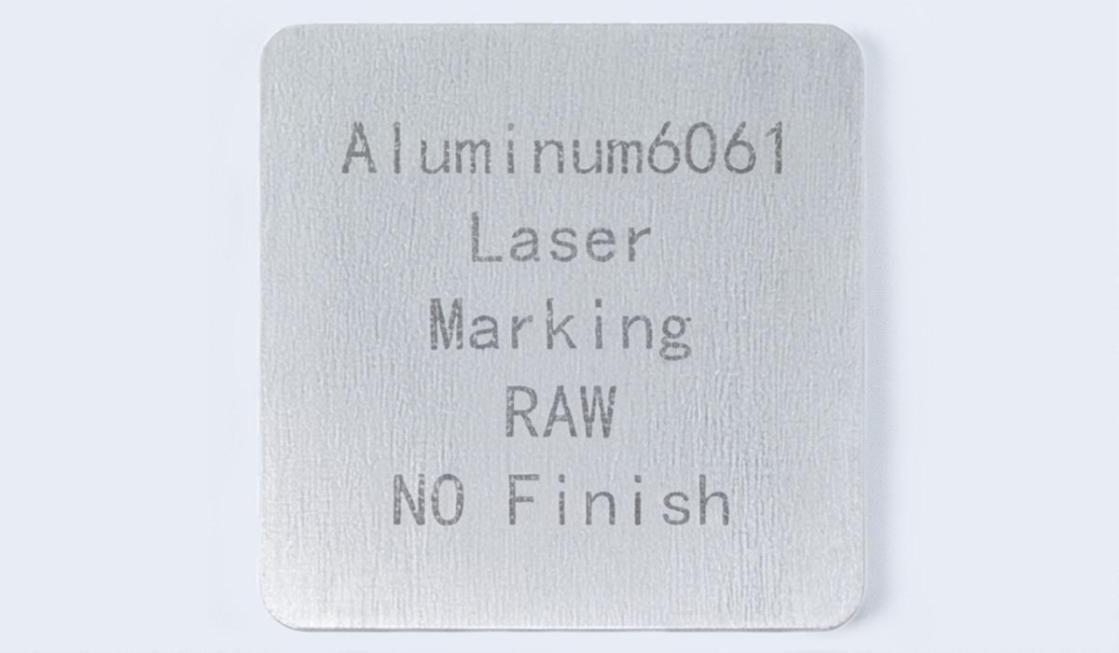
Raw aluminum 6061 laser marking
With no dyed anodic coating to expose, a visible mark on bare aluminum is created through laser-induced texture change, oxidation, and/or shallow material removal. Aluminum's reflectivity and thermal conductivity make the result sensitive to the alloy, surface condition, laser source, and process settings. Compared with dark anodized aluminum, bare aluminum often produces a subtler grey-to-matte contrast, so the artwork should be qualified on the specified alloy and finish.
Surface finish affects both contrast and legibility. Tool marks on a machined face can interfere with thin characters, while bead blasting changes how the surface reflects light and may alter the apparent contrast of the mark. For repeatable production, qualify the artwork on the specified alloy and finish; approval on one grade or surface condition does not automatically validate another.
Laser Marking on Anodized Aluminum
The anodic coating thickness must come from the drawing or finish specification. For context, Type II and Type III anodizing cover broad thickness ranges, but those ranges do not predict how a specific laser mark will look or whether it will reach the aluminum substrate. Qualify the selected alloy, anodizing finish, and marking sequence on a representative sample.
A light mark on dark anodized aluminum is a common target for enclosure legends and identification codes. However, the contrast depends on the anodized finish, material and laser process. Do not assume that every light mark is created by bleaching the dye alone or that the anodic layer remains fully intact. This distinction matters when the coating also provides corrosion or wear protection.
Should Aluminum Be Marked Before or After Anodizing?
Marking after anodizing is a common sequence when the required result is a visible mark on the finished anodized surface. Marking before anodizing may produce a different result because the subsequent coating process can change the appearance of the marked area. Choose the sequence based on the required contrast and whether the anodic coating must remain intact. If either requirement is critical, verify the finish on a sample processed in the same order as production.
Note
Does laser marking affect corrosion protection on anodized aluminum? It can, if the process removes or breaches the anodic layer. If corrosion resistance is a functional requirement, confirm how the marking affects the coating before approving the process for production.
Benefits and Limitations of Laser Engraving Aluminum
Benefits of Laser Engraving Aluminum
Laser marking places the identifier directly on the part surface rather than adding an ink layer or adhesive label that could peel away. The mark is recessed by 0.03–0.1 mm, which gives it a physical feature below the surrounding surface. Its service life still depends on the amount of wear the part experiences and whether later machining or blasting will remove material from the marked area.
Deeper engraving can remain legible after more surface wear because the feature extends further into the base material. However, a deeper recess is not automatically the better choice: it removes more material and may be unsuitable near sealing faces, threads or other tolerance-critical features. Specify the depth according to the part's function rather than choosing it solely for permanence.
Limitations and Factors That Affect Engraving Quality
On aluminum, alloy and surface finish affect how the laser mark appears. JLCCNC laser marking produces a single-tone result determined by the material and surface treatment, so multicolor graphics should not be assumed to be achievable with this process alone. Because the marked area is recessed, later machining or blasting may alter the finished mark. Sustained abrasion can also affect legibility depending on the application.
Greater material removal generally requires more processing time and can increase local heat input. On thin sheet or thin-walled parts, check for unacceptable distortion or finish changes where dimensional stability matters.
Common Applications for Engraved and Laser-Marked Aluminum Parts
Part Identification and Traceability
On CNC-machined aluminum, marks usually carry the part number, drawing revision, serial number or lot code, often as a 2D data matrix. Housings, brackets, heat sinks, fixture plates and tooling components are typical examples, where the code lets a part be matched to its drawing and inspection record after it leaves the machine. Aluminum sheet-metal chassis and mounting plates often need the same part numbers and traceability codes as CNC-machined components. Where anodizing or another cosmetic finish is specified, choose the marking sequence according to the required contrast and coating condition rather than assuming that marking must always take place after the final surface treatment.
Logos, Labels, and Functional Markings
Front and rear panels of enclosures are the most common place for legends: connector and port names, switch positions, indicator labels, ground symbols and ratings. Anodized aluminum panels are widely used for this, since the light mark on a dark finish reads clearly without ink. Nameplates, equipment model markings and company logos fall in the same group, as do alignment marks and scale lines on machined components.
What Should You Specify for Laser Engraving Aluminum?
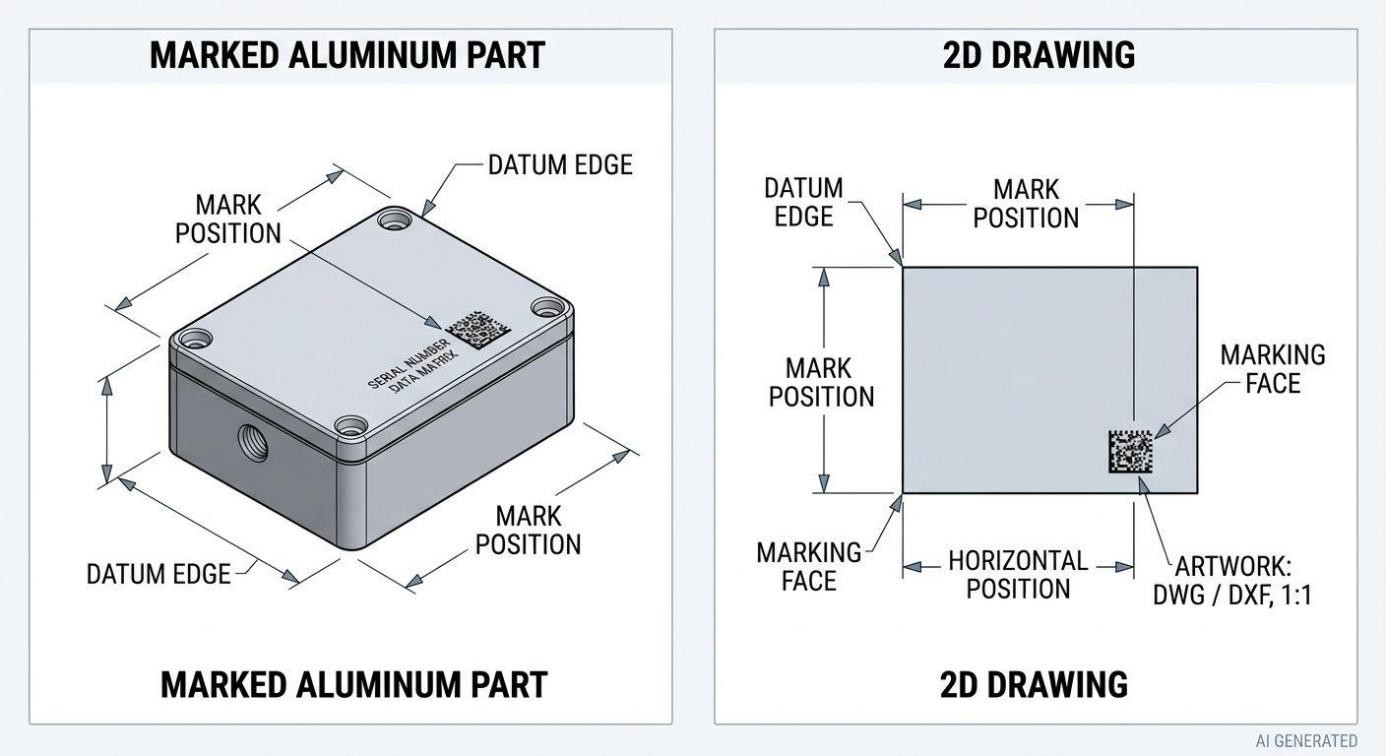
2D drawing and 1:1 DWG or DXF artwork requirement.
For aluminum parts, identify the alloy and surface condition in the drawing or order documentation. If the part is anodized, specify the intended anodizing finish and describe the required mark appearance, such as light characters on a black anodized panel. Supply the marking artwork at 1:1 scale in DWG or DXF format, show the complete dimensions of the graphic, and provide sufficient locating dimensions to identify the marking area. For a special-shaped surface, include the exact marking location and detailed instructions. If coating integrity or marking sequence is critical, state that requirement before production.
JLCCNC offers laser marking on aluminum components, with the mark applied as a surface finish option during ordering. Prepare your 1:1 DWG or DXF artwork, identify the marking face and position on the 2D drawing, and specify the surface finish and contrast you need. The complete requirements are here: design guide for UV printing and laser marking.
Precision CNC Machining Service
Upload your aluminum part with the 2D drawing and artwork for an instant quote, and add laser marking under "Surface Finish".
Laser Engraving Aluminum FAQs
Q: Can Aluminum Be Laser Marked Without Significant Material Removal?
JLCCNC laser marking is specified as a 0.03–0.1 mm recessed mark. It is therefore a local surface-change process, not a zero-removal process. Whether the mark mainly alters the anodic layer or extends into the aluminum substrate depends on the specified alloy, finish, and required result.
Q: Can You Laser Engrave Anodized Aluminum?
Yes, but the required result must be defined. Laser processing may alter or remove the anodic layer and may extend into the aluminum depending on the intended recess and settings. JLCCNC's confirmed service is laser marking with a 0.03–0.1 mm recess; deeper engraving should be treated as a separate capability requirement.
Q: What Determines the Color and Contrast of Laser Marks on Aluminum?
The main factors are the alloy, surface roughness, anodizing type and thickness, dye color and density, and the laser settings. JLCCNC laser marking does not use an independently selectable ink color; the mark is single-tone and determined by the material and surface treatment. However, you should still specify the base anodizing finish and required contrast, for example, "light marking on black anodized aluminum."
Q: Does Laser Marking Affect the Dimensions of Aluminum Parts?
Laser marking creates a local recess of about 0.03–0.1 mm. It does not normally change the unmarked part envelope, but the marked area is dimensionally different from the surrounding surface. Keep markings away from mating faces, sealing surfaces, threads, and tight-tolerance features unless the drawing explicitly permits them.
Keep Learning
CNC Cutting Fluid: Types, Functions, Applications, and Selection Guide
Key Takeaways Cutting fluid in machining performs four functions simultaneously: cooling the tool and workpiece, lubricating the tool-chip interface to reduce friction, carrying chips away from the cut zone, and protecting machined surfaces from corrosion between operations. Different machining operations need different fluid priorities: high-speed aluminum milling may need adhesion control and chip evacuation, threading and tapping need strong lubrication, and grinding requires both cooling and fine ......
Blind Hole Machining Guide: What Is a Blind Hole, Types of Holes, and Tapping Tips
What Is a Blind Hole? Types of Holes and CNC Hole Machining Explained In CNC machining, few operations challenge process control and tool stability as much as blind hole machining. A blind hole is a hole that terminates at a defined internal depth rather than breaking through the opposite surface. Because the cavity is enclosed at the bottom, chip evacuation, thermal behavior, tool wear, and dimensional accuracy become far more difficult to manage compared to through-hole machining. These constraints ......
Rake Angle in Machining: Machinists’ Guide to Perfect Cuts
What is Rake Angle? (minaprem) If you've ever stood in front of a CNC machine or a manual lathe, you know that the cutting tool's geometry isn't just some arbitrary design. Every angle, edge, and surface has a job to do, and one of the most important of those is the rake angle. We've been running machines long enough to know that rake angle can make or break your surface finish, tool life, and machining efficiency. In this guide, we're going to walk you through what rake angle is, how it works, and ho......
Sheet Metal vs CNC Machining: A Guide to Choosing the Right Method for Your Metal Parts
Quick Answer: Choose sheet metal for uniform-thickness enclosures, panels, and formed brackets when bends and production volume support lower unit cost. Choose CNC machining for variable wall thickness, precision bores, tight feature relationships, and complex 3D geometry. Use a hybrid design when a formed structure needs precision-machined interfaces. A quote comes back for a bracket, and it's priced as a CNC part — machined from solid aluminum, a few hours of spindle time, a per-part cost that makes......
What Steps Are Taken To Minimize Waste In CNC Machining Processes?
How to Reduce Waste in CNC Machining: 5 Practical Strategies Quick Answer: CNC machining waste is reduced mainly through DFM, near-net stock, efficient toolpaths, preventive tool maintenance, and alloy-segregated recycling. The biggest gains usually come before cutting: reduce unnecessary material removal and prevent scrap or rework. Every CNC-machined part starts as more material than it ends up being. A pocket gets milled out, a profile gets cut away, a boss gets faced down to size — and all of that......
Machining Burrs Explained: Causes, Types, and Removal Methods
CNC Machining Burrs (Envato) If you've ever run your hand across a freshly machined part and felt a sharp edge catch your skin, you've met the enemy: the burr. At first glance, it looks like a tiny flaw, but in machining, burrs are more than just a cosmetic annoyance. They can cut into assembly time, drive up costs, and in worst cases, create safety hazards for anyone handling the part. So, what is burr in machining? Think of it as the unwanted leftovers of the cutting process, those ragged edges, thi......