PEEK CNC Machining: Properties, Applications & Best Practices
7 min
- PEEK CNC Machining: Properties, Applications & Best Practices
- What Is PEEK?
- Why PEEK Is Harder to Machine Than Most Plastics
- Machining Recommendations
- Where PEEK Shows Up
- PEEK vs. Other High-Performance Materials
- FAQ
PEEK CNC Machining: Properties, Applications & Best Practices
Most plastics get chosen for CNC machining because they're easy to cut and cheap enough that the ease doesn't matter much either way. PEEK gets chosen for the opposite reason — it's genuinely difficult and expensive to machine, and engineers spec it anyway because nothing else in the plastic world does what it does at the temperatures and loads it's asked to handle. Understanding why PEEK earns that reputation, and what it actually takes to machine it well, is worth knowing before a PEEK part shows up on a quote.
Need Custom Titanium CNC Machining?
If you’re looking for a reliable manufacturing partner for titanium parts, JLCCNC can help. We provide precision CNC milling and turning for titanium, with machining parameters and coolant strategies adjusted to handle its heat, work-hardening, and tool-wear challenges.

Precision CNC Machining Service
Professional manufacturing, fast turnaround, and quality assurance.
What Is PEEK?
PEEK (polyether ether ketone) is a high-performance thermoplastic known for an unusual combination of properties for a plastic: it maintains mechanical strength at continuous service temperatures up to around 250°C, resists a wide range of chemicals, has excellent fatigue resistance, and is inherently flame-retardant without additives. It's also one of the few plastics that can genuinely substitute for metal in some applications — not because it's as strong as steel or aluminum, but because its strength-to-weight ratio and chemical/thermal resistance let it replace metal where weight reduction or non-conductivity matters more than raw strength.
That performance comes at a real cost. PEEK resin is expensive relative to nearly every other engineering plastic, and its mechanical behavior under a cutting tool requires more careful process control than the ABS, acrylic, or polycarbonate a shop might cut all day without much thought.
Why PEEK Is Harder to Machine Than Most Plastics
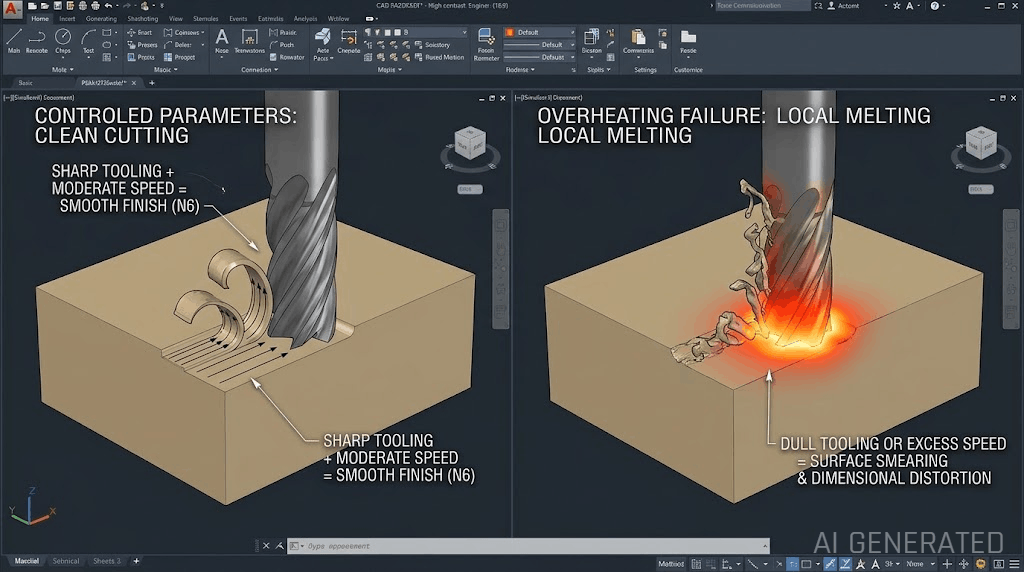
It generates heat that has nowhere good to go. Despite being a high-temperature-rated material, PEEK is a poor thermal conductor, similar to titanium in this specific respect — heat from cutting concentrates at the tool edge rather than dissipating through the part. Excess heat during machining can cause local melting, poor surface finish, or dimensional distortion, which is a frustrating failure mode on an expensive piece of material.
It's semi-crystalline, and that affects how it cuts. PEEK's crystalline structure gives it much of its strength and thermal performance, but it also means the material doesn't cut as predictably as fully amorphous plastics (like acrylic or polycarbonate) — chip formation and surface finish are more sensitive to cutting parameters than with simpler plastics.
It's genuinely expensive to scrap. A ruined PEEK part isn't a minor material cost the way a ruined acrylic prototype is — PEEK stock costs enough that a machining mistake represents real money, which raises the stakes on getting speeds, feeds, and tooling right the first time rather than learning through trial and error on the actual part.
Machining Recommendations
Use sharp, appropriate tooling. Carbide tooling with a sharp cutting edge and appropriate geometry for plastics (typically higher rake angles than metal-cutting tools use) produces cleaner cuts and reduces the heat generated per pass. Dull tooling in PEEK doesn't just cut poorly — it generates disproportionately more heat, which compounds the material's already-limited heat dissipation.
Moderate speeds, controlled feeds. Similar to titanium's logic, excessive cutting speed in PEEK generates more heat than the material can shed, risking local melting right at the cut surface. The right settings depend on the specific tooling and part geometry, but the general principle — don't push speed to what a "plastic should handle easily" instinct suggests — holds throughout.
Coolant and air cooling both have a place. Some shops run PEEK dry with compressed air cooling to avoid any risk of coolant affecting surface finish or being absorbed into the material; others use coolant for more aggressive material removal on larger parts. The right call depends on the specific part's tolerance and finish requirements, but heat management in some form — air or liquid — is not optional the way it might be for an easy-machining plastic.
Account for minimal but real thermal expansion. PEEK's dimensional stability is good relative to many plastics, but not zero — for tight-tolerance parts, allowing the part to reach thermal equilibrium before final finishing passes, and measuring at a consistent temperature, avoids chasing a dimension that's actually just still contracting as it cools from the heat of machining.
Where PEEK Shows Up
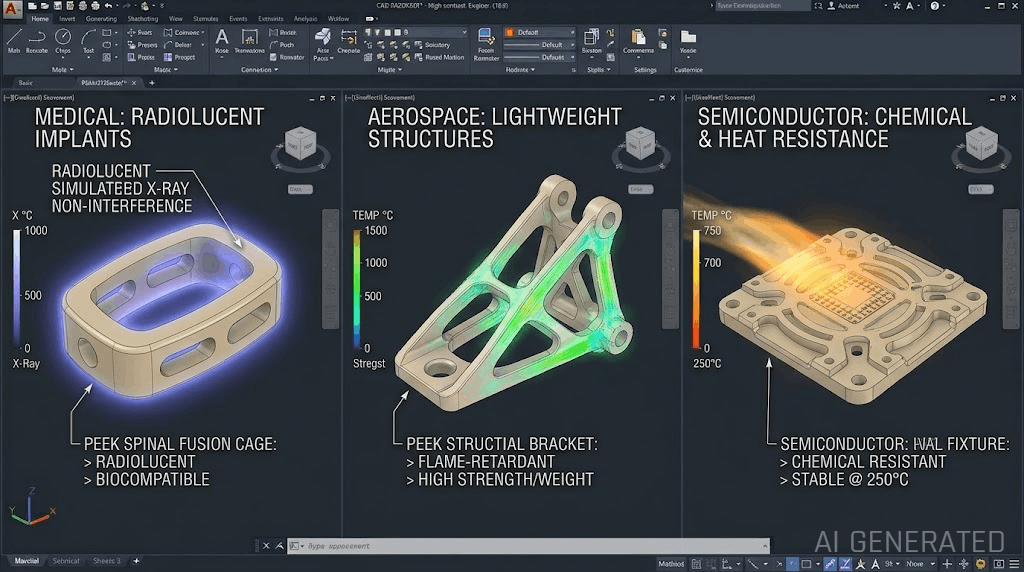
Aerospace uses PEEK for lightweight structural and interior components where its strength-to-weight ratio and flame resistance meet strict aviation requirements without the weight penalty of metal. Medical devices rely on PEEK for implantable components — it's biocompatible, radiolucent (doesn't interfere with X-ray or MRI imaging the way metal implants do), and mechanically similar enough to bone in some applications to reduce stress shielding compared to metal implants. Oil and gas and semiconductor equipment use PEEK where chemical resistance and performance at elevated temperature both matter, in environments that would degrade most other plastics and where the electrical non-conductivity that rules out metal actually matters.
PEEK vs. Other High-Performance Materials
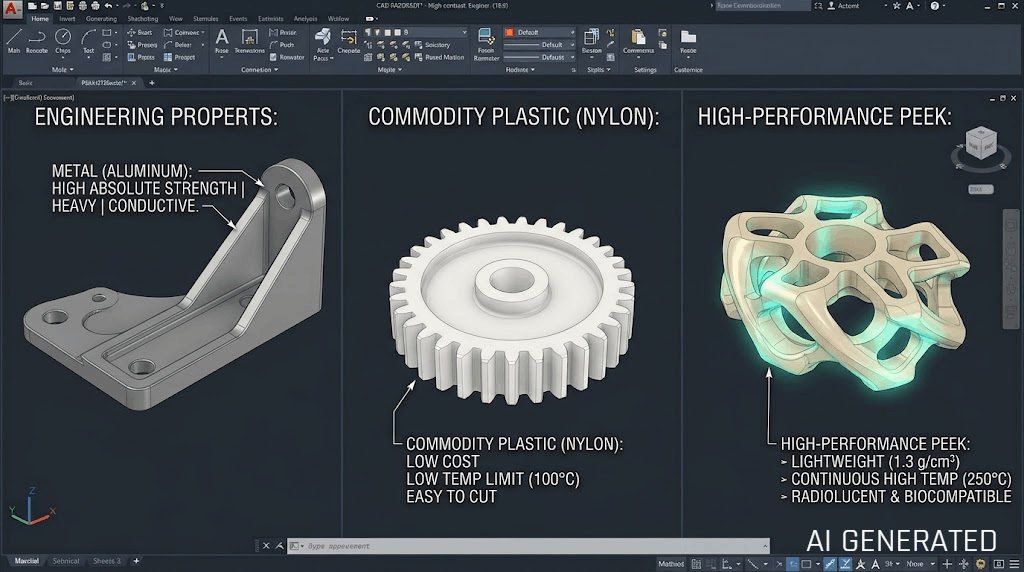
PEEK isn't always the right call just because a part needs to handle heat or chemicals — it's worth weighing against the alternatives before committing to its cost. Metal offers higher absolute strength where weight isn't the primary concern. PTFE offers better chemical resistance and a lower coefficient of friction but far lower mechanical strength and a much lower usable temperature ceiling for load-bearing applications. Other engineering plastics (polycarbonate, nylon) cost significantly less but can't match PEEK's combination of continuous high-temperature strength and chemical resistance. The decision usually comes down to whether the application genuinely needs PEEK's specific combination of properties, or whether a cheaper material would perform adequately — PEEK's cost only makes sense when the application actually uses what it's paying for.
Need Titanium CNC Machining for Your Next Project? Upload your CAD file today to get an instant quote for precision CNC milling and turning.
FAQ
Why is PEEK more expensive to machine than other plastics?
Both the raw material cost and the process itself contribute — PEEK stock costs significantly more than common engineering plastics, and it requires more careful speed, feed, and heat management to machine without local melting or dimensional issues, which generally means slower cycle times than easier-to-machine plastics.
Can PEEK handle high temperatures during machining without melting?
PEEK has a high service temperature rating, but that's different from being immune to heat generated locally at the cutting edge during machining — poor thermal conductivity means that localized heat can still cause surface melting or distortion if cutting parameters aren't controlled, even though the bulk material's temperature rating is high.
Is PEEK stronger than aluminum?
No — PEEK's absolute mechanical strength is well below aluminum's. Its appeal is a strong strength-to-weight ratio combined with chemical resistance, non-conductivity, and high-temperature performance, which makes it attractive for specific applications rather than a general metal replacement.
What industries use PEEK the most?
Aerospace, medical devices (especially implantable components), and oil/gas and semiconductor equipment are the primary users, drawn by PEEK's combination of high-temperature performance, chemical resistance, and — for medical use — biocompatibility and radiolucency.
Keep Learning
Laser Engraving Aluminum: Marking Methods & Surface Effects
Key Takeaways Laser engraving usually removes base material to create a recess. Laser marking is a broader term that can describe a surface-color change or material removal, so the process name alone does not define the final result. On aluminum, alloy and surface finish affect marking contrast. A light mark on dark anodized aluminum is a common design target, but the actual appearance depends on the finish and laser process. JLCCNC laser marking produces a recessed area 0.03–0.1 mm deep. The result i......
CNC Cutting Fluid: Types, Functions, Applications, and Selection Guide
Key Takeaways Cutting fluid in machining performs four functions simultaneously: cooling the tool and workpiece, lubricating the tool-chip interface to reduce friction, carrying chips away from the cut zone, and protecting machined surfaces from corrosion between operations. Different machining operations need different fluid priorities: high-speed aluminum milling may need adhesion control and chip evacuation, threading and tapping need strong lubrication, and grinding requires both cooling and fine ......
Blind Hole Machining Guide: What Is a Blind Hole, Types of Holes, and Tapping Tips
What Is a Blind Hole? Types of Holes and CNC Hole Machining Explained In CNC machining, few operations challenge process control and tool stability as much as blind hole machining. A blind hole is a hole that terminates at a defined internal depth rather than breaking through the opposite surface. Because the cavity is enclosed at the bottom, chip evacuation, thermal behavior, tool wear, and dimensional accuracy become far more difficult to manage compared to through-hole machining. These constraints ......
Rake Angle in Machining: Machinists’ Guide to Perfect Cuts
What is Rake Angle? (minaprem) If you've ever stood in front of a CNC machine or a manual lathe, you know that the cutting tool's geometry isn't just some arbitrary design. Every angle, edge, and surface has a job to do, and one of the most important of those is the rake angle. We've been running machines long enough to know that rake angle can make or break your surface finish, tool life, and machining efficiency. In this guide, we're going to walk you through what rake angle is, how it works, and ho......
Sheet Metal vs CNC Machining: A Guide to Choosing the Right Method for Your Metal Parts
Quick Answer: Choose sheet metal for uniform-thickness enclosures, panels, and formed brackets when bends and production volume support lower unit cost. Choose CNC machining for variable wall thickness, precision bores, tight feature relationships, and complex 3D geometry. Use a hybrid design when a formed structure needs precision-machined interfaces. A quote comes back for a bracket, and it's priced as a CNC part — machined from solid aluminum, a few hours of spindle time, a per-part cost that makes......
What Steps Are Taken To Minimize Waste In CNC Machining Processes?
How to Reduce Waste in CNC Machining: 5 Practical Strategies Quick Answer: CNC machining waste is reduced mainly through DFM, near-net stock, efficient toolpaths, preventive tool maintenance, and alloy-segregated recycling. The biggest gains usually come before cutting: reduce unnecessary material removal and prevent scrap or rework. Every CNC-machined part starts as more material than it ends up being. A pocket gets milled out, a profile gets cut away, a boss gets faced down to size — and all of that......