Sheet Metal vs CNC Machining: A Guide to Choosing the Right Method for Your Metal Parts
18 min
- The Core Difference
- CNC or Sheet Metal — We Do Both
- Decision Framework
- How to Choose: A 5-Step Decision Tree
- Where Sheet Metal Wins
- Where CNC Machining Wins
- Cost Drivers, Not Just Volume
- Tolerance and Feature Reality Check
- Redesigning a Machined Part for Sheet Metal
- One Hybrid Assembly Example
- Material Considerations
- The Real Cost Curve
- A Common Mistake Worth Flagging
- FAQ
- Not Sure Which Process Fits Your Part?
Quick Answer: Choose sheet metal for uniform-thickness enclosures, panels, and formed brackets when bends and production volume support lower unit cost. Choose CNC machining for variable wall thickness, precision bores, tight feature relationships, and complex 3D geometry. Use a hybrid design when a formed structure needs precision-machined interfaces.
A quote comes back for a bracket, and it's priced as a CNC part — machined from solid aluminum, a few hours of spindle time, a per-part cost that makes sense for ten units but starts looking painful at a thousand. The same bracket, cut and bent from sheet stock, would cost a fraction of that at volume. Nobody made a mistake here; the part just got quoted through the wrong process for its actual requirements. That mismatch — sheet metal work priced and built like a machined part, or vice versa — is one of the more expensive mistakes in early product design, and it's usually avoidable with a clear framework for which process actually fits.
The Core Difference
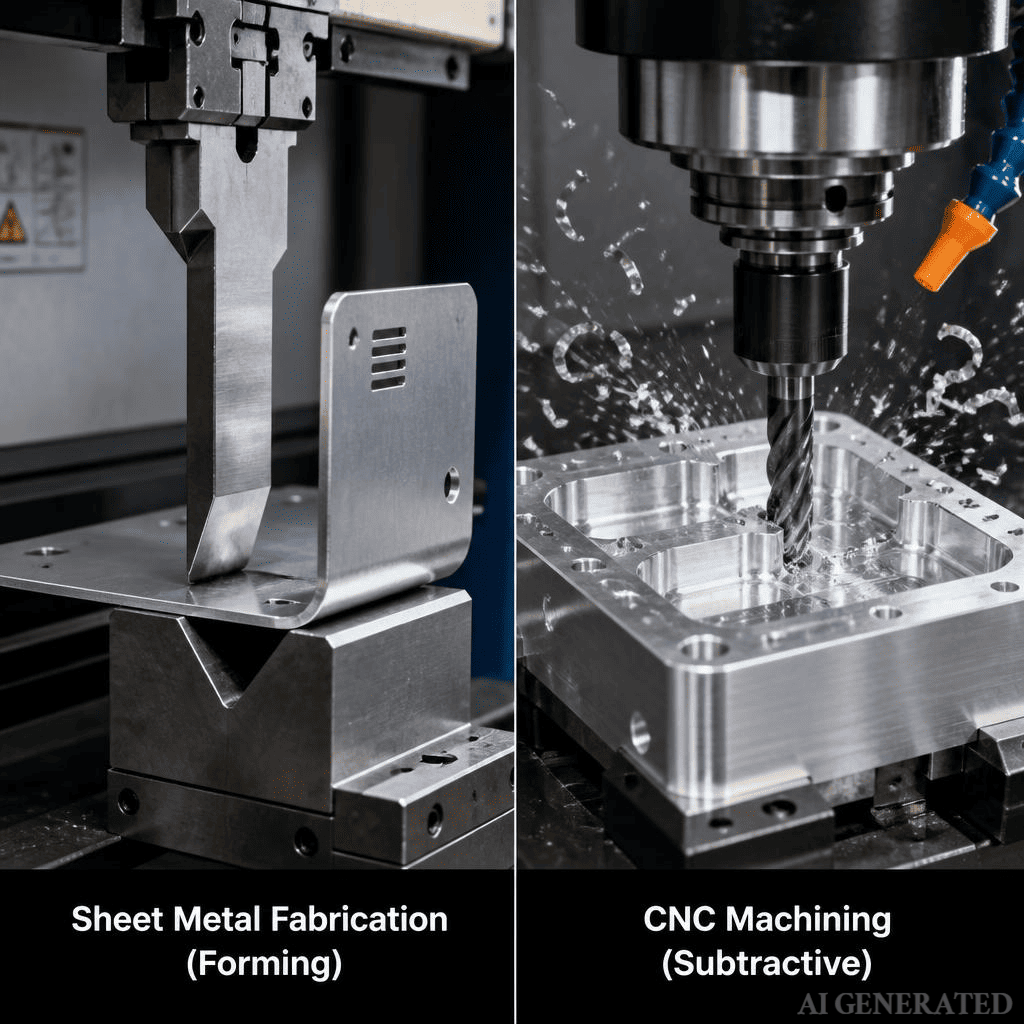
Sheet metal fabrication forms a part from flat stock — cutting, bending, and joining thin material into its final shape. CNC machining removes material from a solid block until the final geometry emerges. That distinction — forming versus removing — is what drives almost every practical difference between the two: cost structure, achievable geometry, tolerance, and how each scales with volume. It's also why the two processes don't compete on a level playing field for most parts — once you know which side of "form vs. remove" your part naturally sits on, half the decision is already made before cost even enters the conversation.
CNC or Sheet Metal — We Do Both

Need CNC and Sheet Metal? We've Got Both
JLCCNC does both CNC machining and sheet metal fabrication in-house. Upload your file, get an instant quote.
Decision Framework
| Factor | Favors Sheet Metal | Favors CNC Machining |
|---|---|---|
| Wall thickness | Uniform, thin — typically under 6mm, though this depends on material and forming method | Variable thickness, thick sections |
| Geometry | Flat panels, bent enclosures, brackets | Complex 3D features, pockets, threaded bosses |
| Tolerance | ±0.1–0.3mm typical, tighter with secondary operations | ±0.01–0.05mm achievable, depending on material and feature size |
| Material waste | Low — forming generates minimal scrap | Higher — material is cut away as chips |
| Volume economics | Cost drops fast with volume, but the rate depends heavily on whether the process is press-brake bending or stamping | Cost scales more linearly with volume |
| Prototype cost | Can be higher per-unit at very low volume due to setup | Often cheaper for true one-offs (no tooling needed) |
| Lead time | Faster once in production; batch-dependent | Often faster for a single prototype, no setup to plan around |
| Surface finish out of process | Generally rougher without secondary finishing, though this varies by material and process | Can achieve fine finish directly off the tool |
The numbers above are typical ranges, not guarantees — actual tolerance and thickness limits depend on the specific material, part size, forming or cutting method, and feature geometry involved. Neither column is "better" in the abstract — the right answer depends entirely on which factors matter for a specific part.
How to Choose: A 5-Step Decision Tree
The table above tells you what each process is generally good at. This turns that into something you can actually run a part through:
- Is wall thickness uniform across the part? If yes, sheet metal is still in play. If the part needs varying thickness in different sections, that alone usually rules sheet metal out.
- Can the geometry be formed by bending, rather than requiring it be cut from solid? A flat pattern that folds into the final shape favors sheet metal. A shape with internal pockets, bosses, or geometry that can't unfold flat needs machining.
- Does any feature need a precision bore, bearing seat, or tightly toleranced hole relationship? If yes, that feature — and possibly the whole part — needs CNC, even if the rest of the geometry would otherwise suit sheet metal.
- Where does your volume sit? Low volume with simple geometry often favors CNC (no tooling, no bend planning). Moderate-to-high volume with sheet-metal-compatible geometry usually favors sheet metal.
- Does the part actually need to be one piece, or could it be a hybrid? If step 3 flagged a precision feature but the rest of the part is sheet-metal-friendly, a hybrid assembly is often cheaper than machining the whole thing.
Running an actual part through these five questions in order, rather than defaulting to whichever process a designer is more familiar with, is usually enough to catch a mismatch before it turns into a bad quote.
Where Sheet Metal Wins
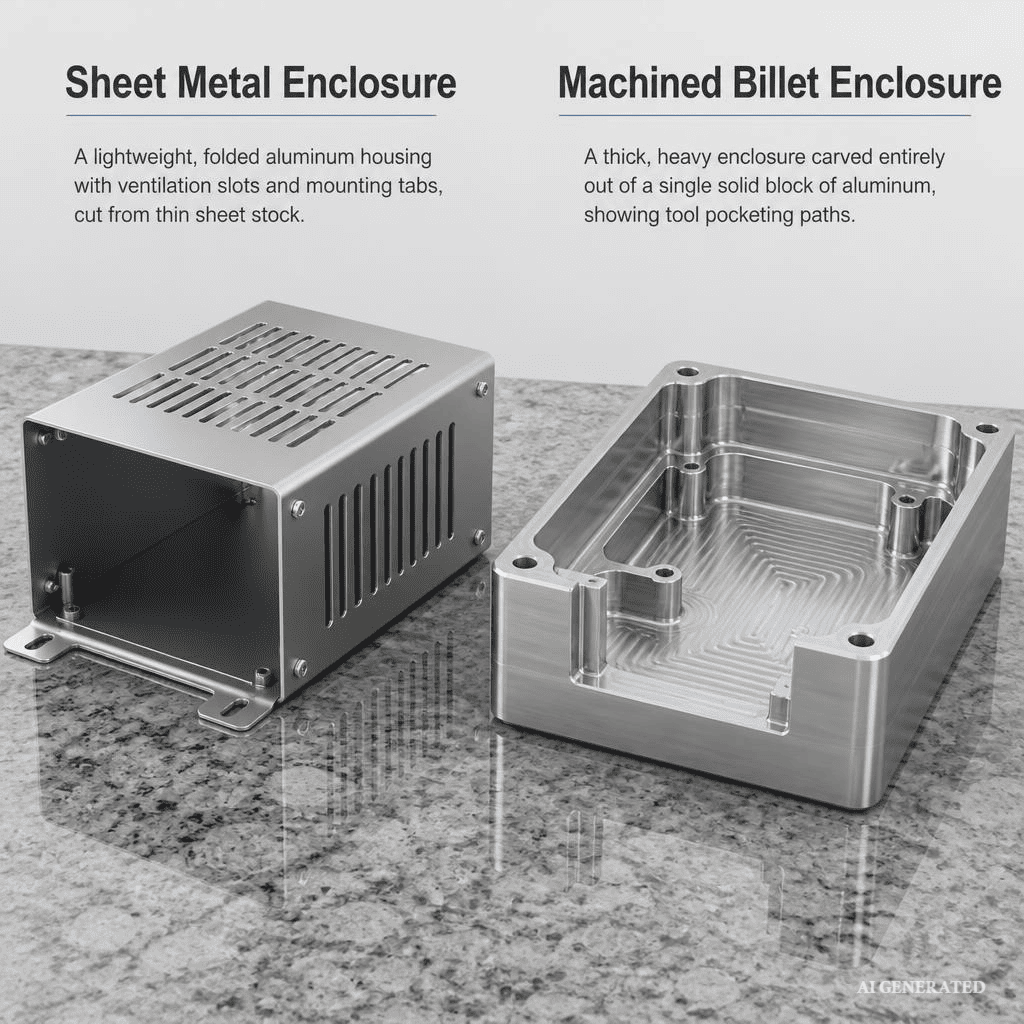
Enclosures, panels, brackets, and chassis with mostly uniform wall thickness are sheet metal's home turf. A sheet metal enclosure that would need a solid block of aluminum hollowed out on a mill costs dramatically more in both material and machine time than the same shape cut flat and folded into a box. At production volume, this gap widens further — sheet metal's low scrap rate and fast cycle time on simple bends make it the clear cost winner for parts that don't need machining's tighter tolerances or 3D complexity.
There are design rules that come with this territory, and they're worth knowing before a part gets drawn rather than after it comes back from the shop with a note attached. Holes placed too close to a bend line will distort during forming — a rough rule of thumb is keeping at least 3x the material thickness between a hole's edge and the bend line. Minimum bend radius matters too: pushing a bend tighter than the material can reasonably take leads to cracking on the outer surface, especially with harder alloys. These aren't limitations that make sheet metal a lesser option — they're just the constraints that come with forming instead of removing material, and designing around them from the start avoids a redesign cycle later. Our sheet metal design guidelines go deeper into these bend, hole-spacing, and flange rules if you're drawing a part now.
Where CNC Machining Wins
Anything needing tight tolerances, threaded holes machined directly into the part, varying wall thickness, or complex 3D features that can't be formed from flat stock belongs in CNC machining. A mounting plate needing precisely located, tightly toleranced holes for a bearing assembly isn't a sheet metal job — the tolerance and feature complexity simply exceed what forming can reliably produce.
Deep features have their own limits worth knowing on the machining side. A pocket deeper than roughly four times its diameter starts requiring longer, more flexible tooling, which drives up cycle time and cost, and increases the risk of chatter or tool deflection affecting the finish. It doesn't rule the feature out — it just changes the cost math, and it's another reason "can CNC do it" and "should CNC do it at this price point" are different questions.
For true one-off prototypes, machining is also often cheaper in practice, since it needs no tooling investment the way some sheet metal processes — stamping in particular — do. Standard press-brake bending, the default for custom and low-volume sheet metal work, doesn't carry that same tooling penalty; it's cutting and forming operations, not a stamping die, which is why a low-volume bracket cut on a laser and folded on a brake can still compete with machining on price even without any tooling amortized into it.
Cost Drivers, Not Just Volume
Volume matters, but it's not the whole cost story — and treating "sheet metal wins at volume" as the entire rule misses where the actual cost comes from on each side.
On the sheet metal side, cost is driven by material utilization (how efficiently the flat pattern nests on the sheet), the number of cuts and bends, whether parts need welding or additional fastening, and any secondary surface finishing. A part with a simple flat pattern and two bends costs very differently from one with a dozen tabs, slots, and a welded seam — even at the same volume and material.
On the CNC side, cost tracks the size of the starting stock, how much material has to be removed to reach final geometry, how many times the part needs to be re-fixtured to reach all its features, tooling wear on harder materials, and how tightly toleranced features need inspecting after the cut. A part that looks simple but needs machining from six sides costs more than its footprint suggests, regardless of order quantity.
This is also where the sheet metal tooling question matters. Laser cutting and press-brake bending — the default route for prototypes and low-to-moderate volume custom sheet metal — carry no tooling cost; you're paying for cutting and setup time per batch. Stamping, by contrast, requires a dedicated die, which is a real upfront cost that only pays off once volume is high enough to amortize it across thousands of parts. Comparing a stamped-part cost curve to a CNC part is a different conversation than comparing a laser-cut-and-bent part to a CNC part, and conflating the two is a common source of quotes that don't match expectations.
Tolerance and Feature Reality Check
Some features have a real answer on which process they need, and it's worth being direct about which ones: bearing bores, features requiring tight coaxiality between two holes, precisely located dowel or locating pin holes, and complex internal cavities are CNC territory. Sheet metal forming doesn't hold that level of geometric precision, and no amount of secondary finishing changes that.
But it's a mistake to jump straight to "this part needs a thread, so it needs CNC." Sheet metal has its own ways of handling fasteners and threaded connections without machining the whole part: bent tabs with clearance holes, PEM self-clinching fasteners pressed into the sheet, riveted nuts, or welded studs all add threaded or fastening points to a sheet metal part without requiring the part itself be machined. The real question isn't "does this need a thread" — it's "does this need a machined thread in solid material, or would a pressed-in fastener do the job." Most bracket and enclosure fastening needs fall into the second category.
Redesigning a Machined Part for Sheet Metal
This is often the highest-value move in the whole decision, and it's the one that's easy to miss when a part starts life as a CNC drawing and never gets reconsidered. If a part is currently machined but doesn't actually need machining's precision everywhere, redesigning it around sheet metal can cut cost meaningfully at volume. A few principles that tend to work:
- Unify wall thickness. A machined part with varying wall thickness for structural reasons can often be redesigned around a single uniform thickness plus added ribs or folded flanges for stiffness, opening the door to sheet metal.
- Replace pocketed/hollowed sections with a folded shell. A block that's mostly hollowed out to save weight is, functionally, often just an enclosure — which is exactly what sheet metal is good at forming instead of removing material to create.
- Use flanges and fasteners instead of solid thick walls. Where a machined part relies on thick material for mounting strength, a folded flange with the right fastener often does the same structural job at a fraction of the material cost.
- Keep precision interfaces as small, separate CNC parts. The redesign doesn't have to eliminate machining entirely — isolating the one feature that genuinely needs tight tolerance into a small machined insert, bolted or riveted into a sheet metal shell, usually costs less than machining the whole part just to get that one feature right.
One Hybrid Assembly Example
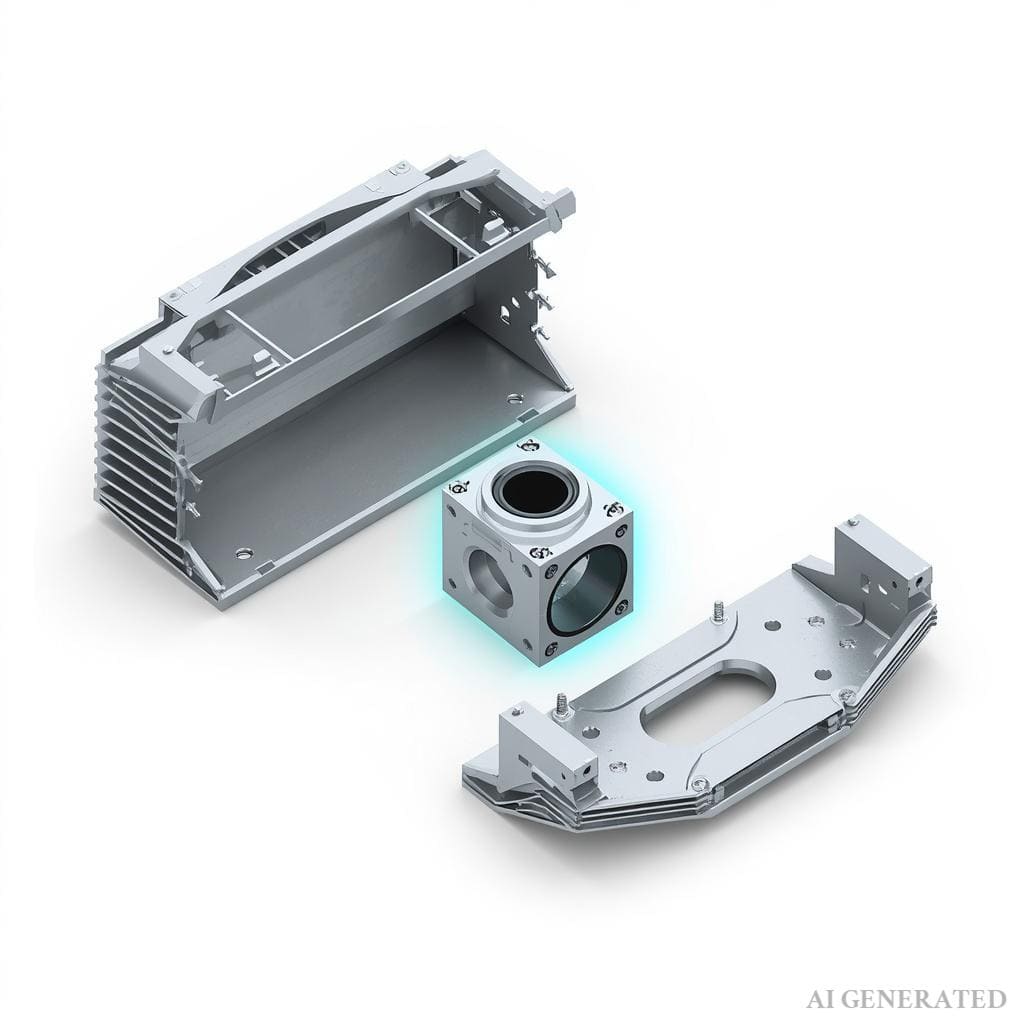
Plenty of real products aren't a clean either/or. A sheet metal chassis provides the lightweight, cost-effective structural shell, while CNC-machined brackets or mounting plates handle the specific spots that need tight tolerances a formed part can't hold — bolted or riveted into the sheet metal structure.
A common version of this: a sheet-metal chassis with a CNC-machined bearing bracket bolted into it. The chassis handles the overall shape, mounting points, and structural panel work — all things sheet metal does well and cheaply at volume. The bearing bracket needs a precisely bored, tightly toleranced hole to seat a bearing correctly, which sheet metal forming can't reliably hold. Rather than machining the entire chassis to get that one bore right, the bore lives on a small dedicated machined part, and the two interfaces — chassis mounting holes and bracket mounting holes — are designed to align during assembly. This hybrid approach is common enough in electronics and equipment housings that it's worth considering from the start of a design, rather than defaulting to one process and forcing every feature to fit it. It's also one of the more practical reasons to source both processes from the same shop — fewer handoffs, fewer tolerance mismatches between the two parts when they're meant to bolt together. Our enclosure design guide goes deeper into this specific decision for enclosure design — covering the same choice this article addresses, but focused on the practical challenges of enclosure geometry, internal component fit, and assembly.
Material Considerations
The two processes don't just differ in how they shape metal — they differ in which metals are practical to work with, and that's often the deciding factor before cost or geometry even get discussed.
- Aluminum 5052 forms well and is a workhorse for sheet metal enclosures, but it's a softer alloy that machines less cleanly at tight tolerances than harder grades.
- Aluminum 6061 is the opposite pattern: it machines cleanly and holds tolerance well on a CNC part, but its formability is more limited — tight bend radii in 6061 are more prone to cracking than in 5052.
- 304 and 201 stainless steel both fabricate well as sheet metal for enclosures and structural panels, but on the machining side stainless work-hardens as it's cut, which means slower feeds, more tool wear, and a costlier part than the same geometry in aluminum or steel.
- Cold rolled steel is a common, economical choice for sheet metal work and machines acceptably too, which is part of why it shows up so often in both processes for general-purpose brackets and housings.
If a design is locked into a specific alloy for strength, corrosion resistance, or cost reasons, it's worth checking that alloy's behavior in the process you're leaning toward before finalizing — a great geometry choice can still get expensive if the material fights the process. See our guide to sheet metal material types for a fuller breakdown by alloy.
The Real Cost Curve
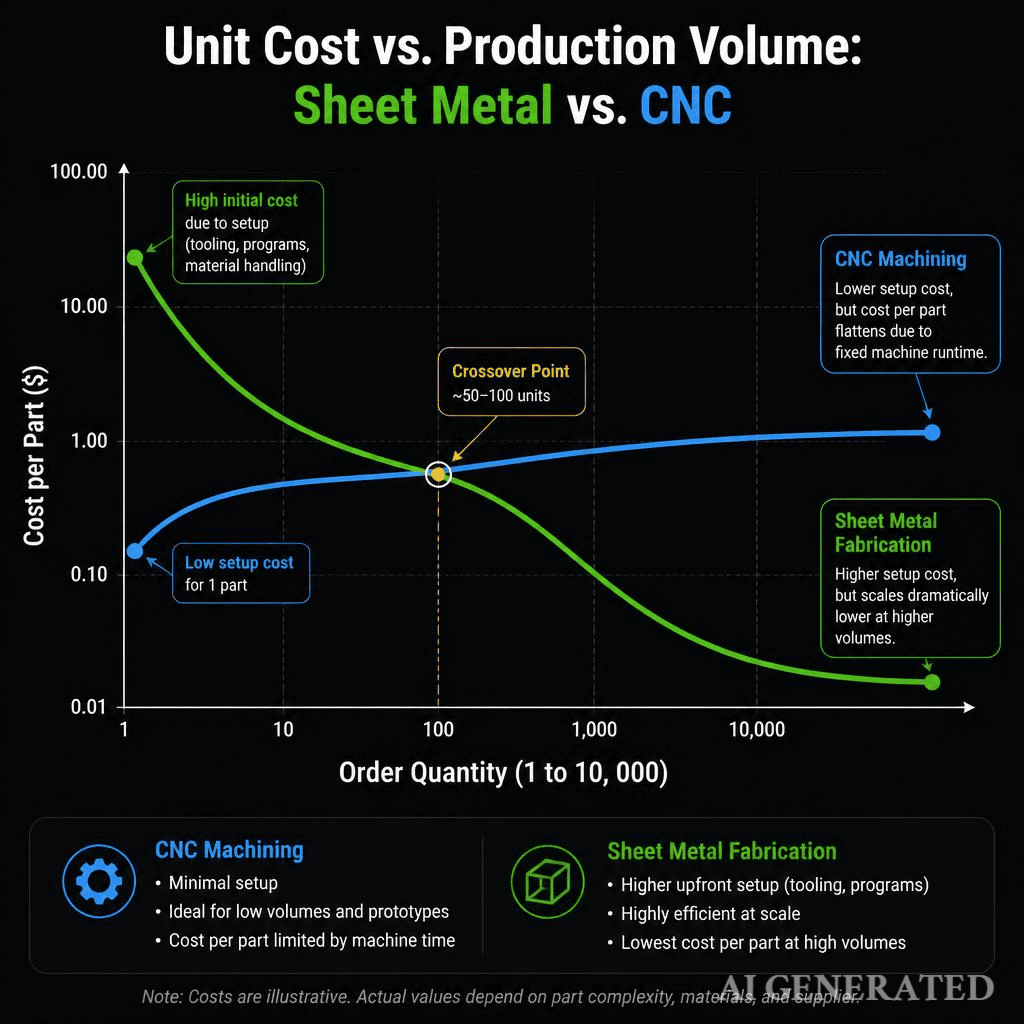
The mismatch described at the top of this article — a bracket quoted as CNC when sheet metal would've been dramatically cheaper at volume — happens because the two processes' cost curves cross at different points depending on the part. At very low volume (a handful of prototypes), the two are often close, sometimes with machining even edging ahead since sheet metal's setup costs don't amortize yet.
As volume grows, sheet metal's per-part cost typically drops well below machining's for parts within its geometric capability — since machining cost stays tied to cutting time and material removed no matter how many parts you order, while sheet metal's setup cost gets spread across a growing batch. Exactly where that crossover happens shifts with the factors above; a simple two-bend bracket crosses over earlier than a part needing several welds and a finish operation. Push volume high enough and the gap widens further for simple flat-and-bend geometries, though a part with genuinely complex 3D features may never cross over — sheet metal simply can't produce it at any volume, which makes the "geometry first, cost second" ordering of this decision worth sticking to. See our breakdown of CNC machining costs for more on how machining cost is actually built up.
A Common Mistake Worth Flagging
Choosing a process based on which one a designer is more familiar with, rather than which one actually fits the part, is a frequent and costly habit. An engineer used to specifying machined parts sometimes defaults to CNC even for a simple bent bracket that sheet metal would produce at a fraction of the cost — not from any real requirement, just familiarity. Running through the decision factors and the 5-step tree above explicitly, rather than defaulting to habit, is a genuinely cheap way to avoid overpaying on a part that didn't need machining's capability in the first place.
FAQ
Is sheet metal fabrication always cheaper than CNC machining? Not always — at very low volume the two can be close, and for parts needing tight tolerances or complex 3D geometry, machining is often the only option regardless of cost. Sheet metal's cost advantage grows most clearly at moderate-to-high volume for parts within its geometric capability.
Can a part be redesigned to use sheet metal instead of machining to save cost? Often, yes — if the part's function doesn't actually require variable thickness or fine 3D features, redesigning around uniform-thickness formed geometry can meaningfully cut cost, especially at volume. This is worth evaluating during design review rather than after tooling or a first production run.
What tolerance can sheet metal fabrication achieve? Typical sheet metal tolerances run around ±0.1–0.3mm depending on the process and material thickness — tighter than many people assume, but still generally looser than CNC machining's ±0.01–0.05mm capability.
Which process has a faster lead time? It depends on where you are in the product cycle. For a single prototype, CNC machining often turns around faster since there's no tooling or bend planning involved. Once you're ordering in batches, sheet metal generally catches up and can move faster per part, since cycle times on cutting and bending are short compared to machining time per unit.
Do sheet metal and CNC machined parts ever get combined in one assembly? Yes, commonly — a sheet metal structure (enclosure, chassis) paired with CNC-machined components at the specific points needing tight tolerance is a standard approach, especially in electronics and equipment housings.
Does material choice limit which process I can use? Not usually as a hard limit, but it changes the cost and quality picture. Softer, more formable alloys like 5052 aluminum favor sheet metal; harder alloys and stainless steel machine well but form less easily, and stainless in particular gets more expensive to machine due to work-hardening during cutting.
Can sheet metal parts use threaded fasteners? Yes — without machining a thread into solid material. PEM self-clinching nuts, riveted nuts, and welded studs are the standard ways to add a threaded connection point to a sheet metal part, and they're usually cheaper than machining a thread would be on an equivalent solid section.
When does stamping change the cost comparison? Stamping requires a dedicated die, which is a real upfront tooling cost that only pays off at high volume — typically thousands of parts. Below that, laser cutting and press-brake bending (no tooling cost) is the more relevant sheet metal comparison against CNC, not stamping.
Can sheet metal meet a ±0.05 mm requirement? Generally no, not directly out of the forming process — sheet metal tolerances typically run ±0.1–0.3mm. A feature genuinely needing ±0.05mm should be isolated to a CNC-machined component, even within an otherwise sheet-metal part or assembly.
Note: tolerance and thickness figures throughout are typical ranges. Actual achievable tolerance depends on material, part size, and process — confirm against your specific part with an engineering review before finalizing a design.
Not Sure Which Process Fits Your Part?
Whether your part is a better fit for sheet metal or CNC machining often comes down to details that are easy to miss on a drawing alone — tolerance requirements, wall thickness consistency, or where your volume actually sits on the cost curve. Our engineering team reviews your design before quoting and can flag which process makes more sense for your specific part, including hybrid approaches where it helps.
Upload your CAD or DXF file to compare a sheet metal, CNC, or hybrid manufacturing route for your part.
- Both Processes, One Shop: Sheet metal fabrication and CNC machining under one roof
- Engineering Review: Manufacturability and process-fit feedback with every quote
- Fast Quotes: Upload your 3D CAD files or drawings (.STEP / .IGES / .DXF) for a rapid review and quote — see our sheet metal order guide for exactly what to prepare before you upload
Keep Learning
Laser Engraving Aluminum: Marking Methods & Surface Effects
Key Takeaways Laser engraving usually removes base material to create a recess. Laser marking is a broader term that can describe a surface-color change or material removal, so the process name alone does not define the final result. On aluminum, alloy and surface finish affect marking contrast. A light mark on dark anodized aluminum is a common design target, but the actual appearance depends on the finish and laser process. JLCCNC laser marking produces a recessed area 0.03–0.1 mm deep. The result i......
CNC Cutting Fluid: Types, Functions, Applications, and Selection Guide
Key Takeaways Cutting fluid in machining performs four functions simultaneously: cooling the tool and workpiece, lubricating the tool-chip interface to reduce friction, carrying chips away from the cut zone, and protecting machined surfaces from corrosion between operations. Different machining operations need different fluid priorities: high-speed aluminum milling may need adhesion control and chip evacuation, threading and tapping need strong lubrication, and grinding requires both cooling and fine ......
Blind Hole Machining Guide: What Is a Blind Hole, Types of Holes, and Tapping Tips
What Is a Blind Hole? Types of Holes and CNC Hole Machining Explained In CNC machining, few operations challenge process control and tool stability as much as blind hole machining. A blind hole is a hole that terminates at a defined internal depth rather than breaking through the opposite surface. Because the cavity is enclosed at the bottom, chip evacuation, thermal behavior, tool wear, and dimensional accuracy become far more difficult to manage compared to through-hole machining. These constraints ......
Rake Angle in Machining: Machinists’ Guide to Perfect Cuts
What is Rake Angle? (minaprem) If you've ever stood in front of a CNC machine or a manual lathe, you know that the cutting tool's geometry isn't just some arbitrary design. Every angle, edge, and surface has a job to do, and one of the most important of those is the rake angle. We've been running machines long enough to know that rake angle can make or break your surface finish, tool life, and machining efficiency. In this guide, we're going to walk you through what rake angle is, how it works, and ho......
Sheet Metal vs CNC Machining: A Guide to Choosing the Right Method for Your Metal Parts
Quick Answer: Choose sheet metal for uniform-thickness enclosures, panels, and formed brackets when bends and production volume support lower unit cost. Choose CNC machining for variable wall thickness, precision bores, tight feature relationships, and complex 3D geometry. Use a hybrid design when a formed structure needs precision-machined interfaces. A quote comes back for a bracket, and it's priced as a CNC part — machined from solid aluminum, a few hours of spindle time, a per-part cost that makes......
What Steps Are Taken To Minimize Waste In CNC Machining Processes?
How to Reduce Waste in CNC Machining: 5 Practical Strategies Quick Answer: CNC machining waste is reduced mainly through DFM, near-net stock, efficient toolpaths, preventive tool maintenance, and alloy-segregated recycling. The biggest gains usually come before cutting: reduce unnecessary material removal and prevent scrap or rework. Every CNC-machined part starts as more material than it ends up being. A pocket gets milled out, a profile gets cut away, a boss gets faced down to size — and all of that......