Titanium CNC Machining: Properties, Challenges & Best Practices
7 min
- Titanium CNC Machining: Properties, Challenges & Best Practices
- Why Titanium Machines Differently
- Common Titanium Grades in CNC Machining
- Machining Strategies That Actually Work
- Where Titanium Shows Up
- A Common Mistake Worth Flagging
- FAQ
Titanium CNC Machining: Properties, Challenges & Best Practices
A shop that's comfortable machining aluminum all day can still get caught off guard the first time a titanium job comes through. The part looks the same on the CAD screen, the toolpath strategy looks reasonable, and then the tool overheats, work-hardens the surface it just cut, and the finish comes out nothing like what aluminum would have produced at the same settings. Titanium isn't just "harder aluminum" — it behaves differently enough under a cutting tool that treating it like any other metal is the fastest way to a scrapped part and a burned-up end mill.
This guide covers what makes titanium genuinely different to machine, the grades that actually show up in CNC work, and the practical adjustments that separate a clean titanium part from a expensive lesson.
Need Custom Titanium CNC Machining?
If you’re looking for a reliable manufacturing partner for titanium parts, JLCCNC can help. We provide precision CNC milling and turning for titanium, with machining parameters and coolant strategies adjusted to handle its heat, work-hardening, and tool-wear challenges.

Precision CNC Machining Service
Professional manufacturing, fast turnaround, and quality assurance.
Why Titanium Machines Differently
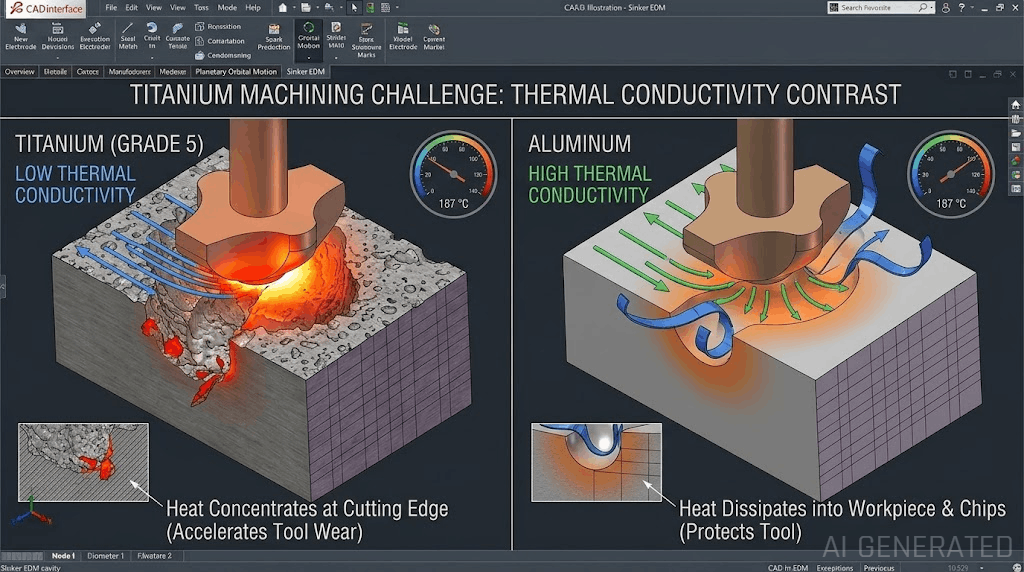
Titanium's appeal — high strength-to-weight ratio, excellent corrosion resistance, biocompatibility — comes from material properties that also make it one of the more demanding metals to cut. Its low thermal conductivity means heat generated during cutting doesn't dissipate into the material or chips the way it would in aluminum or steel; instead, that heat concentrates right at the cutting edge, which is exactly where you don't want it building up. Combine that with titanium's tendency to work-harden when subjected to cutting forces or excess heat, and you get a feedback loop that ruins tools fast if the process isn't controlled carefully: heat builds at the edge, the surface work-hardens, that hardened layer is tougher to cut on the next pass, which generates more heat and more work-hardening.
Titanium is also chemically reactive at the elevated temperatures generated during cutting, which means it can react with cutting tool materials at the tool-chip interface, accelerating tool wear beyond what the material's raw hardness alone would predict.
Common Titanium Grades in CNC Machining
Grade 2 (commercially pure titanium) offers the best machinability among titanium grades, along with excellent corrosion resistance, but lower strength than the alloyed grades. It's a reasonable choice when corrosion resistance matters more than high strength.
Grade 5 (Ti-6Al-4V) is the workhorse titanium alloy, accounting for the large majority of titanium parts machined across aerospace, medical, and industrial applications. It offers a strong balance of strength, weight, and corrosion resistance, at the cost of being noticeably harder to machine than Grade 2 due to its higher strength and hardness.
Grade 23 (Ti-6Al-4V ELI) is an "extra low interstitial" variant of Grade 5, refined for higher purity and better fatigue and fracture properties — common in medical implants where biocompatibility and long-term fatigue performance matter more than the small machinability difference between it and standard Grade 5.
Machining Strategies That Actually Work
Keep cutting speeds lower than instinct suggests. Titanium's poor heat dissipation means high cutting speeds — which would improve efficiency in aluminum — instead concentrate damaging heat right at the tool edge in titanium. Running slower than an aluminum job's speeds, counterintuitively, is often what actually protects the tool and the part.
Maintain constant chip load — never let the tool rub. This is the single most important rule in titanium machining, more important than the specific speed or feed numbers. A tool that's rubbing rather than actively cutting generates heat without removing material efficiently, which is exactly the condition that triggers work hardening. Programming toolpaths that maintain consistent engagement, and avoiding any dwell where the tool sits in contact without cutting, matters more in titanium than in almost any other common material.
Use sharp tools and replace them proactively. A dulling tool in titanium doesn't just cut less efficiently — it accelerates work hardening on the surface it's cutting, which then makes the next pass harder on the next tool too. Waiting until a tool visibly fails is a more expensive strategy in titanium than in most materials, since the damage compounds.
Flood coolant aggressively. Given titanium's poor heat dissipation, getting coolant directly to the cutting zone matters more than in free-machining metals — high-pressure coolant delivery, aimed precisely at the cut, is standard practice on serious titanium work rather than an optional upgrade.
Choose tool coatings suited to titanium's chemical reactivity. Coatings like TiAlN (titanium aluminum nitride) resist the chemical interaction between titanium and the cutting edge better than uncoated or less-suited coated tools, meaningfully extending tool life on titanium jobs specifically.
Where Titanium Shows Up
Aerospace relies on titanium heavily for structural components, fasteners, and engine parts where the strength-to-weight ratio directly translates into fuel efficiency and payload capacity — few other metals deliver comparable strength at titanium's weight. Medical devices use titanium (especially Grade 5 and Grade 23) for implants and surgical instruments, leaning on its biocompatibility and corrosion resistance in a way few other metals can match. Marine and chemical processing equipment takes advantage of titanium's exceptional corrosion resistance in environments — saltwater, aggressive chemicals — that would degrade stainless steel over time.
Our comparison of titanium vs. stainless steel goes deeper into when titanium's added cost is actually justified over a stainless alternative, and our guide to corrosion-resistant alloys covers where titanium fits among the broader set of corrosion-resistant metal options.
A Common Mistake Worth Flagging
Treating a titanium job like a slightly-tougher version of a steel job — same general strategy, adjust speeds and feeds down a bit — misses the actual failure mode that ruins most first titanium parts. The real risk isn't cutting too aggressively in the way that risk shows up in steel (tool breakage from excess force); it's the heat-and-work-hardening feedback loop that builds gradually and shows up as a part that looked fine for the first several passes and then suddenly starts producing a poor finish and rapid tool wear on the passes after that. Programming for continuous, consistent engagement — and genuinely committing to the lower speeds titanium needs rather than splitting the difference toward aluminum-like numbers — is what actually prevents that failure mode, more than any single speed or feed number in isolation.
At JLCCNC, titanium machining runs through the same CNC milling and turning services as other metals, with speeds, feeds, and coolant strategy adjusted specifically for titanium's behavior rather than scaled down generically from a steel or aluminum baseline.
Need Titanium CNC Machining for Your Next Project? Upload your CAD file today to get an instant quote for precision CNC milling and turning.
FAQ
Why does titanium machine slower than steel of similar hardness?
Titanium's low thermal conductivity concentrates cutting heat at the tool edge instead of dissipating it through the material, and combined with its tendency to work-harden under heat and cutting force, this makes higher speeds counterproductive in a way that doesn't apply the same way to steel.
What's the difference between Grade 2 and Grade 5 titanium for machining?
Grade 2 is commercially pure titanium with better machinability and lower strength; Grade 5 (Ti-6Al-4V) is an alloy with significantly higher strength, used in the majority of titanium parts, but is correspondingly more demanding to machine.
Does titanium require special tooling?
Not entirely special, but tool coating matters more than in many other materials — coatings like TiAlN that resist titanium's chemical reactivity at the tool-chip interface meaningfully extend tool life compared to coatings better suited to other metals.
Why is coolant so important in titanium machining?
Titanium's poor thermal conductivity means heat doesn't dissipate away from the cutting zone on its own, so effective coolant delivery directly to the cut is a bigger factor in tool life and part quality than it is in more thermally conductive metals like aluminum.
Keep Learning
Laser Engraving Aluminum: Marking Methods & Surface Effects
Key Takeaways Laser engraving usually removes base material to create a recess. Laser marking is a broader term that can describe a surface-color change or material removal, so the process name alone does not define the final result. On aluminum, alloy and surface finish affect marking contrast. A light mark on dark anodized aluminum is a common design target, but the actual appearance depends on the finish and laser process. JLCCNC laser marking produces a recessed area 0.03–0.1 mm deep. The result i......
CNC Cutting Fluid: Types, Functions, Applications, and Selection Guide
Key Takeaways Cutting fluid in machining performs four functions simultaneously: cooling the tool and workpiece, lubricating the tool-chip interface to reduce friction, carrying chips away from the cut zone, and protecting machined surfaces from corrosion between operations. Different machining operations need different fluid priorities: high-speed aluminum milling may need adhesion control and chip evacuation, threading and tapping need strong lubrication, and grinding requires both cooling and fine ......
Blind Hole Machining Guide: What Is a Blind Hole, Types of Holes, and Tapping Tips
What Is a Blind Hole? Types of Holes and CNC Hole Machining Explained In CNC machining, few operations challenge process control and tool stability as much as blind hole machining. A blind hole is a hole that terminates at a defined internal depth rather than breaking through the opposite surface. Because the cavity is enclosed at the bottom, chip evacuation, thermal behavior, tool wear, and dimensional accuracy become far more difficult to manage compared to through-hole machining. These constraints ......
Rake Angle in Machining: Machinists’ Guide to Perfect Cuts
What is Rake Angle? (minaprem) If you've ever stood in front of a CNC machine or a manual lathe, you know that the cutting tool's geometry isn't just some arbitrary design. Every angle, edge, and surface has a job to do, and one of the most important of those is the rake angle. We've been running machines long enough to know that rake angle can make or break your surface finish, tool life, and machining efficiency. In this guide, we're going to walk you through what rake angle is, how it works, and ho......
Sheet Metal vs CNC Machining: A Guide to Choosing the Right Method for Your Metal Parts
Quick Answer: Choose sheet metal for uniform-thickness enclosures, panels, and formed brackets when bends and production volume support lower unit cost. Choose CNC machining for variable wall thickness, precision bores, tight feature relationships, and complex 3D geometry. Use a hybrid design when a formed structure needs precision-machined interfaces. A quote comes back for a bracket, and it's priced as a CNC part — machined from solid aluminum, a few hours of spindle time, a per-part cost that makes......
What Steps Are Taken To Minimize Waste In CNC Machining Processes?
How to Reduce Waste in CNC Machining: 5 Practical Strategies Quick Answer: CNC machining waste is reduced mainly through DFM, near-net stock, efficient toolpaths, preventive tool maintenance, and alloy-segregated recycling. The biggest gains usually come before cutting: reduce unnecessary material removal and prevent scrap or rework. Every CNC-machined part starts as more material than it ends up being. A pocket gets milled out, a profile gets cut away, a boss gets faced down to size — and all of that......