Titanium vs Stainless Steel: Key Differences and Applications
16 min
- Titanium vs Stainless Steel: Quick Comparison Table
- What Is Titanium?
- What Is Stainless Steel?
- Difference Between Titanium and Stainless Steel
- Titanium vs Stainless Steel in CNC Machining
- Titanium vs Stainless Steel Applications
- Titanium or Stainless Steel: Which Should You Choose?
- FAQs About Titanium vs Stainless Steel
Key Takeaway
- Titanium vs stainless steel weight is where titanium wins most clearly. Titanium is roughly 44% lighter than stainless steel at equivalent volume.
- Titanium vs stainless steel strength shows a more nuanced picture, titanium Grade 5 has higher specific strength (strength per unit weight) than most stainless grades, but some high-strength stainless grades match or exceed titanium's absolute tensile strength.
- The difference between titanium and stainless steel in corrosion resistance is minimal for most environments, both resist seawater and most industrial chemicals effectively, though titanium has an advantage in highly oxidizing acid environments.
- Stainless steel is significantly easier and cheaper to machine than titanium. The titanium or stainless steel decision ultimately comes down to whether weight savings justifies the cost and machining complexity premium titanium carries.
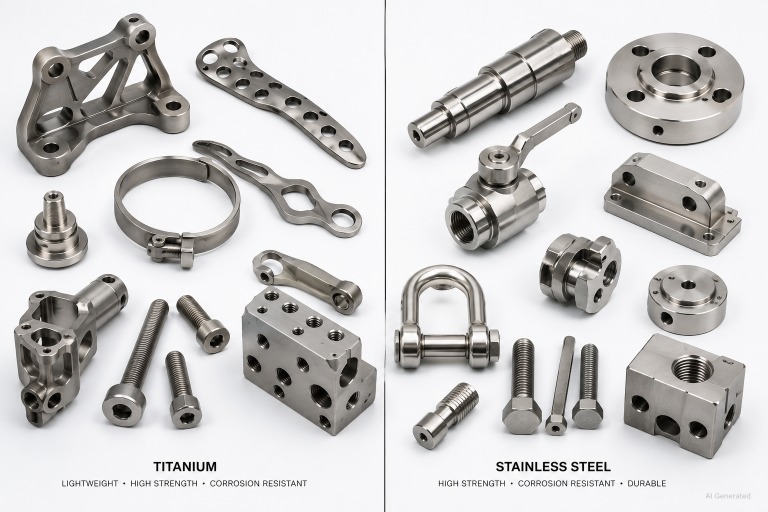
Titanium vs stainless steel components
Two materials that appear on engineering drawings constantly, often in competition with each other for the same application. Titanium vs stainless steel is one of the most common material selection debates in engineering, and it's a debate that genuinely matters, because getting it wrong means either paying far more than necessary for properties you don't need, or specifying a material that can't survive the application.
The difference between titanium and stainless steel isn't simply "one is better." It's that they're optimized for different things. Understanding which properties each one actually delivers, and where each one falls short, is what makes the titanium or stainless steel decision straightforward instead of relying on assumptions.
Titanium vs Stainless Steel: Quick Comparison Table
| Property | Titanium (Grade 5) | Stainless Steel (316L) |
|---|---|---|
| Composition | Ti-6Al-4V (titanium, aluminum, vanadium) | Fe, 16-18% Cr, 10-14% Ni, 2-3% Mo |
| Density | 4.43 g/cm³ | 7.98 g/cm³ |
| Tensile Strength | 900-1100 MPa | 485-620 MPa |
| Yield Strength | 830-1000 MPa | 170-310 MPa |
| Specific Strength | ~200 kN·m/kg | ~60-80 kN·m/kg |
| Hardness (Brinell) | 334 HB | 149-217 HB |
| Max Service Temperature | 300-400°C (sustained) | 870°C (316L) |
| Corrosion Resistance | Excellent | Excellent |
| Thermal Conductivity | 6.7 W/m·K | 16 W/m·K |
| Biocompatibility | Excellent, implant grade | Good, food/medical grade |
| Machinability Rating | ~20-30% (vs free-cutting steel) | ~45-50% (vs free-cutting steel) |
| Relative Material Cost | Very High | Medium |
| CNC Machining Cost | Very High | Medium-High |
| Typical Applications | Aerospace, medical implants, high-performance components | Food processing, marine, medical instruments, general industrial |
If machining cost is part of your material selection, our guide on Stainless Steel CNC Machining explains how different stainless grades behave during CNC machining and what affects manufacturing cost.
What Is Titanium?
Titanium is a transition metal element with atomic number 22, known in engineering for its exceptional strength-to-weight ratio, outstanding corrosion resistance, and full biocompatibility. Pure titanium is relatively soft, but titanium alloying, particularly with aluminum and vanadium, produces titanium grades with mechanical properties that challenge high-strength steels at less than half the weight.
Titanium Properties
Titanium's standout property in this comparison is its density of 4.43 g/cm³, which is significantly lower than stainless steel at 7.98 g/cm³. This difference is the entire basis of titanium vs stainless steel weight advantage, for the same volume of material, titanium is 44% lighter.
Corrosion resistance of titanium comes from a stable titanium dioxide oxide layer that forms spontaneously on the surface and regenerates immediately if damaged. This passive layer resists most acids, alkalis, seawater, chlorine, and oxidizing environments that would compromise many other metals. In the comparison of titanium vs stainless steel corrosion resistance, both materials perform well in most environments, but titanium may provide advantages in concentrated oxidizing acids that attack even high-molybdenum stainless grades.
Biocompatibility of titanium is essentially complete; titanium generally shows excellent biocompatibility and is widely used for implants, making it the material of choice for implanted medical devices. This is a property stainless steel doesn't fully match even in its most refined medical grades.
Common Titanium Grades
| Grade | Composition | Tensile Strength | Key Property | Application |
|---|---|---|---|---|
| Grade 1 | Pure Ti (99.5%) | 240 MPa | Highest ductility | Chemical processing, forming |
| Grade 2 | Pure Ti (99.2%) | 345 MPa | Best corrosion resistance | Marine, chemical, medical |
| Grade 4 | Pure Ti (99.0%) | 550 MPa | Strongest pure grade | Medical implants, aerospace |
| Grade 5 (Ti-6Al-4V) | Ti-6Al-4V | 900-1100 MPa | Best strength-to-weight | Aerospace, medical, high performance |
| Grade 23 (Ti-6Al-4V ELI) | Extra low interstitials | 860-1000 MPa | Highest biocompatibility | Surgical implants, bone screws |
Grade 5 (Ti-6Al-4V) represents about 50% of titanium production. It is the workhorse grade that most engineers mean when they say "titanium" in the context of titanium vs stainless steel comparison. Grade 23 is the implant-specific version with tighter interstitial element control.
When titanium or stainless steel is selected for machined components, material properties are only part of the manufacturing consideration. JLCCNC manufactures precision stainless steel components in grades including 304 and 201 using advanced CNC milling and turning with tight tolerances, excellent surface finishes, and fast turnaround.
Upload your CAD file today for an instant stainless steel CNC machining quote.

Precision CNC Machining Service
Professional manufacturing, fast turnaround, and quality assurance.
Typical Applications of Titanium
Aerospace structural components where the weight saving from titanium vs stainless steel directly translates to payload capacity or fuel efficiency. Medical implants, hip replacements, bone plates, dental implants, where biocompatibility is a requirement. High-performance automotive and motorsport components. Marine hardware in particularly aggressive environments. Chemical processing equipment handling oxidizing acids. Premium consumer products where weight, corrosion resistance, and appearance justify the cost premium.
What Is Stainless Steel?
Stainless steel is an iron-based alloy containing a minimum of 10.5% chromium, which forms a passive chromium oxide layer that provides corrosion resistance. It's the most widely used corrosion-resistant engineering metal, available in hundreds of grades, formable by virtually every metalworking process, and at a cost that makes it the default choice for corrosion-resistant applications where titanium's weight advantage doesn't justify the price.
Stainless Steel Properties
In the stainless steel vs titanium comparison, stainless steel's density of 7.98 g/cm³ is the primary disadvantage, it's heavier than titanium for equivalent volume. The offset comes from lower cost, better machinability, greater availability, and, in some high-strength grades, absolute tensile strength that approaches titanium's.
Stainless steel's maximum service temperature significantly exceeds that of most titanium grades in structural applications, austenitic grades like 316L stainless steel can withstand higher service temperatures than titanium, although allowable temperatures depend on loading conditions and exposure time. For high-temperature applications, this reverses the titanium vs stainless steel comparison outcome entirely.
Common Stainless Steel Grades
| Grade | Type | Tensile Strength | Key Property | Application |
|---|---|---|---|---|
| 304 | Austenitic | 515-720 MPa | General corrosion resistance | Kitchen equipment, architectural |
| 316L | Austenitic | 485-620 MPa | Best chloride resistance in austenitic range | Marine, medical, food processing |
| 17-4 PH | Precipitation hardened | 1000-1310 MPa | High strength, moderate corrosion | Aerospace, valves, turbine blades |
| 440C | Martensitic | 760-1900 MPa | Highest hardness | Bearings, cutting tools, valves |
| 2205 Duplex | Duplex | 620-900 MPa | Strength + chloride resistance | Offshore, chemical processing |
In titanium or stainless steel decisions for high-strength applications, certain heat-treated 17-4 PH stainless steel conditions can reach tensile strengths above 1000 MPa.
Typical Applications of Stainless Steel
Food processing equipment where FDA compliance and cleanability are required. Medical instruments and equipment that need sterilization resistance. Marine structural components and hardware. Chemical processing vessels and piping. Architectural and consumer products where appearance and corrosion resistance matter at practical cost. Fasteners across virtually every industry.
Difference Between Titanium and Stainless Steel
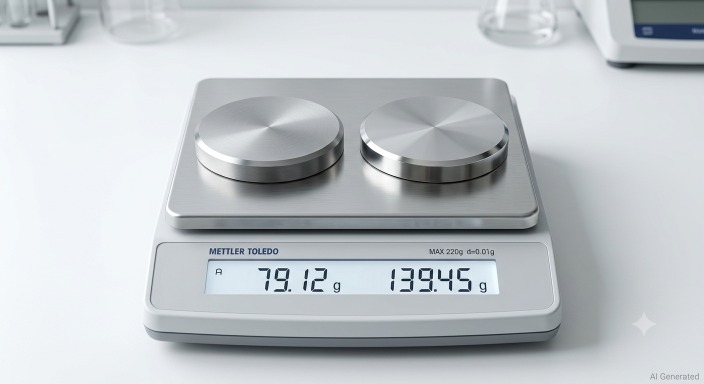
Weighing titanium vs steel
Strength
The titanium vs stainless steel strength comparison depends on which grades are being compared. Against standard austenitic grades (304, 316L), titanium Grade 5 is substantially stronger, 900-1100 MPa vs 485-620 MPa. Against precipitation-hardened stainless (17-4 PH), the absolute strength values are similar.
Where titanium consistently wins on strength is specific strength, strength divided by density. At roughly 200 kN·m/kg for Ti-6Al-4V versus 60-80 kN·m/kg for 316L stainless, titanium delivers 2.5-3x more strength per unit weight. This is the difference between titanium and stainless steel that drives aerospace material selection, an aircraft structure built in titanium instead of stainless steel doesn't just weigh less, it carries more load for the same weight.
Weight
Titanium has lower density and higher specific strength than stainless steel, making it suitable for weight-sensitive applications. Stainless steel provides better cost efficiency and easier manufacturing.
In weight-critical applications, aerospace structures, medical implants that a patient carries permanently, high-performance sports equipment, this difference between titanium and stainless steel is the primary decision factor. In applications where weight is irrelevant, this titanium vs stainless steel weight advantage offers no practical benefit and doesn't justify titanium's cost premium.
Corrosion Resistance
The difference between titanium and stainless steel in corrosion resistance shows in extreme environments. Titanium's passive layer is stable in conditions that can compromise stainless steel's chromium oxide layer, particularly chlorine gas, wet chlorine environments, and concentrated oxidizing acids like hot concentrated nitric acid.
In seawater, both materials perform well, but titanium has a slight edge in crevice corrosion resistance under high-pressure seawater conditions that causes localized corrosion in even high-grade stainless steel over extended exposure. For most industrial, marine, and medical applications, the corrosion resistance difference between titanium and stainless steel is practically negligible with proper grade selection.
Hardness and Wear Resistance
Titanium Grade 5 has higher hardness than standard austenitic stainless grades, 334 HB vs 149-217 HB for 316L. However, titanium's wear resistance doesn't match its hardness, it has a tendency to gall (cold weld to mating surfaces under sliding contact) that limits its use in bearing and sliding contact applications without surface treatment.
High-hardness stainless grades, martensitic grades like 440C reaching 55-60 HRC, significantly outperform titanium in wear resistance and are used in bearing races and cutting tools where wear is the primary failure mode.
Heat Resistance
This is where stainless steel vs titanium comparison outcome reverses for high-temperature applications. Austenitic stainless steels maintain mechanical properties to 500-870°C depending on grade. Titanium Grade 5 starts losing strength above 300°C and isn't suitable for sustained structural applications above 400°C.
For exhaust systems, high-temperature industrial equipment, and anything operating near combustion environments, stainless steel outperforms titanium completely in the titanium vs stainless steel comparison at elevated temperature.
Thermal and Electrical Conductivity
Titanium has thermal conductivity of 6.7 W/m·K, notably lower than stainless steel at 16 W/m·K, and both are dramatically lower than aluminum at 150 W/m·K. For a comparison of stainless steel with another lightweight metal, see our guide to stainless steel vs aluminum. In practical machining terms, titanium's lower thermal conductivity means heat concentrates at the cutting edge rather than conducting into the workpiece, which accelerates tool wear during machining.
Titanium vs Stainless Steel in CNC Machining
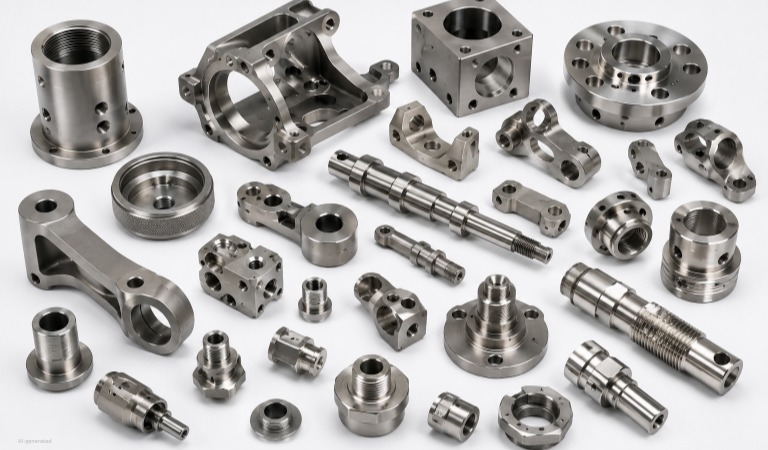
Titanium and stainless steel CNC machining
The machining comparison produces a clear result: stainless steel is significantly easier and cheaper to machine. Titanium requires specialist knowledge, tooling, and process management to produce parts economically.
Machining Challenges
Titanium's machinability challenges in the titanium vs stainless steel comparison come from three properties working against the cutting process simultaneously. Low thermal conductivity means heat doesn't conduct away from the cutting zone, it concentrates at the tool-chip interface and damages tooling rapidly. High chemical reactivity at elevated temperatures means titanium reacts with the cobalt binder in carbide tooling, causing built-up edge and accelerated wear. Work hardening tendency means the surface ahead of the cut hardens as the tool approaches, increasing the cutting force required.
Stainless steel, particularly austenitic grades like 316L, also work-hardens, which is why stainless machining requires consistent engagement and aggressive cutting rather than tentative light cuts. But stainless steel's work hardening is more manageable than titanium's combined heat and chemical wear effects.
Tool Wear and Cutting Parameters
| Parameter | Titanium (Grade 5) | Stainless Steel (316L) |
|---|---|---|
| Cutting Speed | 30-60 m/min | 80-180 m/min |
| Feed Rate | Conservative | Moderate-Aggressive |
| Tooling | Fine-grain carbide, TiAlN coating | Carbide, TiAlN/TiCN coating |
| Coolant | High-pressure flood essential | Flood coolant required |
| Tool Life | Short | Moderate |
| Setup Requirements | Rigid, minimal overhang | Standard |
Titanium machining cutting speeds run at roughly 1/3 to 1/2 the speeds used for stainless steel. Combined with shorter tool life, this means machining time per part for equivalent geometry is substantially higher for titanium than stainless steel, directly increasing CNC prototype and production cost.
Cost Considerations
The cost difference between titanium and stainless steel in CNC machining is significant and comes from three compounding factors: raw material cost (titanium bar stock costs 5-15x more than equivalent stainless), machining time (longer due to lower cutting speeds), and tooling cost (faster tool wear means more inserts). A machined titanium component can cost several times more than an equivalent stainless steel component, depending on geometry and production volume.
For applications where the weight saving from titanium vs stainless steel is the primary driver, this cost premium is justified. For applications where corrosion resistance or reasonable strength are the requirements, stainless steel's dramatically lower machining cost usually determines the titanium or stainless steel selection.
Titanium vs Stainless Steel Applications
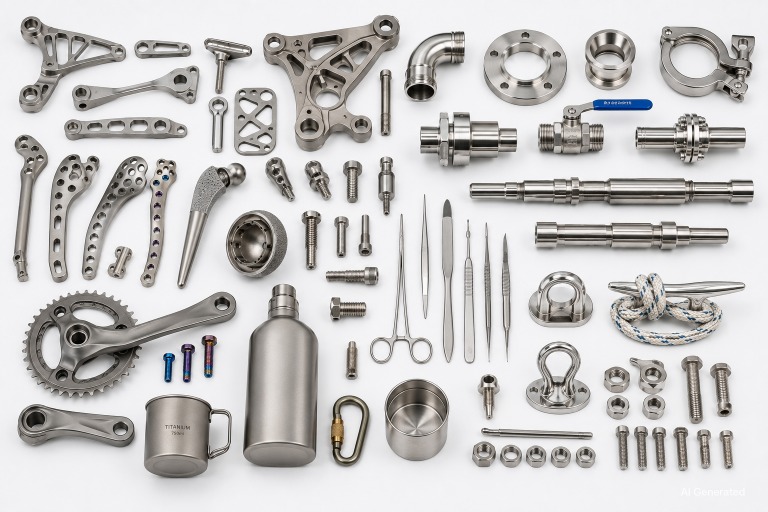
Titanium and stainless steel applications
Aerospace
Aerospace is the application where titanium vs stainless steel most clearly favors titanium. Structural brackets, engine mounts, fuselage frames, landing gear components, and fasteners benefit from titanium's combination of high specific strength and corrosion resistance. The weight saving from titanium vs stainless steel weight in aerospace translates directly to payload capacity or fuel efficiency, both of which have direct commercial value that justifies titanium's higher cost.
Stainless steel appears in aerospace too, in high-temperature applications near engines where titanium's temperature limitations rule it out, and in lower-criticality structural applications where the weight premium of stainless steel is acceptable.
Medical Devices
Medical applications show the titanium vs stainless steel comparison most clearly in the biocompatibility dimension. Bone screws, hip implants, dental implants, and spinal cages are made from titanium because the body accepts titanium without inflammatory response and titanium's osseointegration properties allow bone to grow into implant surfaces.
Stainless steel (316L surgical grade) is used extensively for surgical instruments, trays, and external medical equipment where full biocompatibility isn't required. The difference between titanium and stainless steel for implanted devices is essentially that titanium can go permanently in the body while stainless steel is better suited to instruments that contact the body temporarily.
Marine and Chemical Processing
In marine and chemical processing applications, both materials perform well, and the titanium or stainless steel choice is primarily economic. Standard applications use duplex or 316L stainless steel because the cost difference from titanium isn't justified by meaningful performance difference. For the most aggressive marine environments, deep-sea applications, hot concentrated chloride environments, or where absolute reliability over long service life without inspection is required, titanium's edge in crevice corrosion resistance justifies the premium.
Food Processing and Consumer Products
Food processing is almost entirely stainless steel territory in the titanium vs stainless steel comparison. 316L stainless steel meets FDA food contact requirements, cleans and sterilizes readily, is cost-effective in large sheet and vessel form, and fabricates by conventional welding and forming. Titanium's advantages don't translate into meaningful benefits for most food processing applications at a cost that could be justified.
Consumer products, watches, eyeglasses, premium tools, outdoor equipment, show both materials. Titanium appears in premium segments where weight and corrosion resistance justify price. Stainless steel appears across the broader market where similar aesthetics and adequate performance come at lower cost.
Titanium or Stainless Steel: Which Should You Choose?
Choose titanium when:
- Weight reduction is critical
- Biocompatibility is required
- Extreme corrosion resistance is needed
Choose stainless steel when:
- Cost efficiency matters
- High-temperature performance is required
- Easy machining is important
Material Selection Checklist
| Requirement | Titanium | Stainless Steel |
|---|---|---|
| Weight reduction critical | ✓ | X |
| Budget-sensitive project | X | ✓ |
| Implanted medical device | ✓ | X |
| High temperature (>400°C) | X | ✓ |
| High specific strength | ✓ | X |
| Easy, low-cost machining | X | ✓ |
| Seawater exposure | ✓ | ✓ |
| Food contact application | X | ✓ |
| Oxidizing acid environments | ✓ | X |
| Complex fabrication | X | ✓ |
| Aesthetic premium products | ✓ | ✓ |
JLCCNC provides stainless steel CNC machining services for precision industrial components, including CNC milling and turning production. Parts are checked against manufacturing standards to support reliable production.
Upload your CAD files to receive a fast quote.
Precision CNC Machining Service
Professional manufacturing, fast turnaround, and quality assurance.
FAQs About Titanium vs Stainless Steel
Q: Is titanium stronger than stainless steel?
在此输入答案 1
Q: Is titanium lighter than stainless steel?
Yes. Titanium vs stainless steel weight comparison shows titanium at 4.43 g/cm³ versus stainless steel at approximately 7.98 g/cm³, titanium is roughly 44% lighter for the same volume. A component that weighs 1 kg in stainless steel weighs approximately 0.56 kg in titanium at the same geometry. This titanium vs stainless steel weight advantage is the primary reason titanium is specified in aerospace and medical implant applications.
Q: Which has better corrosion resistance?
Both titanium and stainless steel offer excellent corrosion resistance in most environments. The difference between titanium and stainless steel in corrosion resistance shows in extreme cases, titanium outperforms stainless in concentrated oxidizing acids, high-pressure seawater, and crevice corrosion conditions. For most industrial, marine, and medical applications, both materials provide adequate corrosion resistance with proper grade selection.
Q: Which has better corrosion resistance?
Stainless steel is significantly easier to machine than titanium. Titanium's low thermal conductivity, high chemical reactivity at cutting temperatures, and work hardening make it one of the most difficult common engineering metals to machine efficiently. Stainless steel, while more challenging than aluminum or mild steel, machines at roughly 2-3x the cutting speeds of titanium, with better tool life and lower tooling cost. CNC machining cost for stainless steel is typically 3-8x lower than equivalent titanium components.
Q: Which material is better for CNC machining?
Stainless steel is the better CNC machining choice when machining cost and process simplicity are priorities. For applications where weight reduction justifies the machining cost premium, titanium is the correct choice despite its machining difficulty. In the titanium vs stainless steel CNC machining comparison, stainless steel wins on cost and process accessibility; titanium wins on the properties it delivers in the finished part when those properties are genuinely required.
Popular Articles
• Top 5 Heat-Resistant Metals for CNC Machining and How to Choose
• What are the Main Differences between Aluminum 6061 and 7075
• Aluminum vs Brass: CNC Material Guide for Makers
• Stainless Steel CNC Machining Material Selection Guide Corrosion Resistance and Cost Comparison of 304 vs 316
• Secrets of CNC machining of high hardness stainless steel Cracking the problems of tool wear and work hardening
Keep Learning
Titanium vs Stainless Steel: Key Differences and Applications
Key Takeaway Titanium vs stainless steel weight is where titanium wins most clearly. Titanium is roughly 44% lighter than stainless steel at equivalent volume. Titanium vs stainless steel strength shows a more nuanced picture, titanium Grade 5 has higher specific strength (strength per unit weight) than most stainless grades, but some high-strength stainless grades match or exceed titanium's absolute tensile strength. The difference between titanium and stainless steel in corrosion resistance is minim......
Stainless Steel CNC Machining: Materials, Challenges, Tolerances, and Custom Parts
Key Takeaways About Stainless Steel CNC Machining Stainless steel is usually chosen when aluminum cannot provide enough strength or environmental resistance for the application. Tool wear tends to become a larger concern as cutting time increases. Heat stays near the cutting edge, and the material can harden while machining. Not every stainless grade behaves the same in the machine. A part machined from 303 may run very differently from the same geometry produced in 316. Some cost drivers are easy to ......
Corrosion-Resistant Alloys: Best Metals for CNC Machining & Harsh Environments
Key Takeaways • Corrosion resistance comes from passive oxide layers that form on the metal surface and block further attack. • The most common corrosion resistant metals in CNC machining are stainless steel, aluminum, titanium, nickel alloys, and copper alloys, each suited to different environments and load conditions. • Chloride environments, dissimilar metal contact, and stagnant crevices are the three conditions that most commonly defeat otherwise adequate corrosion resistant materials. • Material......
Steel Machining: CNC Strategies, Material Behavior, and Custom Steel Parts Guide
(AI generated) CNC-machined steel showing raw and finished surface. Steel machining is deceptively simple on a CAD/CAM screen. In the spindle, however, it is a constant calculation of heat soak and chip formation. Unlike softer alloys, steel has lower thermal conductivity than aluminum, causing heat to concentrate near the cutting zone. It doesn't allow for loose parameters. It responds to every pound of pressure, and that inherent resistance is exactly why we specify it for high-stress, load-bearing ......
Ferrous vs Non-Ferrous Metals: Key Differences, Properties & Manufacturing Applications
Choosing between ferrous and non-ferrous metals is a critical decision in CNC machining. Ferrous metals, such as steel, require higher cutting forces, while non-ferrous metals like aluminum allow for higher cutting speeds. The material choice directly impacts spindle speed, tool wear, dimensional stability, and finishing cost, influencing overall manufacturing efficiency. This guide explores the topic from a manufacturing perspective, linking material differences directly to measurable production outc......
Heat Treatment of Metals: Processes, Property Effects, and Manufacturing Decisions
Heat treatment is not merely a material property change; it directly affects how the part behaves during CNC machining. Heat treatment alters a metal’s microstructure, directly affecting hardness and residual stress. Quenching steel can raise hardness from 28 HRC to 52 HRC. Higher hardness increases cutting forces and accelerates tool wear, while annealing reduces both. After annealing, the same material may cut easily, but smears/drags during finishing because internal stresses were redistributed. Th......