Stainless Steel CNC Machining: Materials, Challenges, Tolerances, and Custom Parts
15 min
- What Is Stainless Steel CNC Machining?
- Why Stainless Steel Is Difficult to Machine
- Stainless Steel Grades Used in CNC Machining
- CNC Machining Processes for Stainless Steel Parts
- Designing Stainless Steel Parts for CNC Machining
- Achievable Tolerances and Surface Finishes
- Common Production Challenges in Stainless Steel CNC Machining
- Cost Factors in Stainless Steel CNC Machining
- Industries That Use Stainless Steel CNC Machining
- How to Choose a Stainless Steel CNC Machining Service
- Conclusion About Stainless Steel CNC Machining
- FAQ About Stainless Steel CNC Machining
Key Takeaways About Stainless Steel CNC Machining
- Stainless steel is usually chosen when aluminum cannot provide enough strength or environmental resistance for the application.
- Tool wear tends to become a larger concern as cutting time increases. Heat stays near the cutting edge, and the material can harden while machining.
- Not every stainless grade behaves the same in the machine. A part machined from 303 may run very differently from the same geometry produced in 316.
- Some cost drivers are easy to overlook during design. A deep pocket or an extra setup often has more impact than a small change in raw material price.
- Good machining results depend as much on the design as on the machine tool. Wall thickness, feature accessibility, and tolerance strategy all influence how efficiently a part can be produced.
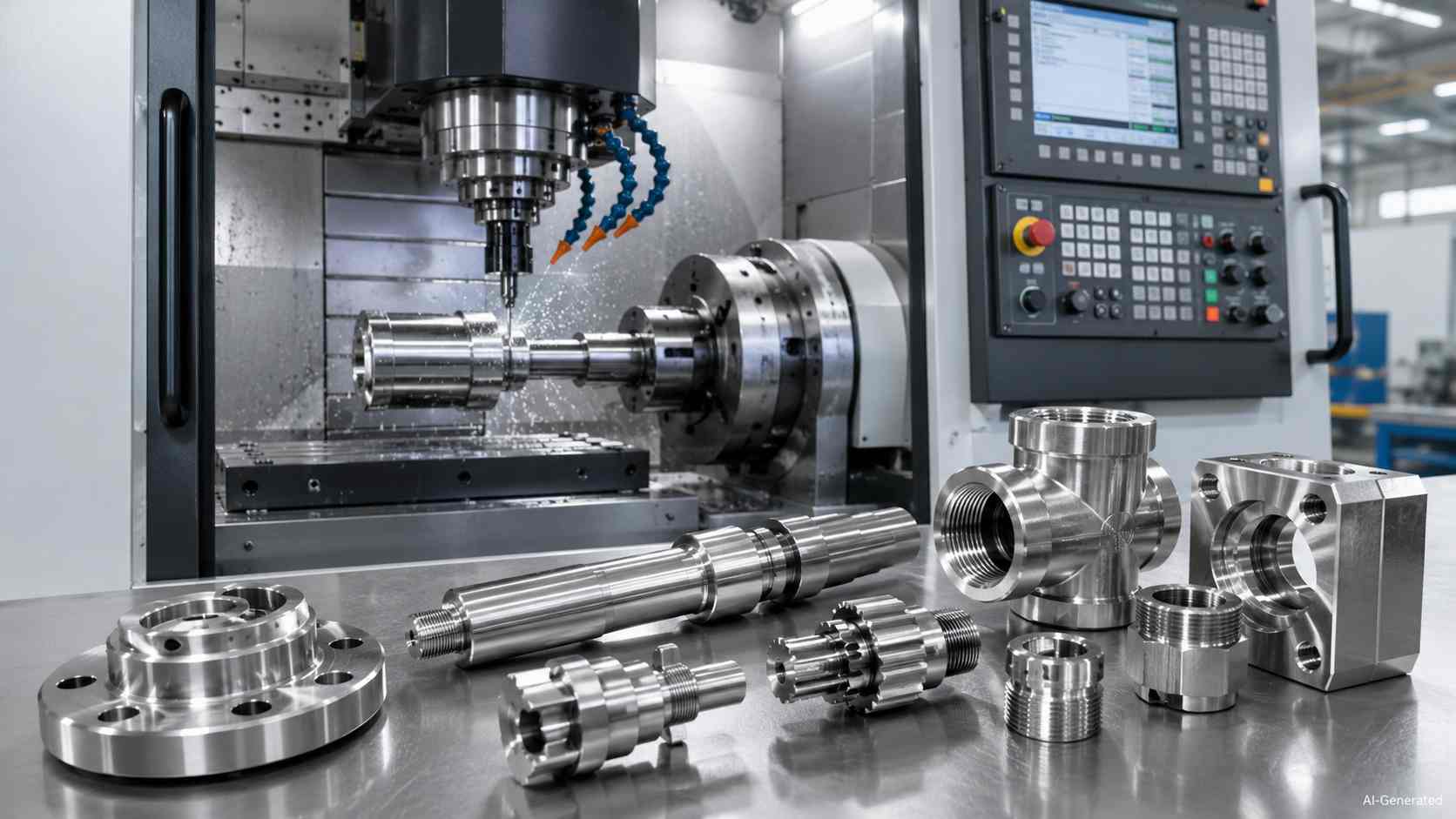
Stainless steel CNC machining parts in workshop
Stainless steel CNC machining is often selected for parts that must operate in demanding environments where strength, corrosion resistance, and long service life are required. Successful stainless steel machining starts long before the material reaches the machine tool. Define the part's purpose, expected use, budget, and production needs early, and after that, let those priorities guide every manufacturing decision.
What Is Stainless Steel CNC Machining?
Stainless steel CNC machining refers to a computer-controlled subtractive method that removes material from stainless steel stock in order to produce accurate components. The process is used to produce parts with controlled dimensions, repeatable geometry, and specified surface finish requirements.
Stainless steel machining can be performed on mills, lathes, multi-axis machining centers, and other CNC equipment, depending on part geometry.
Stainless Steel vs Aluminum CNC Machining
| Factor | Stainless Steel | Aluminum |
|---|---|---|
| Strength | Higher load capacity and wear endurance | Lower load capacity, useful where low weight matters |
| Corrosion Resistance | Excellent resistance to moisture, chemicals, and outdoor exposure | Good protection, which might be improved through coating or anodizing |
| Machinability | More demanding cutting behavior with greater tool demand | Easier cutting behavior with shorter cycle time |
| Cost | Often a higher total price due to slower cutting and tooling needs | Often a lower total price for many machined shapes |
So, choose stainless steel CNC machining services whenever the part must deal with pressure, abrasion, moisture, sanitation needs, or long service life. On the other hand, aluminum makes more sense when weight reduction and lower machining expenses are most important.
Why Stainless Steel Is Widely Used for CNC Parts
Stainless steel is widely used because it resists corrosion, maintains strength across a wide range of service conditions, and can be cleaned or finished for demanding applications. These characteristics make it common in medical devices, food-processing equipment, marine hardware, and industrial machinery.
Why Stainless Steel Is Difficult to Machine
Work Hardening During Cutting
In stainless steel CNC machining, the surface can toughen while the cutter is still moving through it. The next pass may face a harder layer than planned and demand steadier feeds.
Heat Concentration at the Cutting Zone
As the cut continues, heat tends to remain near the edge rather than spread away. Consequently, it raises stress on inserts, coatings, coolant flow, and spindle load.
Compared with aluminum, stainless steel conducts heat less efficiently, so a larger portion of cutting heat remains near the tool edge and cutting zone.
Tool Wear and Built-Up Edge Formation
That heat and pressure can make material cling to the cutter while forming a rough deposit that harms edge life, leaves marks, and interrupts steady production.
Chip Control and Material Removal Behavior
At this point, chip shape matters a lot. If removal is tangled or uneven, custom stainless steel parts may need adjusted feeds, sharper geometry, or better coolant aim for each feature.
Stainless Steel Grades Used in CNC Machining
303 Stainless Steel for Improved Machinability
Grade 303 is shop-friendly in stainless steel CNC machining. The improved machinability comes at the expense of slightly reduced corrosion resistance compared with 304 stainless steel.
304 Stainless Steel for General Engineering Applications
304 is widely used for general-purpose components because it provides good corrosion resistance, is readily available, and performs well in brackets, housings, covers, and equipment parts.
316 Stainless Steel for Corrosive Environments
When chemicals, saltwater, or frequent washdown enter the picture, 316 is often preferred because its molybdenum content improves resistance to chlorides and corrosive environments.
17-4 PH Stainless Steel for High-Strength Components
For higher-load work, 17-4 PH offers heat-treatable performance. It is useful when CNC machined stainless steel parts need extra hardness, stability, and fatigue endurance.
How to Choose the Right Stainless Steel Grade
Grade selection usually starts with the service environment. Corrosion exposure may drive the choice toward 316, while machining efficiency often favors 303. If strength is the primary concern, engineers frequently evaluate precipitation-hardening grades such as 17-4 PH. Cost and material availability are then considered against those performance requirements.
303 is often selected when machining efficiency is the priority. 304 is widely used for general industrial applications. 316 is preferred for marine, chemical, and washdown environments because of its improved corrosion resistance. 17-4 PH is commonly chosen when higher strength and hardness are required without sacrificing corrosion resistance.
CNC Machining Processes for Stainless Steel Parts
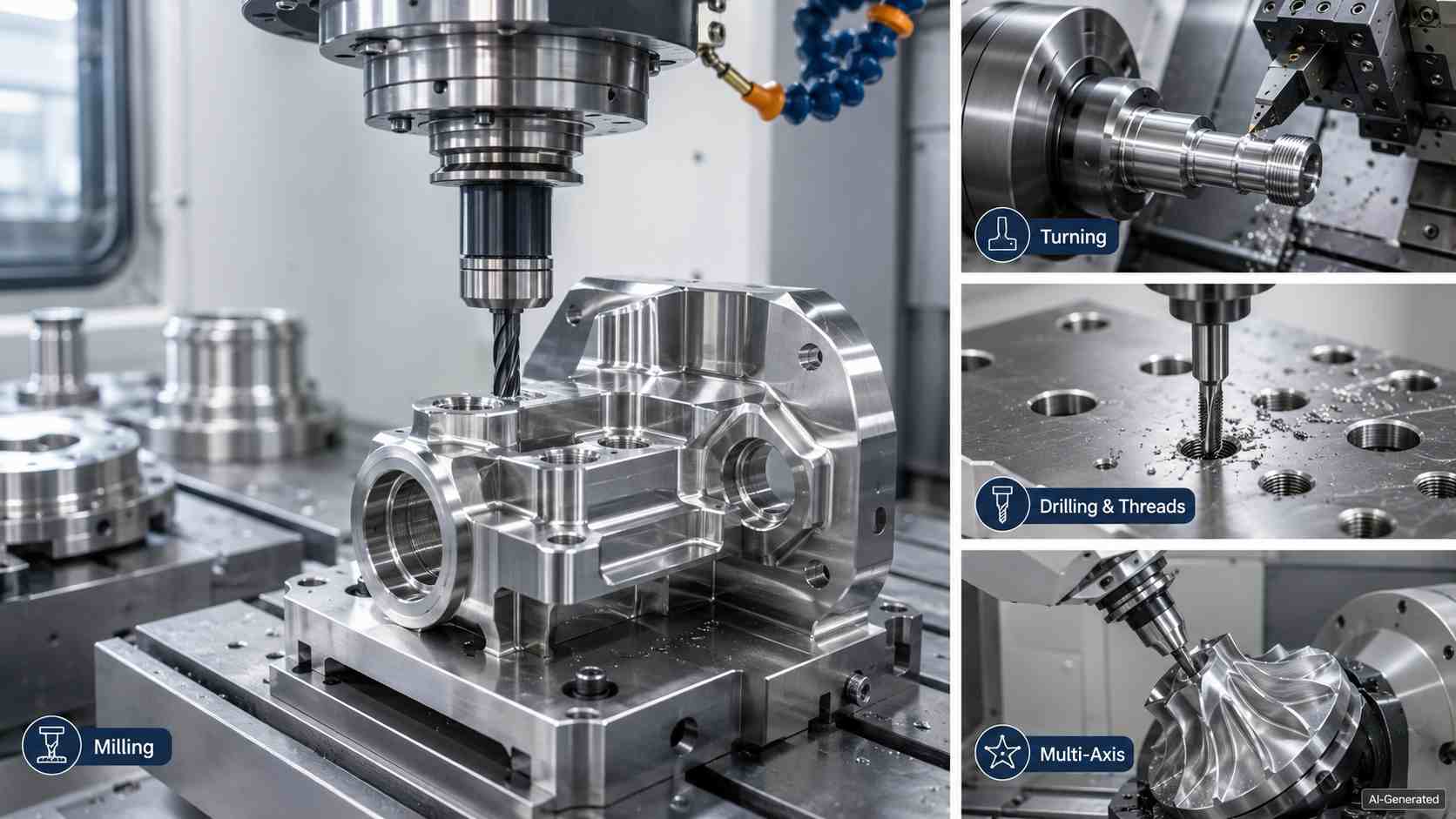
CNC machining processes for stainless steel parts
CNC Milling for Complex Components
Milling might be the method of choice for components that include pockets, slots, flats, and irregular profiles. In the case of stainless steel CNC machining, the cutter rotates around the workpiece, and the setup plan preserves datums, reach, and accuracy requirements.
CNC Turning for Rotational Parts
When the shape is round, the workpiece rotates against a fixed cutter. It allows shafts, collars, spacers, and threaded bodies to gain smooth diameters with less handling between operations.
Drilling, Reaming, and Thread Production
After the main shape is formed, holemaking brings the part closer to assembly use. Meanwhile, CNC drilling opens the path, CNC reaming refines size, and threading prepares secure connections.
Multi-Axis Machining for Complex Geometries
Multi-axis equipment may be used by stainless steel CNC machining services in order to decrease the number of additional setups required for slanted faces, blended shapes, several sides. This helps to maintain production consistency across a batch.
Designing Stainless Steel Parts for CNC Machining
Internal Corners and Cutter Access
Every inside corner asks for a cutter path, and a small radius gives stainless steel CNC machining enough room to reach the feature without forcing special tooling or added finishing.
Hole Depth, Threads, and Deep Features
Holes, tapped areas, and narrow recesses work best when depth remains reasonable, which allows drills, reamers, and taps to keep alignment while reducing breakage risk. As a general DFM guideline, threaded length is often limited to about three times the hole diameter because additional thread engagement provides diminishing strength benefits while increasing machining difficulty. For blind holes, leaving an unthreaded section of roughly half the hole diameter at the bottom helps accommodate tap runout.
Wall Thickness and Structural Stability
Wall thickness also affects machining stability. Thin sections can vibrate, bend, or distort. However, balanced thickness gives the part better support during clamping and cutting. For machined metal parts, wall thicknesses around 0.8 mm are generally easier to produce consistently. JLCCNC's design guideline treats 0.5 mm as the practical minimum, although achievable values depend on material, wall height, geometry, and machining strategy.
Designing for Manufacturability and Cost
Design decisions made during the CAD stage often have a direct impact on machining cost and manufacturability. Machining cost is often determined long before production begins. Deep pockets, restricted tool access, or unnecessarily tight tolerances can increase cycle time and setup complexity. Reviewing these details during the CAD stage usually reduces manufacturing risk.
Upload your design to JLCCNC for manufacturability review and a custom quote.

Precision CNC Machining Service
Professional manufacturing, fast turnaround, and quality assurance.
Achievable Tolerances and Surface Finishes
Typical CNC Machining Tolerances
Stainless steel CNC machining might follow drawing tolerances such as ISO 2768 or even tighter callouts for sealing faces, bearing seats, and mating edges. Remember, the narrower the limit, the more inspection, finishing passes, and setup care it requires. Without a specified drawing callout, many CNC suppliers quote standard tolerances around ±0.1 mm or wider.
Surface Roughness After Machining
After size comes texture, and an as-machined stainless surface may show fine tool lines. Lower Ra values ask for lighter cuts, sharper inserts, and slower feed choices. Standard CNC milling often produces surface finishes around Ra 3.2-6.3 µm, although finer values may be achievable depending on tooling, material, and cutting strategy. Yet, Ra 1.6 µm or better needs finer cutting conditions.
Passivation, Electropolishing, and Bead Blasting
Secondary finishing processes are often applied to modify surface appearance, surface roughness, or corrosion performance, depending on the selected process. Passivation removes free iron, electropolishing brightens and smooths microscopic peaks, and bead blasting gives a muted matte texture.
When Secondary Finishing Is Necessary
Secondary finishing is handy when custom stainless steel parts need better corrosion resistance, lower friction, better appearance, or safer edges for handling and assembly.
Common Production Challenges in Stainless Steel CNC Machining
Dimensional Drift During Long Machining Cycles
In stainless steel CNC machining, a long run can slowly shift as heat, insert wear, and clamping stress change, which renders offset checks part of stable production.
Tool Deflection and Feature Accuracy
Whenever cutting load rises, the tool may lean away from its path, as well as slender details demand rigid holding, shorter reach, and measured compensation.
Burr Formation Around Holes and Edges
Sharp exits, cross-holes, and edge breaks can leave raised material. Meanwhile, planned deburring keeps assembly areas safer without depending on last-minute handwork.
Maintaining Consistent Surface Quality
Surface variation might appear when inserts age, coolant aim drifts, or vibration enters the cut. As a result, it leads teams to watch finish data across each batch.
Inspection and Process Control Requirements
For CNC machined stainless steel parts, inspection closes the loop. First-article checks, in-process gauges, and final reports help confirm geometry before shipment.
Cost Factors in Stainless Steel CNC Machining
Material Cost Differences Between Grades
Pricing begins with the alloy choice. 303, 304, 316, and 17-4 PH carry different raw stock rates, availability patterns, and purchasing risk, which can move a quote before any cutting begins. Raw material cost varies significantly by alloy grade, certification requirements, stock form, and regional supply conditions.
Machining Time and Tool Consumption
In stainless steel CNC machining, time on the spindle may rise when feed, depth, or cutter life must be managed carefully, and worn inserts introduce another expense line.
Geometry Complexity and Setup Requirements
Next, the part shape affects programming, workholding, and access. For instance, undercuts, angled faces, and narrow pockets may call for extra setups or special cutters.
Production Volume and Batch Size Effects
Production volume influences part cost because setup and programming expenses are distributed across the entire batch. As quantities increase, the cost contribution of these fixed activities decreases on a per-part basis.
Industries That Use Stainless Steel CNC Machining
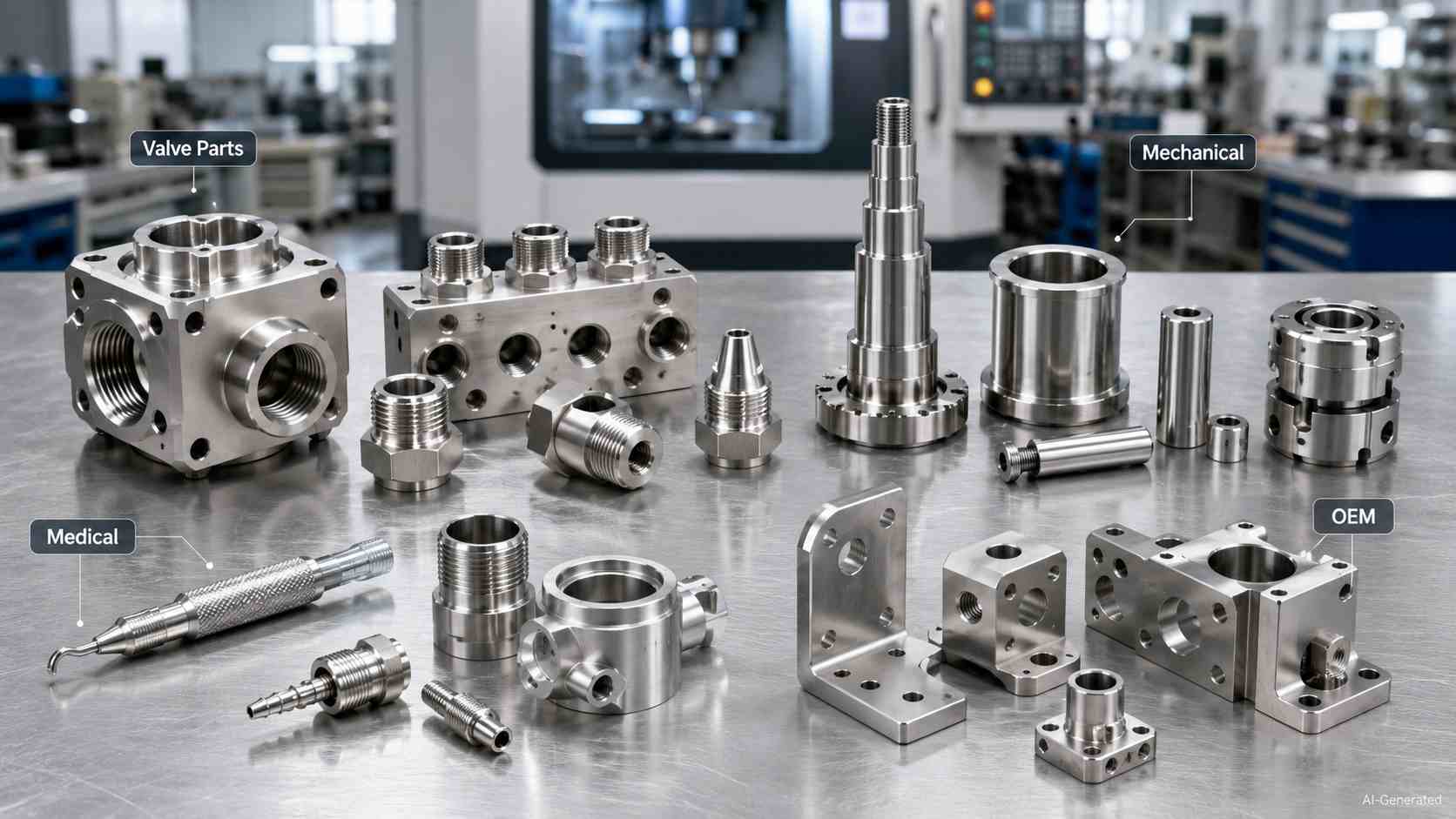
Common CNC machined stainless steel parts
Medical Devices
A machined stainless steel part in a medical device is rarely selected because of strength alone.
Consider a reusable surgical instrument. The cutting edge may be ground after machining, but the handle, hinge area, and locating features often start as CNC-machined components. Those surfaces are exposed to repeated autoclave cycles at temperatures above 120°C. Cleaning chemicals are equally demanding.
For this reason, designers often pay as much attention to surface condition as material grade. Small burrs left around drilled holes can become cleaning issues later. Sharp internal corners are another example. They are easy to draw in CAD but harder to keep clean in service.
Food Processing Equipment
In food equipment, corrosion is not always the main problem.
A filler nozzle handling fruit concentrate behaves differently from a bracket mounted on the side of the machine. One sees product contact. The other sees cleaning chemicals twice a day.
Valve bodies, guide rails, transfer fingers, and pump housings are frequently machined from stainless steel. Some facilities run alkaline cleaning cycles every shift. Others use chlorine-based disinfectants. Material selection therefore depends on the cleaning process almost as much as the product being manufactured.
Machining details can affect maintenance later. Deep blind pockets may trap residue. Narrow internal grooves are another area engineers tend to review carefully before release.
Marine Hardware
Saltwater has a way of exposing design mistakes.
A mounting bracket may look acceptable after installation, then show corrosion staining months later around fastener locations. In many cases the issue is not bulk material failure. Crevice conditions, trapped moisture, or contamination introduced during fabrication are more likely causes.
CNC-machined stainless parts appear throughout marine systems. Sensor housings, hydraulic fittings, winch components, pump hardware. Most are relatively simple geometrically. The challenge is usually service life rather than machining complexity.
316 is frequently specified. Even then, post-machining passivation is often included because surface condition can influence long-term corrosion behavior.
Aerospace Components
Ground-support equipment, actuator mounts, instrumentation brackets, inspection fixtures, and hydraulic hardware are often produced from stainless steel when corrosion resistance or dimensional stability matters more than weight reduction.
Some parts spend far more time being inspected than machined. A locating bore might take seconds to cut and hours to verify through the production route because assembly alignment depends on it.
For precipitation-hardening grades such as 17-4 PH, machining sequence becomes important. Many shops rough machine in the solution-treated condition and perform final operations after heat treatment to control dimensional variation.
Industrial Automation
Walk through a production cell and stainless steel shows up everywhere.
A sensor bracket beside a conveyor. A fixture plate inside a washdown enclosure. End-of-arm tooling moving parts between stations. None of these components are particularly expensive individually. Together they determine whether the system runs consistently.
Many automation parts are not highly stressed. The design challenge is usually different. Access for tooling. Clearance around fasteners. Repeatable locating surfaces. Features that can be inspected without removing the assembly from the machine.
Engineers often discover that a small geometry change saves more machining time than switching materials. Opening a corner radius by a few millimeters, reducing an unnecessary deep pocket, or eliminating a secondary setup can have a noticeable effect on production cost.
How to Choose a Stainless Steel CNC Machining Service
Material Expertise and Grade Availability
When it comes to stainless steel CNC machining, the team should be familiar with grade behavior, stock forms, certifications, and replacement restrictions before submitting a quote. Supplier selection also starts with an understanding of the alloy, rather than a pricing sheet.
Machining Capability and Tolerance Control
After that, ask whether the shop has the right mills, lathes, fixtures, and metrology habits for your drawing. Tight callouts need planned stability rather than hopeful programming.
Quality Assurance and Inspection Standards
A trustworthy supplier backs claims with documented checks, calibrated gauges, CMM access, material paperwork, and records that are in accordance with the part's end-use risk.
Prototype-to-Production Manufacturing Support
If someone asks, "what is CNC machining stainless steel," the best supplier can explain it through your project path, from first sample review to repeat orders without losing context.
Lead Time and Production Capacity
Last but not least, choose stainless steel CNC machining services that can match material sourcing, machine slots, finishing partners, and delivery planning with your launch schedule.
Conclusion About Stainless Steel CNC Machining
Stainless steel is often selected when a part must resist corrosion while carrying mechanical loads over a long service life. The choice of grade affects both machining behavior and end-use performance. Geometry matters too. Deep cavities, thin walls, tight tolerances, and secondary finishing requirements can all increase machining time and manufacturing cost. Reviewing these factors during the design stage usually makes process planning easier and helps avoid unnecessary production challenges later.
For custom stainless steel parts, prototypes, and low-volume production, JLCCNC's stainless steel CNC machining services give engineers a path from CAD file to finished hardware.
Precision CNC Machining Service
Professional manufacturing, fast turnaround, and quality assurance.
FAQ About Stainless Steel CNC Machining
Q: What is stainless steel CNC machining?
Stainless steel CNC machining is a subtractive manufacturing process that uses CNC-controlled machine tools to remove material from stainless steel stock and produce finished parts.
Q: Which stainless steel grade is easiest to machine?
303 stainless steel is generally considered the easiest stainless grade to machine because the added sulfur improves chip breaking and reduces cutting forces.
Q: Is 304 or 316 better for CNC machining?
316 is usually preferred when parts will be exposed to chlorides, saltwater, or aggressive chemicals. Nevertheless, 304 is an excellent choice for widespread industrial usage.
Q: Why is stainless steel harder to machine than aluminum?
When compared to aluminum, stainless steel is more resistant to cutting, retains heat at the cutting edge, and places a heavier demand on tools.
Q: What tolerances can be achieved in stainless steel machining?
Achievable tolerances depend on part geometry, size, and machining strategy. Standard JLCCNC tolerances are often around 0.05 mm unless tighter values are specified.
Q: Can CNC machines produce custom stainless steel parts?
Yes. CNC equipment might create custom stainless steel parts from CAD files for prototypes, replacement items, fixtures, and production hardware.
Q: What surface finishes are available for machined stainless steel parts?
Common options are as-machined, passivation, electropolishing, bead blasting, brushing, and polishing. Nonetheless, it depends on appearance and function.
Popular Articles
• Top 5 Heat-Resistant Metals for CNC Machining and How to Choose
• What are the Main Differences between Aluminum 6061 and 7075
• Aluminum vs Brass: CNC Material Guide for Makers
• Stainless Steel CNC Machining Material Selection Guide Corrosion Resistance and Cost Comparison of 304 vs 316
• Secrets of CNC machining of high hardness stainless steel Cracking the problems of tool wear and work hardening
Keep Learning
Titanium vs Stainless Steel: Key Differences and Applications
Key Takeaway Titanium vs stainless steel weight is where titanium wins most clearly. Titanium is roughly 44% lighter than stainless steel at equivalent volume. Titanium vs stainless steel strength shows a more nuanced picture, titanium Grade 5 has higher specific strength (strength per unit weight) than most stainless grades, but some high-strength stainless grades match or exceed titanium's absolute tensile strength. The difference between titanium and stainless steel in corrosion resistance is minim......
Stainless Steel CNC Machining: Materials, Challenges, Tolerances, and Custom Parts
Key Takeaways About Stainless Steel CNC Machining Stainless steel is usually chosen when aluminum cannot provide enough strength or environmental resistance for the application. Tool wear tends to become a larger concern as cutting time increases. Heat stays near the cutting edge, and the material can harden while machining. Not every stainless grade behaves the same in the machine. A part machined from 303 may run very differently from the same geometry produced in 316. Some cost drivers are easy to ......
Corrosion-Resistant Alloys: Best Metals for CNC Machining & Harsh Environments
Key Takeaways • Corrosion resistance comes from passive oxide layers that form on the metal surface and block further attack. • The most common corrosion resistant metals in CNC machining are stainless steel, aluminum, titanium, nickel alloys, and copper alloys, each suited to different environments and load conditions. • Chloride environments, dissimilar metal contact, and stagnant crevices are the three conditions that most commonly defeat otherwise adequate corrosion resistant materials. • Material......
Steel Machining: CNC Strategies, Material Behavior, and Custom Steel Parts Guide
(AI generated) CNC-machined steel showing raw and finished surface. Steel machining is deceptively simple on a CAD/CAM screen. In the spindle, however, it is a constant calculation of heat soak and chip formation. Unlike softer alloys, steel has lower thermal conductivity than aluminum, causing heat to concentrate near the cutting zone. It doesn't allow for loose parameters. It responds to every pound of pressure, and that inherent resistance is exactly why we specify it for high-stress, load-bearing ......
Ferrous vs Non-Ferrous Metals: Key Differences, Properties & Manufacturing Applications
Choosing between ferrous and non-ferrous metals is a critical decision in CNC machining. Ferrous metals, such as steel, require higher cutting forces, while non-ferrous metals like aluminum allow for higher cutting speeds. The material choice directly impacts spindle speed, tool wear, dimensional stability, and finishing cost, influencing overall manufacturing efficiency. This guide explores the topic from a manufacturing perspective, linking material differences directly to measurable production outc......
Heat Treatment of Metals: Processes, Property Effects, and Manufacturing Decisions
Heat treatment is not merely a material property change; it directly affects how the part behaves during CNC machining. Heat treatment alters a metal’s microstructure, directly affecting hardness and residual stress. Quenching steel can raise hardness from 28 HRC to 52 HRC. Higher hardness increases cutting forces and accelerates tool wear, while annealing reduces both. After annealing, the same material may cut easily, but smears/drags during finishing because internal stresses were redistributed. Th......