Corrosion-Resistant Alloys: Best Metals for CNC Machining & Harsh Environments
27 min
- What Is a Corrosion-Resistant Alloy?
- Corrosion Mechanisms in Metals
- Common Corrosion Resistant Materials Used in CNC Machining
- Corrosion Resistant Stainless Steel for CNC Machining
- Pure Metals and Alloyed Materials: What’s the Difference?
- Material Comparison: Stainless Steel vs Aluminum vs Titanium vs Nickel Alloys
- Recommended Corrosion-Resistant Materials by Application
- CNC Machining Challenges of Corrosion-Resistant Alloys
- Surface Treatments to Improve Corrosion Resistance
- How to Choose Corrosion Resistant Materials for CNC Manufacturing
- Advantages and Limitations of Corrosion-Resistant Alloys
- FAQs About Corrosion-Resistant Alloys in CNC Machining
Key Takeaways
• Corrosion resistance comes from passive oxide layers that form on the metal surface and block further attack.
• The most common corrosion resistant metals in CNC machining are stainless steel, aluminum, titanium, nickel alloys, and copper alloys, each suited to different environments and load conditions.
• Chloride environments, dissimilar metal contact, and stagnant crevices are the three conditions that most commonly defeat otherwise adequate corrosion resistant materials.
• Material selection needs to account for the specific corrosion mechanism the part will face, not just general corrosion resistance.
• Machinability varies significantly across corrosion resistant alloys, some of the best corrosion resistant metals are also the hardest to machine efficiently.
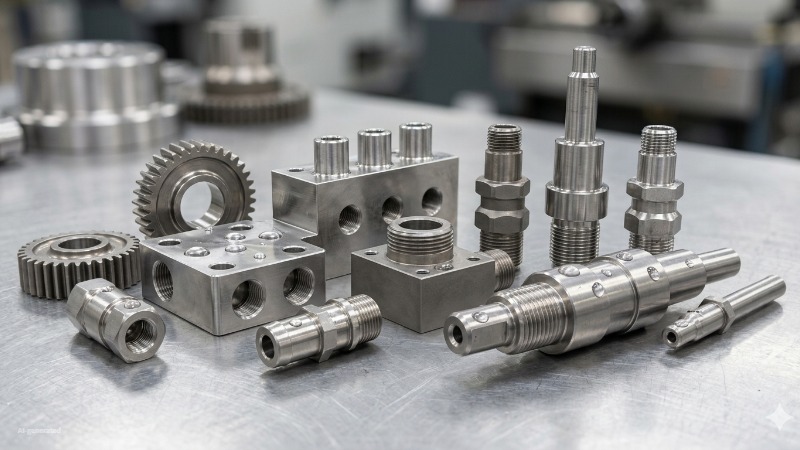
(AI generated) precision CNC machined stainless steel
Choosing the wrong material for a corrosive environment rarely causes immediate failure. More often, the damage appears gradually through leakage, seizure, pitting, or dimensional drift. In CNC-machined parts, corrosion is not just a durability problem. It is a material selection problem that affects service life, precision, maintenance cost, and reliability.
This guide explains how corrosion-resistant alloys perform in CNC machining, which materials work best in marine, chemical, medical, and industrial environments, and how to choose between stainless steel, aluminum, titanium, duplex grades, and nickel alloys without overspecifying the part.
If you are selecting a corrosion-resistant metal for a custom machined part, the best choice depends on the service environment, strength requirements, tolerances, and production volume. JLCCNC supports CNC machining for stainless steel, titanium, aluminum, and other corrosion-resistant materials for prototypes and production runs.

Precision CNC Machining Service
Professional manufacturing, fast turnaround, and quality assurance.
What Is a Corrosion-Resistant Alloy?
A material doesn't need to dissolve completely to become a corrosion problem. In CNC assemblies, small pits or oxide buildup are often enough to change sealing pressure or interfere with movement. This is where corrosion-resistant alloys become relevant.
Definition of Corrosion-Resistant Alloys
A corrosion-resistant alloy is a metal composition specifically formulated to resist chemical attack from its operating environment, whether that's moisture, salt, acids, alkalis, or high-temperature oxidizing gases.
The term alloy is important here. Pure metals like gold and platinum are naturally corrosion resistant, but they're not engineering materials for most applications. Corrosion resistant alloys achieve their performance through deliberate additions of elements, chromium in stainless steel, molybdenum in nickel alloys, copper in brass, that change how the metal responds to its environment at the surface chemistry level.
How Corrosion Resistance Works
Most corrosion resistant metals work through passive layer formation. When chromium in stainless steel contacts oxygen, it forms a thin, stable chromium oxide layer on the surface, typically 1-3 nanometers thick, that physically separates the metal underneath from the corrosive environment. The layer is self-healing: scratch it and it reforms in the presence of oxygen within seconds to hours depending on the alloy.
The quality of that passive layer determines how well the alloy resists different attack mechanisms. A layer that's stable in fresh water may be unstable in chloride solutions. A layer that works at room temperature may break down above 300°C. Understanding what breaks down the passive layer for a specific alloy in a specific environment is the core of corrosion resistant material selection.
Not all corrosion resistant alloys rely on passive layers. Some work through noble metal behavior, gold, platinum, and some copper alloys are simply unreactive to most common chemicals at the electrochemical potential they operate at. Others, such as zinc-coated steel, rely on sacrificial protection. The zinc corrodes preferentially, protecting the steel underneath.
Why Corrosion Resistance Matters in CNC Parts
The obvious answer is part life. A CNC machined component that corrodes in service either fails functionally or requires premature replacement, both of which cost more than specifying the right material upfront.
The less obvious answer is dimensional stability. Corrosion isn't just surface discoloration. Pitting removes material from critical surfaces. Oxidation buildup on mating faces changes clearances. Galvanic corrosion at fastener holes enlarges them over time. In precision CNC assemblies, these dimensional changes affect fit, function, and calibration, the part may still look intact while its geometry has drifted outside tolerance.
For CNC machined parts specifically, corrosion resistance also affects surface finish longevity. A machined surface to Ra 0.8 µm that oxidizes unevenly in service loses that finish consistency. For sealing surfaces, bearing interfaces, and optical mounts, that matters beyond appearance.
Corrosion Mechanisms in Metals
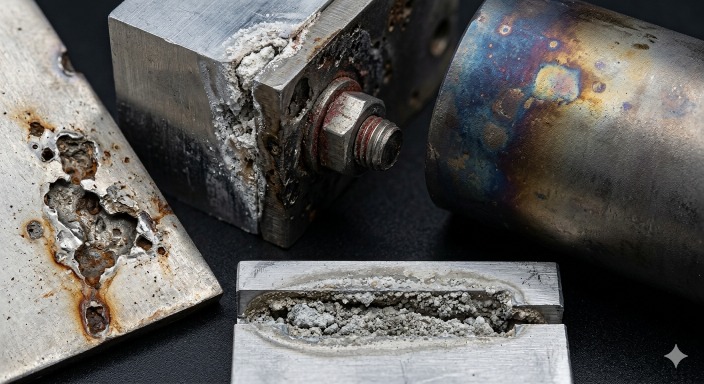
(AI generated) comparison of pitting, galvanic, oxidation, and crevice corrosion on machined metal components
Understanding how corrosion happens is more useful than memorizing which alloys resist it. The same alloy can perform excellently against one mechanism and fail quickly against another.
Oxidation and Passive Layer Formation
Oxidation is the most basic corrosion mechanism, metal reacts with oxygen to form a metal oxide. For iron, that oxide is rust, which is porous and non-protective: it flakes off and exposes fresh metal underneath, allowing corrosion to continue indefinitely. For aluminum, the oxide is dense and adherent, forming a protective barrier that stops further attack. For chromium-containing stainless steel, the chromium oxide passive layer is what makes it stainless.
The difference between protective and non-protective oxidation is whether the oxide layer is denser than the metal it forms from. If the oxide volume is greater than the metal volume it replaces, the layer is compressive and adherent. If it's less, the layer is porous or cracked. This is described by the Pilling-Bedworth ratio, above 1 generally means protective, below 1 generally means non-protective. Carbon steel has a ratio below 1 for iron oxide. Chromium has a ratio well above 1, which is why the chromium oxide layer on stainless steel is protective.
Pitting Corrosion in Chloride Environments
Pitting is the corrosion mechanism that catches engineers off guard most often with stainless steel. The passive layer on stainless steel is stable in most environments but breaks down locally in the presence of chloride ions, in seawater, salt spray, chlorinated water, and many industrial process fluids.
Once a pit initiates, the chemistry inside it becomes acidic and depleted of oxygen, which prevents the passive layer from reforming. The pit grows inward while the surrounding surface remains clean and passive. From the outside, a pitted part can look fine. The damage is subsurface and concentrated, a series of deep holes in an otherwise intact surface that create stress concentrations and can perforate thin sections.
Pitting resistance in corrosion resistant stainless steel is quantified by the
Pitting Resistance Equivalent Number (PREN):
PREN = %Cr + 3.3×%Mo + 16×%N.
Higher PREN means better chloride pitting resistance.
304 stainless has a PREN around 18-20. 316 stainless adds molybdenum, pushing PREN to 24-26.
Duplex stainless grades reach 35-40.
As a rule of thumb, alloys with PREN below about 32 are often not reliable for continuous natural seawater immersion, especially in crevice-prone conditions.
Galvanic Corrosion in Assemblies
When two different metals are in electrical contact in an electrolyte, water with dissolved salts is sufficient, the less noble metal corrodes preferentially. This is galvanic corrosion, and it's an assembly-level problem rather than a material problem.
The galvanic series ranks metals by their electrochemical potential. Metals far apart in the series create large driving voltages for galvanic corrosion when coupled. Aluminum coupled to stainless steel in a marine environment corrodes the aluminum rapidly. Carbon steel fasteners in a titanium structure corrode the fasteners. The rate depends on the potential difference, the relative surface areas, and the conductivity of the electrolyte.
In CNC machined assemblies, galvanic corrosion appears most often at fastener interfaces, a stainless steel screw in an aluminum housing, or a steel pin in a brass body. The small surface area of the fastener relative to the housing matters: if the fastener is the less noble metal, its small area corrodes quickly relative to the large cathodic area driving the reaction. Design practice is to keep dissimilar metals as close as possible in the galvanic series, use isolation, plastic washers, anodize, or coating, to break the electrical circuit, or ensure the less noble metal has the larger surface area if contact is unavoidable.
Crevice Corrosion in CNC Machined Parts
Crevice corrosion occurs in confined spaces where the electrolyte becomes stagnant, under bolt heads, in threaded interfaces, between a gasket and a flange face, in blind holes that trap moisture. The mechanism is similar to pitting: the oxygen inside the crevice gets depleted, the passive layer can't sustain itself, and localized corrosion accelerates in the oxygen-depleted zone while the open surface remains protected.
Crevice corrosion is particularly relevant in CNC machined parts because machined geometry creates crevices by design, counterbores, thread reliefs, undercuts, and press fit interfaces all create the confined geometry that drives this mechanism. The solution is design-level: minimize crevices where possible, use sealant to exclude electrolyte from unavoidable crevices, and specify alloys with higher crevice corrosion resistance when the geometry can't be changed.
For corrosion resistant stainless steel in crevice-prone environments, 316L or duplex grades significantly outperform 304, the molybdenum addition that improves pitting resistance also improves crevice corrosion resistance through the same mechanism.
Common Corrosion Resistant Materials Used in CNC Machining
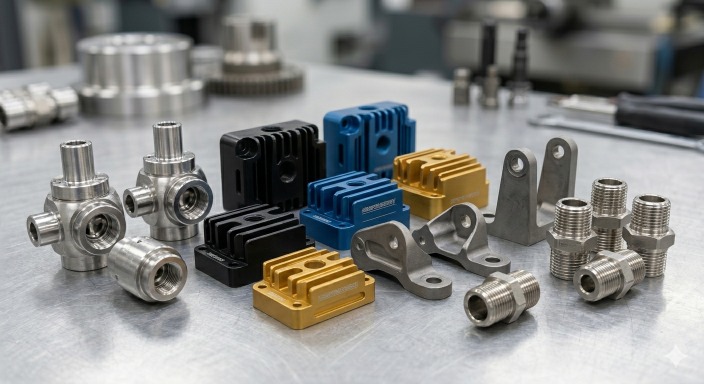
(AI generated) CNC machined corrosion resistant materials
Stainless Steel Alloys
Stainless steel covers the majority of corrosion resistant CNC machining work. 303 stainless machines the most freely due to sulfur additions but has reduced corrosion resistance, suitable for indoor hardware, fasteners, and shafts where finish quality matters more than chemical resistance. 304 and 316L are the workhorses covered in detail in the next section. 17-4 PH stainless combines corrosion resistance with 1000-1200 MPa tensile strength after precipitation hardening, making it the standard for aerospace and defense components needing both properties.
Aluminum Alloys
6061-T6 handles most aluminum corrosion resistant applications, good natural oxide layer, anodizes well for improved surface protection, and machines efficiently. For marine or high-humidity environments where 6061 pits at exposed cut edges, 5052 and 5083 offer better corrosion resistance through higher magnesium content, at the cost of lower strength. 7075 gives maximum strength among aluminum alloys but has lower corrosion resistance than 6061 and should be anodized or coated in any corrosive environment.
Titanium and Nickel Alloys
Titanium Grade 2 is the corrosion resistant choice when chemical resistance breadth matters more than strength, chemical processing equipment, medical devices, and seawater applications where stainless pits. Grade 5 (Ti-6Al-4V) adds structural capability for aerospace and high-load applications. Nickel alloys enter the specification when temperature and chemical aggression exceed what titanium and stainless handle, offshore equipment, chemical reactors, and high-temperature industrial components.
Corrosion Resistant Stainless Steel for CNC Machining
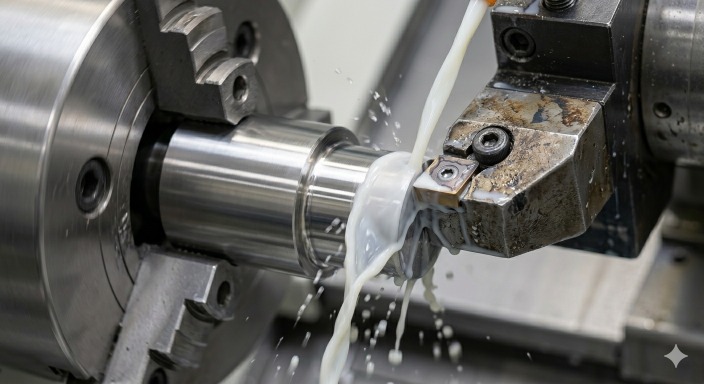
(AI generated) CNC turning operation machining a corrosion resistant stainless steel shaft
Why Stainless Steel Resists Corrosion
As covered in the passive layer section earlier, stainless steel's corrosion resistance comes from chromium content above 10.5% by weight.
The chromium oxide passive layer is stable, self-healing, and dense enough to block further oxidation in most environments.
The addition of molybdenum in 316 grades stabilizes this layer against chloride attack.
Nitrogen additions in duplex and super duplex grades further tighten the passive layer structure, improving both pitting and crevice corrosion resistance.
Common Stainless Steel Grades for CNC Machining
| Grade | Cr/Mo/Ni Content | PREN | Key Characteristic | Best Use |
|---|---|---|---|---|
| 303 | 17/0/8 | 17 | Free machining, sulfur added | Indoor hardware, fasteners |
| 304/304L | 18/0/8 | 18-20 | General purpose, widely available | Food equipment, indoor industrial |
| 316/316L | 16/2/10 | 24-26 | Molybdenum for chloride resistance | Marine, chemical, medical |
| 17-4 PH | 15/0/4 + Cu | 15 | High strength after heat treatment | Aerospace, defense, high-load |
| 2205 Duplex | 22/3/5 | 33-36 | Double strength of 304, better pitting | Offshore, chemical processing |
| 904L | 20/4.5/25 | 36-38 | High alloy, sulfuric acid resistant | Chemical processing, acid environments |
The L designation on 304L and 316L indicates low carbon content, which prevents sensitization during welding, carbide precipitation at grain boundaries that reduces corrosion resistance in the heat affected zone.
For CNC machined components that will be welded, L grades are the correct specification.
CNC Machined Part Applications
Stainless steel CNC parts appear throughout
food processing equipment where hygiene and washdown chemical resistance combine,
pharmaceutical manufacturing where purity and cleanability are regulatory requirements,
medical devices where biocompatibility and sterilization resistance matter,
marine hardware where 316L handles saltwater spray at a reasonable cost,
chemical processing where component geometry is complex enough to require machining rather than casting or forming.
Pure Metals and Alloyed Materials: What’s the Difference?
| Property | Pure Metals (Titanium, Copper, Gold) | Corrosion Resistant Alloys (316 SS, Inconel, Hastelloy) |
|---|---|---|
| Corrosion mechanism | Noble metal behavior or natural oxide | Passive layer from alloying elements (Cr, Mo, Ni) |
| Tensile strength | Low to moderate (titanium cp grades 240-550 MPa) | High (316 SS 480-620 MPa, Inconel 625 up to 930 MPa) |
| Machinability | Varies widely (copper easy, pure titanium difficult) | Generally moderate to difficult (work hardening is common) |
| Cost | High for noble metals, moderate for titanium | Moderate (stainless) to very high (Hastelloy, Inconel) |
| Availability in standard stock | Limited (fewer standard sizes and forms) | Wide (sheet, bar, tube, plate in standard dimensions) |
| Chloride resistance | Titanium excellent, copper poor in oxidizing chlorides | Depends on grade (304 poor, 316 moderate, duplex good) |
| High temperature performance | Titanium loses strength above 300°C | Nickel alloys maintain properties to 1000°C+ |
| Weldability | Titanium requires inert atmosphere, copper good | 316L and duplex good, nickel alloys require care |
| Typical CNC applications | Medical implants, heat exchangers, electrical contacts | Marine hardware, chemical processing, food equipment |
| Surface finish after machining | Excellent on copper, good on titanium | Good on stainless, moderate on nickel alloys |
| Work hardening during machining | Low on copper, moderate on titanium | High on austenitic stainless and nickel alloys |
| Best corrosion resistant metal for general use | Titanium grade 2 for broad chemical resistance | 316L stainless for cost-effective general industrial use |
Material Comparison: Stainless Steel vs Aluminum vs Titanium vs Nickel Alloys
Comparison of Corrosion-Resistant Metals for CNC Machining
| Property | 304 Stainless | 316L Stainless | 6061 Aluminum | Grade 2 Titanium | Grade 5 Titanium (Ti-6Al-4V) |
|---|---|---|---|---|---|
| General corrosion resistance | Good | Very good | Good | Excellent | Excellent |
| Chloride/marine resistance | Poor, pits readily | Moderate, PREN 24-26 | Moderate with anodize | Excellent | Excellent |
| Chemical resistance | Good, avoid chlorides | Better than 304, handles mild acids | Poor in strong acids/alkalis | Broad resistance | Broad resistance |
| Tensile strength | 480-515 MPa | 480-515 MPa | 270-310 MPa | 340-480 MPa | 895-950 MPa |
| Density | 7.9 g/cm³ | 7.9 g/cm³ | 2.7 g/cm³ | 4.5 g/cm³ | 4.4 g/cm³ |
| Machinability | Moderate, work hardens | Moderate, work hardens | Excellent | Difficult, springback | Difficult, heat buildup |
| Relative material cost | Low | Moderate | Low | High | Very high |
| Max service temperature | 870°C (intermittent) | 870°C (intermittent) | 150-200°C | 300°C (strength limited) | 315°C (strength limited) |
| Typical CNC applications | General industrial, food equipment | Marine, chemical, medical | Aerospace, enclosures, structural | Medical implants, chemical equipment | Aerospace, high-strength structural |
Nickel Alloys Performance Comparison
Nickel alloys occupy the applications where stainless steel runs out of capability. They're not general-purpose corrosion resistant alloys and shouldn't be specified where stainless suffices, the cost difference is substantial and the machining difficulty is significantly higher.
Inconel 625 handles seawater, oxidizing acids, and temperatures to 980°C while maintaining structural integrity. PREN equivalent exceeds 50, making it one of the most pitting-resistant materials available for CNC machined components. Tensile strength runs 830-930 MPa in annealed condition.
Hastelloy C-276 extends resistance further into reducing acid environments that attack Inconel, hydrochloric acid, sulfuric acid, wet chlorine, and is the standard for the most aggressive chemical processing applications. Monel 400 (nickel-copper) offers excellent seawater resistance with better machinability than Inconel, at lower cost, making it practical for marine valve bodies and pump components where titanium is overspecified.
Machining all nickel alloys requires sharp tooling, low cutting speeds (15-30 m/min for Inconel 625), heavy feeds to stay below the work-hardened surface layer, and rigid fixturing. Carbide tooling with coolant is standard. Tool life is short by any comparison to stainless steel machining.
Cost vs Corrosion Resistance Trade-off
The corrosion resistant materials cost hierarchy follows the performance hierarchy closely enough to use as a first filter:
304 stainless at $1.5-3/kg is the starting point for most industrial applications.
Moving to 316L adds 15-25% to material cost and meaningfully improves chloride and pitting resistance.
Duplex 2205 costs 2-3x 304 but offers double the yield strength alongside better corrosion performance than 316L.
Titanium Grade 2 runs 5-8x 304 stainless with broader chemical resistance.
Inconel 625 and Hastelloy C-276 run 15-30x the cost of 304 with the machining cost to match.
The decision framework: start with 304, move to 316L if chlorides are present, move to duplex if structural load and corrosion combine, move to titanium if broad chemical resistance or biocompatibility is required, move to nickel alloys only when temperature, reducing acids, or extreme oxidizing conditions make everything else inadequate.
Recommended Corrosion-Resistant Materials by Application
| Application | First Choice | Alternative | Avoid | Reason |
|---|---|---|---|---|
| Outdoor general industrial | 316L stainless | 6061 aluminum anodized | 304 stainless | 304 pits in coastal/humid outdoor exposure |
| Outdoor structural load bearing | Duplex 2205 | Ti-6Al-4V | Carbon steel | Strength and corrosion combined requirement |
| Freshwater immersion | 304 stainless | 6061 anodized | Carbon steel | Freshwater doesn't drive chloride pitting |
| Seawater immersion | Ti Grade 2 | Duplex 2205 | 304 or 316 stainless | Chloride concentration too high for standard stainless |
| Coastal spray environment | 316L stainless | Monel 400 | 304 stainless | Chloride exposure without full immersion |
| Hydrochloric acid contact | Hastelloy C-276 | Titanium Grade 2 | Any stainless steel | HCl attacks passive layer on all stainless grades |
| Sulfuric acid dilute | 316L stainless | 904L stainless | Carbon steel | Concentration and temperature dependent |
| Sulfuric acid concentrated | Hastelloy B-3 | Lead lined | Stainless steel | Concentrated H2SO4 attacks stainless |
| Nitric acid | 304 stainless | Titanium | Molybdenum containing alloys | Mo accelerates attack in oxidizing nitric acid |
| Food processing washdown | 316L stainless | Electropolished 304 | Aluminum | Hygiene regulations, cleaning chemical resistance |
| Pharmaceutical / biotech | 316L EP stainless | Titanium Grade 2 | 303 stainless (sulfur) | Electropolished surface, no sulfur inclusions |
| Chemical pump bodies | Hastelloy C-276 | Duplex 2205 | 304 stainless | Mixed chemical exposure, pitting risk |
| Medical implants | Ti-6Al-4V ELI | PEEK (non-metal) | Standard 316L | Biocompatibility, osseointegration |
| High temperature oxidizing | Inconel 625 | 310 stainless | 304 or 316 | Oxidation resistance above 600°C |
| High temperature reducing | Hastelloy X | Inconel 600 | Any stainless | Reducing atmospheres attack chromium passive layer |
| Marine fasteners | Monel 400 | 316L stainless | Carbon steel, brass in some configs | Galvanic compatibility with hull materials |
| Cryogenic applications | 304L stainless | Ti Grade 2 | Carbon steel | Austenitic stainless retains toughness at low temp |
CNC Machining Challenges of Corrosion-Resistant Alloys
The properties that make corrosion resistant alloys durable in service make them difficult to machine. High strength, work hardening, low thermal conductivity, and chemical reactivity with cutting tools are features of the same microstructure that resists environmental attack.
Machining Hardness and Tool Wear
Austenitic stainless steels like 304 and 316 aren't particularly hard in absolute terms, typically 150-190 HB, but they work harden rapidly during cutting. The surface layer ahead of the cutting tool hardens as the tool approaches, meaning the tool is always cutting into material harder than the bulk material. Running too slow makes this worse, the tool dwells in the work-hardened zone. The correct approach is feeding aggressively enough to cut below the hardened layer on every pass, which runs counter to the instinct to slow down on tough materials.
Nickel alloys are more severe. Inconel 625 offers excellent resistance to chloride pitting and seawater corrosion, far beyond standard austenitic stainless steels. Tool life on Inconel is measured in minutes rather than hours at any reasonable cutting speed. Carbide tooling with TiAlN coating is standard, cutting speeds of 15-30 m/min, and frequent tool changes before wear produces dimensional drift rather than after.
Titanium doesn't work harden as aggressively but has low thermal conductivity, 6-7 W/m·K versus 14-16 for 304 stainless and 150+ for aluminum. Heat generated at the cutting edge has nowhere to go except into the tool. This causes rapid crater wear on the tool rake face and is why titanium machining requires flood coolant directed precisely at the cutting zone, not just general coolant flow.
Heat and Chip Control
Chip control on corrosion resistant materials varies by alloy family. Stainless steel produces long, stringy chips that wrap around tooling if chip breaking isn't addressed in the toolpath — high helix end mills, chipbreaker geometry on turning inserts, and programmed chip breaks on deep drilling operations are standard practice.
Titanium produces segmented chips with high local temperatures at the chip-tool interface. Cutting fluid must reach the actual cutting zone, not just flood the general area. High-pressure coolant directed at the insert or cutting edge is worth the system cost on titanium production work, tool life improvements of 2-3x over conventional flood coolant are documented on titanium turning operations.
Nickel alloys produce short, tough chips with significant built-up edge risk. Sharp edges, positive rake angles, and consistent chip load prevent material from welding to the tool face. Once built-up edge forms on a nickel alloy operation, surface finish deteriorates and the situation doesn't self-correct, the tool needs replacing.
Surface Finish Considerations
Corrosion resistant alloys can achieve excellent surface finish but require correct process discipline to get there. The work-hardened surface layer on stainless steel that wasn't fully removed during roughing produces a tough skin that a light finishing pass won't cut cleanly, it rubs rather than shears, generating heat and poor finish. The finishing pass needs enough depth of cut to get below any work-hardened material from the previous operation.
For medical and food grade stainless components requiring Ra below 0.4 µm, machining alone is rarely sufficient. Electropolishing after machining removes the worked surface layer and surface inclusions, producing a clean passive layer and a surface that resists bacterial adhesion and cleaning chemical attack. Electropolishing removes 5-30 µm of material, which needs to be accounted for in the machined dimensions.
Surface Treatments to Improve Corrosion Resistance
Passivation for Stainless Steel
Passivation is a chemical treatment that removes free iron from the stainless steel surface and promotes a uniform, dense chromium oxide passive layer. Machining introduces iron contamination from tooling, fixtures, and the machining environment, iron particles embedded in the stainless surface will rust and can initiate pitting from those sites.
The process involves immersing the machined part in nitric acid (20-40% concentration at 50-60°C) or citric acid solution for 20-30 minutes, followed by rinsing and air drying. The acid dissolves iron preferentially without attacking the chromium-rich surface. The result is a cleaner, more chemically uniform passive layer that improves corrosion resistance measurably, salt spray resistance improvement of 2-3x over as-machined 316L is typical.
ASTM A967 and AMS 2700 are the standard specifications for passivation of stainless steel CNC parts. For medical and aerospace components, passivation per one of these standards and documented verification is typically a drawing requirement.
Anodizing for Aluminum
Anodizing converts the natural aluminum oxide layer to a controlled, thicker oxide that significantly improves corrosion resistance and wear resistance simultaneously.
Type II anodize produces a 5-25 µm layer, adequate for most industrial corrosion protection.
Type III hardcoat produces 25-75 µm, used where wear resistance and maximum corrosion protection are both required.
The dimensional change from anodizing is roughly half the coating thickness per side, a 25 µm Type III coating adds approximately 12.5 µm per surface. For tight-tolerance CNC features, this needs to be accounted for in machined dimensions. Bores and threaded features are either masked during anodizing or machined after coating.
Sealing after anodizing is important for corrosion resistance. An unsealed anodize layer is porous and absorbs contaminants. Hot water sealing or nickel acetate sealing closes the pores and provides the corrosion protection the anodize layer is specified for.
Coating and Plating Options
Electroless nickel plating deposits a uniform nickel-phosphorus layer on CNC machined parts regardless of geometry complexity, inside bores, blind holes, and undercuts plate at the same rate as external surfaces. Corrosion resistance depends on phosphorus content: high-phosphorus electroless nickel (10-12% P) is essentially amorphous and provides excellent corrosion resistance in mild to moderate environments. Thickness runs 12-50 µm with thickness uniformity of ±2-3 µm, which matters for precision bore dimensions.
PVD coatings (TiN, TiAlN, CrN) are primarily wear coatings but provide additional corrosion barrier properties. CrN specifically offers good corrosion resistance and is used on components needing both wear and chemical resistance.
Ceramic coatings applied by thermal spray produce thick, chemically inert layers for extreme chemical environments where metallic coatings would be attacked. These are typically used on large components where other options don't cover the required chemical exposure range.
Learn surface treatment technologies in details
How to Choose Corrosion Resistant Materials for CNC Manufacturing
Environmental and Performance Requirements
The corrosion mechanism the part will face should drive material selection before any other factor. Using the corrosion mechanism section covered earlier as a framework: identify whether the environment drives uniform oxidation, pitting, galvanic attack, or crevice conditions, then select the material whose passive layer chemistry specifically resists that mechanism.
Temperature matters alongside chemistry. Stainless steel passive layers become unstable above certain temperatures in specific environments. Titanium loses strength above 300°C despite maintaining corrosion resistance. Nickel alloys maintain both properties to much higher temperatures. Specifying a corrosion resistant alloy without checking its performance at the actual operating temperature is an incomplete specification.
Mechanical requirements constrain the choice further. If the part carries structural load, pure corrosion resistance isn't enough, the alloy needs to meet the strength requirement at operating temperature with adequate safety factor. Duplex 2205 at 460-480 MPa yield strength covers applications where 316L at 170-310 MPa yield is insufficient.
Machinability and Production Efficiency
Machinability directly affects part cost and should influence material selection on cost-sensitive work. 303 stainless machines 3-4x faster than 316L for equivalent operations. If the corrosion environment doesn't require 316L's chloride resistance, specifying 316L where 303 suffices adds machining cost with no performance return.
For high-volume production of corrosion resistant parts, free-machining variants of standard grades are worth evaluating. 303 stainless, 6061-T6 aluminum (versus 5052), and Grade 5 titanium versus Grade 2 all offer machinability improvements that change the production economics significantly at volume. The trade-off in corrosion performance needs to be explicitly evaluated rather than defaulting to the most corrosion resistant option available.
Cost and Material Selection Strategy
Work through the selection in order of cost, stopping when the requirements are met. 304 stainless at base cost handles fresh water, food contact, and general indoor industrial. Move to 316L for chloride exposure. Move to duplex for combined high strength and corrosion requirements. Move to titanium for broad chemical resistance and biocompatibility. Move to nickel alloys for extreme temperature and chemical environments. Each step up adds significant cost, the decision to move to the next tier needs a specific requirement that the previous tier can't meet, not just a preference for more corrosion resistance than necessary.
Surface treatment is a legitimate part of the cost strategy. Using 6061 aluminum with Type III hardcoat anodize for a marine bracket costs significantly less than titanium while providing adequate performance in spray environments. Using 304 stainless with passivation rather than 316L saves material cost in environments where chloride concentration doesn't justify the molybdenum premium.
Choosing the right corrosion-resistant material means balancing environmental performance with machinability, cost, and part geometry. At JLCCNC, we support customers in selecting stainless steel, titanium, aluminum, and other corrosion-resistant materials that meet both service requirements and CNC manufacturing needs.
Precision CNC Machining Service
Professional manufacturing, fast turnaround, and quality assurance.
Advantages and Limitations of Corrosion-Resistant Alloys
Key Advantages
Long service life in corrosive environments is the primary value, a correctly specified corrosion resistant alloy part in the right environment lasts the life of the assembly without replacement or maintenance intervention. This is the calculation that justifies the cost premium: the total cost of ownership over the part's service life, including replacement frequency and downtime cost, almost always favors the corrosion resistant alloy over a cheaper material that requires periodic replacement.
Dimensional stability over time is a direct consequence of not corroding. A carbon steel shaft in a humid environment drifts dimensionally as surface oxidation builds up and pits develop. A 316L shaft in the same environment maintains its machined dimensions. For precision assemblies, this stability has engineering value beyond simple durability.
Regulatory compliance in food, pharmaceutical, medical, and offshore industries often mandates corrosion resistant materials regardless of cost. In these contexts the material selection is a compliance requirement, not a trade-off decision.
Common Limitations
Cost is the most consistent limitation. Corrosion resistant alloys cost more to procure and more to machine than carbon steel or standard aluminum. The machining cost gap is particularly large for nickel alloys and titanium, not just tool wear, but the slower speeds and feeds required mean longer cycle times and lower machine utilization on the same equipment.
Galvanic risk in mixed-material assemblies can partially offset the corrosion resistance of a well-specified alloy if the assembly design isn't reviewed for dissimilar metal contact. A 316L stainless part corrodes if it's in the wrong galvanic couple in the wrong electrolyte, despite its own excellent passive layer.
Some corrosion resistant alloys have limited form factor availability. Hastelloy C-276 in a specific bar diameter may be a long-lead item. Super duplex grades in thin sheet are not always in stock. Designing around material availability, or building lead time into the schedule for specialty alloy procurement, is a practical constraint that affects corrosion resistant alloy projects more than standard material work.
Long-Term Manufacturing Value
The manufacturing value of corrosion resistant alloys compounds over the product lifetime. Parts that don't corrode don't generate warranty claims, field replacements, or production stoppages from component failure. In process industries, a corroded valve body or pump component that fails causes downtime worth multiples of the component cost. In medical devices, material failure has consequences beyond cost.
The long-term value argument is strongest when the cost of failure is high relative to the cost of the component, which is true in most applications where corrosion resistant materials are legitimately specified. Where the cost of failure is low and replacement is easy, the premium for corrosion resistant alloys may not be justified, and the selection strategy covered earlier applies: use the cheapest material that meets the requirement, with surface treatment as a cost-effective way to extend the performance of lower-cost base materials.
FAQs About Corrosion-Resistant Alloys in CNC Machining
Q: What is the best corrosion-resistant metal for CNC machining?
Titanium, 316 stainless steel, Hastelloy, and duplex stainless steels are some of the best corrosion resistant metals depending on chemical exposure, saltwater contact, and strength requirements.
Q: Are stainless steels difficult to machine?
Many corrosion resistant stainless steel grades generate heat quickly and work harden during cutting, which increases tool wear and machining difficulty compared to aluminum or mild steel.
Q: Which corrosion-resistant alloy is best for marine applications?
316 stainless steel, duplex stainless steel, titanium, and certain nickel based corrosion resistant alloys perform well in marine and saltwater environments.
Q: How do corrosion-resistant alloys affect tool life?
Corrosion resistant materials often reduce tool life because they retain heat, increase cutting forces, and create more abrasive machining conditions during CNC operations
Popular Articles
• Top 5 Heat-Resistant Metals for CNC Machining and How to Choose
• What are the Main Differences between Aluminum 6061 and 7075
• Aluminum vs Brass: CNC Material Guide for Makers
• Stainless Steel CNC Machining Material Selection Guide Corrosion Resistance and Cost Comparison of 304 vs 316
• Secrets of CNC machining of high hardness stainless steel Cracking the problems of tool wear and work hardening
Keep Learning
Titanium vs Stainless Steel: Key Differences and Applications
Key Takeaway Titanium vs stainless steel weight is where titanium wins most clearly. Titanium is roughly 44% lighter than stainless steel at equivalent volume. Titanium vs stainless steel strength shows a more nuanced picture, titanium Grade 5 has higher specific strength (strength per unit weight) than most stainless grades, but some high-strength stainless grades match or exceed titanium's absolute tensile strength. The difference between titanium and stainless steel in corrosion resistance is minim......
Stainless Steel CNC Machining: Materials, Challenges, Tolerances, and Custom Parts
Key Takeaways About Stainless Steel CNC Machining Stainless steel is usually chosen when aluminum cannot provide enough strength or environmental resistance for the application. Tool wear tends to become a larger concern as cutting time increases. Heat stays near the cutting edge, and the material can harden while machining. Not every stainless grade behaves the same in the machine. A part machined from 303 may run very differently from the same geometry produced in 316. Some cost drivers are easy to ......
Corrosion-Resistant Alloys: Best Metals for CNC Machining & Harsh Environments
Key Takeaways • Corrosion resistance comes from passive oxide layers that form on the metal surface and block further attack. • The most common corrosion resistant metals in CNC machining are stainless steel, aluminum, titanium, nickel alloys, and copper alloys, each suited to different environments and load conditions. • Chloride environments, dissimilar metal contact, and stagnant crevices are the three conditions that most commonly defeat otherwise adequate corrosion resistant materials. • Material......
Steel Machining: CNC Strategies, Material Behavior, and Custom Steel Parts Guide
(AI generated) CNC-machined steel showing raw and finished surface. Steel machining is deceptively simple on a CAD/CAM screen. In the spindle, however, it is a constant calculation of heat soak and chip formation. Unlike softer alloys, steel has lower thermal conductivity than aluminum, causing heat to concentrate near the cutting zone. It doesn't allow for loose parameters. It responds to every pound of pressure, and that inherent resistance is exactly why we specify it for high-stress, load-bearing ......
Ferrous vs Non-Ferrous Metals: Key Differences, Properties & Manufacturing Applications
Choosing between ferrous and non-ferrous metals is a critical decision in CNC machining. Ferrous metals, such as steel, require higher cutting forces, while non-ferrous metals like aluminum allow for higher cutting speeds. The material choice directly impacts spindle speed, tool wear, dimensional stability, and finishing cost, influencing overall manufacturing efficiency. This guide explores the topic from a manufacturing perspective, linking material differences directly to measurable production outc......
Heat Treatment of Metals: Processes, Property Effects, and Manufacturing Decisions
Heat treatment is not merely a material property change; it directly affects how the part behaves during CNC machining. Heat treatment alters a metal’s microstructure, directly affecting hardness and residual stress. Quenching steel can raise hardness from 28 HRC to 52 HRC. Higher hardness increases cutting forces and accelerates tool wear, while annealing reduces both. After annealing, the same material may cut easily, but smears/drags during finishing because internal stresses were redistributed. Th......