Steel Machining: CNC Strategies, Material Behavior, and Custom Steel Parts Guide
21 min
- What Is Steel Machining in CNC Production
- Types of Steel Machining Processes
- Steel Grades and Machinability
- How Steel Affects CNC Machining
- Recommended Cutting Parameters for Steel Machining
- CNC Machining Strategies for Steel
- Design for Manufacturability (DFM) in Steel
- What Drives the Cost of Steel CNC Machining
- Steel vs Aluminum and Other Alternatives (Process Selection)
- When to Use CNC Steel Machining for Custom Parts
- CNC Steel Machining at JLCCNC
- FAQ About Steel Machining
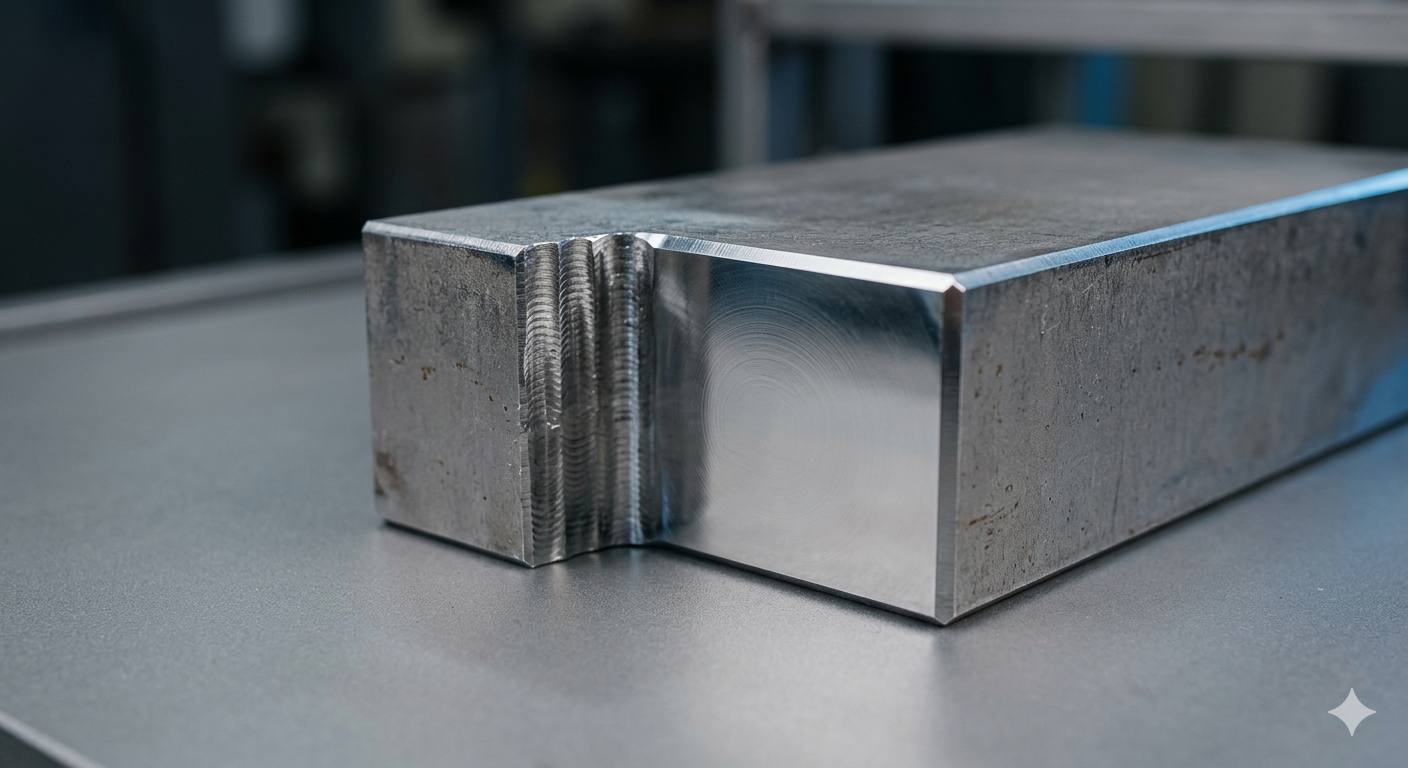
(AI generated) CNC-machined steel showing raw and finished surface.
Steel machining is deceptively simple on a CAD/CAM screen. In the spindle, however, it is a constant calculation of heat soak and chip formation. Unlike softer alloys, steel has lower thermal conductivity than aluminum, causing heat to concentrate near the cutting zone. It doesn't allow for loose parameters. It responds to every pound of pressure, and that inherent resistance is exactly why we specify it for high-stress, load-bearing components.
If you’re working with steel CNC machining, you’re balancing three things at once: material behavior, cutting strategy, and final part requirements. Get those aligned, and your parts come off the machine clean, stable, and within spec. Miss one, and costs creep up fast.
What Is Steel Machining in CNC Production
Steel machining is the controlled removal of material from steel using CNC tools to produce precise, high-strength components.
That sounds simple, but steel behaves very differently from softer metals like aluminum.
In machining steel, cutting forces are higher. The tool doesn’t glide through the material. It pushes against it. That means more spindle load, higher cutting temperatures, and faster tool wear if parameters aren’t dialed in.
Heat is the real problem. Steel doesn’t dissipate heat as quickly as aluminum, so it stays concentrated at the cutting zone. That’s where tools fail. Not because they’re weak, but because the heat builds faster than it can be managed.
Process control becomes tighter, too. You’re not just setting feeds and speeds. You’re managing:
- chip formation (to avoid built-up edge)
- tool engagement (to prevent chatter)
- coolant strategy (to control temperature and tool life)
This is where steel machining properties come into play. Carbon content, hardness, and alloying elements all change how the material cuts. A low-carbon mild steel behaves predictably. A hardened alloy steel? Completely different story.
That’s the gap between general metal machining and steel CNC machining. With steel, you don’t “machine through it.” You engineer the cut.
If you're comparing steel with other manufacturing methods, see how CNC machining compares to alternative processes like sheet metal fabrication in real production scenarios.
Types of Steel Machining Processes
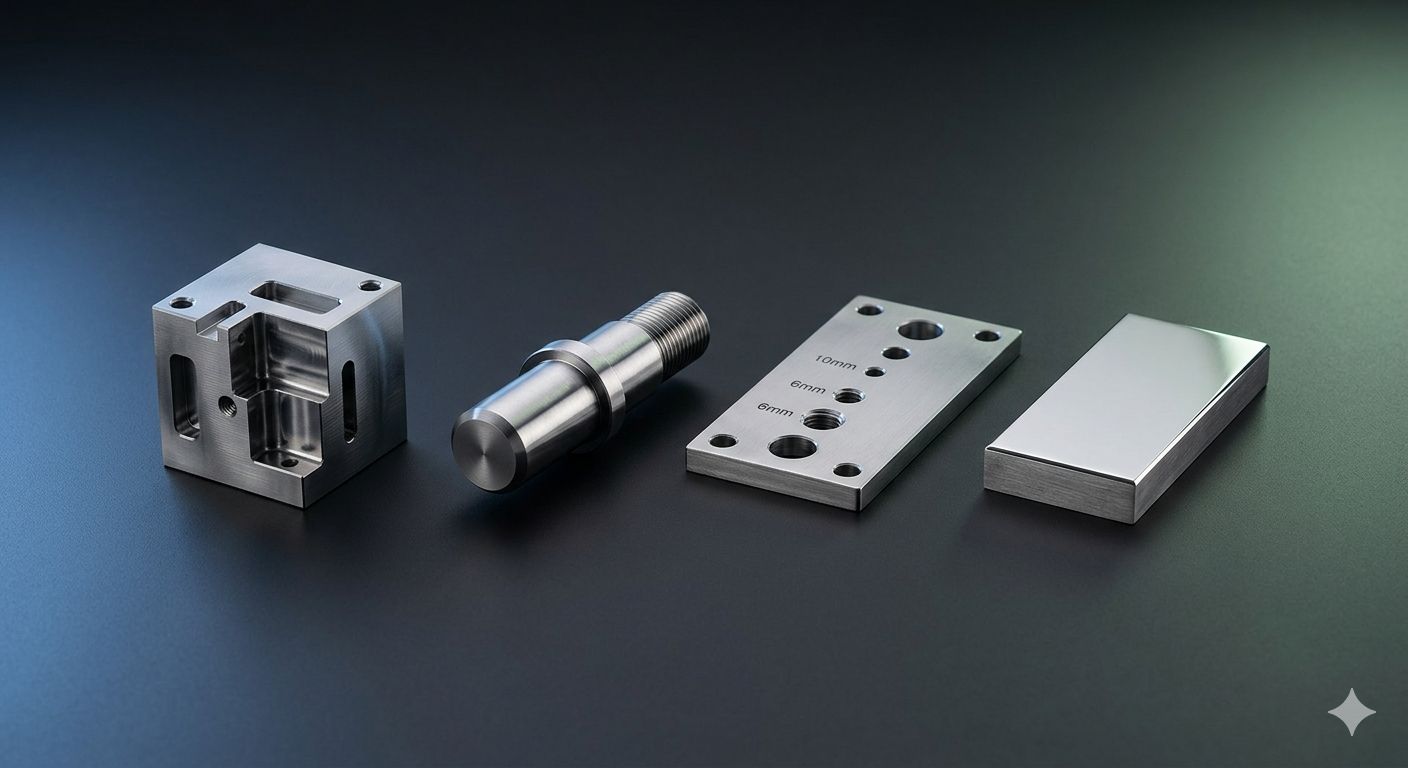
(AI generated) Four steel parts showing different machining process.
| Process | What It Does | Key Behaviors in Steel Machining | Critical Challenges | Practical Impact on CNC Steel Parts |
|---|---|---|---|---|
| CNC Milling for Steel Parts | Uses rotating cutting tools to create slots, pockets, contours, and flat surfaces | High cutting forces require controlled tool engagement; heat builds quickly due to poor thermal dissipation | Tool overload if engagement is too high; rubbing and rapid wear if too low; chip evacuation issues in deep pockets | Adaptive toolpaths maintain consistent load, reduce thermal spikes, and extend tool life; lower spindle speeds improve stability |
| CNC Turning for Steel Components | Rotates the workpiece to create cylindrical parts like shafts, pins, and bushings | More stable than milling if setup is rigid; continuous chip formation along cutting edge | Long, stringy chips can wrap around tool or part; improper insert geometry leads to poor chip control | Chip breakers are essential; establishes primary geometry and concentricity for custom steel parts before secondary operations |
| Drilling, Tapping, and Threading Steel | Produces holes and internal threads in steel components | High heat concentration at drill tip; steel resists deformation, increasing torque during tapping | Chip packing inside holes causes breakage and poor finish; taps can snap under high torque | Through-tool coolant improves chip evacuation; thread milling preferred for better control and reduced scrap risk |
| Grinding and Secondary Finishing | Refines dimensions and surface finish after primary machining | Minimal material removal focused on precision; essential for hardened steels | Traditional tools struggle with hardened materials; distortion after heat treatment needs correction | Achieves micron-level tolerances; improves surface integrity, wear resistance, and final part performance |
Steel Grades and Machinability
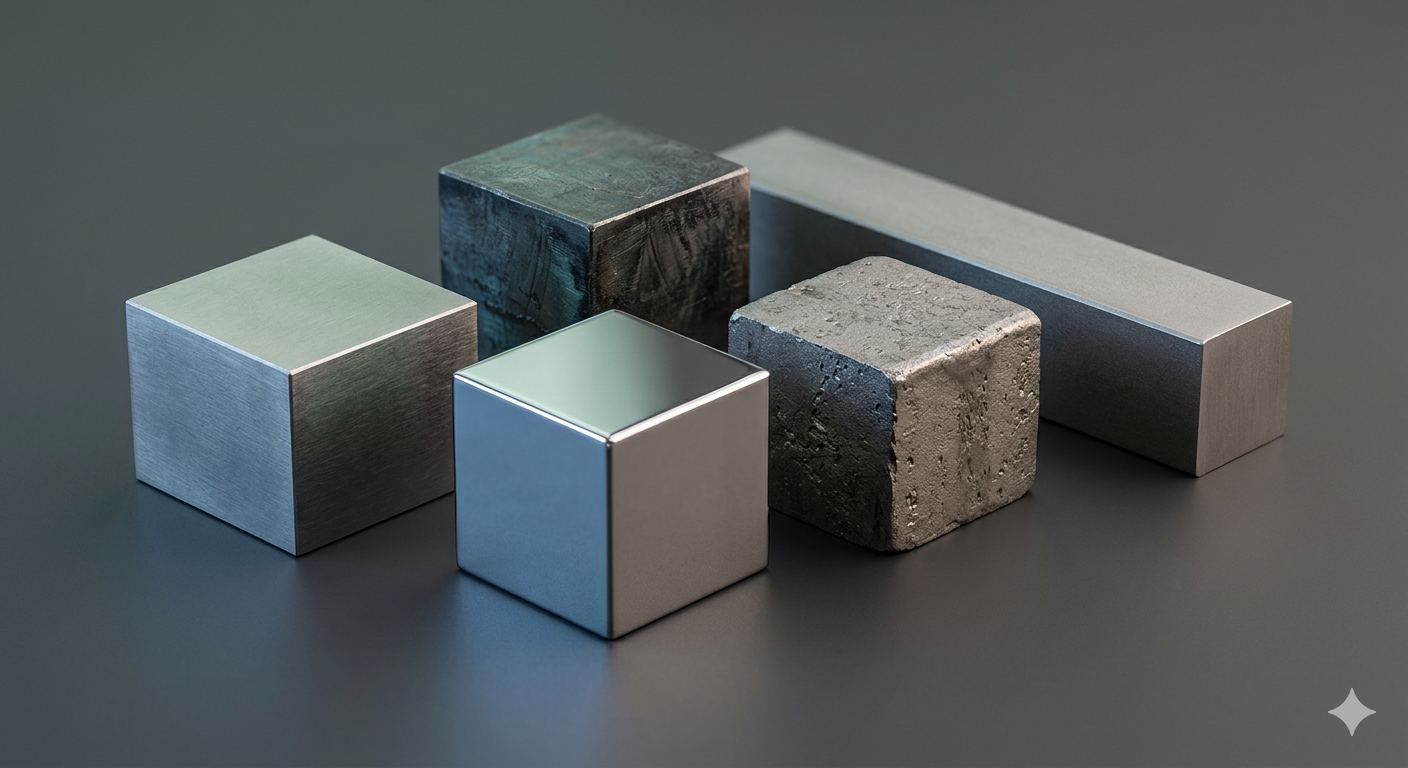
(AI generated) Different steel grade samples.
This is where most machining decisions are actually made.
You don’t start with tooling or speeds. You start with the material. Because in steel machining, the grade dictates everything that follows, cutting force, heat generation, chip behavior, tool wear, even how aggressively you can push cycle time.
Two steels can look identical on a drawing and behave completely differently on the machine.
That’s why understanding steel machining properties at the grade level is what separates predictable production from constant tool adjustments and scrap.
If your part involves sheet-based components or outdoor exposure, material choice goes beyond machinability. See how cold rolled vs galvanized steel sheet affects corrosion resistance, surface condition, and long-term performance in real applications.
Low Carbon Steel vs Alloy Steel
Low-carbon steels are the baseline. They’re softer, more forgiving, and easier to machine.
The machinability of steel depends entirely on how the grain structure responds to the cutting edge. Low-carbon steels serve as the baseline for most operations because their softer composition keeps cutting forces manageable and leads to more predictable chip formation. This stability translates directly to a longer lifespan for your tooling.
That’s why low carbon steels are widely used for general CNC steel parts, brackets, housings, and basic structural components.
But there’s a tradeoff. Strength and wear resistance are limited.
Alloy steels shift that balance.
Once you introduce elements like chromium, molybdenum, or nickel, the material gains strength, hardness, and fatigue resistance. Great for performance. Not so great for machining.
What changes:
- higher cutting forces
- more heat at the tool edge
- increased tool wear
Machining alloy steel isn’t just “harder.” It’s less stable. You’ll see more variation in how the material reacts under load, especially in interrupted cuts or complex geometries.
So the decision isn’t just strength vs machinability. It’s production stability vs performance requirements.
Free-Machining Steels (e.g., 12L14)
12L14 achieves high machinability ratings by incorporating manganese sulfides and lead globules into the steel’s matrix. These additives serve as internal chip-breakers; as the tool shears the material, the lead acts as a localized lubricant that reduces the coefficient of friction at the tool-chip interface.
This prevents the long, stringy chips common in standard low-carbon alloys. Instead, the material fractures into small, manageable 6-shaped chips that clear the flutes immediately. By reducing the thermal load on the carbide coating, you can run higher surface feet per minute (SFM) while maintaining surface finishes that usually require a secondary grinding operation in stable conditions. This makes 12L14 the baseline for high-volume screw machine work where minimizing cycle time is the primary constraint.
But there’s a limitation most people overlook.
These steels sacrifice mechanical performance. They’re not ideal for high-stress or safety-critical applications. Weldability can also be poor, especially with leaded grades.
So they’re perfect for precision components, fittings, and repeat parts. Not for structural loads or harsh environments.
Stainless Steel Machining Challenges
Stainless steel looks clean. It machines anything but.
The biggest issue is work hardening. As you cut, the material actually becomes harder at the surface. If your tool hesitates or rubs instead of cutting cleanly, you’re suddenly machining a harder layer than you started with.
That’s where things go wrong.
In stainless steel machining, you’re dealing with:
- high heat retention
- rapid work hardening
- strong tendency to form a built-up edge
Tools wear faster, and surface finish can degrade quickly if parameters aren’t dialed in.
You can’t “ease into” a cut with stainless. You need:
- consistent feed to stay ahead of work hardening
- sharp tooling with proper coatings
- stable engagement to avoid chatter
Compared to mild steel, stainless demands tighter process control. It’s less forgiving, but necessary for corrosion resistance and long-term durability.
Heat-Treated vs Annealed Steel
This is where machinability can change overnight.
Annealed steel is soft. It’s been heat-treated to relieve internal stresses and reduce hardness. That makes it much easier to machine.
You get lower cutting forces, better tool life, and more predictable behavior.
That’s why most parts are machined in the annealed state first.
Heat-treated steel is a different environment entirely.
Once hardened, the material gains strength and wear resistance, but machinability drops sharply.
Now you’re dealing with increased risk of tool chipping and the need for slower speeds and more rigid setups
In many cases, steel CNC machining happens before heat treatment, followed by grinding or finishing operations afterward to bring the part back into tolerance.
That sequence matters.
Machine first, harden second, finish last.
Ignore that order, and you end up fighting the material instead of cutting it.
Choosing the right steel grade also ties directly to cost and machinability. Our breakdown of material selection for CNC machining across metals goes deeper into how different alloys behave.
How Steel Affects CNC Machining
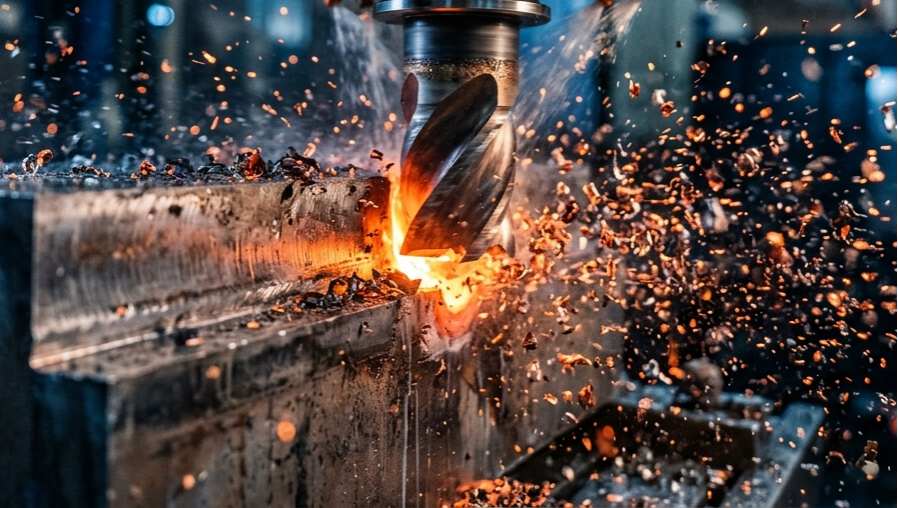
(AI generated) CNC tool cutting steel with chip formation and heat at cutting zone.
Machining steel is a process defined by high-stress material displacement. Unlike aluminum, the metallurgy of steel creates a cycle of high cutting forces and thermal concentration that directly dictates the lifespan of your tooling and the accuracy of your part.
Displacement Forces and Deflection
Cutting steel involves high specific cutting energy, which generates significant reactive forces. These forces propagate from the tool tip through the tool holder and into the machine spindle. Any lack of rigidity in the setup, such as excessive tool overhang (L/D ratio) or insufficient workholding, causes the tool to deviate from its programmed path.
This deflection frequently presents as dimensional inaccuracies rather than audible chatter. In practice, this results in tapered vertical walls or positional drift in bored holes. Achieving sub-thousandth tolerances requires maximizing the stiffness of the assembly; this is achieved by using the shortest possible tool stick-out and high-clamping-force fixturing to resist the lateral loads inherent in steel machining.
Thermodynamics and Edge Geometry Failure
Steel’s low thermal diffusivity limits heat dissipation compared to aluminum. Instead, the thermal energy remains trapped at the primary shear zone, raising the temperature of the carbide edge. If the tool reaches its critical temperature, the binder in the carbide softens, leading to immediate geometry failure.
The failure typically follows two mechanical paths:
- Adhesion (Built-Up Edge): At insufficient cutting velocities, the pressure and heat cause material to pressure-weld to the rake face. This built-up edge intermittently breaks off, tearing the tool coating and leaving a jagged surface finish.
- Chemical Diffusion: At excessive surface speeds, the extreme heat allows atoms from the tool substrate to migrate into the steel. This chemically "erodes" the cutting edge, resulting in crater wear and loss of dimensional control.
Process stability depends on maintaining the Surface Feet per Minute (SFM) within the specific thermal window of the tool coating. Cutting below this window increases friction and mechanical adhesion, while exceeding it leads to rapid thermal softening. Precise chip load management ensures the heat is carried away in the chip volume before it can saturate the tool edge.
Mechanical Chip Control
Steel produces long, continuous stringer chips that can easily bird-nest around the spindle or get trapped in deep pockets. When a chip gets recut, it creates an immediate spike in load that can snap a carbide end mill or gouge the surface of a finished part.
Modern steel machining relies on chip-breaker geometry built into the insert. These features are designed to force the chip to curl and snap under its own tension. In deep-cavity milling, the toolpath strategy must prioritize evacuation, using high-pressure coolant or air blasts, to ensure the machine isn't wasting energy recutting scrap material.
Recommended Cutting Parameters for Steel Machining
There’s no single “correct” set of numbers for steel machining. Parameters shift with grade, hardness, tool coating, and machine rigidity. But you can work from solid ranges that keep the cut stable and predictable, then fine-tune from there.
Instead of guessing feeds and speeds, think in terms of relationships. Cutting speed controls heat. Feed rate controls chip thickness. Depth of cut controls load. Get those balanced, and the process settles down.
Parameter selection also depends heavily on tooling. For a deeper look at how cutting tools and coatings impact CNC machining performance, see our tooling guide.
Cutting Speed and Feed Rate Guidelines
These ranges reflect real shop conditions for common steels using carbide tooling. They’re not maximums. They’re stable starting points for machining steel without burning tools or sacrificing consistency.
| Steel Type | Hardness (Approx) | Cutting Speed (m/min) | Feed Rate (mm/tooth or rev) | What It Means in Practice |
|---|---|---|---|---|
| Low Carbon Steel (e.g., mild steel) | ~120–180 HB | 120–180 | 0.05–0.25 | Stable cutting, predictable chips, good baseline for most cnc steel parts |
| Alloy Steel (e.g., 4140 pre-hard) | ~200–300 HB | 80–140 | 0.04–0.20 | Higher load and heat, requires tighter control and better tooling |
| Stainless Steel (e.g., 304) | ~150–220 HB | 60–120 | 0.03–0.18 | Slower speeds to manage heat and work hardening |
| Hardened Steel | 45+ HRC | 30–80 | 0.02–0.10 | Light cuts, high rigidity, often paired with finishing operations like grinding |
The pattern is consistent. As hardness increases, speed drops, and control becomes more important. You’re trading productivity for tool life and stability.
Also, it’s worth noting that pushing the speed too high destabilizes the entire cut. In steel CNC machining, consistency beats aggression every time.
Tool Selection Based on Steel Hardness
Tooling is where a lot of machining problems either get solved or created.
You don’t pick a tool just because it fits the geometry. You pick it based on how the steel behaves under load.
| Steel Condition | Recommended Tool Type | Coating / Geometry | Why It Works |
|---|---|---|---|
| Low Carbon Steel | Carbide end mills or inserts | TiN or TiCN coatings, general-purpose geometry | Handles moderate heat and provides good tool life at higher speeds |
| Alloy Steel | High-performance carbide tools | AlTiN or TiAlN coatings, stronger edge prep | Better heat resistance and edge strength for higher cutting forces |
| Stainless Steel | Sharp carbide tools | Polished flutes, TiAlN coating, positive rake | Reduces friction and prevents built-up edge formation |
| Hardened Steel | Hard milling tools (CBN or coated carbide) | AlTiN or advanced coatings, rigid geometry | Maintains edge integrity under extreme hardness and heat |
In custom steel parts, tool failure is rarely random. It usually comes from mismatching tool geometry to material behavior.
A tool that works perfectly on mild steel can fail quickly in stainless, even with the same parameters.
Coolant and Lubrication Strategy
In steel machining, a poor coolant strategy shows up fast. Tools overheat, chips stick, and surface finish degrades.
| Operation Type | Coolant Strategy | Why It Matters |
|---|---|---|
| Milling | Flood coolant or high-pressure coolant | Removes heat from cutting zone and clears chips from pockets |
| Turning | Directed coolant at cutting edge | Controls continuous chip formation and prevents chip wrapping |
| Drilling | Through-tool coolant (especially deep holes) | Essential for chip evacuation and preventing tool breakage |
| Tapping / Threading | High-lubricity cutting fluid | Reduces torque and prevents tap failure |
| High-Speed or Light Cuts | Minimum Quantity Lubrication (MQL) in some cases | Reduces friction without excessive cooling, useful for controlled environments |
Too little coolant, and heat builds up. Too much, and you can shock the tool or lose control over chip flow.
Coolant behavior isn’t just about volume. Fluid type, lubrication characteristics, and delivery method all affect how heat and friction are managed at the cutting zone. For a deeper breakdown of coolant types and maintenance considerations in CNC machining, see our guide on CNC coolant types and maintenance.
The goal is consistency, not just volume.
CNC Machining Strategies for Steel
Developing a stable steel process requires managing the mechanical load at the cutting edge. High-performance machining in steel isn't about backing off the parameters; it’s about maintaining a constant chip load to prevent the tool from rubbing and work-hardening the material.
Roughing vs. Finishing Load Distribution
Effective roughing in steel relies on constant radial engagement. Using adaptive or trochoidal toolpaths prevents the sudden load spikes that occur when a tool enters a corner or a full-width slot. By maintaining a consistent engagement angle, you can push higher feed rates without risking a catastrophic edge chip. Finishing passes, by contrast, must be calculated to remove enough material to allow the tool to bite into the surface; too light a finish pass will cause the tool to skate, leading to rapid heat-checking of the carbide.
Feed Rates and Material Work-Hardening
In harder alloys, the relationship between depth of cut and feed rate is critical. If the feed per tooth is too low, the tool will rub against the material rather than shearing it. This creates a localized heat-affected zone that hardens the steel, making subsequent passes significantly more difficult. You must maintain a chip load that exceeds the hone or radius of the cutting edge to ensure the tool is always cutting fresh material.
Toolpath Geometry and Vibration Control
Sudden changes in tool direction create lateral forces that lead to spindle deflection. To counter this, toolpaths should utilize circular interpolation and smooth lead-ins. Avoiding 90-degree directional shifts keeps the chip thickness consistent and prevents the hammering effect that causes vibration. In deep-pocket milling, the priority is minimizing the length-to-diameter ratio of the tool to maintain the highest possible rigidity.
Tool Coatings and Substrate Selection
The thermal demands of steel require coatings like AlTiN (Aluminum Titanium Nitride), which forms a protective aluminum oxide layer when exposed to high heat. This layer acts as a thermal barrier for the carbide substrate. For stainless steels, where friction is the primary concern, a sharper rake angle is required to reduce the drag of the material, whereas alloy steels require a more robust, chamfered edge to handle the higher impact loads.
Design for Manufacturability (DFM) in Steel
The cost of a steel component is often determined by how the geometry affects tool access and deflection. Designs that ignore the physical limits of a cutting tool force the machinist to use slower, less stable setups.
High-Difficulty Geometric Features
Deep, narrow cavities and sharp internal corners are the primary drivers of tool failure. These features force the use of small-diameter, long-reach tools that lack the rigidity to handle steel's cutting forces. By increasing internal corner radii to at least 110% of the tool radius, you allow the tool to sweep through the corner rather than burying it, which prevents the spikes in torque that break end mills.
Managing Wall Stability and Flex
While steel has high structural strength, thin-walled features will flex under the lateral pressure of a CNC cutter. This deflection causes chatter marks and dimensional taper. For stable machining, wall thicknesses should be kept proportional to their height or designed with ribs to provide mechanical support during the material removal phase.
Strategic Tolerance Application
Over-specifying tolerances in steel leads to exponential increases in tool cost and cycle time. Precision should be reserved for functional interfaces, bearing seats, mating surfaces, and press-fits. Relaxing tolerances on non-critical features allows the shop to use faster roughing cycles and reduces the frequency of tool offsets, significantly lowering the per-part cost without compromising the assembly's performance.
What Drives the Cost of Steel CNC Machining
Cost in steel CNC machining doesn’t come from one place. It stacks up across material behavior, cycle time, and how tight you’re trying to hold the part. Most expensive jobs aren’t using “too much steel.” They’re fighting the material the whole way through.
Material Grade and Hardness Condition
The jump from mild steel to alloy or hardened steel isn’t linear. Harder materials cut slower, wear tools faster, and require more stable setups. Annealed steel machines quickly. Heat-treated steel can double machining time and tool cost without changing the part geometry at all.
Geometry Complexity and Machining Time
Time is the biggest cost driver. Deep pockets, tight corners, and multi-axis features all extend cycle time and increase tool wear. In machining steel, complex geometry also means more conservative cutting, which slows everything down further. Simple geometry runs fast. Complicated geometry compounds cost.
Tolerance, Surface Finish, and Inspection Cost
Tighter tolerances don’t just mean slower cuts. They mean more passes, better tooling, and often secondary processes like grinding. Surface finish adds another layer. The smoother the requirement, the more controlled the process needs to be. Inspection also scales with precision, tighter specs mean more time verifying the part.
Batch Size and Production Strategy
Small batches carry setup costs. Large batches spread it out. That’s the basic rule. But with custom steel parts, production strategy also affects tooling and process optimization. High volume allows dialed-in parameters and longer tool life per part. Low-volume jobs stay conservative, which increases per-part cost.
Steel vs Aluminum and Other Alternatives (Process Selection)
| Factor | Steel | Aluminum | Stainless Steel | Plastics (Engineering Grade) | When Steel Makes Sense |
|---|---|---|---|---|---|
| Machinability | Moderate to difficult, high cutting forces and heat | Very easy, low cutting forces, high speeds possible | Difficult, work hardening and heat buildup | Very easy, low force and minimal tool wear | When machining difficulty is acceptable for strength requirements |
| Strength | High strength and load-bearing capability | Moderate strength, lower than steel | High strength with corrosion resistance | Low to moderate depending on type | When structural integrity and durability are critical |
| Weight | Heavy | Lightweight (≈ 1/3 of steel) | Heavy | Very lightweight | When weight is not a limiting factor or adds stability |
| Cutting Speed | Lower speeds required for stability | High-speed machining possible | Lower speeds due to heat and work hardening | Very high speeds possible | When stability matters more than speed |
| Tool Wear | Moderate to high depending on grade | Low tool wear | High tool wear | Minimal tool wear | When longer tool life is not the primary concern |
| Cost (Machining) | Higher due to time and tool wear | Lower due to fast machining | Highest among common metals | Lowest overall | When performance outweighs machining cost |
| Corrosion Resistance | Low to moderate (needs coating or alloying) | Good natural resistance | Excellent | Excellent (non-corrosive) | When coated steel or alloy steel meets environment needs |
| Typical Applications | Structural parts, load-bearing components, industrial machinery | Lightweight parts, enclosures, consumer products | Medical, food, chemical environments | Housings, prototypes, non-load parts | When failure risk is unacceptable and strength is non-negotiable |
When to Use CNC Steel Machining for Custom Parts
Not every part needs steel. But when it does, there’s usually no real substitute.
You choose steel CNC machining when the part has to survive real-world load, wear, or long-term use without failure. It’s less about convenience and more about reliability. Steel is harder to machine, yes, but it holds its shape, resists deformation, and performs under conditions where lighter materials start to give up.
High-Strength Structural Components
If the part carries load, supports weight, or ties into a larger mechanical system, steel is the safe choice. Brackets, frames, mounts, and structural housings all rely on the stiffness and strength that aluminum or plastics can’t consistently match under stress.
Wear-Resistant or Load-Bearing Parts
Any part exposed to friction, repeated motion, or direct mechanical contact benefits from steel. Shafts, gears, pins, and contact surfaces hold up longer and maintain dimensional stability over time. This is where custom steel parts justify their higher machining cost through longer service life.
Low-Volume, High-Precision Applications
For prototypes, tooling components, or critical one-off parts, steel offers predictability. It machines consistently when handled correctly and maintains tight tolerances without long-term deformation. In low-volume production, where failure isn’t an option, steel becomes the reliable baseline.
CNC Steel Machining at JLCCNC
At JLCCNC, steel machining is approached as a system, not just a cutting process.
Every project starts with material selection and design review to avoid unnecessary machining difficulty. Tooling, toolpaths, and cutting parameters are planned around the specific steel grade and part geometry, not generic settings. The focus stays on maintaining stability, controlling cost, and delivering parts that match real-world performance requirements.
Upload your CAD file to receive a customized quote based on your material grade, tolerance requirements, and machining complexity.
FAQ About Steel Machining
Q: Is steel harder to machine than aluminum?
Yes, steel generates higher cutting forces and heat, making it more demanding to machine than aluminum.
Q: What steel is easiest to machine?
Free-machining steels like 12L14 are the easiest due to improved chip breaking and reduced friction.
Q: Why are steel CNC parts expensive?
They take longer to machine, wear tools faster, and often require tighter process control and finishing.
Q: Can steel achieve tight tolerances?
Yes, steel can achieve very tight tolerances, especially when combined with finishing processes like grinding.
Q: What affects CNC steel part lead time?
Material availability, machining complexity, tolerance requirements, and batch size all impact lead time.
Popular Articles
• Top 5 Heat-Resistant Metals for CNC Machining and How to Choose
• What are the Main Differences between Aluminum 6061 and 7075
• Aluminum vs Brass: CNC Material Guide for Makers
• Stainless Steel CNC Machining Material Selection Guide Corrosion Resistance and Cost Comparison of 304 vs 316
• Secrets of CNC machining of high hardness stainless steel Cracking the problems of tool wear and work hardening
Keep Learning
Titanium vs Stainless Steel: Key Differences and Applications
Key Takeaway Titanium vs stainless steel weight is where titanium wins most clearly. Titanium is roughly 44% lighter than stainless steel at equivalent volume. Titanium vs stainless steel strength shows a more nuanced picture, titanium Grade 5 has higher specific strength (strength per unit weight) than most stainless grades, but some high-strength stainless grades match or exceed titanium's absolute tensile strength. The difference between titanium and stainless steel in corrosion resistance is minim......
Stainless Steel CNC Machining: Materials, Challenges, Tolerances, and Custom Parts
Key Takeaways About Stainless Steel CNC Machining Stainless steel is usually chosen when aluminum cannot provide enough strength or environmental resistance for the application. Tool wear tends to become a larger concern as cutting time increases. Heat stays near the cutting edge, and the material can harden while machining. Not every stainless grade behaves the same in the machine. A part machined from 303 may run very differently from the same geometry produced in 316. Some cost drivers are easy to ......
Corrosion-Resistant Alloys: Best Metals for CNC Machining & Harsh Environments
Key Takeaways • Corrosion resistance comes from passive oxide layers that form on the metal surface and block further attack. • The most common corrosion resistant metals in CNC machining are stainless steel, aluminum, titanium, nickel alloys, and copper alloys, each suited to different environments and load conditions. • Chloride environments, dissimilar metal contact, and stagnant crevices are the three conditions that most commonly defeat otherwise adequate corrosion resistant materials. • Material......
Steel Machining: CNC Strategies, Material Behavior, and Custom Steel Parts Guide
(AI generated) CNC-machined steel showing raw and finished surface. Steel machining is deceptively simple on a CAD/CAM screen. In the spindle, however, it is a constant calculation of heat soak and chip formation. Unlike softer alloys, steel has lower thermal conductivity than aluminum, causing heat to concentrate near the cutting zone. It doesn't allow for loose parameters. It responds to every pound of pressure, and that inherent resistance is exactly why we specify it for high-stress, load-bearing ......
Ferrous vs Non-Ferrous Metals: Key Differences, Properties & Manufacturing Applications
Choosing between ferrous and non-ferrous metals is a critical decision in CNC machining. Ferrous metals, such as steel, require higher cutting forces, while non-ferrous metals like aluminum allow for higher cutting speeds. The material choice directly impacts spindle speed, tool wear, dimensional stability, and finishing cost, influencing overall manufacturing efficiency. This guide explores the topic from a manufacturing perspective, linking material differences directly to measurable production outc......
Heat Treatment of Metals: Processes, Property Effects, and Manufacturing Decisions
Heat treatment is not merely a material property change; it directly affects how the part behaves during CNC machining. Heat treatment alters a metal’s microstructure, directly affecting hardness and residual stress. Quenching steel can raise hardness from 28 HRC to 52 HRC. Higher hardness increases cutting forces and accelerates tool wear, while annealing reduces both. After annealing, the same material may cut easily, but smears/drags during finishing because internal stresses were redistributed. Th......