PTFE CNC Machining: Properties, Applications & Best Practices
6 min
- PTFE CNC Machining: Properties, Applications & Best Practices
- What Is PTFE?
- Why PTFE Machines Differently Than Other Plastics
- Machining Recommendations
- Where PTFE Shows Up
- PTFE vs. Other Chemical/High-Performance Plastics
- FAQ
PTFE CNC Machining: Properties, Applications & Best Practices
PTFE — better known by the DuPont trade name Teflon — is a strange material to put on a CNC machine. It's soft, it barely holds a sharp edge itself, and it deforms under clamping pressure in ways that would ruin tolerance on almost any other engineering plastic. And yet it gets machined constantly, because nothing else offers PTFE's combination of an almost unbelievably low coefficient of friction and near-universal chemical resistance. Machining it well means working with its softness rather than fighting it the way you would with a harder material.
Need Custom PTFE CNC Machining?
If you’re looking for a reliable manufacturing partner for PTFE parts, JLCCNC can help. We provide precision CNC milling and turning for PTFE, with machining and fixturing strategies adjusted to handle its softness, deformation, low friction, and thermal expansion.

Precision CNC Machining Service
Professional manufacturing, fast turnaround, and quality assurance.
What Is PTFE?
PTFE (polytetrafluoroethylene) is a fluoropolymer known for the lowest coefficient of friction of almost any solid material, exceptional chemical inertness (it resists attack from nearly every industrial chemical, acid, and solvent), a very wide usable temperature range (roughly -200°C to 260°C), and excellent electrical insulation properties. It's also non-stick in the literal sense that made "Teflon" a household name for cookware, though industrial PTFE applications go far beyond that.
The tradeoff for all that chemical and thermal performance is mechanical: PTFE is soft, has low tensile strength compared to most engineering plastics, and creeps (deforms slowly under sustained load) more than harder materials. It's not a structural material in the way PEEK or nylon can be — it's chosen specifically for friction, chemical resistance, and sealing performance, not load-bearing strength.
Why PTFE Machines Differently Than Other Plastics
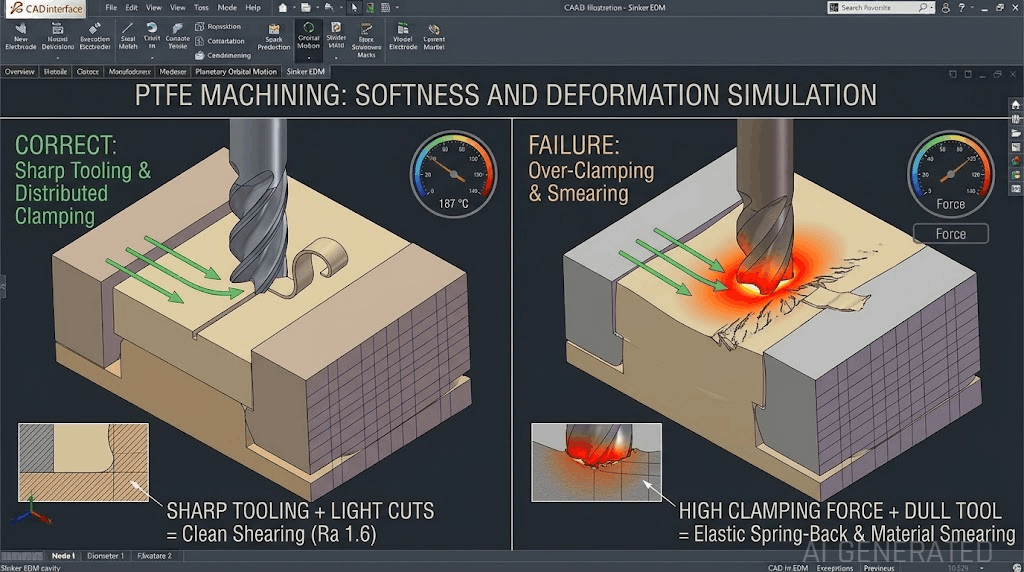
It's soft enough to deform under normal machining forces. Where most CNC machining challenges involve a material being too hard or too heat-sensitive, PTFE's challenge is closer to the opposite — clamping pressure, cutting forces, and even the material's own weight can cause enough deformation that a part machined perfectly to dimension can spring back out of tolerance once released from the fixture. This is the single biggest thing that trips up shops used to harder plastics.
It doesn't chip — it smears. PTFE's low friction and softness mean it tends to be pushed and smeared by a dull or poorly-suited tool rather than cleanly sheared the way a harder plastic chips. A clean cut in PTFE depends more on tool sharpness and geometry than on cutting speed.
Its low friction means it doesn't hold well in standard workholding. The same low coefficient of friction that makes PTFE useful as a bearing surface makes it prone to slipping in a standard vise or chuck — fixturing needs to account for this, often with more surface contact area or a design that doesn't rely purely on friction to hold the part.
Thermal expansion is significant relative to metals and most plastics. PTFE has a notably high coefficient of thermal expansion, which matters for tight-tolerance parts — a part that measures correctly right off the machine, still warm from cutting, can shrink measurably as it cools to room temperature.
Machining Recommendations
Use minimal, even clamping force. Since PTFE deforms under pressure, distributing clamping force over a larger area — rather than a few high-pressure clamp points — reduces the risk of a part that looks fine machined but relaxes out of tolerance once released.
Keep tools genuinely sharp. A sharp tool shears PTFE cleanly; a dull one pushes and smears it, producing a poor finish and inconsistent dimensions. Tool sharpness matters more in PTFE than cutting speed does, which is a different priority order than most metal or even most other plastic machining.
Support thin sections and let the part relax before final measurement. For thin-walled or delicate PTFE geometry, additional fixture support during cutting reduces deflection, and allowing the finished part to sit and reach room temperature before final dimensional checks avoids chasing a dimension that's still settling from thermal contraction.
Take lighter cuts, more of them, rather than fewer aggressive passes. Because PTFE deforms under load, lighter cuts reduce the deflection-induced error that heavier cuts are more prone to, even though this generally means longer cycle times than an equivalent metal or harder-plastic job.
Where PTFE Shows Up
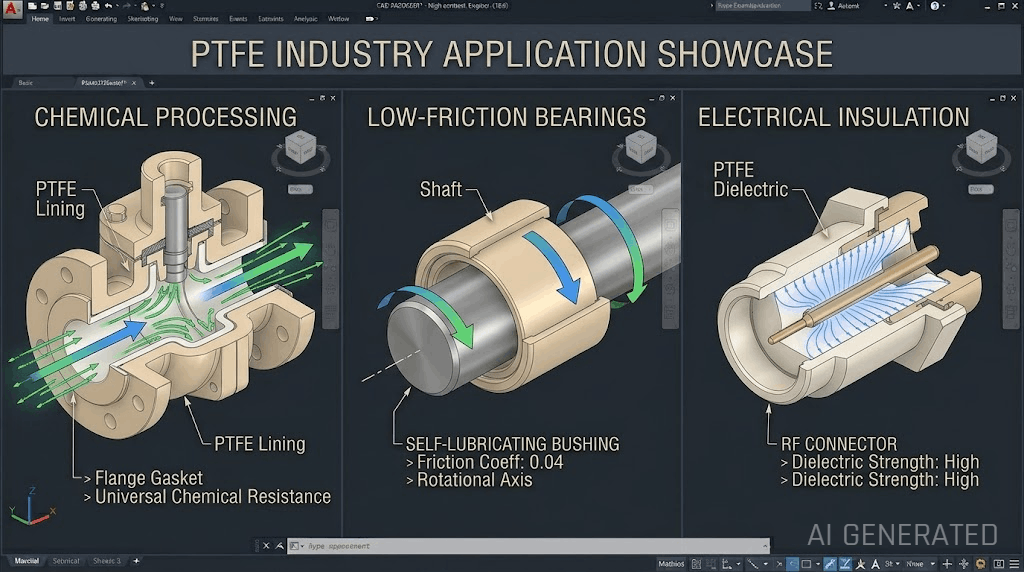
Seals and gaskets are PTFE's signature application — its chemical inertness means it doesn't degrade in contact with aggressive chemicals that would attack rubber or other polymer seals over time. Bearings and low-friction components take advantage of PTFE's exceptionally low friction coefficient, sometimes in applications where lubrication isn't practical or desirable and PTFE's inherent slipperiness does the job instead. Electrical insulation benefits from PTFE's excellent dielectric properties combined with its wide temperature range, useful in demanding electrical and electronic applications. Chemical processing equipment — valve components, linings, fittings — relies on PTFE specifically where the fluid being handled would attack most other materials.
PTFE vs. Other Chemical/High-Performance Plastics
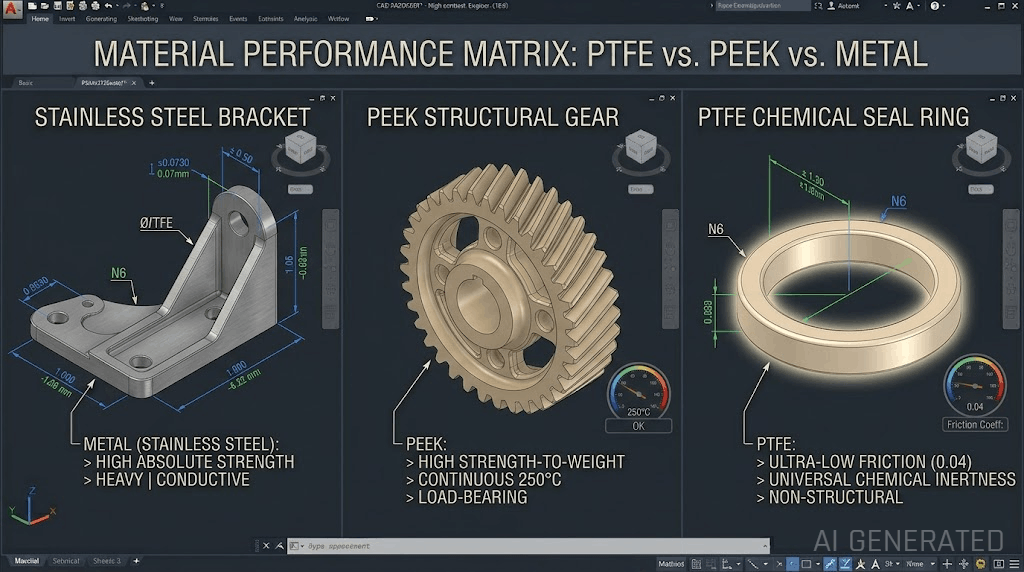
PTFE isn't the right choice whenever "chemical resistance" or "high performance plastic" comes up — its mechanical weakness rules it out for load-bearing applications entirely. Where PEEK offers strength and high-temperature performance in a structural role, PTFE offers unmatched friction and chemical properties in a non-structural role — sealing, bearing surfaces, insulation — where its softness doesn't matter because the part isn't carrying significant mechanical load. Choosing between them usually isn't close once the application's actual demands are clear: if the part needs to bear load, PTFE is the wrong material regardless of its other advantages; if it needs to seal against an aggressive chemical or provide a low-friction surface, PEEK's added strength isn't buying anything PTFE doesn't already handle at lower cost.
Need PTFE CNC Machining for Your Next Project? Upload your CAD file today to get an instant quote for precision CNC milling and turning.
FAQ
Why does a PTFE part sometimes come out of tolerance after machining even when it measured correctly on the machine?
PTFE deforms under clamping and cutting forces during machining, and can relax back toward its unstressed shape once released from the fixture — a common cause of parts that measured in-spec while held but drift out of tolerance afterward. Distributing clamping force and using lighter cuts reduces this effect.
Can PTFE be used for structural or load-bearing parts?
Generally no — PTFE has low tensile strength and creeps under sustained load, making it unsuitable for structural applications. It's chosen for friction, chemical resistance, and sealing performance rather than mechanical strength.
Is PTFE the same as Teflon?
Yes — Teflon is DuPont's trade name for PTFE. The material itself is polytetrafluoroethylene; "Teflon" refers specifically to DuPont's branded version, though the terms are often used interchangeably.
What temperature range can PTFE handle?
PTFE has an unusually wide usable temperature range, roughly -200°C to 260°C, making it suitable for both cryogenic and high-temperature applications where most plastics would fail at one extreme or the other.
Keep Learning
Laser Engraving Aluminum: Marking Methods & Surface Effects
Key Takeaways Laser engraving usually removes base material to create a recess. Laser marking is a broader term that can describe a surface-color change or material removal, so the process name alone does not define the final result. On aluminum, alloy and surface finish affect marking contrast. A light mark on dark anodized aluminum is a common design target, but the actual appearance depends on the finish and laser process. JLCCNC laser marking produces a recessed area 0.03–0.1 mm deep. The result i......
CNC Cutting Fluid: Types, Functions, Applications, and Selection Guide
Key Takeaways Cutting fluid in machining performs four functions simultaneously: cooling the tool and workpiece, lubricating the tool-chip interface to reduce friction, carrying chips away from the cut zone, and protecting machined surfaces from corrosion between operations. Different machining operations need different fluid priorities: high-speed aluminum milling may need adhesion control and chip evacuation, threading and tapping need strong lubrication, and grinding requires both cooling and fine ......
Blind Hole Machining Guide: What Is a Blind Hole, Types of Holes, and Tapping Tips
What Is a Blind Hole? Types of Holes and CNC Hole Machining Explained In CNC machining, few operations challenge process control and tool stability as much as blind hole machining. A blind hole is a hole that terminates at a defined internal depth rather than breaking through the opposite surface. Because the cavity is enclosed at the bottom, chip evacuation, thermal behavior, tool wear, and dimensional accuracy become far more difficult to manage compared to through-hole machining. These constraints ......
Rake Angle in Machining: Machinists’ Guide to Perfect Cuts
What is Rake Angle? (minaprem) If you've ever stood in front of a CNC machine or a manual lathe, you know that the cutting tool's geometry isn't just some arbitrary design. Every angle, edge, and surface has a job to do, and one of the most important of those is the rake angle. We've been running machines long enough to know that rake angle can make or break your surface finish, tool life, and machining efficiency. In this guide, we're going to walk you through what rake angle is, how it works, and ho......
Sheet Metal vs CNC Machining: A Guide to Choosing the Right Method for Your Metal Parts
Quick Answer: Choose sheet metal for uniform-thickness enclosures, panels, and formed brackets when bends and production volume support lower unit cost. Choose CNC machining for variable wall thickness, precision bores, tight feature relationships, and complex 3D geometry. Use a hybrid design when a formed structure needs precision-machined interfaces. A quote comes back for a bracket, and it's priced as a CNC part — machined from solid aluminum, a few hours of spindle time, a per-part cost that makes......
What Steps Are Taken To Minimize Waste In CNC Machining Processes?
How to Reduce Waste in CNC Machining: 5 Practical Strategies Quick Answer: CNC machining waste is reduced mainly through DFM, near-net stock, efficient toolpaths, preventive tool maintenance, and alloy-segregated recycling. The biggest gains usually come before cutting: reduce unnecessary material removal and prevent scrap or rework. Every CNC-machined part starts as more material than it ends up being. A pocket gets milled out, a profile gets cut away, a boss gets faced down to size — and all of that......