How Does CNC Machining Differ From Traditional Machining Methods?
8 min
- How Does CNC Machining Differ From Traditional Machining Methods?
- What "Traditional Machining" Means
- What CNC Machining Changes
- Direct Comparison
- Where CNC Machining Genuinely Wins
- Where Traditional Machining Still Makes Sense
- Cost and How to Choose
- A Common Misconception Worth Correcting
- FAQ
- Have a Part That Needs CNC Machining?
How Does CNC Machining Differ From Traditional Machining Methods?
Quick Answer: Choose CNC machining when repeatability, complex geometry, tight feature relationships, or production quantity justify programming and setup. Choose traditional or manual machining for simple one-off parts, repairs, and highly variable work where a skilled operator can work directly from a sample or drawing. The right choice depends on geometry, tolerance, quantity, and available data.
A machinist trained on manual lathes and mills can absolutely produce precise parts — plenty of skilled work still gets done that way. But hand someone a drawing calling for five hundred identical brackets, each holding a tolerance of a few thousandths of an inch, and the practical difference between CNC and traditional machining stops being academic. Both processes use fundamentally the same cutting principles — a tool removes material from a workpiece — but how that motion gets controlled changes almost everything else about what each is actually good for.

Precision CNC Machining Service
Professional manufacturing, fast turnaround, and quality assurance.
What "Traditional Machining" Means
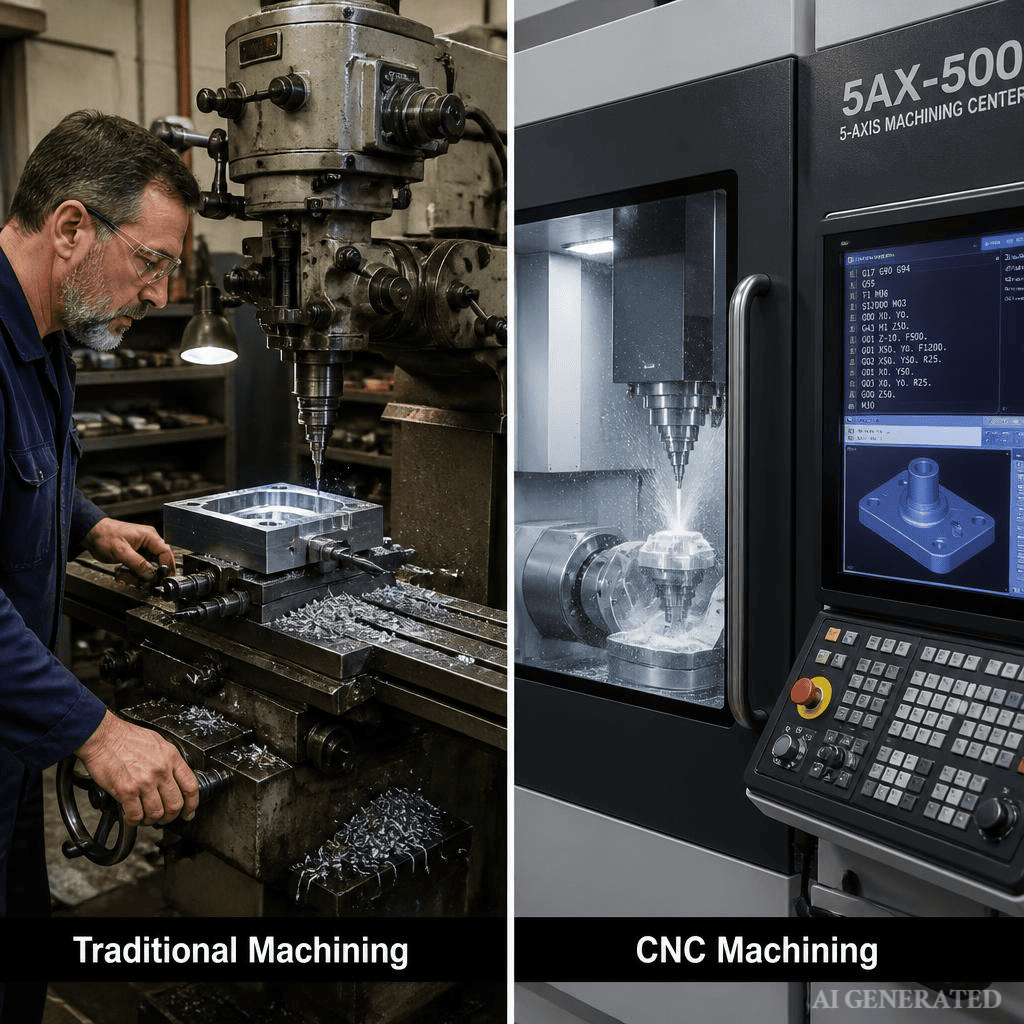
Conventional or traditional machining covers turning, milling, drilling, grinding, and sawing operations where a human operator directly controls the tool's motion — hand cranks, levers, and dials guiding the cut in real time, with the operator's skill and judgment determining accuracy. It's not an outdated or inferior process; it's a manually-controlled version of the same underlying material-removal principles CNC machining automates.
What CNC Machining Changes
CNC (Computer Numerical Control) machining replaces that manual control with pre-programmed instructions — a G-code program dictates exactly where the tool moves, how fast, and in what sequence, and the machine executes it without an operator adjusting the cut in real time. The core cutting physics are unchanged; what's automated is the control and repeatability of the motion.
Direct Comparison
| Factor | Traditional Machining | CNC Machining |
|---|---|---|
| Control | Manual, operator-guided | Computer-programmed |
| Repeatability | Varies with operator skill and fatigue | Consistent across a run — though still affected by tool wear, thermal drift, and fixturing over long runs |
| Typical tolerance | Around ±0.1mm and looser, operator-dependent | Tighter than manual work, commonly cited around ±0.01–0.05mm depending on equipment, material, and inspection — not a universal guarantee for any given shop |
| Setup time for a new part | Often faster for a single simple part | Requires programming, but reusable for repeat runs |
| Production speed | Bounded by operator pace per part | Faster per part once running, especially across a repeat batch |
| Cost structure | Closer to linear with labor time per part, no programming overhead | Upfront programming and setup cost that amortizes across the run |
| Best suited volume | One-off, low volume, highly custom work | Low volume through high volume production |
| Operator skill required | High — direct hands-on control | High, but different — programming and setup, not real-time cutting control |
| Complex geometry | Limited by what's practical to control manually | Handles complex 3D geometry reliably via CAM-generated toolpaths |
The tolerance figures above are typical reference ranges, not fixed capabilities of any specific machine or shop — actual achievable tolerance on either process depends on the equipment, workholding, tooling, material, and inspection method involved.
Where CNC Machining Genuinely Wins
Repeatability is the clearest advantage — a CNC program produces a much more consistent result on part 500 than it did on part 1, in a way manual machining struggles to match, since manual accuracy depends on operator consistency across an entire run and fatigue or attention lapses are a real factor at volume. That said, CNC doesn't eliminate variation entirely — it significantly reduces variation introduced by manual motion control, but tool wear, thermal drift in the machine and workpiece, and fixturing still affect a long CNC run and need to be managed with process controls and inspection, not assumed away.
Complex geometry that would be impractical to hold manually — coordinated multi-axis toolpaths, precise contoured surfaces — is typically impractical or uneconomical to produce by hand, since manually controlling that many simultaneous variables accurately at any consistent rate isn't realistic for most shops. Tight tolerances held consistently across a production run are also a CNC strength, since the process meaningfully reduces the operator variability that shows up run after run in manual work.
Where Traditional Machining Still Makes Sense
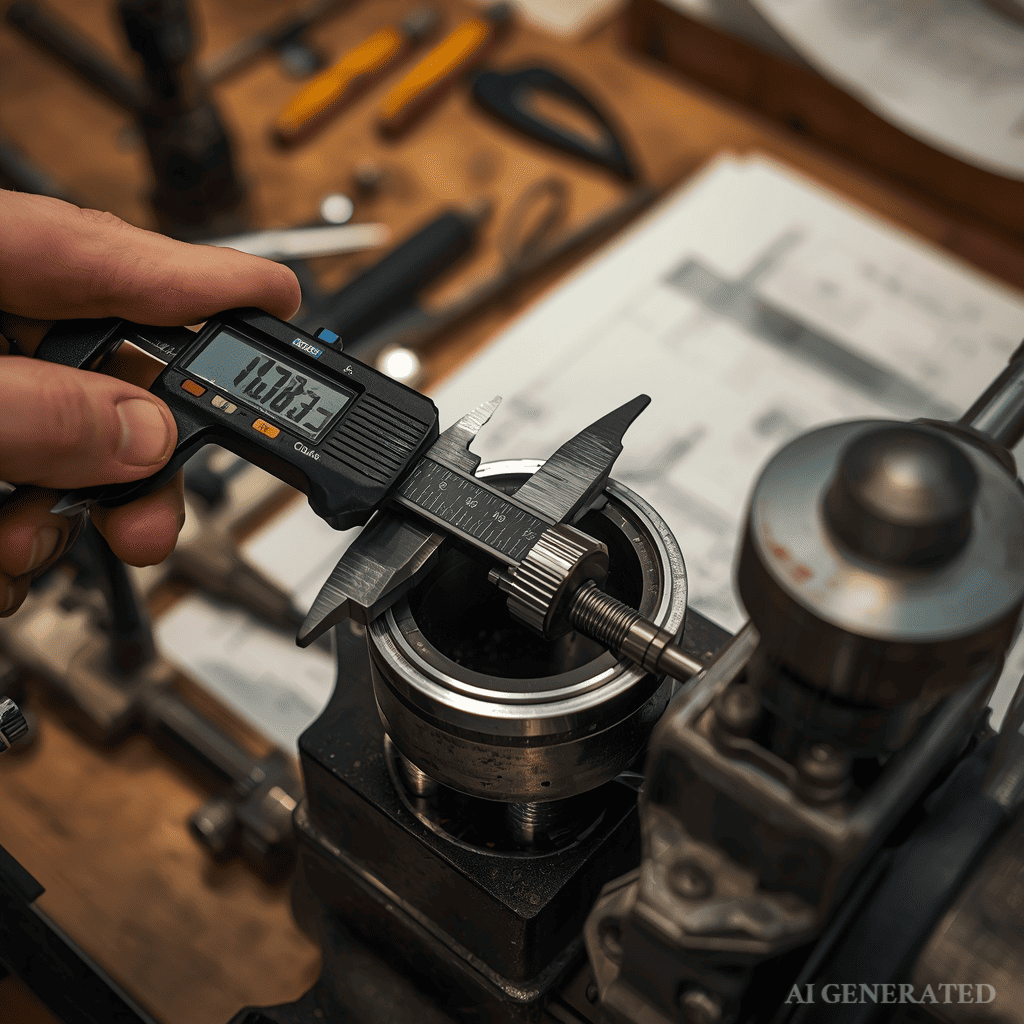
This is the part that often gets glossed over: traditional machining isn't simply an inferior, older version of CNC. For a genuine one-off part — a single custom fitting, a repair part with no digital file and no plan to make a second one — setting up and programming a CNC job can take longer than a skilled machinist simply cutting the part by hand. Small job shops and repair work, where the next job rarely resembles the last one, often favor manual equipment specifically because there's no setup or programming overhead to justify.
Highly experienced machinists can also make real-time adjustments mid-cut in response to how the material is actually behaving — reading chip formation, sound, and vibration — in a way that requires deliberate sensor-based process monitoring to replicate on a CNC setup. A worn-out part on decades-old equipment, with no CAD file and no plan to ever make a second one, is a common example — a skilled machinist measuring the original and cutting a replacement by hand is often faster and cheaper than modeling it, programming it, and verifying a CNC job for a single part that will never be ordered again. And for extremely simple features on a single part, the overhead of writing and verifying a CNC program can genuinely exceed just cutting it by hand.
Cost and How to Choose
CNC machining's upfront cost — programming, CAM work, first-article verification — doesn't pay off on a true one-off; it amortizes across a production run. Traditional machining's cost structure is closer to linear with labor time per part, without that upfront investment, but without CNC's scaling advantage either.
Exactly where the crossover sits between the two isn't a fixed quantity — it depends on how the specific job's programming time, fixturing setup, first-article verification, cycle time, labor rate, geometric complexity, and order quantity all combine. A simple part might favor traditional machining even at a moderate quantity if it's easy for a skilled machinist to hold by hand; a complex part can favor CNC even at very low volume, if manually holding that geometry's accuracy consistently would take a skilled machinist longer per part than programming and running it on a CNC machine. Rather than anchoring on a specific unit count, the more reliable approach is weighing those factors against the actual part and quantity in question — which is exactly what an engineering review before quoting is for.
A Common Misconception Worth Correcting
Framing this as CNC machining having simply "replaced" traditional machining industry-wide oversimplifies what actually happened. CNC dominates high-volume, high-precision, and complex-geometry production for good reason, but traditional machining hasn't disappeared — it persists specifically where its lack of setup overhead and real-time adjustability genuinely outperform CNC's strengths: true one-offs, repair work, and highly variable small-shop jobs. The right framing isn't "which one won," it's "which one fits this specific job's volume, complexity, and variability."
FAQ
Is CNC machining always more precise than traditional machining? Generally yes in terms of consistency across a run — CNC significantly reduces the variation introduced by manual motion control. A highly skilled machinist can achieve comparable precision on a single part manually, but holding that same precision consistently across many parts is where CNC's advantage becomes clear.
Is traditional machining cheaper than CNC for small jobs? Often, for a true one-off or very low quantity — CNC's programming and setup overhead doesn't amortize on a single part the way it does across a production run, and a skilled machinist can sometimes cut a simple one-off part manually faster than programming and verifying a CNC job for it. There's no fixed quantity where this flips; it depends on the part's complexity and the specific job's setup requirements.
Do machinists still need to learn traditional machining skills if CNC is more common? Many shops consider it valuable — understanding manual machining builds an intuitive sense of cutting forces, tool behavior, and material response that translates into better CNC programming and troubleshooting, even for machinists who primarily work on CNC equipment.
Can traditional machining achieve the same complex geometry as CNC? Not reliably for genuinely complex 3D geometry — coordinating multiple simultaneous axes accurately by hand isn't practical the way a CNC program executes it. Traditional machining is better suited to simpler geometry where manual control is sufficient to hold the required accuracy.
Have a Part That Needs CNC Machining?
For a production run, a complex geometry, or anything needing tight tolerances held consistently across multiple parts, CNC is generally the more practical route — and getting a clear picture of cost and feasibility starts with an actual quote against your design.
- Engineering Review: Manufacturability feedback with every quote
- Multi-Axis Capability: 3-, 4-, and 5-axis CNC milling for complex geometry
- Fast Quotes: Upload your 3D CAD files (.STEP / .IGES) for a rapid review and quote
Keep Learning
Blind Hole Machining Guide: What Is a Blind Hole, Types of Holes, and Tapping Tips
What Is a Blind Hole? Types of Holes and CNC Hole Machining Explained In CNC machining, few operations challenge process control and tool stability as much as blind hole machining. A blind hole is a hole that terminates at a defined internal depth rather than breaking through the opposite surface. Because the cavity is enclosed at the bottom, chip evacuation, thermal behavior, tool wear, and dimensional accuracy become far more difficult to manage compared to through-hole machining. These constraints ......
Rake Angle in Machining: Machinists’ Guide to Perfect Cuts
What is Rake Angle? (minaprem) If you've ever stood in front of a CNC machine or a manual lathe, you know that the cutting tool's geometry isn't just some arbitrary design. Every angle, edge, and surface has a job to do, and one of the most important of those is the rake angle. We've been running machines long enough to know that rake angle can make or break your surface finish, tool life, and machining efficiency. In this guide, we're going to walk you through what rake angle is, how it works, and ho......
Sheet Metal vs CNC Machining: A Guide to Choosing the Right Method for Your Metal Parts
Quick Answer: Choose sheet metal for uniform-thickness enclosures, panels, and formed brackets when bends and production volume support lower unit cost. Choose CNC machining for variable wall thickness, precision bores, tight feature relationships, and complex 3D geometry. Use a hybrid design when a formed structure needs precision-machined interfaces. A quote comes back for a bracket, and it's priced as a CNC part — machined from solid aluminum, a few hours of spindle time, a per-part cost that makes......
What Steps Are Taken To Minimize Waste In CNC Machining Processes?
How to Reduce Waste in CNC Machining: 5 Practical Strategies Quick Answer: CNC machining waste is reduced mainly through DFM, near-net stock, efficient toolpaths, preventive tool maintenance, and alloy-segregated recycling. The biggest gains usually come before cutting: reduce unnecessary material removal and prevent scrap or rework. Every CNC-machined part starts as more material than it ends up being. A pocket gets milled out, a profile gets cut away, a boss gets faced down to size — and all of that......
Machining Burrs Explained: Causes, Types, and Removal Methods
CNC Machining Burrs (Envato) If you've ever run your hand across a freshly machined part and felt a sharp edge catch your skin, you've met the enemy: the burr. At first glance, it looks like a tiny flaw, but in machining, burrs are more than just a cosmetic annoyance. They can cut into assembly time, drive up costs, and in worst cases, create safety hazards for anyone handling the part. So, what is burr in machining? Think of it as the unwanted leftovers of the cutting process, those ragged edges, thi......
Feed Rate vs Cutting Speed in CNC Machining: The Complete Guide
Getting to Know Feed Rate and Cutting Speed in CNC Machining Why Feed Rate and Cutting Speed Matter (mellowpine) When you're running a CNC machine, two settings can make or break your results: feed rate and cutting speed. These numbers influence how quickly you can remove material, the lifespan of your cutting tools, and the quality of the finish on your parts. But it's easy, especially when you're just starting out, to mix them up or assume they mean the same thing. At JLCCNC, we see this mix-up all ......