Sulfuric Acid Anodizing for Aluminum in CNC Manufacturing
13 min
- What Is Sulfuric Acid Anodizing?
- How the Sulfuric Acid Anodizing Process Works
- Coating Properties of Sulfuric Acid Anodized Aluminum
- Sulfuric Acid Anodizing vs Hard Anodizing
- How Aluminum Alloys Affect Anodizing Results
- Designing CNC Parts for Sulfuric Acid Anodizing
- Process Control Factors in Sulfuric Acid Anodizing
- Common Problems in Sulfuric Acid Anodizing
- Where Sulfuric Acid Anodizing Is Commonly Used
- Choosing Sulfuric Acid Anodizing for CNC Parts
- Conclusion About Sulfuric Acid Anodizing
- FAQ About Sulfuric Acid Anodizing
Key Takeaways About Sulfuric Acid Anodizing
- Sulfuric acid anodizing is the most widely used anodizing process for CNC-machined aluminum parts.
- The process creates an integral oxide layer that improves corrosion resistance, wear resistance, and surface appearance.
- Coating thickness affects both performance and dimensional growth, making tolerance planning important for precision components.
- Aluminum alloy selection influences anodizing quality, color consistency, and final surface appearance.
- Type II sulfuric acid anodizing is commonly used when appearance, corrosion protection, and color options are prioritized.
- Early consideration of machining, finishing, and design requirements helps improve anodizing consistency and production efficiency.
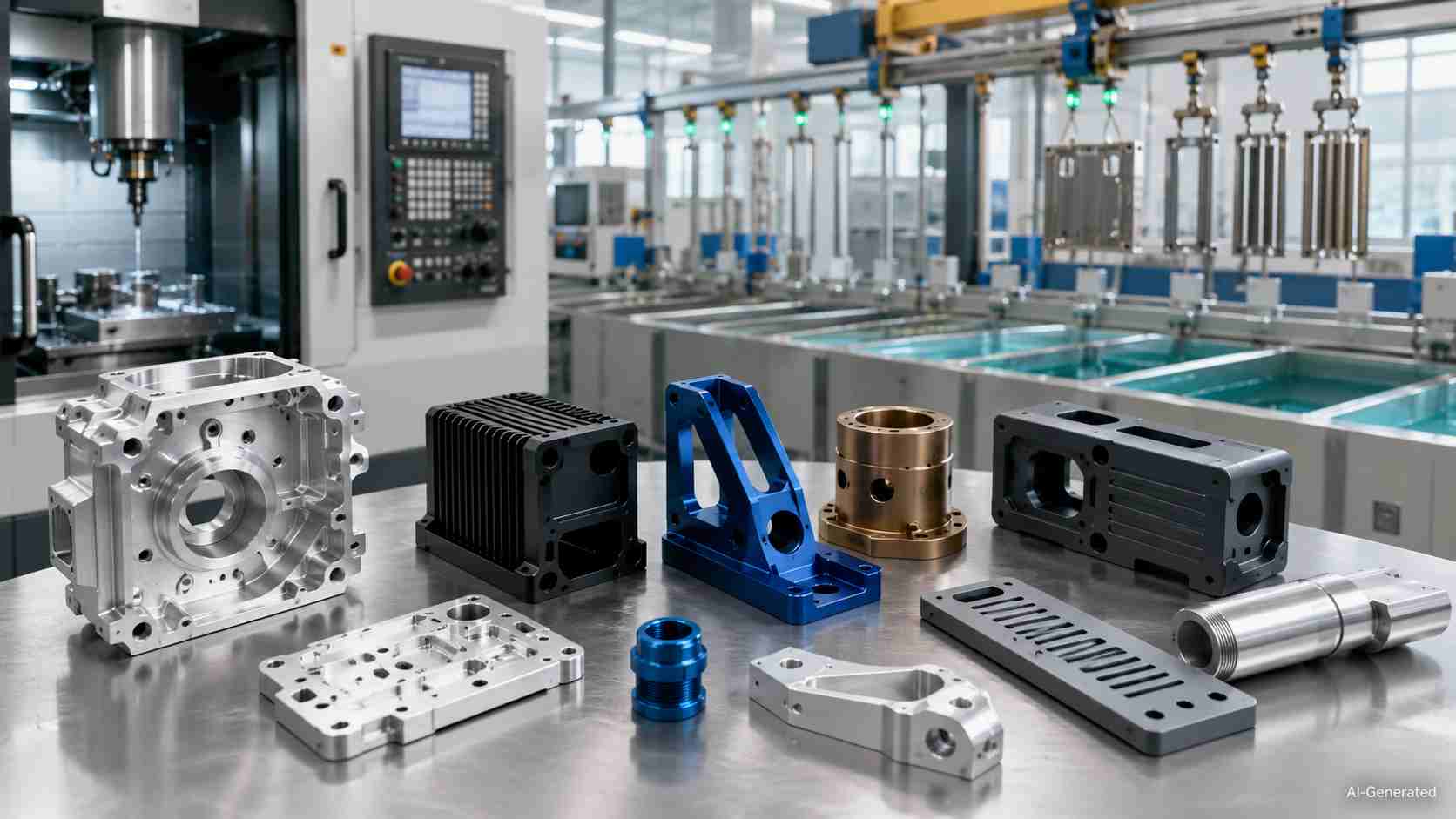
Anodized CNC aluminum parts in production line
Sulfuric acid anodizing is one of the most common surface finishing processes used for CNC-machined aluminum parts. It produces a controlled aluminum oxide layer that becomes part of the base material rather than a coating applied on top. The process is widely used because it can improve corrosion resistance, increase surface durability, provide electrical insulation, and support a broad range of decorative colors.
For engineering teams, anodizing is not simply a finishing step added after machining. Alloy selection, dimensional tolerances, surface preparation, and feature geometry can all influence the final result. Decisions made during design and machining often determine whether anodized parts meet appearance requirements, assembly tolerances, and long-term performance expectations.
This guide explains how sulfuric acid anodizing works, how coating properties develop, what factors affect thickness control and appearance, and how CNC-machined aluminum parts can be designed and manufactured for more predictable anodizing results.
What Is Sulfuric Acid Anodizing?
Sulfuric acid anodizing is a process of electrochemically finishing aluminum in which a machined component serves as the anode in an acid bath. This approach enables engineers to build a measured oxide coating for production usage that is reliable.
How the Oxide Layer Forms on Aluminum
From there, direct current moves oxygen-bearing ions toward the metal. Here, aluminum reacts at the outer face and forms integral aluminum oxide instead of a loose coating laid on top.
Why Sulfuric Acid Became the Standard Anodizing Electrolyte
That balance explains why the sulfuric anodizing route became common in CNC work. It supports reliable bath behavior, moderate oxide growth, receptive pores, and cost for repeat orders.
How the Sulfuric Acid Anodizing Process Works
Surface Preparation and Wash Stage
Before sulfuric acid anodizing begins, machined parts move through degreasing, rinsing, etching, and deoxidizing. This pass removes shop residue and gives the bath a more even starting surface.
Electrolytic Oxide Growth During Anodizing
Next, the racked load enters the electrolyte, current passes through contact points, and a porous layer grows as operators watch time, amperage, temperature, and agitation.
Dyeing and Color Absorption Behavior
Once the layer is open, dye can enter the pores, which is why a sulfuric anodize finish can carry black, red, blue, or other shades when the order calls for color.
Sealing and Post-Treatment Operations
Sealing closes the pore network with hot water, nickel acetate, or another approved method. Rinsing and inspection send each part toward packing with fewer finish risks left behind.
Coating Properties of Sulfuric Acid Anodized Aluminum
Corrosion Resistance and Environmental Protection
With sulfuric acid anodizing, the finished film gives aluminum a tougher shield against moisture, fingerprints, and mild outdoor exposure, which helps CNC parts last longer in daily use.
Surface Hardness and Wear Resistance
As the part moves from bare metal to a ceramic-like outer skin, the surface handles rubbing and handling with less scuffing, particularly on covers, brackets, knobs, and housings.
Electrical Insulation Characteristics
The oxide layer provides electrical insulation on coated surfaces, although masking, wear, or exposed base metal can affect overall conductivity in an assembly.
Surface Appearance and Color Consistency
For visible components, the finish can give a satin or matte look. However, color results depend on material grade, machining marks, and how evenly the surface accepts dye.
Coating Thickness and Dimensional Growth
When a drawing calls out sulfuric acid anodizing, engineers allow for slight dimensional change because part of the oxide layer grows into the aluminum surface while the remainder grows outward from the original surface. Coating thickness requirements vary according to corrosion protection, appearance requirements, and service conditions.
Typical sulfuric acid anodizing thickness ranges are shown below.
Table: Typical Sulfuric Acid Anodizing Thickness Ranges
| Application Type | Typical Thickness |
|---|---|
| Decorative anodizing | 5–10 μm |
| Standard Type II anodizing | 10–25 μm |
| Heavy-duty Type II anodizing | 25–50 μm |
| Type III hardcoat anodizing | 25–100+ μm |
Because anodic coatings grow both inward and outward, dimensional changes should be considered when specifying tight-tolerance bores, threaded features, sealing surfaces, and precision mating components. Critical dimensions may require machining allowances or selective masking before anodizing.
UV Stability and Fading Behavior
Outdoor UV exposure can gradually affect dyed anodized finishes over time. Certain dyed colors, particularly bright reds, blues, and other vivid shades, may fade with prolonged UV exposure. Black anodized finishes generally provide better color stability when outdoor appearance retention is important.
Sulfuric Acid Anodizing vs Hard Anodizing
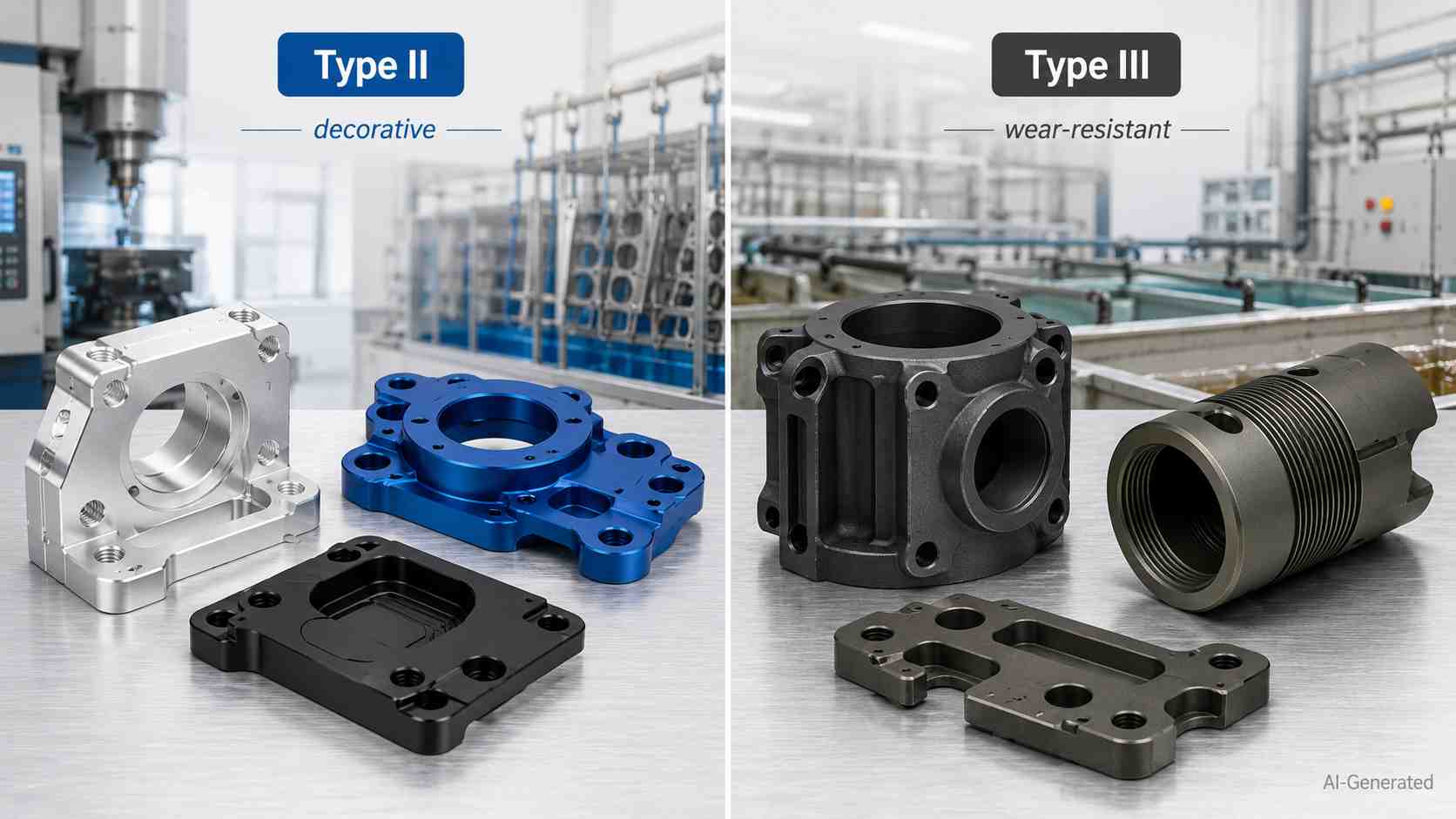
Type II and Type III anodizing comparison
Type II vs Type III Anodizing
Type II anodizing is most commonly performed using sulfuric acid electrolytes and is widely used for decorative and general-purpose aluminum applications. Type III anodizing is commonly referred to as hard anodizing or hardcoat anodizing. In a CNC order, that choice tells the finisher whether the part needs visual quality or tougher service duty.
At this stage, the selection depends on how the part will be used in real service conditions. A more detailed breakdown of performance differences is covered in this guide: anodizing vs hard anodizing differences in CNC applications
Coating Thickness and Hardness Differences
In production, the difference becomes more significant when dimensional requirements are tight. Type II remains thinner for parts with tighter size demands. Yet, Type III is thicker and denser for sliding, gripping, or harsh-contact zones.
Surface Finish and Dyeability
On appearance, sulfuric acid for anodizing aluminum gives brighter color options. Hardcoat lands darker or gray, which is important when an enclosure must look refined and durable.
Functional Differences in CNC Applications
Selection depends primarily on wear requirements, dimensional tolerance, and cosmetic expectations. Pick Type II for production parts that are ready to be displayed, and go with Type III for components that are subject to friction, tools, or wear from the outdoor elements.
How Aluminum Alloys Affect Anodizing Results
6061 Aluminum and General CNC Applications
For CNC shops, 6061 is a familiar alloy in sulfuric acid anodizing. The reason is that it machines well and tends to give an even finish across brackets, panels, and housings.
7075 and High-Strength Alloy Challenges
When the job calls for 7075, the increased zinc and copper concentration of the material might result in a finish that is darker, less consistent, and more difficult to match from batch to batch.
Cast Aluminum and Surface Appearance Limitations
Cast grades generally contain silicon and other elements that interrupt uniform film formation, which leaves a mottled or gray appearance after sulfuric anodizing.
Alloy Composition and Color Variation
As magnesium, silicon, copper, and zinc shift from one grade to another, shade matching becomes less predictable, including across mixed lots or replacement orders.
Why 6061 Is the Industry Standard
That is why many teams pick 6061 for machined aluminum. It offers dependable cutting, broad availability, and finish results that are easier to approve before volume production.
Designing CNC Parts for Sulfuric Acid Anodizing
Tolerance Planning Before Anodizing
Take into consideration the ultimate measured state before beginning the drawing. In the process of sulfuric acid anodizing, a regulated allowance is added to the edges, bores, and mating faces. This modification should be included in the notes before the machining process starts.
Feature Geometry and Masking Considerations
Then review threads, grooves, blind pockets, sharp inside corners, and sealing faces. Any area that must remain bare needs masking. Contact points should remain in hidden zones.
Surface Finish Preparation Before Coating
Surface preparation establishes the visual foundation. Sulfuric anodizing adheres to tool pathways, sanding direction, and bead-blast texture. Furthermore, it provides the greatest aesthetic outcome when each visible face is planned early on.
Anodizing requirements often influence machining decisions long before a part reaches the finishing line. Coating thickness can affect dimensional change, especially on precision features. Cosmetic surfaces may need additional preparation, while close-tolerance areas sometimes require machining allowances to be planned in advance.
JLCCNC reviews part geometry and finishing requirements during quoting. Potential manufacturing concerns can often be identified before production begins.
Upload your CAD file for a customized quote.

Precision CNC Machining Service
Professional manufacturing, fast turnaround, and quality assurance.
Process Control Factors in Sulfuric Acid Anodizing
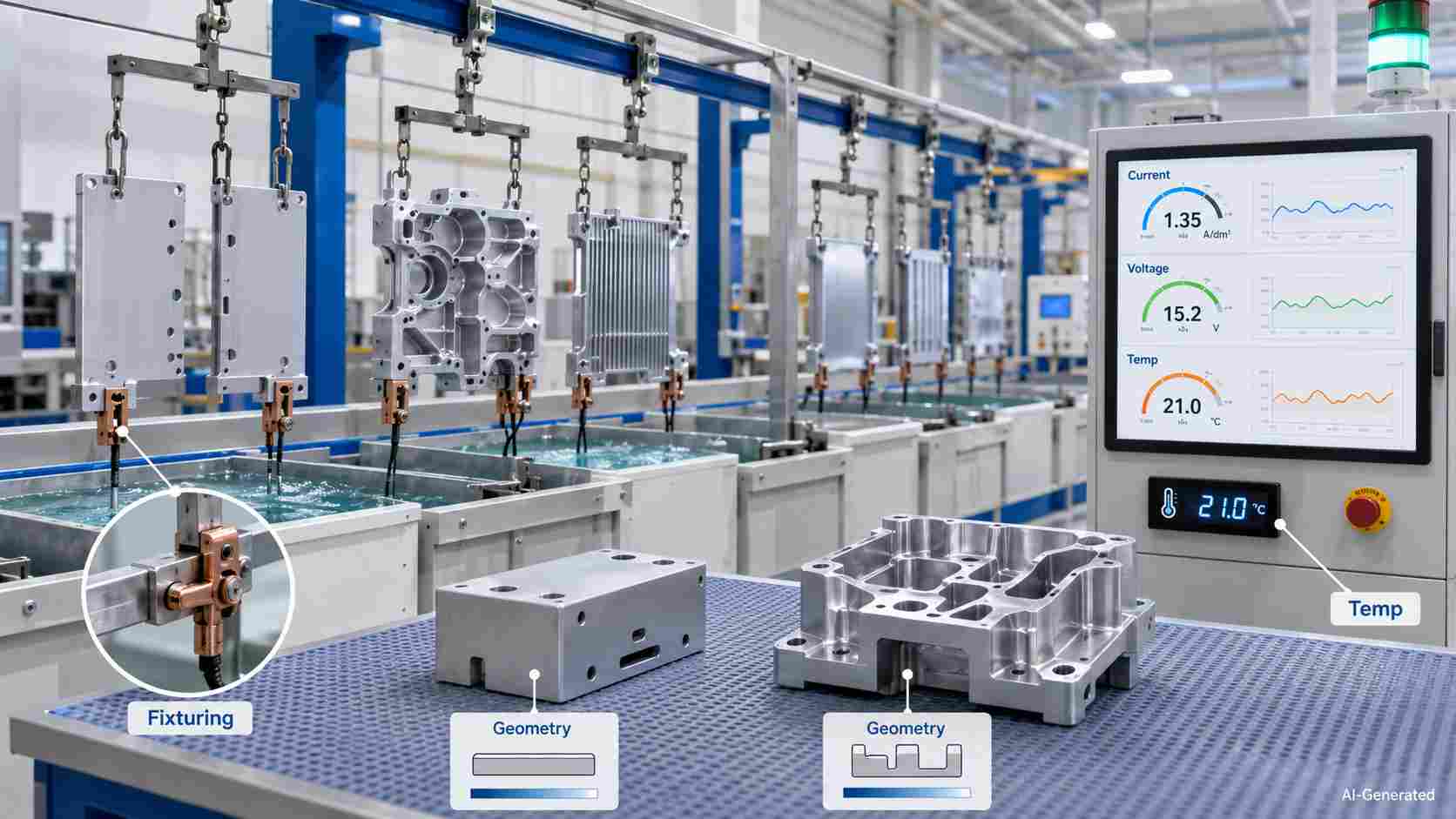
Sulfuric anodizing process control line
Electrolyte Concentration and Bath Chemistry
Sulfuric acid concentration influences how quickly the oxide layer develops and how consistently the anodizing process performs across production batches. Commercial sulfuric anodizing systems typically operate within controlled concentration ranges to balance oxide growth, pore structure, and process stability.
Higher acid concentrations can increase oxide dissolution during anodizing, while lower concentrations may reduce process efficiency and affect coating uniformity. Maintaining stable bath chemistry helps improve thickness consistency, color acceptance, and repeatability between production runs.
In CNC manufacturing environments, electrolyte concentration is usually monitored together with contamination levels, dissolved aluminum content, conductivity, and pH-related process indicators. As production volume increases, routine bath maintenance becomes important because chemistry changes can affect coating quality long before visible defects appear on finished parts.
Bath Temperature Effects in Sulfuric Acid Anodizing
After that, bath temperature becomes the quiet referee, as poor heat balance can change pore structure, shade response, and final quality from one batch to another.
Voltage and Current Density Range
Voltage and current density directly influence oxide growth rate, coating structure, and process stability during sulfuric acid anodizing. Essentially, they guide how steadily each CNC part responds during production.
Fixturing and Electrical Contact Areas
Then the rack takes over an important job. Firm electrical contact gives sulfuric anodizing a steady path, but weak contact can leave dull zones or unfinished marks.
Geometry Effects on Coating Uniformity
Part shape affects coverage, since deep pockets, narrow slots, and sharp edges may receive current differently. It makes early design review valuable for repeatable finishing.
Common Problems in Sulfuric Acid Anodizing
Uneven Color and Appearance Variation
Color trouble might start before the tank, with mixed stock, uneven machining texture, or residue left in recesses, and sulfuric acid anodizing only makes those differences easier to see.
Burning, Pitting, and Surface Damage
When current crowds around edges or local heat rises, burning can darken corners. Pitting may appear when trapped chemistry, inclusions, or rough handling reach the line first.
Poor Coating Coverage or Adhesion
If rack contact is weak or pre-treatment misses oil-filled pockets, the film may look thin, patchy, or fragile, which points back to setup control rather than the bath alone.
Dimensional Variation in Precision Parts
For close-tolerance bores, slots, and mating faces, small thickness changes can affect assembly, which makes inspection after sulfuric anodize a necessary check before release.
Streaking, Smut, and Finish Inconsistency
Streaks and smut trace back to alloy-rich areas, uneven etch response, or tired chemistry. They leave parts with marks that reject cosmetic approval.
Where Sulfuric Acid Anodizing Is Commonly Used

Anodized aluminum uses across industries
Consumer Electronics and Enclosures
In phones, test boxes, and device shells, sulfuric acid anodizing gives machined aluminum a refined outer layer that resists handling marks while keeping weight low.
Aerospace and Automotive Components
For aircraft cabin hardware, sensor brackets, and vehicle trim, the finish supports light assemblies that need weather tolerance, part traceability, and a neat surface.
Industrial and Mechanical Equipment
Next, sulfuric anodize work appears on control panels, instrument plates, clamps, and machine guards. That is where aluminum needs a durable skin with less electrical transfer.
Cosmetic and Appearance-Critical Parts
Ultimately, visible CNC parts such as bezels, nameplates, knobs, and front panels gain a more premium look. They help product teams keep style and function in the same part.
Choosing Sulfuric Acid Anodizing for CNC Parts
When Type II Anodizing Is the Better Choice
Choose sulfuric acid anodizing when the CNC part needs a neat look, color options, light-duty protection, and modest size allowance without the demands of hardcoat.
When Hard Anodizing Is More Suitable
Hard anodizing belongs on parts exposed to sliding contact, frequent handling, or abrasive service. That is when added thickness and higher wear capacity matter more than bright color.
Cosmetic vs Functional Surface Priorities
For appearance-led work, sulfuric anodizing keeps the brief centered on uniform color and presentable faces. For duty-led work, hardness, service life, and mating behavior take priority.
Cost, Lead Time, and Production Efficiency
Last but not least, Type II works well for repeat CNC orders when the goal is balanced performance, predictable finishing, and a smoother path from machining to delivery.
Conclusion About Sulfuric Acid Anodizing
Sulfuric acid anodizing is often treated as a finishing step, but many of the final results are determined much earlier. Alloy choice affects appearance. Coating thickness influences dimensional change. For precision features, machining allowances may need to be planned before the part ever reaches the anodizing line.
JLCCNC supports CNC-machined aluminum parts with anodizing options and DFM review. Upload your CAD file to receive a fast quote and engineering feedback for prototype or production requirements.
Precision CNC Machining Service
Professional manufacturing, fast turnaround, and quality assurance.
FAQ About Sulfuric Acid Anodizing
Q: What is sulfuric acid anodizing?
Sulfuric acid anodizing is an electrolytic aluminum finishing method that grows an integral oxide film on a machined part for supplementary protection and a more refined appearance.
Q: What thickness is typical for sulfuric acid anodizing?
10–25 μm is common for standard Type II anodizing, although coatings may be thinner for decorative applications or thicker when additional corrosion protection is required.
Q: Why is sulfuric acid commonly used for aluminum anodizing?
Sulfuric acid became broadly used for aluminum work thanks to its practical balance of finish quality, dye response, coating range, and production-friendly handling.
Q: What is the difference between sulfuric anodizing and hard anodizing?
Sulfuric anodizing serves appearance-focused and general-use parts. On the other hand, hard anodizing is selected when higher wear duty and thicker coating are required.
Q: Does anodizing affect CNC part dimensions?
Yes, anodizing causes a little variation in final measurements, which implies that drawings should allow for coating growth on holes, edges, and mating faces.
Q: Which aluminum alloys anodize best?
In situations where visual matching is important, wrought aluminum grades such as 6061 provide results that are more predictable than those produced by materials that are rich in copper or cast.
Q: Why does anodized color vary between aluminum alloys?
When alloying elements, grain condition, heat treatment, or past machining markings have an effect on how the oxide takes dye, anodized color variations might occur.
Q: Can threaded holes and precision features be anodized safely?
Yes, though it is possible that threads, narrow bores, and delicate features may need masking, altered tolerances, or post-process inspection before the installation of the finished product.
Popular Articles
• Surface Finish in Machining, Types, Charts & Testing
• Anodizing vs. Hard Anodizing: The Differences in Surface Treatment Techniques
• Anodized Aluminum Colors: Options, Limits, and Real-World Results
• Explanation of different material surface treatment technologies in CNC machining
• How to choose between Laser marking and UV printing?
Keep Learning
Surface Finish in Machining, Types, Charts & Testing
What is Surface Finish in Machining? At its core, surface finish in machining refers to the small-scale irregularities left on the surface of a part after machining. These irregularities are typically grouped into three categories: Roughness: The fine, closely spaced deviations caused by the cutting process itself. Roughness depends heavily on feed rate, tool sharpness, and cutting speed. Waviness: Larger, more widely spaced variations caused by machine tool vibration, deflection, or thermal distortio......
CNC Machining Surface Roughness: A Practical Guide
Why Surface Roughness Matters in CNC Machining When we talk about CNC machining, precision isn't just about hitting the right dimensions, it’s also about how the surface feels and performs. Surface roughness describes the fine irregularities left on a machined surface, and it directly impacts how a part behaves in the real world. So, what is surface roughness? In simple terms, it's the measure of tiny peaks and valleys created by the cutting process. While they might look smooth to the naked eye, thes......
Optimizing Manufacturing Efficiency: A Guide to Computerized Numerical Control (CNC) Machining Surface Finishes
CNC Surface Finishes: Types, Costs, and How to Choose Quick Answer: Choose an as-machined finish when cost and dimensional stability matter most. Use bead blasting or brushing for a uniform cosmetic appearance, anodizing for aluminum corrosion resistance, hard anodizing for wear, and laser marking or UV printing for identification. Confirm material, tolerance, color, masking, and end-use environment before quoting. A CNC-machined part comes off the machine functional but rarely finished — tool marks, ......
Anodizing vs. Hard Anodizing: The Differences in Surface Treatment Techniques
Quick Answer: Choose Type II anodizing when corrosion resistance, color, and cosmetic appearance are the main requirements. Choose Type III hard anodizing when the part needs greater wear resistance and the coating thickness can be accommodated in the fit and tolerance plan. Confirm alloy, coating thickness, color, sealing, and critical dimensions before release. An aluminum bracket for an outdoor enclosure and a hydraulic cylinder rod both might get anodized — but specifying the same process for both......
How to Remove Anodizing from Aluminum Parts
Key Takeaways Chemical stripping is commonly used when anodizing needs to be removed from most or all of an aluminum part, but the process can also attack the underlying aluminum if it is not controlled. Mechanical removal works well for accessible areas but can change the surface texture and remove more base metal than intended. CNC machining gives better control when a defined anodized area needs to be removed from a precision part. Laser-based removal can be useful for controlled localized treatmen......
Anodizing Thickness: How Much Does It Add?
Anodizing Thickness and Dimensional Change at a Glance Feature Approximate dimensional effect One coated external surface +0.5 × coating thickness Outside diameter across two coated surfaces +1 × coating thickness Bore diameter with two coated walls −1 × coating thickness 60° thread pitch diameter Changes by about 4 × surface-growth amount, or about 2 × coating thickness under the 0.5× growth assumption Dimensional estimates below use the 0.5 × coating-thickness surface-growth relationship given in MI......