Types of CNC Machinery: A Practical Guide to Choosing the Right Equipment
9 min
- Types of CNC Machinery: A Practical Guide to Choosing the Right Equipment
- CNC Machinery, Broadly
- Main Categories of CNC Machinery
- Quick Comparison
- How This Plays Out on an Actual Part
- FAQ
Types of CNC Machinery: A Practical Guide to Choosing the Right Equipment
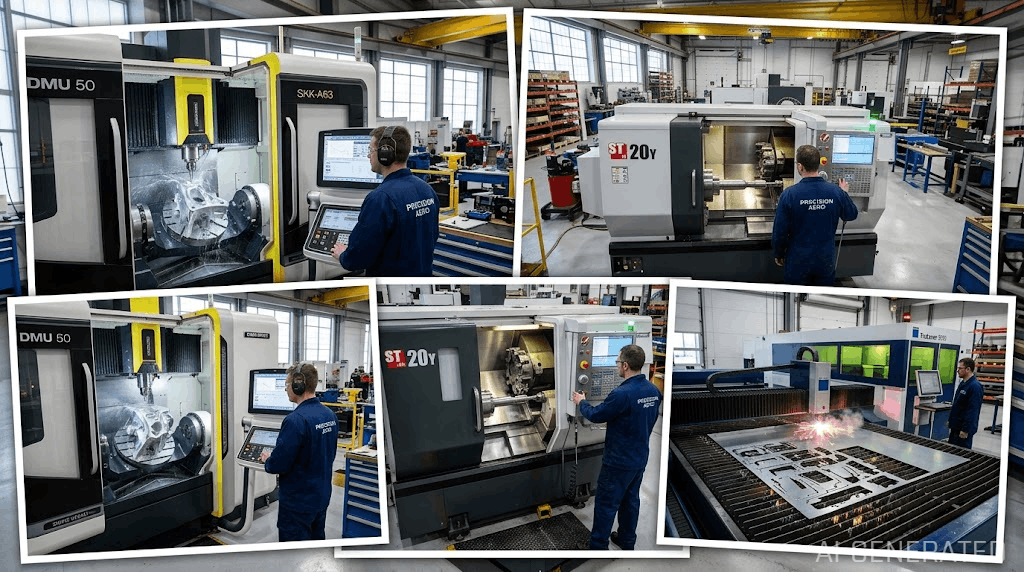
Walk into a machine shop for the first time and "CNC machinery" stops being one thing pretty fast. There's a mill carving pockets into a block of aluminum on one side of the floor, a lathe spinning a shaft to a mirror finish on the other, and — if the shop handles sheet metal too — a laser cutter tracing an outline through steel plate somewhere in between. They're all "CNC," in the sense that a computer controls the motion, but they don't do the same job, and picking the wrong category of machine for a part is a fast way to either overpay or end up with something that doesn't work.
This guide covers the main categories of CNC machinery, what each one is actually built to do, and how to think about which one fits a given part — useful whether you're speccing equipment for a shop floor or just trying to understand what a supplier means when they say a part will run on a "5-axis machine."
Need Precision CNC Machined Parts?
Before diving into how these machines work, if you already have a part designed and need it manufactured, JLCCNC is ready. We operate a full floor of advanced 3-, 4-, and 5-axis mills, lathes, and EDM machines to handle complex geometries and tight tolerances.

Precision CNC Machining Service
Professional manufacturing, fast turnaround, and quality assurance.
CNC Machinery, Broadly
"CNC machinery" covers any machine tool that uses computer numerical control — pre-programmed instructions rather than a human hand on the controls — to move a cutting tool or workpiece with precision. The category spans everything from a benchtop router cutting plywood to an industrial 5-axis machining center holding tolerances measured in microns. What unifies them isn't the process (cutting, grinding, forming, and even non-contact methods like laser and EDM all qualify) but the control method: G-code-driven, repeatable, and largely automated once the program is dialed in.
Main Categories of CNC Machinery
CNC Mills
Mills remove material from a stationary workpiece using a rotating cutting tool, and they're the default choice for anything with flat faces, pockets, slots, or complex 3D contours. A 3-axis mill handles most general work; adding a 4th or 5th axis lets the tool (or the part) rotate, opening up undercuts and compound angles that a 3-axis setup can't reach in a single setup. Our guide on what CNC milling is covers the process in depth, and if a part needs multi-angle access without repositioning, 5-axis CNC milling is worth understanding separately from standard 3-axis work.
CNC Lathes
Lathes work opposite to mills — the workpiece spins while the cutting tool stays largely stationary, which makes them the right tool for round or cylindrical parts: shafts, bushings, pins, threaded components. Anything where the finished part needs to be symmetric around a central axis is usually a lathe job rather than a mill job, and trying to mill a round part from scratch instead of turning it is both slower and harder to hold concentric. For extremely small, long, and slender cylindrical parts (like medical pins or small screws), specialized Swiss-type CNC lathes are used to prevent material deflection during cutting. See our breakdown of what a CNC lathe is and how it works for more on machine types and typical applications.
EDM (Electrical Discharge Machining)
EDM doesn't cut in the conventional sense — it removes material using controlled electrical sparks, which makes it valuable for two situations mills and lathes struggle with: extremely hard materials that would wear out a conventional cutting tool, and geometries too fine or delicate for a physical cutter to reach without breaking. Wire EDM in particular is common for intricate internal features and tight-tolerance cavities that would otherwise need multiple setups on a mill.
CNC Routers
Routers look similar to mills at a glance but are generally built lighter and faster, tuned for softer materials — wood, plastics, composites, and thinner sheet metal — rather than heavy metal removal. The tradeoff for that speed is rigidity: a router won't hold up to the same aggressive cuts in hardened steel that a mill is built for. Our comparison of CNC router specs and features covers where a router fits versus a mill for a given job.
CNC Grinders
Grinders remove very small amounts of material using an abrasive wheel rather than a single-point cutting tool, and they're the go-to when a part needs a surface finish or dimensional tolerance tighter than milling or turning alone can reliably hold. They're usually a finishing step after milling or turning, not a replacement for either. Our CNC grinding guide covers the process and where it fits in a typical production sequence.
CNC Laser and Plasma Cutters
For flat sheet stock, laser and plasma cutters handle the cutting step that would otherwise need a mill or shear — tracing a programmed outline through metal without physical tool contact. They're a category apart from mill/lathe-style machining since they're purpose-built for 2D cutting rather than 3D shaping, and they're the standard first step in most sheet metal fabrication workflows before parts move on to bending and joining.
Quick Comparison
| Machine Type | Best For | Not Suited For |
|---|---|---|
| CNC Mill | Flat faces, pockets, slots, complex 3D contours | Round/cylindrical parts, very hard materials |
| CNC Lathe | Cylindrical, symmetric parts (shafts, bushings, pins) | Non-round or highly asymmetric geometry |
| EDM | Hardened materials, fine internal features, delicate geometry | High-volume, low-complexity parts (too slow to be cost-effective) |
| CNC Router | Wood, plastics, composites, thin sheet material | Hardened metals, heavy stock removal |
| CNC Grinder | Tight tolerances, fine surface finish | Bulk material removal (too slow, use milling/turning first) |
| Laser/Plasma Cutter | 2D flat-pattern cutting from sheet stock | 3D features, internal pockets, threading |
How This Plays Out on an Actual Part
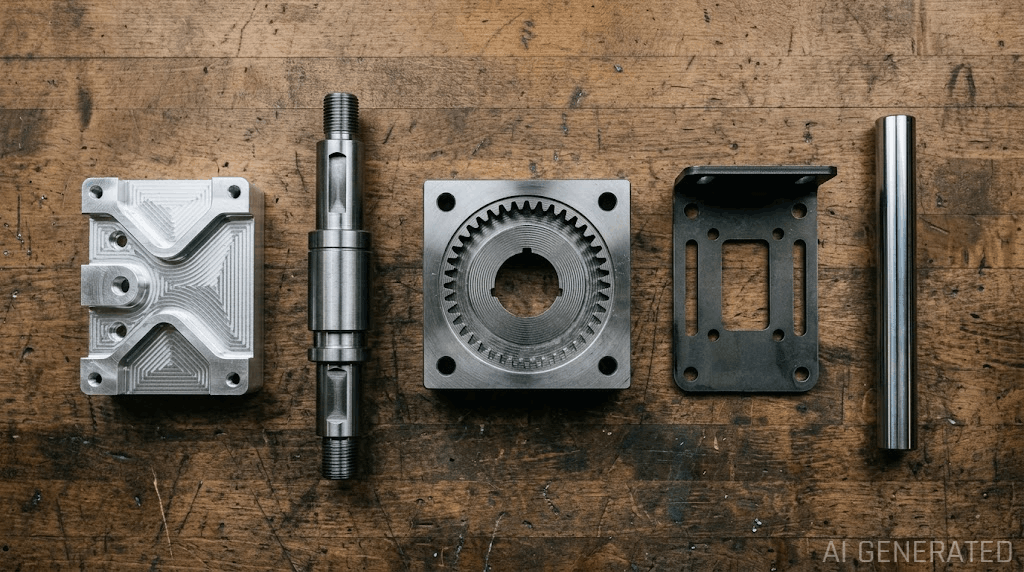
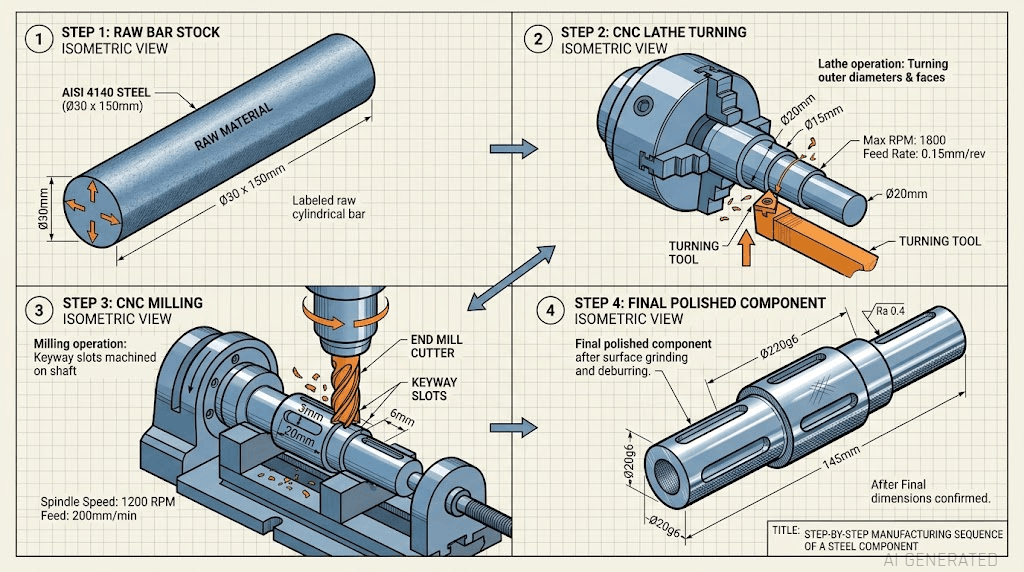
Most real parts don't touch just one machine type — they move through a sequence, and understanding that sequence is often more useful than knowing any single machine in isolation. A shaft might get turned on a lathe for its main profile, then have a keyway milled into it on a secondary mill setup. A sheet metal bracket starts on a laser cutter for its flat pattern, then moves to a press brake for bending — a forming step outside the "cutting" categories above entirely. A hardened tool insert might go through rough milling, then finish on EDM for the fine details a cutter can't safely reach. Knowing which machine handles which stage is what lets you (or a supplier) sequence a job efficiently instead of forcing one machine to do work it's poorly suited for.
One mistake worth flagging: assuming more axes or a fancier machine automatically means a better result. A simple bracket that only needs flat faces and through-holes doesn't benefit from being run on a 5-axis machining center — it just adds cost and setup time for capability the part doesn't use. Matching the machine to the actual geometry, not defaulting to the most capable option available, is where experienced shops save real money on a job.
If you're comparing CNC machinery to the CNC machinery components that make each machine work — spindles, control systems, tool changers — that's a related but different question; our guide on CNC machinery parts and their functions covers what's inside the machine itself rather than which category of machine to choose.
Get the Right Machine for Your Project
At JLCCNC, multi-axis milling, turning, and precision EDM run alongside our sheet metal capabilities under one roof. This means a complex assembly—like a formed chassis with precision-machined mounting plates—doesn't need to be split across multiple vendors and shipping cycles. We match your part to the exact machine it needs for maximum quality and cost-efficiency.
Ready to see your designs machined to spec? Upload your CAD file today to get an instant CNC quote and expert DFM feedback from the JLCCNC engineering team.
FAQ
What's the difference between a CNC mill and a CNC router?
Both remove material with a rotating cutter, but mills are built heavier and more rigid for cutting metal, while routers are optimized for speed on softer materials like wood, plastics, and thin sheet stock. Running hard metal on a router-class machine will wear it out fast or produce a poor finish.
Is a 5-axis machine always better than a 3-axis machine?
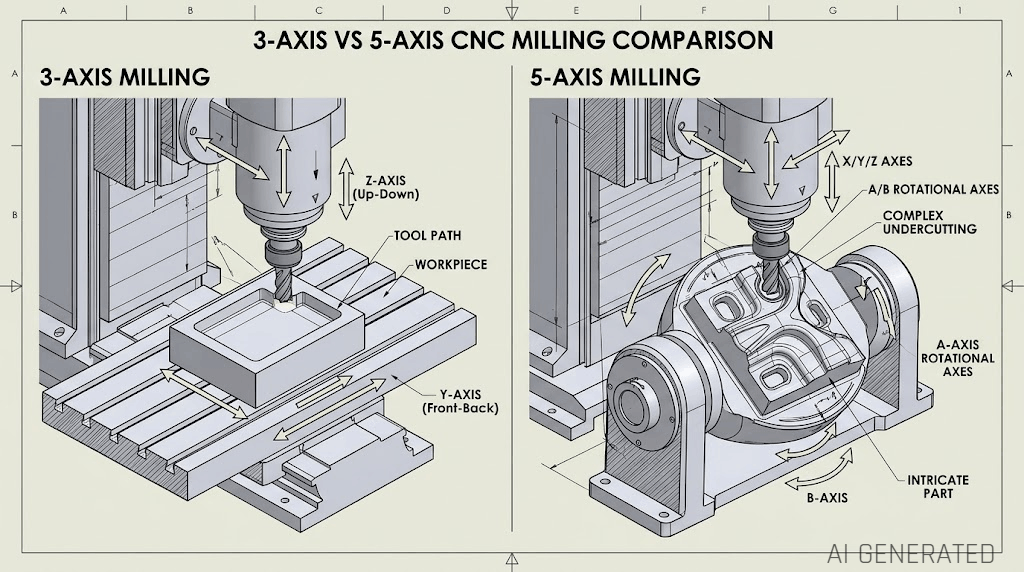
Not for every part. 5-axis machines add the ability to approach a part from multiple angles without repositioning, which matters for complex geometry — but for simple parts, a 3-axis mill does the job faster and cheaper, and there's no benefit to paying for capability the part doesn't need.
When would you use EDM instead of milling?
EDM makes sense for hardened materials that would rapidly wear a cutting tool, and for fine or delicate internal features — thin walls, sharp internal corners, small deep cavities — that a physical end mill can't reach without breaking or leaving a rounded corner where a sharp one is needed.
Do all CNC machines use the same programming?
They all run on G-code at the core, but the specific commands, post-processors, and CAM strategies differ by machine type — a toolpath generated for a mill isn't directly usable on a lathe or a laser cutter without being reprogrammed for that machine's motion and tooling.
Keep Learning
Laser Engraving Aluminum: Marking Methods & Surface Effects
Key Takeaways Laser engraving usually removes base material to create a recess. Laser marking is a broader term that can describe a surface-color change or material removal, so the process name alone does not define the final result. On aluminum, alloy and surface finish affect marking contrast. A light mark on dark anodized aluminum is a common design target, but the actual appearance depends on the finish and laser process. JLCCNC laser marking produces a recessed area 0.03–0.1 mm deep. The result i......
CNC Cutting Fluid: Types, Functions, Applications, and Selection Guide
Key Takeaways Cutting fluid in machining performs four functions simultaneously: cooling the tool and workpiece, lubricating the tool-chip interface to reduce friction, carrying chips away from the cut zone, and protecting machined surfaces from corrosion between operations. Different machining operations need different fluid priorities: high-speed aluminum milling may need adhesion control and chip evacuation, threading and tapping need strong lubrication, and grinding requires both cooling and fine ......
Blind Hole Machining Guide: What Is a Blind Hole, Types of Holes, and Tapping Tips
What Is a Blind Hole? Types of Holes and CNC Hole Machining Explained In CNC machining, few operations challenge process control and tool stability as much as blind hole machining. A blind hole is a hole that terminates at a defined internal depth rather than breaking through the opposite surface. Because the cavity is enclosed at the bottom, chip evacuation, thermal behavior, tool wear, and dimensional accuracy become far more difficult to manage compared to through-hole machining. These constraints ......
Rake Angle in Machining: Machinists’ Guide to Perfect Cuts
What is Rake Angle? (minaprem) If you've ever stood in front of a CNC machine or a manual lathe, you know that the cutting tool's geometry isn't just some arbitrary design. Every angle, edge, and surface has a job to do, and one of the most important of those is the rake angle. We've been running machines long enough to know that rake angle can make or break your surface finish, tool life, and machining efficiency. In this guide, we're going to walk you through what rake angle is, how it works, and ho......
Sheet Metal vs CNC Machining: A Guide to Choosing the Right Method for Your Metal Parts
Quick Answer: Choose sheet metal for uniform-thickness enclosures, panels, and formed brackets when bends and production volume support lower unit cost. Choose CNC machining for variable wall thickness, precision bores, tight feature relationships, and complex 3D geometry. Use a hybrid design when a formed structure needs precision-machined interfaces. A quote comes back for a bracket, and it's priced as a CNC part — machined from solid aluminum, a few hours of spindle time, a per-part cost that makes......
What Steps Are Taken To Minimize Waste In CNC Machining Processes?
How to Reduce Waste in CNC Machining: 5 Practical Strategies Quick Answer: CNC machining waste is reduced mainly through DFM, near-net stock, efficient toolpaths, preventive tool maintenance, and alloy-segregated recycling. The biggest gains usually come before cutting: reduce unnecessary material removal and prevent scrap or rework. Every CNC-machined part starts as more material than it ends up being. A pocket gets milled out, a profile gets cut away, a boss gets faced down to size — and all of that......