Wire EDM Machine: Types, Specs & How to Choose One
6 min
- Wire EDM Machine: Types, Specs & How to Choose One
- What Is a Wire EDM Machine?
- Key Machine Specifications
- Types of Wire EDM Machines
- Choosing the Right Wire EDM Setup for a Job
- A Common Misconception Worth Correcting
- FAQ
Wire EDM Machine: Types, Specs & How to Choose One
Our guide on how EDM wire cutting works covers the process itself — the spark erosion, the dielectric fluid, the tolerances the technique can hold. This one is about the machine that runs that process: what actually differentiates one wire EDM machine from another, and what matters when you're evaluating or specifying one.
💡 Need Precision Wire EDM Services?
Understanding machine specs is crucial, but actually running them takes experience. At JLCCNC, our advanced 4-axis and 5-axis wire EDM machines are ready to tackle your most complex tolerances, seamlessly integrated with our CNC milling and turning services.

Precision CNC Machining Service
Professional manufacturing, fast turnaround, and quality assurance.
What Is a Wire EDM Machine?
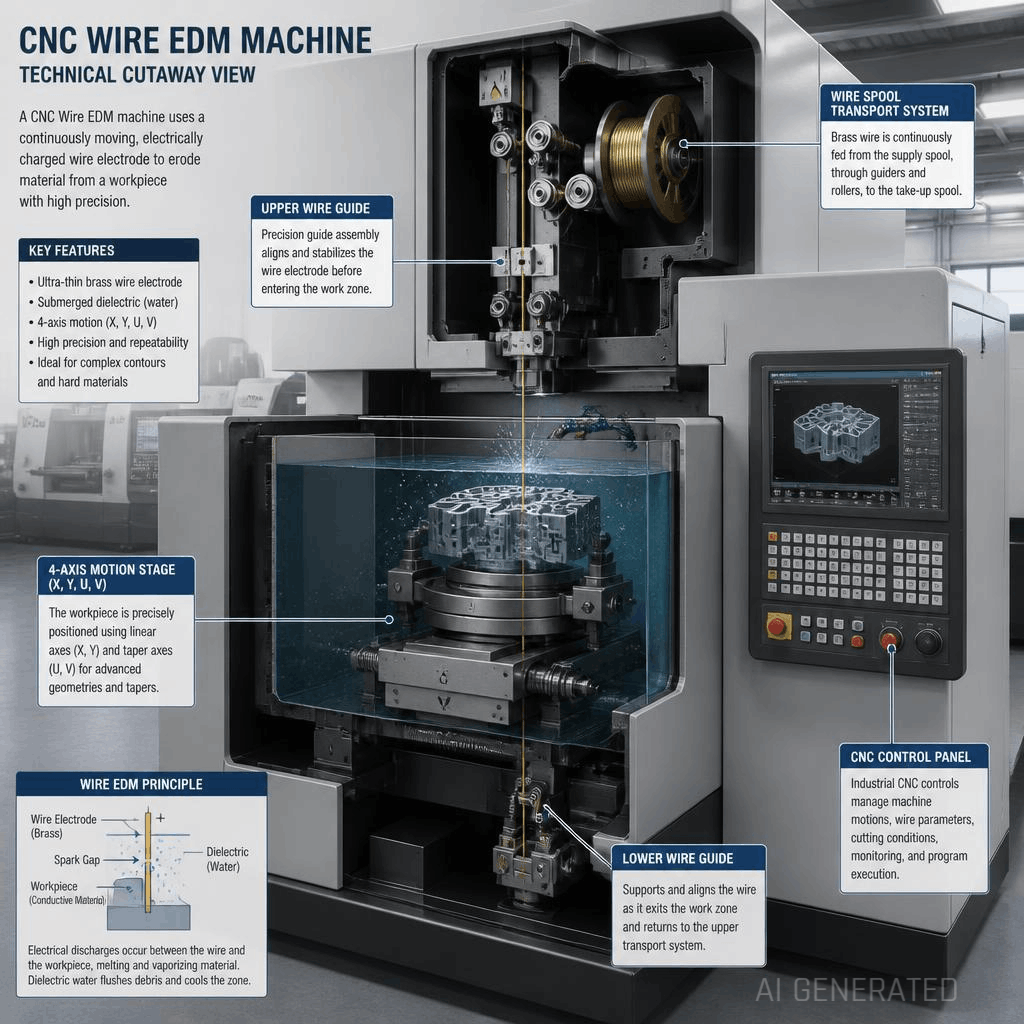
A wire EDM machine is a CNC-controlled system that guides a thin, continuously fed wire electrode along a programmed path to erode material from a conductive workpiece submerged in dielectric fluid. Structurally, it combines a few core systems working together: a wire transport system (spool, guides, tension control, and usually automatic wire threading), a CNC motion system that positions the workpiece or wire head with high precision, a power supply generating the electrical discharge pulses, and a dielectric system that fills, filters, and recirculates the working fluid.
Key Machine Specifications
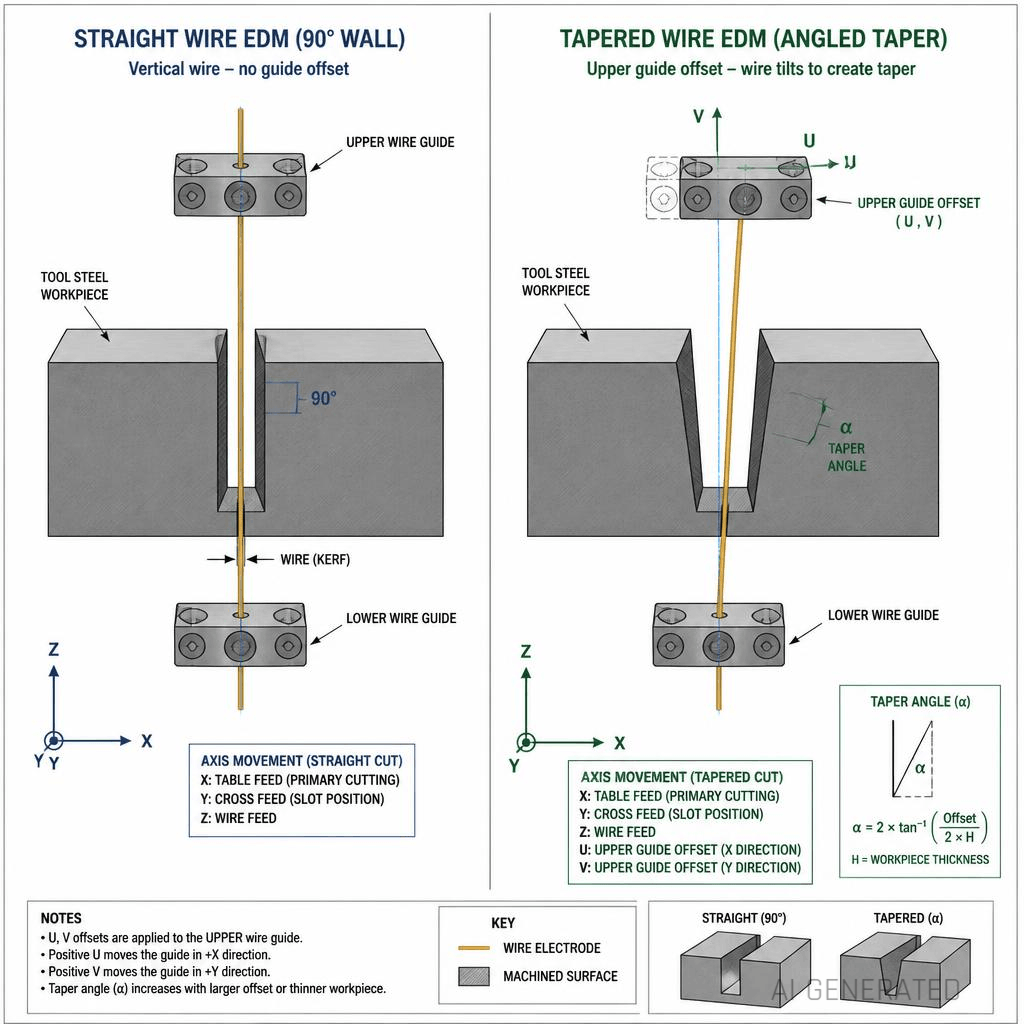
Axis configuration. Most wire EDM machines run on 4 or 5 axes — X and Y for the wire's cutting path, plus U and V axes that let the top wire guide offset independently of the bottom guide, enabling tapered cuts rather than only straight vertical walls. A 5-axis machine adds a rotary capability that opens up more complex, non-planar taper work. For straightforward 2D profile cutting, a 4-axis machine is usually sufficient; taper-heavy die and mold work benefits from the added flexibility.
Maximum workpiece size and travel. Determines the largest part the machine can physically accommodate — a machine with generous X/Y travel but a shallow Z height (workpiece thickness capacity) can still be the wrong fit for a thick part, so both dimensions matter independently, not just footprint.
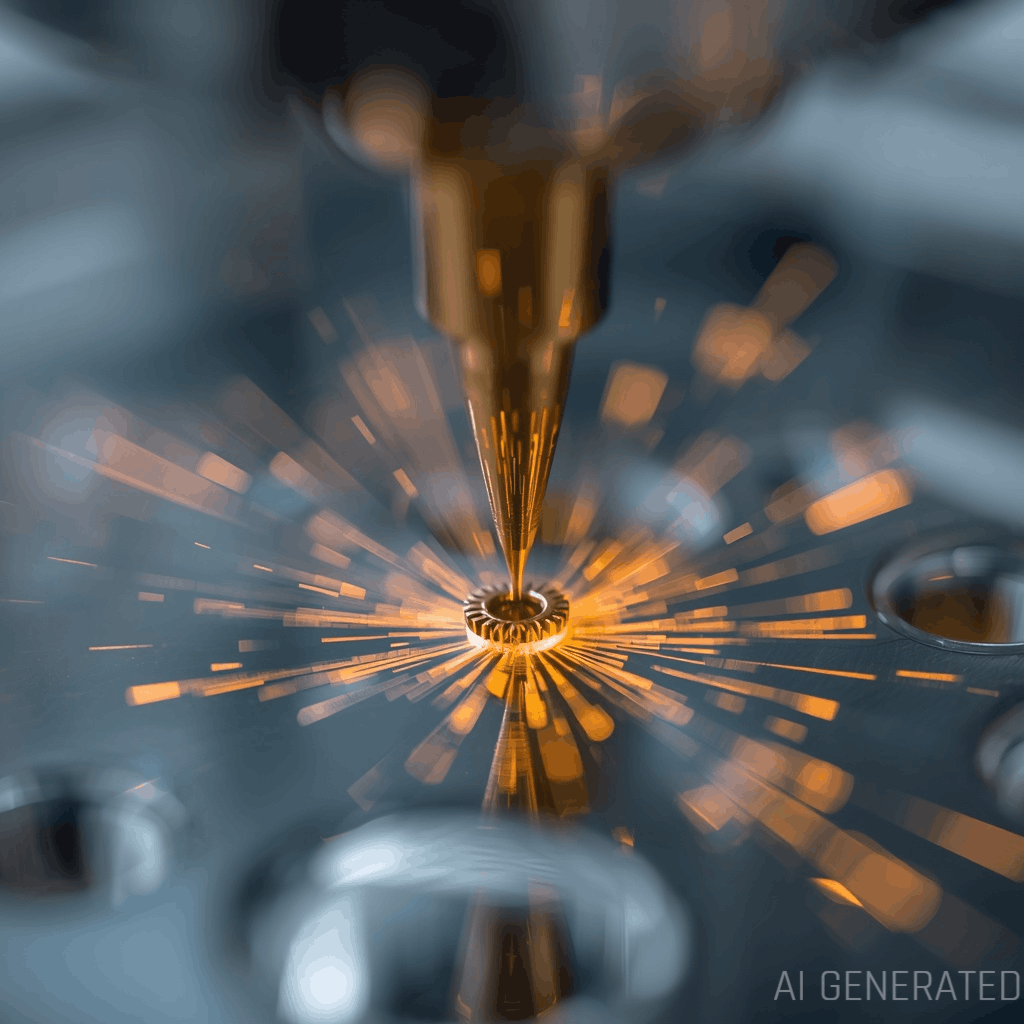
Wire diameter range. Most machines run wire from around 0.1mm up to 0.3mm, with finer wire enabling tighter internal corners and smaller features at the cost of reduced cutting speed and lower current tolerance before wire breakage. Machines built for micro-EDM work sometimes run wire finer than this standard range.
Positioning accuracy and repeatability. Usually specified in microns, this determines how consistently the machine can hit a programmed position — critical for parts that need to match a reference dimension precisely across a production run rather than just on a single part.
Automatic wire threading (AWT). A feature that automatically re-threads the wire after it breaks or after cutting through to make a new start point, without operator intervention. On unattended or lights-out production runs, AWT reliability is a genuinely practical concern — a machine that requires a technician to manually re-thread every wire break isn't realistic for overnight or weekend production.
Types of Wire EDM Machines
Standard production wire EDM machines cover the bulk of commercial work — general tolerance and finish capability suited to mold components, tooling, and precision parts across a wide range of industries.
High-precision wire EDM machines push tolerance and surface finish further, often into single-digit micron territory, aimed at industries — semiconductor, medical, aerospace — where standard tolerances aren't tight enough.
Micro wire EDM machines are purpose-built for extremely fine features and thin wire diameters, used for parts and details too small for standard machines to handle reliably.
Choosing the Right Wire EDM Setup for a Job
Part complexity and taper requirements point toward whether a 4-axis or 5-axis machine is actually needed — paying for 5-axis taper capability on a job that's entirely straight-wall 2D cutting doesn't buy anything.
Tolerance requirements should be checked against a specific machine's published accuracy, not assumed from "wire EDM is precise" in general — there's a real difference between what a standard production machine and a high-precision machine can reliably hold, and matching that to the part's actual drawing tolerance avoids both under- and over-specifying.
Material and thickness affect cutting speed and wire consumption regardless of which machine runs the job, and thicker or harder material may push toward a machine with more available current and power to keep cycle time reasonable.
Production volume shifts what matters most — for one-off or prototype work, setup flexibility and programming ease matter more than raw cutting speed; for repeat production, automatic wire threading reliability and unattended-run capability become the more important differentiators.
A Common Misconception Worth Correcting
Assuming any wire EDM machine automatically delivers the tightest tolerances quoted for the technology as a whole is a frequent source of mismatched expectations. Published tolerance figures for wire EDM (sometimes cited down to ±0.001mm) generally describe what high-end, well-maintained equipment can achieve under controlled conditions — not a guarantee every machine hits by default. Confirming a specific shop's actual, demonstrated tolerance capability on comparable work is worth doing before committing a tight-tolerance job, rather than assuming the process ceiling and the shop's actual capability are the same thing.
At JLCCNC, wire EDM runs alongside milling, turning, and sinker/hole-drilling EDM as part of the standard machining service, so a part needing both conventional machining and wire EDM detail work — a common combination on mold components and precision tooling — doesn't need to be split across separate vendors.
Don't leave your sheet metal specs to chance. Upload your CAD file today to get an instant quote and seamless fabrication for your next project.
FAQ
How many axes does a wire EDM machine need?
4 axes (X, Y, U, V) handle the majority of work, including tapered cuts. 5-axis machines add rotary capability for more complex, non-planar geometry, which most standard 2D profile and straightforward taper work doesn't require.
What's the difference between standard and high-precision wire EDM machines?
High-precision machines are built to hold tighter tolerances and finer surface finishes than standard production machines, typically at a higher cost — worth it for parts genuinely requiring that level of accuracy, unnecessary overhead for parts that don't.
Why does wire diameter matter?
Thinner wire can cut tighter internal corners and finer features, but cuts more slowly and tolerates less current before breaking. Wire diameter selection is a tradeoff between the feature detail a part needs and the cutting speed and reliability the job can afford.
What is automatic wire threading and why does it matter?
It's a system that automatically re-threads the wire electrode after a break or a new-cut start point, without manual operator intervention — important for unattended or overnight production runs where a manual re-thread requirement would stop the machine until a technician is available.
Keep Learning
Laser Engraving Aluminum: Marking Methods & Surface Effects
Key Takeaways Laser engraving usually removes base material to create a recess. Laser marking is a broader term that can describe a surface-color change or material removal, so the process name alone does not define the final result. On aluminum, alloy and surface finish affect marking contrast. A light mark on dark anodized aluminum is a common design target, but the actual appearance depends on the finish and laser process. JLCCNC laser marking produces a recessed area 0.03–0.1 mm deep. The result i......
CNC Cutting Fluid: Types, Functions, Applications, and Selection Guide
Key Takeaways Cutting fluid in machining performs four functions simultaneously: cooling the tool and workpiece, lubricating the tool-chip interface to reduce friction, carrying chips away from the cut zone, and protecting machined surfaces from corrosion between operations. Different machining operations need different fluid priorities: high-speed aluminum milling may need adhesion control and chip evacuation, threading and tapping need strong lubrication, and grinding requires both cooling and fine ......
Blind Hole Machining Guide: What Is a Blind Hole, Types of Holes, and Tapping Tips
What Is a Blind Hole? Types of Holes and CNC Hole Machining Explained In CNC machining, few operations challenge process control and tool stability as much as blind hole machining. A blind hole is a hole that terminates at a defined internal depth rather than breaking through the opposite surface. Because the cavity is enclosed at the bottom, chip evacuation, thermal behavior, tool wear, and dimensional accuracy become far more difficult to manage compared to through-hole machining. These constraints ......
Rake Angle in Machining: Machinists’ Guide to Perfect Cuts
What is Rake Angle? (minaprem) If you've ever stood in front of a CNC machine or a manual lathe, you know that the cutting tool's geometry isn't just some arbitrary design. Every angle, edge, and surface has a job to do, and one of the most important of those is the rake angle. We've been running machines long enough to know that rake angle can make or break your surface finish, tool life, and machining efficiency. In this guide, we're going to walk you through what rake angle is, how it works, and ho......
Sheet Metal vs CNC Machining: A Guide to Choosing the Right Method for Your Metal Parts
Quick Answer: Choose sheet metal for uniform-thickness enclosures, panels, and formed brackets when bends and production volume support lower unit cost. Choose CNC machining for variable wall thickness, precision bores, tight feature relationships, and complex 3D geometry. Use a hybrid design when a formed structure needs precision-machined interfaces. A quote comes back for a bracket, and it's priced as a CNC part — machined from solid aluminum, a few hours of spindle time, a per-part cost that makes......
What Steps Are Taken To Minimize Waste In CNC Machining Processes?
How to Reduce Waste in CNC Machining: 5 Practical Strategies Quick Answer: CNC machining waste is reduced mainly through DFM, near-net stock, efficient toolpaths, preventive tool maintenance, and alloy-segregated recycling. The biggest gains usually come before cutting: reduce unnecessary material removal and prevent scrap or rework. Every CNC-machined part starts as more material than it ends up being. A pocket gets milled out, a profile gets cut away, a boss gets faced down to size — and all of that......