Acetal (POM) Plastic: Properties, Uses & Material Selection
19 min
- What Is Acetal (POM)?
- Acetal Plastic Properties
- Types of Acetal Plastic
- What Is Acetal Used For?
- Advantages and Disadvantages of Acetal
- How to Choose Acetal for Your Application
- Acetal for CNC Machining
- Acetal vs. Other Engineering Plastics
- FAQs About Acetal Plastic
Key Takeaways
- Acetal (POM) is a semi-crystalline engineering thermoplastic with high stiffness, low friction, excellent dimensional stability, and outstanding machinability.
- POM material comes in two main types, homopolymer (POM-H, Delrin) and copolymer (POM-C), with slightly different property profiles suited to different applications.
- Acetal plastic properties include tensile strength of 60-75 MPa, very low moisture absorption (0.2%), and a coefficient of friction of 0.1-0.3 against steel without lubrication.
- Acetal uses span precision gears, bushings, bearings, automotive fuel system components, and any application requiring dimensionally stable sliding or rotating contact.
- Acetal is highly machinable and well suited to CNC milling and turning.
- The main limitations of acetal plastic are its poor performance against strong acids, alkaline environments, and its inability to be painted or bonded without surface treatment.
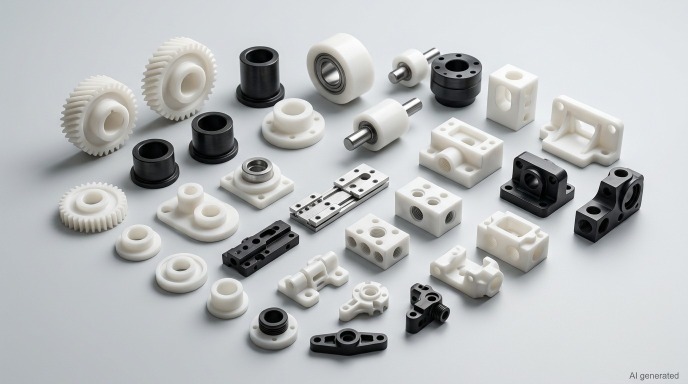
What Is Acetal (POM)?
Acetal plastic is a semi-crystalline engineering thermoplastic belonging to the polyoxymethylene family. It combines high mechanical stiffness, low coefficient of friction, excellent dimensional stability, and superior machinability in a material that processes reliably and delivers consistent properties in finished parts.
JLCCNC provides CNC machining for acetal (POM) parts in commonly used grades, with machined parts checked against manufacturing standards before production. This is suitable for precision gears, bushings, housings, and other custom POM components

Precision CNC Machining Service
Professional manufacturing, fast turnaround, and quality assurance.
What Does POM Stand For?
POM stands for Polyoxymethylene, the chemical name for the polymer chain structure that defines acetal. The name describes the repeating oxymethylene unit (–CH₂–O–) that forms the polymer backbone. This regular, repeating structure produces the high crystallinity that gives POM material its characteristic stiffness and low moisture sensitivity compared to less ordered engineering polymers like nylon.
Acetal vs. POM: Are They the Same Material?
Yes and no. Acetal and POM describe the same polymer chemistry but "acetal" is the commercial name used in engineering practice, while "POM material" is the ISO designation. Delrin, DuPont's trademarked brand name for acetal homopolymer, is so widely used that engineers often say "Delrin" when they mean any acetal plastic, similar to how "Nylon" is used generically for polyamide materials.Acetal and POM refer to the same polymer family, while Delrin® is a trademarked brand of acetal homopolymer. The important distinction is between the two grades within that family, homopolymer and copolymer, which is covered below.
Key Characteristics of Acetal
The properties that define acetal plastic in engineering applications:
High crystallinity from the regular polymer chain structure produces stiffness values above most other unfilled engineering thermoplastics. Acetal material sits stiffer than nylon, HDPE, and polycarbonate at equivalent wall thickness.
Low friction and inherent lubricity make acetal suitable for many dry-running sliding applications.
Excellent machinability makes acetal efficient to mill and turn with conventional carbide tooling.
Acetal Plastic Properties
Strength and Stiffness
Acetal material delivers tensile strength of 60-75 MPa and flexural modulus of 2,500-3,200 MPa, numbers that place it firmly in the engineering plastic category rather than commodity plastics. The stiffness is particularly notable: acetal plastic deflects significantly less than nylon or PETG under equivalent loads, which is why precision mechanical components that must maintain dimensional position under load are routinely made from acetal.
Compressive strength of POM material is excellent, typically 100-140 MPa, which suits bushings and thrust washers that carry compressive loading at contact surfaces. Unlike polymers that creep significantly under sustained compressive load, acetal plastic maintains its shape under moderate sustained compression, which is critical for parts that must preserve clearances in mechanical assemblies.
Dimensional Stability
Dimensional stability is the acetal property that engineers depend on most in precision applications. Two factors define this:
Low moisture absorption (0.2%) means acetal parts don't change dimensions meaningfully when exposed to humidity or water. Nylon parts can absorb 1-3% moisture and change dimensions by 0.3-0.8mm per 100mm, enough to turn a running fit into a binding fit. Acetal material in the same application maintains its machined dimensions.
Low thermal expansion coefficient (110-120 × 10⁻⁶/°C) keeps acetal parts stable across the temperature ranges typical of indoor industrial applications. Combined with low moisture sensitivity, POM is one of the more dimensionally stable engineering plastics for precision mechanical applications.
Low Friction and Wear Resistance
The coefficient of friction for acetal plastic against steel is 0.1-0.3 depending on surface finish, load, and velocity, achieved without any external lubrication. This natural lubricity comes from the smooth, low-energy surface that the crystalline POM material structure produces.
Wear resistance of acetal in dry sliding applications significantly exceeds nylon and most other unfilled engineering plastics. Acetal can provide longer wear life than some unfilled nylon grades in dry-running applications, depending on load, speed, mating surface, and environment. For even better wear performance, internally lubricated acetal grades incorporate PTFE, silicone oil, or graphite particles that further reduce friction and extend service life in demanding contact applications.
Chemical Resistance
Acetal plastic has good resistance to many common industrial chemicals: hydrocarbons, fuels, alcohols, ketones, and most organic solvents leave acetal material unaffected under normal service conditions. This chemical compatibility is what makes acetal the dominant material for automotive fuel system components, fuel caps, valve bodies, pump housings, and carburettor parts that contact fuels continuously.
The limitations of acetal's chemical resistance are specific but important: strong acids, strong alkalis, and certain oxidizing environments can degrade POM, with resistance depending on concentration, temperature, exposure time, and grade. For chemical handling applications, verify specific chemical compatibility before specifying acetal material.
Moisture resistance should not be confused with resistance to prolonged hot-water or steam exposure. Elevated-temperature water and steam can affect POM performance depending on the grade, temperature, and exposure duration. For demanding hot-water or steam applications, materials such as PEEK or PVDF may be considered
Temperature Resistance
Typical continuous-use temperatures for unfilled acetal are generally around the 80–100°C range, but the actual limit depends strongly on grade, load, environment, and required service life. Heat deflection temperature is 110-136°C at 0.45 MPa load. These values suit most indoor industrial applications and automotive under-body locations but may make standard acetal unsuitable for sustained high-temperature applications.
At low temperatures, acetal material retains good impact toughness down to -40°C, a property that suits outdoor and cold-storage applications where some engineering plastics become brittle.
Mechanical and Physical Properties of Acetal
| Property | POM-H (Homopolymer) | POM-C (Copolymer) |
|---|---|---|
| Tensile Strength | 68-75 MPa | 60-67 MPa |
| Flexural Modulus | 2,900-3,200 MPa | 2,500-2,800 MPa |
| Compressive Strength | 120-140 MPa | 100-120 MPa |
| Elongation at Break | 25-40% | 30-50% |
| Izod Impact (notched) | 65-80 J/m | 70-95 J/m |
| Hardness (Rockwell M) | 94 | 80 |
| Density | 1.41-1.43 g/cm³ | 1.39-1.41 g/cm³ |
| Moisture Absorption | 0.20% | 0.22% |
| Coefficient of Friction | 0.15-0.25 | 0.15-0.30 |
| Continuous Service Temp | 80-100°C | 85-105°C |
| Heat Deflection Temp (0.45 MPa) | 110-136°C | 100-110°C |
| Thermal Expansion | 110-120 × 10⁻⁶/°C | 110-120 × 10⁻⁶/°C |
Typical values vary by grade, manufacturer, test method, and conditioning. Use the supplier's datasheet for final material selection.
Types of Acetal Plastic
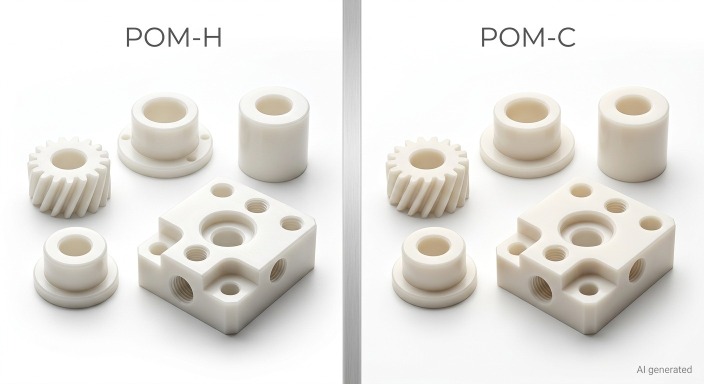
comparing POM-H acetal homopolymer and POM-C acetal copolymer
Acetal Homopolymer (POM-H)
Acetal homopolymer, the most widely known grade under DuPont's Delrin tradename, has a more regular, uniform chain structure than the copolymer variant. This higher crystallinity produces slightly higher tensile strength, flexural modulus, and hardness. POM-H also has lower porosity in the center of thick sections when properly processed.
The characteristic that distinguishes acetal homopolymer most practically: it's available in natural (white/ivory) color as standard, and the natural color suits food-contact and medical applications where material traceability requires white materials. POM-H is also available in black with UV stabilizers for outdoor applications.
Acetal Copolymer (POM-C)
Acetal copolymer introduces small amounts of a comonomer into the polymer chain, disrupting the regularity that creates the homopolymer's higher crystallinity. The result is slightly lower mechanical properties than POM-H in the headline numbers, but better hydrolysis resistance, better performance in hot water and steam environments, and better resistance to acidic environments in the moderate pH range.
POM-C is more widely available in rod, plate, and tube stock form from commodity plastics distributors because the manufacturing process is more forgiving than POM-H production. It's the grade that most machined acetal parts are made from in general industrial applications.
Acetal Homopolymer vs. Copolymer
| Property | POM-H (Homopolymer) | POM-C (Copolymer) | Verdict |
|---|---|---|---|
| Tensile Strength | Higher | Slightly lower | POM-H |
| Stiffness | Higher | Slightly lower | POM-H |
| Hot Water Resistance | Lower | Better | POM-C |
| Acid Resistance | Lower | Better | POM-C |
| Machinability | Both excellent | Both excellent | Tie |
| Stock Availability | Good | More widely available | POM-C |
| Dimensional Stability | Both excellent | Both excellent | Tie |
| Typical Choice | Precision mechanical parts | General industrial applications | Application-dependent |
What Is Acetal Used For?
| Application | Acetal Properties That Matter | Typical Grade |
|---|---|---|
| Precision gears | Stiffness, low friction, dimensional stability, wear resistance | POM-H |
| Sliding bearings and bushings | Low friction, wear resistance, compressive strength | POM-H or POM-C + PTFE filled |
| Fuel system components | Chemical resistance to fuels, dimensional stability | POM-C |
| Food processing equipment | FDA compliance, moisture resistance, easy cleaning | POM-H (natural) |
| Conveyor components | Wear resistance, impact resistance, low friction | POM-C |
| Electrical connectors | Dimensional stability, dielectric properties | POM-C |
| Valve bodies and pump housings | Chemical resistance, pressure capacity, dimensional stability | POM-C |
| Medical components | Grade-specific regulatory support, dimensional stability | Medical-grade POM-H |
| Automotive interior mechanisms | Low noise, fatigue resistance, dimensional stability | POM-H or POM-C |
Gears and Bearings
Acetal is widely used for small precision gears in applications where metal gears are unnecessary and lubrication is impractical. The combination of stiffness (necessary for accurate tooth profile retention under load), fatigue resistance (necessary for high cycle gear applications), dimensional stability (necessary for consistent tooth mesh clearance), and natural lubricity (necessary for dry-running operation) makes POM a common choice for instrumentation gears, appliance gears, and light-load power transmission gears.
Acetal bearings and bushings in dry-running applications outlast most alternative engineering plastics because POM material's wear rate without lubrication is genuinely low. The low coefficient of friction of acetal reduces the running temperature in sliding contact, which extends service life further by keeping the contact zone below the temperature where material properties start to degrade.
Bushings and Rollers
Acetal material's compressive strength and low friction suit it for thrust washers, sleeve bushings, and rollers in moderate-load applications. The acetal bushing doesn't creep significantly under compressive load the way some softer polymers do, maintaining its bore dimension and therefore the shaft clearance throughout service life.
Automotive Components
Fuel system applications, including fuel caps, valve bodies, and emissions equipment, rely on acetal's resistance to fuels and fuel vapors. Acetal plastic in automotive fuel systems has decades of validated service history, and the combination of chemical resistance, strength, and dimensional stability is difficult to match with other engineering plastics at equivalent cost.
Interior mechanisms, including window regulator guides, door handle mechanisms, and airbag housing clips, use acetal for its low friction, fatigue resistance, and dimensional stability.
Advantages and Disadvantages of Acetal
Advantages of Acetal
Excellent machinability
Low moisture absorption
Low friction and good wear resistance
Good stiffness and fatigue performance
Good dimensional stability
Limitations of Acetal
- Temperature limitations
- Chemical limitations
- UV exposure
- Difficult bonding/painting
- Combustibility
How to Choose Acetal for Your Application
When Acetal Is a Good Choice
Choose acetal when dimensional stability must be maintained despite changes in humidity.
Choose acetal plastic when dry-running sliding or rotating contact is required and lubrication is impractical, undesirable (food or medical applications), or a maintenance burden.
Choose POM when machined tolerances must remain stable during service, particularly in applications with moderate humidity variation.
Choose acetal when machinability is critical — it machines better than most engineering plastics and holds tighter tolerances than nylon or PC.
When to Consider Another Plastic
When impact resistance is the primary requirement, impact-modified nylon or polycarbonate absorbs more energy before fracture than standard acetal.
For sustained temperatures above acetal's recommended service range, consider higher-temperature materials such as PEEK or PPS.
When exposure to strong acids or concentrated alkalis is unavoidable, PVDF or PTFE handles aggressive chemical environments that degrade acetal material.
When cost is the primary constraint and precision isn't required, HDPE and polypropylene cost significantly less than acetal and suit non-precision applications.
Choose POM-H when higher strength, stiffness, creep resistance, or fatigue resistance is the priority. Choose POM-C when hydrolysis resistance, chemical resistance, or general-purpose availability is more important.
At JLCCNC, acetal CNC machining is available in both POM-H and POM-C grades with engineering review before production. Tight-tolerance acetal parts, bearing housings, gear blanks, precision bushings, are produced with in-process gauging on critical dimensions.
Upload Your Acetal Part Files for Engineering Review and Quote at JLCCNC
Acetal for CNC Machining
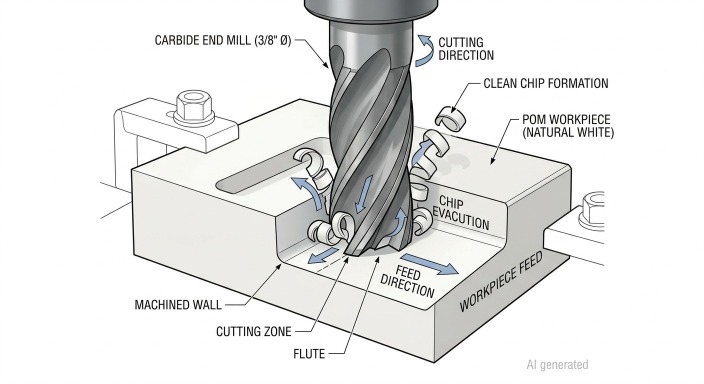
acetal (POM) being CNC machined
Why Acetal Is Suitable for CNC Machining
Acetal plastic is one of the best engineering thermoplastics for CNC machining. The reasons are interconnected: POM material's stiffness means it doesn't deflect significantly under cutting forces, its crystalline structure produces clean fracture at the tool edge rather than gummy tearing, its relatively low thermal conductivity makes heat management important, so sharp tooling and effective chip evacuation help limit heat buildup, and its dimensional stability means machined features retain their dimensions after the part comes off the machine.
These properties combine to produce a material that holds tight tolerances, produces excellent surface finish, requires minimal post-processing, and can be machined efficiently on standard CNC equipment when cutting parameters are matched to the grade and tool geometry.
CNC Milling and Turning of Acetal
A cutting-speed range around 100–300 m/min can be used as a starting point for some acetal milling operations, but actual parameters should be adjusted for the grade, tool diameter, geometry, and machine.
CNC turning acetal produces excellent surface finish with sharp carbide inserts at speeds of 150-400 m/min and feed rates of 0.05-0.15 mm/rev for finishing. POM material doesn't work-harden like some metals, so the cutting parameters are largely independent of the depth of cut for finishing operations. Coolant is optional, compressed air chip clearing is sufficient for most acetal machining operations and avoids coolant contamination of the workpiece.
Acetal is particularly straightforward to machine compared with many other engineering plastics. Here’s a guide to plastic CNC machining covering material selection, cutting tools, chip evacuation, cooling, and the machining problems that can affect plastic parts.
Achieving Tight Tolerances in Acetal Parts
Tolerances around ±0.025 mm may be achievable in suitable acetal parts with proper fixturing, tooling, temperature control, and inspection. Tighter tolerances require application-specific process control. For tighter tolerances, ±0.010-0.015mm is achievable with finish passes and in-process gauging, comparable to machined aluminum at equivalent effort.
The key variables for tight tolerance acetal machining: sharp tools (dull tools generate more heat and cutting force, both of which affect dimensional accuracy), consistent fixturing (acetal parts held inconsistently flex under cutting force), and temperature stabilization (acetal's thermal expansion coefficient means a part measured warm after machining differs slightly from one at room temperature, allow thermal equilibration before final measurement).
CNC Machining Considerations for Acetal
Tool selection, sharp carbide tools outperform high-speed steel for acetal machining. PCD tooling extends tool life in high-volume production. Standard tool geometries work, acetal doesn't require specialized tool forms.
Workholding, acetal parts are rigid enough to hold in standard vises and fixtures without distortion from clamping forces, unlike thinner-walled polymer parts that distort under clamping and spring back after machining. Use soft jaws or pad contact areas on finished surfaces to prevent marking.
Chip management, acetal generates distinctive curled chips that evacuate well from milling operations. Drilling produces long continuous chips that wrap around drills in deep holes, peck drilling with frequent chip clearing prevents chip packing and drill breakage.
Thread quality, acetal machines excellent threads. Standard taps and thread mills work without modification. Rolled threads in acetal are not standard, cut threads are the norm. For functional threaded connections in acetal that will see repeated assembly, coarser thread forms hold better than fine threads because fine threads have less depth relative to the POM material's stiffness.
Acetal Machining Challenges
Thin wall deflection, acetal is stiff but not infinitely so. Thin-walled acetal features can deflect under machining forces, particularly when the walls are tall or poorly supported. Auxiliary support during machining or leaving more wall stock for the final finish pass reduces this.
Static charge buildup, acetal plastic generates static during machining that attracts chips to the workpiece and fixtures. Regular chip clearing and in some cases ionized air blowoff keeps chips from re-cutting and affecting surface quality.
Melting in drilling, standard drill speeds generate heat that can melt acetal at the drill tip in deep holes without adequate chip clearance and cooling. Peck drilling, adequate chip clearance, and controlled cutting conditions help prevent heat buildup and chip packing in deep holes.
Acetal vs. Other Engineering Plastics
Values are representative ranges rather than universal material specifications. Actual properties vary by grade, supplier, test method, temperature, and conditioning.
| Property | Acetal (POM) | Nylon (PA6) | ABS | HDPE | PTFE |
|---|---|---|---|---|---|
| Tensile Strength | 60-75 MPa | 70-85 MPa | 38-48 MPa | 21-37 MPa | 20-35 MPa |
| Flexural Modulus | 2,500-3,200 MPa | 2,500-3,300 MPa | 2,000-2,900 MPa | 800-1,600 MPa | 400-600 MPa |
| Moisture Absorption | 0.20% | 1.5-3.0% | 0.2-0.5% | 0.01-0.02% | <0.01% |
| Coefficient of Friction | 0.15-0.25 | 0.2-0.4 | 0.3-0.5 | 0.10-0.22 | 0.04-0.10 |
| Max Service Temp | 80-100°C | 90-120°C | 70-100°C | 80-90°C | 260°C |
| Dimensional Stability | Excellent | Moderate (moisture) | Good | Good | Good |
| Machinability | Excellent | Good | Good | Good | Moderate |
| Chemical Resistance | Good | Moderate | Limited | Excellent | Outstanding |
| Relative Cost | Medium | Medium | Low | Low | High |
Acetal isn't the only engineering plastic suitable for CNC machining. Here’s a broader comparison of commonly used CNC plastics, including POM, nylon, ABS, polycarbonate, polyethylene, polypropylene, and PET.
Acetal vs. Nylon
Acetal and nylon compete in many precision applications, but they favor different priorities. Acetal is often preferred when moisture-related dimensional change must be minimized, while nylon may be preferable when impact toughness or higher temperature capability is more important.
For dry sliding and rotating contact, both materials can work well in suitable applications, but their performance depends on load, speed, environment, and grade.
Acetal vs. ABS
Acetal and ABS are rarely in direct competition because they serve different application categories. ABS is a general-purpose structural plastic used for enclosures, housings, and non-precision structural parts where stiffness is adequate and dimensional precision isn't critical. Acetal material is an engineering plastic for precision mechanical components. Where the applications overlap, precision housings for mechanisms, acetal's better dimensional stability and chemical resistance generally make it the superior choice at moderate cost premium.
Acetal vs. HDPE
HDPE has lower stiffness, lower strength, and better chemical resistance than acetal material. The key differentiator is dimensional stability: HDPE's low moisture absorption rivals acetal's, but HDPE's lower flexural modulus (800-1,600 MPa versus 2,500-3,200 MPa for acetal) means HDPE parts deflect more under equivalent loads. For cut boards, tank liners, and chemical handling components where precision isn't required, HDPE's better chemical resistance and lower cost win. For precision mechanical components requiring both stiffness and dimensional stability, acetal is often a better fit than HDPE.
Acetal vs. PTFE
PTFE has the lowest coefficient of friction of any engineering plastic, 0.04-0.10 versus 0.15-0.25 for acetal material. For applications requiring extremely low friction, PTFE can offer lower friction than acetal. However, PTFE is significantly softer and weaker than acetal plastic (tensile strength 20-35 MPa versus 60-75 MPa), deforms under moderate loads, and is very difficult to machine to tight tolerances because it's extremely soft and creeps under cutting forces. Where structural integrity alongside low friction is required, PTFE-filled acetal, which incorporates PTFE particles into the POM matrix, provides substantially better friction than standard acetal while maintaining the mechanical stiffness and machinability that pure PTFE lacks.
FAQs About Acetal Plastic
Q: What is acetal plastic?
Acetal is a semi-crystalline engineering thermoplastic based on polyoxymethylene (POM). It is widely used for precision parts that require stiffness, low friction, wear resistance, and dimensional stability.
Q: Is acetal the same as POM?
Yes. Acetal is the common engineering name for POM, or polyoxymethylene. Delrin® is a trademarked acetal homopolymer brand.
Q: What is POM used for?
POM is commonly used for gears, bushings, bearings, rollers, valve components, automotive mechanisms, and other precision parts requiring low friction and dimensional stability.”
Q: What are the main properties of acetal?
Key properties include high stiffness, low moisture absorption, low friction, good wear resistance, dimensional stability, and excellent machinability. Exact values depend on the grade.
Q: Is acetal good for CNC machining?
Yes. Acetal is well suited to CNC milling and turning because it machines cleanly and maintains good dimensional accuracy when properly fixtured and machined.
Keep Learning
Plastic CNC Machining: Guide to Materials, Machines & Cutting Strategies
Understanding Plastic CNC Machining When most people think of CNC machining, metals come to mind first, aluminum, steel, titanium. But plastic CNC machining has quietly creeped into many industries. Why? Because plastics are lightweight, versatile, and cost-effective, making them an ideal option for places where the best performance is needed on the best budget. CNC for plastic is now as common as CNC for metal. At JLCCNC, we don't just work with metals, we also provide CNC machining of plastic parts ......
Polycarbonate vs Acrylic for CNC Parts: Strength, Machining & Material Selection
Quick Comparison: Polycarbonate vs Acrylic Property Polycarbonate Acrylic Tensile strength 55–75 MPa 70–80 MPa Impact resistance 600–900 J/m (notched Izod) 15–30 J/m Flexural modulus 2.1–2.5 GPa 3.0–3.3 GPa Light transmission 88–90% 92–93% Heat deflection temp approximately 110–130°C depending on grade and test condition 75–100°C Chemical resistance Moderate. attacked by solvents Good. resists most common chemicals Machinability Good. tends to melt at edges Excellent. clean chips, sharp edges UV resis......
Acrylonitrile Butadiene Styrene: Properties, Types, and Applications
Key Takeaways ABS can provide useful service performance at moderately elevated temperatures, with the actual continuous-use and heat-deflection limits depending on grade, loading, and service conditions. It's an amorphous terpolymer whose properties come from the combination of three monomers: acrylonitrile contributes chemical resistance and stiffness, butadiene provides impact toughness, and styrene gives the material its processability and surface finish. ABS plastic provides moderate heat resista......
Polycarbonate CNC Machining: Properties, Design Guidelines, and Manufacturing Considerations
Key Takeaways About Polycarbonate CNC Machining Polycarbonate is used for clear guards, covers, housings, and inspection parts where visibility and protection matter in use, not just on drawings. Different machining materials or grades behave differently during cutting and show up mainly in surface clarity and edge condition. Heat from cutting affects surface marks more than the strength of the material itself. Thin walls and wide flat areas are where most surface issues start during machining. Tool s......
Acetal (POM) Plastic: Properties, Uses & Material Selection
Key Takeaways Acetal (POM) is a semi-crystalline engineering thermoplastic with high stiffness, low friction, excellent dimensional stability, and outstanding machinability. POM material comes in two main types, homopolymer (POM-H, Delrin) and copolymer (POM-C), with slightly different property profiles suited to different applications. Acetal plastic properties include tensile strength of 60-75 MPa, very low moisture absorption (0.2%), and a coefficient of friction of 0.1-0.3 against steel without lu......
What Is a Composite Material? Types, Properties, Examples, and Applications
Key Takeaway A composite material is an engineered material made from two or more constituent materials with different properties that, combined, produce a material with superior or unique characteristics neither component has alone. The main types of composite materials are classified by matrix (polymer, metal, ceramic) and by reinforcement form (fiber, particle, sandwich). Composite material properties are directional, they vary depending on fiber orientation, which is both an advantage for optimiza......