Acrylonitrile Butadiene Styrene: Properties, Types, and Applications
18 min
- What Is Acrylonitrile Butadiene Styrene?
- Properties of ABS Plastic
- Types and Grades of ABS Plastic
- ABS Plastic Processing Methods
- What Is ABS Plastic Used For?
- Advantages and Limitations of ABS
- ABS vs. Other Engineering Plastics
- ABS Design and Manufacturing Considerations
- Get Custom ABS Parts Made
- FAQ About Acrylonitrile Butadiene Styrene
Key Takeaways
- ABS can provide useful service performance at moderately elevated temperatures, with the actual continuous-use and heat-deflection limits depending on grade, loading, and service conditions.
- It's an amorphous terpolymer whose properties come from the combination of three monomers: acrylonitrile contributes chemical resistance and stiffness, butadiene provides impact toughness, and styrene gives the material its processability and surface finish.
- ABS plastic provides moderate heat resistance, with heat-deflection temperature (HDT) typically ranging from about 70-100°C depending on the grade and test conditions. It also offers good dimensional stability and can be processed by injection molding, extrusion, CNC machining, thermoforming, and FDM 3D printing.
- Its main weaknesses are poor UV resistance in standard formulations, moderate heat resistance compared to engineering plastics like polycarbonate or nylon, and susceptibility to some organic solvents.
- The right grade, general-purpose, high-impact, heat-resistant, or flame-retardant, depends heavily on the application environment.
What Is Acrylonitrile Butadiene Styrene?
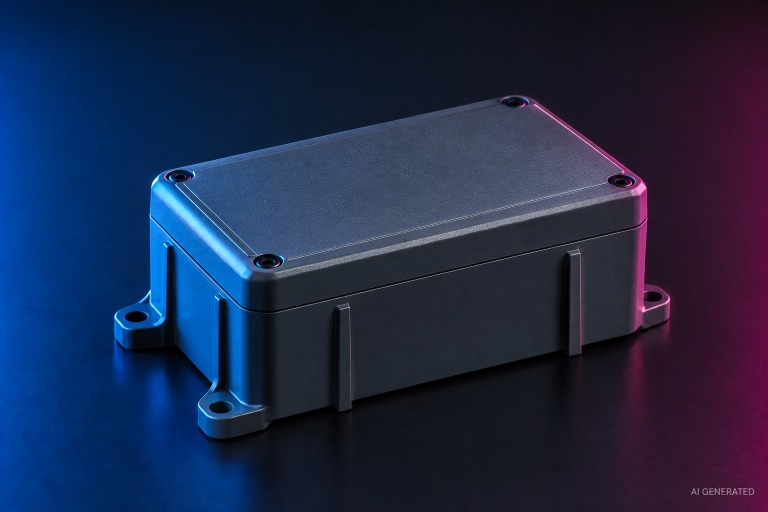
internal structure of ABS plastic
What Is ABS Plastic?
ABS is an amorphous engineering thermoplastic produced from three monomer components. Amorphous means that ABS does not have a crystalline molecular structure. Unlike semi-crystalline polymers such as nylon or polypropylene, it does not have a distinct melting point. It softens over a temperature range instead.
ABS is widely used because it combines good processability, impact resistance, surface finish, and cost efficiency. Injection molding is well understood for ABS. The material can produce good surface finishes and can be bonded with adhesives, painted, or electroplated. For products that need to look good, resist impacts, and be economical to produce in volume, ABS hits those requirements reliably.
For a broader look at commonly machined plastics and how their properties affect material selection, see our guide to frequently used plastic materials for CNC machining
Need custom ABS parts for prototypes, enclosures, or functional components? Upload your CAD file with the material, quantity, and key requirements to get a CNC machining quote from JLCCNC.

Precision CNC Machining Service
Professional manufacturing, fast turnaround, and quality assurance.
What Is ABS Made Of?
ABS plastic is made from three monomers, acrylonitrile, butadiene, and styrene, polymerized together through emulsion, suspension, or continuous mass polymerization processes. ABS formulations can contain different proportions of acrylonitrile, butadiene, and styrene, with the balance varying by grade and manufacturer. These ratios are one of the primary levers manufacturers use to tune the material's properties for specific applications.
The polymerization produces a material in which rubber particles are dispersed through a continuous SAN matrix. The morphology of this rubber-toughened structure, including rubber particle size and distribution, substantially influences impact behavior.
How Do Acrylonitrile, Butadiene, and Styrene Affect ABS?
Acrylonitrile brings chemical resistance and heat resistance to the combination. Higher acrylonitrile content generally improves resistance to oils, greases, and some chemicals, and raises the heat deflection temperature slightly. It also contributes to the material's hardness.
Butadiene is what makes ABS tough at low temperatures. Pure polystyrene is brittle. Adding butadiene rubber particles to the matrix provides energy absorption during impact, when a stress crack begins to propagate through the material, it encounters rubber particles that absorb energy and arrest the crack. Higher butadiene content can improve toughness, but it may also reduce stiffness and surface gloss.
Styrene improves processability, contributes to surface gloss, and reduces cost. High styrene content makes the material flow more easily in injection molding and produces better surface finish. The balance between all three monomers determines where a specific grade of ABS plastic sits on the spectrum from tough-and-easy-to-mold to stiff-and-heat-resistant.
Properties of ABS Plastic
Mechanical Properties
ABS provides a useful balance of strength, stiffness, and impact resistance for many engineering applications. Typical ABS grades have tensile strengths in roughly the 35-55 MPa range, while flexural modulus and impact strength vary substantially by grade, formulation, test method, and processing conditions. These values should therefore be treated as general reference ranges rather than universal specifications. Elongation at break is typically 5-25%, giving the material a useful combination of stiffness and some ductility before failure.
The rubber phase in the microstructure is what drives the impact performance. It also means ABS properties are temperature-dependent in a pronounced way. ABS impact performance generally decreases at lower temperatures, but the extent of the change depends strongly on the grade and rubber-phase formulation
Thermal Properties
The thermal picture for ABS is adequate for many indoor applications and insufficient for demanding environments. Glass transition temperature runs 95-115°C depending on the grade and composition. Heat deflection temperature (HDT) at 1.82 MPa load is typically 70-100°C for standard grades, higher for heat-resistant formulations. Vicat softening point runs somewhat higher.
Practically, ABS plastic starts losing stiffness and dimensional stability before it approaches melting. Parts under sustained load can creep and deform at temperatures below the nominal HDT, depending on the grade, stress level, and exposure time. For under-hood automotive applications, proximity to heat sources, or industrial environments with elevated ambient temperatures, ABS often needs to be replaced with higher-temperature materials.
Chemical Resistance
The acrylonitrile component gives ABS decent resistance to dilute acids, alkalis, oils, and greases. It's also resistant to water and most aqueous solutions, which is why it's used in plumbing fittings and appliance components that see occasional moisture contact.
Where ABS fails chemically: aromatic hydrocarbons (benzene, toluene) and chlorinated solvents cause significant swelling and degradation. Ketones and esters can attack it. This is relevant for industrial cleaning applications and for parts that might contact fuels or solvents. Acetone can also be used to smooth FDM-printed ABS surfaces. The solvent partially dissolves the surface layer, reducing the appearance of layer lines.
Electrical Properties
ABS has good electrical insulation properties, volume resistivity in the 10¹⁵-10¹⁶ Ω·cm range, good dielectric strength, and relatively low dielectric constant. These properties are consistent enough for use in electrical housings, switches, and components where the plastic serves as an insulating enclosure. ABS is also available in electrically conductive or dissipative ABS grades are also available, typically through conductive fillers or additives.
Dimensional Stability
ABS is an amorphous polymer with low moisture absorption (0.2-0.5%) and relatively low linear shrinkage (0.4-0.8% for injection molded parts). This combination contributes to good dimensional stability after processing. ABS generally absorbs less moisture than nylon, so it undergoes less moisture-related dimensional change.
Where dimensional stability degrades: elevated temperatures (creep under load), UV exposure in standard grades (photodegradation causes embrittlement and color change over time), and thermal cycling at temperatures near the glass transition.
Types and Grades of ABS Plastic
These categories are useful for framing material selection but aren't a rigid classification system, grades overlap, different manufacturers use different naming conventions, and some grades straddle multiple categories.
General-Purpose ABS
The baseline grade covering most standard applications where a combination of impact resistance, surface finish, and processability is needed without specific performance demands in heat resistance or flame retardancy. This is what most consumer electronics housings, appliance parts, and injection-molded components are made from. It's the starting point for thinking about ABS material and the formulation most mechanical property data sheets reference.
High-Impact ABS
High-impact ABS grades are formulated to increase toughness and impact resistance, often through changes to the rubber phase and its morphology. Toughness is the primary property being optimized, typically at some cost to stiffness and surface gloss compared to standard grades. Used in applications that see significant impact loading, parts used in cold environments, and structural components where brittle failure would be a problem.
Heat-Resistant ABS
Heat-resistant ABS grades use modified polymer formulations to increase heat resistance and stiffness, while some grades are formulated as blends with other polymers. Some heat-resistant ABS grades are actually blends, PC/ABS (polycarbonate/ABS blend) is the most commercially significant example, combining ABS processability with PC's higher heat resistance and toughness. PC/ABS blends are not the same material as conventional ABS and have their own distinct property profile. When a grade is identified as a blend, it should be evaluated on its actual datasheet rather than assumed to have the same properties as base ABS.
Flame-Retardant ABS
Flame-retardant additives (halogenated or non-halogenated depending on the formulation and applicable regulations) are incorporated to meet UL 94 V-0, V-1, or V-2 flammability ratings. FR grades typically trade off some impact performance and processing characteristics against the flammability performance. Used in electronics, electrical enclosures, and building products where fire safety standards apply.
Transparent and Modified ABS
Standard ABS is opaque because the refractive index of the rubber particles differs from the SAN matrix, causing light scattering. Transparent materials often marketed as "transparent ABS" are typically MABS formulations, methyl methacrylate acrylonitrile butadiene styrene, where methyl methacrylate is added to better match the refractive indices of the phases. These materials can achieve useful transparency but have different property profiles than conventional ABS, particularly in impact strength and processing behavior. The term "transparent ABS" is sometimes used loosely in the market; if transparency combined with specific mechanical properties matters, the actual material formulation should be confirmed.
ABS Plastic Processing Methods
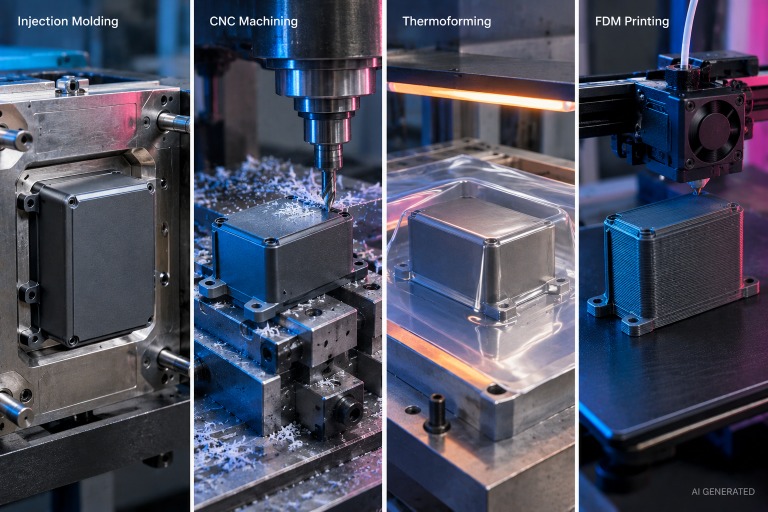
four different ABS processing methods
Injection Molding
Injection molding is the primary processing method for ABS plastic at production volumes. ABS flows well at typical processing temperatures (200-270°C melt temperature depending on grade and equipment), produces excellent surface finish, and ABS generally provides good weld-line performance when the material is properly processed, although weld-line strength depends on grade, mold design, and processing conditions.
ABS has relatively low moisture absorption, but pellets can still pick up enough surface and absorbed moisture during storage to cause molding defects. Drying requirements should follow the specific grade's datasheet.
CNC Machining
ABS machines cleanly with standard carbide tooling. The main considerations are heat management and workholding. ABS has relatively low thermal conductivity, so cutting heat stays near the tool and workpiece. Running dry or with air blast chip clearing is typical, flood coolant is used in some setups but isn't necessary for most operations and adds cleanup complexity.
Thin-walled ABS features deflect under cutting forces because the modulus is modest. Workholding design matters for thin sections, clamping too far from the cutting zone leaves unsupported material that vibrates. Residual stresses in extruded or molded ABS stock can release during machining, causing parts to distort as material is removed. For tight-tolerance machined ABS components, annealing the stock before machining or taking rough and finish passes with time between them reduces this effect.
For more on how CNC machining differs for plastics, including material selection, cutting behavior, and machining considerations, see our guide to plastic CNC machining.
Extrusion
Sheet, profile, and pipe are produced by extrusion, typically at melt temperatures of 200-240°C. Extruded ABS sheet is the starting material for thermoforming and is also CNC machined for signs, housings, and structural panels. Profile extrusion produces edge guards, window seals, and structural sections. ABS can be extruded effectively, but dimensional change and orientation effects still depend on processing conditions and sheet or profile geometry.
Thermoforming
Extruded ABS sheet is thermoformed extensively for enclosures, vehicle interior panels, medical device housings, and display fixtures. ABS sheet is commonly thermoformed within a material-dependent temperature range, often around 150–180°C, depending on sheet grade, thickness, and forming method. The surface finish of thermoformed ABS reflects the finish of the starting sheet and mold surface. Thermoforming is significantly lower tooling cost than injection molding for large parts, which is why it's used for applications like automotive interior panels where the part size would require extremely large and expensive injection molds.
3D Printing
ABS was one of the original FDM/FFF materials and remains widely used, particularly in industrial and professional printers that can handle its processing requirements. ABS generally requires higher print temperatures than PLA and is prone to warping during cooling. Differential shrinkage between layers can create internal stresses that cause corners to lift from the build plate.
Managing this requires a heated build chamber or at minimum a well-heated bed (100-110°C), draft screens to prevent ambient air from cooling the print unevenly, and careful attention to build orientation. Build orientation should be selected based on the required load direction, feature geometry, support requirements, and expected interlayer strength. When these challenges are controlled, ABS can provide higher temperature resistance than PLA and good impact performance. Its surface can also be smoothed with acetone under appropriate conditions.
What Is ABS Plastic Used For?
Automotive Parts
Dashboard panels, door trims, instrument clusters, pillar covers, and interior structural components throughout vehicle cabins are widely made from ABS or ABS blends. The combination of surface finish quality (it takes paint and texture well), dimensional stability in typical cabin temperatures, and impact resistance suits interior applications. Exterior applications generally require UV-stabilized ABS, ASA, or another weather-resistant material.
Electronics and Electrical Housings
Computer and laptop housings, keyboard cases, printer bodies, power tool casings, and electrical enclosures of all kinds are commonly ABS material. The processability (accurate injection-molded features, snaps, bosses), surface finish, electrical insulation properties, and the availability of flame-retardant grades that meet UL 94 requirements make ABS a common material for this application categor
Consumer Products and Appliances
Vacuum cleaners, kitchen appliances, power tool bodies, luggage shells, and sporting goods are all common ABS applications. The material handles the drop impacts, scuffs, and general abuse of consumer product use while maintaining dimensional accuracy for fit and assembly over its service life.
Industrial Components
Pipe fittings, valve bodies for low-pressure fluid handling, machine guards, and industrial enclosures use ABS in environments where its chemical resistance is adequate and where the temperature demands are within its service range. The material's machinability makes it practical for custom industrial components where injection tooling isn't justified.
Toys and Recreational Products
LEGO is the most famous example of ABS in toys, the dimensional precision and long-term stability of the material is what makes the bricks interlock consistently after decades of use. ABS is widely used in rigid injection-molded toys, recreational equipment housings, and hobby products
Advantages and Limitations of ABS
Advantages of ABS
Good impact resistance for many consumer and industrial applications
- Good injection-molding processability
- Good surface finish and paintability
- Available in modified grades for impact, heat, and flame performance
- Relatively low moisture absorption compared with many engineering plastics
Limitations of ABS
- Standard grades have limited long-term UV resistance
- Heat resistance is moderate compared with higher-temperature engineering plastics
- Some organic solvents can cause swelling, cracking, or degradation
- Performance varies substantially among grades
ABS vs. Other Engineering Plastics
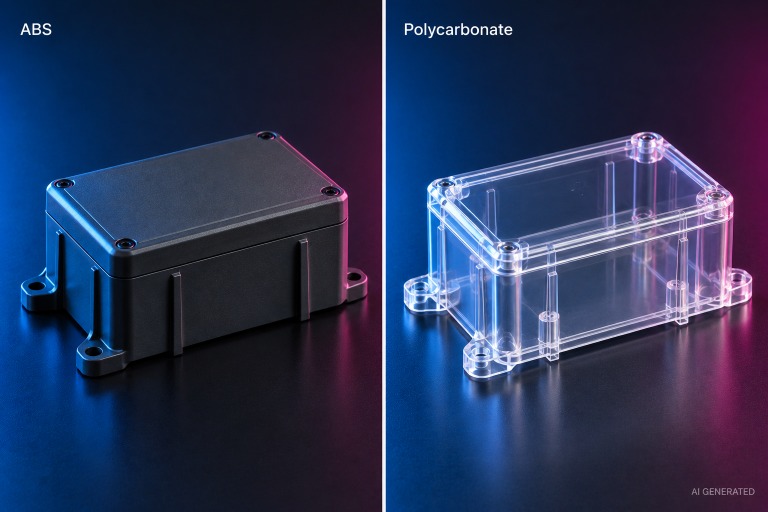
ABS vs polycarbonate
ABS vs. Polycarbonate
Polycarbonate generally offers higher impact resistance and higher temperature capability than many standard ABS grades, while specific strength and stiffness values depend on the grades being compared.
PC/ABS blends combine properties of both, better heat resistance and toughness than standard ABS, better processability and lower cost than pure PC. Much of the material sold as "high-performance ABS" in automotive and electronics applications is actually PC/ABS blend.
For a CNC-specific comparison of ABS and polycarbonate, including machinability, tolerance control, surface finish, and cost, see our guide to ABS vs. polycarbonate for CNC machining
ABS vs. Polypropylene
Polypropylene is lighter and offers strong chemical resistance, particularly in applications where ABS may be attacked by certain solvents. Its limitations relative to ABS: lower impact strength particularly at low temperatures, poorer surface finish from injection molding, and difficulty bonding with adhesives or painting without surface treatment.
The choice depends on the required chemical resistance, surface finish, bonding requirements, and weight constraints of the application.
ABS vs. Nylon
Many nylon grades provide higher strength, fatigue resistance, wear resistance, and temperature capability than standard ABS, but their moisture absorption can cause dimensional and property changes. Many nylon grades provide higher strength, fatigue resistance, wear resistance, and temperature capability than standard ABS, but nylon also absorbs more moisture, which can affect dimensional stability and mechanical properties. ABS may therefore be preferable for housings and cosmetic components where low moisture sensitivity, dimensional stability, and surface finish are more important than high mechanical or wear performance.
ABS Design and Manufacturing Considerations
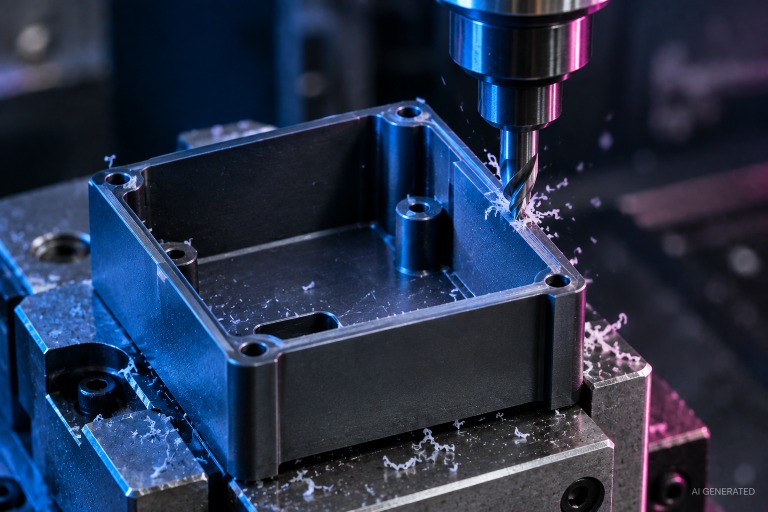
CNC machining ABS
Wall Thickness and Part Geometry
For injection molding, uniform wall thickness is the primary principle, ABS has relatively predictable molding shrinkage, but wall-thickness variations can still cause differential cooling. This can lead to sink marks, warping, and residual stress. For injection-molded ABS, ribs are commonly designed thinner than the adjacent wall to reduce sink marks; a starting guideline is often around 40–60% of the nominal wall thickness, with the final value depending on geometry and molding conditions.
For CNC machining of ABS, thin walls deflect under cutting forces. For example, a 2 mm ABS wall may deflect during face milling if it is not adequately supported. Thin features should therefore be evaluated for stiffness and workholding before machining. Take roughing and finishing passes separately for thin sections.
For FDM printing, build orientation relative to the primary load direction is the dominant design decision. ABS is weaker between layers (Z-direction) than within layers (XY). Parts designed to carry loads should be oriented with the load path running parallel to the build layers where possible.
Shrinkage and Dimensional Stability
Injection-molded ABS can show measurable molding shrinkage, with the actual value depending on wall thickness, mold temperature, packing pressure, gate location, and grade. For tight-tolerance features, mold trials with process optimization are necessary to establish reliable shrinkage for the specific part geometry and processing conditions.
Thermoformed ABS sheet can retain directional properties from extrusion. Mechanical behavior and dimensional change may therefore differ parallel and perpendicular to the extrusion direction.
Surface Finish
Injection-molded ABS can reproduce mold textures well, which makes it suitable for applications requiring controlled surface appearance. Electroplating on ABS (chromium, nickel decorative plating) is well-established and common for bathroom fixtures, automotive trim, and consumer hardware.
CNC-machined ABS surfaces are clean and can be sanded and polished to good finish quality. Acetone vapor smoothing for FDM-printed ABS parts is a practical finishing technique that dissolves the surface layer slightly, effectively removing layer lines and producing a near-injection-molded appearance.
Material Selection and Grade Requirements
Select the grade based on the actual service environment:
- UV exposure: use a stabilized or weather-resistant grade.
- Fire requirements: verify the applicable UL 94 rating for the specific thickness.
- Impact loading: compare grade-specific impact data.
- Elevated temperature: compare HDT and long-term temperature ratings.
- Chemical exposure: check the grade-specific chemical-resistance data.
UL Solutions also notes that UL 94 classifications such as V-0, V-1, and V-2 are based on defined vertical burning tests, so the article should avoid implying that simply being an “FR grade” automatically means a specific UL 94 rating.
Get Custom ABS Parts Made
ABS works well for lightweight housings, functional prototypes, automotive components, and other parts that need a balance of impact resistance, machinability, and cost.
JLCCNC can CNC machine ABS parts to your drawing and specified requirements.
Precision CNC Machining Service
Professional manufacturing, fast turnaround, and quality assurance.
FAQ About Acrylonitrile Butadiene Styrene
Q: What is acrylonitrile butadiene styrene used for?
ABS plastic is used across automotive interior components, consumer electronics housings, appliances, industrial enclosures, pipe fittings, toys, and medical device housings. Its combination of impact resistance, dimensional stability, surface finish quality, and processability makes it the default engineering thermoplastic for injection-molded housings and structural components in applications that don't require elevated temperature performance.
Q: Is ABS plastic strong?
ABS provides a useful combination of strength, stiffness, and impact resistance for many housings and functional components. Its actual mechanical performance varies by grade, so applications involving structural loads should be evaluated using grade-specific datasheet values.
Q: Is ABS plastic heat resistant?
ABS has moderate heat resistance, but its temperature capability depends strongly on grade and loading conditions. Standard grades are generally less suitable for sustained high-temperature service than materials specifically formulated for elevated-temperature applications.
Q: Is ABS plastic suitable for CNC machining?
Yes. ABS generally machines well with standard carbide tooling and can produce clean surfaces. Key considerations include heat management, workholding for thin features, and possible dimensional changes from residual stress in molded or extruded stock.
Q: What is the difference between ABS and other plastics?
ABS occupies the middle range of engineering thermoplastics, tougher than polystyrene and similar commodity plastics, less expensive and easier to process than polycarbonate or PEEK, with better surface finish than polypropylene. Its distinguishing combination is impact resistance from the butadiene rubber phase, good processability from the styrene component, and moderate chemical resistance from the acrylonitrile. Compared with alternatives such as PP or PVDF, ABS may be less suitable for applications requiring high resistance to certain solvents.
Keep Learning
Plastic CNC Machining: Guide to Materials, Machines & Cutting Strategies
Understanding Plastic CNC Machining When most people think of CNC machining, metals come to mind first, aluminum, steel, titanium. But plastic CNC machining has quietly creeped into many industries. Why? Because plastics are lightweight, versatile, and cost-effective, making them an ideal option for places where the best performance is needed on the best budget. CNC for plastic is now as common as CNC for metal. At JLCCNC, we don't just work with metals, we also provide CNC machining of plastic parts ......
Polycarbonate vs Acrylic for CNC Parts: Strength, Machining & Material Selection
Quick Comparison: Polycarbonate vs Acrylic Property Polycarbonate Acrylic Tensile strength 55–75 MPa 70–80 MPa Impact resistance 600–900 J/m (notched Izod) 15–30 J/m Flexural modulus 2.1–2.5 GPa 3.0–3.3 GPa Light transmission 88–90% 92–93% Heat deflection temp approximately 110–130°C depending on grade and test condition 75–100°C Chemical resistance Moderate. attacked by solvents Good. resists most common chemicals Machinability Good. tends to melt at edges Excellent. clean chips, sharp edges UV resis......
Acrylonitrile Butadiene Styrene: Properties, Types, and Applications
Key Takeaways ABS can provide useful service performance at moderately elevated temperatures, with the actual continuous-use and heat-deflection limits depending on grade, loading, and service conditions. It's an amorphous terpolymer whose properties come from the combination of three monomers: acrylonitrile contributes chemical resistance and stiffness, butadiene provides impact toughness, and styrene gives the material its processability and surface finish. ABS plastic provides moderate heat resista......
Polycarbonate CNC Machining: Properties, Design Guidelines, and Manufacturing Considerations
Key Takeaways About Polycarbonate CNC Machining Polycarbonate is used for clear guards, covers, housings, and inspection parts where visibility and protection matter in use, not just on drawings. Different machining materials or grades behave differently during cutting and show up mainly in surface clarity and edge condition. Heat from cutting affects surface marks more than the strength of the material itself. Thin walls and wide flat areas are where most surface issues start during machining. Tool s......
Acetal (POM) Plastic: Properties, Uses & Material Selection
Key Takeaways Acetal (POM) is a semi-crystalline engineering thermoplastic with high stiffness, low friction, excellent dimensional stability, and outstanding machinability. POM material comes in two main types, homopolymer (POM-H, Delrin) and copolymer (POM-C), with slightly different property profiles suited to different applications. Acetal plastic properties include tensile strength of 60-75 MPa, very low moisture absorption (0.2%), and a coefficient of friction of 0.1-0.3 against steel without lu......
What Is a Composite Material? Types, Properties, Examples, and Applications
Key Takeaway A composite material is an engineered material made from two or more constituent materials with different properties that, combined, produce a material with superior or unique characteristics neither component has alone. The main types of composite materials are classified by matrix (polymer, metal, ceramic) and by reinforcement form (fiber, particle, sandwich). Composite material properties are directional, they vary depending on fiber orientation, which is both an advantage for optimiza......