What Is a Composite Material? Types, Properties, Examples, and Applications
18 min
- What Is a Composite Material?
- Types of Composite Materials
- Composite Material Properties
- Composite Materials Examples
- Aluminum Composite Material
- How Composite Materials Are Manufactured
- Composite Materials in CNC Machining
- Advantages and Limitations of Composite Materials
- How to Choose the Right Composite Material
- FAQs About Composite Materials
Key Takeaway
- A composite material is an engineered material made from two or more constituent materials with different properties that, combined, produce a material with superior or unique characteristics neither component has alone.
- The main types of composite materials are classified by matrix (polymer, metal, ceramic) and by reinforcement form (fiber, particle, sandwich).
- Composite material properties are directional, they vary depending on fiber orientation, which is both an advantage for optimization and a complexity for analysis.
- Carbon fiber reinforced polymer is the highest-performance structural composite material; glass fiber reinforced polymer is the most widely used by volume. Aluminum composite material is a specific panel product combining thin aluminum skins with a polyethylene core, widely used in architectural cladding and signage.
- CNC machining composite materials requires specialized tooling and dust management due to the abrasive, layered nature of fiber-reinforced composites.
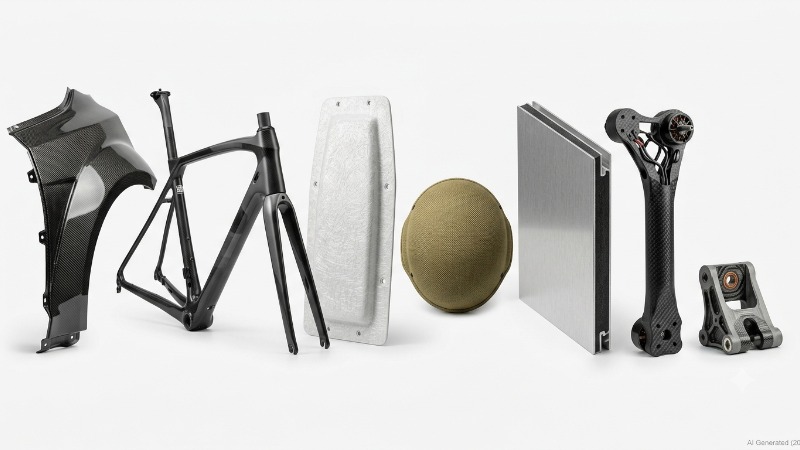
(AI generated)composite material products
Steel is strong but heavy. Aluminum is light but not as strong. Ceramics handle heat but shatter under impact. The engineering challenge for most of history has been choosing which limitation to accept. Composite materials change that equation. By combining two or more distinct constituents, they produce properties that neither component could achieve independently.
That's not a minor refinement. It's how aircraft wings get lighter than aluminum while being stronger than steel, how racing cars absorb crashes that would destroy conventional metal frames, and how infrastructure handles load cycles for decades without fatigue failure. Understanding what composite materials are, how they work, and when to use them is increasingly central to engineering practice across almost every industry.
While composite materials are manufactured differently from conventional plastics and metals, many finished composite parts still require precision secondary machining. If you're comparing engineering materials for manufacturing projects, our guide to CNC machining plastics is a useful companion.
What Is a Composite Material?
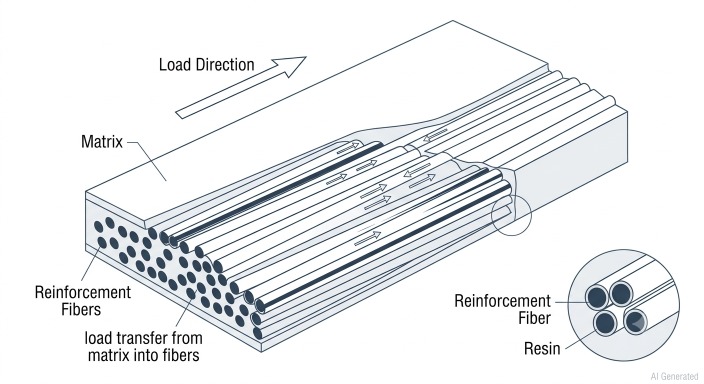
(AI generated)Cross-sectional illustration
Definition of a Composite Material
A composite material is a material system consisting of two or more distinct constituent materials, a matrix and a reinforcement, that are combined at a macroscopic level to produce a material with properties different from, and typically superior to, those of the individual constituents working alone.
The critical word is "distinct." The constituents in a composite material remain physically identifiable at the macro or micro scale. They don't dissolve into each other or chemically combine to form a new substance. A cross-section of a composite material shows the matrix surrounding the reinforcement, each maintaining its own properties while the combination delivers the composite's overall performance.
What Are Composite Materials Made Of?
Every composite material has two essential components: a matrix and a reinforcement.
The matrix is the continuous phase that surrounds and binds the reinforcement. It transfers loads between reinforcement elements, protects the reinforcement from environmental damage, and defines the composite material's temperature resistance, chemical resistance, and toughness. Common matrix materials include polymer resins (epoxy, polyester, vinyl ester), metals (aluminum, titanium), and ceramics.
The reinforcement is the discontinuous or fibrous phase embedded in the matrix. It carries the primary structural loads and provides the stiffness and strength that gives composite materials their mechanical advantage over the unreinforced matrix. Common reinforcements include carbon fiber, glass fiber, aramid fiber (Kevlar), silicon carbide particles, and ceramic whiskers.
Why Composite Materials Are Used in Engineering
The fundamental engineering appeal of composite materials is the ability to tailor properties to specific requirements. By selecting the matrix, reinforcement, and fiber orientation, engineers can optimize strength in the primary load direction. They can also control stiffness, thermal expansion, and surface properties based on application requirements.
Composite Material vs Alloy
The distinction between a composite material and an alloy is one of scale and mechanism. An alloy is a homogeneous mixture at the atomic level. Steel is iron and carbon mixed at the atomic scale, aluminum alloys are aluminum with alloying elements dissolved in the aluminum crystal structure. At any scale of observation, an alloy looks uniform.
A composite material is heterogeneous at the micro or macro scale, the reinforcement and matrix remain physically distinct, visible under sufficient magnification, and each maintaining its own properties. The composite material's properties emerge from the mechanical interaction between constituents, not from atomic-level bonding changes as in alloys.
Types of Composite Materials
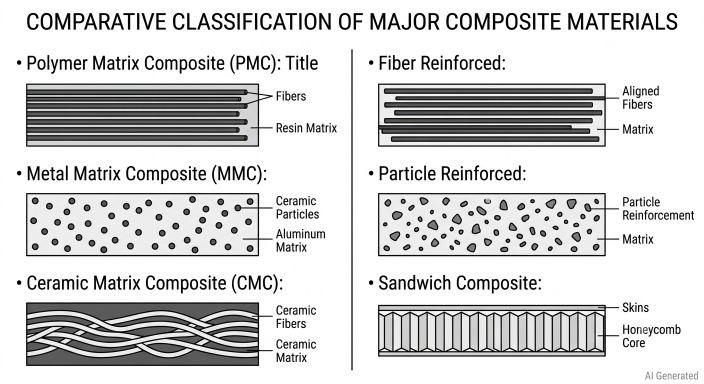
(AI generated)Types of composite material
By Matrix Material
Polymer Matrix Composites (PMCs)
Polymer matrix composites are the most common type of composite material in engineering use. The matrix is a thermosetting or thermoplastic resin, most commonly epoxy, polyester, or vinyl ester, reinforced with fibers (typically carbon, glass, or aramid). PMCs offer excellent specific strength and stiffness, good corrosion resistance, and the ability to be formed into complex shapes. Their limitation is temperature, most polymer matrix composite materials have maximum service temperatures of 120-200°C depending on the resin system.
Metal Matrix Composites (MMCs)
Metal matrix composite materials use a metallic matrix, typically aluminum, titanium, or magnesium, reinforced with ceramic particles, whiskers, or fibers. Aluminum composite in the structural MMC sense (as opposed to the panel product discussed later) uses silicon carbide particles in an aluminum matrix to produce a material with higher stiffness, better wear resistance, and lower thermal expansion than unreinforced aluminum. MMCs offer better temperature resistance than PMCs and improved stiffness over unreinforced metals, at higher manufacturing cost and complexity.
Ceramic Matrix Composites (CMCs)
Ceramic matrix composite materials use a ceramic matrix reinforced with ceramic fibers, most commonly silicon carbide fiber in a silicon carbide matrix. CMCs are designed for applications where temperature exceeds what metals or PMCs can handle, turbine hot section components, re-entry vehicle thermal protection, and high-temperature industrial equipment. The reinforcement in a ceramic composite material addresses ceramics' fundamental brittleness by providing crack deflection and fiber pullout mechanisms that dramatically improve toughness.
By Reinforcement Form
Fiber-Reinforced Composites
Fiber-reinforced composite materials are the dominant structural composite form. Continuous fibers, carbon, glass, or aramid, run through the matrix in defined orientations, providing high strength and stiffness in the fiber direction. The directionality of fiber-reinforced composite material properties is the key design parameter: by stacking layers with fibers at different angles, engineers create a composite with the specific property profile the application requires.
Particle-Reinforced Composites
Particle-reinforced composite materials distribute hard particles, silicon carbide, aluminum oxide, tungsten carbide, within a softer matrix to improve hardness, wear resistance, and stiffness. Properties are isotropic (the same in all directions) because particles are randomly distributed. Particle-reinforced composite materials are used in wear-resistant tooling, grinding wheels, and high-stiffness structural components where directional properties would be a disadvantage.
Sandwich Composites
Sandwich composite materials combine thin, strong face skins with a lightweight core, honeycomb aluminum, foam, or balsa wood. The face skins carry tensile and compressive stress; the low-density core provides thickness and resists shear. The result is a composite material with very high flexural stiffness per unit weight. Aircraft floor panels, marine hull sections, and architectural panels use sandwich composite structures extensively.
| Composite Type | Matrix | Reinforcement | Key Property | Typical Use |
|---|---|---|---|---|
| PMC (CFRP) | Epoxy | Carbon fiber | High specific strength | Aerospace, motorsport |
| PMC (GFRP) | Polyester | Glass fiber | Cost-effective stiffness | Marine, construction |
| MMC | Aluminum | SiC particles | Stiffness, wear resistance | Aerospace, automotive |
| CMC | Silicon carbide | SiC fiber | High-temperature toughness | Turbines, re-entry vehicles |
| Sandwich | Epoxy skins | Aluminum honeycomb | High flexural stiffness per weight | Aircraft structures |
Composite Material Properties
Mechanical Properties
Composite material properties in the mechanical domain are dominated by the reinforcement, particularly its orientation relative to the load direction. A unidirectional carbon fiber composite material can have tensile strength exceeding 1500 MPa in the fiber direction with a density of 1.5-1.6 g/cm³, producing specific strength values that exceed many commonly used engineering metals. Transverse to the fiber direction, strength drops to 50-100 MPa, a factor of 15-30 lower. This anisotropy is the central mechanical reality of fiber-reinforced composite materials.
| Property | CFRP | GFRP | Aluminum 7075 | Steel (4340) |
|---|---|---|---|---|
| Tensile Strength | 600-1800 MPa | 200-500 MPa | 500-570 MPa | 1000-1400 MPa |
| Specific Strength | 400-1200 kN·m/kg | 100-300 kN·m/kg | 185-210 kN·m/kg | 125-175 kN·m/kg |
| Tensile Modulus | 70-400 GPa | 20-55 GPa | 71 GPa | 200 GPa |
| Density | 1.4-1.8 g/cm³ | 1.8-2.2 g/cm³ | 2.81 g/cm³ | 7.85 g/cm³ |
| Fatigue Resistance | Excellent | Good | Good | Moderate |
Physical Properties
Thermal expansion of fiber-reinforced composite materials can be engineered to near-zero in the fiber direction for carbon fiber composites, carbon fiber itself has a negative thermal expansion coefficient that partially cancels the positive expansion of the epoxy matrix. This dimensional stability across temperature is valuable for precision instruments, space structures, and optical systems where thermal distortion is a critical failure mode.
Thermal conductivity of most composite materials is low compared to metals, standard epoxy-carbon fiber composite materials have thermal conductivity of 2-10 W/m·K compared to 150 W/m·K for aluminum. This can be advantageous for thermal insulation or problematic for heat dissipation, depending on the application.
Chemical Properties
Polymer matrix composite materials have excellent corrosion resistance, they don't rust, don't corrode in seawater, and are resistant to most industrial chemicals that would attack metals. The matrix resin determines chemical compatibility; epoxy and vinyl ester matrices handle a broader range of chemicals than polyester matrices. Glass fiber reinforced polymer (GFRP) in particular has outstanding performance in corrosive chemical and marine environments where metal alternatives require significant corrosion protection measures.
Composite Materials Examples
Carbon Fiber Reinforced Polymer (CFRP)
Carbon fiber composite materials are among the highest-performance structural composites used in industrial applications. Carbon fiber in an epoxy matrix produces a composite material with specific strength and stiffness that exceeds all metals in most loading configurations. CFRP is the composite material of choice for aerospace primary structures, Formula 1 monocoques, high-end sporting equipment, and premium automotive body panels. The limiting factors are cost, carbon fiber itself is expensive, and the complexity of manufacturing with controlled fiber orientation.
Glass Fiber Reinforced Polymer (GFRP)
Glass fiber composite material is the most widely produced composite material by volume globally. Far less expensive than carbon fiber, glass fiber produces composite materials with good stiffness and strength that serve boat hulls, wind turbine blades, automotive body panels, water tanks, and construction applications. GFRP is the composite material that established the practical use of fiber composites in industrial manufacturing, it's been in production use since the 1940s and the manufacturing processes are well-understood and widely available.
Kevlar Composites
Aramid fiber (Kevlar) composite material combines the extraordinary tensile strength and energy absorption of Kevlar fiber with the structural forming capability of a polymer matrix. The outstanding characteristic of Kevlar composite material is impact and ballistic resistance, it absorbs energy through fiber deformation rather than fracture, which is why Kevlar composites are used in body armor, ballistic panels, helicopter blades, and pressure vessels for applications where impact tolerance is critical.
Reinforced Concrete
Reinforced concrete is one of the most widely used composite materials on earth, it just doesn't look like one. Concrete (the matrix) has excellent compressive strength but poor tensile strength. Steel reinforcing bar (the reinforcement) has excellent tensile strength. The combination is a composite material that handles both tension and compression, which is why it forms the structural basis of most civil infrastructure from bridges to high-rise buildings.
Aluminum Composite Material
Structure of Aluminum Composite Material
Aluminum composite material (ACM) is a panel product with a specific structure: two thin aluminum alloy skins, typically 0.3-0.5mm thick, bonded to a low-density polyethylene or mineral-filled core 2-6mm thick. The total panel thickness is typically 3-6mm. This is distinct from metal matrix composite materials where aluminum forms the matrix of a structural composite, ACM is an architectural composite panel product rather than a structural engineering composite material.
The aluminum skins of ACM provide weather resistance, surface finish quality, and the ability to accept paint and coating systems. The core provides the panel's overall rigidity, flatness, and lightweight character. The bonded sandwich construction gives the aluminum composite material significantly higher bending stiffness than a solid aluminum sheet of the same weight.
Advantages of ACM
Aluminum composite material panels offer a combination of flatness, lightweight, formability, and surface quality that pure aluminum sheet or other panel products don't match simultaneously. The aluminum surfaces of ACM can be painted, anodized, or pre-coated in virtually any color, making aluminum composite material the dominant choice for building facade cladding, where consistent flat appearance across large panel areas is essential.
Typical commercial panels are often around 3-6 kg/m² depending on thickness and core type. The aluminum composite material is also formable by routing and bending into complex shapes for architectural applications, without the cracking that would occur in thicker solid aluminum sheet being bent to comparable radii.
Although aluminum composite material panels are different from machined aluminum components, understanding aluminum anodizing is helpful when comparing architectural panels with precision CNC aluminum parts.
Common Aluminum Composite Material Applications
| Application | Why ACM? |
|---|---|
| Building facade cladding | Flat, lightweight, weather-resistant, wide color range |
| Signage and display | Rigid, lightweight, printable surface, formable |
| Interior wall paneling | Flat, cleanable, available in decorative finishes |
| Vehicle body cladding | Lightweight, formable, corrosion-resistant |
| Exhibition display systems | Modular, lightweight, easily printed or finished |
How Composite Materials Are Manufactured
Hand Lay-Up and Vacuum Bagging
Hand lay-up is the oldest and most accessible composite material manufacturing method. Fiber reinforcement layers are placed by hand into a mold and wetted with resin by brush or roller. Vacuum bagging improves on hand lay-up by drawing a vacuum over the wet layup, which consolidates the composite material layers, removes entrapped air, and improves fiber volume fraction. Vacuum-bagged composite materials have better mechanical properties and more consistent quality than hand lay-up alone.
Compression Molding and Pultrusion
Compression molding places composite material preforms in heated matched metal tooling and applies pressure to consolidate and cure the composite. This produces composite components with accurate dimensions, good surface finish on both faces, and suitable for medium-volume production. Pultrusion pulls fiber reinforcement through a resin bath and then through a heated die, producing continuous cross-section composite profiles, structural sections, tubes, and rod in composite material form.
Additive Manufacturing of Composite Materials
Continuous fiber 3D printing embeds continuous carbon, glass, or Kevlar fiber in thermoplastic matrix material during the printing process, producing composite material parts with significantly higher stiffness and strength than unreinforced FDM parts. This technology bridges the gap between the geometric freedom of additive manufacturing and the structural performance of fiber composite materials, enabling composite material parts with complex geometry that would be difficult or impossible with conventional composite manufacturing methods.
Composite Materials in CNC Machining
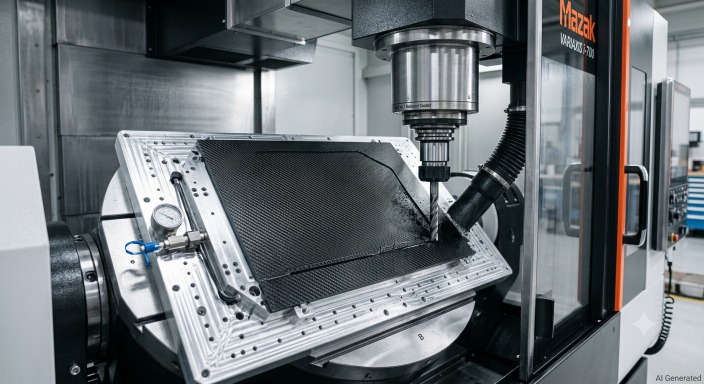
(AI generated)CNC machining composite material
Challenges of Machining Composite Materials
Composite material machining presents challenges that don't exist with metals. The layered structure of fiber-reinforced composite materials delaminates at interlaminar interfaces under cutting forces that separate layers rather than cutting through them cleanly. Carbon fiber composite material generates highly abrasive dust that wears standard tooling rapidly. GFRP composite materials are similarly abrasive. The direction-dependent properties of fiber composite materials mean cutting forces vary significantly as the tool crosses different fiber orientations within each pass.
The dust and fine particles generated during composite material machining are a health hazard, carbon fiber dust is a respiratory irritant and GFRP glass fiber dust is similarly harmful. Composite machining requires enclosed machining environments or effective dust extraction, and operators require appropriate respiratory protection.
Tool Selection and Cutting Parameters
| Composite Material | Recommended Tooling | Cutting Speed | Feed Rate |
|---|---|---|---|
| CFRP | Diamond-coated carbide, PCD | 150-300 m/min | 0.01-0.05mm/tooth |
| GFRP | Diamond-coated carbide | 100-200 m/min | 0.02-0.08mm/tooth |
| Kevlar composite | Special shear-cutting geometry | 50-100 m/min | 0.01-0.04mm/tooth |
| Aluminum MMC | PCD (diamond) tooling | 200-400 m/min | 0.05-0.15mm/tooth |
The cutting speed of CFRP and GFRP typical starting ranges vary depending on tooling, machine capability, laminate structure, and part geometry.
Diamond-coated carbide or PCD (polycrystalline diamond) tooling is standard for CNC machining most composite materials because the carbon fiber and glass fiber reinforcement in composite materials abrades standard carbide rapidly. Compression router bits with up-cut and down-cut flutes simultaneously are used for CFRP and GFRP trimming to manage delamination, the opposing forces hold the composite material layers together while cutting.
Best Practices for High-Quality and Safe Composite Machining
Vacuum fixturing holds composite material panels flat during machining without clamp marks on the panel surface. Sharp tooling is non-negotiable, dull tools in composite materials increase delamination risk rather than just reducing surface quality as they would in metals. Through-spindle coolant or air blast clears chips and dust from the cutting zone; flood coolant contaminates porous composite material structures and is generally avoided unless the composite material type is compatible with fluid exposure.
While JLCCNC doesn't currently manufacture carbon fiber or fiberglass composite components, many engineering products combine composite assemblies with precision-machined aluminum, steel, brass, or engineering plastic parts. We manufacture those mating components with tight tolerances, production-ready finishes, and fast turnaround.
Upload your CAD file for a CNC machining quote. Our team checks drawings against production standards to confirm manufacturing readiness.

Precision CNC Machining Service
Professional manufacturing, fast turnaround, and quality assurance.
Advantages and Limitations of Composite Materials
Advantages
High specific strength and stiffness relative to metals. Composite material properties can be tailored directionally to the load path, eliminating material in directions that don't carry significant load. Composite materials have excellent fatigue resistance compared to metals, no dislocation accumulation or grain boundary fatigue cracking. Corrosion resistance of polymer matrix composite materials eliminates the maintenance burden of protective coatings on metal structures. Complex geometry achievable in single-piece composite material structures replaces multi-piece metal assemblies.
Limitations
Cost, carbon fiber composite material components cost more than equivalent metal parts in most production scenarios, particularly at low volumes. Composite material repair after damage is more complex than metal repair. The directional nature of composite material properties requires more sophisticated analysis than isotropic metal design. Composite materials are generally less suitable for bearing concentrated point loads than metals. Recycling of thermoset matrix composite materials at end of life is challenging.
Composite Materials vs Traditional Materials
| Factor | Composite Material | Metal |
|---|---|---|
| Specific Strength | Very High | Moderate-High |
| Specific Stiffness | Very High | Moderate-High |
| Corrosion Resistance | Excellent (PMC) | Depends on alloy and coating |
| Temperature Resistance | Limited (PMC), High (CMC) | Good-Excellent |
| Machinability | Difficult, specialized tooling | Standard CNC processes |
| Repairability | Complex | Straightforward |
| Recyclability | Difficult (thermoset) | Easy |
| Cost at Volume | High | Low-Moderate |
| Property Tailorability | High | Low |
How to Choose the Right Composite Material
Performance Requirements
Start with the load case. What direction are the primary loads? How high is the peak stress? Is fatigue a concern? What temperature does the component reach in service? These questions narrow the composite material type quickly, high-temperature applications eliminate most PMCs, ballistic requirements suggest Kevlar composites, maximum specific stiffness in a defined direction points to high-modulus carbon fiber CFRP.
Manufacturing Method
The manufacturing method available constrains which composite materials are practical. Hand lay-up with vacuum bagging is accessible for low-volume high-performance composite components. Compression molding suits medium-volume production of consistent composite material parts. Automated fiber placement is cost-effective only at high production volumes or very complex geometry. Additive manufacturing of composite materials suits complex geometry at low volumes where conventional tooling cost isn't justified.
Cost and Application Considerations
Carbon fiber costs can vary widely depending on fiber grade, supplier, and volume. High-performance grades are typically much more expensive than glass fiber. Glass fiber composite material at $1-5/kg serves the broad structural applications where the performance of CFRP isn't necessary and cost is a primary driver. The aluminum composite material panel at $15-40/m² serves architectural applications where the specific structural properties of fiber composites aren't required but flatness, appearance, and lightweight are.
FAQs About Composite Materials
Q: What is a composite material?
A composite material combines two or more distinct materials, usually a matrix and reinforcement, to achieve properties that differ from the individual components.
Q: What are the main types of composite materials?
Composite materials are mainly classified by matrix type (polymer, metal, ceramic) and reinforcement form (fiber, particle, sandwich).
Q: What are some examples of composite materials?
Common examples include CFRP, GFRP, Kevlar composites, reinforced concrete, and ACM panels.
Q: Can composite materials be CNC machined?
Yes, many composite materials can be CNC machined, including CFRP and GFRP. However, their layered structure requires proper tooling and cutting parameters to prevent issues such as delamination, fiber pull-out, and poor edge quality.
Q: How do you choose a composite material?
Composite material selection depends on factors such as strength, weight, temperature resistance, corrosion resistance, manufacturing requirements, and cost. The best choice balances performance needs with the application environment and production conditions.
Keep Learning
Plastic CNC Machining: Guide to Materials, Machines & Cutting Strategies
Understanding Plastic CNC Machining When most people think of CNC machining, metals come to mind first, aluminum, steel, titanium. But plastic CNC machining has quietly creeped into many industries. Why? Because plastics are lightweight, versatile, and cost-effective, making them an ideal option for places where the best performance is needed on the best budget. CNC for plastic is now as common as CNC for metal. At JLCCNC, we don't just work with metals, we also provide CNC machining of plastic parts ......
Polycarbonate vs Acrylic for CNC Parts: Strength, Machining & Material Selection
Quick Comparison: Polycarbonate vs Acrylic Property Polycarbonate Acrylic Tensile strength 55–75 MPa 70–80 MPa Impact resistance 600–900 J/m (notched Izod) 15–30 J/m Flexural modulus 2.1–2.5 GPa 3.0–3.3 GPa Light transmission 88–90% 92–93% Heat deflection temp approximately 110–130°C depending on grade and test condition 75–100°C Chemical resistance Moderate. attacked by solvents Good. resists most common chemicals Machinability Good. tends to melt at edges Excellent. clean chips, sharp edges UV resis......
Acrylonitrile Butadiene Styrene: Properties, Types, and Applications
Key Takeaways ABS can provide useful service performance at moderately elevated temperatures, with the actual continuous-use and heat-deflection limits depending on grade, loading, and service conditions. It's an amorphous terpolymer whose properties come from the combination of three monomers: acrylonitrile contributes chemical resistance and stiffness, butadiene provides impact toughness, and styrene gives the material its processability and surface finish. ABS plastic provides moderate heat resista......
Polycarbonate CNC Machining: Properties, Design Guidelines, and Manufacturing Considerations
Key Takeaways About Polycarbonate CNC Machining Polycarbonate is used for clear guards, covers, housings, and inspection parts where visibility and protection matter in use, not just on drawings. Different machining materials or grades behave differently during cutting and show up mainly in surface clarity and edge condition. Heat from cutting affects surface marks more than the strength of the material itself. Thin walls and wide flat areas are where most surface issues start during machining. Tool s......
Acetal (POM) Plastic: Properties, Uses & Material Selection
Key Takeaways Acetal (POM) is a semi-crystalline engineering thermoplastic with high stiffness, low friction, excellent dimensional stability, and outstanding machinability. POM material comes in two main types, homopolymer (POM-H, Delrin) and copolymer (POM-C), with slightly different property profiles suited to different applications. Acetal plastic properties include tensile strength of 60-75 MPa, very low moisture absorption (0.2%), and a coefficient of friction of 0.1-0.3 against steel without lu......
What Is a Composite Material? Types, Properties, Examples, and Applications
Key Takeaway A composite material is an engineered material made from two or more constituent materials with different properties that, combined, produce a material with superior or unique characteristics neither component has alone. The main types of composite materials are classified by matrix (polymer, metal, ceramic) and by reinforcement form (fiber, particle, sandwich). Composite material properties are directional, they vary depending on fiber orientation, which is both an advantage for optimiza......