CNC Engraving: Processes, Tools, and Precision Marking Methods
14 min
- What Is CNC Engraving?
- CNC Engraving vs Laser Engraving and Other Marking Methods
- Common Types of CNC Engraving
- CNC Engraving Tools and Machining Methods
- Engraving Depth, Line Width, and Readability Control
- Designing Engraved Features for CNC Manufacturing
- Common Problems and Quality Challenges in CNC Engraving
- Material Considerations in CNC Engraving
- How CNC Machine Capability Influences Engraving Accuracy
- CNC Engraved Features on Machined Parts
- Conclusion About CNC Engraving
- FAQ About CNC Engraving
Key Takeaways About CNC Engraving
- CNC engraving cuts permanent marks into a surface using programmed tool movement rather than surface printing or labeling.
- Tool geometry, spindle stability, and cutter runout directly affect line quality, burr formation, and engraving accuracy.
- Engraving depth and line width must match material type, character size, and readability requirements.
- Aluminum and brass generally engrave more easily, while stainless steel, copper, plastics, and composites require tighter control of heat and tool load.
- Fine engraving features are sensitive to vibration, tool deflection, and chip buildup, especially on thin walls or small text.
- Mechanical engraving creates physical grooves, while laser marking relies on heat to change or remove the surface layer.
- CNC engraving is commonly used for serial numbers, logos, traceability marks, control panels, and precision identification features on machined parts.
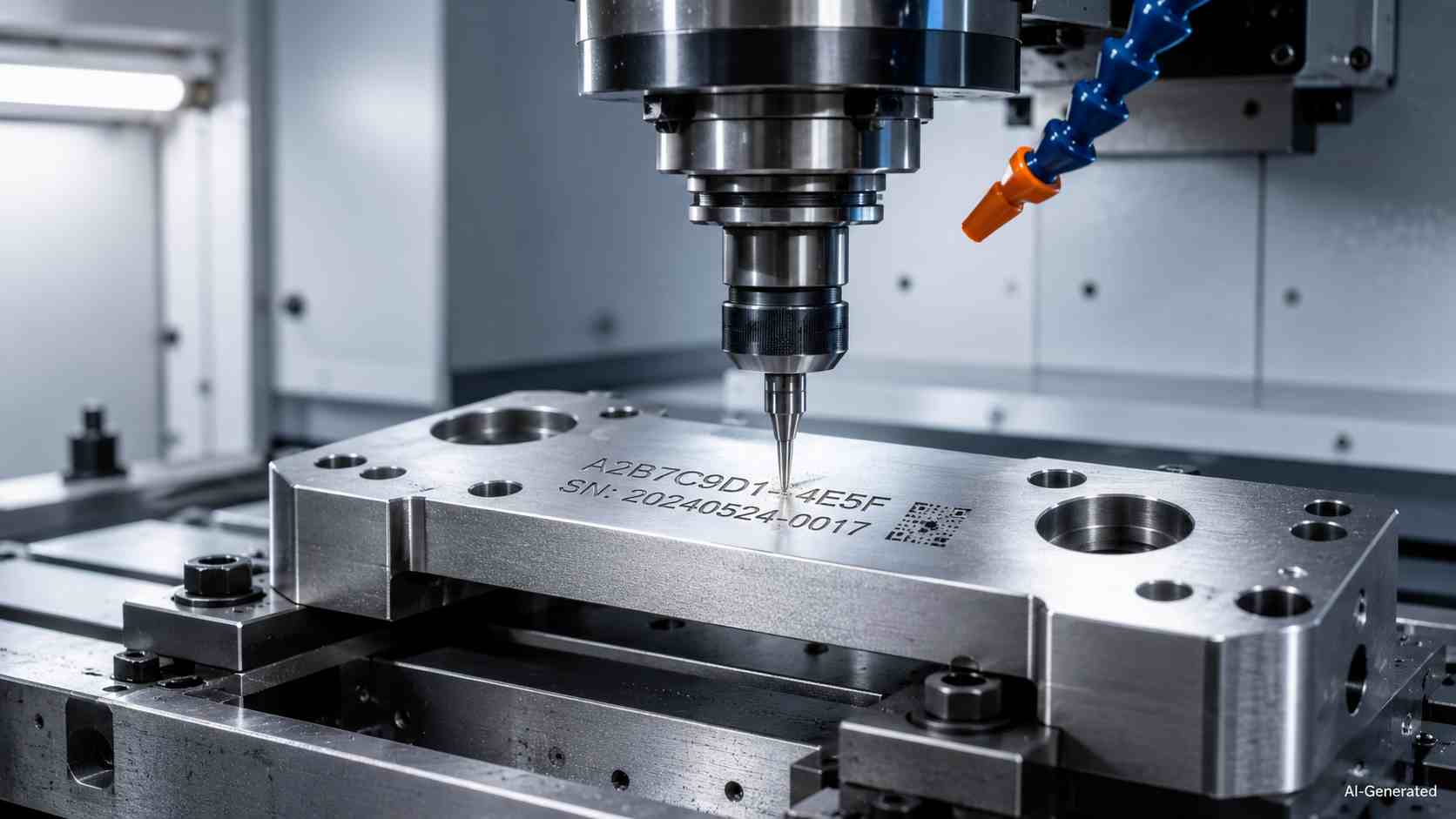
CNC engraving machine marking a metal part
CNC engraving is used to create permanent markings, serial numbers, logos, and identification features on machined parts. A CNC engraving machine removes material through programmed tool motion, allowing marks to maintain physical depth and remain readable after machining, coating, or long-term service use.
Engraving quality depends on tool geometry, spindle stability, material response, and feature size. In production environments, readability and dimensional consistency are usually more important than decorative appearance alone.
What Is CNC Engraving?
CNC engraving is a precision material-removal process for part ID, traceability, decorative detail, and working marks on machined components. Instead of printing on top, a cutter shapes the surface through controlled contact and gives each mark physical depth.
Mechanical Cutting vs Laser Etching
The main difference is whether the marking process uses physical tool contact or focused energy. A CNC engraving machine is dependent on a rotating tool touching the workpiece. On the other hand, laser etching uses focused energy to alter or remove the upper layer without the tool making contact with the workpiece.
CNC Engraving vs Laser Engraving and Other Marking Methods
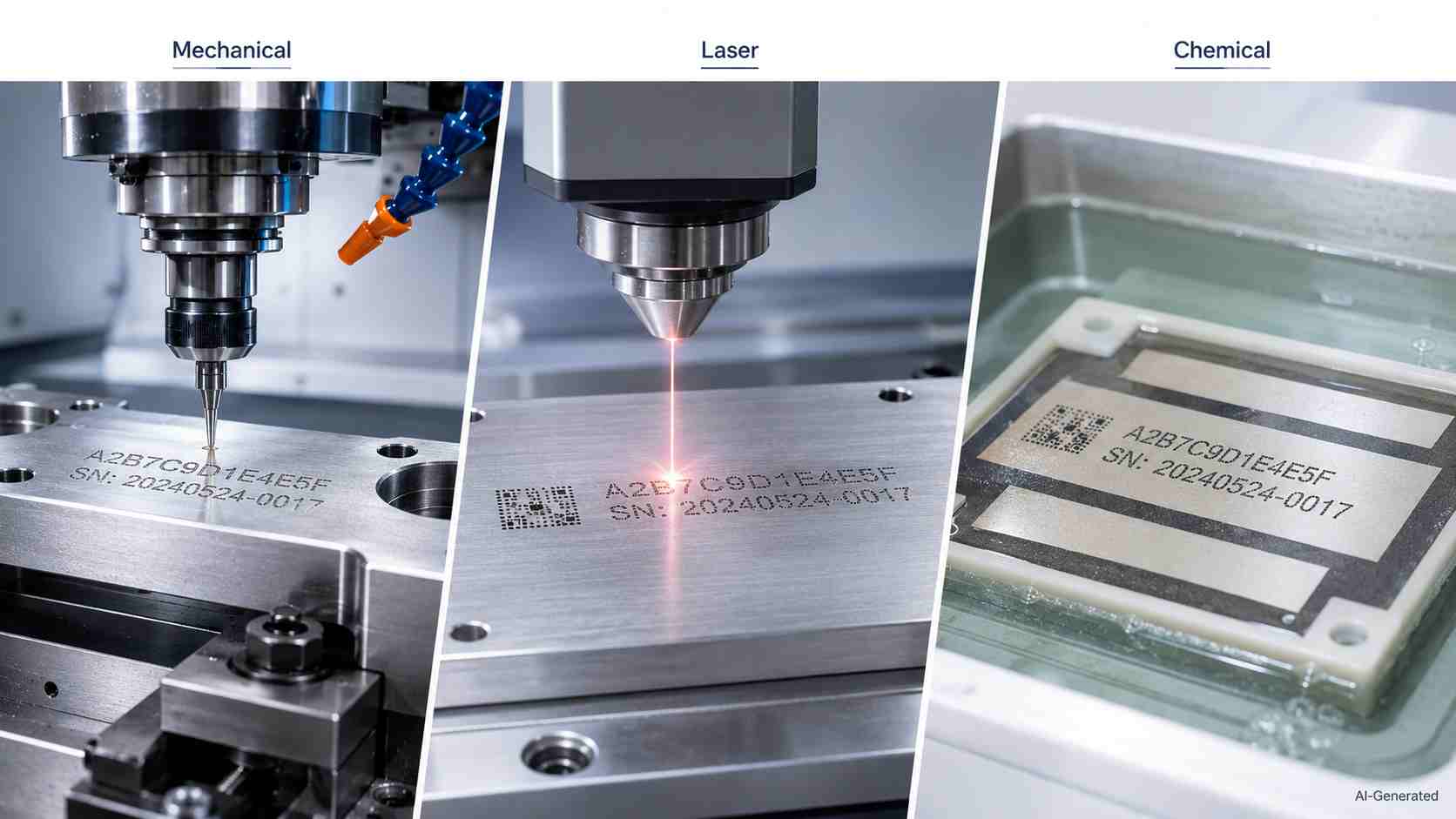
Mechanical, laser, and chemical marking methods
Mechanical Engraving vs Laser Etching
Mechanical engraving involves establishing physical contact with the surface in order to cut a groove. However, laser etching is dependent on heat to alter the top layer. The decision between the two methods is determined by whether the mark requires carved relief or surface contrast.
CNC Engraving vs Laser Engraving
CNC engraving suits machined parts that need a cut-in mark. Laser engraving generally removes more material than laser etching and can create more durable marks on some metals and coated surfaces.
Engraving vs Chemical Etching
Chemical etching takes a different path. A resist protects selected areas while an etchant dissolves exposed metal. It suits flat metal designs when contact force would be unwanted.
When to Use Each Marking Method
Mechanical engraving is commonly used when marks need physical depth and wear resistance. Laser marking and laser engraving are preferred for high-speed surface contrast with minimal mechanical load, while chemical etching suits thin sheet-metal parts where contact force or cutter pressure would be undesirable.
Common Types of CNC Engraving
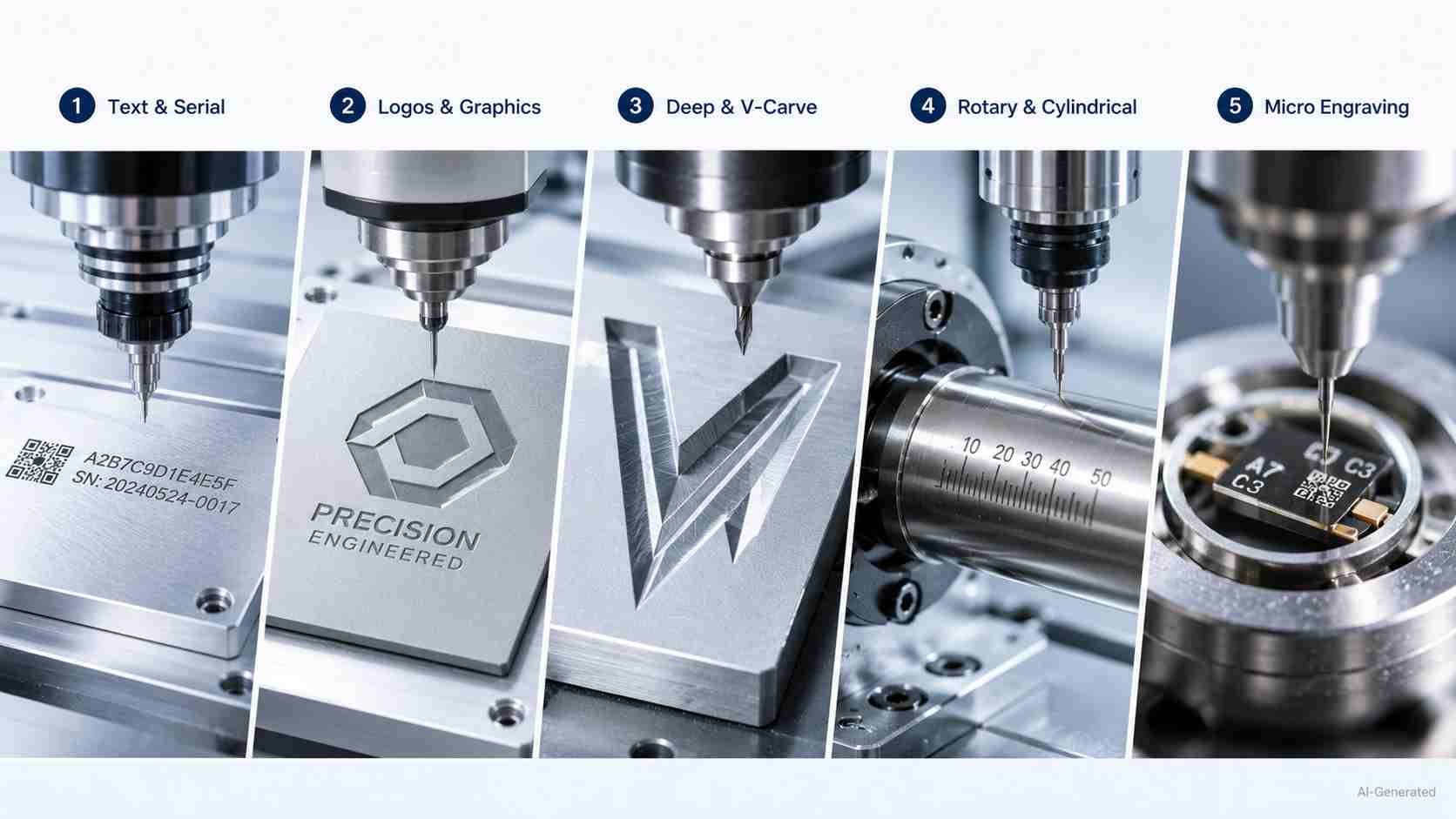
Common CNC engraving types on metal parts
Text and Serial Number Engraving
Within the machining workflow, CNC text engraving provides batch parts with readable IDs, date codes, and serial tags. Consequently, teams are able to connect each item to inspection records, service history, or lot data without the need to add a label.
Logo and Graphic Engraving
CNC engraving is also used for logos, outlines, icons, and branded graphics on metal or plastic parts. This provides housings, panels, and nameplates with built-in visual detail rather than an applied decal.
Deep Engraving and V-Carve Engraving
For bolder geometry, deep work cuts farther into the material. Meanwhile, V-carve paths use angled tools for sloped walls, wider letter strokes, and dimensional artwork on selected areas.
Rotary and Cylindrical Engraving
When the part is round, a CNC engraving machine can work with rotary motion. It allows tubes, shafts, caps, and similar shapes to receive marks around their curved profiles.
Micro Engraving for Precision Components
Micro engraving is used on compact precision components where marks must remain readable within limited space. This kind of work requires careful programming, steady holding, and highly precise cutter movement.
CNC Engraving Tools and Machining Methods
Engraving Cutters and Tool Geometry
Cutters set the character of every mark. Pointed tools create narrow strokes, wider angles make bolder cuts, and edge shape affects chip flow, wall shape, and burr risk during CNC engraving.
Spindle Speed, Feed Rate, and Cutting Depth
Next, the cutting recipe is important because speed, feed, and depth control tool pressure. When these settings drift out of balance, the tip can deflect, chatter, chip, or leave rough lettering. In production engraving of small text, higher spindle speed with shallow passes often reduces burr formation better than a single aggressive cut.
CNC Milling vs Laser Engraving Methods
When it comes to heat, force, fixturing, and edge texture, the CNC engraving machine and laser work are two different methods. The CNC engraving machine removes material via a cutter, while laser work applies concentrated energy without making contact with the material.
Multi-Axis CNC Engraving Applications
When working with curved forms, angled faces, and pockets, multi-axis motion allows the tool to approach from better directions, hence minimizing the number of additional setups required while maintaining consistent cutter access throughout complicated part geometry applications.
Engraving Depth, Line Width, and Readability Control
Minimum Engraving Depth for Visibility
CNC engraving gains readability through enough groove depth to catch shadow, but going deeper raises tool load. Many engraving applications use depths around 0.2-0.5 mm, depending on material, finish, and readability requirements.
Tool Diameter vs Character Size
Letter size has to match the cutter path. Match the cutter to almost half the intended line width for better stroke control. When the tool is too wide for the stroke, the inner gaps close up. Meanwhile, a smaller tip allows compact characters to remain legible without crowding.
Contrast on Different Materials
Readability then depends on how the cut looks against the parent material, since aluminum, steel, plastics, and darker finishes reflect light in different ways after the groove is made.
Effect of Coating and Surface Finish
Surface finish also affects engraving visibility. Anodizing, plating, paint, or surface roughness can either improve contrast or partially hide shallow marks after post-processing. The reason might be that the finish may either disclose the mark with contrast or conceal its shallow detail once post-processing has been performed.
Designing Engraved Features for CNC Manufacturing
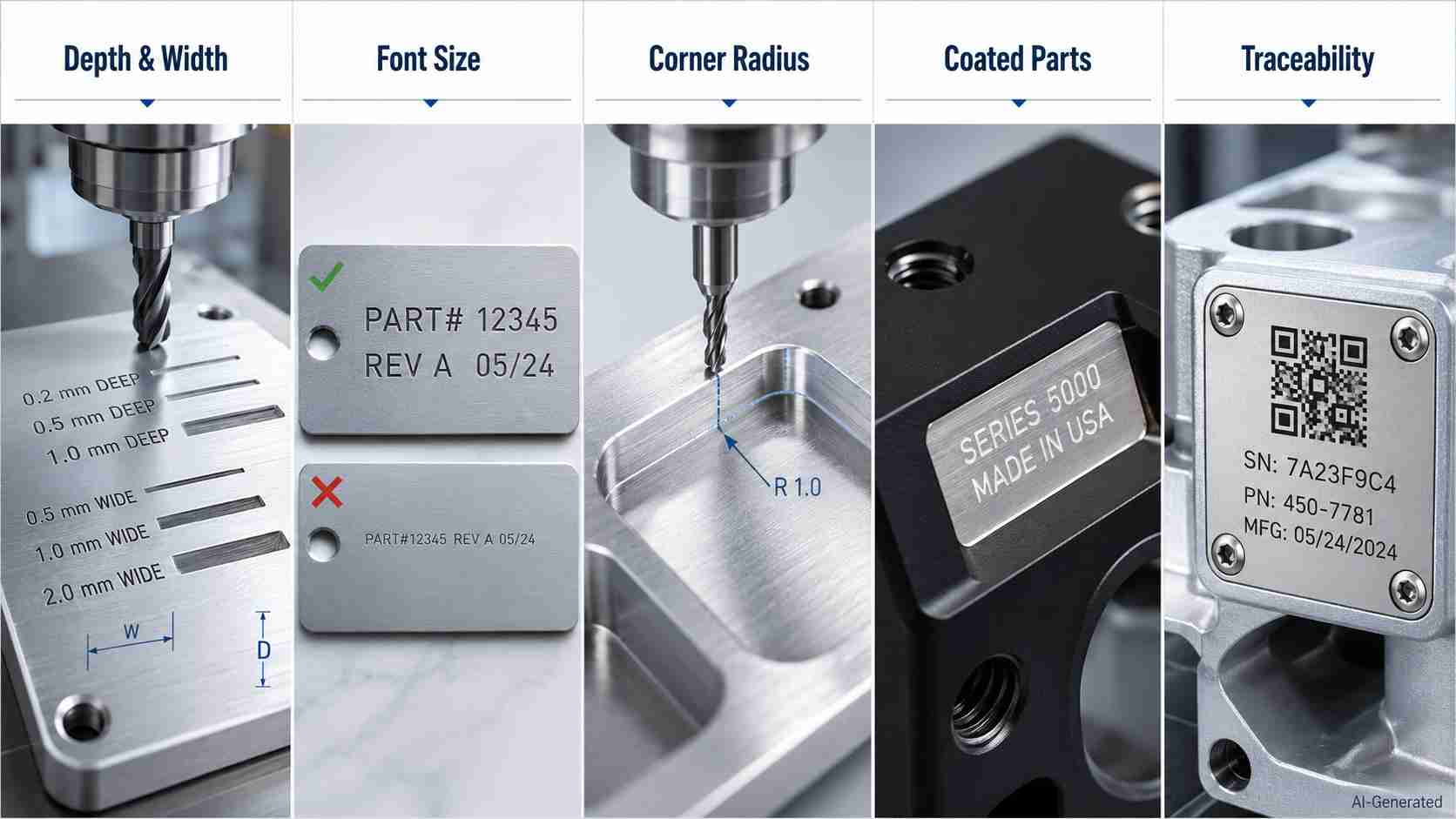
Design factors for CNC engraved features
Choosing Engraving Depth and Line Width
Begin with the mark's purpose. Depth adds durability, and line width supports legibility. But both need enough margin for inspection after machining, handling, and finishing. For most machined parts, engraving depth around 0.2-0.5 mm is commonly used to balance readability, cutter load, and post-processing requirements. CNC engraving works best when these values are written into the drawing and are not left to shop-floor guesswork.
Font Selection and Minimum Feature Size
For engraved text in CNC machining, choose open characters with generous spacing. Note that character sizes that range from 3 mm to 15 mm might be set in 1 mm steps. Narrow counters, thin strokes, and crowded digits can blend together when scaled down for compact labels.
Corner Radius and Cutter Accessibility
For deeper engraved pockets or recessed cavities, the internal corner radius is often limited by tool reach and cutter diameter. One common shop guideline for cavity milling is approximately R = (H/10) + 0.5 mm, where H represents cavity depth in millimeters.
Designing Engraving for Coated or Finished Parts
Surface finishing should be considered early in design. The final look may be altered by plating, anodizing, painting, or blasting, which implies that the engraved area could need additional allowance before the surface treatment is performed.
Engraving for Traceability and Serial Number Systems
In the end, serial codes should be positioned in such a way that they can be read by scanners, inspectors, and service teams over the whole of the part's lifecycle. This may be accomplished by including the location, orientation, and data format into the manufacturing plan.
Common Problems and Quality Challenges in CNC Engraving
Poor Line Definition and Edge Quality
When line edges look ragged, the story starts with chatter, tool wear, or loose holding. The cutter wobbles instead of tracing a steady path, and each letter loses definition before inspection begins.
Uneven Engraving Depth and Tool Deflection
Depth variation appears when the pressure of the cutter varies over the stroke, particularly on hard regions, steep faces, or parts that are not supported. Furthermore, once the tip bends, CNC engraving may move from perfect grooves to uneven markings.
Burr Formation on Soft Materials
Soft metals and plastics can smear at the edge as the tool exits. It leaves raised lips that blur characters and add deburring work before the part can move onward.
Tool Breakage in Fine Engraving
Fine cutters fail when load, runout, or chip packing becomes too high for the tip. This is why small lettering jobs need conservative passes, good chip evacuation, and careful setup.
Surface Distortion on Thin Parts
On thin-wall machined parts or sheet sections, a CNC engraving machine can push the surface to bend or vibrate. It leaves shallow waves, shifted marks, or tolerance issues after release from the clamp.
Material Considerations in CNC Engraving
Aluminum and Anodized Surface Engraving
Aluminum cuts with low resistance, but anodized layers add a harder skin. In CNC engraving, that mix can produce bright contrast while demanding careful chip control and gentle pressure.
Stainless Steel and Hardened Metal Engraving
Moving into stainless and hardened alloys, the job becomes less forgiving. Heat, tool wear, and cutting force rise together, making coolant, coated tools, and conservative passes important.
Brass and Copper Engraving Behavior
Brass engraves with tidy edges and low friction. On the other hand, copper can drag and build up on the cutter, meaning each alloy asks for its own feed, lubricant, and edge preparation.
Plastics and Composite Material Challenges
Plastics and composites bring their own quirks. Heat can soften polymers. Fibers can fray. And a CNC engraving machine needs sharp tooling with stable clamping to keep marks readable.
How CNC Machine Capability Influences Engraving Accuracy
Machine Rigidity and Vibration Stability
A rigid frame keeps the cutter path steady under cutting load. When the structure vibrates, strokes can widen, edges get wavy, and fine details lose the crisp shape the drawing intended.
Spindle Precision and Tool Runout
Spindle bearings and holder alignment guide how true the cutter spins. With excess runout, CNC engraving may show uneven stroke weight, rough texture, and shorter cutter life.
Tool Reach and Small-Feature Control
A long and slender cutter may bend during delicate work, and shorter reach improves stiffness. So, a CNC engraving machine should use the least projection for pocket depth and access.
Positioning Accuracy in Fine Engraving
The motion of the axis determines whether or not repeated characters arrive in the appropriate location. Every single one of these factors—servo control, guideway condition, thermal drift, and calibration—has an impact on the spacing, alignment, and repeatability of microscopic features.
CNC Engraved Features on Machined Parts
CNC engraving on machined parts is usually used for identification rather than decorative marking. Serial numbers, part labels, orientation marks, simple logos, and control panel text are common examples in production machining.
Compared with laser marking, CNC engraving physically removes material from the surface. The engraved feature remains visible after bead blasting, anodizing, or repeated handling, which is why recessed text is still widely used on industrial aluminum and steel parts.
In practice, CNC engraved features are heavily constrained by cutter size, tool reach, and surrounding geometry. Even if the text itself looks machinable in CAD, deep cavities or narrow recessed areas may still prevent tool access.
What Types of Engraving Work Best in CNC Machining
Shallow recessed engraving generally works best in CNC machining because smaller tools become unstable quickly as depth increases.
Production parts commonly use:
- Serial numbers
- Part identification text
- Simple recessed logos
- Panel labels
- Alignment or orientation marks
Very small decorative fonts, complex artwork, or extremely narrow strokes are less suitable for CNC engraving. Small tools lose rigidity quickly, especially on stainless steel or inside confined features.
Deep engraving is also less practical for many machined parts because cutting load rises rapidly once narrow tools are extended deeper into the material.
Material and Surface Considerations
Aluminum is usually the easiest material for CNC engraved features. Cutting forces remain relatively low, and small tools can machine shallow text cleanly under stable conditions.
Stainless steel is more difficult because engraving cutters wear faster and deflect more easily during narrow recessed cuts. Burr formation and heat concentration also become more noticeable on smaller text.
Brass generally machines cleanly and produces sharp engraving edges with minimal burr formation.
Plastic engraving depends heavily on the material itself. Some plastics cut cleanly, while others may smear, melt, or leave rough edges around small engraved text if spindle speed becomes excessive.
Surface finishing can also affect engraving visibility. Bead blasting, anodizing, coating thickness, and polishing may soften edge contrast on shallow recessed text.
Minimum Feature Size and Depth Limits
For CNC machined recessed text, feature size is usually limited by cutter strength and accessibility rather than machine positioning accuracy.
As a general guideline in JLCCNC:
- Font stroke width should usually remain above approximately 0.6 mm
- Engraving depth is typically kept below around 0.3 mm
- Narrow strokes increase tool break risk significantly
- Deep pocket locations may become unreachable with standard engraving tools
Part geometry matters as much as text dimensions. A font may appear large enough for machining, but surrounding walls or cavity depth can still prevent the cutter from reaching the engraving area safely.
Long-reach engraving tools are possible in some situations, although rigidity drops quickly as tool extension increases.
Prototype and Production Applications
CNC engraved features are commonly added to:
- Machined housings
- Fixture plates
- Industrial control panels
- Aerospace identification areas
- Assembly reference surfaces
- Custom aluminum enclosures
Prototype parts often prioritize quick identification and flexible layout changes during development. Production parts usually standardize engraving depth, text placement, and machining sequence to improve consistency across batches.
In higher-volume machining, engraving readability is normally reviewed together with surface finishing processes to ensure the text remains visible after anodizing, blasting, or coating.
Conclusion About CNC Engraving
Taken together, CNC engraving is less a finishing afterthought than a controlled machining step. Cutter selection, spindle accuracy, vibration control, material response, and feature geometry all influence whether or not a mark remains readable, dimensionally dependable, and production-ready. For machined parts that require engraved features, traceability marks, or permanent identification, JLCCNC supports online CNC milling for engraved metal and plastic parts, including prototype and production work with surface finishing and material selection options.

Precision CNC Machining Service
Professional manufacturing, fast turnaround, and quality assurance.
FAQ About CNC Engraving
Q: What is CNC engraving?
CNC engraving is a controlled cutting method to carve letters, symbols, or markings into a workpiece via programmed machine motion for product IDs, panels, labels, and decor details.
Q: What is the difference between CNC engraving and laser etching?
The key difference is contact. A cutter removes material by touch. Nevertheless, Laser etching changes the upper material layer with focused energy to create a shallow surface mark without physical tool contact.
Q: What tools are used for CNC engraving?
Common tools include pointed engraving cutters, V-bits, and small end mills. Meanwhile, tool angle and diameter affect the stroke, groove profile, and character detail.
Q: Which materials are easiest to engrave with CNC machining?
Aluminum and brass are generally easier materials for CNC engraving because they machine with lower cutting resistance. Yet, stainless steel, copper, plastics, and composites need more care with heat, chips, and edge quality.
Q: Can CNC engraving create deep markings?
Yes, deeper markings are possible when the design, cutter, and setup allow it, although wider geometry and staged passes might be better than forcing one heavy cut.
Q: How small can CNC engraved text be?
Small text depends on cutter size, font shape, spacing, and depth. However, different design guides suggest from 2.5 mm to 5 mm character height for dependable readability.
Keep Learning
Laser Engraving Aluminum: Marking Methods & Surface Effects
Key Takeaways Laser engraving usually removes base material to create a recess. Laser marking is a broader term that can describe a surface-color change or material removal, so the process name alone does not define the final result. On aluminum, alloy and surface finish affect marking contrast. A light mark on dark anodized aluminum is a common design target, but the actual appearance depends on the finish and laser process. JLCCNC laser marking produces a recessed area 0.03–0.1 mm deep. The result i......
CNC Cutting Fluid: Types, Functions, Applications, and Selection Guide
Key Takeaways Cutting fluid in machining performs four functions simultaneously: cooling the tool and workpiece, lubricating the tool-chip interface to reduce friction, carrying chips away from the cut zone, and protecting machined surfaces from corrosion between operations. Different machining operations need different fluid priorities: high-speed aluminum milling may need adhesion control and chip evacuation, threading and tapping need strong lubrication, and grinding requires both cooling and fine ......
Blind Hole Machining Guide: What Is a Blind Hole, Types of Holes, and Tapping Tips
What Is a Blind Hole? Types of Holes and CNC Hole Machining Explained In CNC machining, few operations challenge process control and tool stability as much as blind hole machining. A blind hole is a hole that terminates at a defined internal depth rather than breaking through the opposite surface. Because the cavity is enclosed at the bottom, chip evacuation, thermal behavior, tool wear, and dimensional accuracy become far more difficult to manage compared to through-hole machining. These constraints ......
Rake Angle in Machining: Machinists’ Guide to Perfect Cuts
What is Rake Angle? (minaprem) If you've ever stood in front of a CNC machine or a manual lathe, you know that the cutting tool's geometry isn't just some arbitrary design. Every angle, edge, and surface has a job to do, and one of the most important of those is the rake angle. We've been running machines long enough to know that rake angle can make or break your surface finish, tool life, and machining efficiency. In this guide, we're going to walk you through what rake angle is, how it works, and ho......
Sheet Metal vs CNC Machining: A Guide to Choosing the Right Method for Your Metal Parts
Quick Answer: Choose sheet metal for uniform-thickness enclosures, panels, and formed brackets when bends and production volume support lower unit cost. Choose CNC machining for variable wall thickness, precision bores, tight feature relationships, and complex 3D geometry. Use a hybrid design when a formed structure needs precision-machined interfaces. A quote comes back for a bracket, and it's priced as a CNC part — machined from solid aluminum, a few hours of spindle time, a per-part cost that makes......
What Steps Are Taken To Minimize Waste In CNC Machining Processes?
How to Reduce Waste in CNC Machining: 5 Practical Strategies Quick Answer: CNC machining waste is reduced mainly through DFM, near-net stock, efficient toolpaths, preventive tool maintenance, and alloy-segregated recycling. The biggest gains usually come before cutting: reduce unnecessary material removal and prevent scrap or rework. Every CNC-machined part starts as more material than it ends up being. A pocket gets milled out, a profile gets cut away, a boss gets faced down to size — and all of that......