Complete Guide to Custom Fixturing: Design Principles & Workholding Methods
10 min
- What Is Custom Fixturing?
- When Should You Use Custom Fixturing?
- How Custom Fixtures Are Designed
- Benefits of Custom Fixturing
- Common Types of Custom Fixtures
- Custom Fixturing vs Standard Workholding
- Common Applications of Custom Fixturing
- Custom Fixture Manufacturing Process
- How Custom Fixtures Are Designed
- FAQs About Custom Fixturing
Key Takeaways
- Custom fixturing securely locates and supports challenging parts.
- Dedicated designs improve positioning consistency across machining cycles.
- Planned clamping limits movement and workpiece distortion.
- Better tool access can lower multi-sided setups.
- Repeated production justifies the initial fixture expense.
- Inspection and validation prepare the fixture for reliable production.
With custom fixturing, manufacturers have dedicated control over part location, support, and clamping in situations when standard workholding falls short.
What Is Custom Fixturing?
Custom fixturing uses a dedicated fixture engineered for one part or process and keeps the workpiece located, supported, and clamped at a controlled machining reference.
When Should You Use Custom Fixturing?
Complex or Irregular Part Geometry
When ordinary vises are unable to provide reliable locating points due to curves, slanted faces, or unequal contact regions, custom fixturing often provides a more reliable solution.
Tight Tolerance Requirements
A custom fixture becomes worthwhile when critical features depend on one controlled datum scheme, as well as when reclamping could introduce alignment variation. One modular CNC fixture attained 3σ repeatability of ±5.367 µm in X, ±3.286 µm in Y, and ±1.643 µm in Z, indicating positioning variation remained within only a few microns.
Repetitive or High-Volume Production
For recurring batches, dedicated workholding reduces manual alignment and allows operators to load each blank through the same planned sequence.
Multi-Setup or Multi-Axis Machining
When numerous faces require cutting, dedicated workholding helps maintain a single machining reference while limiting transfers between setups.
How Custom Fixtures Are Designed
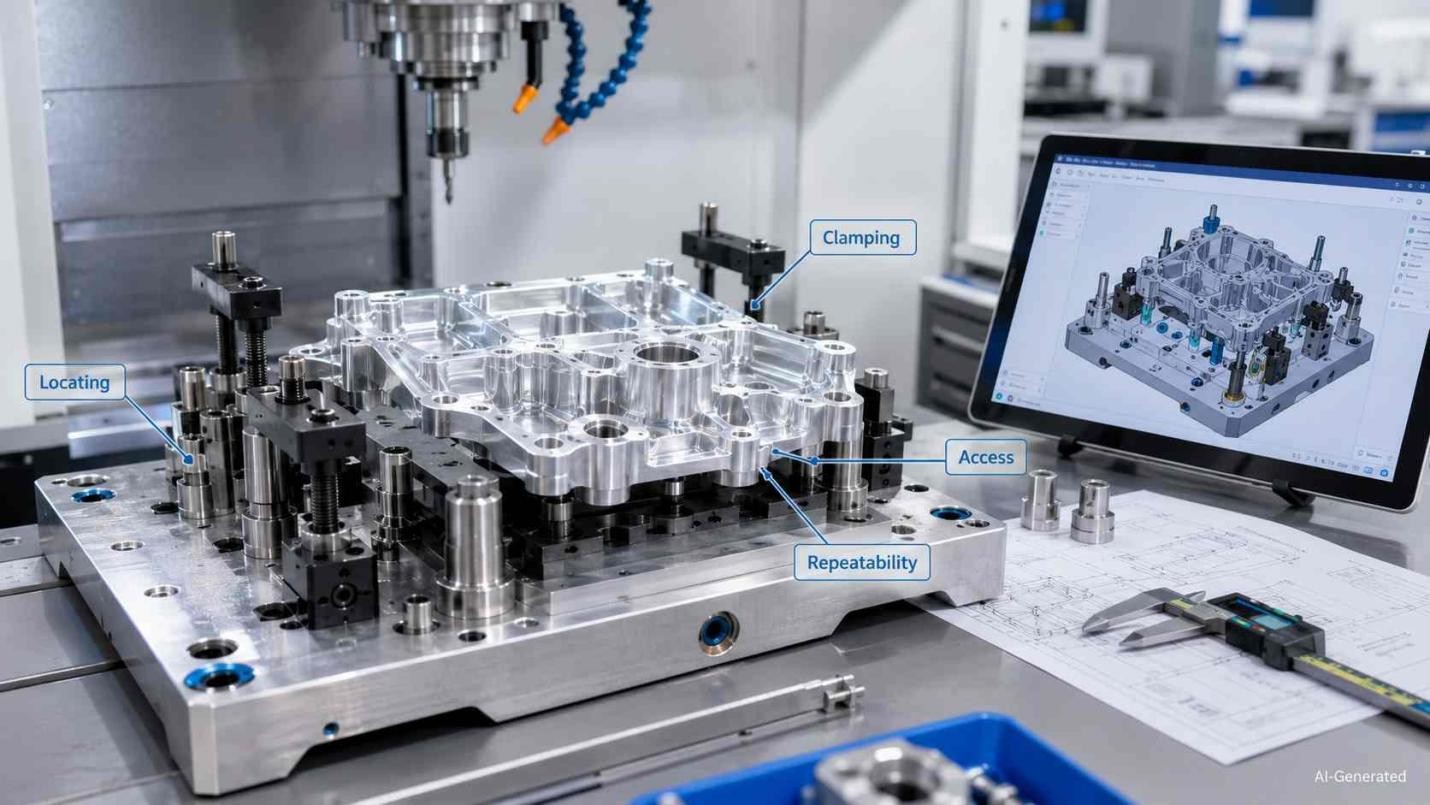
Custom fixture design with locators, clamps, and CAD
Locating and Supporting the Workpiece
A sound custom fixturing design begins with datum surfaces and locators that restrain unwanted motion. Additional supports reinforce areas exposed to cutting loads. Many fixtures follow the 3-2-1 locating principle to constrain six degrees of freedom without over-constraining the workpiece.
In this approach, three supports establish the primary datum plane, two locators constrain movement on the secondary plane, and one final locator fixes the remaining direction. Together, these six contact points constrain all six degrees of freedom while allowing the workpiece to seat consistently without excessive constraint.
Selecting an Effective Clamping Strategy
Engineers then determine clamp locations, clamping force, and the clamping sequence that will press the component against its locators without causing it to move or get compressed.
The clamping method also depends on production volume and part geometry. Manual toggle clamps are often sufficient for prototypes and low-volume machining because they are simple to adjust and inexpensive. Hydraulic or pneumatic clamps provide more consistent clamping force and faster loading in production environments, while vacuum or magnetic workholding may be suitable when conventional clamps would obstruct tool access or deform thin workpieces.
Providing Tool and Machine Accessibility
The fixture layout must ensure that the cutter, spindle, probes, and loading route are not subject to any interference during the whole operation that is planned.
Designing for Repeatable Positioning
A custom fixture uses controlled contacts and durable locating features to return every workpiece to the same machining reference after each reload.
Benefits of Custom Fixturing
Higher Machining Accuracy
Locators and clamps that are positioned appropriately restrict movement and minimize deformation, hence maintaining key dimensions that are closer to their prescribed values. In one study, adaptive clamping reduced maximum deformation by 82.0% and flatness error by 72.9%.
Reduced Setup Time
The amount of indicating, probing, and manual adjustment that must be done before each machining cycle is reduced thanks to dedicated stops and loading features. A CNC case study cut setup time from 1.65 hours to 1.19 hours after redesigning the fixture.
Improved Process Repeatability
By returning each blank to the same references, custom workholding helps to reduce the amount of variance that occurs from part to part across a manufacturing run.
Lower Manufacturing Cost
When volume increases, the preliminary cost of the fixture might be compensated by a reduction in the number of setup hours, rejected parts, and operator corrections. That redesigned fixture (that cut the setup time) recovered its RM2,860 investment within 1.51 months.

Precision CNC Machining Service
Professional manufacturing, fast turnaround, and quality assurance.
Common Types of Custom Fixtures
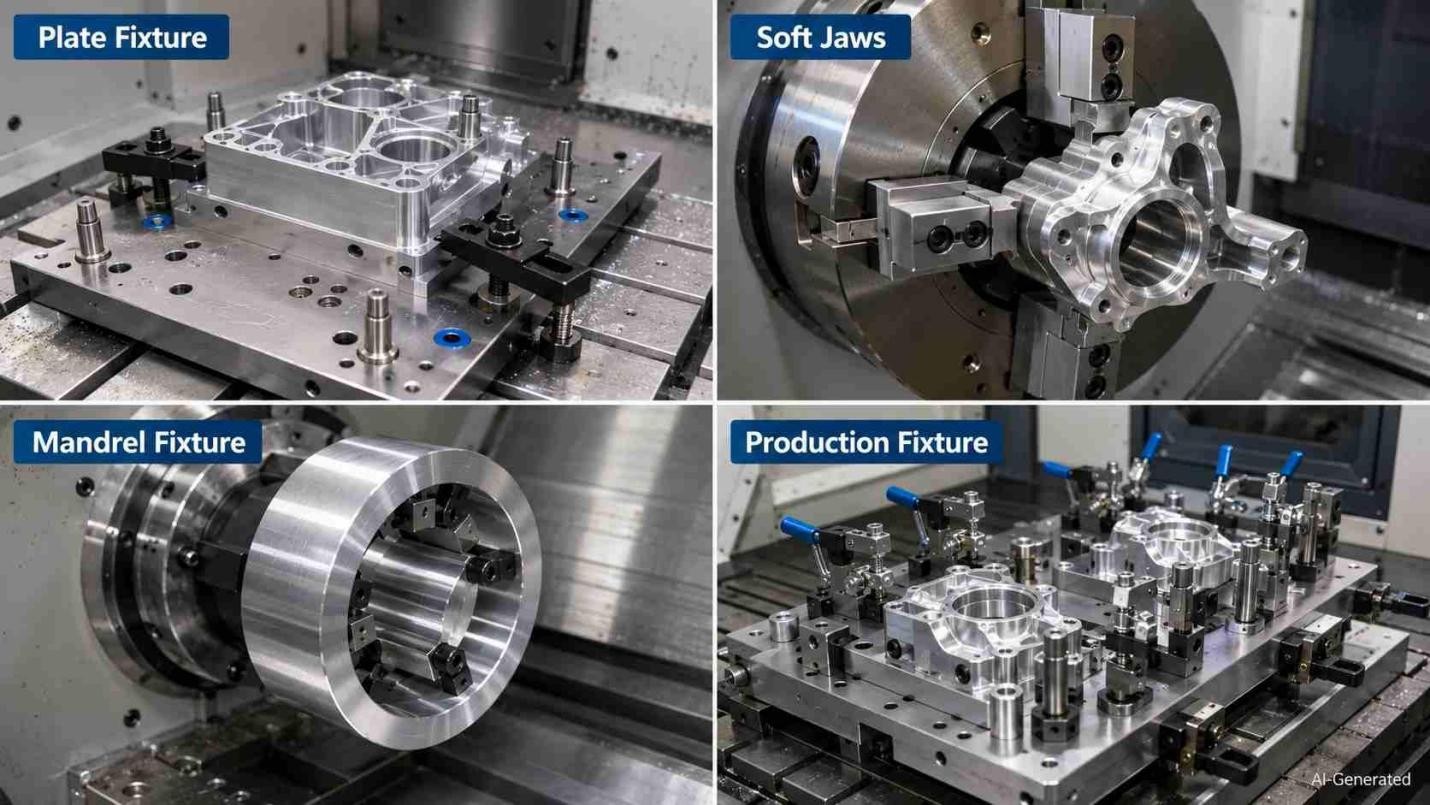
Common custom fixtures for CNC machining
Plate Fixtures
Plate fixtures arrange locators and clamps on a flat base, and consequently, they appear to be appropriate for varied milling tasks and prismatic components.
Custom Soft Jaws
For contoured components, machinable vise or chuck jaws follow the holding profile. This custom fixturing option outfits delicate surfaces and second operations.
Mandrel and Internal Holding Fixtures
When the exterior must remain exposed, mandrels grip a bored component from within. Thanks to this, they are acceptable for hollow or ring-shaped components.
Dedicated Production Fixtures
For recurring output, custom workholding might utilize multiple stations to machine multiple pieces together or carry each part through staged operations.
Custom Fixturing vs Standard Workholding
| Comparison Factor | Custom Fixturing | Standard Workholding |
|---|---|---|
| Setup efficiency | Dedicated locators and clamps reduce recurring alignment and loading work. | Vises, chucks, and adjustable clamps may need renewed indicating and positioning for each job. |
| Repeatability | Fixed contact points provide dependable part placement across repeated cycles. | Results depend more on setup procedure, adjustment, and operator input. |
| Flexibility | Limited to one component, part family, or machining operation. | Reusable devices can accommodate varied sizes, shapes, and production needs. |
| Cost | Initial engineering and manufacturing expenses are higher, though volume spreads that investment across more parts. | Upfront spending is lower and makes this option economical for prototypes and short runs. |
| Production suitability | Best suited to recurring production, demanding tolerances, automation, and specialized geometries. | Better suited to varied jobs, changing designs, prototypes, and lower quantities. |
Common Applications of Custom Fixturing
Multi-Sided CNC Machining
While exposing several faces from a single datum, custom fixturing helps to reduce the amount of workpiece transfers that occur during multi-axis milling.
Thin-Walled Components
Tailored supports and controlled clamp forces help minimize deflection when machining thin-walled parts.
High-Precision Production Parts
Custom fixtures are well suited to components that require tight positional repeatability throughout machining and reclamping.
Automated and High-Volume Manufacturing
The use of powered clamps and dedicated loading features helps to ensure that robotic handling and consistent output are maintained over extended production runs.
Custom Fixture Manufacturing Process
Manufacturing Fixture Components
Once the fixture design is finalized, manufacturing begins with the components that establish part location and structural rigidity. Fixture bodies are typically milled from steel or aluminum plates, while locating pins, bushings, and wear surfaces are machined or ground to tighter tolerances because they directly determine workpiece position. When welded or heavily machined steel bases are used, stress relief may be performed before finish machining to reduce distortion and improve dimensional stability. Critical locating surfaces are inspected throughout manufacturing to prevent accumulated positioning error.
Assembly and Alignment
Assembly starts by establishing the fixture datum rather than simply fastening components together. Locators are installed and verified first, followed by support pads, clamps, and any hydraulic or pneumatic hardware. Alignment is checked using dial indicators, gauge blocks, or a coordinate measuring machine (CMM), depending on the required accuracy. For multi-station fixtures, each station is inspected individually to ensure every workpiece is positioned consistently before production trials begin.
Production Validation
The completed fixture is validated under actual machining conditions rather than through dimensional inspection alone. Trial parts are machined using the intended cutting parameters and then inspected to verify positional accuracy, repeatability, and dimensional stability. Engineers also evaluate practical production issues, including clamp-induced distortion, chip accumulation, tool interference, and loading accessibility. For high-volume applications, repeated loading and machining trials—often 30 to 50 cycles or more—confirm that the fixture maintains consistent positioning before it is released for production.
How Custom Fixtures Are Designed
Engineering Review
Fixture design begins with the machining process rather than the fixture itself. Engineers evaluate the CAD model, machining sequence, cutting forces, tolerance requirements, and available machine travel before selecting the workholding concept. The objective is to establish a stable machining reference while minimizing unnecessary setups and reducing the risk of interference.
Datum Planning and Workpiece Location
A reliable fixture starts with a well-defined datum scheme. Most designs follow the 3-2-1 locating principle to constrain all six degrees of freedom without over-constraining the workpiece. Datum selection usually matches the references used on the engineering drawing so machining, inspection, and assembly share the same coordinate system.
Clamping Strategy
Clamping forces should hold the workpiece securely without introducing distortion. Engineers determine clamp location, direction, and loading sequence according to part stiffness, cutting forces, and the accessibility of machining features. Thin-walled or compliant components often require additional supports to prevent deformation during machining.
Tool Accessibility
Fixture layouts must provide adequate clearance for cutting tools, probes, chip evacuation, and part loading. Potential interference between the fixture, spindle, tool holder, and workpiece is typically verified in the CAD assembly before manufacturing begins.
Repeatable Positioning
Locating elements and contact surfaces are designed to return every workpiece to the same machining reference after each loading cycle. Replaceable wear components, hardened locating surfaces, and controlled contact points help maintain positioning accuracy throughout the fixture's service life.
FAQs About Custom Fixturing
Q: What Is Custom Fixturing?
Custom fixturing makes use of a workholder that is engineered for one component or machining process, as well as has dedicated locators, supports, and clamps.
Q: What Is the Difference Between a Jig and a Fixture?
Traditionally, a jig both locates the workpiece and guides the cutting tool—for example, a drill jig uses bushings to guide the drill bit. A fixture, by contrast, locates and clamps the workpiece securely but does not guide the tool.
Q: What Is Custom Workholding?
The term ''Custom workholding'' refers to a customized arrangement that secures a component at the required orientation for the sake of a planned machining operation.
Q: When Should a Custom Fixture Be Used?
Use one for unusual geometry, demanding tolerances, recurring batches, or machining that actually demands controlled access from numerous directions.
Q: How Does Custom Fixturing Improve Machining Accuracy?
It stops the workpiece from moving in an undesirable direction and provides support against cutting loads, thus minimizing displacement and distortion.
Q: Are Custom Fixtures Worth the Cost?
They might become worthwhile whenever savings in setup labor, production time, and recurring output are much more than the design and manufacturing expense.
Q: What Materials Are Commonly Used for Custom Fixtures?
Steel is commonly selected for production fixtures because of its stiffness, wear resistance, and long service life. Aluminum reduces fixture weight and is easier to handle during frequent setup changes, making it suitable for low- and medium-volume production. Contact surfaces may incorporate nylon, UHMW polyethylene, or bronze pads where finished surfaces require protection from clamping damage or galling.
Q: How Are Custom Fixtures Manufactured?
Engineers analyze the part, design and verify the concept, machine and assemble its elements, inspect the device, and complete prototype trials before release.
Precision CNC Machining Service
Professional manufacturing, fast turnaround, and quality assurance.
Conclusion About Custom Fixturing
Custom fixturing delivers the greatest value when the fixture is developed around the machining process rather than after the process has been defined. A well-designed fixture improves repeatability, shortens setup, and supports consistent production over the intended batch size.
At JLCCNC, fixture design is reviewed together with the machining process before production begins. Upload your CAD file to receive a custom CNC machining quote based on your part geometry and manufacturing requirements.
Popular Articles
• What is Swiss Machining: Swiss CNC Machines and Their Precision
• Desktop 5-Axis CNC Machine: Own One or Outsource to Industrial Services?
• How a Laser Cutter Operates
• The Superiority of CNC Routers Over Laser Cutters in Modern Manufacturing
• Best CNC Machines for Metal: A Guide for Choosing Between Mills, Routers, and Press Brakes
Keep Learning
What is Swiss Machining: Swiss CNC Machines and Their Precision
What is Swiss Machining? (Freepik) When you hear people talk about the “gold standard” in precision manufacturing, they're usually talking about Swiss machining. Swiss machining traces its roots back to 19th-century Switzerland, where it was originally developed for the watchmaking industry. When you're dealing with gears and components smaller than a fingernail, you need more than just accuracy, you need repeatable precision at a microscopic level. That's where the Swiss lathe came in. At its core, S......
5 Signs You Need a CNC Machine for Your Metal Project
You’ve got a metal project on your hands, maybe a few prototypes, maybe a production run, and you're wondering if it’s time to upgrade your toolkit. CNC machines aren’t just fancy toys for industrial giants anymore. Today, shops of all sizes rely on them to cut, mill, drill, and shape metal with unshakable accuracy. But when is the right time to make that leap? This isn’t just about having cool equipment. It’s about knowing when manual methods, traditional tools, or even outsourcing just aren't cuttin......
How to Make a CNC Machine at Home: DIY CNC Router & Lathe Guide
How to Make a CNC Machine? (Reddit) Why would anyone want to build their own CNC machine at home? Isn't that super complicated? Honestly, that's the fun of it. Figuring out how to make a CNC machine can be both exciting and surprisingly cost-effective. Think of it like combining engineering curiosity with the satisfaction of saying, “Yep, I built that myself.” For hobbyists, small workshops, or even engineers tinkering at home, DIY CNC machines open the door to custom fabrication without dropping thou......
Lathe vs Mill: Differences, Applications, and Machine Selection
Key Takeaways Lathe-vs-mill selection starts with the part, not the machine: a lathe is the more direct route for rotational features, while a mill suits prismatic geometry and features distributed across multiple faces. On a lathe the workpiece spins and the tool feeds; on a mill the cutting tool spins while the workpiece is held. That motion difference determines the geometry each machine produces efficiently. Workholding, feature access, setup count, and cross-feature tolerance relationships decide......
5-Axis CNC Machining: Why Is It Needed for Complex Parts?
Key Takeaways 3-axis CNC machining is often a practical and cost-effective choice when all critical features can be reached using a small number of straightforward setups, with the tool orientation fixed relative to the workpiece during each setup. A 5-axis machine can improve access to angled or multi-sided features and reduce re-clamping. These benefits can often be achieved with 3+2 positioning, without simultaneous 5-axis cutting. 3+2 machining uses two rotary axes to position the workpiece or cut......
Desktop CNC Machines: Cost, Capabilities, and Limitations
Key Takeaways Desktop CNC machines commonly range from under $1,000 for basic routers to several thousand dollars for better-equipped mills and routers, while specialized 5-axis systems can reach well into the five-figure range. Tooling, workholding, software, fixturing, and other setup costs can add another $1,000$5,000 or more depending on the machine and application. Desktop CNC machines are well suited to prototyping, smaller parts, softer materials, and learning CNC fundamentals. Desktop CNC mach......