HDPE: Material Properties, Machining, and Applications
18 min
- What Is HDPE?
- HDPE Material Properties
- HDPE Plastic for CNC Machining
- HDPE Sheet: Sizes, Thicknesses, and Uses
- Advantages and Limitations of HDPE
- HDPE vs Other Engineering Plastics
- Common Applications of HDPE
- Design Considerations for HDPE Parts
- FAQs About HDPE
Key Takeaways
- HDPE stands for high-density polyethylene, a thermoplastic polymer with high strength-to-density ratio, excellent chemical resistance, and very low moisture absorption.
- HDPE material machines well on standard CNC equipment without coolant in most operations.
- HDPE plastic is FDA-compliant in food-grade grades, making it common in food processing equipment and cutting board applications.
- HDPE sheet is the most common stock form for machined flat components, available in thicknesses from 1.5mm to over 100mm.
- HDPE properties that matter most in industrial applications are chemical resistance, moisture resistance, impact toughness, and low coefficient of friction.
- HDPE is not the right choice when temperature resistance above 80-90°C or high stiffness under sustained load is required, those applications need a different material.
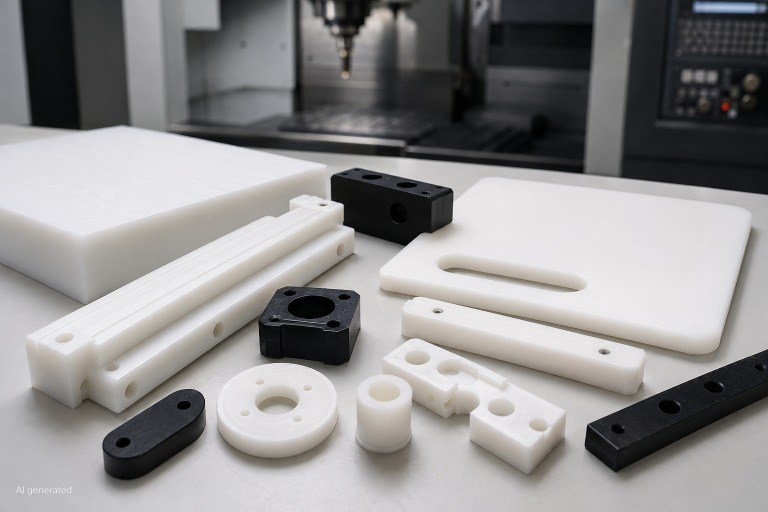
(AI generated) CNC-machined HDPE plastic components
Some materials make engineers' lives easier. HDPE is one of them. It machines cleanly, resists most chemicals, handles moisture without absorbing it, costs less than most engineering plastics, and doesn't complain when it gets left outdoors. For a broad range of industrial, food processing, marine, and chemical handling applications, HDPE plastic is often one of the most practical material choice, not the most exciting, but consistently the right one.
This guide covers HDPE properties, how it behaves in CNC machining, what to know about HDPE sheet stock, and how it compares to the alternatives.
What Is HDPE?
HDPE is a high-density polyethylene thermoplastic produced from ethylene monomer through a catalytic polymerization process that creates long, relatively unbranched polymer chains with high molecular packing density, which is exactly where the "high density" part of the name comes from.
What Does HDPE Stand For?
HDPE stands for High-Density Polyethylene. The "high density" distinguishes it from LDPE (low-density polyethylene) and LLDPE (linear low-density polyethylene), which have more branched polymer chain structures and correspondingly lower density, strength, and stiffness. HDPE material's less-branched molecular structure allows the chains to pack more tightly, producing a harder, stiffer, stronger plastic than the low-density variants while remaining fully within the polyethylene family.
How HDPE Is Manufactured
HDPE plastic is produced through several catalytic polymerization processes. The Ziegler–Natta and Phillips processes are the most common, which polymerize ethylene gas under controlled temperature and pressure conditions in the presence of a catalyst. The result is a linear, high-molecular-weight polyethylene with relatively few side branches, giving HDPE material its characteristic combination of rigidity and chemical resistance.
HDPE sheet stock is produced by either extrusion (running molten HDPE through a flat die and calendering rolls to produce continuous sheet) or by compression molding of billet stock for applications requiring isotropic properties in all directions. Extruded HDPE sheet is the standard for most fabrication and machining applications. Compression-molded HDPE offers better dimensional stability for precision machining applications where the directional properties of extruded sheet would create problems.
Why HDPE Is Popular in Industrial Applications
The combination that makes HDPE plastic attractive across so many applications is hard to match at its price point. Chemical resistance that covers most industrial solvents, acids, and bases. Near-zero water absorption that keeps dimensions stable in wet environments. Impact toughness that handles rough service without cracking. FDA compliance in food-contact grades. And a cost per kilogram that's substantially lower than most engineering plastics with comparable performance.
For applications where HDPE properties are a match, the material is genuinely can be difficult to beat on value. The question isn't "is HDPE good?", it clearly is. The question is always "is HDPE the right material for this specific requirement?"
HDPE Material Properties
Mechanical Properties
| Property | Typical Value |
|---|---|
| Density | 0.93-0.97 g/cm³ |
| Tensile Strength | 21-37 MPa |
| Flexural Modulus | 800-1600 MPa |
| Impact Strength (Izod, notched) | No break to 960 J/m |
| Hardness (Shore D) | 60-70 |
| Elongation at Break | 100-1000% |
| Coefficient of Friction | 0.10-0.22 |
HDPE material sits in the middle of the engineering plastic mechanical performance range. Stronger and stiffer than LDPE, softer and more flexible than Delrin or nylon under sustained load. The high elongation at break is a practical advantage. Instead of shattering under impact, HDPE deforms. This makes it suitable for applications where brittle fracture failure would be dangerous.
The relatively low flexural modulus means HDPE sheet deflects more under sustained load than stiffer alternatives like Delrin or UHMW at equivalent thickness. Parts that need to resist deflection under load may need increased wall thickness in HDPE to achieve the same stiffness as a thinner section in a higher-modulus material.
Chemical and Moisture Resistance
HDPE plastic has excellent resistance to most common industrial chemicals, dilute acids, dilute alkalis, alcohols, petroleum-based solvents, and many organic chemicals. Water absorption is only about 0.01–0.02%. As a result, HDPE remains dimensionally stable in wet environments and resists swelling.
Where HDPE properties fall short: concentrated oxidizing acids (nitric acid above 50%, concentrated sulfuric acid) attack HDPE over time. Aromatic hydrocarbons like benzene and toluene cause some swelling. Chlorinated solvents are a known issue. For these chemical environments, HDPE isn't the right material, PVDF or PP may be better choices.
FDA-compliant HDPE grades in food contact applications meet 21 CFR 177.1520 requirements. Marine-grade HDPE sheet for outdoor applications often includes UV stabilizers that significantly extend service life in sunlight exposure.
Thermal and Electrical Properties
| Property | Typical Value |
|---|---|
| Maximum Continuous Service Temperature | 80-90°C |
| Melting Point | 120-140°C |
| Thermal Expansion Coefficient | 120-200 × 10⁻⁶/°C |
| Thermal Conductivity | 0.45-0.52 W/m·K |
| Volume Resistivity | 10¹⁵ Ω·cm |
| Dielectric Strength | 18-20 MV/m |
The thermal expansion coefficient for HDPE material is high, roughly 10x that of steel. For machined HDPE parts with tight tolerances that operate across a wide temperature range, thermal expansion needs to be factored into the design. A 200mm HDPE component experiencing a 30°C temperature change will expand by approximately 0.7-1.2mm, which matters when that component mates with a metal counterpart that expands far less over the same temperature change.
The maximum service temperature of 80-90°C is the most common limitation that pushes engineers to alternative materials. HDPE plastic is not suitable for steam cleaning, autoclaving, or applications near heat sources. For those environments, PEEK, PPS, or PTFE carry the thermal requirement.
HDPE Plastic for CNC Machining
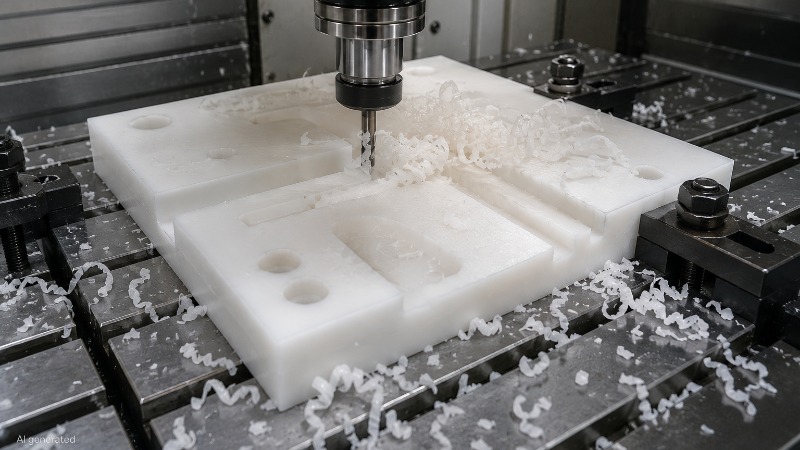
(AI generated) CNC machining HDPE
Machinability of HDPE
HDPE machines work well on standard CNC equipment. It cuts cleanly with sharp tooling, produces manageable chips rather than dust or fine particles, and doesn't require specialized setup beyond standard plastic machining precautions. HDPE plastic is significantly easier to machine than most engineering plastics, no abrasive fillers, no hard particles, and no tendency to generate heat that degrades the material at cutting conditions suitable for most operations.
The main machining challenge with HDPE material is its tendency to flex rather than support cutting forces rigidly, particularly in thin sections. HDPE sheet parts with thin walls or long unsupported spans can deflect during cutting, producing dimensional errors that don't appear in more rigid materials at equivalent wall thickness.
Coolant isn't required for most HDPE machining operations, compressed air for chip clearing is usually sufficient. When coolant is used, water-soluble coolants are appropriate. Avoid oil-based coolants that may be incompatible with FDA requirements for food-contact HDPE parts.
Recommended CNC Machining Operations
Milling HDPE sheet works well with standard end mills at high spindle speeds and moderate feed rates. Carbide tooling preferred; high-speed steel is acceptable for short runs. Sharp edges are essential, dull tools produce torn rather than cut surfaces in HDPE plastic.
Turning HDPE material on a lathe produces excellent results with similar tooling requirements, positive rake angle inserts, moderate speeds, light chip loads for finishing passes. HDPE's low coefficient of friction means it doesn't load the tool the way some other plastics do.
Drilling HDPE sheet uses standard twist drills at reduced feed rates compared to metals. Backing material prevents tear-out at the exit. Through-hole feature quality improves significantly with a sharp drill and moderate feed, pushing too hard produces a rough hole wall in HDPE material.
Threading HDPE is straightforward for coarse threads. Fine threads hold less reliably in HDPE than in higher-modulus materials, consider threaded inserts for fine-thread connections in HDPE parts that will see repeated assembly.
Design Tips for HDPE Parts
When designing HDPE parts for CNC machining, focus on three factors:
- Provide sufficient wall thickness for stiffness.
- Allow clearance for thermal expansion.
- Use inserts for fine or frequently assembled threads.
HDPE is considered one of the easier plastics to machine, but every engineering plastic behaves differently. For machining recommendations across engineering plastics, see our Plastic CNC Machining Guide, which explains tooling, feeds, tolerances, and common machining challenges across different materials.
The following section explains each consideration in more detail.
HDPE Sheet: Sizes, Thicknesses, and Uses
Standard HDPE Sheet Sizes
HDPE sheet is available in standard sheet sizes of 1220 × 2440mm (4' × 8' in imperial markets) as the most common format. Larger sheets at 1500 × 3000mm and 2000 × 4000mm are available from specialist HDPE material suppliers for large fabrication applications. HDPE sheet can be cut to custom sizes from stock before machining, most rapid prototyping services and CNC shops order HDPE sheet cut to the work envelope rather than purchasing full sheets for small parts.
Common Thickness Options
HDPE sheet stock is available in a range of thicknesses from 1.5mm through to 150mm and beyond for billet stock. Common thicknesses for machined components:
| Thickness | Typical Application |
|---|---|
| 1.5-3mm | Liners, gaskets, thin panels |
| 4-6mm | Light structural panels, enclosure walls |
| 8-12mm | General fabrication, cutting boards |
| 15-25mm | Bearing pads, wear plates, structural components |
| 30-50mm | Heavy-duty wear components, thick structural parts |
| 75-150mm | Billet for machined 3D components |
Typical Uses of HDPE Sheets
HDPE sheet in its flat form is used for tank liners, conveyor wear strips, cutting boards, marine dock fenders, chemical containment liner panels, playground equipment, and outdoor signage. HDPE sheet's combination of impact resistance, moisture resistance, and UV stability (in stabilized grades) makes it the default material for many outdoor flat-panel applications where more expensive alternatives don't provide additional value.
In CNC machining applications, HDPE sheet serves as the starting stock for machined flat components, panels with pockets and holes, wear plates, guide rails, spacers, and fixtures for lower-precision applications.
Advantages and Limitations of HDPE
Advantages of HDPE
- Easy to machine with standard CNC equipment
- Low coefficient of friction for sliding applications
- Cost-effective for large-volume industrial components
- Available in a wide range of sheet thicknesses and grades
- Good dimensional stability in wet environments
For applications where these characteristics match the design requirements, HDPE provides an excellent balance of manufacturability and cost.
Limitations of HDPE
Temperature resistance is one of HDPE's primary limitations. Continuous service temperatures above approximately 80–90°C generally require another material. Stiffness under sustained load is lower than many alternatives, HDPE creeps over time under sustained compressive load, which limits its use in structural applications with long-term loading. Painting and adhesive bonding are difficult without surface treatment because HDPE plastic's low surface energy causes poor adhesion. UV degradation in non-stabilized HDPE grades limits outdoor use to UV-stabilized formulations.
When HDPE Is the Best Choice
HDPE is the best material choice when chemical resistance. For cutting surfaces, guide components, chemical containment, marine hardware, food processing equipment parts, and general industrial components in wet environments, HDPE plastic delivers the right properties at the right cost more consistently than most alternatives.
HDPE vs Other Engineering Plastics
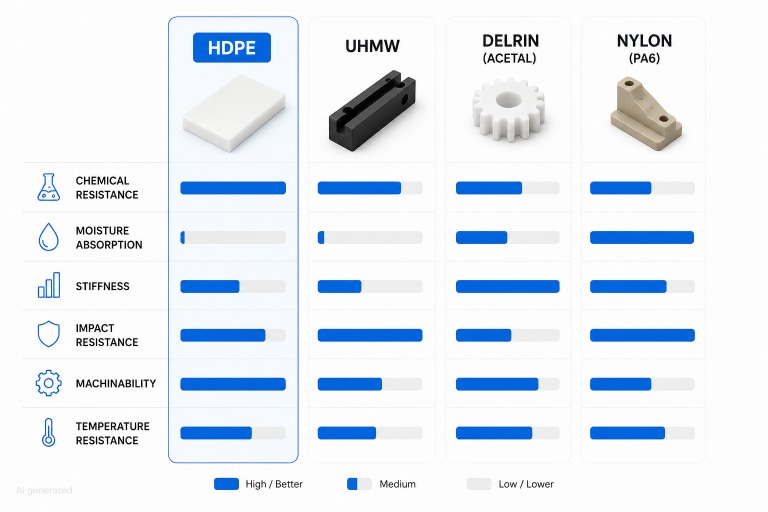
(AI generated) HDPE vs other Plastics comparison chart
| Property | HDPE | UHMW-PE | Delrin (Acetal) | Nylon (PA6) |
|---|---|---|---|---|
| Density (g/cm³) | 0.93-0.97 | 0.93-0.94 | 1.40-1.42 | 1.13-1.15 |
| Tensile Strength | 21-37 MPa | 35-48 MPa | 60-75 MPa | 70-85 MPa |
| Flexural Modulus | 800-1600 MPa | 700-900 MPa | 2800-3200 MPa | 2500-3300 MPa |
| Impact Strength | Very High | Extremely High | High | High |
| Moisture Absorption | 0.01-0.02% | 0.01% | 0.2-0.8% | 1.5-3.0% |
| Max Service Temp | 80-90°C | 80-85°C | 90-120°C | 90-120°C |
| Chemical Resistance | Excellent | Excellent | Good | Moderate |
| Machinability | Good | Moderate | Excellent | Good |
| Cost | Low | Low-Medium | Medium | Low-Medium |
| FDA Compliance | Yes (food grade) | Yes (food grade) | Yes (specific grades) | Yes (specific grades) |
HDPE vs UHMW
HDPE plastic and UHMW (ultra-high molecular weight polyethylene) are related materials that are often confused. Both are polyethylene; UHMW has a much higher molecular weight (3-6 million g/mol vs 0.3-0.5 million for HDPE), which gives it significantly higher impact strength and better wear resistance, but makes it harder to machine than HDPE material. HDPE is the right choice when impact toughness is adequate and machinability matters. UHMW is the right choice when wear resistance and impact are paramount and the slower, more difficult machining is acceptable.
HDPE vs Delrin (Acetal)
Delrin (acetal, POM) is stiffer, harder, and more dimensionally precise than HDPE material, it holds tighter tolerances, machines more cleanly, and maintains better dimensional stability under sustained load. The trade-offs: Delrin costs more, has lower chemical resistance than HDPE plastic particularly to acids, and is less impact-resistant. For precision machined components needing tight tolerances, Delrin is usually the right choice. For chemical-resistant, moisture-resistant, food-contact components where dimensional precision is moderate, HDPE is more appropriate.
HDPE vs Nylon
Nylon outperforms HDPE on stiffness, tensile strength, and temperature resistance. The significant limitation of nylon is moisture absorption, nylon absorbs 1.5-3% moisture from the environment, which changes its dimensions, reduces its mechanical properties, and makes parts cut to size in a dry environment measure differently after exposure to humidity. HDPE's near-zero moisture absorption makes it dramatically more dimensionally stable in wet environments than nylon. For applications where parts will be in contact with water, food, or outdoor moisture, HDPE plastic often produces more consistent results than nylon despite lower absolute mechanical properties.
JLCCNC does not currently machine HDPE. However, we offer CNC machining for a wide range of engineering plastics, including Delrin (POM), Nylon, FR4, Bakelite, and ABS. If your application requires one of these materials, upload your drawings for a manufacturing standards review and quotation.

Precision CNC Machining Service
Professional manufacturing, fast turnaround, and quality assurance.
Common Applications of HDPE
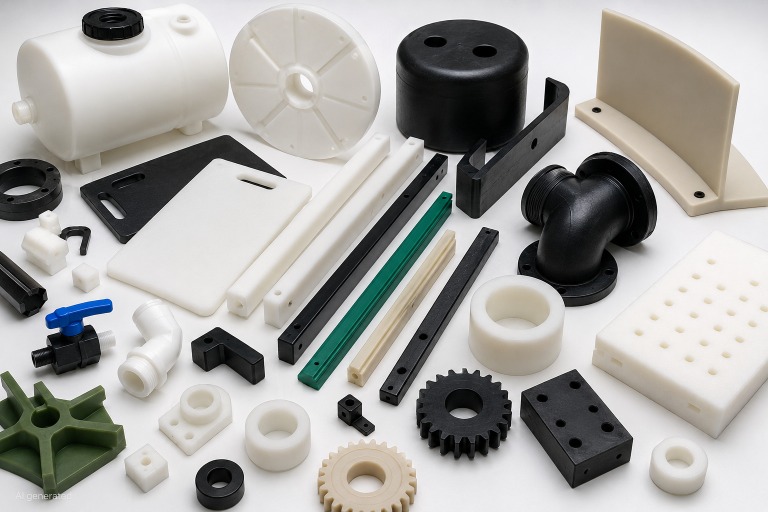
(AI generated) HDPE components
Industrial Components
HDPE plastic is used extensively for industrial wear parts, guide rails, conveyor components, rollers, spacers, and structural panels in applications where chemical exposure, moisture, and impact loading are common. Industrial HDPE material handles the rough service of manufacturing and processing environments without the brittleness or chemical vulnerability that some higher-performance engineering plastics exhibit.
Food Processing Equipment
Food-grade HDPE sheet is the material of choice for cutting boards, food contact wear strips, conveyor guides, and food processing equipment components because it meets FDA food contact requirements, has near-zero moisture absorption that prevents bacterial growth in cracks and pores, and is easy to clean. The material doesn't absorb odors or flavors, doesn't corrode, and doesn't react with food acids or processing chemicals. HDPE plastic in food processing applications is as much a food safety decision as an engineering one.
Outdoor and Marine Applications
UV-stabilized HDPE material is used for dock fenders, marine hardware, outdoor playground equipment, outdoor furniture, agricultural components, and outdoor storage. The combination of UV resistance (in stabilized grades), impact toughness, moisture resistance, and no corrosion makes HDPE a common choice for outdoor applications where metals would corrode, untreated wood would rot, and less impact-resistant plastics would crack in cold weather. HDPE sheet in marine environments handles saltwater exposure without degradation.
Chemical Handling and Storage
HDPE plastic's broad chemical resistance makes it standard in chemical storage tanks, pipe systems for chemical handling, laboratory bench liners, secondary containment systems, and chemical processing equipment. The material handles dilute acids, alkalis, and most industrial solvents without swelling, degrading, or losing structural integrity. For chemical handling applications requiring FDA compliance or food-safe certification, food-grade HDPE material meets both the chemical resistance and regulatory requirements simultaneously.
Design Considerations for HDPE Parts
Wall Thickness and Part Geometry
Minimum wall thickness for machined HDPE plastic parts depends on the structural requirement. For non-load-bearing panels and covers, 4-6mm is adequate. For parts carrying load or needing rigidity, 10mm or above is more appropriate, and ribbing on reverse faces significantly improves stiffness without adding material to the full wall. The material's relatively low stiffness means parts require more wall thickness than equivalent Delrin or nylon components.
Avoid deep narrow slots in HDPE plastic, the walls deflect during machining, producing dimensional errors in the finished slot. Where deep narrow features are required, rough cut and allow the material to relax before taking finishing passes.
Tolerances and Dimensional Stability
Standard machining tolerances achievable in HDPE material are ±0.1-0.25mm for most features. Tighter tolerances are possible with careful fixturing and multiple light finishing passes, but the material's thermal expansion and slight resilience under cutting forces make sub-0.05mm tolerances on HDPE sheet challenging to maintain consistently.
Temperature during machining matters for tight tolerance HDPE work, elevated temperatures from machining expand the part, and measurement immediately after machining produces different readings than measurement after thermal equilibration. Measure at a consistent temperature and allow parts to equilibrate before final inspection.
Assembly and Fastening Methods
Mechanical fastening with screws, bolts, and rivets is the standard assembly method for HDPE plastic parts. Threads machined into HDPE material hold adequately for coarse, large-diameter threads, use threaded inserts for fine thread connections and any application involving repeated assembly and disassembly. The material's resilience means threads tend to creep slightly under sustained load rather than holding the rigid contact that metal threads provide.
Adhesive bonding of HDPE is difficult without surface treatment because HDPE material's low surface energy prevents conventional adhesives from wetting the surface properly. Surface treatment options include flame treatment, corona treatment, or plasma treatment, all of which oxidize the surface and increase surface energy enough for adhesive bonding to work reliably. Without treatment, adhesive joints on HDPE plastic are unreliable under load.
Welding HDPE is viable using hot plate, butt fusion, or extrusion welding methods with compatible HDPE welding rod. Properly executed HDPE welds approach the parent material strength.
Tight tolerances aren't always necessary and can significantly increase machining costs.
FAQs About HDPE
Q: What is HDPE used for?
HDPE plastic is used for cutting boards, food processing equipment, chemical storage tanks, marine dock fenders, outdoor playground equipment, pipe systems, conveyor components, industrial wear parts, and agricultural applications.
Q: Is HDPE easy to machine?
Yes. HDPE is one of the more user-friendly engineering plastics for CNC machining. It cuts cleanly with standard tooling, doesn't require coolant in most operations, and produces manageable chips. The main challenges are the material's tendency to flex in thin sections under cutting forces and its relatively high thermal expansion. Standard milling, turning, drilling, and routing operations all work well on HDPE sheet and HDPE material billet.
Q: What are the advantages of HDPE over other plastics?
HDPE plastic's main advantages are near-zero moisture absorption (keeping dimensions stable in wet environments), broad chemical resistance, high impact toughness, FDA compliance in food-contact grades, and low cost compared to most engineering plastics. HDPE material is particularly advantaged over nylon in wet environments and over more brittle materials in impact-loading applications.
Q: Can HDPE sheets be CNC machined?
Yes. HDPE sheet is a standard CNC machining stock material. Standard sheet sizes in thicknesses from 1.5mm to 100mm+ are available for machining flat components, and HDPE billet stock is available for 3D machined components. HDPE sheet machines cleanly on standard CNC milling and routing equipment with sharp carbide tooling.
Q: Is HDPE suitable for outdoor use?
UV-stabilized HDPE material is well-suited for outdoor use. Standard HDPE without UV stabilizers degrades in prolonged sunlight exposure, becoming brittle over time. UV-stabilized HDPE sheet specified for outdoor applications includes additives that significantly extend service life. HDPE's moisture resistance, impact toughness, and non-corrosive nature make it generally suitable for outdoor and marine environments when the correct grade is specified.
Keep Learning
Plastic CNC Machining: Guide to Materials, Machines & Cutting Strategies
Understanding Plastic CNC Machining When most people think of CNC machining, metals come to mind first, aluminum, steel, titanium. But plastic CNC machining has quietly creeped into many industries. Why? Because plastics are lightweight, versatile, and cost-effective, making them an ideal option for places where the best performance is needed on the best budget. CNC for plastic is now as common as CNC for metal. At JLCCNC, we don't just work with metals, we also provide CNC machining of plastic parts ......
Polycarbonate vs Acrylic for CNC Parts: Strength, Machining & Material Selection
Quick Comparison: Polycarbonate vs Acrylic Property Polycarbonate Acrylic Tensile strength 55–75 MPa 70–80 MPa Impact resistance 600–900 J/m (notched Izod) 15–30 J/m Flexural modulus 2.1–2.5 GPa 3.0–3.3 GPa Light transmission 88–90% 92–93% Heat deflection temp approximately 110–130°C depending on grade and test condition 75–100°C Chemical resistance Moderate. attacked by solvents Good. resists most common chemicals Machinability Good. tends to melt at edges Excellent. clean chips, sharp edges UV resis......
Acrylonitrile Butadiene Styrene: Properties, Types, and Applications
Key Takeaways ABS can provide useful service performance at moderately elevated temperatures, with the actual continuous-use and heat-deflection limits depending on grade, loading, and service conditions. It's an amorphous terpolymer whose properties come from the combination of three monomers: acrylonitrile contributes chemical resistance and stiffness, butadiene provides impact toughness, and styrene gives the material its processability and surface finish. ABS plastic provides moderate heat resista......
Polycarbonate CNC Machining: Properties, Design Guidelines, and Manufacturing Considerations
Key Takeaways About Polycarbonate CNC Machining Polycarbonate is used for clear guards, covers, housings, and inspection parts where visibility and protection matter in use, not just on drawings. Different machining materials or grades behave differently during cutting and show up mainly in surface clarity and edge condition. Heat from cutting affects surface marks more than the strength of the material itself. Thin walls and wide flat areas are where most surface issues start during machining. Tool s......
Acetal (POM) Plastic: Properties, Uses & Material Selection
Key Takeaways Acetal (POM) is a semi-crystalline engineering thermoplastic with high stiffness, low friction, excellent dimensional stability, and outstanding machinability. POM material comes in two main types, homopolymer (POM-H, Delrin) and copolymer (POM-C), with slightly different property profiles suited to different applications. Acetal plastic properties include tensile strength of 60-75 MPa, very low moisture absorption (0.2%), and a coefficient of friction of 0.1-0.3 against steel without lu......
What Is a Composite Material? Types, Properties, Examples, and Applications
Key Takeaway A composite material is an engineered material made from two or more constituent materials with different properties that, combined, produce a material with superior or unique characteristics neither component has alone. The main types of composite materials are classified by matrix (polymer, metal, ceramic) and by reinforcement form (fiber, particle, sandwich). Composite material properties are directional, they vary depending on fiber orientation, which is both an advantage for optimiza......