MAG Welding: Process, Advantages, MIG Comparison, and Applications
16 min
- What Is MAG Welding?
- Why MAG Welding Is Used in Sheet Metal Fabrication
- Typical Applications of MAG Welding in Sheet Metal Parts
- When MAG Welding Is Not the Best Choice
- MIG vs MAG Welding: Key Differences in Sheet Metal Fabrication
- MAG Welding in Integrated Sheet Metal Fabrication
- FAQ
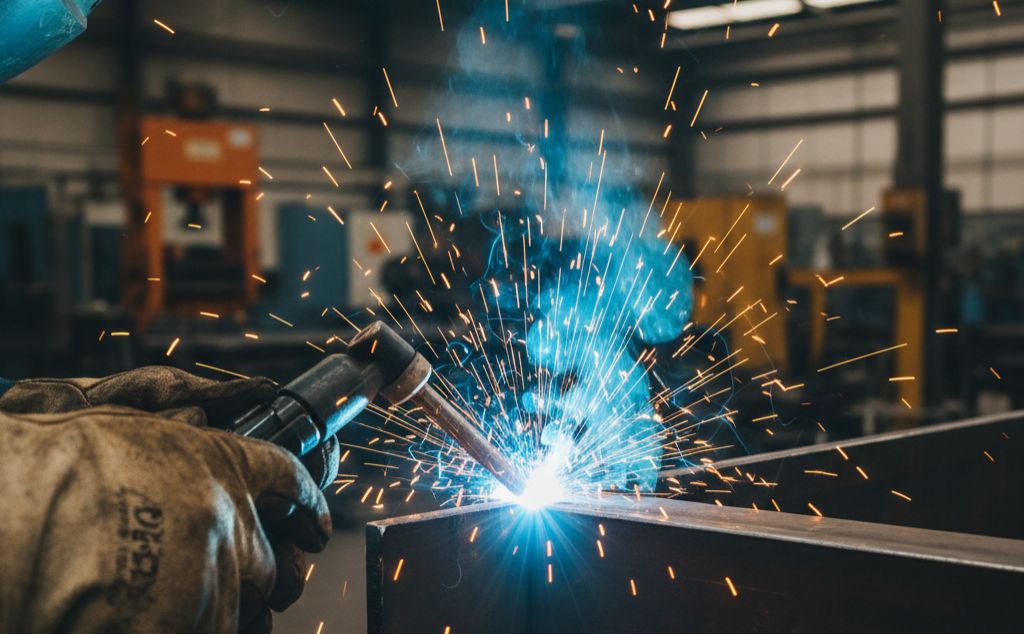
(AI generated) MAG welding process on steel sheet metal using active shielding gas in an industrial fabrication workshop
The MAG welding (Metal Active Gas welding) process uses a continuously fed wire electrode and an active shielding gas that participates in the arc chemistry, which distinguishes it from other welding processes. The active shielding gas distinguishes MAG welding from MIG welding, contributing to its superior performance on carbon steels and low-alloy steels.
MAG welding is widely used in industrial steel sheet metal fabrication, especially in medium- to high-volume production environments where speed, joint strength, and repeatability matter more than cosmetic appearance.
In practical manufacturing environments, it is often chosen for carbon steel parts that require reliable penetration, consistent fusion, and predictable cycle times across large production batches. When production efficiency and structural performance are the priority, MAG welding is frequently the practical choice.
What Is MAG Welding?
MAG welding (Metal Active Gas welding) is a gas metal arc welding (GMAW) process that uses a continuously fed wire electrode and active shielding gases, such as CO₂ or argon–CO₂ mixtures, to achieve deep penetration and strong fusion when welding carbon and low-alloy steels.
It uses a continuously fed wire electrode and an active shielding gas, such as CO₂ or argon–CO₂ mixtures. The active gas participates in the arc chemistry, increasing arc energy and penetration compared to inert-gas processes.
Because of this behavior, MAG welding is suited to steel applications where strong fusion and production efficiency are required.
This is where the distinction between MIG and MAG welding becomes unclear. On the floor, the machines look the same, but the shielding gas composition fundamentally changes arc behavior and penetration characteristics. Using inert gas (MIG) on heavy steel is generally less effective than MAG welding for achieving consistent penetration and productivity; you need that active gas (MAG) to actually bite into the carbon steel.
That’s exactly the kind of work JLCCNC is set up for. We run production-grade MAG welding as part of a full sheet metal workflow, cutting, bending, fixturing, and welding all under one roof, so steel parts don’t just get welded, they come out square, strong, and ready to assemble.
Why MAG Welding Is Used in Sheet Metal Fabrication
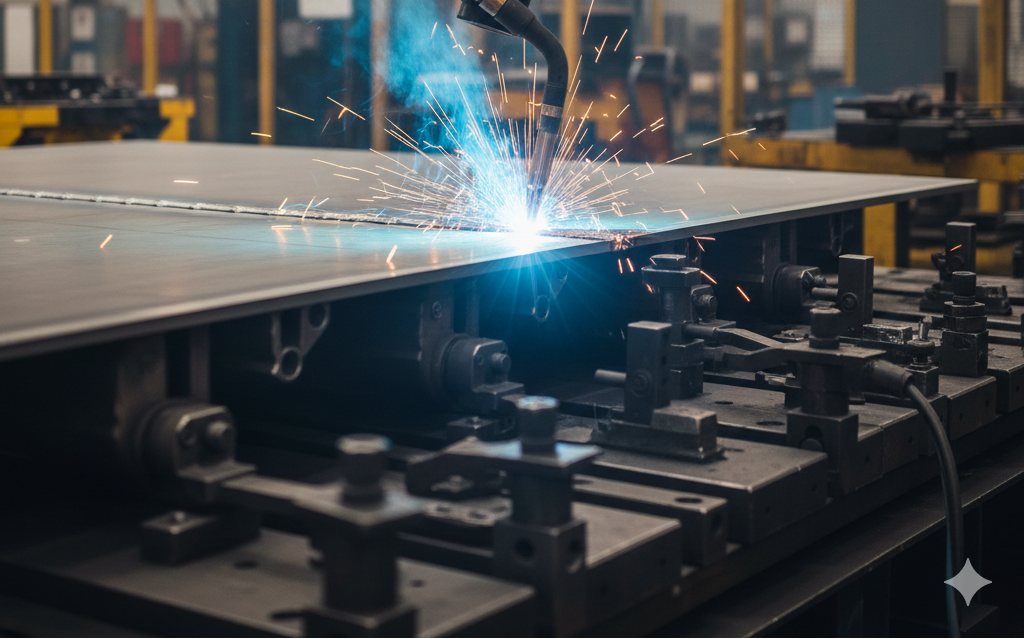
(AI generated) High-productivity MAG welding used for strong steel sheet metal fabrication in production environments
In many high-volume steel fabrication environments, MAG welding is a baseline process. In steel sheet metal fabrication, MAG welding is often chosen because it supports high-throughput production while still delivering structurally reliable joints.
For load-bearing parts, frames, and functional assemblies, the process allows manufacturers to maintain consistent weld quality without sacrificing cycle time or driving up per-part cost. This makes MAG welding a practical baseline process for many production environments, as opposed to a specialized or niche solution.
Strength and Penetration Characteristics
Adequate penetration cannot be achieved through appearance alone and depends on arc energy and gas chemistry. It’s not just about a clean bead; that active gas mix actually forces the heat into the root of the joint. On medium-gauge brackets or frames, you’re getting full fusion in one shot without babying the arc. If you’re building enclosures that are going to get rattled by vibration or heavy stress, you need that depth. While bead appearance may be less uniform, the resulting weld provides reliable mechanical strength under service loads.
It’s also more forgiving than processes like TIG. Slight gaps, small inconsistencies in edge prep, or minor misalignment don’t immediately ruin the weld, which is important in real production, not ideal lab conditions.
Productivity Benefits for Medium-to-Thick Steel Sheet Metal
From a production standpoint, MAG welding offers high efficiency for steel sheet metal fabrication. The continuous wire feed means there’s no stopping to change electrodes, and travel speeds are high compared to TIG.
On medium-to-thick steel sheet metal, this translates directly into shorter cycle times. Operators can run longer welds in a single pass, and automated or robotic setups can repeat those welds with very little variation. That’s why MAG is the default choice in automotive and industrial fabrication lines.
It also scales well. The same process works for manual welding, jigs, fixtures, and full robotic cells, which makes it easier to standardize across different parts and production volumes.
Cost Efficiency for Structural and Functional Assemblies
MAG welding is cost-effective because everything around it is efficient. Consumables are inexpensive, shielding gases are readily available, and deposition rates are high. You’re putting more metal into the joint per hour compared to slower, more controlled processes.
At the end of the day, you’re paying for the clock. Faster arc time and skipping the fancy post-weld cleanup is how you actually keep the cost per part from spiraling. For structural steel components where weld appearance is not critical, MAG welding provides a cost-effective and reliable solution.
If you’re designing steel parts that need real penetration, repeatable strength, and predictable costs at volume, this is where working with an experienced fabrication partner matters. MAG welding isn’t forgiving of poor prep or bad sequencing, and getting it right early saves redesigns later.
This is the point where many teams choose to get a quick quote from a shop that already understands steel behavior, weld pull, and tolerance stacking.
Typical Applications of MAG Welding in Sheet Metal Parts
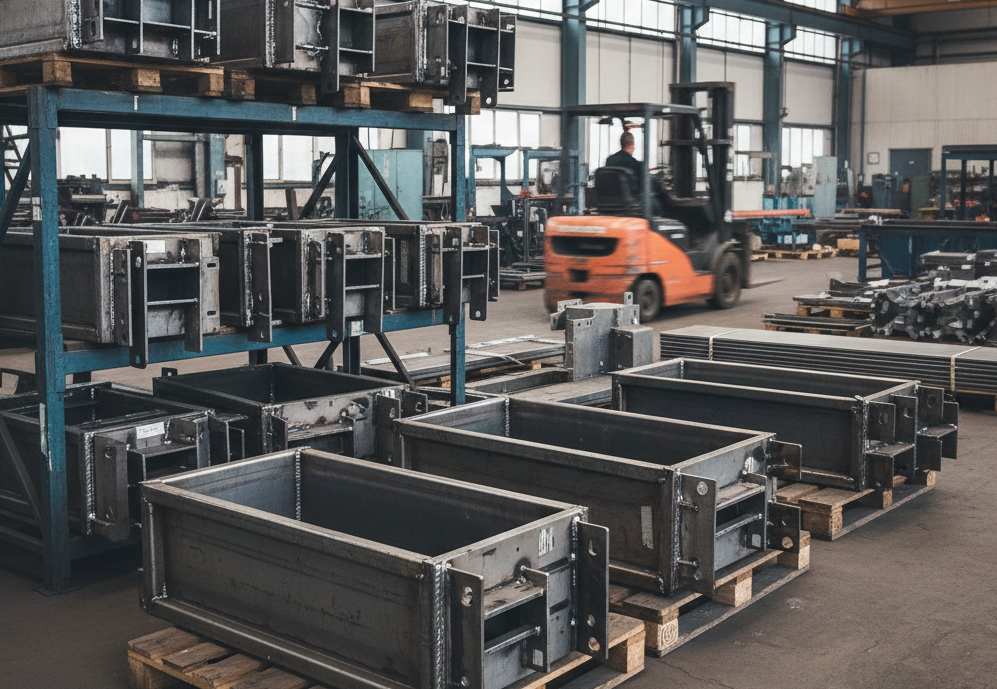
(AI generated) MAG welded steel sheet metal frames and enclosures used in industrial and structural applications
MAG welding is commonly used for steel sheet metal parts that require high-strength joints and efficient production at scale. It’s about building assemblies that hold shape, carry load, and survive real use.
Structural Frames and Load-Bearing Assemblies
This is where MAG welding demonstrates its strengths in structural applications. Steel frames, supports, bases, and load-bearing brackets rely on consistent penetration and solid fusion more than perfect bead appearance. MAG handles fillet and corner joints extremely well, which is exactly what most structural sheet metal assemblies are built from.
It is commonly used in equipment frames, racks, supports, and welded sub-assemblies where strength and repeatability are required. The process tolerates small variations in joint fit-up, which is unavoidable in larger steel structures, and still produces reliable welds without slowing production.
Enclosures, Brackets, and Welded Sheet Metal Frames
When you’re staring at a pile of mild steel enclosures, control cabinets, or heavy machine guards, the priority is mechanical strength and enclosure integrity rather than weld appearance. These housings are usually cut, bent, and assembled under production conditions, and MAG is what actually keeps the line moving. It gives you more than enough strength to handle the weight of the components inside without the heat-soak issues you'd get from slower processes. It’s the sweet spot for getting a housing built fast enough to be profitable while ensuring it won’t fall apart under vibration.
MAG welding works well here because it balances speed with adequate weld strength. Brackets and frames often need multiple short welds across different edges, and the continuous wire feed makes these operations efficient without frequent stops. In production environments, this keeps labor time down while maintaining consistent joint quality.
Surface finish usually isn’t the priority in these applications. Strength, alignment, and dimensional stability come first, which suits MAG welding perfectly.
Machinery and Industrial Sheet Metal Components
In heavy machinery, MAG is the backbone. We aren't talking about cosmetic skins or 'pretty' covers; we’re talking about the mounts, conveyor supports, and structural panels that actually hold the system together. These parts are under constant fire from vibration and mechanical load. You use MAG here because you need that deep, gritty fusion that can take a beating without cracking. When you're welding a machine base or a structural rib, you aren't looking for an art piece, you’re looking for a joint that’s going to stay rock-solid for the next ten years of three-shift operation.
These components often see vibration, impact, and repeated loading. MAG welds provide the penetration and fusion needed to handle those conditions without excessive post-processing. The process also integrates easily with automated welding, which is why it’s common in high-volume industrial equipment manufacturing.
When MAG Welding Is Not the Best Choice
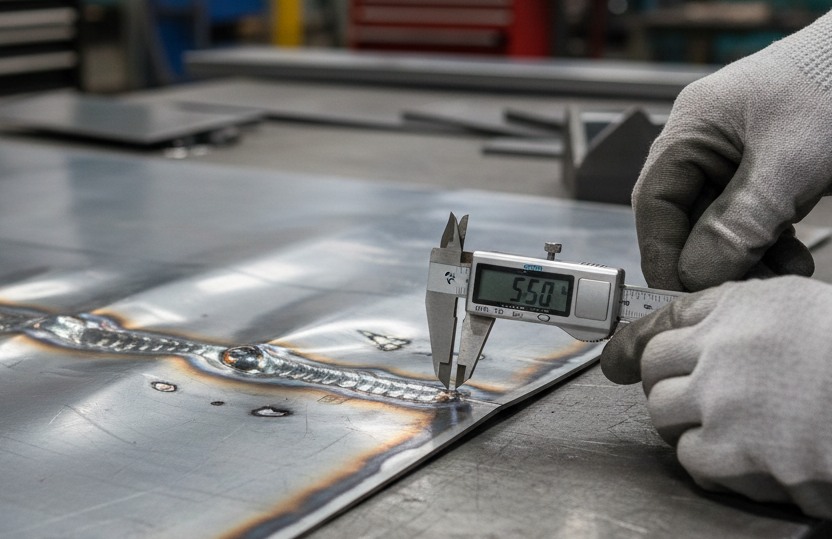
(AI generated) Thin steel sheet distortion caused by excessive heat during MAG welding
MAG welding is not a universal solution. There are plenty of situations in sheet metal fabrication where it introduces more problems than it solves, mainly because of heat input, bead size, and control limitations. Many of the distortion issues seen in MAG welding are closely related to the same forming stresses and material behavior that cause bending defects in sheet metal parts.
Thin Sheet Metal and Heat Distortion Risks
MAG welding delivers high arc force and heat input, which can be excessive for thin-gauge sheet metal applications. Once that thickness drops, the heat input becomes a liability. Operators must carefully balance heat input to avoid lack of fusion or burn-through. Even if you stay on the line, distortion becomes the primary limiting factor. A panel that was flat a minute ago can curl or warp significantly during cooling, and suddenly you're wasting hours on a straightening bench. When dimensional accuracy is the goal, MAG’s high travel speed can become counterproductive if distortion control is not properly managed, as post-weld straightening may offset time savings.
Appearance-Critical or Precision Weld Requirements
If the weld is visible and expected to look clean without heavy grinding, MAG is rarely the best option. The process produces wider beads and more spatter compared to finer welding methods. You can clean it up, but that usually means extra grinding, blending, and finishing.
Precision-sensitive components also suffer here. MAG offers less control over the weld pool than TIG or laser welding, making it harder to place small, exact welds without affecting surrounding material. When tolerances are tight, that lack of control becomes a real risk.
Situations Better Suited for TIG or Laser Welding
When the job calls for surgical precision, TIG is the only way to go. It’s built for the 'clean' work, thin-gauge sheets and visible seams where you can’t afford any splatter or messy cleanup. You’re trading speed for total control, ensuring the bead looks as good as it holds.
If you need to push that precision even further, laser welding is the real deal. It’s all about a 'cold' weld; the heat input is so concentrated and low that you barely give the metal a chance to warp or distort. For high-end panels or enclosures that have to stay perfectly true to the CAD model, laser outclasses MAG every time. The upfront cost for the gear is steep, but it pays for itself the first time you realize you don't have to spend three hours fixing a 'potato-chipped' frame.
MIG vs MAG Welding: Key Differences in Sheet Metal Fabrication
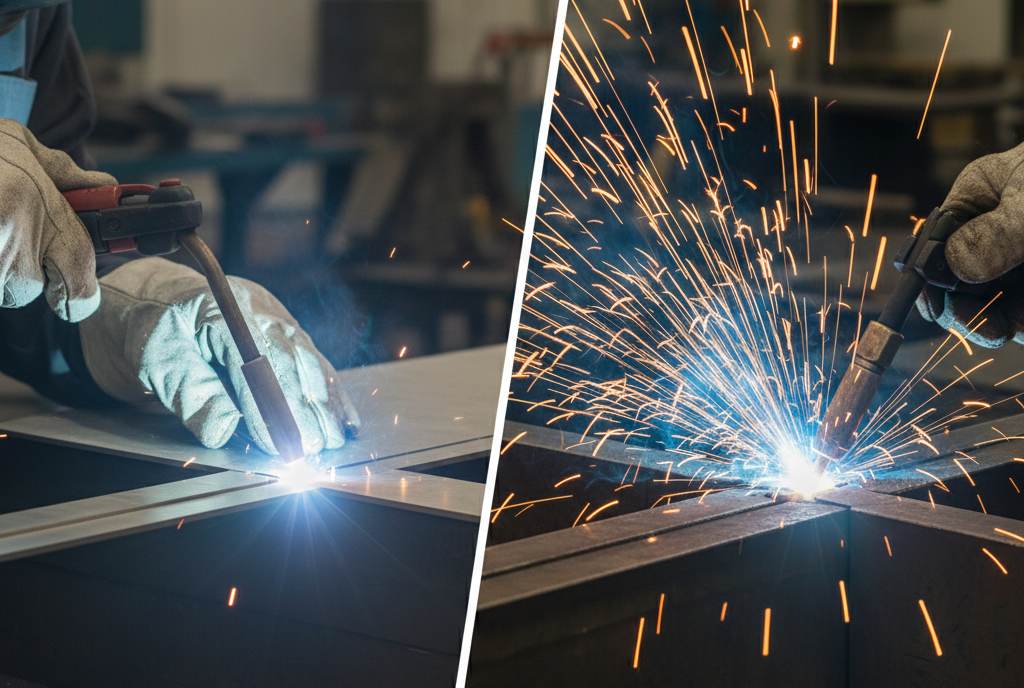
(AI generated) Visual comparison of MIG and MAG welding processes on aluminum and steel sheet metal
MIG and MAG welding are often grouped together because they use the same basic equipment and fall under the broader GMAW family. In practice, the difference comes down to shielding gas behavior, how the arc interacts with the material, and what kind of sheet metal work each process is actually suited for on the shop floor.
This same process-selection logic shows up elsewhere in manufacturing too, for example when teams weigh sheet metal fabrication against CNC machining depending on strength, volume, and cost targets.
Shielding Gas: Inert vs Active Gases
This is the real dividing line.
The 'I' in MIG stands for Inert, and that's the key. When you're working with finicky stuff like aluminum or stainless, you need a gas like pure Argon that stays out of the way. It keeps the arc predictable and clean so you don't contaminate the pool.
MAG is a different animal because that gas is 'Active', it’s actually getting in there and messing with the chemistry. By mixing in a little CO2 or Oxygen, the active gas increases arc energy and penetration. That’s why MAG is the king of carbon steel fabrication; it forces the fusion to go deep where a pure inert gas might just let the weld sit on the surface. This results in shallower penetration for MIG and deeper fusion for MAG under comparable conditions.
Weld Penetration, Spatter, and Arc Stability
MAG welding process generally produces deeper penetration than MIG. The active gas increases arc energy and helps drive the weld into the base metal, which is ideal for structural and load-bearing steel parts.
The trade-off is spatter. MAG welding creates more spatter and a slightly rougher bead profile, especially with higher CO₂ content. Arc stability is still good, but it’s more aggressive than MIG.
MIG welding produces cleaner welds with less spatter and a smoother bead. The arc is very stable, but penetration is shallower, which can be a limitation on thicker steel sections unless multiple passes are used.
This is why MIG is preferred when weld appearance matters, while MAG is chosen when strength and fusion matter more.
Material Types and Thickness Ranges
In the end, it’s all about the material and the gauge. If you’re pushing carbon steel or heavy plate through a production line, MAG is your workhorse. It’s built for those 'get it done' industrial parts where you need the weld to bite deep and you need to lay down a lot of metal fast.
But the second you move to aluminum, stainless, or the really thin stuff, MIG takes over. You’re moving away from raw power and toward finesse. It’s the go-to for enclosures or visible panels where you can't afford to burn through the metal or spend all day grinding down ugly splatter. You’re choosing control and a clean finish over pure, high-speed penetration.
MAG Welding in Integrated Sheet Metal Fabrication
MAG welding works best when it’s not treated as a standalone step, but as part of a full sheet metal workflow. Cutting accuracy, bend consistency, and fixture design all directly affect weld quality, distortion, and final assembly fit.
Combining MAG Welding with Cutting and Bending Processes
In integrated fabrication, MAG welding usually comes after laser cutting or turret punching and bending. Poor cutting quality directly limits achievable weld quality. If your laser or punch leaves a heavy oxide layer or a ragged burr, this increases the risk of porosity and inconsistent penetration.
Bending is where the real headaches start, though. Since MAG is going to shrink and pull the metal anyway, you can't afford to start with a flange that's already off by a degree. If your bend radii or gaps are sloppy, the weld heat is just going to amplify that error. A good shop doesn't just weld, they 'aim' the weld. They control the upstream tolerances so that when the metal naturally shrinks and pulls, it actually pulls the part into spec, not into the scrap bin.
This is why MAG welding pairs well with laser-cut steel parts and press brake bending, the repeatability upstream keeps welding predictable.
Post-Weld Alignment, Tolerance, and Assembly Considerations
MAG welding puts real heat into the part. That means distortion is expected, not optional. Integrated workflows plan for this.
Fixtures, tack weld sequencing, and controlled weld order are used to keep assemblies square. For tighter tolerances, parts may be welded slightly “out of position” on purpose, knowing they’ll pull back during cooling.
Post-weld steps often include straightening, stress relief for critical parts, or light machining on mating surfaces. If a design requires tight flatness or precision alignment after welding, that needs to be decided before the first cut, not after the weld is done.
Typical Integrated Sheet Metal Fabrication Scenarios
When you’re looking at heavy frames, ribbed brackets, or machine bases, you have to stop thinking about the weld as an isolated step. In a real shop, cutting accuracy, bending precision, and welding heat input interact directly. MAG is the glue that makes the whole assembly work. The priority is structural stability and long-term performance under vibration, rather than cosmetic weld appearance. It’s about making sure that after the heat is gone, the bolt holes still line up and the structural ribs actually carry the load they were designed for. This makes MAG welding a cost- and time-efficient alternative to TIG for structural steel assemblies.
MAG welding works best when it’s part of a bigger picture, not a last-minute operation bolted onto a design. When cutting accuracy, bend consistency, fixturing, and weld sequencing are aligned, steel parts go together cleanly and stay that way in the field.
If you’re ready to move from “it should work” to production-ready steel assemblies, JLCCNC can quote your sheet metal parts with MAG welding included, fast, transparent, and engineered for real-world use. Upload your files, get pricing quickly, and let the manufacturing details stop being your problem.

FAQ
What is MAG welding and how does it differ from MIG?
MAG welding uses active shielding gases, such as CO₂ or argon–CO₂ mixtures, which influence arc behavior and penetration. MIG uses inert gases and produces cleaner but less penetrating welds.
When should MAG welding be used for sheet metal parts?
When welding carbon steel parts that need strength, good fusion, and efficient production, especially for structural or load-bearing assemblies.
Can MAG welding be used on thin steel sheets?
Yes, but with careful control of heat input and joint design. Thin sheets are more prone to burn-through and distortion, so lower heat input and proper joint design are critical.
How do you choose shielding gas for MAG welding?
Higher CO₂ content gives deeper penetration and more spatter. Argon-CO₂ mixes balance penetration, arc stability, and weld appearance.
MAG vs TIG welding: which is better for precision steel components?
TIG is better for appearance and tight control. MAG is better for strength, speed, and production efficiency on steel parts.
Popular Articles
• 9 Sheet Metal Cutting Problems and Solutions
• Hole cutting in sheet metal: techniques, tolerances and applications
• Introduction to Sheet Metal Processing: Techniques and Tools for Precision
• Bending and Forming Technology in Sheet Metal Processing
• Laser cutting technology in sheet metal processing
Keep Learning
Galvanized Sheet Metal: Grades, Specs & When to Use It
Galvanized Sheet Metal: Grades, Specs & When to Use It A design engineer specs "galvanized sheet metal" on a drawing and sends it out for quotes. Three shops come back with three different prices, and one of them asks a follow-up question the others didn't: which gauge, which coating class, hot-dip or electro-galvanized? That question is the difference between a part that survives outdoors for fifteen years and one that starts showing rust spots after eighteen months — and it's the kind of detail that......
Custom Sheet Metal Fabrication: How the Process Works From Design to Delivery
Custom Sheet Metal Fabrication: How the Process Works From Design to Delivery A stock enclosure almost fits. The mounting holes are close but not quite right, the depth is half an inch too shallow, and the vendor's next size up is twice the volume you actually need. This is the point where most people start looking into custom sheet metal fabrication — not because they set out to design a part from scratch, but because nothing off the shelf actually solves the problem. Custom fabrication sounds like i......
Sheet Metal Assembly: How Fabricated Parts Come Together
Sheet Metal Assembly: How Fabricated Parts Come Together Cutting and bending gets a lot of attention because that's where a flat sheet visibly turns into a 3D part. But a single bracket by itself rarely finishes the job — most real sheet metal products are assemblies, multiple formed pieces joined into one working unit, and that assembly step is where a lot of designs quietly succeed or fail. A part that measured perfectly on its own can still not fit once it's supposed to mate with three other pieces......
Sheet Metal Bender: Types, Specs & How to Choose the Right Machine
Sheet Metal Bender: Types, Specs & How to Choose the Right Machine Every sheet metal bracket, enclosure, and panel eventually passes through a bender of some kind — that's the machine, not the process. Our guide on sheet metal bending covers how bending actually deforms metal — springback, minimum radius, bend allowance, and the core press brake and CNC press brake setups most shops run. This one goes further into the equipment side specifically: the less common bender types beyond the standard press ......
What Is Galvanized Metal? Process, Types & How It Works
What Is Galvanized Metal? Process, Types & How It Works Leave a piece of bare steel outside for a season and you'll see exactly why galvanizing exists. Rust doesn't wait for dramatic weather — a little humidity and a few weeks is enough to start eating into an unprotected surface. Galvanized metal solves that problem by giving steel a sacrificial layer of zinc that corrodes in its place, and it's done this job well enough that it's become the default choice for anything from highway guardrails to HVAC......
What Is Sheet Metal Fabrication? The Complete Guide
What Is Sheet Metal Fabrication? The Complete Guide Somewhere between a CAD file and a working enclosure sitting on your bench, a flat piece of metal gets cut, bent, joined, and finished into something that actually does a job. That's sheet metal fabrication — and if you've never ordered a part before, the term can feel bigger than it needs to be. Ask five people what "sheet metal fabrication" covers and you'll get five different answers: some think laser cutting, some think welding, some just picture......