Micro EDM Machining: Capabilities, Materials, and Applications for Precision Components
14 min
- What Is Micro EDM Machining?
- What Can Micro EDM Machine?
- Small Hole EDM Drilling Techniques
- Materials Suitable for Micro EDM
- Micro EDM Electrodes and Tooling
- Accuracy, Feature Size, and Process Capability in Micro EDM
- Surface Integrity in Micro EDM
- Advantages and Limitations of Micro EDM
- Design Considerations for Micro EDM
- Micro EDM vs Other Micro Manufacturing Processes
- Applications of Micro EDM Machining
- Micro EDM in Precision Manufacturing Projects
- When Should You Use Micro EDM?
- Conclusion About Micro EDM Machining
- FAQ About Micro EDM Machining
Key Takeaways About Micro EDM Machining
- Only electrically conductive materials can be machined.
- Hole diameters can reach below 50 μm on specialized equipment.
- The process produces almost no mechanical cutting force, making it suitable for thin or delicate features.
- Surface integrity still requires attention because recast layers and heat-affected zones may remain after machining.
- Micro EDM is often combined with CNC machining, with milling producing the main geometry before EDM finishes critical micro features.
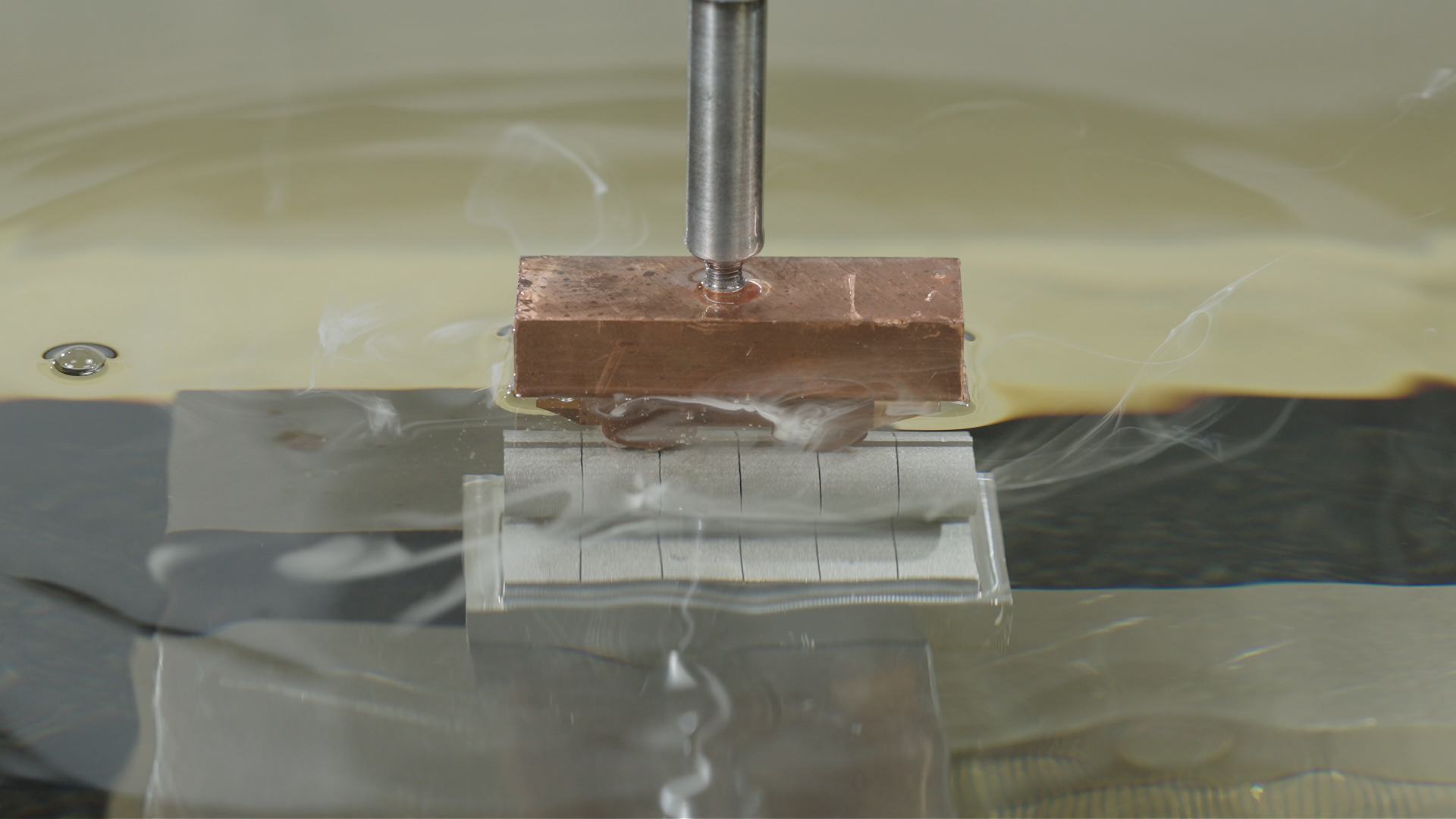
Micro EDM machining precision metal component
When a component needs detail beyond ordinary cutting, micro EDM machining provides you with a reasonable path. By using controlled electrical sparks, micro EDM allows manufacturers to create fine features in conductive materials as well as keep mechanical stress low.
What Is Micro EDM Machining?
Micro EDM refers to a machining methodology that removes material through controlled electrical discharges. This technique uses miniature electrodes and customized pulse settings in order to create small features on electrically conductive workpieces.
How Micro EDM Works
A shaped tool and the component remain apart through a narrow fluid gap. Pulsed voltage breaks the fluid path and removes minute areas through heat.
How Micro EDM Differs From Conventional EDM
Micro EDM machining uses lower pulse energy, finer tools, and tighter motion control than standard EDM. This makes it more suitable for miniature geometry than broad cavity removal.
What Can Micro EDM Machine?
Micro Holes and Small Hole Drilling
For very fine passages, small hole EDM can create round openings for flow paths, vents, nozzles, and cooling channels where ordinary drills may wander or break.
Narrow Slots and Fine Grooves
The process can also form slim slots, shallow channels, and fine grooves, all of which are examples of features in which the width is just as important as the length.
High-Aspect-Ratio Features
Since EDM pulses may extend narrow forms into the workpiece while reducing side pressure, they are useful in situations where a design requires depth but does not need a broad aperture.
Complex Micro Geometries
With shaped electrodes and consistent positioning, the same approach can produce small pockets, contours, and internal forms for precision assemblies.
Small Hole EDM Drilling Techniques
Micro drilling EDM is commonly used for precision holes where mechanical drilling may cause tool deflection or breakage.
What Is Small Hole EDM Drilling
Small hole EDM drilling uses a slender tubular electrode to make fine passages in metal parts. That might be done with flushing through the electrode to carry debris away.
Typical Hole Diameter Range
In micro hole EDM drilling, production holes are commonly between 0.1 and 1.0 mm, while specialized systems may produce holes below 50 μm, depending on equipment, electrode size, and part needs.
Deep Hole Drilling and Aspect Ratio Limits
Depth depends on flushing, debris removal, electrode wear, and straightness. Whenever the passage gets deeper, progress may slow, and taper may rise.
Through-Hole vs Blind Micro Holes
Through-holes pass all the way through the wall. Blind holes stop at a predetermined depth and need careful depth control near the end.
Industrial Use Cases for Small Hole EDM
This method is commonly selected for start holes, cooling passages, vent features, nozzle details, and hard-metal parts. This is especially useful when contact drilling risks tool breakage.
Materials Suitable for Micro EDM
In micro machining EDM, material hardness is less important than electrical conductivity and thermal response.
Tool Steels and Hardened Materials
Tool steels and hardened grades respond well once they carry electricity. Their hardness is less important than heat behavior and alloy mix, which guide spark erosion.
Carbide and Tungsten Alloys
Carbide and tungsten alloys are common when parts must resist wear. Their high melting point can slow removal. However, stiffness helps preserve fine edges.
Titanium and Nickel-Based Alloys
Titanium and nickel-based alloys need careful energy control during micro machining EDM. These alloys handle demanding service, though low heat flow may affect edge quality.
Other Conductive Materials
Stainless steel, copper alloys, cobalt alloys, and some advanced ceramics can also be machined when they allow electrical discharge. Each material needs tuned settings before production.
At JLCCNC, EDM machining capability supports precision features in conductive metals such as aluminum, steel, copper, and brass. The final process selection depends on geometry, tolerance, and production requirements.

Precision CNC Machining Service
Professional manufacturing, fast turnaround, and quality assurance.
Micro EDM Electrodes and Tooling
Electrode Materials
Material choice guides the whole job. For instance, copper conducts well. Tungsten holds its shape. Brass might be used for tube type drilling tools.
Electrode Wear in Micro Scale Machining
When the tool is worn down to this size, the final profile may be altered. The wear rate, offset, and inspection are all important factors to consider from the very first pass.
Tool Fabrication and Sharpening
It is possible to grind, dress, or etch rods or tubes before machining. The goal is an end shape that matches the drawing.
Electrode Design for Small Hole Drilling
For the micro drilling EDM process, tubular tools can help send fluid through the center. During fine passage work, this facilitates the clearance of debris.
Accuracy, Feature Size, and Process Capability in Micro EDM
Hole Diameter Range (Typical vs Best Case)
Most production holes remain within shop-approved ranges. Depending on the machine capability, electrode size, and material, micro EDM can produce holes from sub-millimeter sizes down to tens of microns.
Depth-to-Diameter Ratio Limits
As depth rises against diameter, flushing becomes harder. This is why professional EDM small hole drilling solutions focus heavily on debris removal, electrode stability, and discharge control.
Surface Finish Capability
Surface finish depends on discharge energy and finishing passes. Lower-energy finishing passes generally improve surface finish, although critical components may still require secondary processing.
Factors Affecting Precision
Accuracy depends on pulse setting, electrode shape, thermal behavior, fluid flow, servo response, and how well the component is held during machining.
Common Sources of Variation
Variation might come from electrode wear, debris that gets trapped in the cut, taper, runout, recast layer, or measurement error after the part leaves the machine.
Surface Integrity in Micro EDM
Micro EDM removes material without cutting force, but every discharge still leaves a thermal footprint on the workpiece. Surface quality, therefore, depends on more than dimensional accuracy. Surface condition usually becomes part of the inspection plan before a fuel nozzle enters flow testing. Mold inserts may need polishing after EDM, while some medical components require additional surface verification before assembly.
Recast Layer and Heat-Affected Zone
A small amount of molten metal does not leave the discharge gap. It solidifies again on the surface after the spark ends, forming what is known as the recast layer. Directly beneath it lies a very shallow heat-affected zone where the material has experienced rapid heating and cooling.
The thickness is usually measured in micrometers rather than tenths of a millimeter. It changes with discharge energy and also with flushing quality. Rough machining generally leaves a thicker layer, while finishing passes remove part of it before final inspection.
Micro Cracks and Surface Defects
Surface cracking is not expected on every part. It becomes more of a concern when machining cemented carbide or hardened tool steel with aggressive machining parameters. Poor flushing can make the situation worse because molten material remains in the discharge gap longer than intended.
For components exposed to cyclic loading, shops often reduce pulse energy during the final passes instead of trying to maximize the removal rate. The machining time increases a little, but the surface condition is usually more consistent.
Burr Formation and Cleaning
Mechanical burrs are rarely an issue in micro EDM because there is no cutting edge pushing material sideways. That is one reason the process is often selected for miniature holes or narrow slots where deburring would otherwise be difficult.
The work does not end after machining. Loose particles left by spark erosion have to be removed before inspection, especially inside deep holes where flushing becomes less effective as depth increases.
Secondary Finishing Operations
Not every micro EDM part goes directly into service. A sealing face may be ground after EDM if flatness is critical. Medical components are sometimes electropolished before cleaning and passivation. In mold manufacturing, however, the EDM surface may already satisfy the drawing after a fine finishing cycle, so no additional processing is required.
Advantages and Limitations of Micro EDM
Advantages of Micro EDM
Micro EDM is advantageous when the part is hard, fragile, or detailed. It can shape fine characteristics with low tool pressure and high dimensional control.
Limitations of the Process
The process demands conductive material, careful setup, and stable flushing. Cycle time might rise when features are deep, narrow, or highly detailed.
When Conventional Micro Machining Is a Better Choice
For soft alloys, open shapes, and larger batch work, mechanical micro milling or drilling may cost less. It also works well when cutter access is open and burr control is manageable.
Design Considerations for Micro EDM
Plan for Stable Flushing
Deep micro features are usually limited by debris removal rather than spark generation. As the discharge gap becomes narrower, eroded particles are more likely to remain between the electrode and the workpiece. Unstable flushing increases machining time and can also affect taper or surface quality.
When possible, avoid making extremely deep features from a single direction. In some cases, changing the machining direction or increasing the opening slightly improves flushing without affecting part function.
Leave Enough Space for Electrode Access
Every EDM feature requires a practical path for the electrode. A cavity may appear manufacturable in CAD but become difficult once surrounding walls restrict tool movement.
This is particularly important for miniature pockets and intersecting internal features. Reviewing electrode access during part design often avoids additional setups or custom electrode fabrication later.
Apply Tight Tolerances Selectively
Micro EDM is capable of producing very small features with high dimensional control, but not every surface requires the same level of accuracy.
Critical locating features may justify additional finishing passes or compensation for electrode wear. Relief grooves or clearance pockets often do not. Assigning tight tolerances only where assembly depends on them usually improves manufacturing efficiency without changing part performance.
Consider Inspection During Design
Very small features are not always difficult to machine, but they may be difficult to verify.
Some micro EDM features cannot be checked with standard gauges after machining. Deep holes may require optical measurement to verify diameter and taper. Very small cavities are often inspected under a microscope, while complex internal features sometimes require CT scanning. Adding suitable datum surfaces or inspection access during part design usually simplifies dimensional verification later.
Micro EDM vs Other Micro Manufacturing Processes
| Process | Best For | Material Compatibility | Feature Capability | Accuracy and Finish Notes | Main Limitations |
|---|---|---|---|---|---|
| Micro EDM | Fine cavities, micro holes, narrow slots, hard-metal details | Conductive metals and alloys | Small internal features and shaped profiles | High control on delicate geometry with low cutting pressure | Slower removal rate and careful electrode control |
| Mechanical Micro Drilling | Straight holes in machinable materials | Metals, plastics, and some composites | Round holes with drill-access geometry | Good option for open access and stable materials | Burrs, tool breakage, runout, and wear risk |
| Laser Micro Drilling | Thin sections, high hole counts, fine apertures | Metals, ceramics, glass, polymers, and more | Very small holes and patterned openings | Non-contact process with high speed potential | Heat-affected zone, recast layer, taper, and microcrack risk |
| Wire EDM | 2D profiles, slots, cutouts, and contour cuts | Conductive materials only | Through-cut shapes along a programmed path | Good edge control for hard materials and thin walls | Cannot make blind holes or enclosed cavities without wire access |
Applications of Micro EDM Machining
Medical Components
Medical teams use micro EDM machining for surgical tools, implant details, diagnostic hardware, and catheter related parts. Fine metal features need reliable repeatability.
Aerospace Components
Aerospace parts might need small cooling paths, sensor openings, and lightweight metal details. EDM helps produce these forms in alloys that can challenge contact cutting.
Electronics and Semiconductor Parts
In electronics work, the process can support connector features, probe components, micro cavities, and delicate conductive details around compact assemblies.
Precision Tooling and Mold Components
Tooling teams use EDM for inserts, dies, pins, punches, and molded part details. That is where sharp corners and fine internal profiles are needed.
Micro EDM in Precision Manufacturing Projects
Producing Features Beyond CNC Machining Limits
CNC can handle the main shape first. EDM adds fine details that cutting tools cannot reach. This keeps the workflow practical without having to force one process to do every task.
Combining CNC Machining and Micro EDM
A common route is to mill the blank, verify datum faces, and after that, move the part to micro EDM for the final micro features. Good fixture planning keeps both stages aligned.
Prototype and Low-Volume Production Applications
For early trials, this workflow allows engineers to test hard-to-machine details without investing in full tooling. It also supports low-volume parts when design changes may still happen.
Selecting the Right Process for Micro Features
Choose the route by access, material, tolerance, depth, and inspection needs. If cutters can reach the area, CNC may handle it. If not, EDM can complete the last detail.
When Should You Use Micro EDM?
- Use it when the part conducts electricity.
- Choose it for hard metal details.
- Use it for very fine hole work.
- Choose it when cutter force may bend the part.
- Use it when burr control is critical.
- Choose it for narrow slots and cavities.
- Use it when tool access is limited.
- Choose it for delicate production geometry.
- Use it when slower cycle time is acceptable.
- Choose another method for nonconductive parts.
Conclusion About Micro EDM Machining
Micro EDM becomes valuable when part features move beyond the practical limits of conventional cutting. Fine holes, narrow slots, high-aspect-ratio features, and delicate conductive materials are situations where spark erosion often provides a more reliable manufacturing route. The process is slower than conventional machining, but it offers capabilities that mechanical cutting cannot always achieve.
At JLCCNC, EDM is incorporated into the manufacturing plan only when part geometry requires it. Our engineering team evaluates whether micro EDM, wire EDM, sinker EDM, or conventional CNC machining is the most suitable process based on the feature geometry, material, tolerance requirements, and production volume. This helps ensure that each feature is produced using the method best suited to its manufacturing requirements.
Precision CNC Machining Service
Professional manufacturing, fast turnaround, and quality assurance.
FAQ About Micro EDM Machining
Q: What is micro EDM?
Micro EDM is a spark erosion method for making miniature details in current-carrying materials. Controlled pulses are used rather than cutter contact in this approach.
Q: How small can a micro EDM hole be?
It is possible to achieve micron-level holes using specialized equipment. The production size is determined by the electrode, the depth, the material, and the inspection plan.
Q: What is the difference between micro EDM and conventional EDM?
Conventional EDM commonly handles larger cavities or cuts. The micro version makes use of finer energy control, smaller tools, and closer motion guidance.
Q: What materials can be machined with micro EDM?
Any electrically conducting material may be considered. Common choices include hardened steel, carbide, titanium alloys, nickel alloys, and copper alloys.
Q: Is micro EDM more accurate than CNC machining?
Not necessarily. Micro EDM excels at producing fine conductive features that are difficult or impossible to machine mechanically, while CNC machining generally provides higher productivity and may achieve comparable or better accuracy on accessible features.
Q: Can micro EDM produce deep small holes?
Yes. It can produce deep, small-diameter holes. Depth depends on factors such as flushing, electrode stability, taper control, and the required wall quality.
Q: What industries use micro EDM?
Medical equipment, aircraft hardware, electronics, semiconductor tooling, molds, dies, and precision metal components are some of the applications that make use of this method.
Q: When should micro EDM be used instead of laser machining?
Employ it in situations where conductive metal requires a better level of edge control, fewer levels of thermal damage, or a hole profile that is more regulated than laser drilling.
Keep Learning
Laser Engraving Aluminum: Marking Methods & Surface Effects
Key Takeaways Laser engraving usually removes base material to create a recess. Laser marking is a broader term that can describe a surface-color change or material removal, so the process name alone does not define the final result. On aluminum, alloy and surface finish affect marking contrast. A light mark on dark anodized aluminum is a common design target, but the actual appearance depends on the finish and laser process. JLCCNC laser marking produces a recessed area 0.03–0.1 mm deep. The result i......
CNC Cutting Fluid: Types, Functions, Applications, and Selection Guide
Key Takeaways Cutting fluid in machining performs four functions simultaneously: cooling the tool and workpiece, lubricating the tool-chip interface to reduce friction, carrying chips away from the cut zone, and protecting machined surfaces from corrosion between operations. Different machining operations need different fluid priorities: high-speed aluminum milling may need adhesion control and chip evacuation, threading and tapping need strong lubrication, and grinding requires both cooling and fine ......
Blind Hole Machining Guide: What Is a Blind Hole, Types of Holes, and Tapping Tips
What Is a Blind Hole? Types of Holes and CNC Hole Machining Explained In CNC machining, few operations challenge process control and tool stability as much as blind hole machining. A blind hole is a hole that terminates at a defined internal depth rather than breaking through the opposite surface. Because the cavity is enclosed at the bottom, chip evacuation, thermal behavior, tool wear, and dimensional accuracy become far more difficult to manage compared to through-hole machining. These constraints ......
Rake Angle in Machining: Machinists’ Guide to Perfect Cuts
What is Rake Angle? (minaprem) If you've ever stood in front of a CNC machine or a manual lathe, you know that the cutting tool's geometry isn't just some arbitrary design. Every angle, edge, and surface has a job to do, and one of the most important of those is the rake angle. We've been running machines long enough to know that rake angle can make or break your surface finish, tool life, and machining efficiency. In this guide, we're going to walk you through what rake angle is, how it works, and ho......
Sheet Metal vs CNC Machining: A Guide to Choosing the Right Method for Your Metal Parts
Quick Answer: Choose sheet metal for uniform-thickness enclosures, panels, and formed brackets when bends and production volume support lower unit cost. Choose CNC machining for variable wall thickness, precision bores, tight feature relationships, and complex 3D geometry. Use a hybrid design when a formed structure needs precision-machined interfaces. A quote comes back for a bracket, and it's priced as a CNC part — machined from solid aluminum, a few hours of spindle time, a per-part cost that makes......
What Steps Are Taken To Minimize Waste In CNC Machining Processes?
How to Reduce Waste in CNC Machining: 5 Practical Strategies Quick Answer: CNC machining waste is reduced mainly through DFM, near-net stock, efficient toolpaths, preventive tool maintenance, and alloy-segregated recycling. The biggest gains usually come before cutting: reduce unnecessary material removal and prevent scrap or rework. Every CNC-machined part starts as more material than it ends up being. A pocket gets milled out, a profile gets cut away, a boss gets faced down to size — and all of that......