Sheet Metal Enclosure Design: Complete Guide to Materials, Thickness, and Manufacturing
25 min
- What Is a Sheet Metal Enclosure Design
- Key Considerations in Sheet Metal Enclosure Design
- How to Design a Custom Sheet Metal Enclosure (Step-by-Step)
- Choosing Materials for Sheet Metal Enclosures
- How to Choose Sheet Metal Enclosure Thickness
- Structural Design Features for Sheet Metal Boxes
- Thermal Management and Ventilation Design
- Sealing Design for IP-Rated Sheet Metal Enclosures
- Surface Finishing and Corrosion Protection
- Design for Manufacturability in Custom Sheet Metal Enclosures
- FAQs
What Is a Sheet Metal Enclosure Design
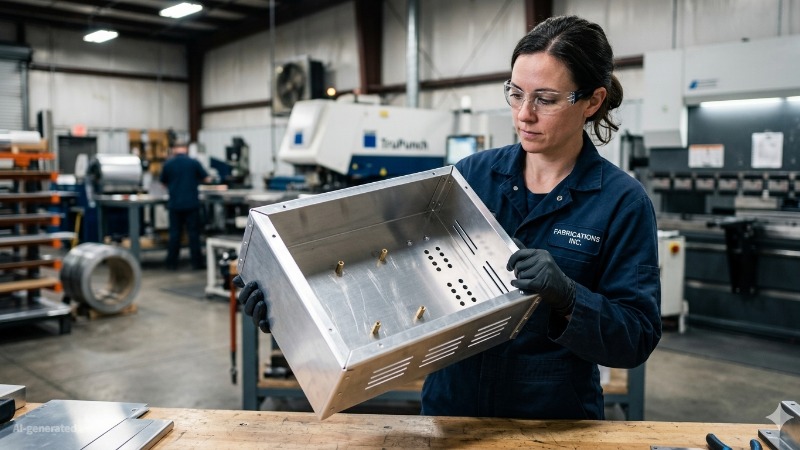
(AI generated) Technician holding an open sheet metal enclosure box with internal mounting features inside a modern fabrication workshop.
An enclosure is essentially the protective chassis for a system’s sensitive internals. Fabricators take flat sheet stock, cut and bend it, and then assemble a rigid housing to keep PCBs, drives, and wiring safe from environmental factors like dust or vibration.
These boxes are functional parts of the electrical design. They handle the grounding path and provide the EMI shielding required to keep the equipment running correctly. Proper grounding, conductive coatings, and controlled ventilation openings are often required to maintain EMI shielding performance. You'll run into them in nearly every sector—industrial control panels, medical devices, networking racks, and even EV chargers.
As automation and power electronics scale up, the demand for these fabricated housings is climbing. Industry reports show that the surge in electrical equipment production is trickling down directly to the fabrication floor. The material choice usually comes down to the environment: aluminum for weight and rust resistance, stainless for corrosive areas, and cold-rolled steel when the priority is structural strength and cost.
Many enclosure designs fail during fabrication because basic manufacturability rules get ignored. If you want a deeper breakdown of fabrication processes and cost drivers, see our guide on CNC machining vs traditional manufacturing methods.
Many companies that design a sheet metal enclosure eventually run into the same challenge. The design works in CAD, but turning it into real parts requires precise cutting, accurate bending, and reliable finishing.
That’s where JLCCNC comes in. JLCCNC provides professional custom sheet metal fabrication, CNC machining, and rapid manufacturing services for engineers, startups, and hardware companies. From early prototypes to full production runs, their manufacturing platform helps turn enclosure designs into finished metal parts quickly and reliably.
Whether you're building an electronics housing, an industrial control box, or a custom sheet metal enclosure, working with an experienced fabrication partner can dramatically reduce lead time and design headaches.
What Is an Enclosure in Sheet Metal Fabrication
In fabrication terms, an enclosure is simply a formed metal housing built from sheet stock.
The process usually starts with a flat sheet. A laser cutter or turret punch creates the blank and cuts features such as mounting holes, ventilation slots, and cable openings. After that, the part goes to a press brake where operators bend the sheet along programmed lines to form the walls of the enclosure.
At this stage the part already looks like a box, but fabrication isn't finished. Additional steps follow depending on the design. Hardware might be pressed into the sheet using PEM inserts. Panels may be welded together. Some parts get powder coating, anodizing, or bead blasting to improve durability and appearance.
Engineers often design the enclosure at the same time they design the electronics. Internal mounting points determine where circuit boards sit. Clearance space controls airflow and heat dissipation. Even cable routing depends on the enclosure layout.
The metal housing ends up defining the physical structure of the product.
Types of Sheet Metal Enclosure Designs (With Examples)
Several enclosure styles appear again and again in fabrication shops because they’re practical to manufacture.
One common design is the folded box enclosure. A single sheet forms the base and side walls through multiple bends. A removable lid attaches later with screws. This layout reduces assembly work and keeps the structure stiff.
Another design is the two-piece clamshell enclosure. Two formed halves come together to create the full housing. This style works well when technicians need easy access to internal electronics.
For networking and data infrastructure, engineers often use rack-mount enclosures. These follow standardized widths used in equipment racks. Mounting flanges allow the enclosure to bolt directly into a rack frame.
Heavy industrial equipment sometimes uses welded enclosures. Instead of fasteners, the corners are welded together to create a sealed structure. This improves durability in outdoor or high-vibration environments.
The choice mostly depends on assembly access, strength requirements, and production cost.
Sheet Metal Enclosure Applications in Industry
Sheet metal enclosures appear in a huge range of technical equipment.
Factories use them in industrial control panels. These panels contain PLC controllers, power distribution components, and motor drives. The enclosure protects the electronics from dust and mechanical damage while keeping everything electrically grounded.
Power electronics rely heavily on metal housings as well. Battery systems, inverters, and EV chargers generate heat and electrical noise during operation. The enclosure helps dissipate that heat and shields surrounding electronics from interference.
Telecommunications infrastructure also depends on metal housings. Networking switches and server hardware typically sit inside rack-mount sheet metal enclosures designed for structured equipment racks.
Medical equipment uses them too. Diagnostic machines, monitoring devices, and laboratory instruments require rigid housings that keep sensitive electronics protected and properly aligned.
According to market research from Grand View Research, the global sheet metal fabrication market continues to expand, with electronics housings representing a large share of fabricated components used in industrial hardware. As electronic systems become more complex and widely deployed, enclosure designs are increasingly required to meet defined protection and performance standards.
Many industrial and outdoor applications require IP-rated enclosures such as IP65 or IP67 to ensure protection against dust ingress and water exposure. In parallel, electromagnetic compatibility (EMC) requirements are becoming more stringent, requiring proper EMI shielding through conductive materials, grounding strategies, and controlled opening designs.
Manufacturing precision also plays a critical role. Typical sheet metal enclosure designs follow general tolerance standards such as ISO 2768, with bending tolerances, hole positioning, and flatness all affecting final assembly and sealing performance. These combined requirements make modern sheet metal enclosure design not only a structural task, but also a critical part of system reliability and compliance.
Key Considerations in Sheet Metal Enclosure Design
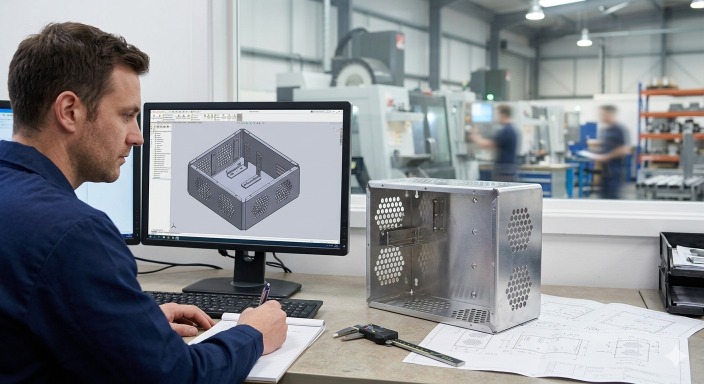
(AI generated) Engineer reviewing a sheet metal enclosure design beside a physical metal enclosure prototype.
Designing a sheet metal enclosure looks simple on paper. It’s just a metal box around electronics. In practice, a lot can go wrong if the design ignores real-world constraints.
Engineers need to think about what goes inside the enclosure, how strong the structure needs to be, how technicians will assemble it, and how the metal housing affects electrical behavior. A good sheet metal enclosure design makes assembly straightforward and protects the system for years.
Once fabrication starts, fixing enclosure problems becomes expensive. That’s why these design choices usually happen early in product development.
Internal Component Layout and Space Planning
Start with the internal layout. Every sheet metal enclosure box must fit circuit boards, power supplies, connectors, and cables.
Spacing matters more than people expect. Large connectors need room for cable bends. Power electronics need airflow around them. Even small details like screwdriver clearance can affect assembly time.
Mounting hardware also needs planning. Engineers often add threaded inserts or standoffs directly into the sheet metal enclosure so boards can bolt securely to the chassis.
If the layout is cramped, technicians struggle during assembly. Wiring becomes messy. Cooling suffers. A clean internal layout makes the sheet metal enclosure design easier to manufacture and easier to service.
Structural Strength and Impact Resistance
A sheet metal enclosure needs to survive handling, installation, and daily use. Thin metal panels can flex or dent if the structure lacks reinforcement.
Most of the strength actually comes from the bends. Flanges along the edges stiffen the panels. Corner folds increase rigidity across the whole sheet metal enclosure box.
Material choice matters too. Aluminum works well when weight is important. Steel works better when the enclosure must resist impact or vibration.
You’ll see this in industrial equipment. Control panels and electrical cabinets often use thicker steel sheets because the equipment operates in rough environments.
A strong sheet metal enclosure design protects the electronics inside from mechanical stress.
Accessibility for Assembly and Maintenance
Technicians still have to work inside the sheet metal enclosure. If the design blocks access to connectors or fasteners, assembly slows down immediately.
Removable covers help a lot. Many sheet metal enclosure boxes include a detachable lid or a front access panel so installers can reach internal components easily.
Fastener placement also matters. Screws should stay reachable after boards and wiring are installed. Otherwise technicians end up removing parts just to reach a single screw.
Maintenance is another factor. Networking equipment, power supplies, and control systems often require upgrades or inspection. A practical sheet metal enclosure design lets technicians open the housing and reach key components quickly.
How to Design a Custom Sheet Metal Enclosure (Step-by-Step)
Designing a custom sheet metal enclosure involves more than just creating a box around components. A structured approach helps ensure the enclosure is functional, manufacturable, and cost-effective.
1. Define Requirements
Start by clearly defining the application requirements. Consider the operating environment, required protection level (such as IP rating), thermal conditions, and any compliance standards. Identify internal components, including PCBs, power supplies, and connectors, along with their size, weight, and positioning constraints.
Understanding these requirements early helps avoid major redesigns later in the sheet metal enclosure design process.
2. Select Material
Choose the material based on environmental and mechanical needs. Aluminum is commonly used for lightweight enclosures with good thermal performance. Cold rolled steel provides strength and cost efficiency for indoor applications, while stainless steel is preferred for corrosive or outdoor environments.
Material selection also affects fabrication processes, finishing options, and overall cost.
3. Choose Thickness
Determine the appropriate sheet metal enclosure thickness based on panel size, load requirements, and expected mechanical stress. Larger panels or enclosures exposed to vibration may require thicker materials or additional reinforcement.
Balancing thickness with structural features such as bends and ribs can help achieve stiffness without unnecessary weight or cost.
4. Design Structure
Develop the enclosure geometry with manufacturability in mind. Define bend lines, corner structures, fastener locations, and access panels. Ensure adequate space for assembly, cable routing, and maintenance.
Incorporate standard hardware such as PEM inserts, and follow bending guidelines to avoid cracking or deformation. A well-structured design improves both strength and production efficiency.
5. Validate with DFM
Before moving to production, validate the design using Design for Manufacturability (DFM) principles. Review bend radii, hole tolerances, material suitability, and assembly feasibility.
Many manufacturers provide DFM feedback to identify potential issues early. Addressing these points before fabrication reduces cost, shortens lead time, and improves overall product quality.
Choosing Materials for Sheet Metal Enclosures
Material | When to Use It in a Sheet Metal Enclosure | Key Properties | Typical Applications |
|---|---|---|---|
Cold Rolled Steel Enclosures | Use cold rolled steel when cost matters and the sheet metal enclosure will operate indoors or in controlled environments. It works well for equipment installed inside factories, electrical rooms, or server racks. | Strong, rigid, easy to bend and weld, affordable. Usually requires powder coating or paint to prevent corrosion. | Industrial control panels, electronics chassis, server hardware, indoor electrical cabinets. |
Stainless Steel Enclosures | Choose stainless steel when the sheet metal enclosure box must survive harsh environments such as moisture, chemicals, or outdoor exposure. | Excellent corrosion resistance, strong mechanical durability, hygienic surface. Harder to machine and more expensive than mild steel. | Food processing equipment, marine electronics, outdoor electrical boxes, medical devices. |
Aluminum Sheet Metal Enclosures | Aluminum works well when weight matters or when the sheet metal enclosure design needs natural corrosion resistance without heavy coatings. | Lightweight, corrosion resistant, easy to machine and form, good thermal conductivity for heat dissipation. | Consumer electronics housings, EV charging equipment, telecom hardware, aerospace electronics. |
Galvanized Steel and Specialty Materials | Galvanized steel provides corrosion protection for sheet metal enclosures used in semi-outdoor environments or industrial facilities with humidity exposure. | Steel strength with zinc coating for corrosion resistance. Slightly harder to weld due to coating. Specialty materials may include coated steels or copper alloys. | Electrical junction boxes, outdoor control cabinets, HVAC equipment enclosures. |
Material Selection Tips for Custom Enclosures | When designing a custom sheet metal enclosure, engineers usually consider environment, weight limits, corrosion exposure, and fabrication cost before choosing the material. | Match the material to the operating environment. Stainless steel for corrosion-heavy conditions. Aluminum for lightweight systems. Steel for strength and affordability. | Custom electronics housings, industrial equipment enclosures, specialized mechanical assemblies. |
How to Choose Sheet Metal Enclosure Thickness
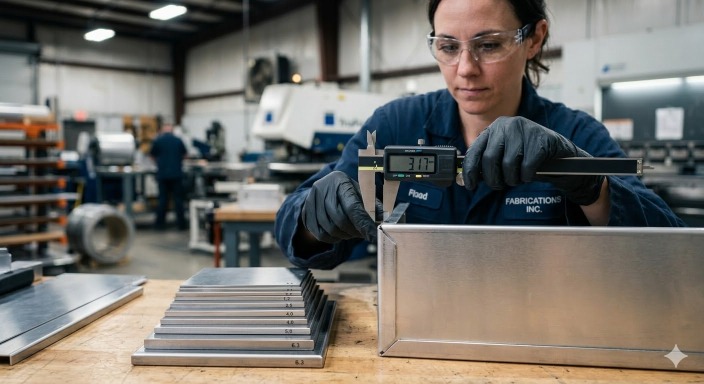
(AI generated) Technician measuring the thickness of a sheet metal enclosure panel using digital calipers.
Sheet thickness is usually the first big headache in enclosure design. It’s the baseline for strength, weight, and how difficult the part is to manufacture efficiently. Go too thin and the whole box feels flimsy, flexing or "oil-canning" during shipping. Go too heavy and you’re just stacking up material costs and weight for no reason, plus you’re making the bending process way harder than it needs to be.
Most engineers land on a thickness by looking at the enclosure's span and the weight of the internals. A big, flat panel needs that extra meat to keep from sagging or vibrating under load. In practice, thickness is strongly influenced by panel span and unsupported flat area. A small enclosure may feel rigid at 1.5 mm, while a larger panel in the same material can still flex or oil-can without added bends or reinforcement. Panel stiffness is strongly influenced by unsupported span length. Large panels often require either increased thickness or additional reinforcement features such as ribs or bends. You also have to design for the shop; thick plate needs more tonnage on the press brake and forces you into wider bend radii, which can kill your internal clearances if you aren't careful. You’ll generally see thin gauges on electronics housings to keep things light, while the heavy-duty industrial chassis need the extra thickness to survive a rough environment.
Typical Thickness Range for Sheet Metal Enclosures
Most sheet metal enclosures fall within a predictable thickness range. Electronics housings often use thinner sheets, while industrial equipment requires heavier panels. These values are general guidelines only, since the right thickness also depends on enclosure size, unsupported panel span, stiffness targets, and regional material standards.
Material | Typical Thickness Range | Common Uses in Sheet Metal Enclosures |
|---|---|---|
Aluminum | 1.0 mm – 3.0 mm | Lightweight sheet metal enclosure boxes for electronics, telecom hardware, EV charging units |
Cold Rolled Steel | 1.2 mm – 2.5 mm | Industrial control panels, electrical cabinets, rack enclosures |
Stainless Steel | 1.0 mm – 2.0 mm | Outdoor or corrosion-resistant sheet metal enclosures |
Heavy Industrial Steel | 2.5 mm – 4.0 mm | Floor cabinets, machinery control systems, large electrical enclosures |
Smaller electronic housings usually stay near the lower end of these ranges. Large cabinets or high-vibration systems often move toward thicker sheets.
Strength vs Weight Tradeoffs
Thickness directly affects structural stiffness. A thicker panel resists bending and vibration better than a thin one. This matters when the sheet metal enclosure supports heavy components such as transformers or power supplies.
Weight increases at the same time. Doubling the thickness can significantly increase the weight of the sheet metal enclosure box, especially in large panels. That creates challenges for wall mounting, shipping, and installation.
Engineers often balance stiffness with structural design. Flanges, ribs, and folded edges can increase rigidity without increasing material thickness. A smart sheet metal enclosure design often achieves strength through geometry rather than heavier material.
Thickness Selection Based on Application
The best thickness depends on how the sheet metal enclosure will be used.
Small electronics housings typically use thinner aluminum sheets. These systems prioritize weight and thermal performance over heavy structural strength.
Industrial control panels usually rely on thicker steel panels. The enclosure must support internal components and survive vibration from nearby equipment.
Outdoor enclosures often use stainless steel or coated steel with moderate thickness. These sheet metal enclosure boxes must resist corrosion while maintaining structural stability.
Large floor cabinets sometimes use reinforced panels combined with thicker steel sheets. This prevents panel flex when the enclosure contains heavy electrical hardware.
Application requirements usually determine the final thickness choice.
Cost Implications of Material Thickness
Material thickness has a direct effect on manufacturing cost.
Thicker sheets increase raw material consumption. Even small increases in thickness can raise the cost of a large sheet metal enclosure because the total surface area multiplies the material usage.
Fabrication costs can rise as well. Thicker material requires higher cutting power, stronger press brake tonnage, and sometimes additional machining steps.
Shipping and handling costs also increase because heavier sheet metal enclosure boxes require more packaging and transportation weight.
Procurement teams often balance cost and performance carefully. The goal is to choose a thickness that delivers enough strength for the sheet metal enclosure design without adding unnecessary material expense.
Structural Design Features for Sheet Metal Boxes
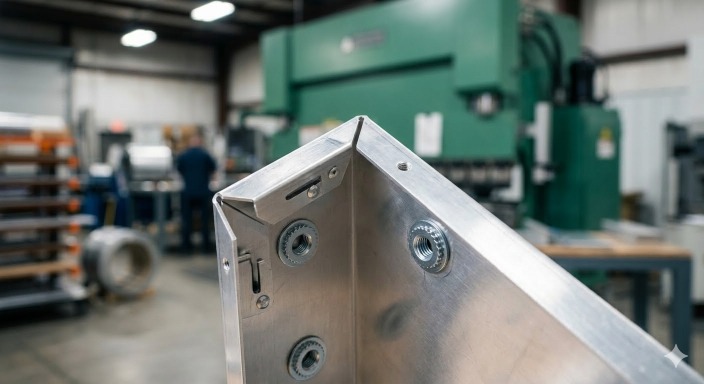
(AI generated) Close-up of structural features in a sheet metal enclosure including bends, flanges, and inserted fasteners.
Once thickness is set, the next challenge in a sheet metal enclosure is structure. A flat metal box sounds simple, but large panels love to flex, vibrate, and twist once the equipment goes into the real world. Good enclosure design quietly solves those problems with geometry and hardware.
This is where the small details matter. Bend lines, fastener locations, reinforcement features. Each one changes how the sheet metal enclosure box behaves under load. Get them right and the enclosure feels solid and stable. Get them wrong and you end up with rattling panels, warped corners, or parts that fight you during assembly.
Most structural features in a sheet metal enclosure design exist for two reasons. They stiffen the metal or they make the enclosure easier to assemble and service.
Bending Radius and Sheet Metal Forming Guidelines
Every bend in a sheet metal enclosure adds strength. A flat sheet flexes easily. Add a flange or folded edge and the panel suddenly becomes much stiffer.
But bends come with rules. A common rule of thumb is Ri≈1t, but the minimum bend radius depends on material, temper, grain direction, and tooling. For aluminum, a larger bend radius (Ri ≥ 1.5t) is often recommended to prevent cracking, especially for harder tempers. Push the radius too tight and the metal starts cracking or stretching unevenly. Aluminum shows this problem quickly, especially on thicker sheets.
Bend direction also matters. Fabricators usually try to bend across the grain of the metal instead of along it. That reduces the chance of fracture and keeps the edges cleaner.
These limits shape the entire sheet metal enclosure design. Bend radii affect internal clearances, mounting positions, and panel fit. Engineers who forget this often discover late in production that parts interfere with each other.
Fasteners, Rivets, and PEM Inserts
Fasteners hold the sheet metal enclosure box together and secure the components inside it. The challenge is making those fasteners strong without turning assembly into a slow, frustrating process.
Threaded PEM inserts solve a lot of problems here. These small pressed-in fasteners create durable threads directly in thin sheet metal. That means technicians can remove panels repeatedly without stripping the material.
Rivets show up in places where permanent joints make sense. They’re fast, cheap, and strong. You’ll often see them holding internal brackets or reinforcement plates inside a sheet metal enclosure.
Screw selection also matters more than people expect. Using too many fasteners increases assembly time. Using too few can leave panels vibrating during operation.
A clean sheet metal enclosure design usually balances strength with easy assembly.
Hinges, Access Panels, and Mounting Points
At some point someone has to open the enclosure. That sounds obvious, but many sheet metal enclosures get designed with maintenance as an afterthought.
Access panels fix this problem. A removable lid or side panel lets technicians reach internal components without tearing apart the entire sheet metal enclosure box.
Hinged doors appear in larger electrical cabinets and control panels. They allow quick inspection while keeping the rest of the enclosure structure intact.
Mounting points matter just as much. Internal brackets, studs, or rails support circuit boards, power supplies, and cooling hardware. If these mounts aren’t planned early, engineers end up forcing awkward adapters into the design later.
Good enclosure layout keeps service access simple and predictable.
Designing for Stiffness and Vibration Resistance
Large metal panels behave like drums. Hit them with vibration from fans, motors, or nearby machinery and they start resonating. That noise and movement eventually loosens fasteners or stresses internal components.
Engineers usually fight this with geometry instead of thicker metal. Small ribs, folded edges, or stamped features add stiffness across the surface of a sheet metal enclosure. Even shallow embosses can break up large flat areas and stop panel vibration.
Corner structure also plays a role. Folded corners and welded seams prevent the sheet metal enclosure box from twisting when mounted to equipment frames.
The goal is simple. Make the enclosure feel rigid even when the environment around it isn’t. When the structure is right, the entire sheet metal enclosure design ends up quieter, stronger, and easier to handle during installation.
Structural rigidity often depends on how parts are cut before bending. Laser cutting accuracy directly affects bend alignment and hole positioning, which we explain in detail in our laser cutting vs plasma cutting comparison.
Thermal Management and Ventilation Design
Heat quietly kills electronics. Inside a sheet metal enclosure, that heat has nowhere to go unless the design deliberately gives it a path out. Power supplies, converters, processors. They all dump heat into the air inside the box.
Small enclosures heat up faster than people expect. A sealed sheet metal enclosure box with dense electronics can climb well past safe operating temperatures within minutes. That’s why thermal design usually starts early in the sheet metal enclosure design, right alongside the internal layout.
Engineers manage enclosure heat in two ways. Move the heat out with airflow. Or spread it through the enclosure structure itself.
Passive Cooling with Ventilation Slots
The simplest cooling strategy in a sheet metal enclosure is passive airflow. Ventilation slots cut into the metal let hot air escape while cooler air enters from below.
Air naturally rises when it heats up. Designers take advantage of that. Intake vents usually sit near the bottom of the sheet metal enclosure box, while exhaust slots appear near the top. That layout creates a natural convection path through the enclosure.
Vent pattern design matters more than people realize. Large openings improve airflow but weaken the panel and reduce EMI shielding. In higher-sensitivity applications, engineers may use honeycomb vents, conductive meshes, or EMI gaskets, and they often control opening size and pattern layout based on shielding requirements. Engineers usually balance airflow with structural strength in the sheet metal enclosure design.
Even small slot patterns can dramatically reduce internal temperature when placed correctly.
Active Cooling Using Fans and Heat Sinks
Passive airflow stops working once power density climbs. High-performance electronics need forced airflow.
Fans pull cool air through the sheet metal enclosure and push hot air out quickly. The challenge is managing airflow paths so air actually reaches the hot components instead of circulating randomly.
Heat sinks solve another part of the problem. These metal fins attach directly to heat-generating components and increase surface area for heat transfer. In many systems, the heat sink touches the sheet metal enclosure box itself, allowing the enclosure to act as a secondary heat spreader.
The goal is simple. Move heat away from sensitive components before temperatures climb high enough to affect reliability.
The enclosure material itself plays a role in cooling. Aluminum conducts heat far better than steel, which makes aluminum sheet metal enclosures popular in electronics equipment.
Sealing Design for IP-Rated Sheet Metal Enclosures
Designing a sheet metal enclosure for IP-rated protection requires careful attention to sealing details. Unlike standard enclosures, IP-rated designs must prevent the ingress of dust, moisture, or water under defined test conditions.
A reliable sealing strategy typically starts with a continuous sealing path along all panel interfaces. Gaps between covers, doors, and mating surfaces must be minimized and consistent to ensure proper gasket compression. Designers often use foam, silicone, or rubber gaskets that compress evenly when fasteners are tightened.
Fastener placement plays a critical role in sealing performance. If screws are spaced too far apart, sections of the panel may deform slightly, breaking the seal and allowing contaminants to enter. Uniform fastener distribution helps maintain even pressure across the sealing surface.
Cable entry points are another common failure area. IP-rated sheet metal enclosures usually incorporate sealed cable glands or grommets to prevent leakage around wiring. Similarly, ventilation openings must be carefully designed using protective features such as louvers, mesh screens, or labyrinth structures to balance airflow with ingress protection.
Panel stiffness also affects sealing reliability. Thin or unsupported panels can flex under mechanical stress or temperature changes, reducing gasket compression over time. Engineers often reinforce large panels or increase material thickness to maintain a stable seal.
A well-designed sealing system ensures that the sheet metal enclosure meets its required IP rating while maintaining long-term durability in real-world environments.
Surface Finishing and Corrosion Protection
Bare metal rarely survives long in the real world. Surface finishing protects the sheet metal enclosure from corrosion while improving appearance and durability.
Different finishes exist for different materials and environments. Some finishes focus on corrosion resistance. Others improve wear resistance or create a cleaner appearance for visible equipment.
Powder Coating for Steel Enclosures
Powder coating is one of the most common finishes for steel sheet metal enclosures.
The process applies a dry powder to the metal surface and then cures it in an oven. The powder melts and forms a durable protective layer across the sheet metal enclosure box.
Powder coating resists scratches, corrosion, and chemicals better than standard paint. It also allows manufacturers to produce consistent color finishes across large production batches.
Industrial control panels and electrical cabinets often rely on powder-coated steel enclosures.
Anodizing for Aluminum Enclosures
Aluminum enclosures often use anodizing instead of paint.
Anodizing thickens the natural oxide layer that already forms on aluminum. The process improves corrosion resistance and hardens the surface of the sheet metal enclosure.
The finish also accepts dyes easily, which allows manufacturers to produce colored aluminum enclosures without applying paint layers.
Many electronics products use anodized sheet metal enclosure boxes for both durability and visual quality.
Galvanization for Outdoor Applications
Galvanization protects steel by coating it with zinc. The zinc layer sacrifices itself slowly to protect the steel underneath from corrosion.
This makes galvanized sheet metal enclosures useful in outdoor environments where moisture exposure is unavoidable.
Electrical junction boxes, outdoor control cabinets, and infrastructure equipment often rely on galvanized steel for long-term durability.
Finishing Considerations for Custom Sheet Metal Boxes
When designing a custom sheet metal enclosure, finishing decisions affect both durability and cost.
Powder coating adds corrosion protection and color control. Anodizing improves aluminum durability. Galvanization protects steel in outdoor environments.
Each finish also affects fabrication. Some coatings require masking certain surfaces or grounding points during the finishing process.
Engineers usually finalize the finishing process once the sheet metal enclosure design and material selection are complete.
Design for Manufacturability in Custom Sheet Metal Enclosures
A custom sheet metal enclosure may look perfect in CAD and still be painful to manufacture. Good engineers design the enclosure with the fabrication process in mind from the start.
Small design decisions can dramatically affect cost and production speed. Fewer parts, simpler bends, and standardized hardware all make fabrication easier.
Manufacturing-friendly design keeps the sheet metal enclosure box affordable when production scales.
Reducing Part Count and Welding
Every extra component adds assembly time.
Designers often reduce complexity by forming more structure directly into the sheet metal enclosure instead of welding separate brackets or reinforcements.
Folded features can replace welded seams in many cases. Fewer welds reduce distortion and simplify fabrication.
A simplified sheet metal enclosure design usually produces stronger and more consistent parts.
Standardizing Components and Hardware
Using standardized fasteners speeds up both fabrication and assembly.
Many custom sheet metal enclosures rely on common screw sizes and standard PEM inserts. This allows fabrication shops to use existing tooling instead of special hardware.
Standardization also simplifies maintenance. Technicians can service the sheet metal enclosure box with common tools and replacement parts.
Choosing the Right Manufacturing Process
Different fabrication methods suit different enclosure designs.
Laser cutting handles complex shapes and small production runs well. Turret punching becomes efficient when the sheet metal enclosure contains many repeated features.
Press brake forming builds most enclosure geometry. The bend sequence often determines how easily the enclosure assembles later.
Selecting the right process keeps the sheet metal enclosure design practical for production.
FAQs
Q: How to choose sheet metal enclosure thickness for custom boxes?
Choose thickness based on panel size, internal component weight, vibration exposure, and the structural rigidity required for the sheet metal enclosure.
Q: What materials are best for enclosure sheet metal fabrication?
Cold rolled steel, stainless steel, and aluminum are the most common materials used for enclosure sheet metal because they balance strength, corrosion resistance, and manufacturability.
Q: How to ensure IP-rated sealing in sheet metal enclosures?
Use compression gaskets, sealed cable glands, and tight panel tolerances to maintain proper sealing in a sheet metal enclosure box. A reliable IP-rated design also requires a continuous sealing path, proper fastener spacing, and sufficient panel stiffness to prevent door or cover deformation that can break the seal.
Q: What are common structural design mistakes in sheet metal boxes?
Common issues include oversized flat panels, poor fastener placement, ignoring bend radius limits, and inadequate reinforcement in the sheet metal enclosure design.
Q: Can one enclosure design serve multiple applications?
Yes, a modular sheet metal enclosure can support different applications if mounting points, ventilation options, and panel configurations remain flexible.
Popular Articles
• 9 Sheet Metal Cutting Problems and Solutions
• Hole cutting in sheet metal: techniques, tolerances and applications
• Introduction to Sheet Metal Processing: Techniques and Tools for Precision
• Bending and Forming Technology in Sheet Metal Processing
• Laser cutting technology in sheet metal processing
Keep Learning
Galvanized Sheet Metal: Grades, Specs & When to Use It
Galvanized Sheet Metal: Grades, Specs & When to Use It A design engineer specs "galvanized sheet metal" on a drawing and sends it out for quotes. Three shops come back with three different prices, and one of them asks a follow-up question the others didn't: which gauge, which coating class, hot-dip or electro-galvanized? That question is the difference between a part that survives outdoors for fifteen years and one that starts showing rust spots after eighteen months — and it's the kind of detail that......
Custom Sheet Metal Fabrication: How the Process Works From Design to Delivery
Custom Sheet Metal Fabrication: How the Process Works From Design to Delivery A stock enclosure almost fits. The mounting holes are close but not quite right, the depth is half an inch too shallow, and the vendor's next size up is twice the volume you actually need. This is the point where most people start looking into custom sheet metal fabrication — not because they set out to design a part from scratch, but because nothing off the shelf actually solves the problem. Custom fabrication sounds like i......
Sheet Metal Assembly: How Fabricated Parts Come Together
Sheet Metal Assembly: How Fabricated Parts Come Together Cutting and bending gets a lot of attention because that's where a flat sheet visibly turns into a 3D part. But a single bracket by itself rarely finishes the job — most real sheet metal products are assemblies, multiple formed pieces joined into one working unit, and that assembly step is where a lot of designs quietly succeed or fail. A part that measured perfectly on its own can still not fit once it's supposed to mate with three other pieces......
Sheet Metal Bender: Types, Specs & How to Choose the Right Machine
Sheet Metal Bender: Types, Specs & How to Choose the Right Machine Every sheet metal bracket, enclosure, and panel eventually passes through a bender of some kind — that's the machine, not the process. Our guide on sheet metal bending covers how bending actually deforms metal — springback, minimum radius, bend allowance, and the core press brake and CNC press brake setups most shops run. This one goes further into the equipment side specifically: the less common bender types beyond the standard press ......
What Is Galvanized Metal? Process, Types & How It Works
What Is Galvanized Metal? Process, Types & How It Works Leave a piece of bare steel outside for a season and you'll see exactly why galvanizing exists. Rust doesn't wait for dramatic weather — a little humidity and a few weeks is enough to start eating into an unprotected surface. Galvanized metal solves that problem by giving steel a sacrificial layer of zinc that corrodes in its place, and it's done this job well enough that it's become the default choice for anything from highway guardrails to HVAC......
What Is Sheet Metal Fabrication? The Complete Guide
What Is Sheet Metal Fabrication? The Complete Guide Somewhere between a CAD file and a working enclosure sitting on your bench, a flat piece of metal gets cut, bent, joined, and finished into something that actually does a job. That's sheet metal fabrication — and if you've never ordered a part before, the term can feel bigger than it needs to be. Ask five people what "sheet metal fabrication" covers and you'll get five different answers: some think laser cutting, some think welding, some just picture......