Threaded Inserts for Plastics: A Complete Guide to Types and Applications
24 min
- What Are Threaded Inserts for Plastics?
- Types of Threaded Inserts for Plastics
- Press-In Inserts for Plastic
- Self-Tapping Inserts for Plastic
- Heat-Set and Ultrasonic Inserts for Plastic
- Molded-In and Helical Inserts
- How to Choose the Right Threaded Insert for Plastic
- Threaded Insert Design Considerations
- Threaded Inserts for CNC Machined Plastics
- Threaded Inserts for 3D-Printed and Injection-Molded Plastics
- Common Mistakes When Using Threaded Inserts in Plastics
- FAQs About Threaded Inserts for Plastics
Key Takeaways
- Threaded inserts provide reusable metal threads in plastic parts and can improve retention and assembly repeatability compared with directly tapped plastic threads.
- Common insert types include press-in, self-tapping, heat-set, ultrasonic, and molded-in designs, with each suited to different materials and production conditions.
- Heat-set inserts are widely used for thermoplastic and FDM applications, while press-in and self-tapping inserts offer alternatives when heat installation is unsuitable.
- Insert performance depends on the plastic grade, insert geometry, hole dimensions, boss geometry, and installation process.
- Always use the insert manufacturer's specifications for hole size, tolerance, installation parameters, and required boss dimensions. </ul
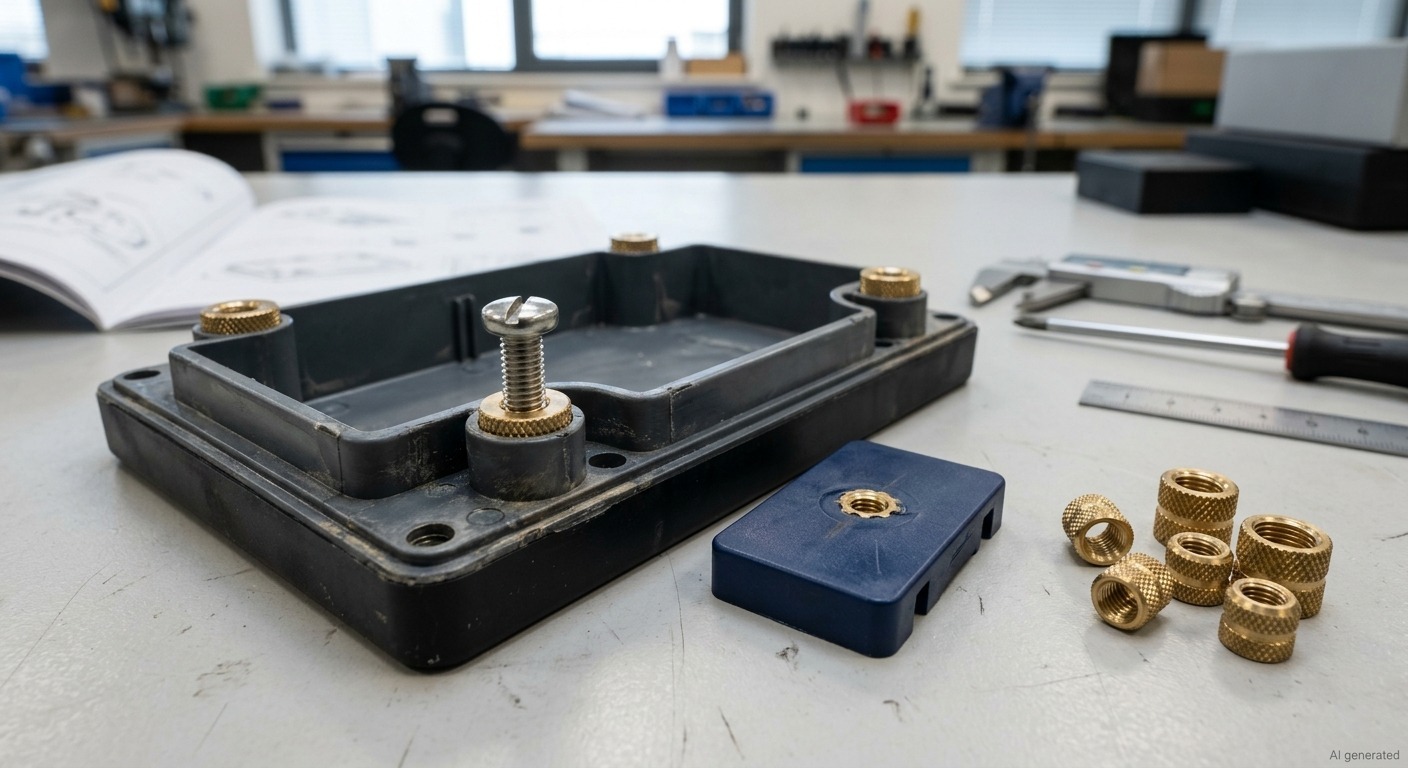
selection of plastic components using threaded inserts
Plastic threads strip. That's not a design failure, it's a material reality. Plastic has lower shear strength than metal, and threads cut directly into a plastic boss provide a fraction of the pull-out and torque resistance that a metal-to-metal connection delivers. For parts assembled once and never touched again, direct plastic threads are sometimes adequate. For anything assembled repeatedly, carrying real fastener loads, or requiring a reliable torque specification, threaded inserts for plastics are the engineering solution.
A threaded insert relocates the thread engagement from plastic material to metal, typically brass, while the insert itself grips the plastic surrounding it through knurling, heat flow, mechanical deformation, or molded-in retention. The fastener sees metal threads. The plastic sees distributed retention forces over a much larger surface area than a tapped thread provides. The assembly becomes repeatable and reliable.
For CNC-machined plastic parts, JLCCNC can manufacture insert-ready holes and related features to your specified dimensions and tolerances. Submit your CAD file or drawing for a manufacturing quote and production-readiness check.

Precision CNC Machining Service
Professional manufacturing, fast turnaround, and quality assurance.
What Are Threaded Inserts for Plastics?
Threaded inserts for plastics are metal fastener elements, typically brass, with stainless steel, steel, or aluminum used for specific performance or environmental requirements, installed into a plastic part to provide a durable, accurate internal thread that accepts standard machine screws and bolts. The insert body grips the plastic host material through external retention features (knurls, ribs, flanges, or thermoplastic reflow), while the internal thread accepts the fastener with metal-to-metal engagement.
Why Use Threaded Inserts in Plastic Parts?
Direct plastic threads can fail in several ways. They may strip before the intended clamp load is reached, wear with repeated assembly cycles, or crack the boss when over-torqued.
Plastic threaded inserts solve all three failure modes simultaneously. Pull-out resistance increases because the insert engages the plastic over its full length with distributed surface contact, not a narrow thread depth. Torque resistance increases because the fastener now engages metal threads that don't deform under the torque required to develop proper clamp load. Repeat assembly is practical because metal threads don't degrade with each tightening cycle.
How Threaded Inserts Reinforce Plastic Threads
The reinforcement mechanism varies by insert type, but the common goal is to transfer fastener loads into the surrounding plastic through an insert geometry designed for the selected installation method: distribute the fastener load over a larger contact area between the insert and the surrounding plastic than a tapped thread provides, and provide metal thread engagement so the fastener develops proper clamp force without stripping.
Common Applications of Plastic Threaded Inserts
Electronics enclosures requiring repeated service access. Automotive interior assemblies where vibration would loosen direct plastic threads over time. Medical device housings requiring certified fastener torque specifications. 3D printed functional prototypes and end-use parts where layer adhesion makes direct threads particularly unreliable. Injection-molded components at all production volumes where assembly reliability is a product quality requirement.
Types of Threaded Inserts for Plastics
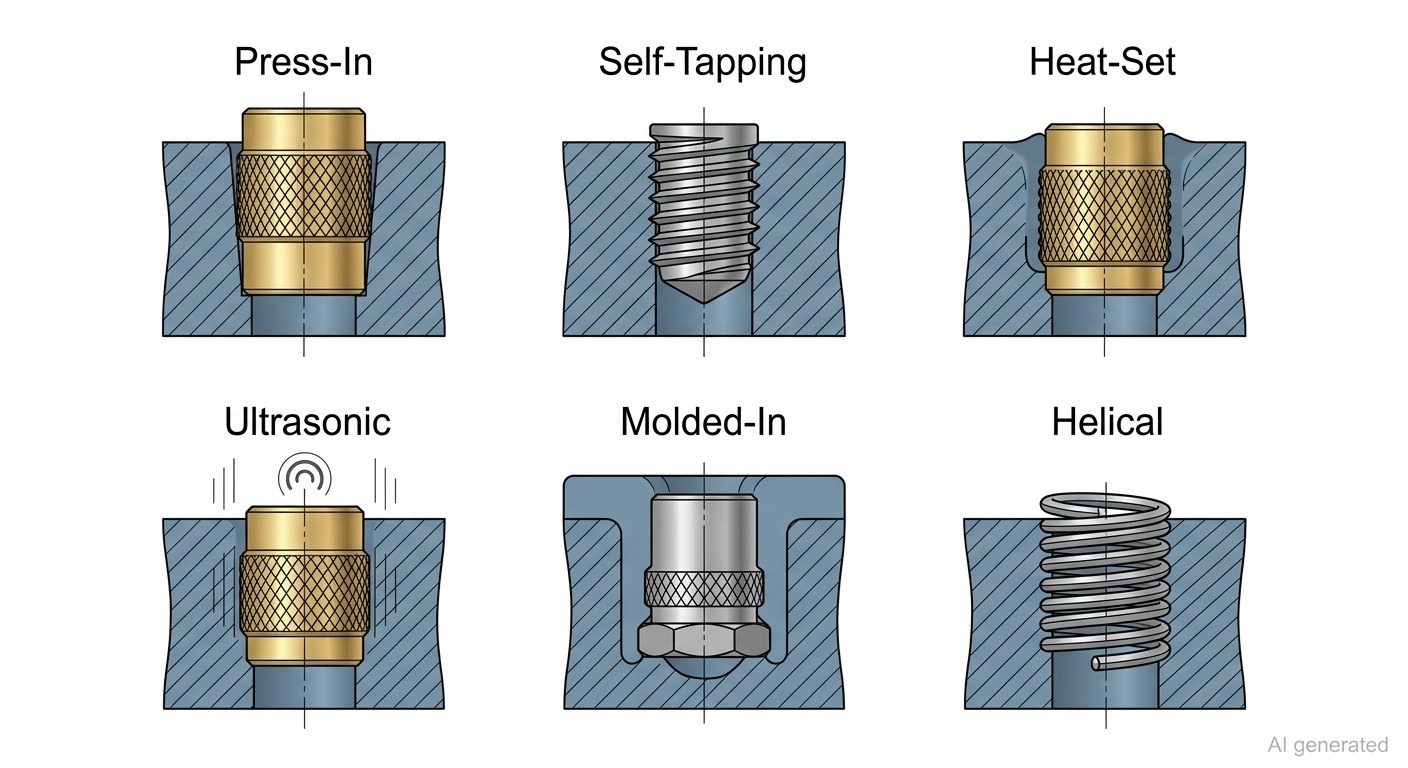
common threaded insert types for plastic
| Insert Type | Installation | Typical Use | Retention Trend | Production Fit | Insert Type |
|---|---|---|---|---|---|
| Press-In | Axial force | Soft/ductile plastics | Moderate | Low to medium volume | Press-In |
| Self-Tapping | Rotary drive | Soft to medium-rigidity plastics | Moderate to high | Low to medium volume | Self-Tapping |
| Heat-Set | Heat + axial force | Thermoplastics, FDM parts | High | Low to high volume | Heat-Set |
| Ultrasonic | Vibration + axial force | Thermoplastics | High | Medium to high volume | Ultrasonic |
| Molded-In | Installed during molding | Molded parts | High | High volume | Molded-In |
| Helical | Tapped hole + rotary installation | Thread repair / selected machined parts | Application-dependent | Low to medium volume | Helical |
Press-In Inserts
Press-in: Simple axial installation using interference, knurls, or ribs; best suited to softer or more ductile plastics. No heat, no vibration, no rotary torque required during installation.
Self-Tapping Inserts
Self-tapping: Installed by rotation into a prepared hole, creating mechanical engagement with the plastic.
Heat-Set Inserts
Heat set inserts for plastic use thermoplastic reflow to embed the insert in the host material. Heat applied to the insert causes the surrounding thermoplastic to soften, allowing the insert to be pressed into position, after which the plastic solidifies around the insert's external knurl geometry.
Molded-In Inserts
Inserts placed in the injection mold before the shot, which are then encapsulated in the molded plastic. Molded-in inserts can provide very high pull-out and torque resistance when the insert geometry, resin, and molding process are properly matched.
Helical Inserts
Wire-form coil inserts (Helicoil is the common brand name) installed into a tapped hole, providing a wear-resistant metal thread surface within a pre-tapped plastic hole.
Ultrasonic Inserts
Functionally similar to heat set inserts for plastic but installed using ultrasonic vibration rather than a heated tool. High-frequency vibration generates frictional heat locally at the insert-plastic interface, softening the thermoplastic for installation.
Press-In Inserts for Plastic
How Press-In Inserts Work
Press-in inserts for plastic rely on an interference fit between the insert's external geometry and the pre-drilled hole. The hole diameter is specified slightly smaller than the insert's maximum outer diameter, creating interference that the plastic deforms around during installation. External knurls or longitudinal ribs increase contact with the plastic and help resist pull-out and rotation.
Installation requires only downward force, a manual arbor press, a small bench press, or in low-volume applications, a bench vise. No heat source, no vibration equipment, no rotary tool required. This simplicity can make press-in inserts economical for low-volume and straightforward assemblies.
Suitable Plastic Materials
Press-in inserts work best in thermoplastics with sufficient ductility to deform around the insert without fracturing during installation. Polyethylene, polypropylene, soft PVC, and some TPU grades may be suitable, depending on the insert design. Rigid, brittle plastics like unfilled polystyrene or high-filled composites can crack around press-in inserts because the material fractures rather than deforming when the insert is pressed in.
Press-In Insert Applications
Consumer electronics where single or limited-use assembly applies. Automotive interior panels in soft thermoplastics. Packaging and thin-wall plastic parts where heat application would distort the part. Low-cost product assemblies where installation speed matters more than maximum pull-out resistance.
Advantages and Limitations
Advantages: simple installation, limited equipment requirements, suitability for some heat-sensitive plastics, and fast installation in sufficiently ductile materials.
Limitations: lower pull-out resistance than heat set or molded-in inserts, rotation resistance depends entirely on knurl geometry and interference, not suitable for rigid or brittle plastics, performance degrades in materials that creep under sustained load.
Self-Tapping Inserts for Plastic
How Self-Tapping Inserts Work
Self-tapping inserts for plastic combine two thread forms: external cutting threads that engage the plastic host as the insert is driven in, and internal machine threads that accept the assembly fastener. The external thread engages a pre-drilled hole as the insert advances. Depending on the insert design, it may cut or form the plastic to create the required engagement.
Drive installation uses a standard power driver or manual screwdriver through the insert's internal thread socket or a dedicated installation tool. The driving torque controls depth and seating.
Pull-out resistance in self-tapping inserts for plastic comes from the mechanical interlock between the external thread and the plastic thread it created during installation. Torque resistance comes from the same interlock plus friction from the interference at the thread flanks.
Advantages and Limitations
Advantages: no heat required, faster installation than heat set inserts in some configurations, good pull-out resistance in softer to medium-rigidity thermoplastics, widely available standard sizes.
Limitations: pull-out resistance lower than heat set inserts in most thermoplastics, hard or brittle plastics can crack during driving, installation torque should follow the insert manufacturer's recommended process parameters, particularly in thin-wall or lower-strength plastics, not recommended for thin-wall bosses where thread-cutting forces cause cracking.
Self-Tapping Insert Applications
Electronics and appliance housings in ABS and polycarbonate. Automotive interior plastics. Post-installation repair of stripped direct plastic threads. Applications where a heat source isn't available but better retention than press-in is needed.
Heat-Set and Ultrasonic Inserts for Plastic
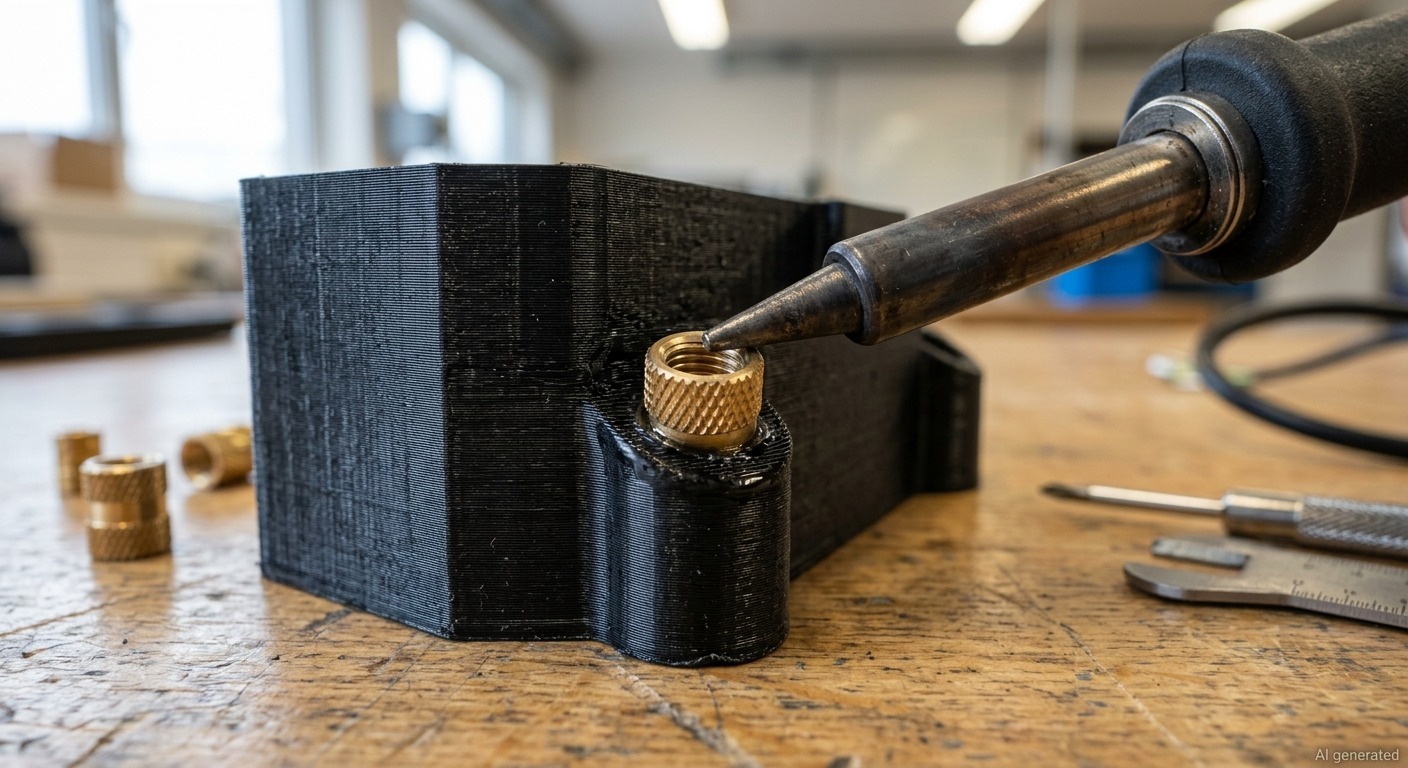
heat-set brass threaded insert
Heat-Set Inserts
Heat-set inserts are widely used in engineering prototypes, 3D-printed parts, and thermoplastic assemblies. The installation sequence:
- Pre-drill or form the hole to the manufacturer-specified diameter
- Heat the insert using a temperature-controlled soldering iron with an insert tip, a heat press, or an oven
- Press the heated insert into the hole while applying axial force
- Hold the insert in position while the thermoplastic solidifies around the knurled surface
- Allow to cool before applying fastener load
The heat-set process allows softened thermoplastic to flow around the insert's external features, creating mechanical interlock and retention. Knurl designs include diamond knurls, longitudinal knurls, and undercut geometries that all produce different retention characteristics in different thermoplastics.
Temperature control matters significantly for heat set insert installation. Too cool and the plastic doesn't flow adequately into the knurl, reducing retention. Too hot and the plastic degrades locally, produces voids around the insert, and reduces structural integrity in the boss.
Ultrasonic Inserts
Ultrasonic inserts may use the same or similar geometries as heat-set inserts. The main difference is the installation method. the difference is the installation method. An ultrasonic press applies high-frequency (20-40 kHz) vibration to the insert through a shaped horn (sonotrode), generating frictional heat at the insert-plastic interface. The insert advances into the softened plastic as vibration continues, achieving the same thermoplastic reflow as heat installation.
Heat-Set vs. Ultrasonic Installation
| Factor | Heat-Set | Ultrasonic |
|---|---|---|
| Equipment cost | Low (soldering iron) to Medium (heat press) | High (ultrasonic press) |
| Installation speed | Medium, per-insert heating time | Fast, 0.5-1 second cycle time |
| Process consistency | Operator-dependent with manual iron | Highly repeatable with calibrated press |
| Best production volume | Low to medium volume, prototypes | High volume production |
| Material sensitivity | Lower, controlled temperature | Higher, vibration energy requires tuning |
| Suitable for 3D printed parts | Yes, widely used | Yes, with appropriate support |
Suitable Thermoplastics
Heat-set and ultrasonic inserts can be used with many engineering thermoplastics, provided the resin's softening or melting behavior and the insert manufacturer's installation parameters are compatible. The plastic must be thermoplastic (capable of softening when heated), thermoset plastics and elastomers don't accommodate heat set inserts.
For 3D printed parts specifically, heat set inserts for plastic are the standard solution for creating durable threaded connections in FDM printed ABS, PLA, PETG, and Nylon parts. Heat-setting allows the surrounding thermoplastic to flow around the insert's external features, which can provide strong retention when the printed geometry and process parameters are appropriate.
Molded-In and Helical Inserts
Molded-In Inserts
Molded-in inserts are placed in the injection mold cavity before the plastic shot, becoming encapsulated in the molded part as plastic flows around them. No post-installation required, the insert is integral to the part as it comes from the mold.
Pull-out resistance of molded-in threaded inserts is the highest of all plastic threaded insert types because the plastic flows into every detail of the insert's external geometry during molding and cures against it under pressure. The encapsulation is as complete and intimate as any post-installation method can achieve.
Limitations: molded-in inserts require insert placement in the mold before each shot, which adds cycle time and process complexity. Incorrect placement causes non-conforming parts. The approach requires inserts available at production time and integrated into the molding process, not retrofittable.
Helical Inserts
Helical coil inserts (most commonly known by the Helicoil brand name) are stainless steel wire coils installed into a pre-tapped hole. Unlike other threaded inserts that create their own retention in the plastic, helical inserts require the plastic host to be pre-tapped, typically one or two thread sizes larger than the final thread. The coil is wound into the tapped hole using an installation tool, where it expands against the tapped thread walls and provides a precision internal thread for the assembly fastener.
If you're machining the tapped hole on a CNC, our guide to CNC tap types and selection covers tap geometry, blind-hole considerations, and choosing the right tap for the material.
Helical inserts are the standard repair solution for stripped plastic threads and are also specified for high-wear thread applications where a direct plastic thread or tapped hole would wear prematurely. They suit CNC machined plastic parts well because the pre-tapping operation is straightforward on a machining center.
Molded-In vs. Post-Installed Inserts
| Factor | Molded-In | Post-Installed (all types) |
|---|---|---|
| Pull-out resistance | Highest | Lower (varies by type) |
| Process complexity | High, in-mold placement | Lower, separate operation |
| Design flexibility | Limited by mold | High, insert after machining or printing |
| Prototyping suitability | Poor, requires tooling | Excellent |
| Cost at high volume | Low per-insert | Higher per-insert |
| Retrofit / repair | Not possible | Yes |
How to Choose the Right Threaded Insert for Plastic
Plastic Material
The plastic host material constrains the viable plastic threaded inserts immediately. Thermoplastics that soften when heated accept heat set inserts and ultrasonic inserts. Soft, ductile thermoplastics like PE and PP accept press in inserts for plastic. Hard, brittle materials that crack under driving torque or installation pressure require heat set installation or molded-in inserts to avoid boss cracking.
Pull-Out and Torque Requirements
Define the required pull-out force and installation torque before selecting an insert. Insert manufacturers publish pull-out and torque specifications for each insert in specific plastic materials. Match the required retention to the insert's published specification with an appropriate safety factor, typically 2.0-3.0 for structural connections and 1.5-2.0 for non-critical enclosure fastening.
Installation Method
Available installation equipment determines the practical insert types. A manual soldering iron and basic tooling allows heat set inserts for plastic across all production volumes. Ultrasonic equipment is justified at production volumes where installation speed matters and equipment cost amortizes across enough parts. Press installation requires only a simple press, low barrier. Self-tapping inserts require only a power driver.
Production Volume and Cost
| Volume | Recommended Insert Types |
|---|---|
| 1-50 parts (prototype) | Heat set inserts with soldering iron |
| 50-500 parts | Heat set with press, or self-tapping |
| 500-5,000 parts | Heat set with press, ultrasonic at upper range |
| 5,000+ parts | Ultrasonic, or molded-in if design allows |
Manufacturing Process
Manufacturing method: Match the insert and installation process to the way the plastic part is produced. FDM parts commonly use heat-set inserts, while CNC-machined parts offer more flexibility in hole preparation. Injection-molded parts can use any post-installation type or molded-in inserts.
Assembly Frequency
Parts assembled once (permanent enclosures) can tolerate lower pull-out resistance and simpler insert types. Parts assembled and disassembled repeatedly for service access require heat set or helical inserts that maintain thread integrity through multiple cycles. Self-tapping and press in inserts degrade with repeated disassembly more than heat set types.
Threaded Insert Design Considerations
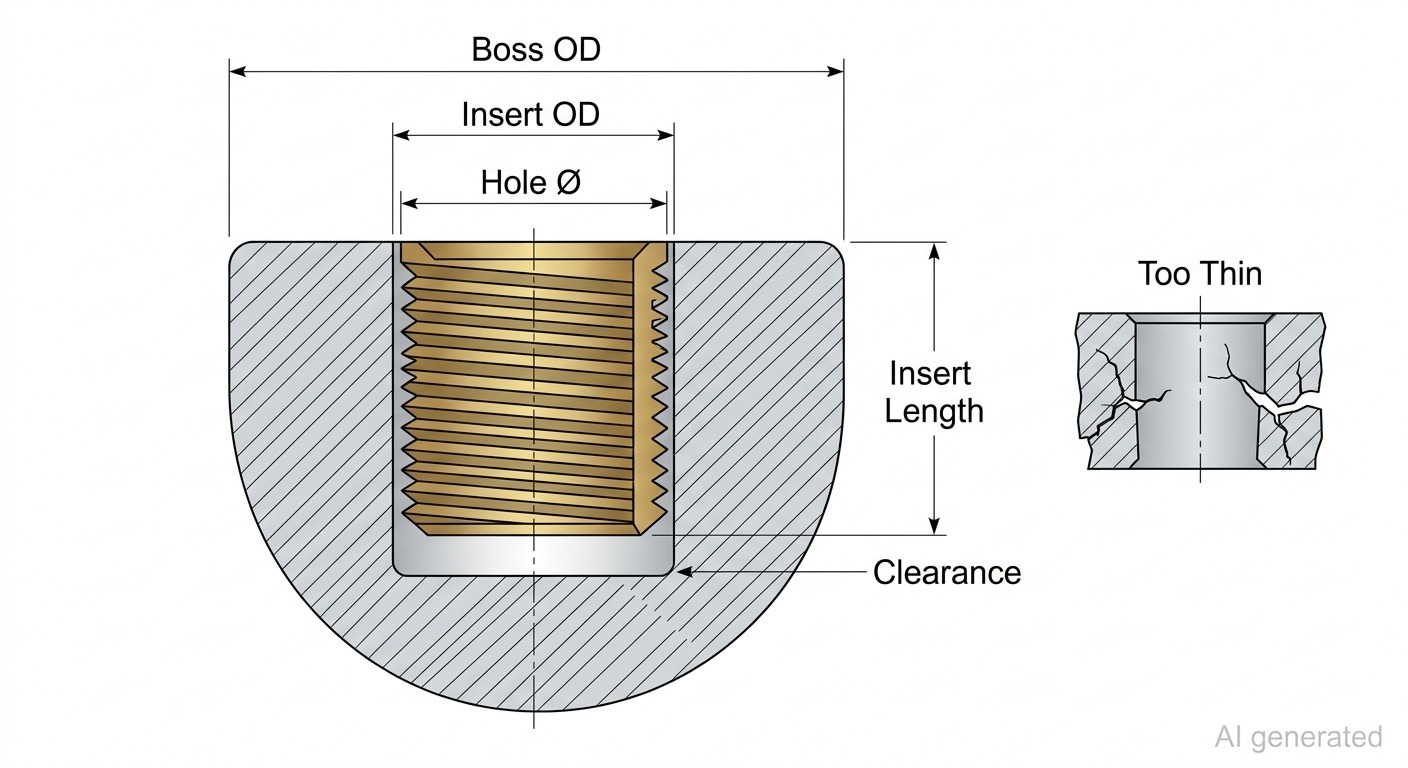
brass threaded insert in plastic boss
Hole Diameter and Tolerance
Every plastic threaded insert type has a manufacturer-specified hole diameter and tolerance. This is the single most critical design parameter, too tight and the boss cracks during installation; too loose and the insert has insufficient retention.
For heat set inserts, the hole is typically 0.1-0.2mm smaller than the insert's nominal outer diameter, allowing the insert to be pressed into position while displacing minimal plastic. For self-tapping inserts for plastic, the pilot hole is matched to the minor diameter of the external thread to give the cutting features adequate plastic to engage. For press in inserts for plastic, interference is designed into the hole-to-insert diameter relationship.
Always verify hole diameter requirements from the specific insert manufacturer's datasheet for the plastic being used, the same insert may require different hole diameters in different plastics.
Hole Depth and Insert Length
The hole must be at least as deep as the insert length plus 0.5-1.0mm clearance beyond the insert bottom. An insert bottoming out before it's fully seated leaves the top of the insert proud of the surface, which prevents the mating fastener from developing clamp load against the plastic or the mating component.
For blind holes, design hole depth = insert length + 1.0mm minimum clearance. For through-holes, verify the insert length doesn't exceed the material thickness.
If the insert sits in a blind hole, hole depth and chip clearance become especially important. Our blind hole machining guide explains the design and machining considerations in more detail.
Boss Diameter and Wall Thickness
Boss diameter must provide sufficient wall thickness around the insert to withstand installation and service loads. Use the insert manufacturer's recommended boss dimensions, then verify the geometry for the selected plastic and loading conditions.
| Insert OD | Minimum Boss OD | Recommended Boss OD |
|---|---|---|
| 4.0mm | 8.0mm | 9.0-10.0mm |
| 5.0mm | 10.0mm | 11.0-12.5mm |
| 6.0mm | 12.0mm | 13.5-15.0mm |
| 8.0mm | 16.0mm | 18.0-20.0mm |
Thread Size
Match insert thread size to the fastener requirement, don't oversize the insert to get a larger boss area. An M4 insert in an undersized boss is weaker than an M3 insert in a correctly sized boss. Specify the smallest thread that meets the clamp load requirement, then design the boss for that insert size.
Knurl Design
Different external knurl geometries produce different retention characteristics. Diamond knurls can provide a balance of pull-out and rotational resistance, while longitudinal knurls, undercuts, ribs, and other external features are selected according to the required load direction and installation method. Undercut knurls trap plastic material above the undercut, providing exceptional pull-out resistance at the cost of more complex installation control.
Insert Installation Force and Temperature
Heat-set installation temperature should be established from the insert manufacturer's process recommendations and the plastic's softening or melting behavior. The insert must be hot enough to allow controlled material flow around the external features without causing excessive thermal degradation.
Threaded Inserts for CNC Machined Plastics
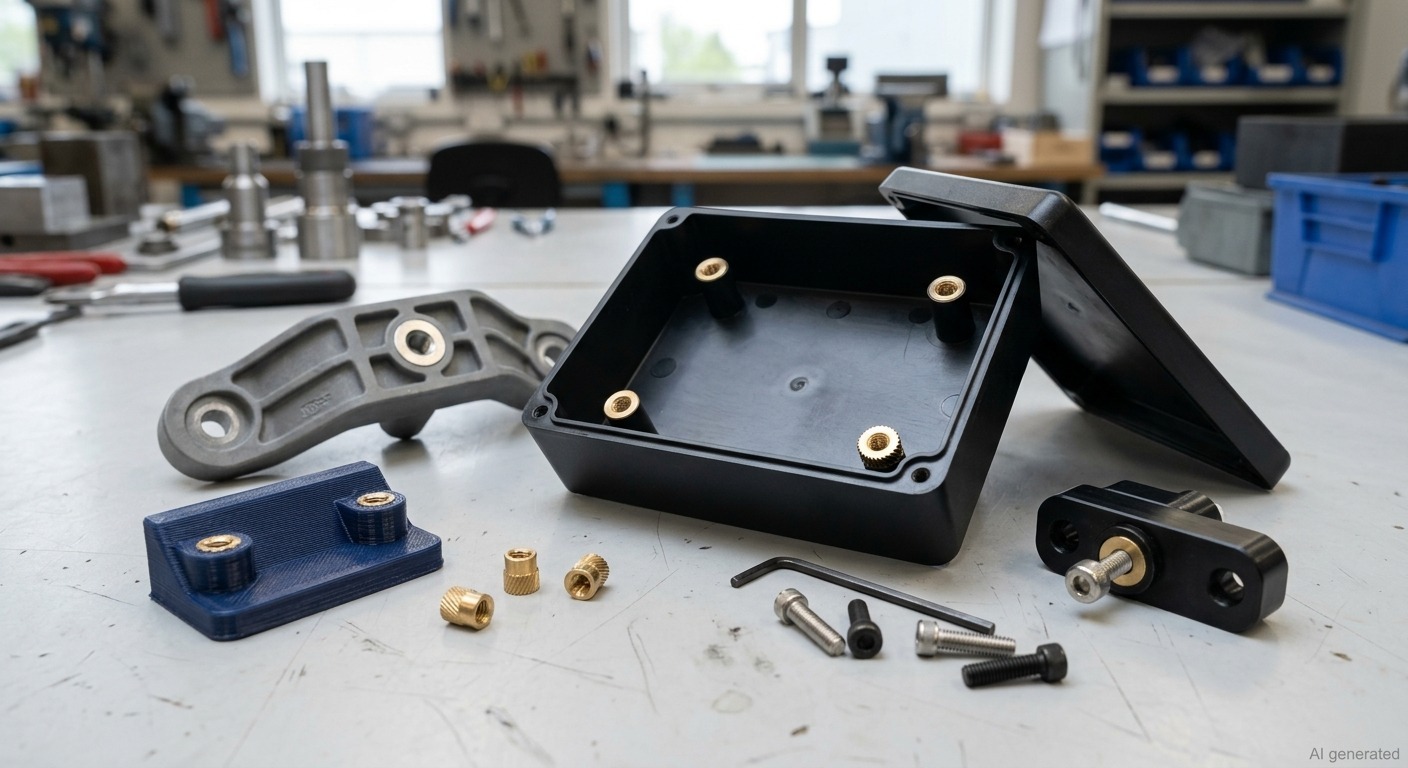
Common Applications of Plastic Threaded Inserts
Preparing Holes for Threaded Inserts
CNC machining can provide highly controlled hole dimensions and tolerances for threaded insert installation. For a broader look at how engineering plastics behave during machining, see our guide to plastic CNC machining, including material selection, tooling, cooling, and achievable tolerances.
CNC machining can provide more controlled hole dimensions than many 3D-printing processes. The required diameter and tolerance should still be based on the selected insert manufacturer's specifications.
For heat set inserts in CNC machined acetal or nylon, a through-drill at the specified diameter followed by a chamfer on the entry provides ideal installation conditions. The chamfer guides the insert into alignment and prevents surface cracking at the hole entry during installation.
For helical inserts in CNC-machined plastics, the tapping operation can be performed on the machining center using tooling and parameters appropriate for the plastic. Sharp tooling and controlled cutting conditions can help reduce tearing and surface damage.
CNC Machining Tolerances for Inserts
CNC machining can provide tighter and more repeatable hole dimensions than many additive processes, but achievable tolerance depends on the material, machine, tooling, hole geometry, and process conditions. This tolerance capability means a correctly specified CNC machined hole will accept the intended insert consistently, without the hole-to-hole diameter variation that 3D printing or injection molding can produce.
Suitable CNC Machined Plastics
Acetal (POM), nylon (PA6, PA12), PEEK, polycarbonate, and HDPE are the most common CNC machined plastics that accept threaded inserts. Acetal and nylon suit heat set inserts, helical inserts, and self-tapping inserts. PEEK requires heat set installation at higher tip temperatures matching its higher Vicat temperature. HDPE suits press in inserts for plastic and self-tapping inserts due to its softness.
CNC Machining vs. Other Plastic Manufacturing Methods
CNC machined plastic parts accept all threaded insert types and provide the most controlled hole preparation. 3D printed parts suit heat set inserts best due to layer structure. Injection-molded parts can use any post-installation type. For low-volume precision applications, fixtures, instrument housings, engineering prototypes, CNC machined plastic parts with heat set or helical inserts provide the best combination of dimensional accuracy and connection reliability.
If your plastic part needs precise insert holes, bosses, or threaded features, JLCCNC can machine the part to your drawing and prepare the features for the insert you specify. Upload your CAD file for an engineering review and quote.
Precision CNC Machining Service
Professional manufacturing, fast turnaround, and quality assurance.
Threaded Inserts for 3D-Printed and Injection-Molded Plastics
Threaded Inserts for 3D-Printed Parts
Heat-set inserts are a common choice for FDM parts. FDM layer structure can reduce the reliability of directly tapped threads, particularly when the thread orientation and loading direction expose weak interlayer bonding.
Installation in 3D printed parts: design the hole with the manufacturer-specified diameter in the CAD file. Use a temperature-controlled soldering iron with an insert tip or a dedicated heat press. Apply gentle axial force while the heated insert softens the surrounding thermoplastic. The material then flows around the insert's external features. The result is a metal thread that can provide better resistance to repeated fastening than a directly tapped FDM thread.
SLS and MJF nylon parts generally have more uniform properties than typical FDM prints, although properties can still vary with material, build orientation, and process parameters.
Threaded Inserts for Injection-Molded Parts
Injection-molded parts use any post-installation plastic threaded insert type inserts. The choice between molded-in and post-installed inserts for injection-molded production depends on production volume (molded-in is justified at high volume), assembly flexibility requirements, and whether the insert must be retrofittable.
Self-tapping and heat-set inserts can both be used in injection-molded thermoplastics when their installation requirements match the material and part geometry. Ultrasonic installation can be advantageous for high-volume injection-molded assemblies because it can provide consistent cycle times and process control.
Choosing an Insert Based on Manufacturing Method
| Manufacturing Method | Recommended Insert Types | Avoid |
|---|---|---|
| FDM 3D printing | Heat set inserts (primary), helical | Press-in (poor layer adhesion grip) |
| SLS/MJF 3D printing | Heat set, press-in for soft grades | Self-tapping (unpredictable engagement) |
| CNC machined plastics | Helical, heat set, press-in | — all types work |
| Injection molding (low volume) | Heat set, self-tapping, press-in | Molded-in (tooling cost) |
| Injection molding (high volume) | Molded-in, ultrasonic heat set | Manual heat set (too slow) |
Common Mistakes When Using Threaded Inserts in Plastics
Incorrect Hole Size
Using the wrong pilot hole diameter is the most common installation failure. A hole that is too small can require excessive installation force. For press-in inserts, this may crack the boss. For heat-set inserts, it can prevent the insert from seating properly before the plastic re-solidifies. A hole that is too large can reduce the interference or engagement required for retention. As a result, insert pull-out performance may be significantly reduced.
Solution: always drill or machine the hole to the insert manufacturer's specified diameter for the specific plastic being used. Don't use nominal insert dimensions, use the datasheet value for the host material.
Insufficient Boss Diameter
An undersized boss doesn't have enough plastic surrounding the insert to resist the hoop stress of installation or the pull-out force in service. Cracking during heat set installation or pull-through failure in service are the consequences. The required boss diameter depends on the insert geometry, plastic grade, wall thickness, and applied load. Follow the insert manufacturer's recommended dimensions rather than applying a universal ratio.
Incorrect Hole Depth
For blind holes, insufficient clearance below the insert can interfere with seating and displaced material. Follow the insert manufacturer's recommended hole depth and clearance. A hole with a completely flat bottom (no clearance) concentrates the displaced plastic during heat setting and can crack the bottom of the boss. Design hole depth with at least 1.0mm clearance beyond the insert bottom for blind holes.
Excessive Installation Torque
Self-tapping inserts for plastic can strip their own external thread during installation if driving torque isn't controlled. Once the external thread strips, the insert has no retention and must be removed and replaced in a larger pilot hole. Use a torque-controlled driver and set the clutch to the manufacturer's recommended installation torque.
Choosing the Wrong Insert Type
Using press in inserts for plastic in a rigid, brittle material produces boss cracking. Using heat set inserts for plastic in a thermoset (epoxy, polyester composite) that doesn't soften with heat produces no retention, the insert sits loose in the hole. Self-tapping inserts in hard crystalline plastics like unfilled POM require careful pilot hole sizing to avoid excessive driving torque. Match insert type to the material properties of the specific plastic.
For CNC-machined plastic parts that need reliable threaded connections, the insert is only half the equation. Hole size, boss geometry, material, and machining accuracy all determine whether the finished connection performs as intended.
FAQs About Threaded Inserts for Plastics
Q: What are threaded inserts for plastics?
Threaded inserts for plastics are metal elements installed into plastic parts to provide durable internal threads that accept machine screws. They dramatically improve pull-out resistance, torque resistance, and assembly repeatability compared to threads tapped directly into plastic material. The main plastic threaded inserts types are press-in, self-tapping, heat set, ultrasonic, molded-in, and helical.
Q: What are threaded inserts for plastics?
Threaded inserts for plastics are metal elements installed into plastic parts to provide durable internal threads that accept machine screws. They dramatically improve pull-out resistance, torque resistance, and assembly repeatability compared to threads tapped directly into plastic material. The main plastic threaded inserts types are press-in, self-tapping, heat set, ultrasonic, molded-in, and helical.
Q:Are heat-set inserts suitable for all plastics?
Heat-set inserts are intended for thermoplastics that can soften or melt without excessive degradation. The specific resin grade and installation temperature must be compatible with the insert manufacturer's process requirements.
Q: What is the difference between press-in and self-tapping inserts?
Press in inserts for plastic rely on an interference fit between the insert's external knurl and the plastic hole, installation requires only axial force, no rotary motion. Self-tapping inserts for plastic create their own external thread in the plastic host as they're driven in rotationally, they require a driver and controlled installation torque. Press-in installation is simpler but produces lower retention; self-tapping provides better pull-out resistance in soft to medium-rigidity plastics, depending on insert geometry and plastic grade.
Q: How do you choose the right size threaded insert for plastic?
Match the internal thread to the fastener size the assembly requires, typically M2 through M8 for most plastic enclosure applications. Then select insert length based on the available boss depth, start with the required fastener size and available boss depth. Then select an insert length and outer diameter that meet the manufacturer's recommendations for the plastic, required load, and installation method. Verify the specified hole diameter and tolerance before machining the part.
Keep Learning
Laser Engraving Aluminum: Marking Methods & Surface Effects
Key Takeaways Laser engraving usually removes base material to create a recess. Laser marking is a broader term that can describe a surface-color change or material removal, so the process name alone does not define the final result. On aluminum, alloy and surface finish affect marking contrast. A light mark on dark anodized aluminum is a common design target, but the actual appearance depends on the finish and laser process. JLCCNC laser marking produces a recessed area 0.03–0.1 mm deep. The result i......
CNC Cutting Fluid: Types, Functions, Applications, and Selection Guide
Key Takeaways Cutting fluid in machining performs four functions simultaneously: cooling the tool and workpiece, lubricating the tool-chip interface to reduce friction, carrying chips away from the cut zone, and protecting machined surfaces from corrosion between operations. Different machining operations need different fluid priorities: high-speed aluminum milling may need adhesion control and chip evacuation, threading and tapping need strong lubrication, and grinding requires both cooling and fine ......
Blind Hole Machining Guide: What Is a Blind Hole, Types of Holes, and Tapping Tips
What Is a Blind Hole? Types of Holes and CNC Hole Machining Explained In CNC machining, few operations challenge process control and tool stability as much as blind hole machining. A blind hole is a hole that terminates at a defined internal depth rather than breaking through the opposite surface. Because the cavity is enclosed at the bottom, chip evacuation, thermal behavior, tool wear, and dimensional accuracy become far more difficult to manage compared to through-hole machining. These constraints ......
Rake Angle in Machining: Machinists’ Guide to Perfect Cuts
What is Rake Angle? (minaprem) If you've ever stood in front of a CNC machine or a manual lathe, you know that the cutting tool's geometry isn't just some arbitrary design. Every angle, edge, and surface has a job to do, and one of the most important of those is the rake angle. We've been running machines long enough to know that rake angle can make or break your surface finish, tool life, and machining efficiency. In this guide, we're going to walk you through what rake angle is, how it works, and ho......
Sheet Metal vs CNC Machining: A Guide to Choosing the Right Method for Your Metal Parts
Quick Answer: Choose sheet metal for uniform-thickness enclosures, panels, and formed brackets when bends and production volume support lower unit cost. Choose CNC machining for variable wall thickness, precision bores, tight feature relationships, and complex 3D geometry. Use a hybrid design when a formed structure needs precision-machined interfaces. A quote comes back for a bracket, and it's priced as a CNC part — machined from solid aluminum, a few hours of spindle time, a per-part cost that makes......
What Steps Are Taken To Minimize Waste In CNC Machining Processes?
How to Reduce Waste in CNC Machining: 5 Practical Strategies Quick Answer: CNC machining waste is reduced mainly through DFM, near-net stock, efficient toolpaths, preventive tool maintenance, and alloy-segregated recycling. The biggest gains usually come before cutting: reduce unnecessary material removal and prevent scrap or rework. Every CNC-machined part starts as more material than it ends up being. A pocket gets milled out, a profile gets cut away, a boss gets faced down to size — and all of that......