What Is Broaching? Process, Types & Applications
12 min
- What Is Broaching?
- What Are the Main Types of Broaching?
- What Is Broaching Used For?
- What Are the Advantages and Limitations of Broaching?
- What Materials Can Be Broached?
- Broaching vs. Milling: Which Process Should You Choose?
- FAQs About Broaching
- Conclusion: When Is Broaching the Right Choice?
Key Takeaways
- Broaching is a machining process that uses a multi-tooth broach to create a defined internal or external profile.
- The broaching process can often complete a profile in one continuous stroke.
- Common types of broaching include internal, external, pull, push, and rotary broaching.
- Internal broaching is commonly used for keyways, splines, and polygonal holes.
- Broaching is most effective when the same profile must be produced repeatedly.
- Broaching vs. milling is mainly a question of dedicated tooling versus machining flexibility.
- Broaching can be used on a range of metals when the material and part geometry are suitable.
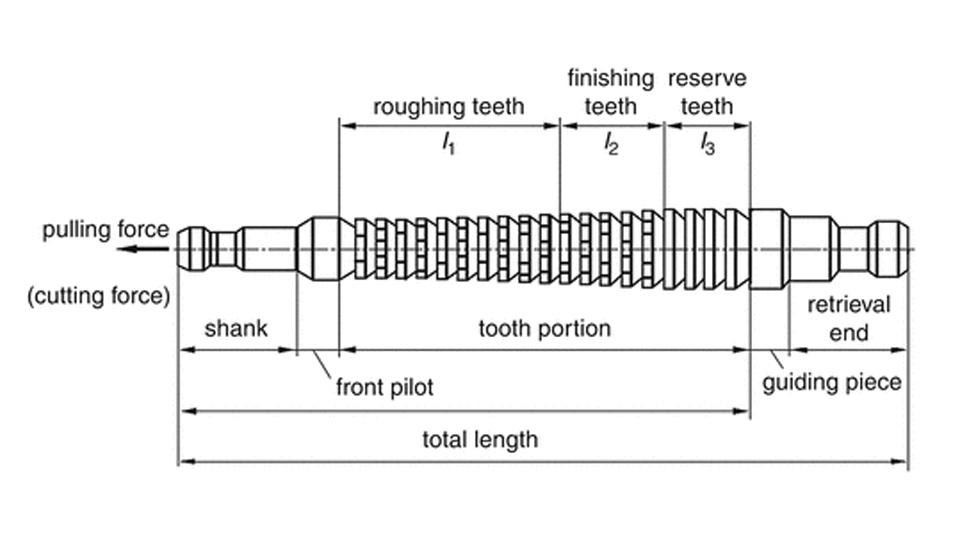
(Getzshape) Broaching process diagrammaterial and geometry are suitable.
What Is Broaching?
Broaching is a machining process that uses a multi-tooth cutting tool called a broach to progressively remove material and form a precise internal or external profile. In conventional linear broaching, the broach can produce the final profile in a single stroke, making the process well suited to repeated production of defined features.
The main tradeoff is tooling flexibility. A broach is designed for a specific profile, so it can provide consistent results once the tooling is established, but CNC milling is usually more practical when part geometry or production requirements change.
How Does a Broach Remove Material?
A broach contains multiple cutting teeth arranged progressively along its length.
The first cutting teeth remove a small amount of material. Each successive cutting tooth removes a controlled increment of stock, known as the rise per tooth, until the roughing teeth have removed most of the material and the finishing teeth establish the final profile and dimensions. This continues through the roughing and finishing teeth until the final tooth reaches the required profile.
A simplified sequence looks like this:
Workpiece → roughing teeth → intermediate teeth → finishing teeth → finished profile
The important point is that the entire machining allowance is divided among many teeth rather than removed by one cutting edge.
The vertical or radial increase between successive cutting teeth is the rise per tooth. This value controls how much stock each tooth removes and is selected based on the workpiece material, profile, and required cutting load.
For a simple internal keyway, for example, the first teeth may barely enter the material. Teeth farther along the broach progressively deepen the keyway until the finishing teeth establish the final width and depth.
This incremental cutting action is the foundation of the broaching process.
It also explains why a broach is generally designed for a particular geometry. The tooth progression itself contains much of the information needed to generate the final feature.
What Are the Main Types of Broaching?
Broaching is commonly described by where the feature is cut, how the tool is loaded, and how the tool moves. These categories can overlap. An internal spline may be produced by pull broaching, while a small hexagonal socket may use rotary broaching.
Internal and External Broaching
Internal broaching cuts a profile inside an existing opening, such as a keyway, spline, square hole, or hexagonal hole. The starting hole must be large enough for the broach to pass through.
External broaching removes material from the outside of a part to produce features such as flats, slots, serrations, or external profiles. The key distinction is simply whether the broach works through an opening or across an exterior surface.
Pull and Push Broaching
Pull broaching draws the tool through the workpiece. Because the broach is loaded in tension, it can be relatively long and carry a large number of progressively larger teeth. This makes pull broaching common in production work.
Push broaching forces the tool through the part in compression. Push broaches are generally shorter because compressive loading increases the risk of tool buckling, especially with long, slender tools.
Rotary Broaching
Rotary broaching uses a specialized holder that offsets the broach axis to create a controlled wobbling motion. This allows the tool to form polygonal profiles such as hexagonal and square holes on CNC lathes and machining centers.
It is often used for small polygonal features such as hexagonal or square sockets and can be performed on CNC lathes without a dedicated linear broaching machine.
What Is Broaching Used For?
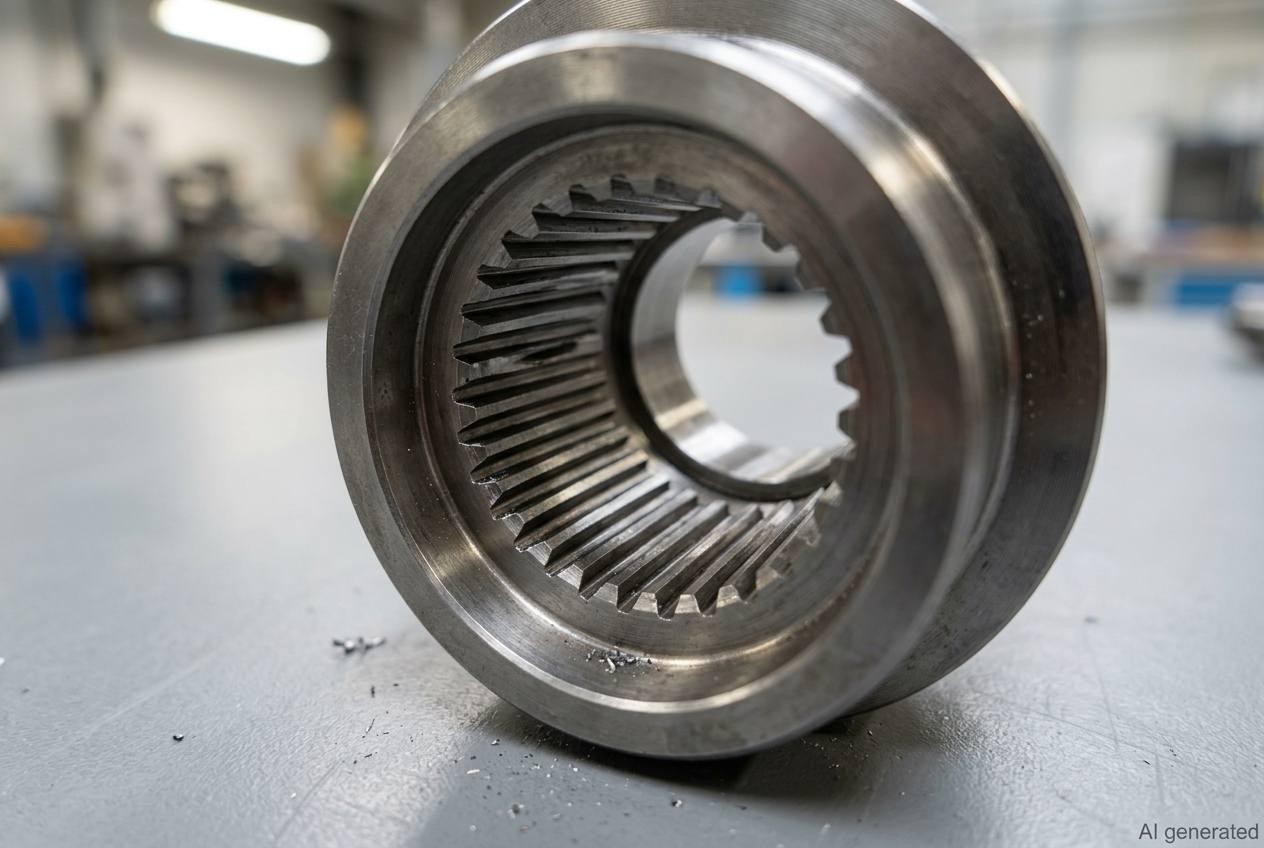
Broached precision metal component
Broaching is used primarily to produce defined internal and external profiles that need to be repeated accurately across multiple parts.
The process is especially effective when the geometry is difficult or inefficient to produce through conventional drilling or milling but can be represented directly by the broach profile.
Internal Keyways, Splines, and Polygonal Holes
Internal keyways are one of the classic applications of broaching.
A keyway must have controlled width, depth, and location relative to the surrounding bore. Broaching allows these dimensions to be established with a dedicated tool containing the required tooth progression.
If you're comparing broaching with milling for a keyway or precision slot, here's a guide to CNC slot milling and the tooling, methods, and tolerances involved.
Splines are another important application. Internal spline profiles can contain many teeth around the circumference, making them difficult to generate efficiently with conventional machining methods.
Broaching can produce the complete spline profile through a controlled sequence of cutting teeth.
Polygonal holes are also common. Square, hexagonal, and other non-round internal profiles can be produced when the broach geometry is designed around the required shape.
These applications share one characteristic: the desired profile is clearly defined and needs to be reproduced consistently.
External Profiles and Surfaces
External broaching is used when a defined shape must be produced across the outside of a component.
Examples include:
- External flats
- Serrations
- External splines
- Slots
- Contoured surfaces
Instead of programming multiple milling passes to generate the same profile, a dedicated broach can contain the geometry directly in its cutting teeth.
That can make the operation highly repeatable once the tooling and setup have been established.
What Are the Advantages and Limitations of Broaching?
Broaching works best when the same profile has to be produced repeatedly. The cutting teeth increase in size along the tool, so material is removed in controlled increments and the final profile is largely determined by the broach itself. This makes the process predictable for production features such as keyways and internal splines.
Advantages of Broaching
High repeatability. Once the broach, workholding, and machine are set correctly, the same feature can be reproduced with little toolpath-related variation. This is useful for keyways or splines that must maintain a consistent fit across a production run.
Efficient cutting. Several teeth share the cutting load, with each tooth removing only part of the stock. A conventional push or pull broach can therefore finish the feature in a single stroke rather than building the profile through multiple milling passes.
The process is also relatively insensitive to operator-dependent tool positioning because the broach physically contains the required profile. For high-volume parts, that can reduce cycle time and simplify process control.
Limitations of Broaching
If the keyway width, spline form, or finished bore changes between revisions, the dedicated broach may need to be replaced rather than simply reprogrammed. The tool is dedicated to a specific profile, and a new feature may require a different broach. For a short production run, the tooling cost can outweigh the machining-time savings.
Part geometry can also limit its use. Internal broaching normally requires a hole large enough for the broach to enter, and the workpiece must be rigid enough to resist the cutting force without distortion. Blind internal features are generally unsuitable for conventional through-broaching, although rotary broaching can produce certain blind polygonal features.
Conventional linear broaching works best when the feature is accessible along the direction of the broach stroke and the surfaces being cut do not interrupt tool travel. Geometry that prevents the broach from passing through the feature may require another process.
For example, a production keyway repeated on thousands of shafts can justify a dedicated broach, while a small batch with several different keyway sizes is often easier to produce by CNC milling.
Note
For internal broaching, the starting bore is part of the process design, not simply a clearance feature. Its diameter, straightness, depth, and entrance chamfer affect broach engagement, cutting force, chip evacuation, and tool life. Thin walls or poorly supported sections can deflect under broaching load, so the fixture and part geometry must provide adequate support around the cutting area.
Broaching isn't the right fit for every project, especially when you're working with prototypes, low volumes, changing designs, or geometries that are easier to produce with CNC machining. JLCCNC provides CNC milling and turning for parts where dedicated broaching tooling is not economical.
Upload your CAD file for an engineering review of the geometry, tolerances, and production requirements.

Precision CNC Machining Service
Professional manufacturing, fast turnaround, and quality assurance.
What Materials Can Be Broached?
A wide range of metals can be broached, including carbon steels, alloy steels, stainless steels, aluminum alloys, brass, bronze, and cast iron.
Material selection matters because hardness, ductility, machinability, and work-hardening behavior influence cutting forces and tool life.
Material condition matters as much as alloy designation. Heat-treated steels, work-hardening stainless grades, and abrasive cast irons can require different broach geometry, cutting conditions, and tooling materials.
| Material | Broaching Characteristics | Typical Considerations |
|---|---|---|
| Carbon steel | Generally good machinability | Cutting forces depend on grade and hardness |
| Alloy steel | Broachable across many grades | Hardness strongly affects tool loading |
| Stainless steel | Broachable with appropriate tooling | Work hardening can increase cutting difficulty |
| Aluminum alloys | Generally easy to cut | Soft material requires attention to chip control |
| Brass | Generally excellent machinability | Tool geometry should match the alloy |
| Bronze | Generally machinable | Behavior varies significantly by alloy |
| Cast iron | Can be broached | Abrasiveness and graphite structure affect tool wear |
Broaching vs. Milling: Which Process Should You Choose?
Broaching is generally the better choice when the same defined profile must be produced repeatedly, while CNC milling is usually the better choice for prototypes, low-volume production, complex geometries, and designs that may change.
Broaching is optimized for repeatedly producing a defined profile with dedicated tooling, while CNC milling is optimized for flexibility and programmable geometry.
Neither process is universally better though.
The right choice depends on the geometry, quantity, tooling requirements, cycle time, and likelihood of design changes.
| Factor | Broaching | CNC Milling |
|---|---|---|
| Tooling | Dedicated broach | General-purpose cutting tools |
| Initial tooling cost | Higher for specialized profiles | Usually lower |
| Profile flexibility | Limited | Very high |
| Design changes | Tool may need modification/replacement | Usually program change |
| Repeated production | Excellent | Excellent |
| One-off parts | Often impractical | Excellent |
| Complex 3D geometry | Limited | Excellent |
| Internal keyways | Excellent | Possible |
| Internal splines | Excellent for suitable profiles | Possible but often more involved |
| Polygonal holes | Excellent | Possible |
| Setup flexibility | Lower | Higher |
| Cycle time for defined profile | Often very fast | Depends on geometry and toolpath |
| Best fit | Repeated defined profiles | Flexible production |
Choose broaching when the profile is fixed and repeated production justifies dedicated tooling. Choose CNC milling when flexibility, low-volume production, complex geometry, or frequent design changes matter more.
For a broader overview of milling methods, see the guide to types of milling operations.
FAQs About Broaching
Q: Is Broaching a CNC Machining Process?
Broaching is a machining process, but it is not inherently a CNC machining process. Traditional broaching machines use dedicated mechanical or hydraulic motion. Rotary broaching can also be performed on CNC lathes and machining centers.
Q: Does Broaching Require a Pilot Hole?
Internal broaching normally requires a pre-machined hole that provides access for the broach and sufficient clearance for the cutting operation. Internal rotary broaching also requires a prepared hole, with the pilot diameter, depth, and lead chamfer matched to the broach geometry. External broaching does not require a pilot hole.
Q: Is Broaching Faster Than Milling?
For a suitable repeated profile, broaching can be faster than milling because the feature may be completed in a single continuous stroke. Milling can be faster for small quantities or geometries that would require expensive dedicated broaching tooling.
Q: Can Broaching Produce Complex Internal Profiles?
Yes. Broaching can produce complex internal profiles including splines, keyways, serrations, polygonal holes, and other defined shapes. The practical limitation is that the geometry must be accessible and suitable for the broach's cutting motion.
Conclusion: When Is Broaching the Right Choice?
Broaching is most effective when a fixed profile needs to be produced repeatedly and consistently. Because the broach contains the required geometry, the feature can often be completed in a single stroke once the tooling and setup are established.
For production parts with the same keyway, spline, or polygonal profile, broaching can offer faster and more consistent results than milling. When volumes are low or the design is likely to change, CNC milling is usually more practical because the geometry can be changed through the toolpath rather than by replacing dedicated tooling.
The choice therefore depends largely on how stable the design is and how much production volume can justify the broach. A fixed profile in a repeat production run may favor broaching, while a more flexible machining route is often better for prototypes and shorter runs.
JLCCNC provides CNC milling for precision machined parts where dedicated broaching tooling is not the most practical option. The engineering team can review the part geometry and drawing requirements to determine a suitable machining approach.
Upload Your CAD File for Engineering Review & Quote
Precision CNC Machining Service
Professional manufacturing, fast turnaround, and quality assurance.
Keep Learning
What Are Secondary Operations in Manufacturing?
Key Takeaways Secondary operations refine a part after its main production stage. Their classification depends on the production route. Typical tasks include machining, heat treatment, finishing, joining, and marking. Final drawing requirements help determine which added steps are needed. Extra stages can influence cost, lead time, handling, and inspection. Secondary operations are additional manufacturing steps performed after an earlier production stage to bring a part to its required final conditio......
What Is EDM? How Electrical Discharge Machining Works
What Is EDM (Electrical Discharge Machining)? How It Works & Applications A mold shop needs to cut a cavity into hardened tool steel — the kind of material that would dull a carbide end mill before the cut is even halfway done. A medical device maker needs a slot 0.05mm wide in a titanium component, thinner than most drill bits can even produce. Neither job is solvable with a spinning cutting tool, because the material is either too hard, the geometry too fine, or both. That's the gap EDM was built to......
Wire EDM Machine: Types, Specs & How to Choose One
Wire EDM Machine: Types, Specs & How to Choose One Our guide on how EDM wire cutting works covers the process itself — the spark erosion, the dielectric fluid, the tolerances the technique can hold. This one is about the machine that runs that process: what actually differentiates one wire EDM machine from another, and what matters when you're evaluating or specifying one. 💡 Need Precision Wire EDM Services? Understanding machine specs is crucial, but actually running them takes experience. At JLCCNC......
Titanium CNC Machining: Properties, Challenges & Best Practices
Titanium CNC Machining: Properties, Challenges & Best Practices A shop that's comfortable machining aluminum all day can still get caught off guard the first time a titanium job comes through. The part looks the same on the CAD screen, the toolpath strategy looks reasonable, and then the tool overheats, work-hardens the surface it just cut, and the finish comes out nothing like what aluminum would have produced at the same settings. Titanium isn't just "harder aluminum" — it behaves differently enough......
High Volume CNC Machining: What Changes When You Scale Production
High Volume CNC Machining: What Changes When You Scale Production Ten prototypes and ten thousand production parts are not the same problem wearing different clothes. A process that works fine for a handful of pieces — a bit of manual deburring here, a quick visual check there, tooling that gets swapped whenever it feels a little dull — falls apart the moment volume multiplies by a thousand. High volume CNC machining isn't just "the same thing, more of it." It's a different set of priorities, where de......
PTFE CNC Machining: Properties, Applications & Best Practices
PTFE CNC Machining: Properties, Applications & Best Practices PTFE — better known by the DuPont trade name Teflon — is a strange material to put on a CNC machine. It's soft, it barely holds a sharp edge itself, and it deforms under clamping pressure in ways that would ruin tolerance on almost any other engineering plastic. And yet it gets machined constantly, because nothing else offers PTFE's combination of an almost unbelievably low coefficient of friction and near-universal chemical resistance. Mac......