Custom Bicycle Parts: CNC Machining Guide
20 min
- Common Custom Bicycle Parts for CNC Machining
- Why Use CNC Machining for Custom Bicycle Parts
- CNC Machining Process for Custom Bicycle Parts
- Design Considerations for CNC Machined Bicycle Parts
- Materials and Finishes for Custom Bicycle Parts
- From Bicycle Part Prototype to Production
- Custom Bicycle Parts FAQs
- Conclusion About Custom Bicycle Parts
Key Takeaways
- CNC machining is often a practical choice for custom bicycle parts when production quantities are low, the geometry is complex, or critical interfaces require tighter dimensional control than near-net-shape forming can provide.
- The parts that benefit most are the ones where fit accuracy genuinely matters, such as bearing seats, bottom bracket interfaces, derailleur mounting features, and suspension pivots, where dimensional variation can affect assembly and performance.
- For CNC-machined bicycle parts, 6061-T6 and 7075-T6 aluminum are common choices because they combine low weight, machinability, and useful strength. Other metals such as stainless steel, carbon steel, brass, and copper may be selected when the part's wear, corrosion, electrical, or strength requirements call for them.
- Getting from a concept to a production-ready part requires clean CAD geometry, a proper drawing with tolerance callouts, and realistic thinking about what surface finishes and fits the part actually needs to function.
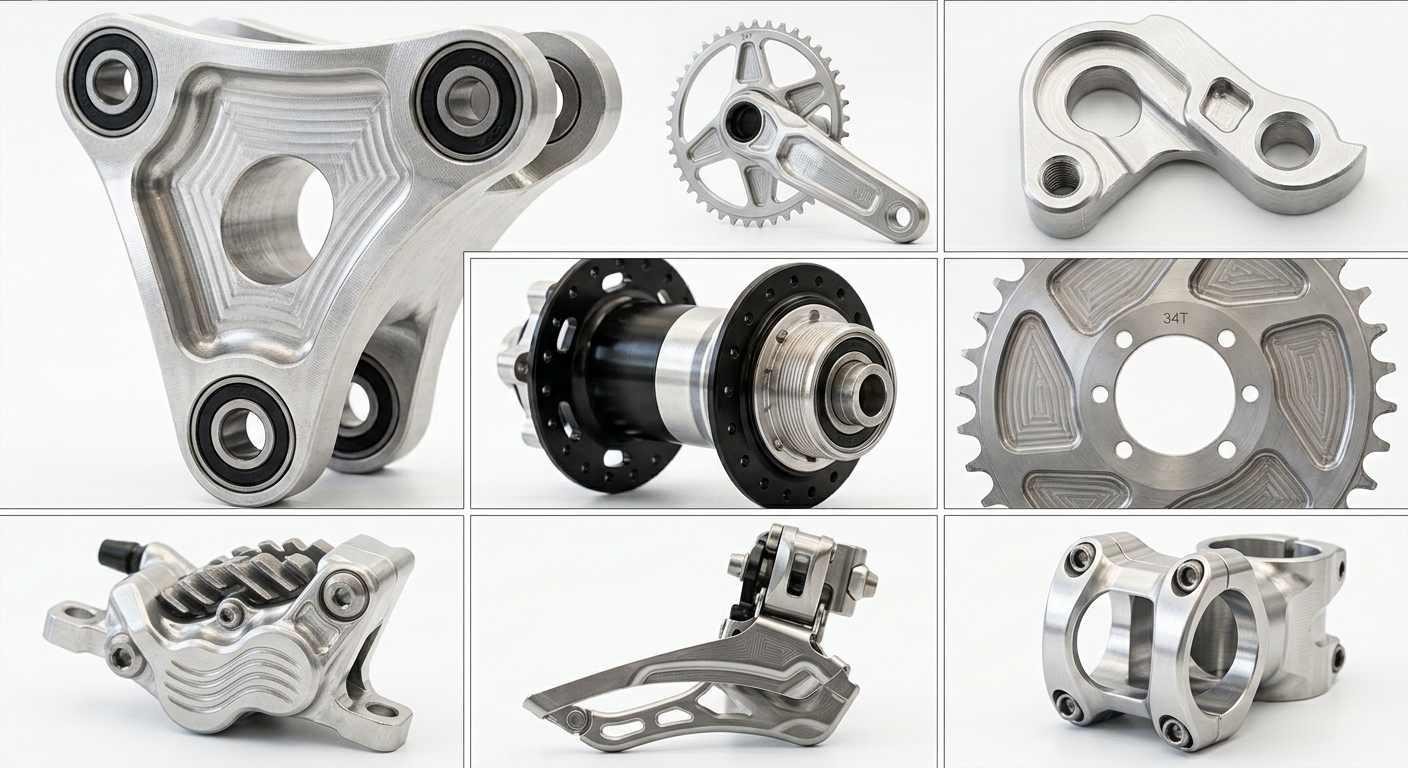
Custom CNC machined bicycle components
Custom bike parts occupy an interesting space in manufacturing. The quantities are usually small, sometimes one-off prototypes, sometimes batches of a few hundred for a boutique brand, and the technical requirements can be surprisingly demanding. A suspension linkage bearing bore that is oversized can create excessive clearance and allow the bearing outer ring to creep, while an undersized bore can impose excessive interference and distort the bearing. A bottom bracket shell with an off-axis or damaged thread can complicate installation and affect how the bottom bracket assembly seats, although creaking can result from several different interface or assembly conditions.
CNC machining is well suited to low-volume bicycle components because the same digital design can be produced without dedicated forming dies, while critical features can be controlled through machining, fixturing, and inspection. The practical economics of custom CNC bicycle parts come from avoiding dedicated forging dies or casting molds while allowing design changes to be implemented through the machining program and setup. This guide covers which bicycle parts are typically CNC machined, why the process suits cycling applications specifically, and what you need to get from design to production.
Common Custom Bicycle Parts for CNC Machining
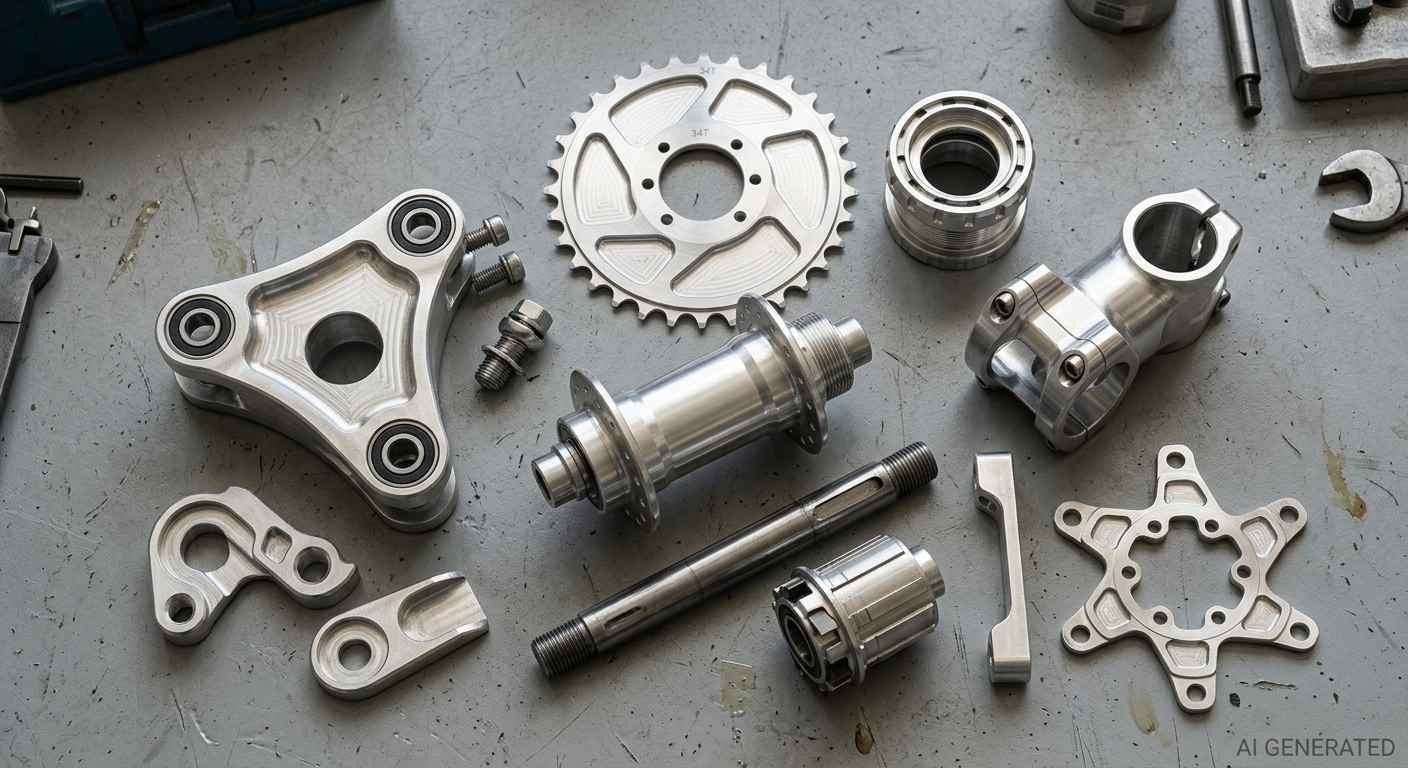
CNC machined custom bicycle parts
Custom bicycle parts are bike components manufactured to a customer-specific geometry, interface, material, or fit rather than selected from a standard catalog. CNC machining is often used for these parts because the same digital design can be adapted from prototype to small-batch production without dedicated forming dies or molds.
| Bicycle Part | Typical CNC Process | Critical Features | Common Materials |
|---|---|---|---|
| Hub shell | CNC turning + milling | Bearing seats, flange position | 6061, 7075 |
| Suspension link | CNC milling | Bearing bores, bore location | 6061, 7075 |
| Derailleur hanger | CNC milling | Mounting face, thread location | 6061, 7075 |
| Chainring | CNC milling | Tooth profile, BCD | 7075 |
| Stem | CNC milling | Clamp bores, face alignment | 6061, 7075 |
Drivetrain Components
Chainrings, bottom bracket cups, crank interfaces, and derailleur hangers all show up as custom CNC-machined bicycle parts regularly. Chainrings seem simple until you look at the tooth profile geometry and the shift ramp features. On a high-end road or MTB chainring, those details are machined precisely because they affect how reliably the chain picks up under load. The bolt circle diameter and spider interface dimensions have to be accurate enough for interchangeability with whatever cranks the customer runs.
Bottom bracket interfaces must be specified by the exact frame and bearing standard. BSA and T47 use threaded frame interfaces, while systems such as PF30 and BB86 use press-fit shell interfaces. Custom cups, adapters, or related components must match the specified thread, shell dimensions, bearing interface, and spindle system rather than being treated as interchangeable parts.
Derailleur hangers are commonly produced by CNC machining, forging, casting, stamping, or combinations of these processes, depending on geometry, material, and production volume. Because a derailleur hanger is a replaceable alignment component, its alloy, temper, cross-section, and intended failure behavior should follow the validated design rather than assumptions about how easily the part should bend or break. The specified aluminum alloy and temper must also be maintained through material sourcing and manufacturing, because machining accuracy alone does not determine the part's strength or fatigue performance.
Hubs, Axles, and Wheel Components
Precision bicycle parts don't get much more demanding than hubs. An out-of-round or incorrectly sized bearing seat can create uneven interference around the bearing ring, increasing the risk of distortion, excessive preload, creep, or premature wear. The required housing fit should be selected from the bearing type, loading, rotating ring, material, and operating conditions rather than from diameter alone. Hub flange diameter, spacing, and spoke-hole location affect spoke bracing angles and wheel stiffness, while concentricity of the bearing seats and axle interfaces affects bearing loading and wheel alignment. Axle interfaces to frame dropouts or thru-axle sockets have to be right for the wheel to seat consistently. For a deeper look at clearance, transition, and interference fits for bearing and shaft assemblies, see our guide to limits and fits in CNC machining.
Custom hubs for track cycling, BMX racing, or tandems are regularly machined in small batches. So are replacement axles and skewers, freehub bodies for obscure cassette standards, and rotor carriers for disc brake wheels. The flange drilling pattern, spoke hole chamfers, and valve hole positions are all features that appear simple but require care to produce correctly.
Frame, Suspension, and Structural Components
Mountain bike suspension linkage components are among the more complex custom cnc bike parts from a machining standpoint. A single-pivot suspension link might be a simple aluminum billet with bearing bores, manageable with 3-axis machining. A multi-link design with closely controlled bore locations and axis relationships across multiple faces may benefit from 4-axis or 5-axis machining because these approaches can reduce the number of setups and re-referencing operations required to access the critical features.
The bearing bore dimensions in suspension links directly determine how long the pivot system stays tight. An undersized housing bore can impose excessive interference on the bearing outer ring and distort it, while an oversized bore can allow the outer ring to creep or spin in the housing. The appropriate fit depends on the bearing type, load, which ring rotates, bearing size, and mounting conditions, so the housing and shaft fits should be specified from the bearing manufacturer's recommendations rather than chosen generically. The drawing should reflect the actual load, duty cycle, bearing arrangement, and required service life of the component rather than applying the same tolerance strategy to every bicycle application.
Frame interface components, dropout inserts, cable stop bosses, derailleur mounts, head tube reinforcement rings, are all machined parts that frame builders integrate into welded or carbon structures. The machined interface geometry has to be right because welding or bonding it into a frame is a one-way process.
Controls, Braking, and Other Custom Components
Brake caliper mounts, custom lever bodies, handlebar clamps with specific stack heights, and stem faceplates for unusual bar configurations all appear as custom cycling machining projects. Racing teams running custom cockpit setups, ergonomics-focused fitters building up unusual positions, and boutique component brands releasing limited runs all use CNC machining for parts that wouldn't justify injection molding tooling.
Custom brake mounts, caliper bodies, and rotor adapters may be CNC-machined when their geometry and dimensional requirements call for it. Because these are safety-related components, the design and manufacturing process should also account for applicable load requirements, material specifications, and validation or testing requirements. Safety relevance alone does not determine the manufacturing process.
Why Use CNC Machining for Custom Bicycle Parts
Precision for Critical Fits and Interfaces
The case for CNC machining in bicycle components isn't really about aesthetics or perceived quality, it's about functional precision at the interfaces that determine how the component performs in assembly and service. Bearing fits in hubs, headsets, and suspension pivots need to be right within a few hundredths of a millimeter. Thread forms in bottom bracket shells and dropout inserts need to be clean and accurate to the specified standard. Bolt circles on chainrings and rotors need to be true for even bolt loading.
Forging or casting can establish a near-net shape efficiently at suitable production volumes, but critical bores, threads, bearing seats, and alignment features are often finish-machined to achieve their final dimensions and relationships. At higher production volumes, bicycle components may use forging, casting, stamping, or other near-net-shape processes, followed by CNC or other secondary machining on features that require tighter dimensional or geometric control.
Complex Geometry and Material Removal
Some bicycle part geometries need significant material removal from the starting billet to produce a lightweight finished part: a crank arm with extensive weight-relief pockets, a suspension link shaped to clear specific frame tubes, a stem with integrated cable routing and unusual clamp geometry. At small quantities, CNC machining is often practical because the part can be cut directly from billet without committing to dedicated forming tooling. For more on how CNC machining achieves tight dimensional accuracy on complex parts, see our guide to CNC precision machining.
Multi-axis machining becomes relevant for parts where compound angles, undercuts, or continuous curved surfaces need to be produced accurately. A dropout with a specific alignment tab orientation, a spider arm with angled chainring bolt bosses, or a suspension rocker with complex curvature are all cases where 4-axis or 5-axis machining earns its cost premium over simpler 3-axis approaches.
Flexible Production Without Dedicated Forming Molds or Dies
The practical economics of custom CNC cycling parts come from avoiding dedicated forging dies or casting molds, while allowing design changes to be implemented directly in the machining program and setup. For a small frame builder who needs 50 custom dropout inserts, or a cycling startup developing a new hub design that will go through three prototype iterations before production, this flexibility matters enormously. For a closer look at small-batch CNC production, material use, setup costs, and production economics, see our guide to low volume CNC machining.
The trade-off is higher per-part cost when material removal, setup time, or inspection requirements are significant. A complex hub body in titanium with tight bearing tolerances costs serious money per unit. And custom fixtures or soft jaws for holding unusual geometries are a real cost that gets wrapped into small production runs. The economics work because the alternative, casting or forging tooling, would cost far more at these quantities. But "no tooling cost" doesn't mean "low per-part cost."
CNC Machining Process for Custom Bicycle Parts
Reviewing the CAD Model, Drawing, and Requirements
Before machining starts, the CAD geometry and drawing need to be reviewed together. The model carries the 3D geometry. The drawing carries the specification, tolerances, surface finish callouts, material, any heat treatment or finishing requirements. Submitting a 3D model without a drawing for precision components means the machinist works to standard tolerances, which may or may not be adequate for the specific part.
For custom bike parts with critical fits, features such as bearing seats, threaded interfaces, and pivot bores need explicit tolerance callouts on the drawing. A general ±0.1 mm title-block tolerance may be too loose for a hub bearing seat. Critical bearing features should have their own dimensional limits and, where required, form or positional controls based on the bearing fit and assembly requirements.
DFM review at this stage, checking for features that will be difficult to machine, geometries that require special tooling, or tolerance specifications that will significantly drive up cost, is where you prevent expensive surprises. A suspension link design with deep narrow pockets that need very long end mills, or thread forms that require non-standard taps, should be identified before production begins.
Selecting the Machining Process for the Part Geometry
Most custom bicycle parts can be handled on 3-axis CNC milling and CNC turning, sometimes in combination. A hub shell is primarily a turning operation with milled flange features, a turning center with live tooling handles it in fewer setups than separate turning and milling. A chainring is primarily a milling operation. A suspension link with features on multiple faces might need 4-axis or 5-axis machining to maintain feature-to-feature accuracy.
The decision about machining approach affects cost, lead time, and achievable precision. Fewer setups generally means better feature relationships and less accumulated positioning error. More complex machining approaches cost more but can be the only practical way to hit specific tolerance requirements on complex geometry.
Inspecting Critical Features Before Production
Dimensional inspection after machining verifies that the part meets its drawing requirements before it ships. For precision custom CNC cycling components, critical features such as bearing seats, threaded interfaces, and pivot dimensions should be verified using calibrated measurement methods rather than visual inspection or assembly feel alone.
CMM inspection can verify geometric relationships on complex parts, while bore gauges can verify bearing seats and thread gauges can be used for critical internal or external thread forms. For a production run of custom hubs, a first-article inspection with documentation of all critical dimensions before the batch runs protects both the manufacturer and the customer.
Have a custom bicycle part with tight fits, complex geometry, or difficult tool access? Upload your CAD file and drawing for a project-specific quote and DFM review from JLCCNC.

Precision CNC Machining Service
Professional manufacturing, fast turnaround, and quality assurance.
Design Considerations for CNC Machined Bicycle Parts
Tolerances, Fits, and Critical Features
The temptation when specifying custom precision bicycle parts is to put tight tolerances everywhere to be safe. Resist this. Tighter tolerances cost more, take longer, and add inspection burden. The right approach is identifying which features are functionally critical, bearing seats, threaded interfaces, alignment features, and specifying appropriate tolerances on those, with standard tolerances everywhere else.
Bearing fits in particular need appropriate specification. Do not specify H7/p6 as a generic bearing fit. Bearing mounting requires separate housing and shaft tolerances, selected according to the bearing type, load, rotating ring, size, and mounting conditions. The resulting limits should be defined on the drawing or referenced to the bearing manufacturer's fit recommendations.
Geometry, Tool Access, and Workholding
Features that can't be reached with standard tooling from accessible directions add cost. Deep narrow slots, undercuts that require T-slot cutters, and internal features that require excessively long tools can all increase machining difficulty, tool deflection, and cost. These are all situations where the machining difficulty and cost increase significantly.
Internal pocket corners inherit the radius of the cutting tool, so a sharp internal 90-degree corner can require a smaller cutter, additional operations, or a different machining strategy.
Workholding matters more for bicycle parts than for simple prismatic components because bicycle parts often have organic shapes, compound curves, and no obvious flat reference surface. A suspension link might need a custom soft jaw to hold it reliably for the second operation without distorting the geometry machined in the first. This is a real cost that needs to be factored into small-batch production pricing.
Materials and Finishes for Custom Bicycle Parts
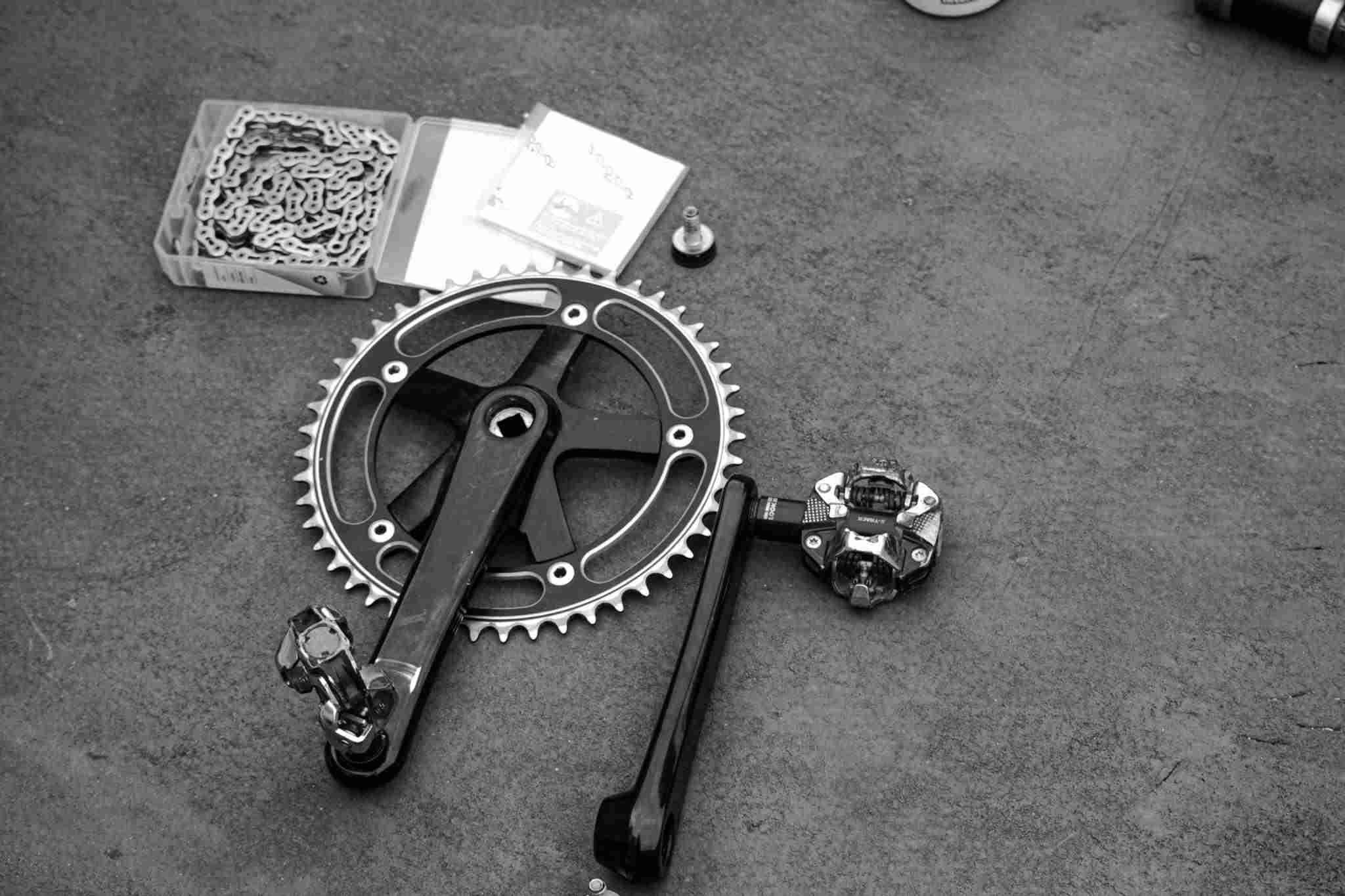
Custom bicycle crankset, pedals, and chain (Pexels)
Aluminum for Lightweight Bicycle Components
6061-T6 is a practical starting point for many CNC-machined aluminum bicycle parts because it offers good machinability, corrosion resistance, and a useful balance of strength and cost. It also responds well to anodizing, making it suitable for components where both dimensional control and surface appearance matter.
7075-T6 provides substantially higher strength than 6061-T6 and can be considered for higher-stress components where the design benefits from its higher strength-to-weight ratio. The alloy is generally more expensive and its higher strength does not automatically make it suitable for every bicycle component; load requirements, fatigue behavior, geometry, and manufacturing cost still need to be considered.
Representative yield-strength values are about 503 MPa for 7075-T6 and 276 MPa for 6061-T6, although actual properties vary with product form and specification. This difference illustrates why 7075 may be selected for higher-stress designs, but alloy strength alone does not determine whether a bicycle component is structurally adequate.
Other Metal Options for Custom Bicycle Parts
Aluminum is not the only option for CNC-machined bicycle components. Stainless steel can be used where corrosion resistance and durability are important, while carbon steel may be selected for applications that require higher strength, wear resistance, or specific mechanical properties. Brass and copper are also used for smaller bicycle components and functional hardware where their machinability, electrical conductivity, or other material characteristics are useful.
Material selection should follow the actual load, wear, corrosion, weight, and interface requirements of the part rather than choosing a material solely because it is commonly used in cycling.
JLCCNC's publicly listed CNC machining materials include 6061 and 7075 aluminum, SUS304 stainless steel, 45# steel, H59 brass, and T2 copper. For bicycle components, aluminum is generally the most relevant starting point when weight and machinability are important, while the other materials may suit specific wear, corrosion, strength, or functional requirements.
Surface Finishes for Appearance and Protection
Anodizing is a common finish for CNC-machined aluminum bicycle parts because it improves surface protection and provides a range of appearance options. Type II anodizing is widely used when color and general corrosion resistance are required, while Type III hard anodizing provides a harder, more wear-resistant surface for suitable applications. Because anodizing changes the surface dimensions, critical bearing seats, threads, and other fits should be considered during the finishing specification.
For parts requiring a different appearance or functional surface treatment, other finishing options may include bead blasting, brushing, polishing, or marking. The required finish should be specified together with the functional surfaces that must remain dimensionally controlled.
From Bicycle Part Prototype to Production
Prototyping and Design Validation
The first machined prototype of a custom bike part tells you things that CAD simulation doesn't. Whether the fit to the mating component is what you expected. Whether the part looks and feels right in the assembly. Whether the weight matches what the model predicted. And frequently, what needs to change in the design before it's right.
Prototype quantities of one to five parts are common for custom cycling components. The per-part cost is higher than production, the lead time is shorter, and changes can be made between iterations without the sunk cost of committed tooling. Two or three documented prototype iterations can reduce the risk of releasing a production design before fit, function, and manufacturability have been validated.
Small-Batch and Repeat Production
Once the design is validated, production in quantities of ten to several hundred is where online CNC machining services work well for custom bicycle components. The same CAD files and drawing that produced the prototypes serve as the production documentation.
For repeat production, the inspection scope should be defined by the drawing requirements, part risk, customer requirements, and demonstrated process capability. Prototypes often receive more comprehensive dimensional verification, while production runs may use a documented sampling plan after the process has been validated.
For repeat orders, retaining the same manufacturing process and inspection setup can reduce reprogramming, fixture preparation, and process-validation work compared with restarting the job with a new supplier. Repeat orders can be more efficient once the machining process, fixtures, tooling, and inspection requirements have already been established and validated.
What to Include When Requesting a Quote
A STEP file of the 3D geometry. A 2D drawing in PDF with dimensional tolerances, GD&T callouts, surface finish requirements, material specification, and any finishing requirements. The quantity needed and whether this is a prototype or a production run. Any specific delivery timeline requirements. If there are mating components or assembly context that affects how the part needs to fit, mentioning this helps the machinist understand what matters.
Leaving out the drawing and submitting only a 3D model is the most common reason quotes come back with assumptions that don't match what was intended. The model is geometry. The drawing is the specification.
Custom Bicycle Parts FAQs
Q: What materials are common for CNC machined bicycle parts?
6061-T6 and 7075-T6 aluminum are the most relevant starting points for many CNC-machined bicycle components. JLCCNC also publicly lists SUS304 stainless steel, 45# steel, H59 brass, and T2 copper for CNC machining. The appropriate material depends on the component's load, weight target, corrosion environment, wear requirements, and interface conditions.
Q: What files are needed for a custom bicycle part quote?
A STEP file for the 3D geometry and a 2D drawing in PDF format with tolerances, material, surface finish, and any special requirements. For precision bicycle parts where bearing fits or threaded interfaces are involved, the drawing with explicit tolerance callouts is necessary, a model alone doesn't communicate the specification fully.
Q: Can CNC machined bicycle parts be produced in small batches?
Yes, and small-batch production is one of the main use cases for CNC cycling parts. CNC machining does not inherently require the die- or mold-driven minimum quantities associated with forging and casting, although suppliers may still apply commercial minimums when setup, fixturing, finishing, or inspection costs are significant. CNC machining can support small production batches such as several dozen hub shells or derailleur hangers, although setup, fixturing, finishing, and inspection requirements still affect the economics of the order.
Q: What information affects a custom bicycle part quote?
Material, part geometry and size, tolerances (particularly on critical fits), surface finish requirements, quantity, any special inspection or documentation requirements, and delivery timeline. Tighter tolerances, harder materials, more complex geometry, and lower quantities all push the price up. Having a complete drawing with this information specified clearly produces a more accurate quote than an incomplete submission that requires the supplier to make assumptions.
Conclusion About Custom Bicycle Parts
CNC machining works for custom bicycle components because of the combination of precision, flexibility, and the ability to produce small quantities without tooling commitment. The process is appropriate when the part has functional fit requirements that matter, bearing seats, threaded interfaces, alignment features, when the geometry involves significant material removal or complex shapes, and when the quantities don't justify the investment in casting or forging tooling.
Getting good results requires complete documentation, model and drawing together, with explicit tolerances on critical features rather than relying on default title block tolerances. It requires honest thinking about which features need tight control and which don't, because over-specifying tolerances across the board adds cost without improving function.
At JLCCNC, custom bicycle parts from prototype through small-batch production are supported with engineering review before production starts, appropriate inspection of critical fits, and documentation to back up the parts that ship.
Precision CNC Machining Service
Professional manufacturing, fast turnaround, and quality assurance.
Popular Articles
• CNC Machining in the Medical Industry
• CNC for Luxury Watchmaking: Achieving Sub-Micron Tolerances
• Micro CNC Machining: Techniques for Manufacturing Miniature Components
• CNC Machining vs Sheet Metal: Which is Better for Enclosures?
• Micro CNC Machining Explained: Process, Precision & How Small It Can Really Get
Keep Learning
Custom Bicycle Parts: CNC Machining Guide
Key Takeaways CNC machining is often a practical choice for custom bicycle parts when production quantities are low, the geometry is complex, or critical interfaces require tighter dimensional control than near-net-shape forming can provide. The parts that benefit most are the ones where fit accuracy genuinely matters, such as bearing seats, bottom bracket interfaces, derailleur mounting features, and suspension pivots, where dimensional variation can affect assembly and performance. For CNC-machined ......
Online CNC Machining Services for Startups: Benefits & Uses
Key Takeaways Online CNC machining lets startups upload CAD files, get quotes, order custom parts, and manage production through a digital workflow. Prototyping: Startups can order single or small quantities to test fit, function, materials, and designs before scaling production. Production flexibility: The same CNC service can support prototypes, small batches, and higher quantities as product demand develops. Cost factors: Material, part size, geometry, tolerances, quantity, machining requirements, ......
CNC Machining for the Automotive Industry
Key Takeaways Automotive CNC machining is used both to produce certain low-volume components directly and to finish cast or forged parts at critical interfaces, including engine blocks, transmission housings, suspension uprights, brake components, and EV motor housings. CNC machining isn't how most automotive parts get manufactured in volume; casting, forging, and stamping handle the majority of mass production. What CNC does well is prototyping, low-volume production, precision finishing of cast or f......
CNC Machining for the Optics Industry: Optical Components & Housings
Key Takeaways CNC machining for optical systems primarily produces optomechanical components that hold, locate, align, and protect optical elements, including housings, lens barrels, mounts, spacers, retaining rings, and alignment fixtures. Conventional CNC machining is primarily used for the mechanical components around optical elements, while lenses and mirrors are generally produced through specialized grinding, polishing, coating, or ultra-precision machining processes. CNC machining provides the ......
Semiconductor CNC Machining: Precision Parts for Semiconductor Equipment
Key Takeaways CNC machining produces semiconductor equipment parts such as vacuum plates, manifolds, chambers, stages, brackets, and equipment housings. The function of a feature should set its machining requirements. A sealing surface needs suitable flatness and surface condition, while locating holes depend more on diameter and position. Large pockets can make an aluminum plate move after material removal. Roughing and finishing operations may therefore need separate setups. Thin walls can deflect u......
CNC Machining for Electronic Hardware: Design, Tolerances, and Manufacturing Considerations
(AI-generated) CNC milling of an aluminum electronics enclosure CNC machining plays a supporting but critical role in electronics manufacturing. While PCB fabrication creates traces, vias, and plated circuit features, CNC machining is used to produce the structural and mechanical parts that help the final device function reliably. What Is CNC Machining for Electronics CNC machining for electronics is the process of manufacturing high-precision mechanical parts used to support, protect, align, cool, or......