Types of Sheet Metal: Materials, Properties, and Applications
22 min
- What Is Sheet Metal?
- Types of Sheet Metal
- Common Types of Steel Sheet Metal
- Properties of Different Sheet Metal Types
- Common Applications of Different Sheet Metal Types
- How to Choose a Type of Sheet Metal
- Sheet Metal Fabrication by Material
- Final Thoughts
- FAQs About Types of Sheet Metal
Key Takeaways
- The most common sheet metal types are aluminum, stainless steel, carbon steel, galvanized steel, copper, and brass.
- Carbon steel generally offers the best combination of strength, weldability, availability, and low material cost.
- Stainless steel provides excellent corrosion resistance and is widely used in food, medical, architectural, and harsh-environment applications.
- Aluminum sheet metal weighs about one-third as much as steel, making it valuable for aerospace, transportation, electronics, and lightweight structures.
- Copper sheet is primarily selected for its exceptional electrical and thermal conductivity.
- Brass sheet combines good corrosion resistance, formability, machinability, and an attractive appearance.
- Sheet metal is commonly associated with thicknesses from roughly 0.5 to 6 mm, although the exact boundary between sheet and plate varies by industry and material.
- Gauge numbers are not universal thicknesses across every metal. A higher gauge generally means thinner material, but the actual thickness depends on the material and gauge standard.
- Material selection should consider strength, corrosion resistance, ductility, formability, weldability, density, conductivity, thickness, surface finish, availability, and cost rather than strength alone.
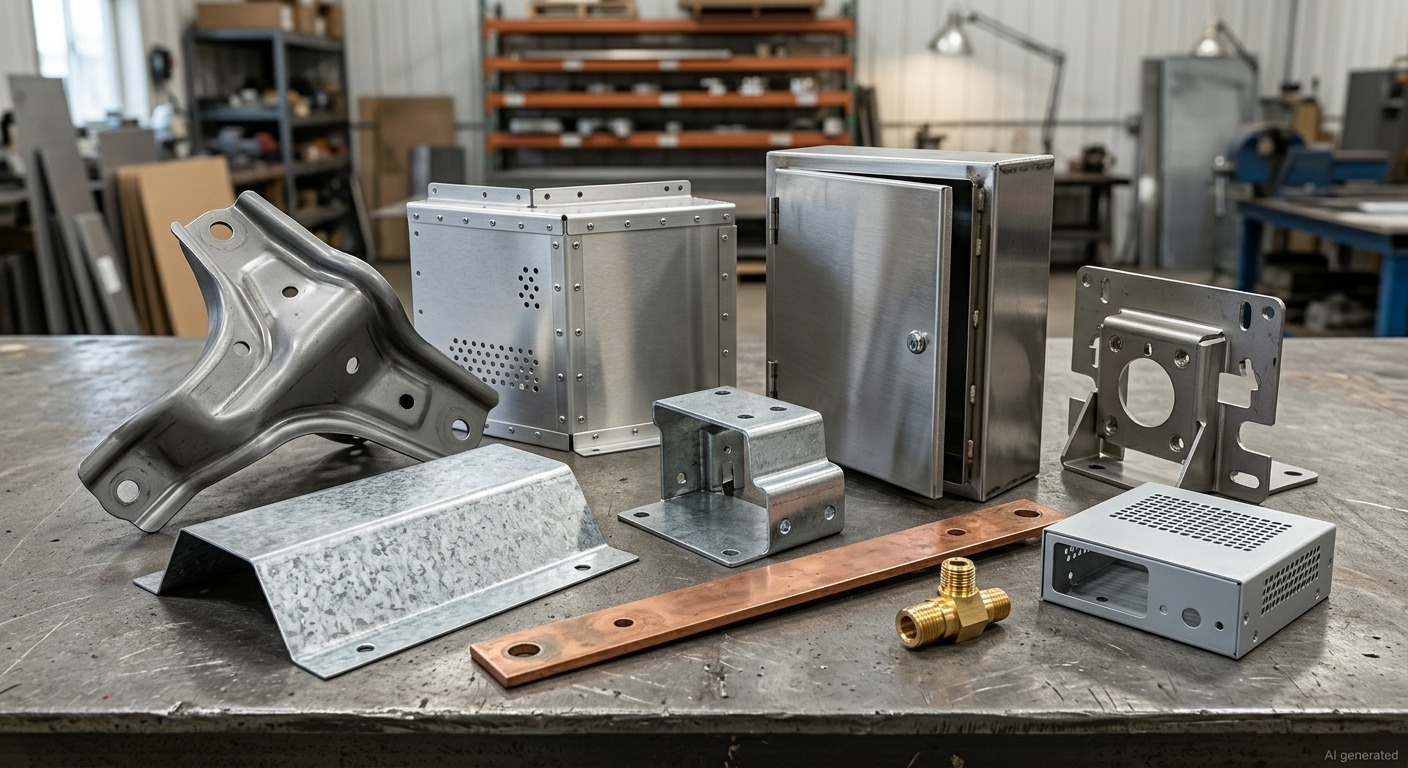
finished sheet metal materials and components
Sheet metal is available in dozens of metals, alloys, grades, and finishes, but most manufactured sheet metal parts start with a relatively small group of materials. The most common types of sheet metal include aluminum, stainless steel, carbon steel, galvanized steel, copper, and brass. Each trades strength, weight, corrosion resistance, formability, conductivity, cost, and fabrication characteristics differently.
Many metals and alloys are available as sheet metal, but most fabricated parts use a small group. The most common types are aluminum, stainless steel, carbon steel, galvanized steel, copper, and brass. Each differs in strength, weight, corrosion resistance, formability, conductivity, and cost.
There is no universally best sheet metal material. Aluminum is often chosen to reduce weight, stainless steel for corrosion resistance, carbon steel for cost-effective strength, and copper when conductivity matters. This guide compares their properties, applications, and the factors that influence material selection.
Need custom sheet metal parts? JLCCNC supports common sheet metal materials and can check manufacturing requirements against production standards. Upload your CAD file to get a quote.

Precision Sheet Metal Fabrication
Professional manufacturing, fast turnaround, and quality assurance.
What Is Sheet Metal?
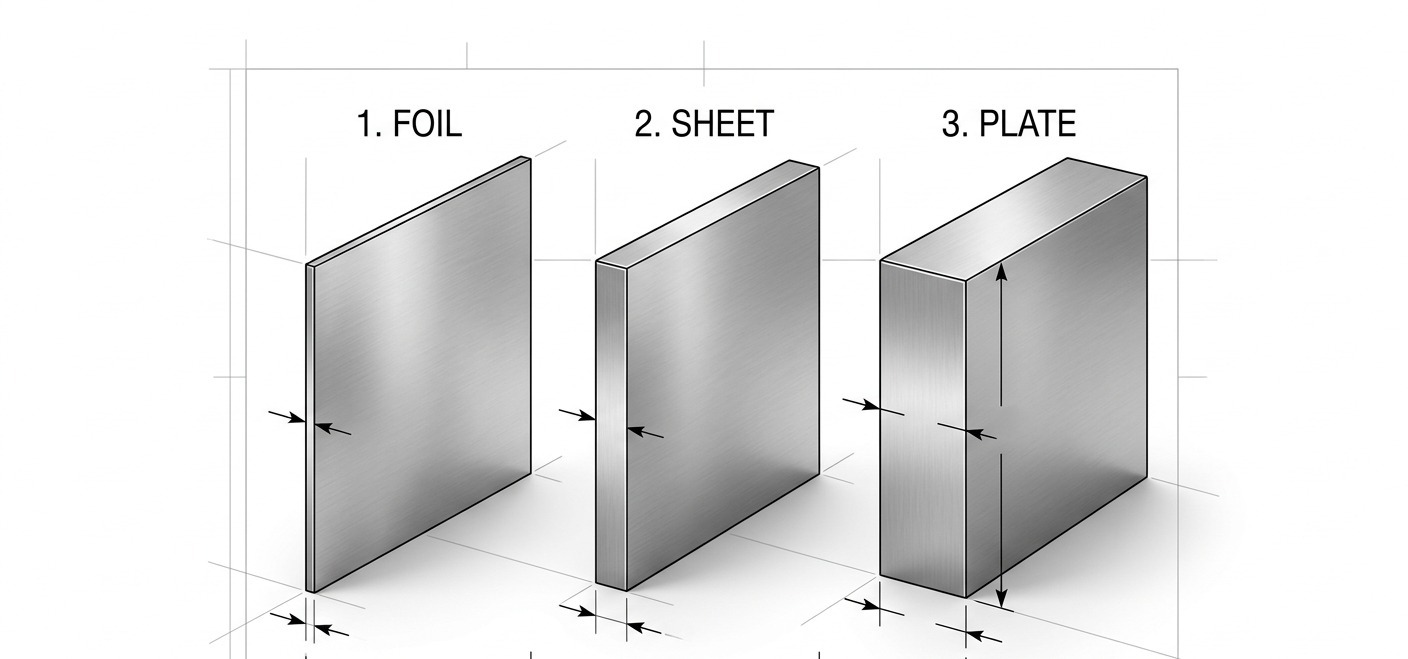
difference between metal foil, sheet, and plate
Sheet metal is metal manufactured and supplied in thin, flat forms for fabrication into components, enclosures, panels, brackets, housings, ducts, structural elements, and other products.
The term sheet metal describes the form and thickness of the material, not its chemical composition. Aluminum, carbon steel, stainless steel, copper, brass, titanium, and many other metals can all be supplied as sheet metal.
In manufacturing, the flat sheet becomes the starting material for operations such as cutting, bending, forming, punching, stamping, and joining. The material's alloy and temper then determine how easily it can be formed, welded, finished, and ultimately used.
For most general engineering applications, the important question isn't simply "What is sheet metal?" but which sheet metal material provides the required combination of mechanical and manufacturing properties?
Sheet Metal vs. Plate and Foil
Sheet, plate, and foil are essentially different thickness categories of flat metal.
| Material form | Approximate thickness | Typical applications |
|---|---|---|
| Foil | <0.5 mm | Electrical shielding, packaging, thin diaphragms |
| Sheet | ~0.5–6 mm | Enclosures, brackets, panels, automotive parts |
| Plate | >6 mm | Machine bases, structural parts, pressure equipment |
These boundaries are conventions rather than universal physical laws. Some standards and suppliers use different limits depending on the material. A commonly used engineering range puts sheet metal at approximately 0.5–6 mm, with plate above that range and foil below it.
The distinction becomes important because manufacturing methods change with thickness. Thin sheet can often be bent and formed relatively easily, while thicker plate may require substantially greater forming force or different processing methods.
Sheet Metal Thickness and Gauge
Sheet metal thickness can be specified directly in millimeters or inches, or indirectly using a gauge number.
Gauge has an inverse relationship with thickness: a higher gauge number generally means thinner sheet metal. However, gauge is not a universal thickness measurement across every metal. The same gauge number can correspond to different actual thicknesses for steel, stainless steel, galvanized steel, and aluminum.
For engineering drawings and production orders, specifying the actual thickness in millimeters or inches is usually less ambiguous than specifying gauge alone.
Thickness affects much more than weight. It changes:
- Bending force
- Minimum bend radius
- Part stiffness
- Buckling resistance
- Welding behavior
- Cutting parameters
- Formability
- Finished part weight
- Material cost
Common Metals Used for Sheet Metal
Common sheet metal materials include carbon steel, stainless steel, aluminum, galvanized steel, copper, and brass. Specialty options such as titanium, nickel alloys, zinc, and specialty steels are also available for applications with more specific performance requirements.
Other metals such as titanium, nickel alloys, zinc, and specialty steels are also available as sheet metal when their specific performance justifies their higher material or fabrication cost.
Types of Sheet Metal
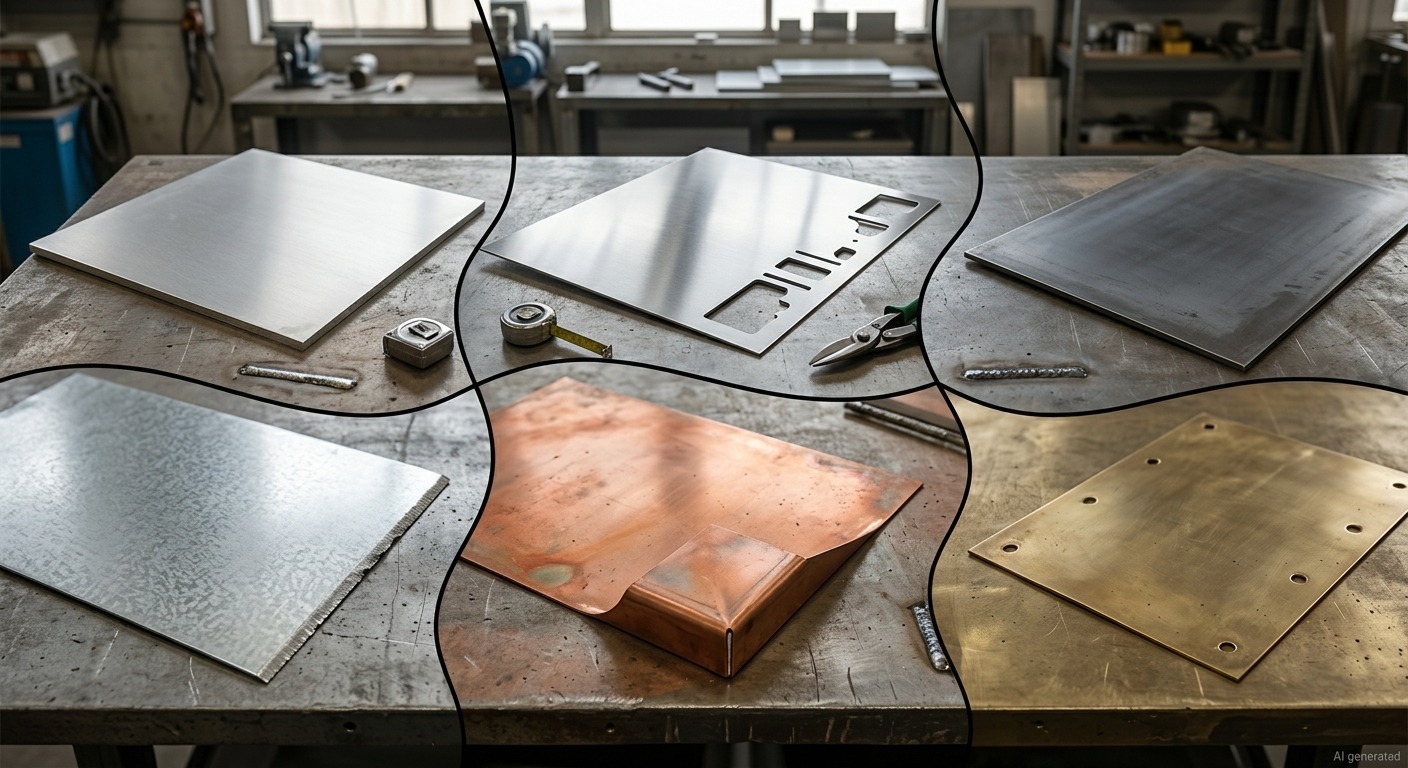
six different sheet metal materials
The six different types of sheet metal below cover a large share of general manufacturing and fabrication applications.
| Sheet metal type | Typical density | Main advantage | Main limitation | Common applications |
|---|---|---|---|---|
| Aluminum | ~2.7 g/cm³ | Low weight | Lower stiffness than steel | Aerospace, electronics, transportation |
| Stainless steel | ~7.9–8.0 g/cm³ | Corrosion resistance | Higher cost and forming force | Food, medical, marine, industrial |
| Carbon steel | ~7.85 g/cm³ | Strength and low cost | Rusts without protection | Brackets, frames, enclosures |
| Galvanized steel | ~7.85 g/cm³ | Low-cost corrosion protection | Coating can be damaged during fabrication | HVAC, roofing, outdoor panels |
| Copper | ~8.9 g/cm³ | Electrical/thermal conductivity | High material cost | Busbars, heat exchangers |
| Brass | ~8.4–8.7 g/cm³ | Formability and machinability | Heavier and more expensive than steel | Fittings, electrical parts, decorative components |
The values above are representative rather than grade-specific. Actual mechanical properties can vary substantially with alloy, temper, thickness, and processing history.
Aluminum Sheet Metal
Aluminum offers a major weight advantage over steel while providing useful corrosion resistance and formability. The most appropriate grade depends on the required strength, bendability, and temper.
Common sheet grades include 1100, 3003, 5052, and 6061, although their forming behavior differs considerably.
For fabrication, 3003 and 5052 are particularly useful because they combine strength with good formability. 6061-T6 provides higher structural strength but is less forgiving during tight-radius bending.
Advantages
- Very low density
- Good corrosion resistance
- Good thermal conductivity
- Non-magnetic
- Good strength-to-weight ratio
- Good formability in appropriate grades
- Easy to anodize and finish
Limitations
- Lower stiffness than steel
- Softer surface can scratch or dent
- Some high-strength tempers have limited formability
- Welding can reduce strength in heat-affected areas
Common Applications
Aluminum sheet metal is common in:
- Aircraft and aerospace structures
- Automotive components
- Electronic enclosures
- Transportation equipment
- Lightweight panels
- Heat-management components
- Architectural panels
For formed aluminum parts, 5052 is often a more practical choice than 6061-T6 because it tolerates bending better.
Stainless Steel Sheet Metal
Stainless steel sheet metal is often selected when corrosion resistance, durability, hygiene, or appearance justify its higher cost.
Stainless steel contains at least approximately 10.5% chromium, which allows the surface to form a passive chromium-rich oxide layer that protects the underlying material.
The most common families include austenitic 300-series grades such as 304 and 316, as well as ferritic and martensitic 400-series grades.
304 Stainless Steel
304 is one of the most widely used stainless grades. It offers a useful combination of corrosion resistance, ductility, formability, weldability, and availability.
Common applications include:
- Food-processing equipment
- Kitchen equipment
- Medical equipment
- Enclosures
- Architectural panels
- Industrial components
316 Stainless Steel
316 contains molybdenum, which generally improves resistance to chloride-induced corrosion compared with 304.
It is particularly useful in:
- Marine environments
- Coastal equipment
- Chemical processing
- Pharmaceutical equipment
- Salt-exposed components
Advantages
- Excellent corrosion resistance
- High strength
- Good durability
- Hygienic surface
- Wide range of finishes
Some stainless steel grades retain useful strength and corrosion resistance at elevated temperatures, depending on the grade and service conditions.
Limitations
- More expensive than carbon steel
- Higher density than aluminum
- Requires greater forming forces
- Some grades work-harden rapidly
- More difficult to cut and form than mild steel
Carbon Steel Sheet Metal
Carbon steel is widely used when strength, availability, weldability, and cost are important requirements.
Low-carbon sheet steels are widely used for brackets, panels, enclosures, automotive components, frames, and general industrial fabrication.
Common specifications include grades such as A36, A1008, and A1011, although the appropriate grade depends on the required mechanical and forming properties.
Advantages
- High strength for its cost
- Excellent availability
- Good weldability
- Good formability in low-carbon grades
- Easy to paint or powder coat
- Relatively low material cost
Limitations
- Poor corrosion resistance when uncoated
- Requires paint, plating, powder coating, or another protective system in corrosive environments
- Heavier than aluminum
- Surface can require preparation before finishing
For indoor equipment, machinery covers, brackets, frames, and painted enclosures, carbon steel is often difficult to beat on cost.
Galvanized Steel Sheet Metal
Galvanized steel is carbon steel protected by a zinc coating that provides sacrificial corrosion protection.
The zinc coating protects exposed steel because zinc preferentially corrodes before the underlying steel. This makes galvanized sheet particularly useful where the part will see moisture but the cost and strength characteristics of steel are still desirable.
Common applications include:
- HVAC ductwork
- Roofing
- Outdoor panels
- Fencing
- Agricultural equipment
- Electrical enclosures
Galvanized steel is not a completely different base metal from carbon steel. It is better understood as steel plus a corrosion-protective zinc coating.
Advantages
- Better corrosion resistance than bare carbon steel
- Relatively low cost
- Good strength
- Good availability
- Suitable for many outdoor applications when the coating and exposure conditions are appropriate.
Limitations
- Zinc coating can be damaged during cutting and forming
- Welding requires process control because of the zinc coating
- Surface appearance differs from bare steel
- Cut edges can require additional protection in aggressive environments
Copper Sheet Metal
Copper sheet is selected primarily for its electrical and thermal conductivity.
Copper has a density of approximately 8.9 g/cm³, so it is substantially heavier than aluminum. Its conductivity, however, makes that weight worthwhile in applications where current or heat needs to move efficiently.
Typical applications include:
- Busbars
- Electrical connectors
- Heat exchangers
- Roofing
- Thermal spreaders
- EMI/RFI shielding
- Decorative architectural components
Copper is also highly ductile and formable, although its softness can make it susceptible to scratching and deformation.
Advantages
- Exceptional electrical conductivity
- Excellent thermal conductivity
- Good corrosion resistance
- Excellent ductility
- Good formability
- Attractive appearance
Limitations
- High material cost
- High density
- Softer than steel
- Surface oxidizes and develops patina
- Copper's high thermal conductivity makes heat management particularly important.
Brass Sheet Metal
Brass is a family of copper-zinc alloys rather than a single material. Different zinc contents and alloying additions change its strength, formability, machinability, and appearance.
Brass sheet is useful where a combination of corrosion resistance, formability, electrical properties, machinability, and appearance is desirable.
Typical applications include:
- Electrical components
- Switchgear
- Instrument components
- Plumbing fittings
- Decorative panels
- Architectural trim
- Musical instruments
Advantages
- Good corrosion resistance
- Good formability in suitable grades
- Good machinability
- Attractive appearance
- Useful electrical conductivity
- Good wear characteristics in selected applications, depending on alloy and mating conditions.
Limitations
- More expensive than carbon steel
- Higher density than aluminum
- Some grades are less weldable than steel
- Copper-zinc composition varies significantly between grades
Common Types of Steel Sheet Metal
Steel sheet can be divided into several important categories based on composition, rolling history, coating, and corrosion protection.
This distinction is important because "steel sheet" is not one material.
| Steel sheet type | Surface | Corrosion resistance | Typical characteristic | Common use |
|---|---|---|---|---|
| Hot-rolled steel | Rougher, mill scale possible | Low without coating | Economical, less precise | Structural parts |
| Cold-rolled steel | Smooth | Low without coating | Better surface and dimensional control | Enclosures, panels |
| Galvanized steel | Zinc-coated | Good | Sacrificial corrosion protection | Outdoor/HVAC |
| Stainless steel | Passive oxide surface | Excellent | Corrosion-resistant alloy | Food, medical, marine |
Hot-Rolled Steel
Hot-rolled steel is processed at elevated temperatures, allowing large reductions in thickness with relatively low forming resistance.
It generally has:
- Rougher surface
- Mill scale
- Less precise dimensional control than cold-rolled products
- Lower material cost
- Good structural performance
Hot-rolled sheet is commonly used where surface appearance and tight dimensional tolerances are secondary.
Typical applications include structural components, brackets, machinery, frames, and heavy-duty parts.
Cold-Rolled Steel
Cold-rolled steel undergoes additional rolling at or near room temperature after hot rolling.
The result is generally:
- Smoother surface
- Better dimensional consistency
- More controlled thickness
- Good forming characteristics in suitable grades
- Excellent base for painting and powder coating
Cold-rolled steel is widely used for electrical enclosures, appliance panels, automotive components, brackets, and precision sheet metal parts.
Galvanized Steel
Galvanized steel starts with a steel substrate and adds zinc protection.
That means it differs from cold-rolled steel primarily in corrosion protection, not because the underlying material suddenly becomes a different structural metal.
Stainless Steel
Stainless steel differs fundamentally from galvanized steel.
Galvanized steel relies on a zinc coating over carbon steel. Stainless steel relies on its chromium-containing alloy chemistry to form a protective passive surface.
That distinction affects durability, finishing, welding, maintenance, and service life.
Properties of Different Sheet Metal Types
The most useful way to compare sheet metal materials is by the properties that actually affect part performance.
Strength and Hardness
Strength determines how much load a sheet can withstand before yielding or fracturing. Hardness describes resistance to indentation, wear, and localized deformation.
Typical trends are:
- Carbon steel: high strength at low cost
- Stainless steel: high strength with excellent corrosion resistance
- Aluminum: lower absolute strength but excellent strength-to-weight performance
- Copper: moderate strength with exceptional conductivity
- Brass: moderate strength with good machinability and formability
Grade and temper matter enormously. A 5052 aluminum sheet and a 6061-T6 sheet should not be treated as interchangeable simply because both are aluminum.
Ductility and Formability
Ductility determines how much a metal can deform before cracking. Formability describes how well it can undergo bending, drawing, stamping, and other shaping operations.
For example:
- 3003 aluminum is highly formable.
- 5052 aluminum combines good strength with good bending performance.
- 6061-T6 is stronger but less forgiving during tight-radius bending.
- 304 stainless steel is highly ductile but requires higher forming forces.
- Low-carbon cold-rolled steel is highly useful for bending and stamping.
- Copper is exceptionally ductile.
For complex formed parts, choosing the right alloy and temper can matter more than choosing the broader material family.
Corrosion Resistance
Corrosion resistance varies dramatically among different types of sheet metal.
Corrosion resistance varies significantly with the alloy, coating, surface condition, and service environment. Stainless steel generally provides strong corrosion resistance, while aluminum, copper, and galvanized steel can also perform well under suitable conditions. Uncoated carbon steel typically requires additional corrosion protection in wet or corrosive environments.
This is only a general comparison. Chlorides, pH, temperature, galvanic coupling, coating damage, and exposure time can change the result.
Stainless steel forms a passive oxide film. Aluminum naturally forms aluminum oxide. Copper develops protective surface films and patina. Galvanized steel relies on zinc. Bare carbon steel has no comparable protective mechanism and rusts readily in moisture.
Weldability
Weldability depends on alloy chemistry, thickness, temper, heat input, joint design, and welding process.
Low-carbon steel is generally easy to weld.
Austenitic stainless steels such as 304 and 316 are also widely welded, but heat input and contamination control matter.
Aluminum can be welded effectively but requires different process parameters because of its thermal and physical characteristics.
Copper's high thermal conductivity makes heat management particularly important.
Galvanized steel can be welded, but the zinc coating requires appropriate ventilation, process control, and post-weld corrosion protection.
Weight and Density
Density is one of the clearest differences between common sheet metal materials.
| Material | Approx. density |
|---|---|
| Aluminum | 2.7 g/cm³ |
| Carbon steel | 7.85 g/cm³ |
| Stainless steel | 7.9–8.0 g/cm³ |
| Brass | ~8.4–8.7 g/cm³ |
| Copper | ~8.9 g/cm³ |
Aluminum is widely used in aerospace where low density and adequate structural performance are important.
That is why aluminum is so valuable in aerospace, transportation, portable equipment, and applications where reducing mass affects operating cost.
Electrical and Thermal Conductivity
Copper is the standout among these common sheet metal types for electrical conductivity.
Aluminum also conducts electricity well while offering a major weight advantage.
Steel and stainless steel are much poorer electrical conductors but provide considerably greater structural stiffness.
This creates a straightforward engineering split:
Electrical/thermal priority → copper or aluminum
Structural priority → steel or stainless steel
Machinability and Fabrication Characteristics
Sheet metal is usually cut and formed rather than CNC-machined from a solid block, but machinability can still matter for secondary operations such as drilled holes, countersinks, tapped features, and precision-machined areas.
Fabrication behavior varies by material:
- Aluminum generally cuts and forms easily.
- Low-carbon steel is highly versatile.
- Stainless steel requires more force and careful heat management.
- Copper conducts heat rapidly and can require specialized cutting parameters.
- Brass generally machines well but varies considerably by alloy.
- Galvanized steel adds coating-related considerations during cutting and welding.
The material therefore influences not only the finished part but also how difficult and expensive it is to manufacture.
Material choice also affects what happens after cutting. Aluminum, stainless steel, and carbon steel can produce different edge conditions, so the finishing method has to match the alloy and the burr itself. If you're dealing with sharp edges or burrs after cutting, here's a practical guide to sheet metal deburring methods and how they differ by material.
Common Applications of Different Sheet Metal Types
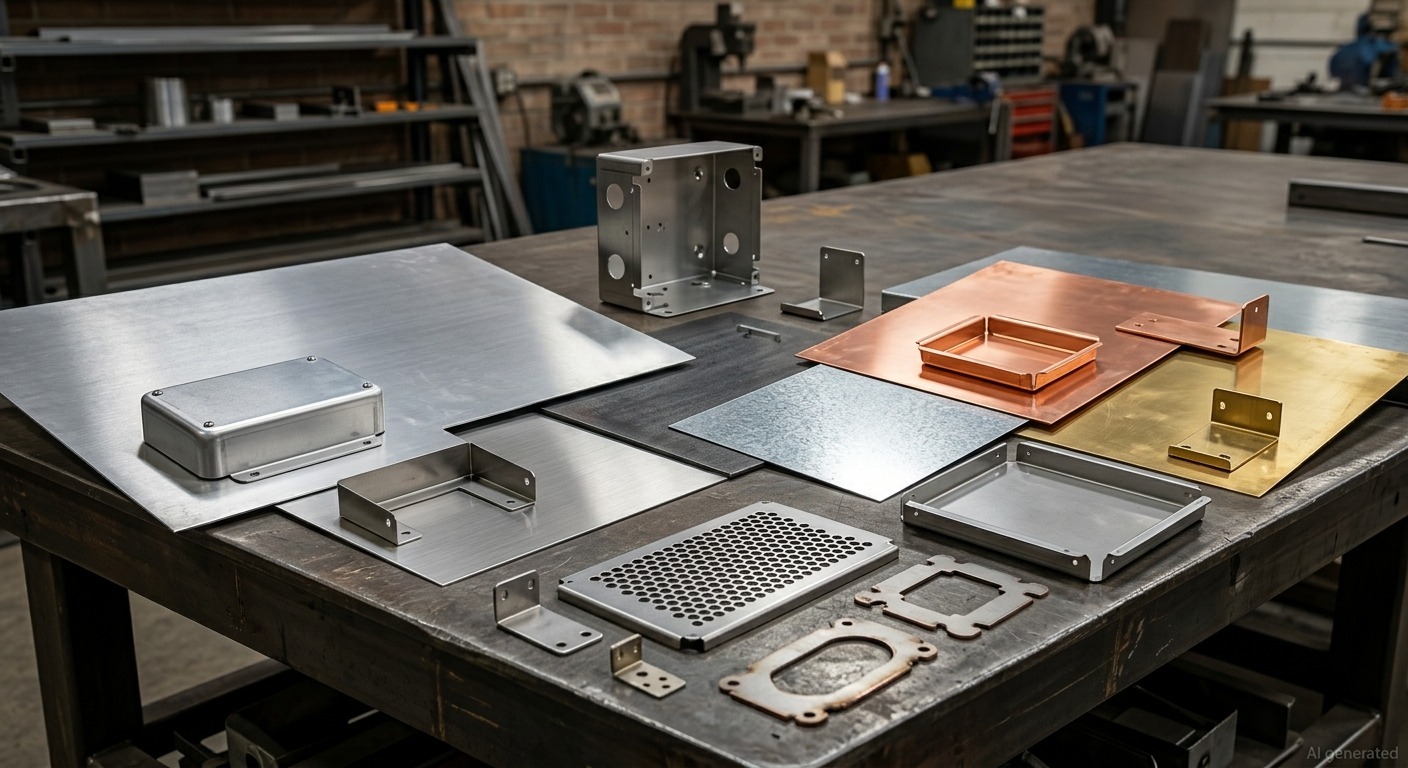
real-world finished sheet metal components
The best sheet metal material usually becomes obvious once the application requirement is clear.
Automotive Components
Automotive sheet metal must balance strength, weight, crash performance, corrosion resistance, formability, and cost.
Carbon and high-strength steels remain important for structural components because they provide high strength at relatively low material cost.
Aluminum is used where weight reduction justifies the additional material and manufacturing cost.
Stainless steel appears in selected exhaust, trim, and corrosion-sensitive components.
Aerospace Components
Aerospace applications place an unusually high value on weight.
Aluminum sheet remains important because its density is approximately one-third that of steel, while suitable alloys provide useful strength and corrosion resistance.
Titanium and nickel alloys are also used where their performance justifies higher cost, although they are not normally the first choice for general sheet metal fabrication.
Electronics and Electrical Enclosures
Electronics enclosures commonly use:
- Aluminum
- Cold-rolled steel
- Stainless steel
Aluminum is attractive when low weight and thermal management matter.
Cold-rolled steel provides rigidity and low cost, particularly when powder coated.
Stainless steel is useful when corrosion resistance, hygiene, or appearance is important.
Copper and aluminum are used internally for busbars, shields, and conductive components where electrical performance matters.
Industrial Equipment
Industrial equipment frequently combines several sheet metal types.
Carbon steel works well for painted frames, brackets, panels, and guards.
Stainless steel becomes preferable where the equipment encounters moisture, chemicals, food, or frequent cleaning.
Galvanized steel is useful for HVAC and outdoor equipment where corrosion protection is needed without the cost of stainless steel.
Construction and Architecture
Construction applications use carbon steel, galvanized steel, stainless steel, aluminum, and copper extensively.
Galvanized steel is common for roofing, ducts, and exterior components.
Aluminum is valuable for lightweight cladding, architectural panels, and trim.
Stainless steel is used where appearance and long-term corrosion resistance matter.
Copper is often selected for roofing and architectural features where its natural patina is part of the design.
Consumer Products
Consumer products place more emphasis on appearance, weight, tactile quality, corrosion resistance, and cost.
Aluminum appears in laptops, appliances, transportation products, and housings.
Stainless steel is common in kitchen equipment and premium consumer products.
Brass and copper are often selected when the material itself is part of the product's visual identity.
How to Choose a Type of Sheet Metal
Selecting among different types of sheet metal starts with the requirements of the finished component rather than the material price.
Mechanical Requirements
Ask:
- How much load will the part carry?
- Does it need high stiffness?
- Will it experience impact?
- Is fatigue resistance important?
- Does the part need to resist wear?
If strength and rigidity dominate, steel may be preferable. If weight dominates, aluminum may be better.
Environmental Conditions
Consider:
- Humidity
- Salt water
- Chemicals
- Temperature
- Outdoor exposure
- Cleaning chemicals
- Galvanic contact with other metals
A low-cost carbon steel part can become expensive if it requires extensive corrosion protection or fails prematurely.
Forming and Fabrication Requirements
Consider the actual geometry.
A material that looks excellent on a datasheet can be a poor choice if the required bend radius causes cracking or excessive springback.
For highly formed components, alloy and temper selection are particularly important.
Weight and Thickness
Reducing material thickness saves weight, but thinner sheet also reduces stiffness and may increase susceptibility to buckling or deformation.
Aluminum often provides a major weight advantage, but the design may require additional thickness, ribs, beads, or bends to achieve equivalent stiffness.
Cost and Availability
Material cost is only one component of total part cost.
Total part cost can include material, cutting, forming, welding, finishing, scrap, and secondary operations.
A material that costs more per kilogram can still produce a competitive finished part if it reduces weight, eliminates coating, simplifies finishing, or improves service life.
Surface Appearance and Finish
The required finish can influence material selection from the beginning.
Examples include:
- Powder-coated carbon steel
- Brushed stainless steel
- Anodized aluminum
- Natural copper
- Polished brass
If the finished surface is visible, selecting a material that naturally provides the required appearance can reduce finishing work.
Sheet Metal Fabrication by Material
Different sheet metal materials require different fabrication strategies even when the final geometry is similar.
Aluminum
Aluminum generally offers good cutting and forming characteristics, particularly in sheet-friendly grades such as 3003 and 5052.
However, alloy and temper are critical. A structural 6061-T6 sheet should not automatically be treated as a direct substitute for highly formable 5052.
Stainless Steel
Stainless steel usually requires higher forming forces than mild steel and can work-harden during fabrication.
Tooling, bend radius, heat input, and surface protection therefore matter more.
The advantage is a finished part that can withstand harsh environments without relying on a paint or powder-coat system for basic corrosion protection.
Carbon Steel
Carbon steel is generally straightforward to cut, bend, weld, and finish, particularly in low-carbon grades.
For indoor applications, this makes carbon steel one of the most practical types of sheet metal available.
Copper and Brass
Copper and brass are highly workable but introduce different considerations.
Copper's high thermal conductivity affects welding and thermal cutting.
Brass varies significantly by alloy, so machinability and forming behavior should be checked against the specific grade rather than assumed from the word "brass."
How Material Choice Affects Fabrication
Material selection changes:
- Cutting parameters
- Bend force
- Minimum bend radius
- Springback
- Welding parameters
- Tool wear
- Surface finishing
- Scrap rate
- Part cost
- Lead time
That's why material should be specified before finalizing fabrication parameters.
JLCCNC's sheet-metal material guide covers the practical selection factors in more detail, including strength, formability, corrosion resistance, surface finish, and cost.
Precision Sheet Metal Fabrication
Professional manufacturing, fast turnaround, and quality assurance.
The same cutting process can behave very differently depending on the alloy, thickness, and machine settings. Burrs, dross, warping, burn marks, poor surface finish, and kerf variation are all possible when those variables aren't properly controlled. If you want to see what can actually go wrong during sheet metal cutting, and how each problem is corrected, this guide covers 9 common cutting problems and their solutions.
Final Thoughts
The "best" sheet metal material depends on what the part actually has to do.
The right sheet metal material depends on the part's mechanical, environmental, fabrication, and cost requirements. Aluminum is often favored for low weight, stainless steel for corrosion resistance, carbon steel for cost-effective strength, galvanized steel for economical corrosion protection, copper for conductivity, and brass for applications that value a combination of formability, machinability, and appearance.
The important distinction is that sheet metal is a manufacturing form, not a single material. The alloy, grade, temper, thickness, surface condition, and fabrication process all contribute to the performance of the finished component.
For manufacturers, getting that choice right early can prevent a much more expensive problem later: a material that looks appropriate on paper but bends poorly, corrodes in service, weighs too much, requires excessive finishing, or costs more to fabricate than the application warrants.
FAQs About Types of Sheet Metal
Q: What Are the Most Common Types of Sheet Metal?
The most common types are aluminum, stainless steel, carbon steel, galvanized steel, copper, and brass. The best choice depends on strength, weight, corrosion resistance, conductivity, formability, and cost.
Q: What Is the Most Common Sheet Metal Material?
Carbon steel is one of the most widely used sheet metal materials because it combines low cost, strength, availability, weldability, and good formability.
Q: What Is the Strongest Type of Sheet Metal?
There is no single strongest type. High-strength steels can greatly exceed common aluminum or mild-steel grades, while specialized stainless, titanium, and nickel alloys provide even higher performance for specific applications.
Q: What Is the Difference Between Aluminum and Steel Sheet Metal?
Aluminum is about one-third the density of steel, while steel generally provides higher stiffness and strength at the same thickness. Aluminum is favored for weight reduction; steel is often favored for structural strength and cost.
Q: What Is the Difference Between Stainless Steel and Galvanized Steel?
Stainless steel gets corrosion resistance from its alloy chemistry, while galvanized steel relies on a zinc coating over steel. Stainless generally provides better long-term corrosion resistance but costs more.
Popular Articles
• 9 Sheet Metal Cutting Problems and Solutions
• Hole cutting in sheet metal: techniques, tolerances and applications
• Introduction to Sheet Metal Processing: Techniques and Tools for Precision
• Bending and Forming Technology in Sheet Metal Processing
• Laser cutting technology in sheet metal processing
Keep Learning
Galvanized Sheet Metal: Grades, Specs & When to Use It
Galvanized Sheet Metal: Grades, Specs & When to Use It A design engineer specs "galvanized sheet metal" on a drawing and sends it out for quotes. Three shops come back with three different prices, and one of them asks a follow-up question the others didn't: which gauge, which coating class, hot-dip or electro-galvanized? That question is the difference between a part that survives outdoors for fifteen years and one that starts showing rust spots after eighteen months — and it's the kind of detail that......
Custom Sheet Metal Fabrication: How the Process Works From Design to Delivery
Custom Sheet Metal Fabrication: How the Process Works From Design to Delivery A stock enclosure almost fits. The mounting holes are close but not quite right, the depth is half an inch too shallow, and the vendor's next size up is twice the volume you actually need. This is the point where most people start looking into custom sheet metal fabrication — not because they set out to design a part from scratch, but because nothing off the shelf actually solves the problem. Custom fabrication sounds like i......
Sheet Metal Assembly: How Fabricated Parts Come Together
Sheet Metal Assembly: How Fabricated Parts Come Together Cutting and bending gets a lot of attention because that's where a flat sheet visibly turns into a 3D part. But a single bracket by itself rarely finishes the job — most real sheet metal products are assemblies, multiple formed pieces joined into one working unit, and that assembly step is where a lot of designs quietly succeed or fail. A part that measured perfectly on its own can still not fit once it's supposed to mate with three other pieces......
Sheet Metal Bender: Types, Specs & How to Choose the Right Machine
Sheet Metal Bender: Types, Specs & How to Choose the Right Machine Every sheet metal bracket, enclosure, and panel eventually passes through a bender of some kind — that's the machine, not the process. Our guide on sheet metal bending covers how bending actually deforms metal — springback, minimum radius, bend allowance, and the core press brake and CNC press brake setups most shops run. This one goes further into the equipment side specifically: the less common bender types beyond the standard press ......
What Is Galvanized Metal? Process, Types & How It Works
What Is Galvanized Metal? Process, Types & How It Works Leave a piece of bare steel outside for a season and you'll see exactly why galvanizing exists. Rust doesn't wait for dramatic weather — a little humidity and a few weeks is enough to start eating into an unprotected surface. Galvanized metal solves that problem by giving steel a sacrificial layer of zinc that corrodes in its place, and it's done this job well enough that it's become the default choice for anything from highway guardrails to HVAC......
What Is Sheet Metal Fabrication? The Complete Guide
What Is Sheet Metal Fabrication? The Complete Guide Somewhere between a CAD file and a working enclosure sitting on your bench, a flat piece of metal gets cut, bent, joined, and finished into something that actually does a job. That's sheet metal fabrication — and if you've never ordered a part before, the term can feel bigger than it needs to be. Ask five people what "sheet metal fabrication" covers and you'll get five different answers: some think laser cutting, some think welding, some just picture......