Sheet Metal Bender: Types, Specs & How to Choose the Right Machine
6 min
- Sheet Metal Bender: Types, Specs & How to Choose the Right Machine
- What Is a Sheet Metal Bender?
- Bender Types Beyond the Standard Press Brake
- Quick Comparison
- What Actually Determines Which Bender You Need
- A Common Misconception Worth Correcting
- FAQ
Sheet Metal Bender: Types, Specs & How to Choose the Right Machine
Every sheet metal bracket, enclosure, and panel eventually passes through a bender of some kind — that's the machine, not the process. Our guide on sheet metal bending covers how bending actually deforms metal — springback, minimum radius, bend allowance, and the core press brake and CNC press brake setups most shops run. This one goes further into the equipment side specifically: the less common bender types beyond the standard press brake, and the selection factors (tonnage, bed length, back gauge precision) that actually decide which machine fits a given job.

Precision Sheet Metal Fabrication
Professional manufacturing, fast turnaround, and quality assurance.
What Is a Sheet Metal Bender?
A sheet metal bender is a machine that applies controlled force to fold flat sheet stock into a defined angle or shape. Most commercial benders work on the same basic principle — a moving upper tool (punch) presses the sheet into a fixed lower tool (die) — but they vary widely in tonnage, bed length, control precision, and the range of geometries they can handle, which is why "bender" covers a range of quite different machines rather than one standard piece of equipment.
Bender Types Beyond the Standard Press Brake
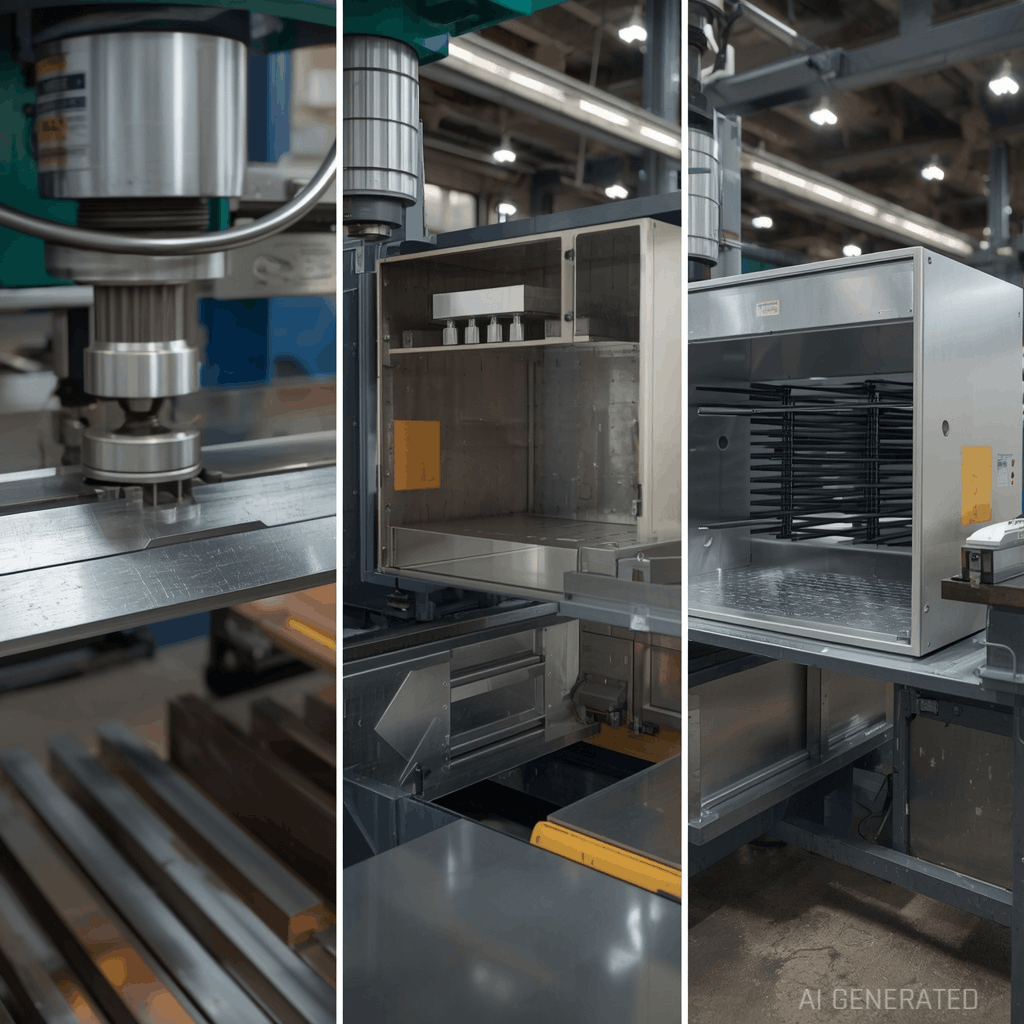
Press brakes, CNC press brakes, hydraulic press brakes, and roll bending machines cover most fabrication work and are already covered in depth in our sheet metal bending guide. A few other bender types show up for more specific situations and are worth knowing about separately:
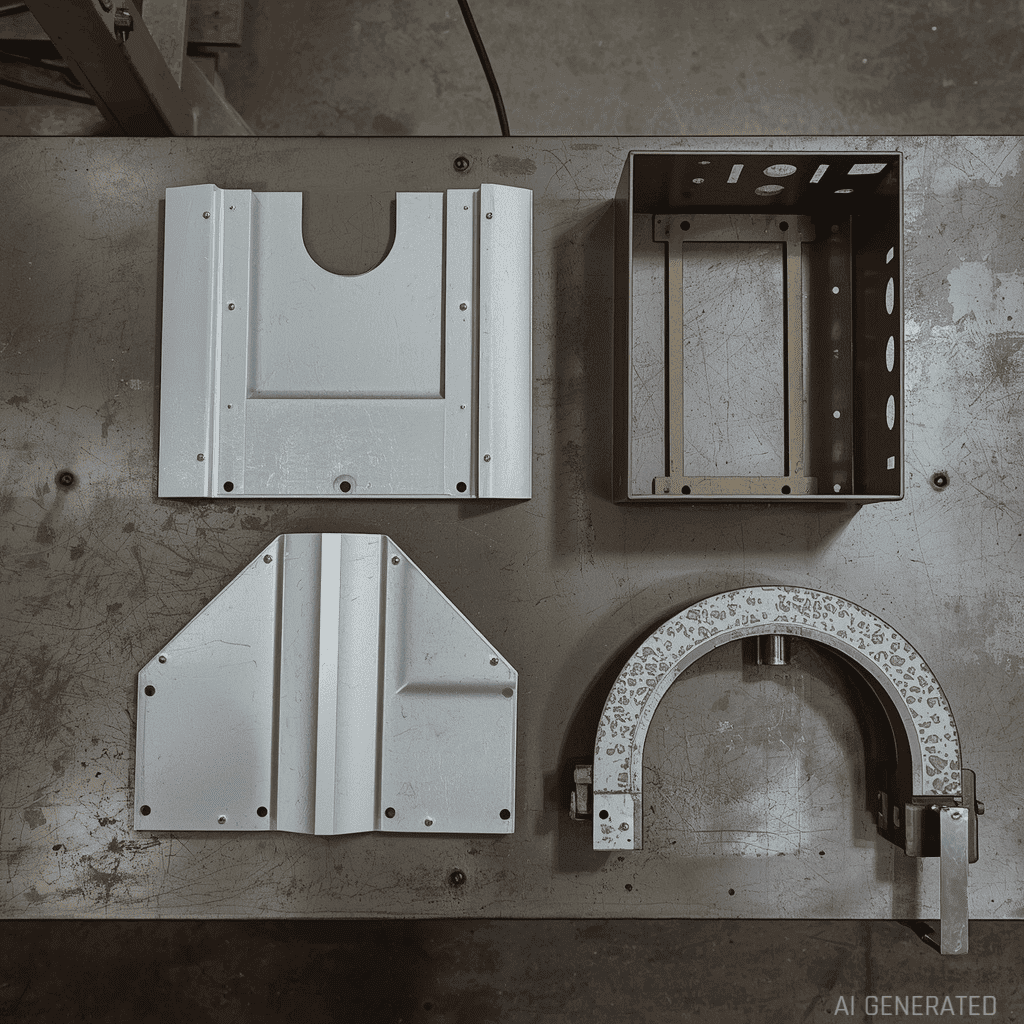
Panel benders use a different mechanism from a press brake — the sheet is clamped in place and a rotating blade folds the edge upward, rather than a punch pressing down through a die. They're built for high-volume, repetitive bending of similar panel geometries, trading some flexibility for speed and reduced material handling on long production runs.
Box and pan brakes use interchangeable, segmented upper tooling that can be arranged with gaps, which lets them fold up multiple sides of a box-shaped part (like an enclosure) in a single setup — something a standard press brake with one continuous die can't do without repositioning the part between bends.
Folding machines clamp the sheet and fold it using a hinged beam rather than a punch-and-die system, producing bends with minimal surface marking — a common choice for pre-finished or painted material where a press brake's tooling contact could mar the visible surface.
Manual/hand brakes rely on human-applied leverage rather than powered force, limited to thin material and simple bends, but useful for prototyping, repair work, and low-volume shops where a full CNC brake isn't justified.
Quick Comparison
| Machine Type | Strengths | Limitations |
|---|---|---|
| Panel Bender | Fast, efficient for repetitive geometry, less material handling | Less flexible for varied/complex geometry |
| Box & Pan Brake | Can fold multiple box sides in one setup | Tooling changeover needed for different segment configurations |
| Folding Machine | Minimal surface marking, good for finished material | Typically lower tonnage than a press brake, fewer bend profile options |
| Manual Brake | Low cost, no programming needed | Limited to thin material, low precision, slow at volume |
What Actually Determines Which Bender You Need
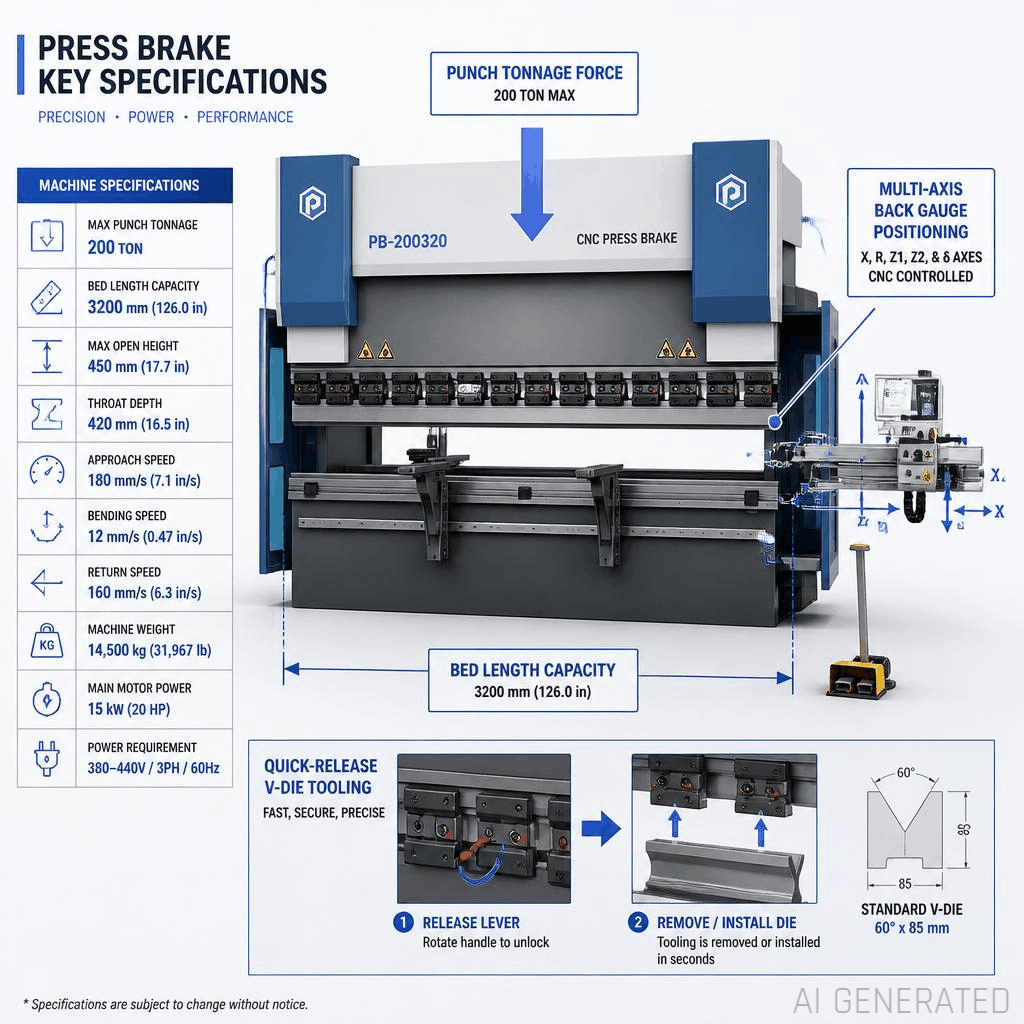
Tonnage — the force the machine can apply — has to exceed what the material and thickness require, with margin. Undersized tonnage either fails to complete the bend cleanly or forces the operator to run multiple passes, which hurts both accuracy and cycle time. Tonnage requirements scale with material thickness and strength, so a machine sized comfortably for mild steel brackets may be underpowered for the same job in thicker or higher-strength stainless.
Bed length sets the maximum part width the machine can bend in one pass. A machine with a shorter bed than the part simply can't do the job, regardless of tonnage — this is a hard limit, not a performance tradeoff, and it's worth checking early since it's an easy detail to overlook when focusing mainly on tonnage and precision.
Back gauge precision controls how accurately the machine positions the sheet before each bend, which directly determines how consistent flange lengths and bend positions are across a production run. On multi-bend parts, back gauge accuracy compounds — a small positioning error on an early bend can throw off every subsequent bend's reference point.
Tooling flexibility — how easily the die and punch can be swapped for different bend profiles (V, U, tighter or looser radii) — matters more for shops running varied custom work than for a line dedicated to one repeated part.
A Common Misconception Worth Correcting
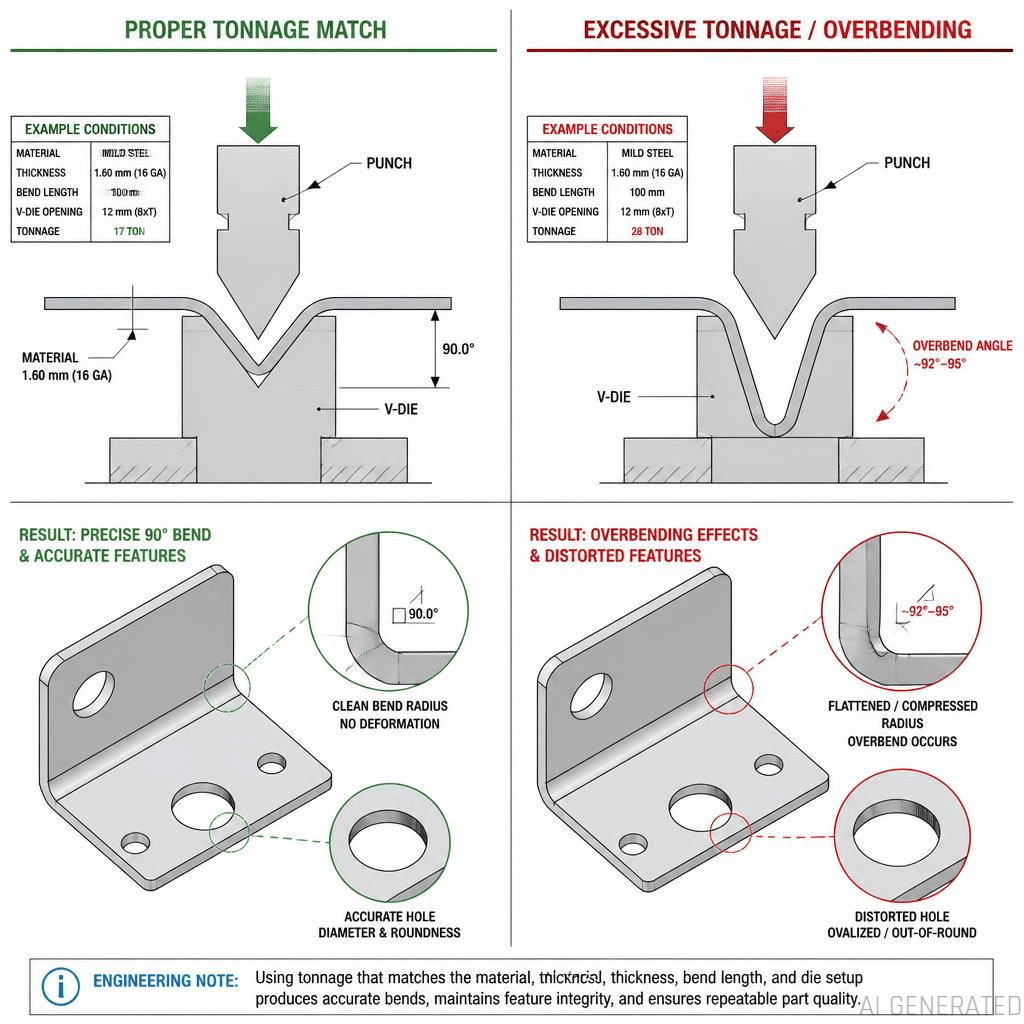
Higher tonnage doesn't automatically mean better results on every job. A press brake sized well beyond what a given part's material and thickness require doesn't produce a more accurate bend — it just means the machine is oversized for the work, which mainly shows up as higher operating cost and, on very thin material, an increased risk of overbending if the operator isn't controlling the process carefully. Matching tonnage to the actual job, rather than defaulting to "bigger is safer," is where experienced shops keep both cost and quality consistent.
At JLCCNC, CNC press brakes handle the bending stage of sheet metal orders, with tonnage and tooling matched to each job's material and thickness as part of the standard production process — not something the customer needs to specify manually when submitting a design.
Precision Sheet Metal Fabrication
Professional manufacturing, fast turnaround, and quality assurance.
FAQ
What's the difference between a press brake and a panel bender?
A press brake uses a punch pressing into a die and offers more flexibility for varied bend geometry; a panel bender clamps the sheet and folds it with a rotating blade, favoring speed and consistency on repetitive panel shapes over flexibility.
How is press brake tonnage calculated?
Tonnage requirements depend on material type, thickness, and bend length — thicker or higher-strength material and longer bends both require more force. Shops typically use tonnage charts or software that factors in these variables rather than estimating by eye, since underestimating leads to incomplete bends and overestimating wastes machine capacity.
Can the same machine bend both thin and thick sheet metal?
Within a range, yes — a given press brake has a tonnage rating and bed length that define its working range, and most shops run material across that full range on the same machine. Material well outside that range (either too thin to control precisely or too thick for the tonnage available) needs a different machine.
Do folding machines produce different results than press brakes?
Both produce a bent angle, but folding machines apply force differently (a hinged beam rather than a punch and die), which typically leaves less surface marking — useful for pre-finished material — though folding machines are generally available in lower tonnage ranges than heavy-duty press brakes.
Popular Articles
• 9 Sheet Metal Cutting Problems and Solutions
• Hole cutting in sheet metal: techniques, tolerances and applications
• Introduction to Sheet Metal Processing: Techniques and Tools for Precision
• Bending and Forming Technology in Sheet Metal Processing
• Laser cutting technology in sheet metal processing
Keep Learning
Galvanized Sheet Metal: Grades, Specs & When to Use It
Galvanized Sheet Metal: Grades, Specs & When to Use It A design engineer specs "galvanized sheet metal" on a drawing and sends it out for quotes. Three shops come back with three different prices, and one of them asks a follow-up question the others didn't: which gauge, which coating class, hot-dip or electro-galvanized? That question is the difference between a part that survives outdoors for fifteen years and one that starts showing rust spots after eighteen months — and it's the kind of detail that......
Custom Sheet Metal Fabrication: How the Process Works From Design to Delivery
Custom Sheet Metal Fabrication: How the Process Works From Design to Delivery A stock enclosure almost fits. The mounting holes are close but not quite right, the depth is half an inch too shallow, and the vendor's next size up is twice the volume you actually need. This is the point where most people start looking into custom sheet metal fabrication — not because they set out to design a part from scratch, but because nothing off the shelf actually solves the problem. Custom fabrication sounds like i......
Sheet Metal Assembly: How Fabricated Parts Come Together
Sheet Metal Assembly: How Fabricated Parts Come Together Cutting and bending gets a lot of attention because that's where a flat sheet visibly turns into a 3D part. But a single bracket by itself rarely finishes the job — most real sheet metal products are assemblies, multiple formed pieces joined into one working unit, and that assembly step is where a lot of designs quietly succeed or fail. A part that measured perfectly on its own can still not fit once it's supposed to mate with three other pieces......
Sheet Metal Bender: Types, Specs & How to Choose the Right Machine
Sheet Metal Bender: Types, Specs & How to Choose the Right Machine Every sheet metal bracket, enclosure, and panel eventually passes through a bender of some kind — that's the machine, not the process. Our guide on sheet metal bending covers how bending actually deforms metal — springback, minimum radius, bend allowance, and the core press brake and CNC press brake setups most shops run. This one goes further into the equipment side specifically: the less common bender types beyond the standard press ......
What Is Galvanized Metal? Process, Types & How It Works
What Is Galvanized Metal? Process, Types & How It Works Leave a piece of bare steel outside for a season and you'll see exactly why galvanizing exists. Rust doesn't wait for dramatic weather — a little humidity and a few weeks is enough to start eating into an unprotected surface. Galvanized metal solves that problem by giving steel a sacrificial layer of zinc that corrodes in its place, and it's done this job well enough that it's become the default choice for anything from highway guardrails to HVAC......
What Is Sheet Metal Fabrication? The Complete Guide
What Is Sheet Metal Fabrication? The Complete Guide Somewhere between a CAD file and a working enclosure sitting on your bench, a flat piece of metal gets cut, bent, joined, and finished into something that actually does a job. That's sheet metal fabrication — and if you've never ordered a part before, the term can feel bigger than it needs to be. Ask five people what "sheet metal fabrication" covers and you'll get five different answers: some think laser cutting, some think welding, some just picture......