Ultrasonic Welding Guide: How It Works, Materials, Applications, and Benefits
23 min
- Introduction
- What Is Ultrasonic Welding?
- How Does Ultrasonic Welding Work?
- Types of Ultrasonic Welding
- Materials Suitable for Ultrasonic Welding
- How to Choose Ultrasonic Welding
- Advantages and Limitations of Ultrasonic Welding
- Common Ultrasonic Welding Applications
- Ultrasonic Welding in Multi-Process Manufacturing
- Ultrasonic Welding vs Other Joining Methods
- Ultrasonic Welding Cost Factors
- FAQ About Ultrasonic Welding
Key Takeaways
- Ultrasonic welding uses high-frequency mechanical vibrations to create solid-state welds without melting materials
- It works exceptionally well for thermoplastics and many metals, especially dissimilar combinations
- The process is fast, clean, and requires no additional adhesives or fillers
- Different applications require specific frequency and power configurations
- Initial equipment costs are higher, but operating costs are typically lower than alternative methods
Introduction
Ultrasonic welding is widely used in manufacturing to assemble plastic components, battery parts, and thin metal structures where fast, clean, and repeatable joining is required.Ultrasonic welding is different—it creates strong bonds without excessive heat. In fact, most of the welding happens below the melting point of the materials. This makes it perfect for delicate components where heat would cause damage.
This guide explains how ultrasonic welding works, which materials are compatible, where it is used, and what factors engineers should consider before selecting the process.
What Is Ultrasonic Welding?
Definition of ultrasonic welding
Ultrasonic welding is a solid-state joining process that uses high-frequency ultrasonic acoustic vibrations to create a solid-state weld. The process works by applying these vibrations under pressure to the workpieces, causing localized friction, surface deformation, and bonding mechanisms such as molecular diffusion in plastics and surface oxide disruption in metals.
Unlike traditional welding methods, ultrasonic welding doesn't require external heat or filler materials. This is one of its biggest advantages, especially when working with heat-sensitive components. The process generates localized heat at the interface, allowing thermoplastic materials to soften or melt only at the joint interface while minimizing heat exposure to surrounding areas while minimizing heat exposure to surrounding components.
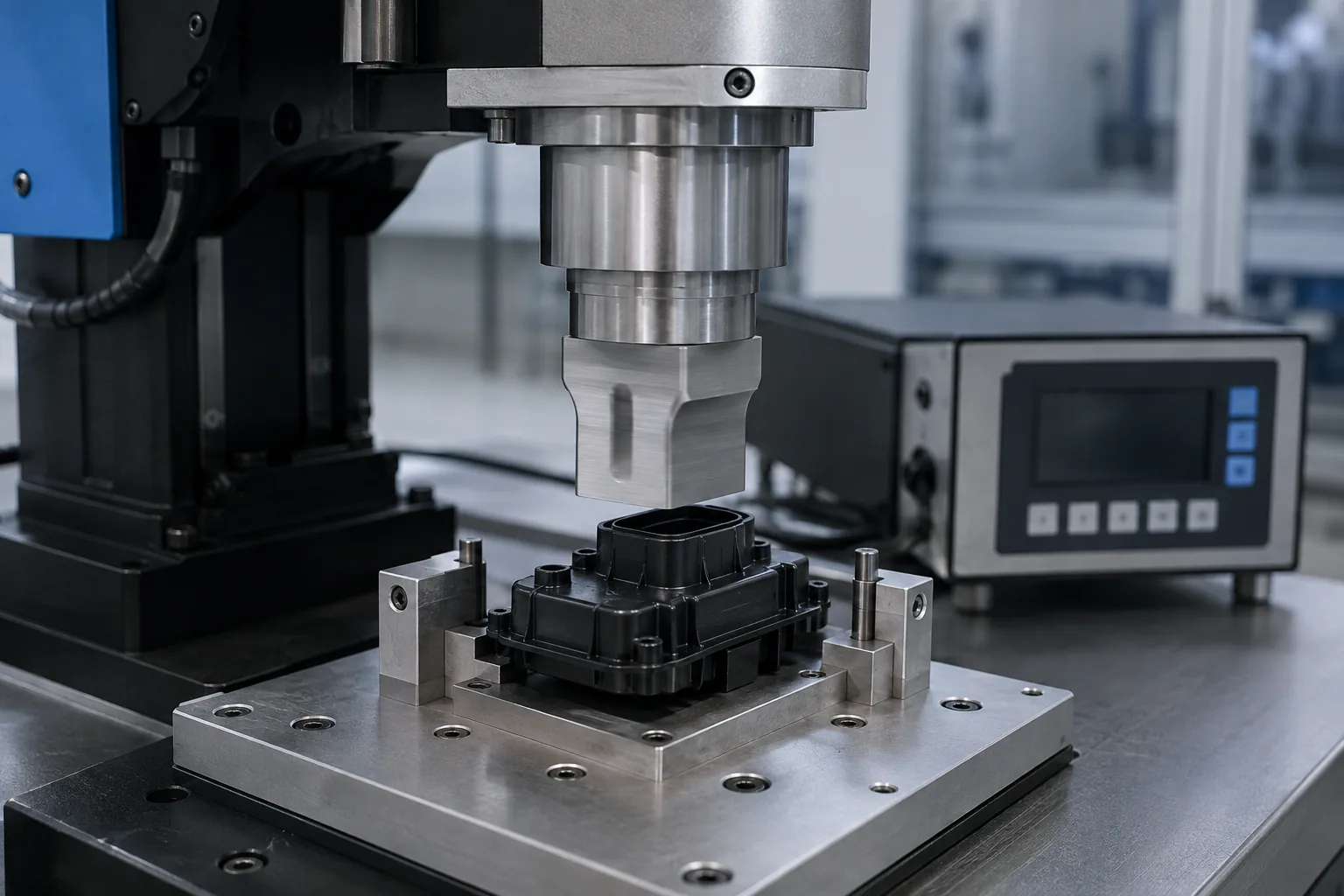
Basic overview of welding process
The basic process is actually simpler than you might expect. You clamp the two materials together between a sonotrode (the tool that delivers the vibration) and an anvil. Then, you apply controlled high-frequency vibration and pressure. The vibration creates friction heat at the interface, which softens the materials and creates the bond.
The entire process usually takes less than a second—often just a few hundred milliseconds. For high-volume production, this speed is a game-changer. In automated production environments, ultrasonic welding can complete thousands of cycles per hour while maintaining repeatable weld quality.
Core welding principles summary
At its core, ultrasonic welding relies on three basic principles: friction, heat generation, and plastic deformation. The vibratory energy creates friction between the two surfaces, which generates localized heat. This heat softens the materials without fully melting them, allowing molecular diffusion across the interface. When the vibration stops, the materials cool and solidify under pressure, forming a strong permanent bond.
The key here is that the heat is generated exactly where you need it—at the joint interface. The rest of the part stays relatively cool, which protects sensitive components nearby.
How Does Ultrasonic Welding Work?
Ultrasonic Welding Equipment Components
Every ultrasonic welding system has four main components: the power supply, the transducer, the booster, and the sonotrode (also called the horn).
The power supply takes standard line voltage (50/60 Hz) and converts it to the high-frequency electrical energy needed—usually between 15 kHz and 75 kHz. The transducer then converts this electrical energy into mechanical vibration using piezoelectric materials.
The booster adjusts the amplitude of the vibration, amplifying or reducing it based on the application. Finally, the sonotrode delivers the vibration directly to the workpieces. The shape of the sonotrode is specifically designed for the part being welded—this is critical for consistent results.
Energy conversion process
Here's what happens step by step when you start a weld. First, the power supply sends high-frequency electrical energy to the transducer. The piezoelectric crystals in the transducer expand and contract at the same frequency as the electrical input, converting electricity into mechanical vibration.
This vibration travels through the booster, which modifies the amplitude to the correct level for the application. Then it reaches the sonotrode, which directly contacts the top workpiece and applies the vibrating pressure.
The energy conversion happens almost instantly during the welding cycle. It's really quite elegant when you think about how quickly energy gets from the wall outlet to the weld joint.
Weld formation mechanism
Once the vibration starts, the contact surfaces of the two materials slide against each other. This sliding creates frictional heat right at the interface. As the temperature rises, the materials begin to soften and plasticize at the contact surface.
The continued vibration and pressure cause the plasticized materials to mix across the interface. When the vibration stops, the pressure is maintained for a short "hold time" while the materials cool and solidify. The result is a continuous, uniform weld that doesn't require any additional materials or fasteners.
What I find most interesting is that different materials form bonds in slightly different ways. For plastics, it's mainly about intermolecular diffusion. For metals, you also get breaking up of surface oxides and mechanical interlocking.
Types of Ultrasonic Welding
Ultrasonic plastic welding
Ultrasonic plastic welding is the most common form of ultrasonic welding, especially for thermoplastic assemblies. It's designed specifically for joining thermoplastic materials. The process works exceptionally well for most amorphous thermoplastics and many semi-crystalline varieties.
The typical frequency range for plastic welding is between 15 kHz and 30 kHz. Lower frequencies (15-20 kHz) are used for larger parts, while higher frequencies (30 kHz) work better for smaller, more delicate components. In most cases, you're looking at power levels between 0.5 kW and 5 kW.
Ultrasonic metal welding
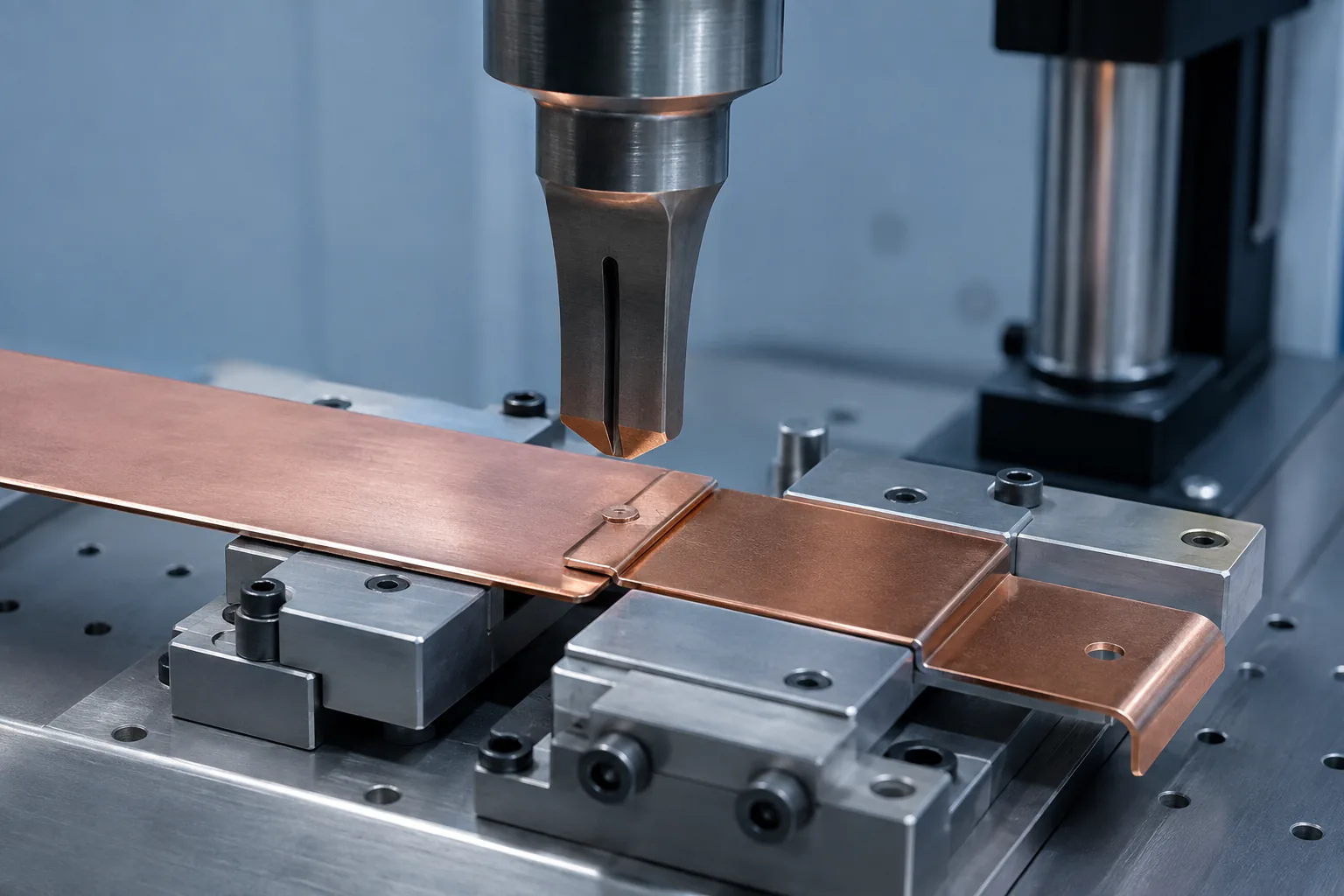
Ultrasonic metal welding is used for joining metals, particularly thin sheets, foils, and wires. What makes this special is that you can join dissimilar metals that you can't weld with traditional fusion methods. Aluminum to copper connections in batteries are a perfect example.
Metal welding generally uses higher frequencies (20-75 kHz) and higher power levels (1-10 kW) than plastic welding. The process works at room temperature, so you don't get heat-affected zones that can weaken the metal or change its properties.
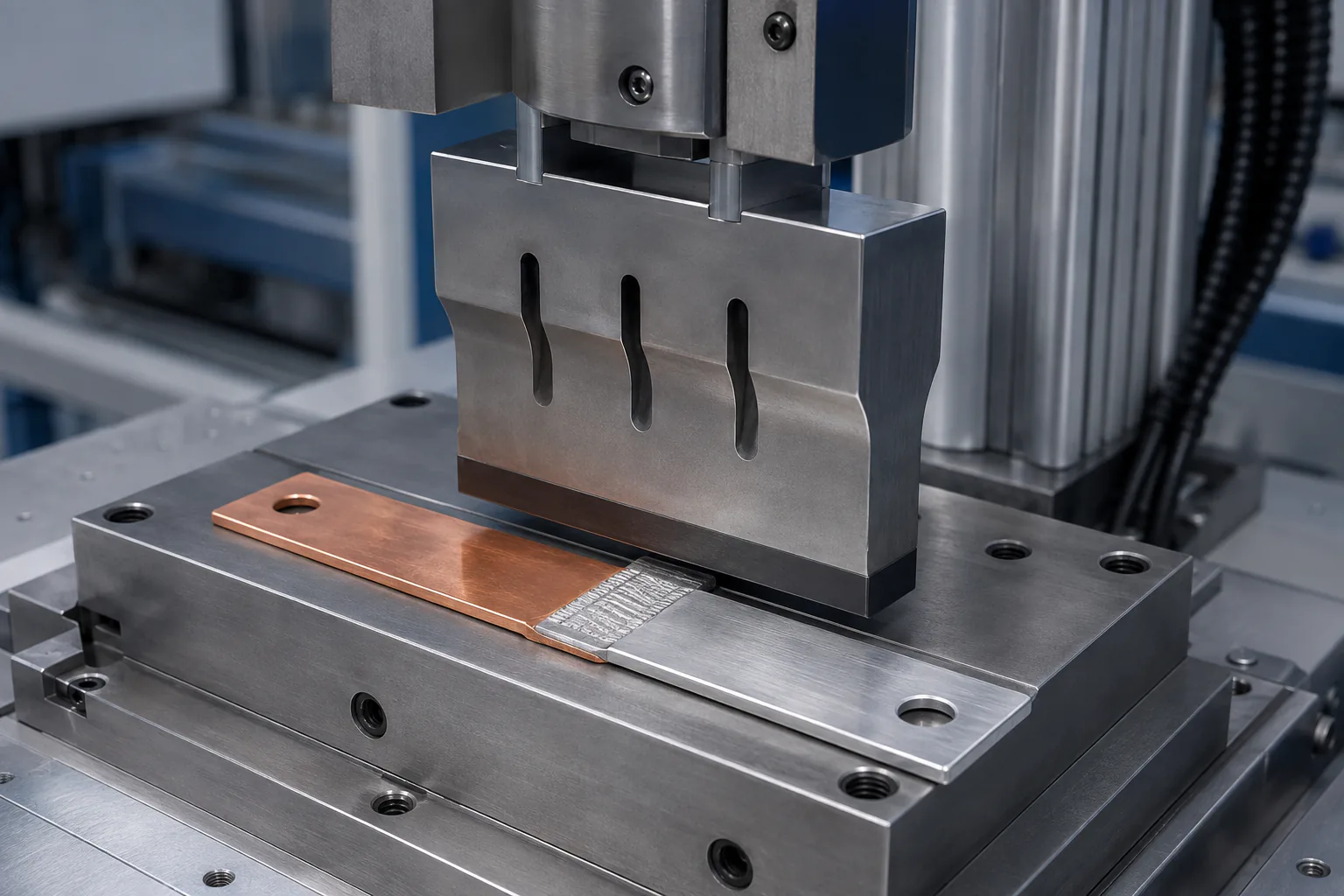
Specialty ultrasonic welding types
Beyond plastic and metal welding, there are several specialty variations. Ultrasonic riveting is used to stake plastic parts together without a second component. Ultrasonic inserting embeds metal components like threaded inserts into plastic parts.
There's also ultrasonic staking, where you deform a plastic stud to hold another component in place, and ultrasonic cutting, where the same technology is used to cleanly cut materials like fabric or food. Each of these uses the same basic vibration principle but applies it differently.
| Feature | Plastic Welding | Metal Welding | Specialty Welding |
|---|---|---|---|
| Material | Thermoplastics | Metals/alloys | Specific materials |
| Frequency | 15-30 kHz | 20-75 kHz | 10-40 kHz |
| Power | 0.5-5 kW | 1-10 kW | Variable |
| Applications | Assembly | Joining/foil | Unique cases |
Looking at this comparison, you can see that the type of ultrasonic welding you need depends almost entirely on what materials you're joining. Plastic welding is by far the most common in general manufacturing, but metal welding is absolutely essential in industries like battery manufacturing and electrical connections.
The required frequency and power depend on part size, material properties, joint design, and production requirements. If you're working with thin metals or dissimilar combinations, you'll need a system set up for metal welding with the appropriate frequency and power.
Materials Suitable for Ultrasonic Welding
Compatible thermoplastics
Most thermoplastics work well with ultrasonic welding. Amorphous thermoplastics like ABS, polystyrene, and polycarbonate are excellent choices because they soften gradually with temperature and transmit ultrasonic energy well.
Semi-crystalline thermoplastics like nylon, polypropylene, and PET can be welded too, but they require more energy because they have a sharp melting point. They also tend to absorb more ultrasonic energy, so you need more power to get the heat to the interface.
Some thermoplastics are more challenging. PEEK and other high-temperature polymers require special equipment and parameters. Elastomers can be tricky because they absorb too much vibration energy.
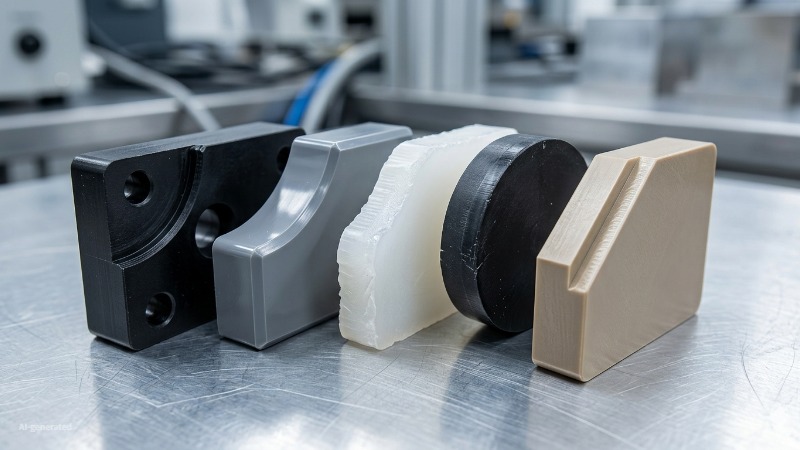
Weldable metals and alloys
Ultrasonic welding works for most soft, ductile metals. Aluminum, copper, brass, nickel, and silver all weld very well. You can even join combinations like aluminum to copper, which is impossible with traditional fusion welding.
Thicker materials are more challenging—most ultrasonic welding of metals is done with materials under 3 mm thick. It's particularly useful for foils, wires, and thin sheets. In battery manufacturing, for example, ultrasonic welding is the go-to method for joining multiple layers of foil current collectors.
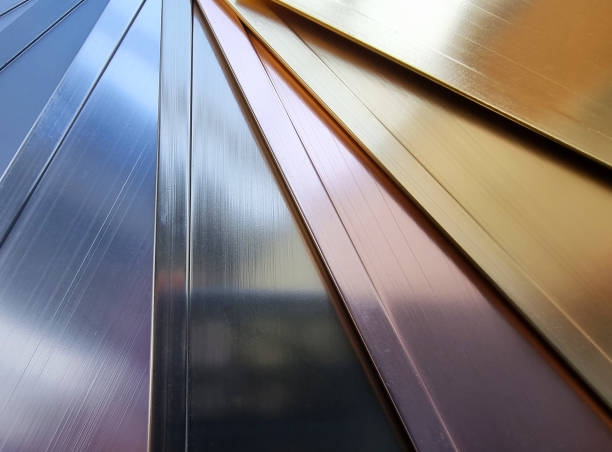
Material compatibility factors
Several factors affect whether two materials can be ultrasonically welded together. First, they need to have similar melting points for plastics. If one material melts much earlier than the other, you'll get uneven heating and weak welds.
For plastics, chemical compatibility matters too—materials that are chemically compatible form stronger bonds. Some combinations that work well include ABS to ABS, polycarbonate to polycarbonate, and PP to PP.
With metals, ductility is more important than melting point. Softer, more ductile metals work better because they can deform properly at the interface. Hard, brittle metals are much more difficult to weld ultrasonically.
| Material | Suitability | Typical Applications | Notes |
|---|---|---|---|
| ABS | Excellent | Automotive interiors, electronics | Easy energy transmission |
| PP | Good | Packaging, containers | Requires proper joint design |
| Nylon | Good | Engineering parts | Higher energy requirement |
| Aluminum | Excellent | Battery connections | Common in battery applications |
| Copper | Good | Electrical components | Requires controlled parameters |
How to Choose Ultrasonic Welding
Choosing ultrasonic welding is not only about whether two materials can be bonded. A successful ultrasonic welding process depends on the combination of material properties, part design, production requirements, and expected performance.
Before selecting this joining method, engineers usually evaluate three key factors: material compatibility, joint design, and production volume.
Material compatibility assessment
The first step is confirming whether the materials can effectively transmit ultrasonic energy and form a reliable bond. Material selection is one of the first considerations when choosing ultrasonic welding. Thermoplastics such as ABS, PC, PP, and Nylon are commonly used, while thin metals including aluminum and copper are suitable for specific applications such as battery connections. The final choice depends on material compatibility, thickness, and joint design.
Part design considerations
Even when materials are compatible, the part design has a major impact on weld quality. Ultrasonic welding requires the joint area to be designed specifically for vibration energy transfer.
Joint geometry
The shape and location of the welding area determine how effectively energy is concentrated.
A well-designed joint should:
- Provide a clear contact area
- Maintain consistent pressure distribution
- Allow vibration energy to reach the interface efficiently
Poor joint geometry can lead to weak welds, incomplete bonding, or excessive material deformation.
Energy director design
For plastic components, energy directors are commonly used to improve welding performance.
An energy director is a small raised feature, usually a triangular ridge, placed on the joining surface. During welding, ultrasonic vibration concentrates energy at this point, allowing the plastic to melt and bond more efficiently.
Proper energy director design helps:
- Reduce welding time
- Improve weld consistency
- Lower required energy input
Wall thickness and part size
Part thickness is another important factor.
Thin and medium-sized components usually work best because ultrasonic energy can travel effectively through the material. Very thick sections may absorb too much energy before it reaches the joint area, resulting in incomplete welding.
Large parts may also require:
- Higher power systems
- Multiple welding points
- Custom tooling designs
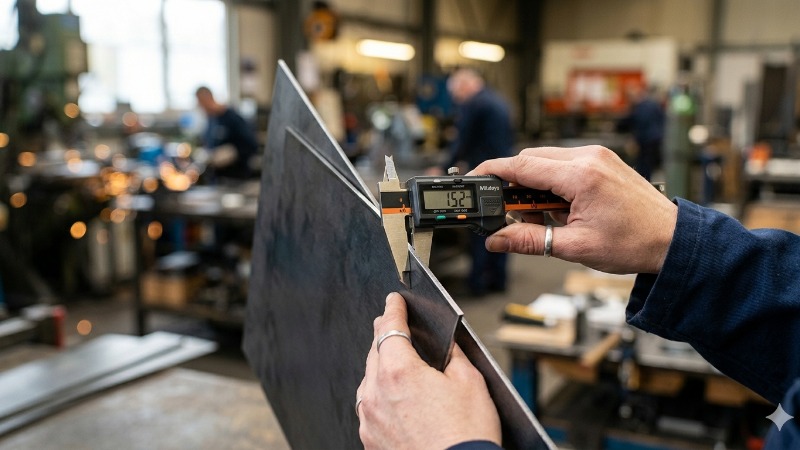
Tolerance requirements
Ultrasonic welding is a precision joining process, but part variation can affect results.
Cons
- Uneven gaps reduce energy transfer
- Misalignment affects weld strength
- Excessive variation creates inconsistent production results
For precision assemblies, engineers should consider manufacturing tolerances during the initial part design stage.
Production volume requirements
Ultrasonic welding is most valuable when production volume justifies dedicated equipment and tooling investment.
High-volume production
Ultrasonic welding is an excellent choice for:
- Automotive components
- Medical devices
- Electronics assemblies
- Battery manufacturing
- Plastic housings
The process is completed in milliseconds to seconds, requires no consumables, and can be easily integrated into automated production lines.
For large production runs, the higher initial equipment cost is usually offset by:
- Faster cycle times
- Lower labor requirements
- Reduced material waste
- Consistent weld quality
Low-volume or prototype projects
For one-off prototypes or small production quantities, ultrasonic welding may not always be the most economical option.
The main challenges include:
- Custom sonotrode and fixture costs
- Equipment investment
- Process optimization time
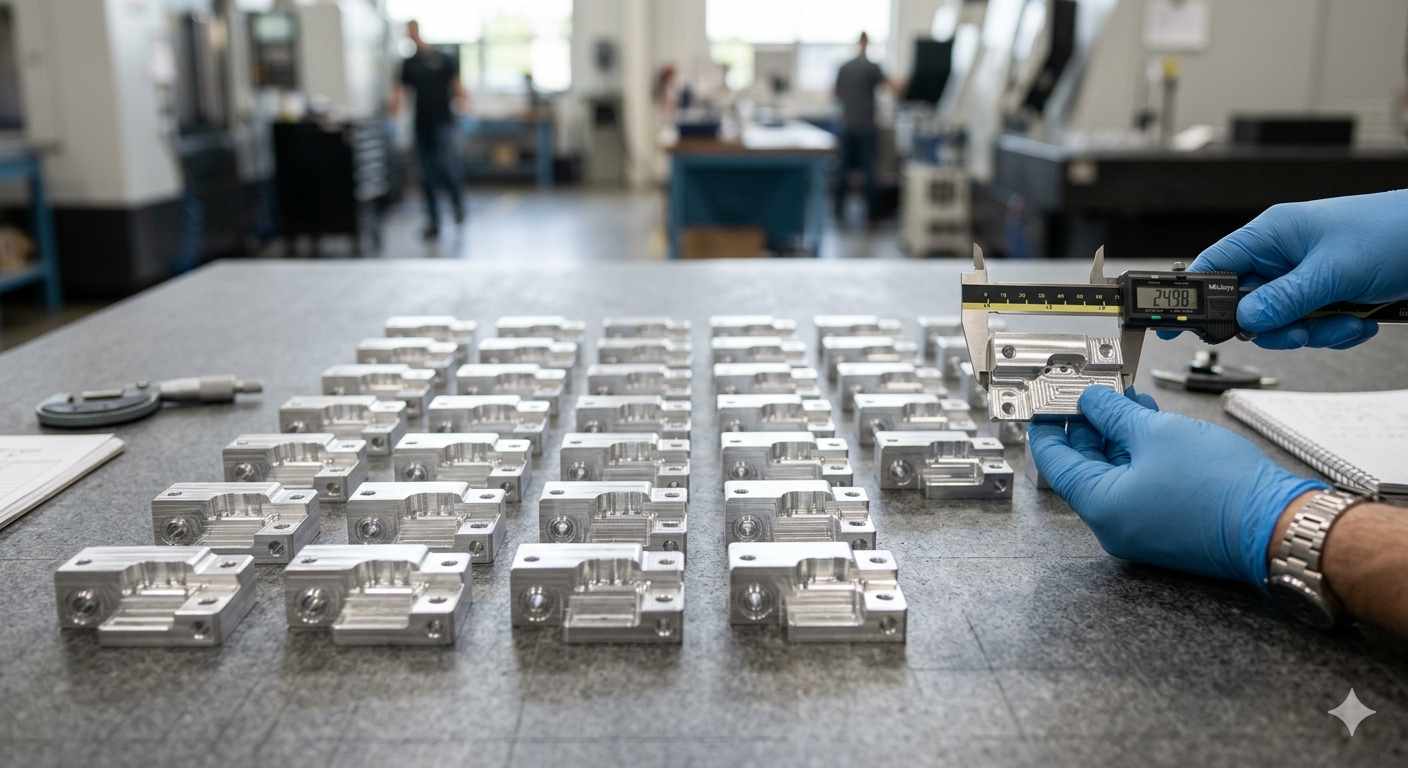
In early-stage product development, alternatives such as mechanical fastening, adhesive bonding, or CNC-machined prototype assemblies may be more practical depending on project requirements.
Final selection considerations
In practice, ultrasonic welding is usually selected when a project requires:
- Fast and repeatable assembly
- Minimal heat impact
- Clean joining without adhesives
- High production efficiency
- Reliable bonding of compatible materials
However, the best joining method depends on the complete manufacturing situation. Material selection, part geometry, production volume, and final performance requirements should all be evaluated together before choosing ultrasonic welding.
Advantages and Limitations of Ultrasonic Welding
Key advantages
Ultrasonic welding offers several advantages, especially for high-volume manufacturing. First, it's extremely fast. Most welds are done in less than one second, which makes it perfect for high-volume production.
Second, you don't need any additional materials. No adhesives, no solder, no filler metals. That means no curing time, no messy cleanup, and no material costs for consumables beyond what you're already joining.
Compared with processes requiring adhesives or additional consumables, ultrasonic welding can reduce material waste and secondary processing requirements. No fumes, no solvents, no waste from consumables. This is a big reason why it's so popular in medical and food packaging applications.
Another big advantage is that it works with dissimilar materials that can't be joined any other way. Aluminum to copper, plastic to metal, different plastics that wouldn't normally bond together—ultrasonic welding can often handle these combinations.
Energy efficiency is another plus. Because you're only generating heat exactly where you need it, you use much less energy than processes that heat the entire part. And because there's no cure time, you don't need big ovens or continuous heating systems.
Current limitations
Of course, no technology is perfect, and ultrasonic welding does have limitations. The biggest one is part thickness and size. You can't ultrasonically weld really thick sections—generally speaking, materials thicker than 3-5 mm become challenging, especially with metals.
There's also an initial capital cost to consider. Good ultrasonic welding equipment isn't cheap, especially if you need custom tooling. For low-volume production, the ROI can be hard to justify when cheaper alternatives like adhesives exist.
Some materials are simply not suitable. Very hard, brittle metals crack during the process. High-performance plastics with extremely high melting points require more energy than most systems can deliver. Materials that are too soft or elastic absorb too much vibration, preventing heat from reaching the interface.
Joint design is also critical. You can't just put any two surfaces together and expect a good weld. You need proper joint design with energy directors (small ridges on the contact surface) to concentrate the energy at the interface. This adds a bit of complexity to part design.
Common Ultrasonic Welding Applications
Automotive industry
The automotive industry is one of the biggest users of ultrasonic welding, and for good reason. Modern vehicles need lightweight components, and joining dissimilar materials is a constant challenge.
You'll find ultrasonic welding in interior components like door panels, instrument clusters, and dashboard components. It's also used for lighting assemblies, bumpers, and under-the-hood components. Even things like airbag components and sensors rely on ultrasonic welding for clean, consistent assembly.
With the push toward electric vehicles, ultrasonic welding has become even more important. It's used extensively for battery pack assembly, joining bus bars, and connecting multiple layers of current collectors.
Medical device manufacturing
Cleanliness and consistency are everything in medical device manufacturing, and that's exactly what ultrasonic welding delivers. No adhesives means no chance of contamination or outgassing. The process is completely sterile when done properly.
Common medical applications include assembling disposable devices like syringes, IV connectors, and blood filters. It's also used for permanent implants, surgical instruments, and diagnostic equipment components. The ability to create hermetic seals makes it perfect for implantable devices that need to prevent fluid penetration.
Electronics and battery manufacturing
In consumer electronics, you'll find ultrasonic welding in everything from smartphone components to laptop casings. It's used to assemble connectors, switches, and plastic housings. The process doesn't damage sensitive electronic components because it generates minimal heat away from the joint.
But where ultrasonic welding really shines in this industry is battery manufacturing. Lithium-ion batteries require joining multiple layers of copper and aluminum foil. Traditional welding methods can damage the thin foils or create too much heat. Ultrasonic welding creates strong, low-resistance connections between these dissimilar metals without damaging the foils.
Packaging industry
Packaging is another huge application area. Ultrasonic welding creates hermetic seals that are perfect for food packaging, pharmaceutical packaging, and industrial packaging. It's faster than heat sealing and more consistent.
You'll find it used for sealing blister packs, forming flexible packaging, assembling plastic bottles and containers, and creating tamper-evident seals. The process doesn't require heating the entire seal bar, so it's more energy efficient than traditional heat sealing, especially for continuous operation.
If you're evaluating ultrasonic welding for a specific project, you probably already have a good idea of whether your application fits into one of these common industries. But every application is different, and getting the right recommendations for frequency, power, and tooling makes all the difference. Many equipment suppliers offer free application evaluations—taking advantage of that can save you a lot of time and money down the road.
Ultrasonic Welding in Multi-Process Manufacturing
Ultrasonic welding is often an important step in the assembly process, but it is rarely the only manufacturing method involved in a complete product.
Many industrial products combine multiple manufacturing processes to achieve the required performance, cost, and production efficiency. Ultrasonic welding is commonly used for joining plastic components, thin metal parts, and electronic assemblies, while other processes such as CNC machining and sheet metal fabrication are used to create supporting structural or functional components.
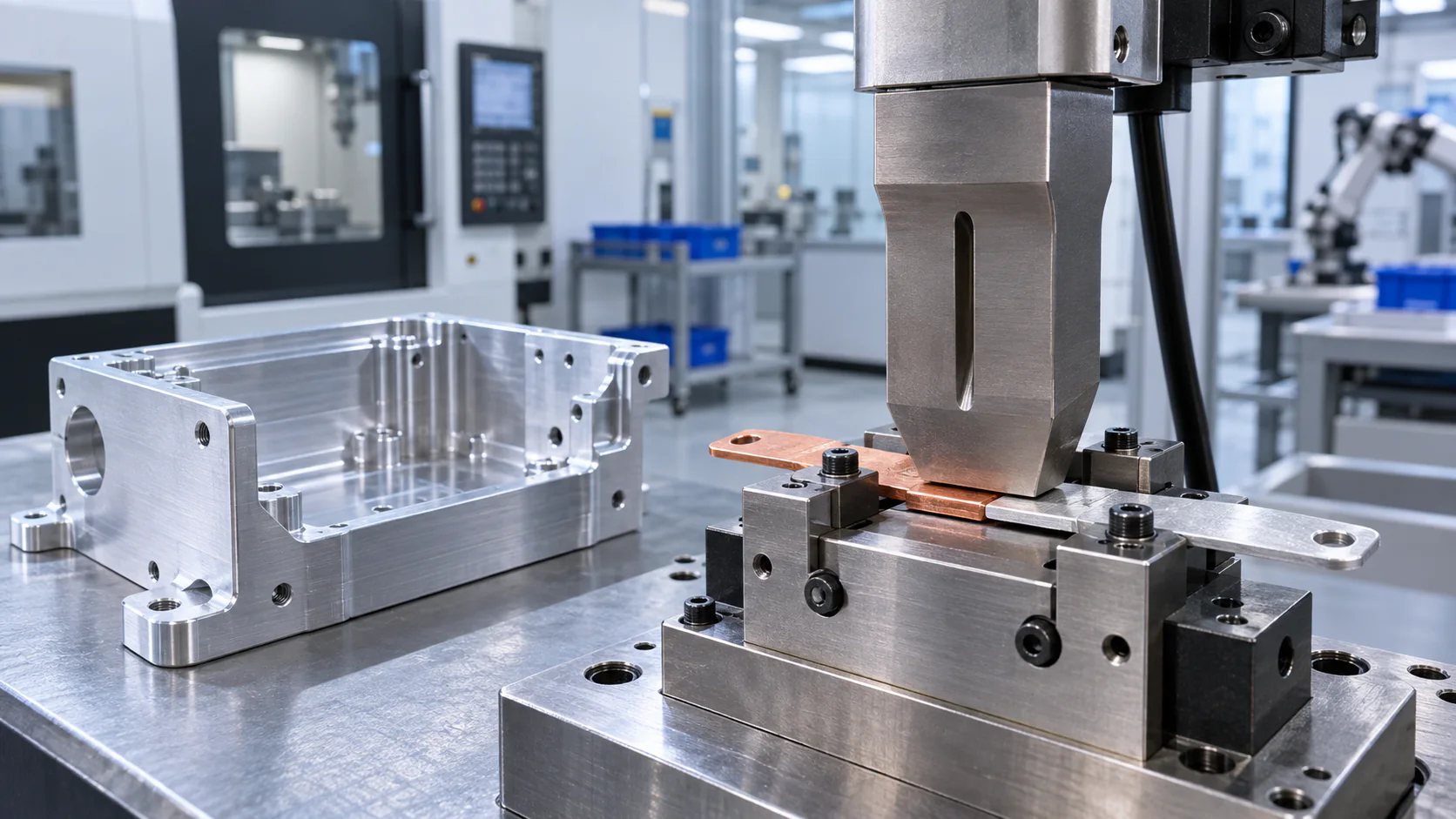
For example, an ultrasonic-welded electronic enclosure may require precision-machined mounting brackets, threaded inserts, or sheet metal shielding parts. A battery assembly may use ultrasonic welding for connecting metal foils while relying on CNC-machined housings or fabricated metal structures for mechanical protection.
Choosing the right combination of manufacturing processes depends on factors such as:
- Material requirements
- Dimensional accuracy
- Production volume
- Assembly method
- Structural performance
- Cost considerations
Instead of replacing other manufacturing methods, ultrasonic welding is often part of a broader manufacturing workflow where different processes work together.
CNC Machined Components for Ultrasonic Welding Assemblies
CNC machining is commonly used alongside ultrasonic welding when a product requires precision components with tight tolerances or complex geometries.
While ultrasonic welding is excellent for creating fast and repeatable joints, it is not designed to produce precision mechanical features such as:
- Accurate mounting holes
- Threaded connections
- Complex metal brackets
- Precision alignment structures
- Functional mechanical interfaces
These components are often manufactured through CNC machining.
For example, an ultrasonic-welded plastic housing may require CNC-machined aluminum or stainless steel inserts to provide stronger fastening points. In automotive and electronic applications, machined components can improve structural stability and ensure accurate assembly between different parts.
CNC machining is especially useful during prototyping and low-to-medium volume production because engineers can quickly produce functional parts without investing in expensive tooling.
Common CNC-machined components used in ultrasonic welding assemblies include:
- Metal inserts
- Mounting brackets
- Structural supports
- Precision connectors
- Custom fixtures
The combination of ultrasonic welding and CNC machining allows manufacturers to balance fast assembly with precise mechanical performance.
Sheet Metal Components for Ultrasonic Welding Assemblies
Sheet metal fabrication is another manufacturing process often used in products that include ultrasonic welding.
Many assemblies require lightweight metal structures, protective covers, frames, or brackets that cannot be produced efficiently through welding alone.
Sheet metal processes such as laser cutting, bending, and forming are commonly used to create:
- Metal enclosures
- Protective shields
- Support brackets
- Mounting panels
- Structural frames
For example, an electronic device may use ultrasonic welding to seal plastic internal components while using sheet metal parts as an external protective structure. Battery systems may combine ultrasonic-welded electrical connections with sheet metal housings that provide mechanical protection and heat management.
Compared with machined parts, sheet metal components are often more cost-effective for larger flat structures and higher-volume production. The best manufacturing approach depends on the part geometry, strength requirements, and production quantity.
For projects that combine welded assemblies with precision mechanical components, JLCCNC provides CNC machining and sheet metal fabrication services to support prototype and production needs.

Precision CNC Machining Service
Professional manufacturing, fast turnaround, and quality assurance.
Why Precision Components Matter in Welded Assemblies
A strong ultrasonic weld depends not only on the welding parameters but also on the accuracy and quality of the surrounding components.
Poorly designed or inaccurate supporting parts can create problems such as:
- Misalignment during assembly
- Uneven pressure distribution
- Reduced joint strength
- Increased production variation
Precision components help ensure that welded assemblies maintain consistent performance.
For example, mounting brackets and inserts must be manufactured within appropriate tolerances so that welded parts fit correctly. Sheet metal housings must maintain accurate dimensions to protect internal components and support final assembly.
In many engineering projects, the best results come from combining different manufacturing strengths:
- Ultrasonic welding provides fast and reliable joining
- CNC machining provides precision and complex geometries
- Sheet metal fabrication provides lightweight and cost-effective structures
This multi-process approach is common in industries such as automotive, electronics, medical devices, and battery manufacturing.
JLCCNC supports these manufacturing needs through CNC machining and sheet metal fabrication, helping engineers produce accurate components that integrate smoothly into complex assemblies.
Ultrasonic Welding vs Other Joining Methods
Ultrasonic Welding vs Adhesive bonding
Adhesive bonding is the most common alternative to ultrasonic welding for plastics. Let me compare the two.
Adhesives have lower initial equipment costs—you really just need a way to apply the adhesive. But they require curing time, which slows down production. You also have ongoing material costs for the adhesive itself, and there's always the mess and potential for contamination.
Ultrasonic welding has higher upfront costs, but no ongoing consumable costs. The weld is done in less than a second, so production speeds are much faster. The bonds are also typically stronger and more consistent, and there's no curing time required.
Ultrasonic Welding vs Laser welding
Laser welding is another option, especially for metals and high-precision applications. Laser welding can handle thicker materials and creates very strong welds. But the equipment is significantly more expensive than ultrasonic welding, and it requires more safety precautions.
Laser welding also generates much more heat, which can damage heat-sensitive components or create heat-affected zones that weaken the material. For thin materials and dissimilar combinations, ultrasonic welding usually gives better results at a lower cost.
Ultrasonic Welding vs Heat welding
Heat welding uses heated tooling to melt the materials at the joint. It's been around a long time and works well for many applications. But heat welding takes longer because you have to wait for the heat to conduct through the material. It can also cause distortion or discoloration on the part surfaces that come into contact with the heated tool.
Ultrasonic welding is faster and only heats the interface, so the part surfaces stay looking good. No tool sticking, no discoloration, minimal distortion.
| Feature | Ultrasonic | Adhesive | Laser | Heat |
|---|---|---|---|---|
| Speed | Very fast | Slow | Medium | Medium |
| Cleanliness | Very clean | Messy | Clean | Moderate |
| Initial Cost | Higher | Lower | Highest | Medium |
| Operating Cost | Low | High | High | Medium |
| Strength | Good | Very good | Excellent | Good |
Looking at this comparison, the choice really comes down to your production volume and requirements. For high-volume production where speed and consistency matter, ultrasonic welding is almost always the better choice despite the higher initial investment. For low-volume production or very large parts, adhesives or heat welding might make more sense.
Laser welding is typically selected when deeper penetration, higher temperature resistance, or complex metal joining requirements are needed. If you need to weld thick sections or require deep penetration, laser is better. But for most assembly applications, ultrasonic is faster, cheaper, and cleaner.
Ultrasonic Welding Cost Factors
When you're budgeting for ultrasonic welding equipment, you need to consider several cost factors beyond just the initial purchase price.
Equipment capital costs are the biggest upfront expense. A basic benchtop system for small parts might start around $10,000-$20,000. A fully automated production system with multiple stations can easily cost $50,000-$100,000 or more. Equipment costs vary significantly depending on power requirements, automation level, tooling complexity, and supplier.
Tooling is another significant capital cost. Custom sonotrodes and anvils designed for your specific part usually cost $500-$2,000 per tool. If you're running multiple different parts, you'll need multiple tools. Some manufacturers offer standard tooling for common applications at lower prices.
Operating and energy costs are actually pretty low compared to other joining methods. The equipment only uses energy during the actual weld, which is just a fraction of a second. For a typical 3 kW system running 8 hours a day, you're looking at just a few dollars of electricity per day.
Maintenance expenses are also relatively low. The piezoelectric transducers in modern equipment last for many years—often 10 years or more with proper use. You'll need to occasionally clean the sonotrode, check for wear, and calibrate the system. Annual maintenance typically runs a few hundred dollars.
Tooling replacement costs depend on how much you use the equipment. A well-made sonotrode can last for millions of welds before it needs replacement. If you're running high-volume production, you might get 5-10 years of use from a single sonotrode.
FAQ About Ultrasonic Welding
Q: What is ultrasonic welding?
Ultrasonic welding is a joining process that uses high-frequency vibration and pressure to bond materials, mainly plastics and thin metals, without adhesives or filler materials.
Q: What materials can ultrasonic welding join?
Ultrasonic welding is commonly used for thermoplastics such as ABS, PP, PC, and nylon, as well as thin metals including aluminum and copper. Material compatibility and joint design affect weld quality.
Q: What are the disadvantages of ultrasonic welding?
Main limitations include equipment cost, tooling requirements, material restrictions, and difficulty welding very thick or complex parts.
Q: Can ultrasonic welding replace screws or fasteners?
Yes, ultrasonic welding can replace screws and fasteners in many plastic assembly applications. However, it is mainly suitable for permanent joints where disassembly is not required.
Q: Is ultrasonic welding suitable for CNC machined parts?/h3>
It can work with some CNC-machined plastic and thin metal components. The final result depends on material compatibility, joint design, and production requirements.
Popular Articles
• 9 Sheet Metal Cutting Problems and Solutions
• Hole cutting in sheet metal: techniques, tolerances and applications
• Introduction to Sheet Metal Processing: Techniques and Tools for Precision
• Bending and Forming Technology in Sheet Metal Processing
• Laser cutting technology in sheet metal processing
Keep Learning
Galvanized Sheet Metal: Grades, Specs & When to Use It
Galvanized Sheet Metal: Grades, Specs & When to Use It A design engineer specs "galvanized sheet metal" on a drawing and sends it out for quotes. Three shops come back with three different prices, and one of them asks a follow-up question the others didn't: which gauge, which coating class, hot-dip or electro-galvanized? That question is the difference between a part that survives outdoors for fifteen years and one that starts showing rust spots after eighteen months — and it's the kind of detail that......
Custom Sheet Metal Fabrication: How the Process Works From Design to Delivery
Custom Sheet Metal Fabrication: How the Process Works From Design to Delivery A stock enclosure almost fits. The mounting holes are close but not quite right, the depth is half an inch too shallow, and the vendor's next size up is twice the volume you actually need. This is the point where most people start looking into custom sheet metal fabrication — not because they set out to design a part from scratch, but because nothing off the shelf actually solves the problem. Custom fabrication sounds like i......
Sheet Metal Assembly: How Fabricated Parts Come Together
Sheet Metal Assembly: How Fabricated Parts Come Together Cutting and bending gets a lot of attention because that's where a flat sheet visibly turns into a 3D part. But a single bracket by itself rarely finishes the job — most real sheet metal products are assemblies, multiple formed pieces joined into one working unit, and that assembly step is where a lot of designs quietly succeed or fail. A part that measured perfectly on its own can still not fit once it's supposed to mate with three other pieces......
Sheet Metal Bender: Types, Specs & How to Choose the Right Machine
Sheet Metal Bender: Types, Specs & How to Choose the Right Machine Every sheet metal bracket, enclosure, and panel eventually passes through a bender of some kind — that's the machine, not the process. Our guide on sheet metal bending covers how bending actually deforms metal — springback, minimum radius, bend allowance, and the core press brake and CNC press brake setups most shops run. This one goes further into the equipment side specifically: the less common bender types beyond the standard press ......
What Is Galvanized Metal? Process, Types & How It Works
What Is Galvanized Metal? Process, Types & How It Works Leave a piece of bare steel outside for a season and you'll see exactly why galvanizing exists. Rust doesn't wait for dramatic weather — a little humidity and a few weeks is enough to start eating into an unprotected surface. Galvanized metal solves that problem by giving steel a sacrificial layer of zinc that corrodes in its place, and it's done this job well enough that it's become the default choice for anything from highway guardrails to HVAC......
What Is Sheet Metal Fabrication? The Complete Guide
What Is Sheet Metal Fabrication? The Complete Guide Somewhere between a CAD file and a working enclosure sitting on your bench, a flat piece of metal gets cut, bent, joined, and finished into something that actually does a job. That's sheet metal fabrication — and if you've never ordered a part before, the term can feel bigger than it needs to be. Ask five people what "sheet metal fabrication" covers and you'll get five different answers: some think laser cutting, some think welding, some just picture......