Blackening Coating: How It Works, Types, and Applications
18 min
- What Is Blackening Coating?
- How Does the Blackening Process Work?
- Types of Black Oxide and Blackening Processes
- Blackening Coating for Different Metals
- Benefits and Limitations of Blackening Coating
- Wear Resistance and Lubricity
- Blackening Coating Applications
- Black Oxide vs. Other Black Metal Finishes
- Design Considerations for Blackening Coating
- Blackening Coating Standards and Specifications
- FAQ About Blackening Coating
Key Takeaways
- Blackening coating is a broad category of dark metal surface treatments, while black oxide is a specific conversion coating.
- Conventional hot black oxide on steel forms a thin magnetite surface through an alkaline oxidizing process.
- Cold blackening uses different chemistry and should not automatically be treated as equivalent to hot black oxide.
- Black oxide has minimal dimensional impact and can reduce surface reflectivity.
- Corrosion protection depends heavily on the sealing treatment and service environment.
- The process and specification must match the substrate material.
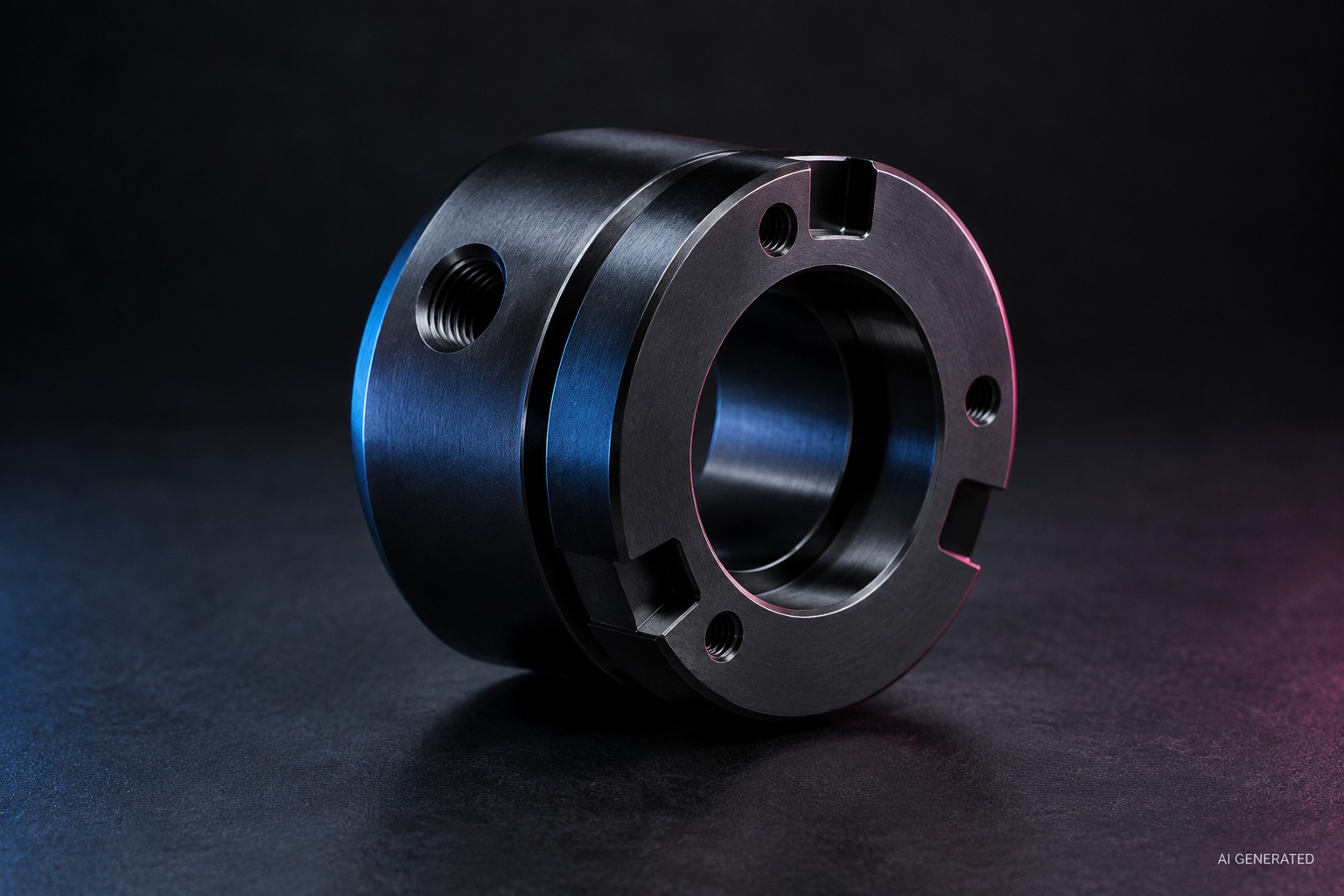
steel mechanical component with a deep black oxide finish
What Is Blackening Coating?
Blackening coating is a broad term for surface treatments that produce a dark or black finish on metal. Depending on the method, the finish may result from chemical conversion, reaction, or deposition. These processes differ fundamentally from painting or powder coating. Instead of depositing a conventional film on top of the metal, a conversion process transforms the metal surface itself.
That said, "blackening coating" covers genuinely different processes with different chemistry, different substrate compatibility, and different performance characteristics. Grouping them under one name sometimes causes confusion in specifications and supplier conversations, which is worth understanding before getting into the details.
For CNC-machined parts that require blackening, JLCCNC can coordinate machining and surface finishing to the specified material and finish requirements. Submit your CAD file and finishing specification for a CNC machining quote.

Precision CNC Machining Service
Professional manufacturing, fast turnaround, and quality assurance.
What Is Black Oxide?
Conventional hot black oxide on carbon and low-alloy steel forms a thin magnetite (Fe₃O₄) conversion layer on the metal surface. The exact chemistry and process depend on the substrate and blackening method.
Because “black oxide” is sometimes used loosely for room-temperature blackening, drawings should identify the required process or specification when the distinction matters. Both look black, but they're not the same thing. If a drawing calls for black oxide to MIL-DTL-13924, that's a specific requirement for the conventional hot process and the specification explicitly excludes cold processes.
For a deeper look at black oxide chemistry, performance, applications, and limitations in CNC parts, see our guide to black oxide in metal finishing.
How Does Blackening Coating Work?
Hot black oxide converts the outer surface of steel into a thin magnetite layer through a controlled alkaline oxidation process. The resulting surface is porous and is commonly sealed with oil or another post-treatment to improve corrosion protection.
Black oxide itself provides limited corrosion protection, so a suitable post-treatment is commonly used to improve resistance to moisture and oxidation.
What Does Blackening Coating Do to Metal?
The honest answer is: Its main functional advantages are minimal dimensional impact, low reflectivity, and modest lubricity. What it does: produces a dark, low-reflectance surface that looks professional, provides some lubricity benefit at sliding surfaces, and offers modest protection from oxidation when properly sealed with oil.
For precision components where dimensional change from a coating would be a problem, this is actually the main appeal.
For an overview of how different surface treatments change corrosion resistance, wear behavior, appearance, and surface properties, see our guide to surface treatment technologies in CNC machining
How Does the Blackening Process Work?
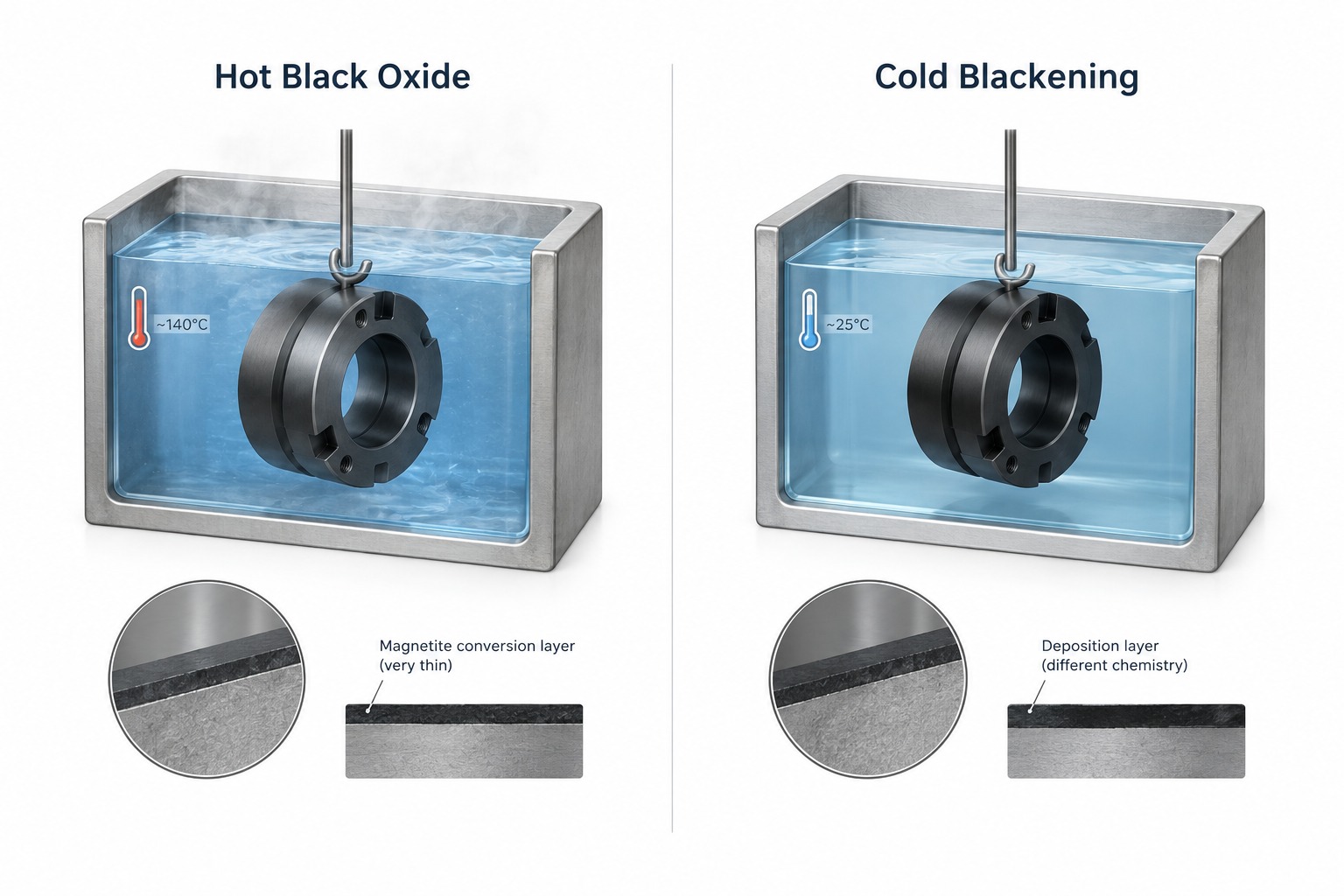
conventional hot black oxide process for a machined steel part
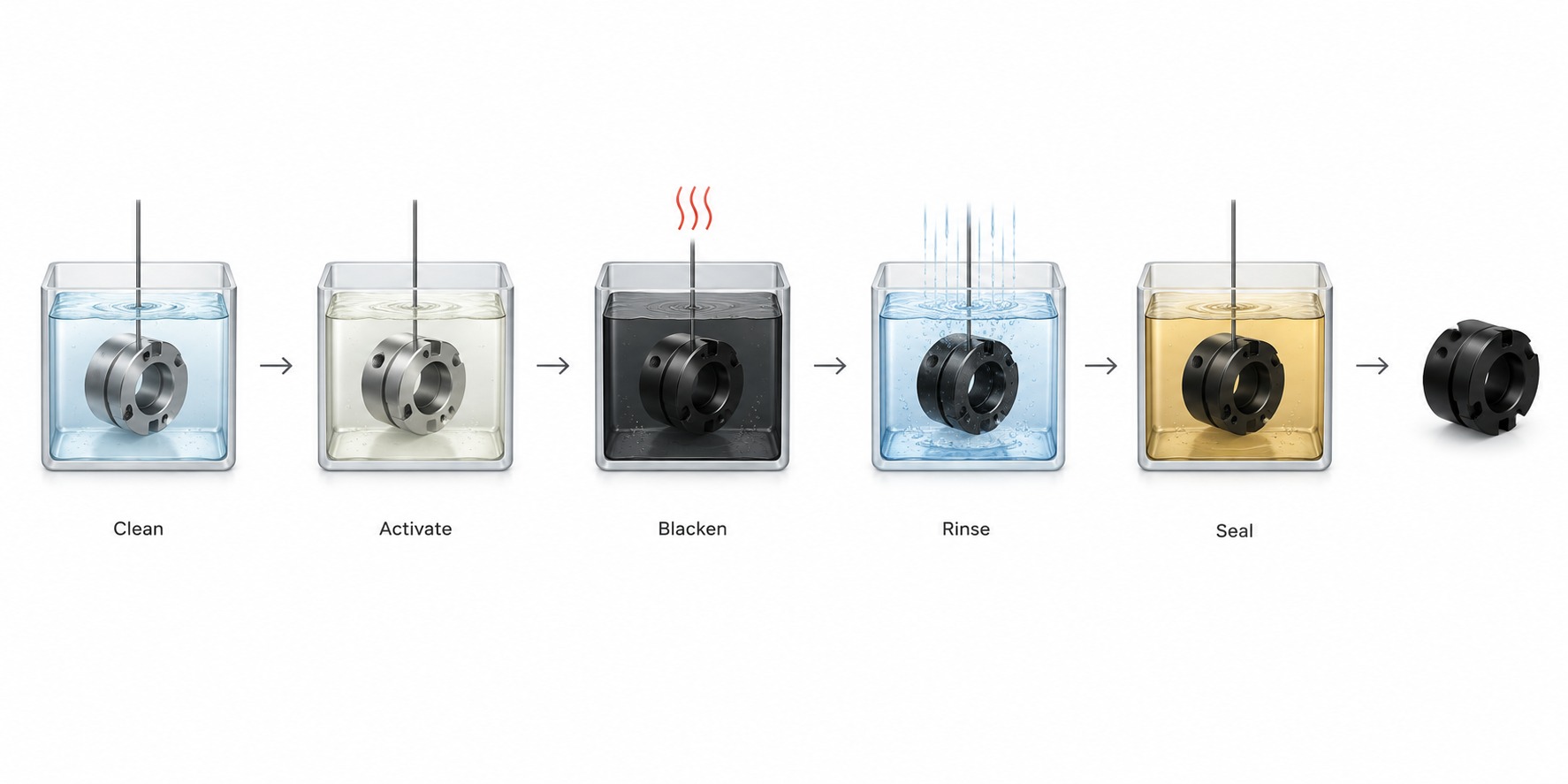
Surface Preparation
Surface preparation determines whether the blackening reaction produces a uniform, consistent result. Oils, oxide scale, machining residue, and any surface contamination interfere with the chemical reaction and produce patchy or incomplete blackening. Parts typically go through alkaline cleaning, acid activation (pickling) to remove surface oxides and scale, and thorough rinsing before entering the blackening bath.
The surface condition of the metal going in matters too. Smoother, more consistent metal surfaces produce more uniform black finishes. Heavy machining marks, scale, or surface irregularities show through the conversion layer. The blackening follows the existing surface topography rather than hiding it.
Chemical Blackening
Parts are immersed in the blackening bath at the specified temperature and held for the treatment time, typically several minutes for hot black oxide. The alkaline oxidizing salts (usually sodium hydroxide with sodium nitrate and/or sodium nitrite in conventional hot processes) react with the iron surface to form magnetite. Bath temperature and chemistry concentration are both controlled because they affect the reaction rate and coating characteristics.
This is where the process differs significantly between hot black oxide, mid-temperature processes, and cold processes. More on those distinctions shortly.
Rinsing and Drying
After the blackening bath, parts are thoroughly rinsed to remove process chemicals before they can continue reacting or dry to white salt residue on the surface. Rinsing quality matters. Inadequate rinsing can leave residues that affect appearance and contribute to later corrosion problems.
Oil or Wax Sealing
The final step is almost always sealing with oil or wax, linseed oil, water-displacing oil, petroleum-based protective oils depending on the application and specification. The porous magnetite layer absorbs the sealing agent, which fills the pore structure and provides a barrier against moisture. Without a suitable sealing treatment, black oxide provides only limited corrosion protection and is much more susceptible to moisture and corrosion.
The choice of sealing agent affects the performance, appearance, and handling characteristics of the finished parts. Light protective oil gives a clean, slightly shiny appearance. Wax coatings can provide additional protection but may affect how parts are used. A waxed precision bore may be unsuitable for an interference-fit surface.
Types of Black Oxide and Blackening Processes
Hot Black Oxide
Hot black oxide is the conventional process, the one MIL-DTL-13924 and similar specifications are written around. Bath temperature runs 135-150°C (275-300°F) for carbon steel. The reaction produces true magnetite conversion on steel, with the layer integrated into the surface rather than deposited on top. It's the most chemically consistent of the blackening processes, the most widely specified for industrial and military applications, and the one with the longest track record.
Hot black oxide is aggressive and the bath chemistry requires careful management. Contamination of the bath, temperature variation, and inconsistent part loading all produce non-uniform results. Shops running hot black oxide seriously invest in process control to keep the baths at specification.
The finish produced is consistently dark, relatively uniform, and has the lubricity and oil-retention characteristics that come from a genuine magnetite surface.
Mid-Temperature Black Oxide
Mid-temperature processes run at approximately 90-120°C, lower than hot black oxide but not room temperature. The intent is similar chemistry to hot black oxide with somewhat less demanding operating conditions. Mid-temperature processes can produce good results but are not uniformly accepted as equivalent to hot black oxide for specifications that explicitly require the conventional process. If a drawing calls for a specific spec, confirming which processes are compliant is necessary rather than assuming mid-temperature is acceptable.
Cold Blackening (Often Called Cold Black Oxide)
Room-temperature blackening processes are widely available and commonly called "cold black oxide", but the chemistry is fundamentally different from hot black oxide, and the resulting surface is not the same thing. Most cold processes use copper/selenium compounds that deposit a copper selenide layer on the steel surface rather than converting surface iron to magnetite.
The practical implications: cold blackening is easier to run in a shop environment, requires less infrastructure than a hot process bath, and can be applied in the field. The finish looks similar to hot black oxide. But the corrosion resistance is generally lower than a properly done hot process, and it doesn't meet specifications written around conventional black oxide. For applications where the aesthetic is the primary requirement and no specific specification is called out, cold blackening can be perfectly adequate. For applications where a specific standard is required or where performance characteristics matter, the process chemistry needs to be confirmed with the supplier.
Black oxide and other blackening processes need to match the metal, surface condition, dimensional requirements, and corrosion environment. If you’re ordering CNC machined parts that need a specific black finish, send the material, drawing, quantity, and finish requirement with your CAD file.
Blackening Coating for Different Metals
Blackening Steel
Carbon steel and low-alloy steels are the primary substrates for conventional hot black oxide. The process was developed for these materials and works well on them. High-carbon tool steels blacken well, as do most structural and machinery steels. Cast iron can be blackened. The metallurgy affects the resulting finish. The same process conditions can produce slightly different shades and surface characteristics on different steels.
Hardened steels can be blackened after heat treatment when the process is properly controlled to avoid unacceptable hardness changes or embrittlement.
Blackening Stainless Steel
Blackening stainless steel requires different chemistry and process conditions than blackening carbon steel. Stainless steel does not respond to conventional black oxide chemistry in the same way. Chromium in the alloy changes the surface reaction compared with plain carbon steel. Stainless blackening processes use either oxidizing acid treatment at elevated temperature or proprietary blackening systems specifically formulated for stainless alloys.
The resulting finish on stainless can look similar to black oxide on carbon steel, but the conversion chemistry, coating characteristics, and performance are different. The resulting finish can differ in durability and corrosion performance from conventional hot black oxide on carbon steel, depending on the stainless grade and blackening process. For stainless parts where a black, low-reflectance finish is needed, confirming with the finishing shop what their stainless blackening process achieves, and whether it meets any specification being called out, is necessary.
Blackening Copper and Copper Alloys
Copper and brass can be darkened through specific chemical processes. Liver of sulfur, a sulfur-based mixture containing potassium sulfides and polysulfides Proprietary copper blackening baths are also available. These produce dark brown-to-black surfaces on copper alloys through different chemistry than black oxide on steel.
These copper darkening processes are common in jewelry, decorative hardware, and some electrical and optical applications. They're not the same as black oxide on steel, don't meet black oxide specifications, and have their own performance characteristics.
Blackening Other Metals
Aluminum doesn't blacken through black oxide chemistry, the aluminum oxide layer that naturally forms on aluminum has completely different chemistry and doesn't react to conventional black oxide baths. Black aluminum finishes are typically achieved through black anodizing (an electrochemical process that thickens the anodic oxide layer and accepts black dye) or proprietary aluminum blackening products that work through different mechanisms.
For a closer look at how black anodizing works on aluminum, including surface preparation and dimensional considerations, see our guide to black anodizing aluminum
Black anodizing and black oxide are both black, but they're entirely different processes, have different coating characteristics, and are specified and evaluated differently. Using the terms interchangeably causes specification errors that create problems when parts come back with the wrong finish.
Benefits and Limitations of Blackening Coating
Dimensional Stability
The most practically significant advantage of black oxide over most other finishing options for precision parts: the coating is so thin, typically 1-2 micrometers, that it doesn't meaningfully change part dimensions. For precision components where tight tolerances need to be maintained through the finishing process, this is the main reason black oxide gets specified over alternatives like powder coating or zinc plating.
A 25mm bore that's been black oxide treated is still essentially 25mm. A powder-coated bore can have a noticeably different finished dimension, depending on the applied film thickness, which can affect fit.
Corrosion Resistance
Limited, and it's worth being honest about that. With oil or wax sealing, it offers modest protection suitable for indoor storage and controlled environments. Salt-spray performance varies substantially with the substrate, process, and post-treatment, so a specific hour rating should only be stated when tied to a defined specification and test method.
For parts that need real corrosion protection in harsh environments, black oxide is the wrong finish. Zinc plating, nickel plating, or other barrier coatings provide orders-of-magnitude better corrosion resistance.
Wear Resistance and Lubricity
Black oxide doesn't meaningfully improve hardness or wear resistance. What it does offer is improved lubricity at the surface, the magnetite layer and absorbed oil create a surface that performs better in sliding contact applications than bare steel. Tools, machine components, and threaded fasteners benefit from this somewhat. The improvement is real but modest.
Appearance and Light Absorption
The low-reflectance matte black surface is often why black oxide gets specified. Optical instruments, gun components, machine tool parts, and measurement equipment use black oxide specifically to minimize light reflection. The finish is visually uniform and consistent in a way that paint isn't, without the thickness penalties of paint.
Limitations of Black Oxide
The honest list:
- performance depends strongly on sealing
- surface defects remain visible
- substrate and process compatibility matters
Blackening Coating Applications
CNC Machined Parts
Precision machined components where dimensional change from coating is a concern, appearance matters, and mild corrosion protection is sufficient are the core application for black oxide. Jigs and fixtures, precision tooling components, gauging equipment, and machine parts that need low reflectance in optical or measurement applications all end up black oxide coated regularly.
Fasteners and Hardware
Screws, bolts, nuts, and small hardware items are commonly treated with black oxide, particularly for firearms, industrial equipment, and applications where a black finish is specified for appearance or identification. The process works efficiently on large batches of small hardware.
Tools and Machine Components
Drill bits, end mills, taps, dies, saw blades, and similar cutting tools are often black oxide treated. The finish doesn't improve cutting performance directly but provides corrosion protection during storage and handling, and the improved lubricity at the surface has some modest benefit for certain operations.
Automotive and Aerospace Components
Engine components, brackets, and hardware in automotive applications use black oxide where appearance and mild protection are needed without dimensional impact. Aerospace applications often specify black oxide to specific standards (MIL-DTL-13924) for optical blackout requirements on instrument components and structural hardware where a non-reflective finish matters.
Black Oxide vs. Other Black Metal Finishes
comparison of black metal finishes on machined parts
Black Oxide vs. Black Anodizing
Black anodizing applies to aluminum; black oxide applies primarily to steel. These finishes exist in different application spaces and aren't direct competitors except in discussions about choosing a metal and finish combination. Type II black anodizing commonly falls in the 5–25 micrometer range, depending on the specification and process. Completely different chemistry, different process, different substrate.
Black Oxide vs. Powder Coating
Because powder coating adds a comparatively thick film, even a coating thickness of 50–150 micrometers on each surface can significantly reduce the effective diameter of a precision bore and affect a tight-tolerance fit. For appearance and corrosion protection on non-precision parts, black powder coating is an excellent choice. For precision components where dimensional change matters, it's the wrong finish.
Black Oxide vs. Zinc Plating with Black Passivation
Zinc plating with black chromate or passivation produces a black finish with substantially better corrosion resistance than black oxide. The zinc layer provides sacrificial protection, although its thickness depends on the specified plating class. The trade-off is dimensional change from the zinc layer, which matters for tight-tolerance applications. For fasteners and hardware where corrosion resistance is a priority and dimensional precision is less critical, black zinc plating is often a better choice than black oxide.
Design Considerations for Blackening Coating
Material and Surface Preparation
The process needs to be matched to the substrate. Carbon steel and low-alloy steels get conventional hot black oxide. Stainless steel requires stainless-specific blackening chemistry. Other metals require their own treatment systems entirely.
Surface condition matters for finish quality. Cast surfaces, flame-cut edges, and heavily corroded surfaces require more aggressive preparation. Machined surfaces in good condition blacken more uniformly.
Dimensional Tolerances
Black oxide is often considered when critical dimensions must remain essentially unchanged after finishing. Tight-tolerance bores, precision threads, and interference fit surfaces can be blackened without changing the as-machined dimensions in any meaningful way. Designers who need to maintain tolerances through a finishing step often specify black oxide specifically for this reason.
Corrosion Protection Requirements
Honestly assess whether black oxide provides adequate corrosion protection for the application environment. For controlled indoor environments with oil or wax sealing, it's often sufficient. For outdoor exposure, salt environments, or high-humidity applications, a different finish is needed. Specifying black oxide on a part that lives outside in a wet climate and expecting corrosion protection is setting up for early failure.
Post-Treatment and Sealing
Specify the sealing requirement explicitly. Oil-sealed black oxide, wax-sealed, or dry (no sealing) all perform differently. For components that will be assembled with lubricants applied, dry parts may be appropriate. For parts requiring maximum corrosion protection from the finish, the sealing agent selection matters and should be confirmed with the finishing shop.
Blackening Coating Standards and Specifications
MIL-DTL-13924
MIL-DTL-13924 is a U.S. military specification covering inorganic black conversion coatings for ferrous metals. The current MIL-DTL-13924F revision, dated May 10, 2023, defines Classes 1 through 5, with different classes covering different substrate and process conditions.
MIL-DTL-13924F defines five classes:
- Class 1: Alkaline oxidizing process for wrought iron, cast and malleable irons, plain carbon steels, and low-alloy steels.
- Class 2: Alkaline chromate oxidizing process for certain corrosion-resistant steels tempered below 900°F (482°C).
- Class 3: Fused-salt oxidizing process for certain corrosion-resistant steels tempered at 900°F (482°C) or higher.
- Class 4: Alkaline oxidizing process for other corrosion-resistant steels.
- Class 5: A classification introduced in MIL-DTL-13924F; detailed process requirements and objective quality evidence provisions should be checked against the current specification.
The specification covers process requirements, coating characteristics, and acceptance criteria. Critically, it's written for conventional black oxide processes and explicitly excludes cold processes using copper/selenium chemistry from classification compliance.
AMS 2485
AMS 2485 is an SAE Aerospace Material Specification covering black oxide coatings on parts. The current revision is AMS2485M, revised September 9, 2024. When a drawing cites AMS 2485, the applicable revision and requirements should be confirmed rather than relying on a generic “black oxide” description.
Finish and Acceptance Requirements
Black oxide finishes are typically accepted visually for color uniformity and surface condition, combined with dimensional inspection of critical features, and corrosion resistance verification (salt spray testing to a specified duration for performance-critical applications). The specific acceptance criteria depend on the specification invoked and the application requirements.For drawings without a specific specification, defining the expected appearance, sealing treatment, and testing requirements helps prevent ambiguity about part acceptance.
Blackening is a good choice when you need a dark, low reflectivity finish with minimal dimensional change. It is not the right answer for every corrosion environment or every metal, so the substrate and performance requirements should be clear before production.
JLCCNC can machine your parts and coordinate surface finishing based on your material, tolerances, geometry, and application requirements.
Precision CNC Machining Service
Professional manufacturing, fast turnaround, and quality assurance.
FAQ About Blackening Coating
Q: Is blackening coating the same as black oxide?
Black oxide is one type of blackening coating, specifically, the conversion of surface iron to magnetite (Fe₃O₄) on ferrous metals through alkaline oxidizing chemistry. "Blackening coating" is a broader term that includes black oxide, cold processes with different chemistry, stainless steel blackening, copper darkening, and other dark surface treatments. The terms are often used interchangeably but they describe different things.
Q: Does black oxide coating prevent rust?
With oil or wax sealing, black oxide provides modest corrosion protection suitable for controlled indoor environments. Without sealing, essentially none. Black oxide is not a serious corrosion barrier and shouldn't be relied on for parts exposed to outdoor conditions, salt environments, or persistent moisture without additional protection.
Q: Can stainless steel be blackened?
Yes. Stainless steel requires a stainless-specific blackening process rather than the conventional carbon-steel hot black oxide process. The applicable finish depends on the stainless grade and specified process.
Q:Does black oxide change the dimensions of a part?
Black oxide generally produces negligible dimensional buildup. The exact dimensional effect depends on the process and specification, but it is much smaller than that of thicker applied coatings.
Q: What metals can be treated with black oxide?
Conventional hot black oxide is formulated for carbon steel and low-alloy steels. Stainless steel requires stainless-specific blackening processes. Copper and copper alloys can be darkened through separate chemistry. Aluminum is not treated with black oxide, black aluminum finishes use black anodizing or proprietary processes with entirely different chemistry.
Popular Articles
• Surface Finish in Machining, Types, Charts & Testing
• Anodizing vs. Hard Anodizing: The Differences in Surface Treatment Techniques
• Anodized Aluminum Colors: Options, Limits, and Real-World Results
• Explanation of different material surface treatment technologies in CNC machining
• How to choose between Laser marking and UV printing?
Keep Learning
Surface Finish in Machining, Types, Charts & Testing
What is Surface Finish in Machining? At its core, surface finish in machining refers to the small-scale irregularities left on the surface of a part after machining. These irregularities are typically grouped into three categories: Roughness: The fine, closely spaced deviations caused by the cutting process itself. Roughness depends heavily on feed rate, tool sharpness, and cutting speed. Waviness: Larger, more widely spaced variations caused by machine tool vibration, deflection, or thermal distortio......
CNC Machining Surface Roughness: A Practical Guide
Why Surface Roughness Matters in CNC Machining When we talk about CNC machining, precision isn't just about hitting the right dimensions, it’s also about how the surface feels and performs. Surface roughness describes the fine irregularities left on a machined surface, and it directly impacts how a part behaves in the real world. So, what is surface roughness? In simple terms, it's the measure of tiny peaks and valleys created by the cutting process. While they might look smooth to the naked eye, thes......
Optimizing Manufacturing Efficiency: A Guide to Computerized Numerical Control (CNC) Machining Surface Finishes
CNC Surface Finishes: Types, Costs, and How to Choose Quick Answer: Choose an as-machined finish when cost and dimensional stability matter most. Use bead blasting or brushing for a uniform cosmetic appearance, anodizing for aluminum corrosion resistance, hard anodizing for wear, and laser marking or UV printing for identification. Confirm material, tolerance, color, masking, and end-use environment before quoting. A CNC-machined part comes off the machine functional but rarely finished — tool marks, ......
Anodizing vs. Hard Anodizing: The Differences in Surface Treatment Techniques
Quick Answer: Choose Type II anodizing when corrosion resistance, color, and cosmetic appearance are the main requirements. Choose Type III hard anodizing when the part needs greater wear resistance and the coating thickness can be accommodated in the fit and tolerance plan. Confirm alloy, coating thickness, color, sealing, and critical dimensions before release. An aluminum bracket for an outdoor enclosure and a hydraulic cylinder rod both might get anodized — but specifying the same process for both......
How to Remove Anodizing from Aluminum Parts
Key Takeaways Chemical stripping is commonly used when anodizing needs to be removed from most or all of an aluminum part, but the process can also attack the underlying aluminum if it is not controlled. Mechanical removal works well for accessible areas but can change the surface texture and remove more base metal than intended. CNC machining gives better control when a defined anodized area needs to be removed from a precision part. Laser-based removal can be useful for controlled localized treatmen......
Anodizing Thickness: How Much Does It Add?
Anodizing Thickness and Dimensional Change at a Glance Feature Approximate dimensional effect One coated external surface +0.5 × coating thickness Outside diameter across two coated surfaces +1 × coating thickness Bore diameter with two coated walls −1 × coating thickness 60° thread pitch diameter Changes by about 4 × surface-growth amount, or about 2 × coating thickness under the 0.5× growth assumption Dimensional estimates below use the 0.5 × coating-thickness surface-growth relationship given in MI......