Electroplating vs Anodizing: How to Choose
16 min
- Quick Comparison
- How Do Anodizing and Electroplating Work?
- Can Aluminum Be Electroplated?
- How Do Anodizing and Electroplating Compare on CNC Parts?
- When Should You Choose Anodizing or Electroplating?
- What Affects the Cost of Anodizing vs Electroplating?
- What Should You Specify on a Drawing or RFQ?
- FAQs About Electroplating vs Anodizing
- Conclusion About Electroplating vs Anodizing
Key Takeaways
- Anodizing converts the aluminum surface into an oxide layer, while electroplating deposits a separate metal coating onto the substrate.
- Anodizing suits corrosion protection and hard surfaces on aluminum; electroplating adds conductive, solderable, or wear-resistant metallic finishes.
- Coating thickness, part geometry, and pretreatment (such as zincate on aluminum) drive both cost and adhesion.
- JLCCNC currently offers anodizing for aluminum parts but does not provide electroplating services.
Quick Comparison
| Feature | Anodizing | Electroplating |
|---|---|---|
| Mechanism | Converts the aluminum surface into an oxide layer that becomes part of the substrate. | Deposits a metal coating onto the substrate through an electrochemical process. |
| Materials | Commonly used on aluminum. The available anodizing process depends on the alloy and required finish. | Used on metals such as steel, copper, and brass. Aluminum and plastics generally require suitable pretreatment before plating. |
| Adhesion | The oxide layer is integrated with the aluminum substrate. Its performance depends on the alloy and process conditions. | Adhesion depends on the substrate, pretreatment, plating process, and coating quality. Poorly bonded deposits may peel or flake. |
| Dimensions | The oxide layer grows partly into the aluminum and partly outward. The dimensional change depends on the anodizing process and coating thickness. | The deposited metal increases external dimensions and reduces internal clearances. The buildup depends on coating thickness and geometry. |
| Electrical Properties | Ordinary and hardcoat anodizing are generally electrically insulating. Conductive anodizing is designed for electrical conductivity. | Generally electrically conductive, with performance depending on the deposited metal and coating condition. |
| Hardness | Hardcoat anodizing produces a thicker, harder oxide layer than ordinary anodizing. | Hardness varies by deposited metal and plating process. Hard chromium is generally much harder than typical zinc coatings. |
| Threads & Bores | Coating growth can reduce bore diameters and affect thread fit. Critical dimensions may require machining allowances or masking. | Coating buildup can reduce bore diameters and alter thread fit. Thickness distribution depends on part geometry and plating conditions. |
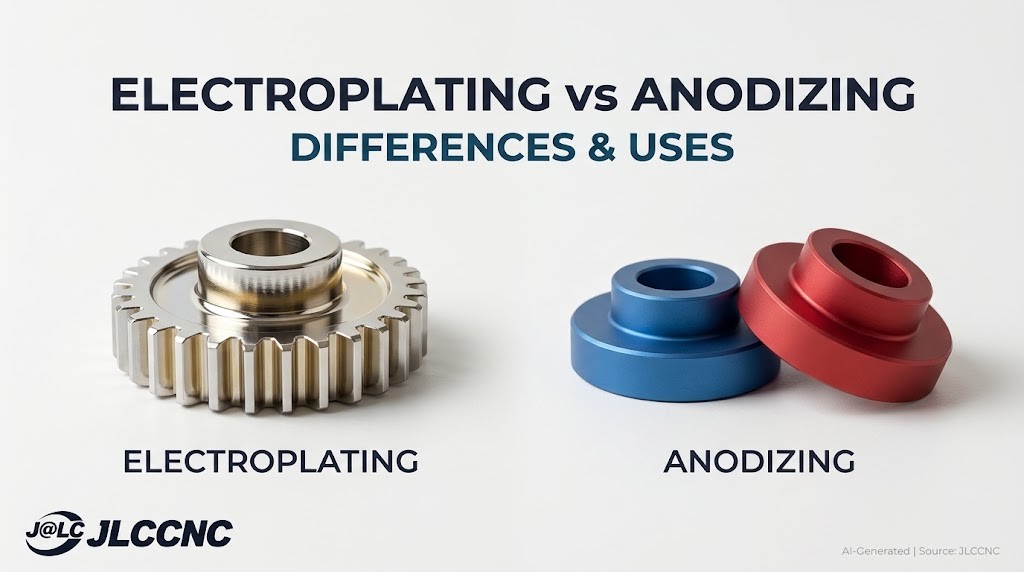
Electroplating vs anodizing: differences & uses
For CNC-machined parts, anodizing and electroplating differ in how they form a surface layer and affect finished dimensions. Anodizing converts the aluminum surface into aluminum oxide, while electroplating deposits a separate metal coating. The resulting dimensional change depends on the process and specified coating thickness.
For parts with close-fitting bores, threaded holes, or electrical contact surfaces, the finish should be specified before machining allowances are finalized. This is especially important when the finished part must meet a tight assembly tolerance.
Note
JLCCNC currently offers anodizing for aluminum parts but does not provide electroplating services. This article compares both processes to help you understand their differences and choose the appropriate finish for your project.

Precision CNC Machining Service
Professional manufacturing, fast turnaround, and quality assurance.
How Do Anodizing and Electroplating Work?
How Anodizing Forms an Oxide Layer
Anodizing is an electrolytic conversion process in which the aluminum workpiece serves as the anode in an electrolyte bath. When direct current is applied, electrochemical reactions at the aluminum surface form an aluminum oxide layer. The coating grows from the substrate itself rather than being deposited as a separate metal layer.
The oxide layer is formed through a constant balancing act. As the electricity causes a solid layer of oxide to form, the acid bath is simultaneously dissolving it. In sulfuric acid anodizing, oxide formation occurs alongside partial dissolution of the oxide in the electrolyte. This process can produce a porous oxide structure, and the pore characteristics depend on the alloy and anodizing conditions. Sealing is commonly used to reduce the porosity of conventional decorative anodic coatings.
Anodizing changes the part's dimensions because some of the oxide layer forms by consuming the aluminum substrate, while the remainder grows beyond the original surface. The inward and outward growth proportions vary with the alloy and process conditions, so critical dimensions should be evaluated against the specified coating thickness rather than a universal 50/50 rule.
JLCCNC offers anodizing for aluminum CNC parts, with finish options selected according to the part's requirements. If you have a part ready for production, upload your CAD file for a project-specific review and a fast quote starting from $1, with lead times as short as 3 days.
How Electroplating Deposits a Metal Layer
Electroplating is an additive electrolytic process. The workpiece is the negative cathode. The bath contains metal salts in solution. Direct current causes electrons to flow to the cathode, where they reduce the dissolved metal ions and cause a metallic crystal lattice to precipitate out directly onto the surface of the part. The anodes in the bath can be sacrificial (they will dissolve to replenish the metal ions in solution) or inert (in which case the bath will have to be manually made up).
Why the Plating Metal and Specification Matter
Faraday's law relates the theoretical mass of deposited metal to the applied current and plating time: $m = \frac{MIt}{nF}$, where $M$ is the molar mass of the deposited metal, $I$ is current, $t$ is time, $n$ is the number of electrons transferred per metal ion, and $F$ is the Faraday constant. Actual deposition can differ from the theoretical value because of current efficiency and process conditions. The metal you're plating (nickel, copper, chromium, gold, zinc, etc.) will have a direct effect on the final surface properties in terms of hardness, conductivity, solderability, and corrosion protection. If you are new to this concept, reviewing what plating actually is can help. It will clarify exactly how different metals behave when introduced to these electrical baths.
Can Aluminum Be Electroplated?
Why Aluminum Needs Pretreatment Before Electroplating
Aluminum can be electroplated, but reliable adhesion requires specialized pretreatment. Its native oxide film interferes with direct metal deposition, and untreated aluminum may develop poorly adherent deposits in a plating bath. The process commonly uses cleaning, deoxidizing or de-smutting, and zincate treatment before the selected plating sequence. The exact preparation depends on the aluminum alloy and the required coating system.
Reliable plating adhesion typically requires a controlled pretreatment sequence. The exact chemistry and processing conditions depend on the aluminum alloy and the plating system.
- Alkaline Etching: The native oxides and surface impurities are removed by a 5 to 10% NaOH solution at elevated temperature.
- Acid De-smutting: The insoluble alloying elements are removed by means of specially formulated acid mixtures.
- Zincate Immersion: The clean metal is dipped into an alkaline zincate bath. This chemically removes any oxides that may be left and deposits an ultra-thin layer of zinc by galvanic displacement.
- Double Zincate Process: The first zinc deposit is removed with nitric acid, and the part is re-immersed. This gives a considerably denser, finer-grained zinc seed layer for the final plating to grab onto.
When Electroplating Aluminum Makes Sense
Electroplating aluminum may be appropriate when a component requires a metallic surface that conventional anodizing cannot provide. The decision depends on the required electrical or mechanical performance and whether the added coating can meet the part's dimensional and adhesion requirements.
- Hitting Electrical Targets: Take electrical performance, for example. Components like microwave waveguides, busbars, and enclosures requiring reliable EMI/RFI shielding all need high conductivity and low surface contact resistance. Anodizing, in fact, creates an insulating layer, so you have to plate those parts with silver, gold, or copper to ensure the current can flow.
- Electrical Contact: When a part requires low contact resistance or a solderable surface, a suitable metallic coating may be preferable to ordinary anodizing. The appropriate coating depends on the required conductivity, contact conditions, and service environment. Conductive anodizing may also be considered for aluminum parts where the specified process can meet the electrical requirements.
- Enabling Assembly and Soldering: Bare or anodized aluminum is not readily solderable using conventional soldering methods. When a solderable surface is required, a qualified pretreatment and coating system may be necessary. The selected metallization must be compatible with the aluminum alloy, soldering process, and service conditions.
- Wear and Friction: Type III hardcoat anodizing produces a hard aluminum oxide surface, while hard chromium plating can provide high hardness and wear resistance in applications suited to that coating. Neither finish is universally superior under severe sliding contact. The selection should account for the contact conditions, lubrication, coating thickness, and the risk of coating damage.
- Galvanic Corrosion: When aluminum is electrically connected to a dissimilar metal in the presence of an electrolyte, galvanic corrosion may occur. A suitable coating system can reduce the risk, but protection depends on coating integrity, exposed substrate areas, and the joint design. Coating selection alone does not eliminate the need to assess the galvanic couple.
How Do Anodizing and Electroplating Compare on CNC Parts?
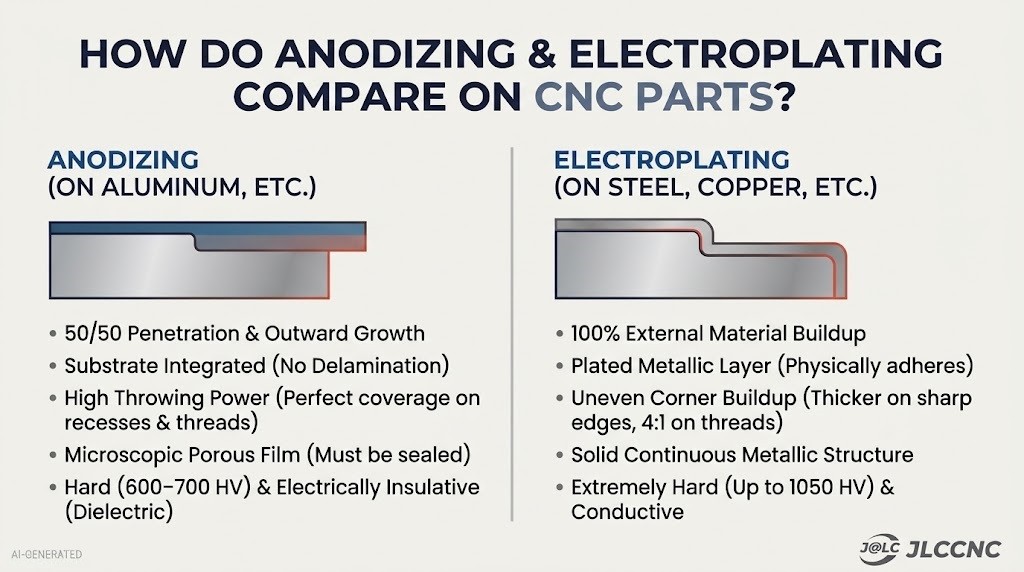
Comparison between anodizing & electroplating on CNC parts
Layer Mechanics and Substrate Integration
Anodizing converts the aluminum surface into an oxide layer that is integrated with the substrate. Its resistance to wear, corrosion, and thermal exposure depends on the anodizing type and service conditions. Electroplating forms a separate metallic deposit, whose adhesion depends on substrate preparation and the coating system. Aluminum can be electroplated after suitable pretreatment, while steel, copper, and brass can be plated using processes selected for the base material and required finish.
Electroplated coatings may contain pores or other defects depending on the deposit and process conditions. Conventional porous anodic coatings are often sealed to improve corrosion resistance, although the appropriate sealing treatment depends on the anodizing type and application.
Mechanical, Wear, and Electrical Performance
Type III hardcoat anodizing and hard chromium plating can both provide high hardness and wear resistance, but the measured result depends on the coating specification, substrate, thickness, post-treatment, counterface, lubrication, and loading. Standard anodizing and hardcoat anodizing generally increase surface electrical resistance, while metallic coatings may be selected where low contact resistance or conductivity is required. Specify and verify corrosion performance using the applicable coating standard, coating thickness, sealing or supplementary treatment, substrate, test method, and acceptance criteria; no universal salt-spray duration establishes suitability for every part.
Metallic coatings such as copper, silver, gold, zinc, nickel, and chromium are selected for different functional requirements. Their conductivity, corrosion protection, hardness, and wear performance depend on the deposited metal, coating thickness, substrate, and service environment.
Throwing Power and Feature Geometry Effects
Sulfuric acid anodizing baths have strong throwing power, and chromic acid (Type I) is particularly good at covering narrow, recessed areas. With electroplating, the current density jumps at sharp outside corners, and hence the plating naturally develops up thicker there.
On sharp edges, plating usually accumulates at a 2:1 ratio, and it grows thread pitch diameters at a whopping 4:1 ratio. For plating deep blind holes (> 3:1 aspect ratio), it will not plate evenly without auxiliary internal anodes. Anodizing electrolytes can penetrate considerably further into internal cavities.
When Should You Choose Anodizing or Electroplating?
Primary Selection Drivers
- Aluminum Structural Parts: Anodizing is your best bet for protection. It works by hardening the outer surface and stops corrosion without adding any significant weight. Ideal for strong lightweight parts.
- Conductive Electronics: Electroplating may be appropriate when an aluminum component requires a conductive metallic surface or low contact resistance. The coating metal and pretreatment should be selected according to the electrical requirements and service environment. Conductive anodizing or local removal of anodizing may also be considered for certain aluminum grounding applications.
- Steel and Brass Parts: Conventional aluminum anodizing is not applicable to steel or brass. Electroplating may be appropriate when the part requires a metallic coating for corrosion protection, conductivity, wear, or appearance. The finish should be selected according to the base material and required performance.
- Decorative Finishes: Anodizing can provide colored finishes on aluminum through dyeing or other suitable coloring methods. Electroplating can produce metallic finishes, including bright or reflective surfaces, depending on the deposited metal and plating process.
Environmental and Operating Trade-offs
Anodizing can provide durable outdoor protection on aluminum when the coating type and sealing treatment suit the service environment. Its performance under impact and thermal cycling still depends on the coating and application. Electroplating can also provide effective corrosion protection, but coating integrity and substrate compatibility must be considered.
Both processes require appropriate chemical handling and wastewater treatment. Electroplating baths containing regulated metals may require additional controls for wastewater and waste disposal. A meaningful environmental comparison should account for the specific process chemistry, energy use, and waste-treatment requirements.
What Affects the Cost of Anodizing vs Electroplating?
Pretreatment, Bath Chemistry, and Tooling
The cost of electroplating aluminum is more expensive initially due to the need for a heavy pretreatment sequence (caustic cleaning, acid de-smutting, double zincate and strike layers). The chemicals used for anodizing (sulfuric acid and basic dyes) are dirt cheap compared to precious metal plating salts. However, type III Hardcoat anodizing is energy intensive, since the bath must be severely cold (approximately 32 degrees Fahrenheit) while running at very high current densities.
Geometry, Rack Density, and Rework Risk
Part geometry can affect finishing cost because complex shapes may require more careful racking or coating-thickness control. For anodized aluminum parts, critical dimensions and any areas requiring local coating removal should be reviewed before production. Rework can affect the substrate or finished dimensions, depending on the stripping method and the amount of material removed.
What Should You Specify on a Drawing or RFQ?
Substrate Alloy, Temper, and Surface Condition
Specify the required pre-finish surface condition when it affects appearance or functional performance. For aluminum alloys such as 6061 and 7075, confirm the anodizing requirements in advance because alloy composition can affect the final color and surface appearance.
Masking and Local Removal of Anodizing
JLCCNC supports masking for threaded holes under M5 and smaller during aluminum anodizing. For other areas that need to remain free of the oxide layer, local removal can be performed after anodizing through CNC post-machining or laser removal, depending on the part geometry and dimensional requirements.
Specify the masking requirements for threaded holes under M5 on the drawing. If other areas require exposed aluminum for electrical contact or assembly, identify those locations so the appropriate post-machining or laser removal method can be assessed.
Performance and Inspection Requirements
Specify the applicable finishing standard and revision on the drawing. MIL-PRF-8625 covers anodic coatings on aluminum and aluminum alloys, while ASTM B633 covers electrodeposited zinc coatings on iron and steel. Select the standard according to the substrate and required coating rather than treating either standard as universal.
The drawing should specify whether critical dimensions apply before or after finishing. For anodized aluminum, the 50/50 growth rule provides a general estimate of how much the coating extends beyond the original surface. Actual dimensional changes depend on the alloy and anodizing process. Electroplated coatings add material to the substrate, with local buildup varying according to the geometry and plating conditions. Critical bores and threads should be checked against the required finished dimensions. Specify coating thickness, the applicable inspection method, and any required corrosion-resistance test on the drawing or RFQ. The inspection method must be suitable for the substrate and coating system. Include salt spray testing only when it is part of the specified acceptance requirements, and state the applicable test standard and acceptance criteria.
FAQs About Electroplating vs Anodizing
Does electroplating or anodizing affect CNC part tolerances?
Yes. Anodizing and electroplating can both affect CNC part tolerances. Anodizing consumes part of the aluminum substrate as the oxide layer grows, so the final dimensional change depends on the coating thickness and the inward and outward growth. The 50/50 rule is a common estimate, not a universal guarantee. Electroplating adds material to the surface, but the deposit may be thicker at sharp edges and thinner in recessed areas. For close-fitting bores and threaded features, specify the required finished dimensions and coating thickness before machining.
Is electroplating always more expensive than anodizing?
No. Cost depends on the substrate, coating metal, pretreatment requirements, part geometry, and production volume. High-volume zinc plating for steel fasteners can be economical, while plating aluminum may require additional pretreatment to achieve reliable adhesion. Precious-metal coatings generally cost more because of the deposited material.
What should you specify when a CNC aluminum part needs electrical contact?
For CNC aluminum parts requiring electrical contact, identify the contact area and the required electrical performance on the drawing. If anodizing must be removed locally, the removal method should be reviewed against the part geometry and dimensional requirements. The required finish for the exposed aluminum should be confirmed separately with the finishing supplier.
Can anodized aluminum be electroplated?
Anodized aluminum generally cannot be electroplated directly through the existing oxide layer because the coating is electrically insulating. A subsequent plating process usually requires removal of the anodic coating and appropriate surface preparation, or a specifically qualified metallization process. Stripping can affect the substrate and finished dimensions, so the proposed process should be assessed against the part's tolerance requirements.
Does anodizing conduct electricity?
Conventional anodized aluminum is electrically insulating because of its aluminum oxide layer. The actual electrical resistance depends on the coating thickness and condition. If a part requires grounding or electrical contact, the drawing should identify the contact area and its electrical requirements. Conductive anodizing or local removal of the anodic coating may be suitable, depending on the required performance and application.
Which finish is better for corrosion resistance?
Properly sealed Type II and Type III anodizing provides excellent barrier protection for aluminum. It will routinely survive over 1,000 hours in salt spray without any risk of peeling. Electroplated zinc provides excellent sacrificial protection for steel components. However, plated coatings on aluminum can fail, undercut, and delaminate if there are any micro-cracks or pinholes in the plating.
Conclusion About Electroplating vs Anodizing
Anodizing and electroplating serve different purposes. Anodizing converts the surface of aluminum into an oxide layer that improves corrosion resistance and can increase surface hardness. The coating is integrated with the substrate, although its wear resistance and performance depend on the anodizing process and application.
Electroplating deposits a metal coating onto the substrate. The deposited layer can provide electrical conductivity or improve surface properties, depending on the coating metal and plating process. Because the added layer can affect critical dimensions, coating thickness and fit requirements should be considered during part design.
For CNC aluminum parts that require anodizing, JLCCNC can review your drawing to assess critical dimensions and local coating removal requirements before production. Upload your CAD file to get a fast quote starting from $1, with lead times as short as 3 days.
Precision CNC Machining Service
Professional manufacturing, fast turnaround, and quality assurance.
Popular Articles
• Surface Finish in Machining, Types, Charts & Testing
• Anodizing vs. Hard Anodizing: The Differences in Surface Treatment Techniques
• Anodized Aluminum Colors: Options, Limits, and Real-World Results
• Explanation of different material surface treatment technologies in CNC machining
• How to choose between Laser marking and UV printing?
Keep Learning
Electroplating vs Anodizing: How to Choose
Key Takeaways Anodizing converts the aluminum surface into an oxide layer, while electroplating deposits a separate metal coating onto the substrate. Anodizing suits corrosion protection and hard surfaces on aluminum; electroplating adds conductive, solderable, or wear-resistant metallic finishes. Coating thickness, part geometry, and pretreatment (such as zincate on aluminum) drive both cost and adhesion. JLCCNC currently offers anodizing for aluminum parts but does not provide electroplating service......
Surface Finish in Machining, Types, Charts & Testing
What is Surface Finish in Machining? At its core, surface finish in machining refers to the small-scale irregularities left on the surface of a part after machining. These irregularities are typically grouped into three categories: Roughness: The fine, closely spaced deviations caused by the cutting process itself. Roughness depends heavily on feed rate, tool sharpness, and cutting speed. Waviness: Larger, more widely spaced variations caused by machine tool vibration, deflection, or thermal distortio......
CNC Machining Surface Roughness: A Practical Guide
Why Surface Roughness Matters in CNC Machining When we talk about CNC machining, precision isn't just about hitting the right dimensions, it’s also about how the surface feels and performs. Surface roughness describes the fine irregularities left on a machined surface, and it directly impacts how a part behaves in the real world. So, what is surface roughness? In simple terms, it's the measure of tiny peaks and valleys created by the cutting process. While they might look smooth to the naked eye, thes......
Optimizing Manufacturing Efficiency: A Guide to Computerized Numerical Control (CNC) Machining Surface Finishes
CNC Surface Finishes: Types, Costs, and How to Choose Quick Answer: Choose an as-machined finish when cost and dimensional stability matter most. Use bead blasting or brushing for a uniform cosmetic appearance, anodizing for aluminum corrosion resistance, hard anodizing for wear, and laser marking or UV printing for identification. Confirm material, tolerance, color, masking, and end-use environment before quoting. A CNC-machined part comes off the machine functional but rarely finished — tool marks, ......
Anodizing vs. Hard Anodizing: The Differences in Surface Treatment Techniques
Quick Answer: Choose Type II anodizing when corrosion resistance, color, and cosmetic appearance are the main requirements. Choose Type III hard anodizing when the part needs greater wear resistance and the coating thickness can be accommodated in the fit and tolerance plan. Confirm alloy, coating thickness, color, sealing, and critical dimensions before release. An aluminum bracket for an outdoor enclosure and a hydraulic cylinder rod both might get anodized — but specifying the same process for both......
How to Remove Anodizing from Aluminum Parts
Key Takeaways Chemical stripping is commonly used when anodizing needs to be removed from most or all of an aluminum part, but the process can also attack the underlying aluminum if it is not controlled. Mechanical removal works well for accessible areas but can change the surface texture and remove more base metal than intended. CNC machining gives better control when a defined anodized area needs to be removed from a precision part. Laser-based removal can be useful for controlled localized treatmen......