High Volume CNC Machining: What Changes When You Scale Production
8 min
- High Volume CNC Machining: What Changes When You Scale Production
- What Counts as High Volume?
- What Actually Changes at High Volume
- Design for High Volume Manufacturing
- Automation's Role at Volume
- Cost Structure: How High Volume Actually Saves Money
- Choosing a Partner for High Volume Production
- A Common Mistake Worth Flagging
- FAQ
High Volume CNC Machining: What Changes When You Scale Production
Ten prototypes and ten thousand production parts are not the same problem wearing different clothes. A process that works fine for a handful of pieces — a bit of manual deburring here, a quick visual check there, tooling that gets swapped whenever it feels a little dull — falls apart the moment volume multiplies by a thousand. High volume CNC machining isn't just "the same thing, more of it." It's a different set of priorities, where decisions that barely matter at prototype scale become the difference between a profitable production run and one that quietly bleeds money on every part.
Need High Volume CNC Machining for Your Production Run?
If you’re looking for a reliable manufacturing partner for high-volume CNC parts, JLCCNC can help. We provide precision CNC milling and turning for production runs, with optimized tooling, fixturing, and quality control processes designed to maintain consistent parts at scale.

Precision CNC Machining Service
Professional manufacturing, fast turnaround, and quality assurance.
What Counts as High Volume?
There's no universal threshold — it depends on part complexity, material, and cycle time — but the practical marker isn't a specific number so much as a shift in what drives cost and risk. At low volume, engineering time and setup cost dominate the per-part economics. At high volume, tool wear, cycle time optimization, and process consistency dominate instead. If you're at the point where shaving 10 seconds off a cycle time or extending tool life by 20% meaningfully moves your total cost, you're in high volume territory regardless of the exact unit count.
What Actually Changes at High Volume
Tooling investment becomes worth it. A dedicated fixture that costs real money to design and build doesn't make sense for ten parts — the fixture cost alone would dwarf the material and machine time. At high volume, that same fixture investment amortizes across thousands of parts, often reducing per-part cost enough to pay for itself many times over. This is one of the biggest mental shifts moving from prototype to production thinking: spending more upfront to save more per part, rather than minimizing every upfront cost.
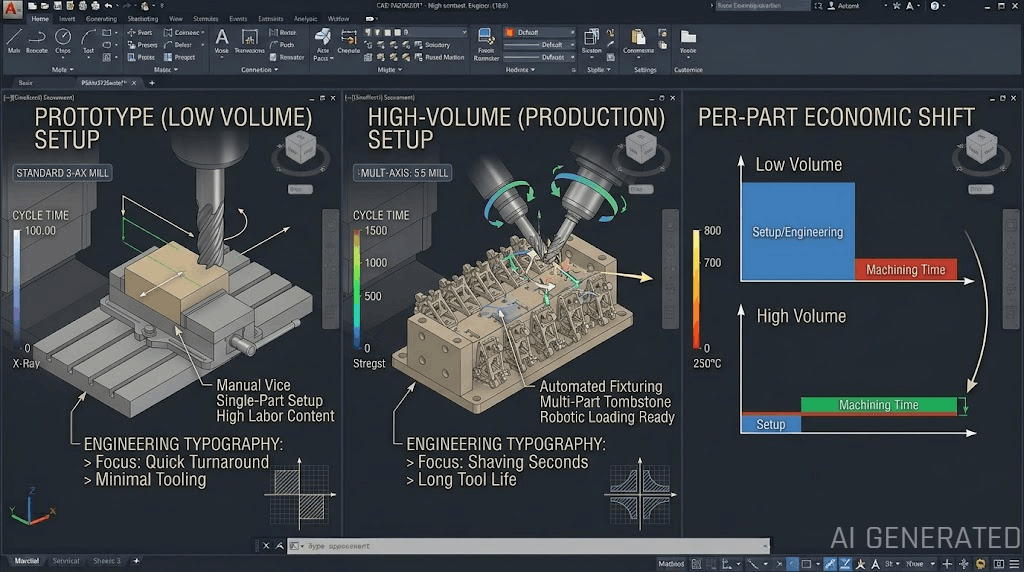
Tool wear becomes a planned variable, not a surprise. Running the same toolpath thousands of times means the same cutting tool wears down predictably across the run. Production shops track tool life against expected part count and swap tooling on a schedule, rather than reactively when a part comes out wrong. A tool change strategy that isn't planned in advance shows up as a batch of parts drifting slowly out of tolerance as a tool degrades — often not caught until well into the run if inspection isn't structured to catch gradual drift.
Cycle time optimization pays for itself repeatedly. At prototype quantities, spending an extra hour optimizing a toolpath to save 30 seconds per part isn't worth the engineering time. At ten thousand parts, that same 30 seconds saved is nearly 80 hours of machine time back — a very different calculation. Production programming genuinely benefits from a level of toolpath refinement that would be wasted effort on a one-off part.
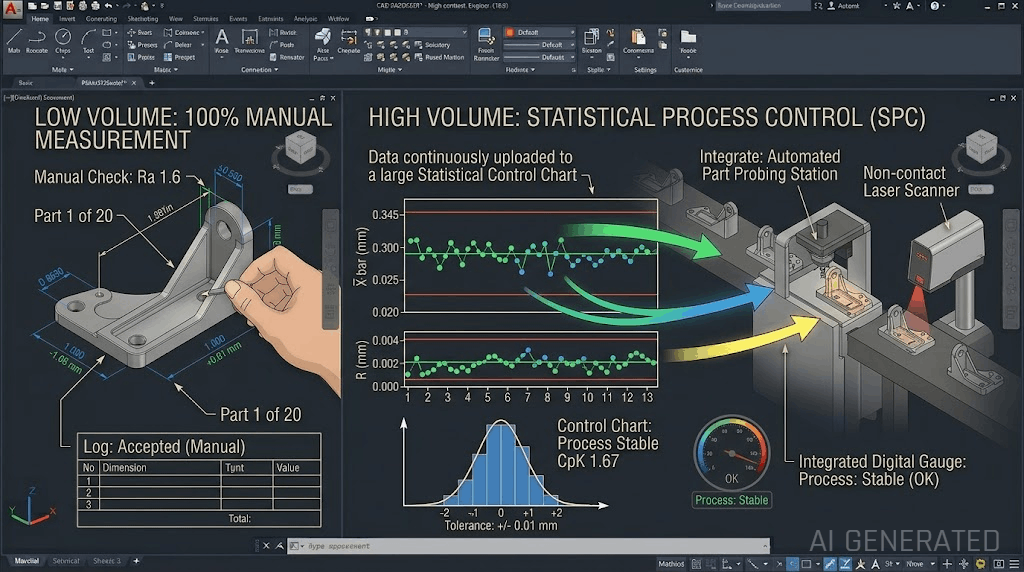
Quality control shifts from inspecting every part to statistical process control. Measuring every single part with a CMM works fine for a batch of twenty. It doesn't scale to ten thousand without either enormous inspection cost or becoming the actual bottleneck in production. High volume runs typically rely on statistical sampling and process capability data — confirming the process is stable and centered on target, then sampling at intervals to catch drift, rather than inspecting every unit.
Material sourcing and consistency matter more. At low volume, a slight variation between material lots barely registers. At high volume, running through enough raw material that lot-to-lot variation becomes statistically visible means machining parameters that worked perfectly on one batch of stock can behave slightly differently on the next, and a production process needs enough margin — or tight enough material specs — to absorb that variation without drifting out of tolerance.
Design for High Volume Manufacturing
Design decisions that don't matter much at prototype scale start mattering a lot once volume climbs. A feature that requires a slow, careful finishing pass is a minor inconvenience on ten parts and a real cycle-time tax on ten thousand. Reviewing a design specifically for high-volume manufacturability — standardizing hole sizes to reduce tool changes, avoiding features that force slow feed rates, designing for a stable, repeatable fixturing setup — is worth doing before committing to production, since a design change after tooling and fixtures are built is far more expensive than one made on paper.
Automation's Role at Volume
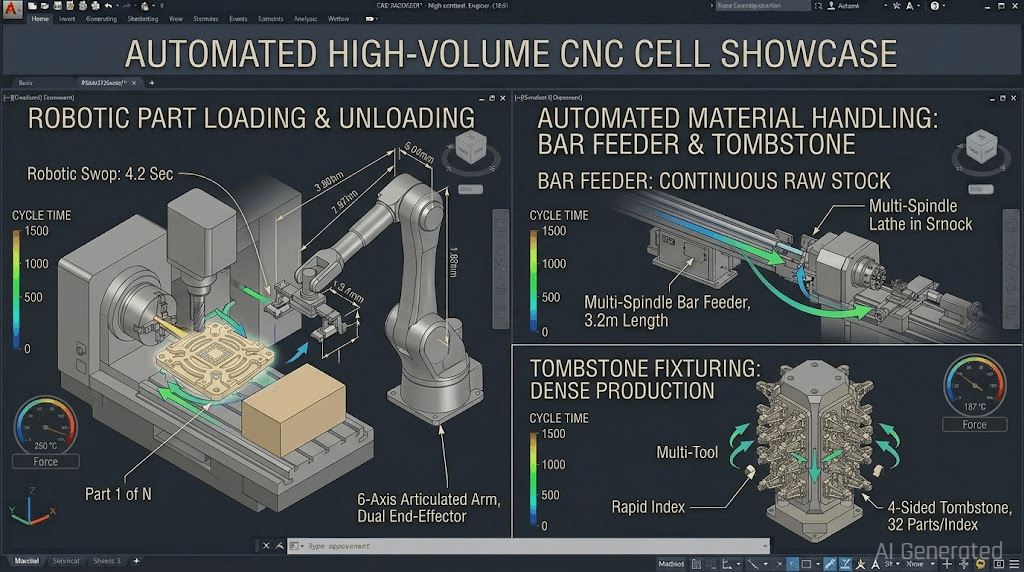
Bar feeders, robotic part loading/unloading, and multi-spindle machines all become economically justified at high volume in a way they aren't at low volume — the capital cost of automation amortizes across enough parts to make sense, and the labor savings compound across every single cycle rather than just a handful. Lights-out or minimally-attended production, where a machine runs unattended overnight on a well-characterized process, is realistic at high volume specifically because the process has been proven stable enough not to need constant operator judgment calls.
Cost Structure: How High Volume Actually Saves Money
The per-part cost curve in CNC machining drops as volume increases, but not linearly, and not indefinitely. Setup and programming cost gets spread across more parts. Tooling investment amortizes. Material purchasing at volume often unlocks better pricing per unit of raw stock. But cycle time — the actual machine time per part — doesn't disappear just because volume is high; it's usually the floor below which per-part cost can't drop further without a genuinely different process (like switching a machined bracket to a stamped one, if volume justifies that tooling investment instead).
Understanding where you are on that curve matters for planning: doubling volume from 100 to 200 parts often meaningfully drops per-part cost as setup amortizes further, while doubling from 50,000 to 100,000 might barely move the number at all because you're already deep into the cycle-time-dominated part of the curve.
Choosing a Partner for High Volume Production
A shop that's excellent at fast-turnaround prototypes doesn't automatically excel at high volume production, and the reverse is just as true. Worth checking specifically for high-volume work: does the shop have genuine multi-machine capacity to run parallel production rather than a single machine working through the whole order sequentially, what's their actual process for statistical quality control rather than just "we check parts," and can they demonstrate consistent tolerances across a long production history rather than just a strong first-article sample. A shop's prototype turnaround speed says very little about their production-scale discipline — they're genuinely different capabilities.
For context on the other end of the volume spectrum, our guide on low volume CNC machining covers the strategies specific to scaling from prototype to early production, and our guide to on-demand manufacturing covers the flexible, order-triggered production model that sits between the two. If your parts are physically large rather than high in quantity, our large part CNC machining guide addresses that different set of challenges.
A Common Mistake Worth Flagging
Treating a prototype-validated process as production-ready without re-optimizing it for volume is a common and costly assumption. A toolpath, fixture, and inspection plan that worked fine for producing ten first-article parts wasn't actually optimized for cost or cycle time — it was optimized for getting a working part quickly. Running that same unoptimized process at ten thousand units means paying the inefficiency cost ten thousand times over, when a production-focused review upfront could have caught it once.
Need High Volume CNC Machining for Your Next Production Run? Upload your CAD file today to get an instant quote for precision CNC milling and turning.
FAQ
At what quantity does a job count as "high volume" CNC machining?
There's no fixed number — it depends on part complexity and cycle time — but the practical marker is when tool wear, cycle time, and process consistency start driving cost more than setup and programming time do.
Does high volume CNC machining always cost less per part than low volume?
Generally yes, up to a point — setup and tooling costs amortize across more parts — but the savings taper off once you're deep into the cycle-time-dominated part of the cost curve, where further volume increases don't meaningfully reduce per-part cost without a process change.
Is CNC machining still practical at very high volumes, or should I switch to stamping or casting?
It depends on the part and volume. CNC machining remains practical and often preferable at high volumes for parts needing tight tolerances or complex geometry that stamping or casting tooling can't easily replicate. For very high volumes of simpler geometry, the tooling investment in stamping or casting can eventually undercut machining on per-part cost — the crossover point depends heavily on part complexity.
What's the biggest quality control difference between low and high volume production?
Low volume production can afford to inspect every part individually. High volume production typically shifts to statistical process control — confirming the process is stable and capable, then sampling at intervals — because inspecting every unit at scale becomes both cost-prohibitive and a production bottleneck.
Keep Learning
Laser Engraving Aluminum: Marking Methods & Surface Effects
Key Takeaways Laser engraving usually removes base material to create a recess. Laser marking is a broader term that can describe a surface-color change or material removal, so the process name alone does not define the final result. On aluminum, alloy and surface finish affect marking contrast. A light mark on dark anodized aluminum is a common design target, but the actual appearance depends on the finish and laser process. JLCCNC laser marking produces a recessed area 0.03–0.1 mm deep. The result i......
CNC Cutting Fluid: Types, Functions, Applications, and Selection Guide
Key Takeaways Cutting fluid in machining performs four functions simultaneously: cooling the tool and workpiece, lubricating the tool-chip interface to reduce friction, carrying chips away from the cut zone, and protecting machined surfaces from corrosion between operations. Different machining operations need different fluid priorities: high-speed aluminum milling may need adhesion control and chip evacuation, threading and tapping need strong lubrication, and grinding requires both cooling and fine ......
Blind Hole Machining Guide: What Is a Blind Hole, Types of Holes, and Tapping Tips
What Is a Blind Hole? Types of Holes and CNC Hole Machining Explained In CNC machining, few operations challenge process control and tool stability as much as blind hole machining. A blind hole is a hole that terminates at a defined internal depth rather than breaking through the opposite surface. Because the cavity is enclosed at the bottom, chip evacuation, thermal behavior, tool wear, and dimensional accuracy become far more difficult to manage compared to through-hole machining. These constraints ......
Rake Angle in Machining: Machinists’ Guide to Perfect Cuts
What is Rake Angle? (minaprem) If you've ever stood in front of a CNC machine or a manual lathe, you know that the cutting tool's geometry isn't just some arbitrary design. Every angle, edge, and surface has a job to do, and one of the most important of those is the rake angle. We've been running machines long enough to know that rake angle can make or break your surface finish, tool life, and machining efficiency. In this guide, we're going to walk you through what rake angle is, how it works, and ho......
Sheet Metal vs CNC Machining: A Guide to Choosing the Right Method for Your Metal Parts
Quick Answer: Choose sheet metal for uniform-thickness enclosures, panels, and formed brackets when bends and production volume support lower unit cost. Choose CNC machining for variable wall thickness, precision bores, tight feature relationships, and complex 3D geometry. Use a hybrid design when a formed structure needs precision-machined interfaces. A quote comes back for a bracket, and it's priced as a CNC part — machined from solid aluminum, a few hours of spindle time, a per-part cost that makes......
What Steps Are Taken To Minimize Waste In CNC Machining Processes?
How to Reduce Waste in CNC Machining: 5 Practical Strategies Quick Answer: CNC machining waste is reduced mainly through DFM, near-net stock, efficient toolpaths, preventive tool maintenance, and alloy-segregated recycling. The biggest gains usually come before cutting: reduce unnecessary material removal and prevent scrap or rework. Every CNC-machined part starts as more material than it ends up being. A pocket gets milled out, a profile gets cut away, a boss gets faced down to size — and all of that......